Introduction: Morocco's Liquid Gold
In the southwestern corner of Morocco, where the Atlas Mountains meet the Atlantic coast, grows a tree found nowhere else on Earth. The argan tree (Argania spinosa) has survived in this harsh, semi-arid landscape for millions of years, its gnarled roots reaching deep into rocky soil, its thorny branches defying drought and heat.
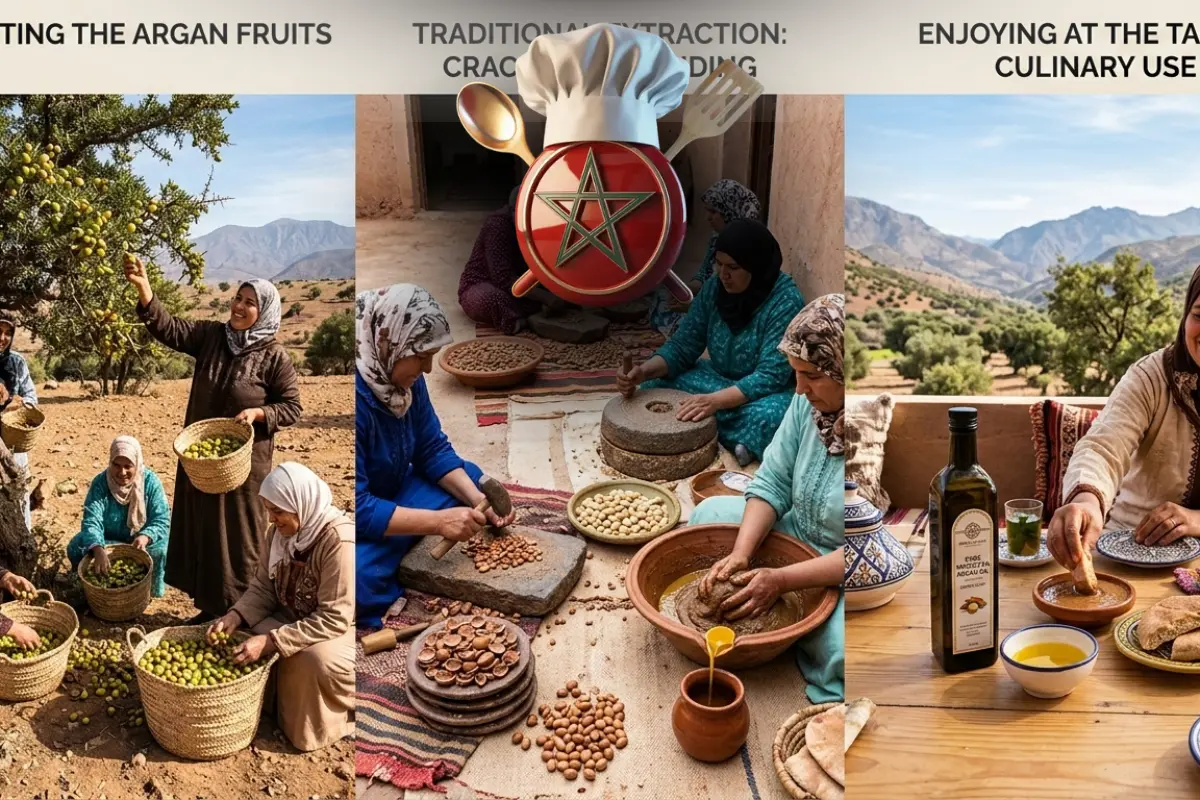
From the small, bitter fruits of this ancient tree comes argan oil—a substance so precious, so labor-intensive to produce, that it's been called "Moroccan gold." A single liter requires approximately 30 kilograms of fruit, harvested by hand, dried in the sun, cracked open nut by nut, then cold-pressed using techniques passed down through Berber generations.
But here's what most people don't know: the argan oil sold in beauty stores is completely different from the argan oil Moroccans drizzle on bread, mix into amlou, and use in traditional cooking. One is cosmetic-grade, made from unroasted kernels, odorless and bland. The other is culinary-grade, made from roasted kernels, with a deep nutty flavor that defines Berber and Moroccan cuisine.
This isn't just another "superfood" article. This is a complete, authentic guide to argan oil written from the Moroccan perspective—covering everything from how the oil is actually produced in women's cooperatives, to why you should never cook with cosmetic argan oil, to the traditional recipes that have sustained Berber communities for centuries. You'll learn to identify real versus fake argan oil, understand fair trade certification, discover health benefits backed by science, and master the culinary uses that make this oil a kitchen treasure.
Whether you're a cook seeking authentic ingredients, a health enthusiast investigating superfoods, or simply curious about this remarkable Moroccan treasure, this is your comprehensive education in argan oil—from tree to table.

Understanding the Argan Tree
The Tree That Shouldn't Exist
🌳 Argan Tree Fast Facts:
| Characteristic | Details | Why It Matters |
|---|---|---|
| Scientific name | Argania spinosa | Only species in its genus |
| Native range | Southwestern Morocco only | Cannot grow anywhere else successfully |
| UNESCO status | Biosphere Reserve (1998) | Protected ecological importance |
| Lifespan | 150-400 years | Ancient trees still producing |
| Root depth | Up to 30 meters deep | Survives drought, prevents erosion |
| Fruit production | Begins at 5-6 years, peaks at 60 years | Long-term investment for communities |
| Harvest season | June-September | Limited annual production |
| Ecological role | Prevents desertification | Holds back the Sahara Desert |
The Sacred Geography of Argan
🗺️ Where Argan Grows:
Primary Region: The argan forest covers approximately 800,000 hectares in southwestern Morocco.
Main Production Areas:
- Essaouira Province: Largest concentration, highest quality oil
- Agadir Region (Souss-Massa): Major production center, many cooperatives
- Taroudant: Traditional Berber heartland of argan production
- Tiznit: Southern limit of argan forest
Why only Morocco? The argan tree requires very specific conditions: Mediterranean climate with Atlantic influence, specific soil composition, particular rainfall patterns (250-400mm annually), and temperature ranges that exist only in this region. Attempts to cultivate argan elsewhere have largely failed.
The Goats in the Trees
🐐 The Famous Tree-Climbing Goats:
You've probably seen photos: goats perched impossibly in argan trees, munching on fruits. This is real, not Photoshop!
The truth:
- Goats DO climb argan trees to eat the fleshy fruit pulp
- They spit out or excrete the hard nuts
- Traditionally, herders collected these pre-cracked nuts
- BUT: Modern argan oil production does NOT use goat-processed nuts (despite tourist myths)
- Cooperatives harvest fruits directly from trees before goats can reach them
- Goat photos = tourist attraction, not actual oil production
Cultural note: In the past, poor communities did collect goat-processed nuts. Today, this is considered low-quality and is not used by reputable producers.

How Argan Oil is Made
The Traditional Production Method
🔨 The 10-Step Traditional Process:
This is how argan oil has been made for centuries, and how reputable cooperatives still make it today.
| Step | Process | Time Required | Tools |
|---|---|---|---|
| 1. Harvest | Hand-pick ripe fruits from trees (June-Sept) | Daily during season | Hands, baskets |
| 2. Sun-drying | Spread fruits on rooftops/patios to dry | Several weeks | Sun, rooftops |
| 3. De-pulping | Remove dried flesh, revealing hard nuts | Hours per batch | Hands |
| 4. Nut cracking | Crack incredibly hard shell (harder than macadamia!) between two stones | THE MOST LABOR-INTENSIVE STEP | Two stones |
| 5. Kernel extraction | Remove 1-3 kernels from each nut | 15 hours to process 30kg | Hands, patience |
| 6A. For culinary oil | ROAST kernels over fire until golden | 20-30 minutes | Fire, pan |
| 6B. For cosmetic oil | Skip roasting (use raw kernels) | - | - |
| 7. Grinding | Grind roasted kernels into paste using stone mill | 30-60 minutes | Stone grinder |
| 8. Kneading | Knead paste by hand, adding warm water gradually | 1-2 hours | Hands, warm water |
| 9. Oil extraction | Oil separates from paste during kneading | Part of kneading | Hands |
| 10. Filtering | Filter oil through cloth to remove particles | 30 minutes | Clean cloth |
Final yield: 1 liter of oil from approximately 30kg of fruit (about 2.5kg of kernels)
Modern vs Traditional Production
| Aspect | Traditional Hand Method | Modern Mechanical Method |
|---|---|---|
| Nut cracking | By hand with stones (15 hours for 30kg) | Mechanical cracker (much faster) |
| Grinding | Stone grinder, manual labor | Electric grinder |
| Pressing | Hand-kneading with water | Cold-press machine (no water) |
| Purity | May contain trace water | 100% pure oil, no water |
| Time | 2-3 days for small batch | Hours for large batch |
| Quality | Excellent (if done properly) | Excellent (if cold-pressed properly) |
| Cost | Higher (labor-intensive) | Lower (efficiency) |
| Availability | Small batches, artisanal | Larger quantities, commercial |
Which is better? Both can produce excellent oil IF done correctly. Hand-pressed oil has romantic appeal and supports traditional techniques. Mechanically-pressed oil is more consistent and allows cooperatives to produce larger quantities. Method matters less than quality of kernels and proper cold-pressing technique.
Women's Cooperatives: The Heart of Argan Production
👩 The Cooperative Movement:
In the 1990s, a remarkable transformation occurred: Berber women organized into cooperatives to control argan oil production, cut out exploitative middlemen, and keep profits in their communities.
What cooperatives provide:
- Fair wages: Women earn 3-5x more than working for private companies
- Education: Literacy classes, business training
- Healthcare: Health insurance, medical care
- Childcare: On-site childcare while mothers work
- Economic independence: Women control their income
- Quality control: Rigorous standards for authentic oil
- Environmental protection: Sustainable harvesting practices
Famous cooperatives include:
- Cooperative Amal (Agadir)
- Cooperative Tamounte (Essaouira)
- Cooperative Taitmatine (Agadir)
- Cooperative Ajddigue (Essaouira)
Why buy cooperative oil? You're not just buying oil—you're supporting women's empowerment, environmental conservation, and fair labor practices.

Culinary vs Cosmetic Argan Oil
The Critical Difference
🥄 Two Completely Different Products:
| Characteristic | Culinary (Food-Grade) | Cosmetic (Beauty-Grade) |
|---|---|---|
| Kernel processing | ROASTED before pressing | Raw (unroasted) |
| Color | Deep golden to amber | Pale yellow, almost clear |
| Aroma | Intensely nutty, toasted, rich | Mild, barely noticeable |
| Flavor | Strong nutty taste (like toasted hazelnuts + sesame) | Virtually flavorless |
| Uses | Cooking, drizzling, amlou, dips | Skincare, haircare, massage |
| Heat stability | Medium heat okay (up to 180°C) | NOT FOR COOKING |
| Price (per liter) | $80-150 | $60-120 |
| Labels say | "Culinary" or "Alimentaire" or "Roasted" | "Cosmetic" or "Cosmétique" or "Cold-pressed" |
| Where sold | Specialty food stores, Moroccan shops | Beauty stores, pharmacies |
⚠️ CRITICAL WARNING: Do NOT cook with cosmetic argan oil! It has no flavor and is a waste of money. Do NOT put food-grade argan oil on your face—it will smell strongly and may stain.
How Roasting Transforms the Oil
🔥 The Maillard Magic:
What happens during roasting:
- Maillard reaction: Proteins and sugars in kernels react at high heat, creating hundreds of new flavor compounds
- Color deepens: From cream to golden brown
- Oils release: Heat ruptures cell walls, making oil easier to extract
- Aroma develops: The signature nutty smell emerges
- Flavor intensifies: From bland to complex, toasted, nutty
Why cosmetic oil isn't roasted: Roasting creates the flavor Moroccans want for food, but the color and smell would be wrong for skincare. Cosmetic users want odorless, colorless oil. Two different markets, two different products.
Health Benefits: Science vs. Hype
What Science Actually Says
💊 Evidence-Based Benefits:
✅ PROVEN Benefits (good scientific evidence):
- Rich in healthy fats: 80% unsaturated fats (similar to olive oil)
• 45% oleic acid (omega-9, heart-healthy)
• 35% linoleic acid (omega-6, essential fatty acid) - High in Vitamin E: Powerful antioxidant, protects cells from damage
- Contains polyphenols: Anti-inflammatory compounds
- May improve cholesterol: Studies show increased HDL (good cholesterol), decreased LDL (bad cholesterol)
- Antioxidant properties: May reduce oxidative stress
- Supports heart health: Similar benefits to olive oil in Mediterranean diet
⚠️ POSSIBLE Benefits (limited or preliminary evidence):
- May help regulate blood sugar
- Possible anti-cancer properties (cell studies only, not proven in humans)
- May reduce inflammation markers
- Potential benefits for arthritis (very preliminary)
❌ UNPROVEN Claims (no good evidence):
- "Cures" diabetes
- "Reverses" aging
- "Melts" belly fat
- "Miracle" weight loss properties
- "Cures" any specific disease
Nutritional Profile
| Per 1 Tablespoon (15ml) | Amount |
|---|---|
| Calories | 120 |
| Total Fat | 14g |
| Saturated Fat | 2g (10%) |
| Monounsaturated Fat | 6g (43%) |
| Polyunsaturated Fat | 5g (36%) |
| Vitamin E | 5mg (30% DV) |
| Carbohydrates | 0g |
| Protein | 0g |
Comparison to olive oil: Very similar fatty acid profiles. Argan has slightly more vitamin E, olive oil has slightly more polyphenols. Both are excellent healthy fats.
How to Use Argan Oil for Health
🥄 Recommended Intake:
For general health: 1-2 tablespoons per day
Best ways to consume:
- Drizzle on food: Salads, couscous, soups (do NOT cook—use as finishing oil)
- Morning ritual: 1 tbsp on empty stomach (traditional Moroccan practice)
- In amlou: Traditional almond butter spread
- With bread: Dip fresh bread in argan oil + honey
⚠️ Important notes:
- Argan oil is high in calories (120 per tbsp)—don't overconsume
- Use as REPLACEMENT for other fats, not in addition
- No oil is a "miracle cure"—argan is healthy but not magic
- Quality matters—fake/rancid oil has no benefits

How to Buy Authentic Argan Oil
The Fake Oil Problem
⚠️ The Harsh Reality:
Up to 50% of "argan oil" sold globally is fake, diluted, or rancid.
Common frauds:
- Pure vegetable oil: Sold as "argan oil" (complete fake)
- Diluted argan: 10-30% real argan + 70-90% sunflower/soybean oil
- Rancid oil: Old, oxidized oil past its shelf life
- Cosmetic sold as culinary: Wrong type for cooking
- Mixed-origin: Claims "Morocco" but includes oils from other countries
Why fakes are so common:
- Real argan is expensive ($80-150/liter retail)
- Limited supply (only grows in one region)
- Labor-intensive production
- High global demand
- Weak regulation in many countries
How to Identify Real Culinary Argan Oil
✅ The 10-Point Authenticity Test:
| Test | Real Argan Oil | Fake/Diluted Oil |
|---|---|---|
| 1. Price check | $80-150 per liter ($12-20 for 100ml) | Under $40 per liter = suspicious |
| 2. Color | Deep golden to amber (culinary) | Too pale or too dark/orange |
| 3. Aroma | Strong nutty, toasted, rich smell | Odorless, weak, or "off" smell |
| 4. Taste | Intense nutty flavor (like toasted hazelnuts + sesame) | Bland, bitter, or wrong flavor |
| 5. Texture | Slightly thick, coats spoon | Too thin/watery or too thick/sticky |
| 6. Cold test | Becomes cloudy/semi-solid when refrigerated overnight | Stays completely liquid (sign of dilution) |
| 7. Label check | Lists "culinary" or "alimentaire," shows origin, certification | Vague labels, no certifications, suspicious claims |
| 8. Bottle type | Dark glass bottle (protects from light) | Clear plastic or glass (oil degrades faster) |
| 9. Sediment | Small amount of natural sediment at bottom is normal | Excessive sediment or cloudiness = poor quality |
| 10. Seller reputation | Specialty Moroccan shops, cooperatives, verified sellers | Unknown online sellers, too-good-to-be-true deals |
Certifications to Look For
🏅 Trusted Quality Marks:
Essential certifications:
- IGP (Indication Géographique Protégée): EU-protected geographical indication for Moroccan argan oil
- UCFA (Union des Coopératives des Femmes de l'Arganeraie): Union of argan women's cooperatives—guarantees cooperative-produced oil
- AMIGHA (Association Marocaine des Coopératives de l'Huile d'Argan): Moroccan association of argan cooperatives
- Ecocert: Organic certification (if applicable)
- Fair Trade certification: Ensures fair labor practices
Red flags:
- No certifications at all
- Made-up or fake-sounding certifications
- "100% Pure" without any verification
- Excessive marketing claims ("miracle," "anti-aging," etc.)
Where to Buy Authentic Argan Oil
Culinary Uses: How to Cook with Argan Oil
Traditional Moroccan Uses
🍽️ How Moroccans Use Culinary Argan Oil:
1. Amlou (أملو) - The Signature Use
Berber almond butter made with argan oil and honey. Spread on bread for breakfast. This is THE traditional use of argan oil.
(Full recipe below)
2. Drizzled on Couscous
After steaming couscous, drizzle argan oil over it instead of butter. The nutty flavor is incredible.
3. With Fresh Bread
Dip warm khobz in argan oil + honey + crushed almonds. Traditional Berber breakfast.
4. On Bissara (Bean Soup)
Drizzle generously on fava bean soup with cumin. Classic winter breakfast.
5. Mixed with Honey
Simple mixture: 2 parts honey + 1 part argan oil. Spread on bread or msemen.
6. Finishing Oil for Tagines
Add a drizzle at the end of cooking for extra richness and nutty flavor.
7. In Salad Dressings
Mix with lemon juice, cumin, salt for Moroccan salad dressing.
Modern Culinary Applications
👨🍳 Creative Uses for Contemporary Cooks:
- Roasted vegetable finish: Drizzle on roasted carrots, cauliflower, Brussels sprouts
- Hummus enhancement: Replace tahini with argan oil for unique flavor
- Pasta sauce: Toss pasta with argan oil, garlic, lemon, herbs
- Soup drizzle: Add to butternut squash soup, carrot soup, or any pureed soup
- Breakfast oatmeal: Stir into oatmeal with honey and nuts
- Yogurt topping: Drizzle on Greek yogurt with honey
- Grilled fish: Brush on fish after grilling (not during—too delicate)
- Cheese pairing: Drizzle on goat cheese or feta
- Ice cream (!?): Adventurous chefs drizzle on vanilla ice cream with sea salt
Cooking Temperature Guidelines
| Use | Temperature | Recommended? |
|---|---|---|
| High heat frying | Above 200°C / 390°F | ❌ NO—will smoke and lose flavor |
| Medium sautéing | 150-180°C / 300-350°F | ⚠️ Acceptable but not ideal—flavor diminishes |
| Low-temp cooking | Below 150°C / 300°F | ✅ Yes—gentle cooking preserves flavor |
| Finishing oil (no heat) | Room temperature | ✅ BEST—full flavor, maximum benefits |
Key rule: Use argan oil as a FINISHING OIL, not a cooking oil. Add it at the end of cooking or use raw to preserve its delicate flavor and health properties.
