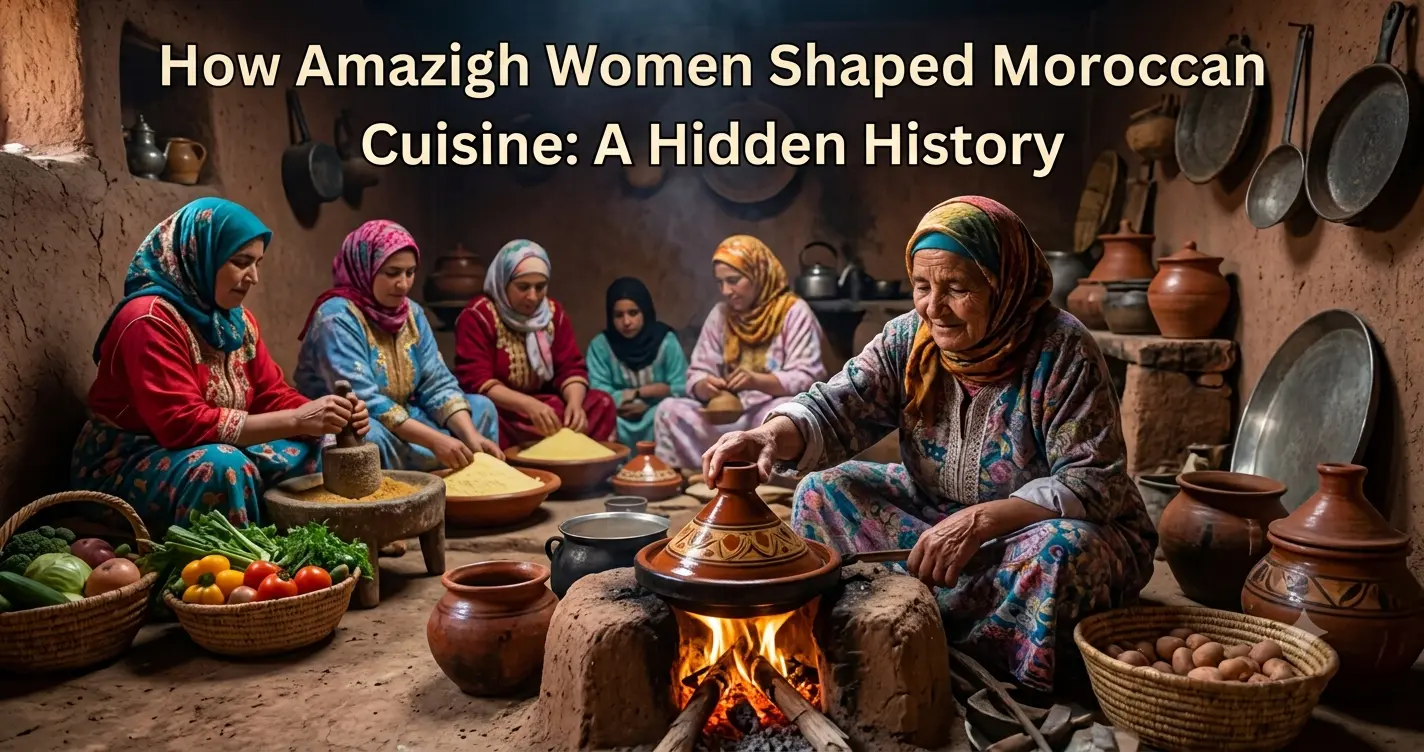
Every time someone sits down to a fragrant, slow-cooked Moroccan tagine, every time a family gathers around a mountain of perfectly steamed couscous on a Friday afternoon, every time the warm perfume of ras el hanout fills a kitchen from London to Los Angeles — they are, without knowing it, honoring the work of women whose names history never bothered to record. I have spent the better part of two decades traveling through Morocco, sitting in kitchens in the High Atlas Mountains, in the pre-Saharan villages of the Draa Valley, in the ancient medinas of Fez and Marrakech, and in the windswept coastal towns of the Rif. What I found, over and over again, was the same quiet truth: behind the celebrated flavors of one of the world's great culinary traditions stands a largely invisible force — the Berber woman, the Amazigh woman, who built this cuisine from the earth up, over thousands of years, with nothing more than an earthenware pot, a stone grinding mill, and an encyclopedic knowledge of her land that no university could have taught her. This is the story that rarely gets told in the glossy food magazines or the celebrity chef cookbooks. Today, here at MaCooking, we are going to tell it properly.
Who Are the Amazigh? Understanding the People Before the History
Before we can talk about food, we have to talk about people. The Berbers — or as they prefer to call themselves, the Amazigh (plural: Imazighen), meaning "free people" — are the indigenous inhabitants of North Africa. They predate the Arab conquests of the 7th century, the Roman occupation, the Phoenician traders, and arguably every other group that has shaped the Moroccan cultural landscape. Genetic and archaeological evidence places Amazigh presence in North Africa at well over 10,000 years. That is not a typo. We are talking about a civilization whose roots go back to the Neolithic period, when the Sahara was still green and fertile, when people were just beginning to domesticate animals and cultivate grains.
Today, the Amazigh people make up anywhere between 40 and 60 percent of Morocco's population, depending on how you count those who identify culturally versus linguistically. They speak Tamazight, a language with multiple regional dialects — Tachelhit in the south and High Atlas, Tamazight in the Middle Atlas, and Tarifit in the north. In 2011, Morocco officially recognized Tamazight as a national language alongside Arabic, a moment of enormous cultural significance for a people who had spent centuries watching their heritage be systematically minimized.
But even as Amazigh language and art have gained recognition, one of the most profound contributions of Imazighen to world culture remains deeply underappreciated: their food. Specifically, the food created, preserved, and transmitted by Amazigh women across hundreds of generations.
The Role of Women in Amazigh Society
To understand why Berber women became the custodians of Moroccan culinary tradition, you need to understand something about Amazigh social structures, which have historically given women a notably different — and in many ways more autonomous — role than the societies that later arrived in Morocco. Amazigh women in rural communities have long been the managers of household economies. They raised livestock, cultivated gardens, processed grains, preserved foods for winter, traded at local markets, and made decisions about what the family would eat and how it would be prepared.
This was not merely domestic labor in the diminished sense we sometimes attach to that phrase. This was sophisticated agricultural and culinary knowledge management. An Amazigh woman in the High Atlas who managed her household's food supply was doing something closer to what a modern farm-to-table chef and a food scientist combined might do — understanding terroir, seasonal availability, preservation chemistry, and flavor pairing — all without formal training, all passed down through a living oral and practical tradition from mother to daughter over countless generations.
"The Amazigh woman is the library of her people's food knowledge. Every dish she makes is a chapter in a book that was never written down, but has never been lost."
— A sentiment shared by nearly every rural Amazigh grandmother I have had the privilege of cooking beside
The Ancient Foundations: What Amazigh Women Cooked Before the Arab Conquest
When most people think about Moroccan cuisine, they think about the dishes that became famous through the imperial courts of Fez and Marrakech — the bastilla with its paper-thin warqa pastry and pigeon filling dusted with cinnamon and sugar, the intricately spiced mechoui, the sophisticated pastries of the palace kitchens. These are real and extraordinary dishes. But they represent a relatively recent layer of Moroccan culinary history, built upon a much older foundation that was purely Amazigh.
Before the Arab conquests of the Maghreb in the 7th and 8th centuries CE, and long before the Phoenicians established trading posts on the Moroccan coast, Amazigh communities had developed a coherent and sophisticated food culture based on the ingredients their land provided. Let us look at what that foundational cuisine actually looked like.
Grains: The Backbone of Amazigh Cooking
Wheat and barley were — and in many Amazigh communities remain — the absolute cornerstone of the diet. Amazigh women were the processors of these grains. The handstone quern, a simple but effective grinding tool, was operated primarily by women, who would grind grain into flour every day. This was not an incidental chore; it was a skilled process. The coarseness of the grind, the sifting of the flour, the decision about which grain or combination of grains to use for which purpose — all of this required knowledge and judgment.
From these grains, Amazigh women created a remarkable range of staple foods:
- Aghrum: The basic Amazigh flatbread, cooked on a clay griddle or directly in the embers of a fire. This is the ancestor of the modern khobz, Morocco's iconic round bread.
- Tafarnout: A barley-based flatbread from the Souss region, still made today in wood-fired communal ovens called ferran, with a distinctive smoky, nutty flavor that no modern oven can replicate.
- Asida: A thick porridge made from barley or wheat flour, cooked slowly in water or milk, often enriched with argan oil or honey. This is one of the oldest prepared foods in North African history, eaten across the Sahara and into West Africa.
- Couscous: Perhaps the most world-famous of all Amazigh culinary creations — more on this in depth below.
- Amazigh msemen and harcha: Semolina-based flatbreads that predate their Arab-influenced cousins by centuries.
The Argan Tree: A Sacred Amazigh Resource
The argan tree (Argania spinosa) grows almost exclusively in the Souss-Massa region of southwestern Morocco, and it has been central to Amazigh life — particularly women's lives — for millennia. The UNESCO-recognized process of extracting argan oil from the kernels of argan fruit was developed and maintained almost entirely by Amazigh women. The process is extraordinarily labor-intensive: collecting the fallen fruits, separating the pulp, cracking the incredibly hard nuts to extract the kernels, roasting them (for culinary oil) or leaving them raw (for cosmetic oil), then grinding them in stone mills and kneading the paste with water to extract the oil.
Culinary argan oil has a rich, nutty, toasty flavor that is absolutely unlike olive oil or any other cooking fat. Amazigh women used it — and still use it — in amlou (a sublime paste of argan oil, almonds, and honey that is essentially the world's original nut butter), as a finishing oil for couscous, and in traditional medicinal preparations. The global beauty industry's recent obsession with argan oil as "liquid gold" is somewhat ironic to anyone who knows this history: Amazigh women were the world's original argan oil producers, a role that was largely unpaid and unrecognized for centuries before the cosmetics industry arrived.
Couscous: The Most Important Dish in Moroccan History Was Created by Berber Women
Let us talk about couscous. Not the five-minute couscous from a box that you might have encountered in a Western supermarket — but real couscous, hand-rolled from semolina, steamed three times in a couscoussier over a bubbling broth, each grain separate and perfectly tender, draped with slow-braised vegetables and meat and finished with a glass of warm, spiced broth poured over the top. This dish, in all its magnificent complexity, is one of the greatest culinary achievements in human history. And it was created by Amazigh women.
The origins of couscous are disputed by food historians, but the most credible evidence places its invention among the Amazigh people of North Africa somewhere between the 9th and 13th centuries CE, though some scholars argue for an even earlier origin. The earliest unambiguous written references to couscous appear in Arabic texts from the Maghreb in the 13th century, but the technique itself is almost certainly older than those texts.
The making of traditional hand-rolled couscous — what is called couscous mftoul or simply s'mida in Morocco — is one of the most technically demanding food preparation processes in any culinary tradition. Here is what it actually involves:
- Preparing the semolina: Fine semolina (smida) is spread on a large, flat, shallow basket called a gsaa. Salted water is sprinkled over it in tiny amounts, and the semolina is worked with circular hand motions to form tiny pellets.
- Sifting: The formed pellets are sifted through a fine sieve to separate uniform-sized grains from larger clumps and remaining flour, which is then re-worked.
- First steaming: The couscous goes into the top of a couscoussier — a specialized double-boiler steamer — for the first steam, which partially cooks and sets the grains.
- Spreading and drying: The partially steamed grains are spread out, broken apart with the hands, and allowed to cool and dry slightly, then oiled and salted.
- Second steaming: Back into the couscoussier for a longer second steam.
- Final working and third steaming: The grains are again worked by hand — this time with butter or smen (aged preserved butter) — broken apart, and steamed a final time until perfectly light and fluffy.
This process, done from scratch, takes between three and five hours. An experienced Amazigh woman can produce couscous of a quality and texture that no commercial process has ever come close to replicating. The knowledge of how much water to add, how hard to work the semolina, when the grains are ready — this is entirely embodied, tactile knowledge, passed from hands to hands across generations.
UNESCO inscribed couscous on the Intangible Cultural Heritage list in 2020, recognizing it as a shared heritage of Algeria, Mauritania, Morocco, and Tunisia. But within Morocco, the specific acknowledgment of Amazigh women as the originators and primary custodians of this tradition remains woefully incomplete in mainstream discourse.
Regional Variations: The Diversity Within Amazigh Couscous Traditions
| Region | Couscous Type | Typical Broth & Toppings | Distinctive Feature |
|---|---|---|---|
| High Atlas Mountains | Barley couscous (azenbu) | Lamb, turnips, dried fava beans, wild herbs | Earthy, nutty flavor; often finished with argan oil |
| Souss Valley (Tachelhit) | Fine semolina couscous | Chicken, onion confit (tfaya), raisins, chickpeas | Sweet-savory contrast; unique use of caramelized onions |
| Draa Valley | Corn and semolina mixed | Dried meat (gueddid), root vegetables, cumin-heavy broth | Preserved meat is a hallmark of desert-adjacent communities |
| Rif Mountains | Fine semolina | Fish (near coast), vegetables, lots of fresh herbs | Mediterranean influence; fresher, lighter seasoning |
| Middle Atlas (Beni Mguild) | Mixed grain couscous | Mutton, wild plants (fennel, wild thyme), buttermilk | Nomadic pastoral tradition; buttermilk finishing is unique |
The Tagine: An Amazigh Invention That Conquered the World
The tagine — both the conical clay cooking vessel and the slow-braised dish cooked within it — is now Morocco's most internationally recognized culinary symbol. You will find tagines on the menus of Michelin-starred restaurants in Paris and London, in Williams-Sonoma stores across America, and in every food hall from Sydney to Toronto. But how many of the people buying those beautiful painted tagine dishes know that this cooking method was developed by Amazigh people, and that the technique was perfected and transmitted by Amazigh women?
The tagine pot is a masterpiece of low-technology engineering. The conical lid creates a self-basting system: steam rises from the food, condenses on the cooler upper cone, and falls back down onto the food as droplets of concentrated, flavor-rich liquid. This means that even with very little added water or broth, the food inside cooks in its own juices, developing intensely concentrated flavors without drying out. For communities cooking over open fires in arid, water-scarce mountain environments, this was not a luxury design choice — it was a brilliant practical solution to the real constraints of their lives.
Amazigh women learned to use the tagine in ways that extracted extraordinary results from humble ingredients. A tough piece of lamb shoulder, some preserved lemons, olives, and wild herbs — in the hands of a skilled Amazigh cook, these become something transcendent over two to three hours of patient, low heat. The technique is fundamentally about patience and knowledge of ingredients: knowing how much fat is in the meat, how much liquid the vegetables will release, when to add the preserved lemon (too early and it becomes bitter, too late and its flavor does not penetrate), how high the fire should be at which stage.
How Amazigh Tagine Techniques Differ from Urban Moroccan Cooking
| Aspect | Traditional Amazigh Tagine | Urban Moroccan (Fez/Marrakech) Style |
|---|---|---|
| Cooking vessel | Unglazed, rough clay; locally made | Often glazed; sometimes copper-bottomed for stovetop |
| Heat source | Wood fire or charcoal brazier (kanoun) | Gas stove or electric diffuser plate |
| Spice profile | Simpler; cumin, turmeric, wild herbs; fewer spices overall | More complex; ras el hanout, multiple warm spices, saffron |
| Fat used | Argan oil, smen (preserved butter), animal fat | Olive oil, fresh butter, or smen |
| Protein focus | Lamb, goat, preserved meats, dried legumes | Chicken, lamb, seafood (coastal cities); more varied |
| Liquid added | Minimal — relies on ingredient moisture | More broth added; slightly saucier result |
| Cooking time | 3-5 hours; very low heat | 1.5-2.5 hours; medium-low heat |
| Finishing | Argan oil drizzle; fresh wild herbs | Preserved lemon, olives, fresh herbs; sometimes egg |
The Spice Routes and Amazigh Women as Guardians of Botanical Knowledge
Morocco's position at the crossroads of the Saharan trade routes, the Mediterranean, and the Atlantic meant that spices from sub-Saharan Africa, the Middle East, and eventually the Far East and the Americas all passed through or into Morocco over the centuries. But before any of those exotic spices arrived, Amazigh women had already built a sophisticated herbal and botanical pharmacopeia from what grew in their own mountains, valleys, and plains.
This knowledge was dual-purpose: culinary and medicinal. For the Amazigh, as for most pre-modern agricultural peoples, the line between food and medicine was not sharply drawn. The same herbs that flavored a dish might also treat a fever, ease a digestive complaint, or help a woman through a difficult childbirth. This integrated knowledge system is what anthropologists call an "ethnobotanical tradition," and among Amazigh women, it was extraordinarily rich.
Key Wild Ingredients That Amazigh Women Introduced to Moroccan Cuisine
- Wild thyme (zaatar): Used fresh and dried in tagines, bread, and medicinal teas. The High Atlas is home to particularly aromatic wild thyme varieties that are far more intensely flavored than cultivated herbs.
- Wild rosemary (azir): Used to flavor meat dishes and as a digestive tea. Amazigh women harvest and dry rosemary in bundles hung from kitchen rafters.
- Smen (preserved butter): Not a wild ingredient, but an Amazigh preservation technology of great sophistication. Butter is clarified, mixed with wild herbs and salt, packed into clay pots, and aged for months or even years. Properly aged smen has a funky, complex flavor somewhere between blue cheese and miso — it is Morocco's answer to anchovy paste or fish sauce in terms of umami depth.
- Dried wild mushrooms: Particularly in the Middle Atlas forest regions, Amazigh women foraged and dried several varieties of wild mushrooms that add a deep, earthy quality to winter tagines.
- Wild carrot and parsnip varieties: Foraged in spring and used in couscous broths and vegetable tagines.
- Dried rose petals: From the famous Kelaat M'Gouna rose harvest, dried petals have been used by Amazigh women in spice blends, sweet preparations, and even meat marinades long before the modern rose water industry emerged.
- Fenugreek (helba): Used as a spice and a medicine; Amazigh women traditionally gave fenugreek preparations to new mothers to promote milk production.
- Black seed (nigella / hbat al baraka): Sprinkled on bread, used medicinally; considered one of the oldest continuously used herbs in North African medicine and cooking.
The Creation of Spice Blends: A Female Art Form
The spice blend known as ras el hanout — literally "head of the shop," meaning the best of what the spice merchant has to offer — is now internationally famous and commercially produced in standardized forms. But the original concept of a personalized, complex spice blend was an Amazigh domestic practice. Women would create their own household spice blends, adjusted for the specific dishes they were making, the preferences of their family, the season, and the available ingredients. These blends might contain anywhere from 5 to 35 different spices, and no two households' versions were identical.
The knowledge of which spices to combine, in what proportions, and for which applications was considered a form of expertise that significantly contributed to a woman's status within her community. A woman known for her spice blending was a woman of knowledge and skill — respected in a real and practical way. At MaCooking, we have documented dozens of regional spice blend variations from across Morocco, and the diversity is staggering — a testament to this tradition of individual, feminine expertise in flavor crafting.
Fermentation, Preservation, and the Science of Amazigh Women
Before refrigeration, before canning, before any of the industrial food preservation technologies we take for granted, Amazigh women were food scientists. The hostile winters of the High Atlas, the brutal summers of the pre-Saharan south, the isolation of mountain communities from markets — all of these realities made sophisticated food preservation not a hobby but a matter of life and death. The techniques that Amazigh women developed over millennia to keep food safe and nutritious through harsh conditions represent a genuine scientific achievement, even if they achieved it empirically rather than through formal chemistry.
Key Preservation Techniques Developed and Maintained by Amazigh Women
- Preserved lemons (l'hamd m'rakad): Perhaps the most internationally recognized Moroccan preserved food. Lemons are packed in salt, sometimes with spices, and left to ferment and cure in their own juice for at least four weeks. The result is a completely transformed ingredient — the bitterness of the peel disappears, replaced by an intensely savory, deeply complex, almost umami-rich flavor that is unlike anything else in the culinary world. This technique was developed by Amazigh women long before it became a hallmark of restaurant-style Moroccan cooking.
- Gueddid (dried preserved meat): Traditionally made at Aid al Adha (the feast of the sacrifice), meat is cut into strips, heavily salted and spiced with cumin and coriander, then dried in the sun or near a fire. Properly made gueddid can last for a year or more and adds extraordinary depth to couscous and bean dishes.
- Khlea (confit meat): A more elaborate preservation method in which meat (usually beef) is dried, then cooked in and stored under its own rendered fat — essentially the same technique as French duck confit, developed independently in North Africa. The fat seals out oxygen and bacteria, preserving the meat for months.
- Fermented dairy: Amazigh pastoralist communities produced a range of fermented dairy products including leben (similar to yogurt or buttermilk), jben (fresh cheese), and aged cheese varieties that are rarely documented but still made in some Atlas communities.
- Dried figs, dates, and apricots: Systematic sun-drying of seasonal fruits for winter use; Amazigh women developed specific varieties of apricots in the Draa Valley and Atlas foothills that are grown specifically for drying and have a concentrated, almost jammy sweetness.
- Fermented olive paste: Green olives cracked and packed in brine with preserved lemon, hot peppers, and herbs — a living fermentation that develops in flavor over months.
What strikes me every time I sit with an older Amazigh woman discussing these techniques is how completely intuitive and systematic this knowledge is simultaneously. She cannot tell you the pH at which lactic acid fermentation becomes safe. But she can tell you exactly what the preserved lemons should smell like at two weeks, four weeks, and three months. She knows, from decades of practice and from what her mother taught her, when a ferment has gone wrong and when it is perfect. That is not superstition — that is empirical science, accumulated and transmitted across generations.
The Arab Conquest and Its Culinary Impact: Fusion, Not Replacement
The Arab conquests of the Maghreb in the late 7th and early 8th centuries CE brought new ingredients, new techniques, and new cultural influences that would profoundly shape Moroccan cuisine. Persian-influenced cooking styles, new spice trade connections, sugar from the Middle East, new cooking techniques from the Abbasid culinary tradition — all of these enriched the Moroccan table. Later, the influx of Andalusian Muslims and Jews expelled from Spain in 1492 brought yet another layer of culinary sophistication, particularly the art of pastry-making, the use of orange flower water and rose water, and refined meat-and-fruit combinations.
But here is what is crucial to understand: none of these influences replaced the Amazigh culinary foundation. They were layered on top of it, absorbed into it, hybridized with it. The Amazigh women who were already cooking with tagines, steaming couscous, and preserving lemons did not abandon their techniques — they incorporated new ingredients and flavors into their existing framework. The result was the extraordinary synthesis we now call Moroccan cuisine.
Think of it this way: if Moroccan cuisine were a building, the Amazigh culinary tradition would be the foundation and load-bearing walls. The Arab, Andalusian, Ottoman, Jewish, and sub-Saharan African influences would be the beautiful and essential architectural details — the tiles, the carved plaster, the painted cedar — that make the building magnificent. You cannot have the details without the structure. You cannot have Moroccan cuisine as it exists without the Amazigh foundation that Berber women built and maintained.
The Threat to This Living Tradition: What We Risk Losing
I want to be honest with you here, because this is a subject that matters enormously to me and to everyone at MaCooking. The Amazigh culinary tradition that I have been describing is not safely archived in museums or cookbooks. It is a living tradition, transmitted person-to-person, hands-to-hands, and it is under genuine threat.
The pressures are multiple and reinforcing:
- Rural-to-urban migration: As young Moroccans move from mountain villages to cities, they move away from the conditions and contexts in which traditional knowledge made sense. A young woman in Casablanca has little need to know how to roll couscous by hand or pack preserved lemons in clay jars when a supermarket sells both in packaged form.
- The speed economy: Instant couscous, pre-made spice blends, and convenience foods have dramatically reduced the time Moroccan families spend on traditional food preparation. This is understandable — time is finite and urban life is demanding — but the knowledge that was embedded in those hours of labor is lost when the labor stops.
- Globalization of taste: Pizza, fast food, and internationally standardized flavors are increasingly preferred by young Moroccans, particularly in cities. This is not unique to Morocco — it is a global pattern — but the stakes are particularly high when the tradition being displaced is as ancient and sophisticated as Amazigh cuisine.
- Lack of documentation: Because this tradition was transmitted orally and practically by women operating in domestic spaces, it was never systematically documented. There is no comprehensive catalog of Amazigh recipes, no archive of regional spice blends, no encyclopedia of traditional preservation techniques. When the women who hold this knowledge die, much of it dies with them.
- Attribution erasure: When Moroccan cuisine is presented internationally, it is often without any mention of its Amazigh origins. This is not merely a historical injustice — it actively discourages the kind of interest and investment in Amazigh culinary heritage that might help preserve it.
What Is Being Done — And What Needs to Happen
There are reasons for cautious optimism. A growing number of Moroccan chefs, food writers, and cultural activists are working to document and revitalize Amazigh culinary traditions. Several women's cooperatives in the Souss region and the High Atlas have achieved international recognition for their argan oil, their preserved foods, and their traditional crafts — and this economic recognition has created incentives to maintain traditional practices. The UNESCO inscription of couscous has raised global awareness of North African culinary heritage, even if the Amazigh attribution within that recognition could be stronger.
At MaCooking, we have made it a core part of our editorial mission to document, attribute, and celebrate Amazigh culinary traditions in every piece of content we produce. When we write about a tagine recipe, we talk about where the technique came from. When we feature a couscous preparation, we include the hand-rolling process and its Amazigh origins. When we discuss spice blends, we acknowledge the domestic female expertise that created them. This is not just cultural virtue signaling — it is basic culinary accuracy. You cannot truly understand Moroccan food without understanding its Amazigh roots.
But documentation alone is not enough. What is needed is:
- Formal recognition of Amazigh women as the primary custodians and originators of the core Moroccan culinary tradition, in educational curricula, in cultural institutions, and in international food media
- Investment in women's culinary cooperatives that practice traditional techniques, creating economic incentives for knowledge preservation
- Ethnographic documentation projects that record the knowledge of older Amazigh women before it is lost — video documentation of techniques, recipe recording in Tamazight as well as Arabic and French
- Integration of Amazigh culinary history into Morocco's growing food tourism sector, with tours that visit Atlas villages and feature Amazigh women cooks
- International food media — including platforms like this one — consistently and accurately attributing the origins of Moroccan dishes to their Amazigh sources
Frequently Asked Questions: Berber Women and Moroccan Cuisine
Q: Is couscous really a Berber invention, or is it Arab?
A: The historical evidence strongly supports an Amazigh (Berber) origin for couscous. The earliest written references appear in Arabic texts from the Maghreb in the 13th century, but by that point, couscous was already described as an established staple food — suggesting it predates those texts considerably. The word "couscous" itself derives from the Tamazight word seksu or kseksu, not from Arabic. The technique of rolling semolina into tiny pellets and steaming them is found throughout Amazigh communities across North Africa, including in regions that were never under significant Arab cultural influence. While Arab, Andalusian, and other influences certainly shaped how couscous evolved and how it is seasoned, the foundational grain-processing technique is definitively Amazigh. Credible food historians including Charles Perry and Clifford Wright have supported this attribution, and it is the position consistently maintained here at MaCooking after extensive research and on-the-ground documentation.
Q: Why has the Amazigh contribution to Moroccan cuisine been overlooked for so long?
A: Several factors have contributed to this historical blind spot. First, food knowledge transmitted by women in domestic spaces has been systematically undervalued and underdocumented across virtually all cultures and historical periods — Morocco is not unique in this regard. Second, the Amazigh people have experienced centuries of cultural marginalization under successive ruling powers, including Arab dynasties and the French and Spanish colonial administrations, all of which prioritized Arabic-language and Arab-identified culture. Third, the most internationally visible face of Moroccan cuisine has been the aristocratic cooking traditions of the imperial cities — Fez, Meknes, Marrakech — which have a more complex, hybrid character that does not foreground Amazigh origins. And fourth, until Morocco's 2011 constitutional recognition of Tamazight as an official language, there was little institutional support for Amazigh cultural claims of any kind. The food media has simply reflected these broader social and political realities, but it is past time for that to change.
Q: What are some traditional Amazigh dishes that Western food lovers might not have encountered?
A: Beyond the internationally famous couscous and tagine, there is a whole world of Amazigh food that rarely appears on restaurant menus or in mainstream cookbooks. Amlou — that extraordinary paste of toasted ground almonds, argan oil, and wild honey — deserves to be as internationally famous as peanut butter or Nutella; it is genuinely one of the most delicious things I have ever eaten for breakfast, spread on warm tafarnout bread. Berkoukech, tiny hand-rolled pasta pearls cooked in lamb broth with dried figs and chickpeas, is a winter dish of haunting depth. Tride, paper-thin sheets of flatbread layered with a rich, spiced chicken or lamb broth, is the Amazigh ancestor of Morocco's famous bastilla and a dish of extraordinary elegance in its simplicity. Harira — the soup that breaks the Ramadan fast — has deep Amazigh roots, though it has been adopted across Moroccan culture. And asida, that ancient barley porridge finished with argan oil and honey, is a breakfast food that connects you directly to 10,000 years of North African history with every spoonful.
Q: Can I learn to make traditional Amazigh-style couscous at home, or is it too difficult without years of training?
A: You can absolutely attempt it, and I strongly encourage you to try — but I will be honest with you: the hand-rolling technique takes practice and will not be perfect the first time. The good news is that even an imperfect attempt at hand-rolled couscous will likely be dramatically better than anything from a box, because the process of rolling and steaming gives the grain a texture and flavor that instant couscous simply cannot achieve. Start with a smaller batch — about 500 grams of fine semolina — and be prepared to spend two to three hours. The key variables to focus on are: adding the salted water in very small amounts (you want to barely moisten the semolina, not wet it), using a firm circular rolling motion to build the pellets, and being patient with the three-step steaming process. After your first attempt, you will understand intuitively what needs to be adjusted. By your third or fourth attempt, you will have the beginnings of a real technique. Traditional Amazigh cooks would tell you that couscous teaches you patience, and they are absolutely right.
Q: Are there Amazigh communities where traditional culinary practices are still fully alive and where travelers might experience them?
A: Yes, genuinely — and seeking them out is one of the most rewarding food travel experiences Morocco offers. The villages of the High Atlas, particularly in the Aït Benhaddou region, the Ourika Valley near Marrakech, and the Imilchil area, still have communities where traditional cooking practices are maintained. The Souss-Massa region around Tiznit and Taroudant is home to active women's argan oil cooperatives where you can see traditional argan processing and, if you are lucky, be invited to share a meal. The Draa Valley south of Ouarzazate, and the oasis towns of Tinghir and Kelaat M'Gouna, offer opportunities to encounter a desert-influenced Amazigh food tradition that is fascinatingly different from the mountain cooking. I would recommend going with a knowledgeable local guide rather than just passing through — the real culinary experiences happen in homes and cooperatives, not in tourist restaurants. Going during a local market day (the weekly souk) in any Atlas or Souss town will expose you to traditional preserved foods, fresh cheeses, argan products, and wild herbs that you simply will not encounter anywhere else.
Conclusion: Giving Credit Where It Has Always Been Due
I started this piece by saying that every time someone eats a Moroccan tagine or a bowl of couscous, they are unknowingly honoring the work of women whose names history never recorded. I want to end by saying something slightly different: it does not have to remain unknowing. The knowledge is there, the history is recoverable, the living tradition still exists — fragile in places, but alive. All that is required is the willingness to look, to listen, and to attribute correctly.
Moroccan cuisine is celebrated around the world, and rightly so. It is one of the most complex, nuanced, and historically rich food traditions on earth. But that complexity, that depth, that extraordinary marriage of simplicity and sophistication — it did not emerge from royal courts or from famous named chefs. It emerged from thousands of years of accumulated wisdom, practice, and creativity among Amazigh women working in domestic kitchens, over open fires, in mountain villages and desert oases, in conditions that were often harsh and in roles that were never celebrated but were absolutely essential.
When you make a tagine this week — or when you attempt hand-rolled couscous for the first time, or when you spread amlou on warm bread for breakfast — take a moment to think about the lineage of knowledge embedded in that dish. Think about the hands that shaped it over thousands of years. Think about the Amazigh women of the High Atlas and the Souss and the Draa Valley, the ones living today and the countless ancestors who came before them, who built the culinary foundation that the world is now finally beginning to appreciate.
That appreciation, and that accurate, respectful attribution, is something we are committed to at MaCooking. We invite you to explore our full library of Moroccan recipes, food history, and cultural guides — all written with the same depth of research and genuine respect for the traditions behind the dishes that you have found in this article. Because great food deserves its true story to be told.
— Chef Jamal, MaCooking.com