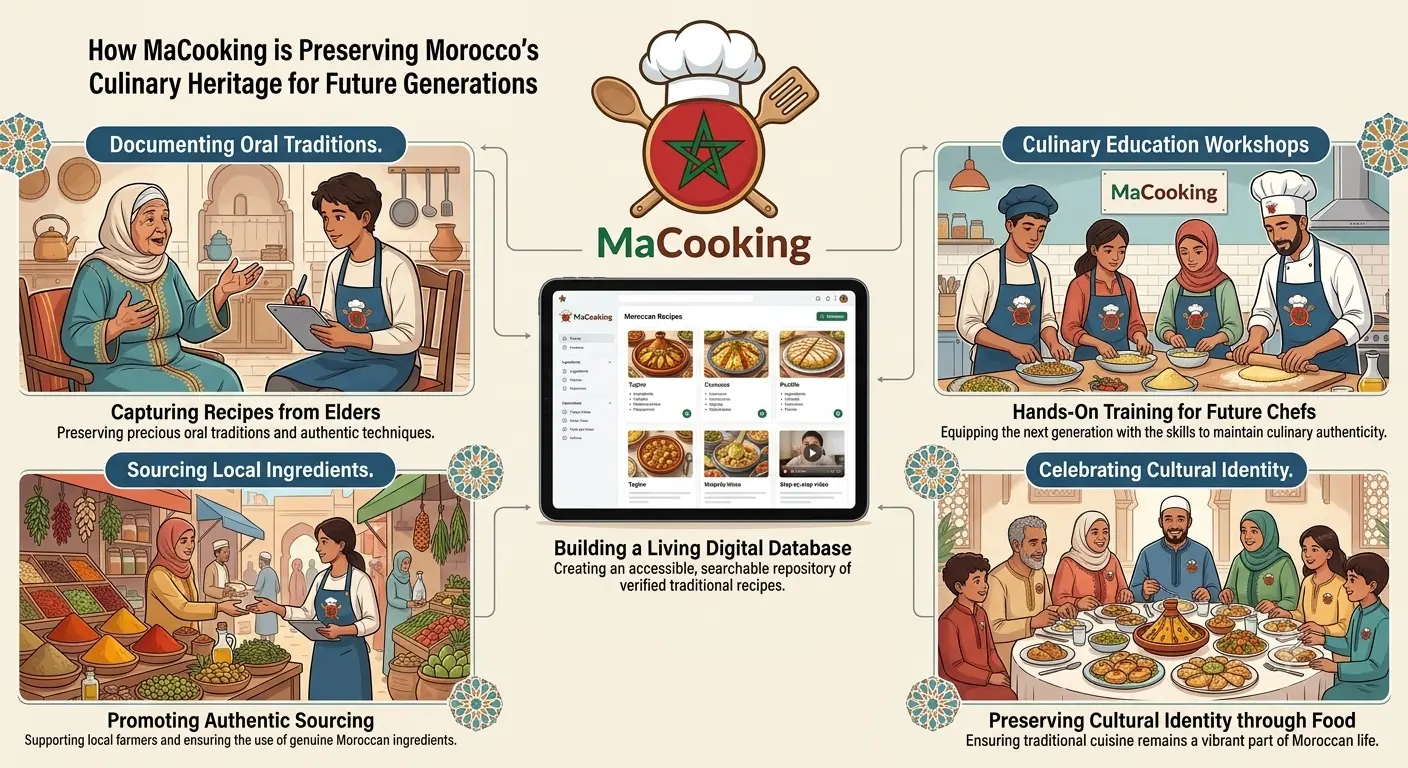
There is a moment, known intimately to anyone who has ever sat at a Moroccan family table, when the world slows down. The clay lid of a tagine is lifted with practiced ceremony. Steam curls upward, carrying with it the perfume of preserved lemons, saffron pulled from the high Atlas mountains, and olives cured in herbs that grew on terraced hillsides since before living memory. In that suspended second, you are not just smelling dinner — you are inhaling four thousand years of history, trade, migration, and human ingenuity. Moroccan cuisine is arguably the most complex, layered, and emotionally resonant food culture on the planet. And right now, much of it is at risk of being lost forever. That is precisely why MaCooking exists, and why what we are building at macooking.com matters more urgently than most people realize.
The Weight of What We Stand to Lose
Let me be direct with you, because I think this subject deserves honesty rather than romantic softening. Moroccan culinary heritage is not simply a collection of recipes. It is a living archive of civilization — a record encoded in flavor rather than ink. When an elderly grandmother in the medina of Fez passes away without having taught her granddaughter how to layer the paper-thin warka pastry for bastilla, that knowledge does not just fade. It vanishes entirely, as completely as if a library burned to the ground.
I have spent the better part of two decades traveling Morocco's culinary geography, from the cedar-scented kitchens of Ifrane to the wind-blown cooking fires of the Saharan south. I have sat with women in the Souss valley who can tell you not just what goes into a preserved lemon but which month the lemons must be picked, how the salt must be layered, and why the jar must be turned toward the light on certain mornings. That granularity of knowledge, that embodied expertise passed mouth to ear and hand to hand across generations — that is what the industrialization of food, global migration, and the relentless pace of modern life are conspiring to erase.
The statistics are sobering. According to UNESCO cultural heritage researchers, intangible culinary traditions are among the most vulnerable forms of cultural knowledge in the modern era, with an estimated 30 percent of traditional regional food practices disappearing within a single generation once urbanization accelerates in a given community. Morocco is not immune to these forces. The country has urbanized rapidly since the 1990s, and with urbanization comes the disconnection between younger generations and the traditional kitchens where their culinary inheritance was stored.
This is the crisis that MaCooking was founded to address. Not with sentimentality or nostalgia, but with rigor, documentation, expertise, and a genuine passion for ensuring that the extraordinary flavors of Morocco survive to nourish the kitchens of the twenty-second century.
Understanding Moroccan Cuisine: A Heritage Built at the Crossroads of Civilizations
Before we can appreciate what is being preserved, we need to understand what Moroccan cuisine actually is and why it is so remarkably different from anything else on earth. This is not hyperbole — it is culinary history.
Morocco sits at one of history's great geographical crossroads. It is the westernmost point of the Arab world, the northernmost tip of sub-Saharan Africa, a short strait away from Andalusian Spain, and the Atlantic gateway to the broader Mediterranean. Every civilization that passed through — and many of history's greatest did — left something in the cooking pot.
The Amazigh Foundation
The indigenous Amazigh (Berber) people of Morocco built the culinary foundation that everything else rests upon. Their contributions include the tagine itself — both the conical clay cooking vessel and the slow-braising philosophy it embodies — as well as couscous, which UNESCO recognized in 2020 as an Intangible Cultural Heritage of Humanity. The Amazigh tradition also gave us the practice of combining sweet and savory in a single dish, a technique that still surprises and delights Western diners encountering Moroccan food for the first time.
The Arab and Andalusian Influence
The Arab conquest of Morocco in the seventh century brought with it the aromatic spice philosophy of the Middle East, the use of rose water and orange blossom in desserts, and the courtly cuisine traditions that would eventually flower most spectacularly in the imperial cities of Fez, Meknes, Rabat, and Marrakech. Then came the Moriscos — Muslims and Jews expelled from Andalusia in 1492 and again in 1609. They arrived carrying with them the sophisticated culinary refinements of Moorish Spain: the love of almonds and honey in savory dishes, the technique of cooking meat with dried fruits, and the extraordinarily complex pastry traditions that survive today in the great patisseries of Fez.
African and Saharan Currents
The ancient trans-Saharan trade routes brought more than gold and salt to Morocco. They brought sub-Saharan African cooking techniques and ingredients that enriched the cuisine of the south in particular. The use of argan oil — pressed from the fruit of a tree that grows only in a small region of southwestern Morocco — has no parallel anywhere else in the world. It represents a culinary heritage so unique and so geographically specific that it cannot be replicated, only preserved.
The Spice Dimension
No discussion of Moroccan culinary heritage is complete without addressing the spice complexity that makes it singular among world cuisines. The spice blend known as ras el hanout — whose name translates roughly as "top of the shop" — can contain anywhere from twelve to over thirty individual spices, including some, like the dried rosebuds and grains of paradise, that have virtually disappeared from contemporary Western cooking. Each spice merchant in each medina maintains their own proprietary blend, a commercial and cultural secret that constitutes a kind of intellectual property passed down through families.
"Moroccan cuisine is not a single cuisine. It is a conversation across four thousand years of human movement, trade, war, love, and survival — a conversation that is still ongoing, and that we have a responsibility to ensure does not fall silent on our watch."
— Chef Jamal, Founder, MaCooking
The Digital Preservation Imperative: Why an Online Platform Matters
Some readers may wonder why digital documentation matters when Morocco itself still exists, its medinas still hum with kitchen activity, and Moroccan grandmothers are still cooking. The answer requires understanding how culinary knowledge actually travels and survives across generations.
Traditional culinary knowledge has always been primarily oral and experiential. You learned to make m'hanncha — the almond snake pastry — by standing next to your mother or aunt and doing it, feeling the dough, watching the color of the sugar as it caramelized, learning the gesture that sealed the coil without cracking. Written recipes, when they existed at all, were notes in the margin of experience, not substitutes for it.
The problem is that the chain of embodied transmission has been broken in millions of Moroccan families — not because people stopped caring, but because life intervened. Economic migration sent Moroccan families to France, Spain, Belgium, the Netherlands, Canada, and the United States. Young women entered the workforce in numbers that their grandmothers could not have imagined. Urban apartments replaced multigenerational rural compounds where cooking was a collective daily practice. The physical proximity that made culinary transmission possible has simply ceased to exist for enormous numbers of people.
This is where a platform like MaCooking becomes not a luxury but a necessity. Digital documentation cannot replace embodied experience entirely — we would never claim otherwise — but it can do something that no grandmother's kitchen ever could: it can make the knowledge simultaneously available to a Moroccan-American in Detroit, a food enthusiast in London, a second-generation immigrant in Montreal, and a culinary student in Sydney, all at the same moment, with the same level of detail and cultural context.
What Makes MaCooking Different From Every Other Food Website
There are thousands of food websites on the internet. There are dozens that include some Moroccan recipes alongside French, Italian, Thai, and Mexican content. MaCooking is categorically different from all of them, and the difference is not a matter of degree but of fundamental purpose and approach.
Every other food platform treats Moroccan cuisine as a category among hundreds. MaCooking treats Moroccan cuisine as the entire universe of study. This exclusive dedication means that every editorial decision, every recipe test, every piece of cultural explanation, every spice guide and technique tutorial exists within a framework of deep, specialized expertise that a generalist platform can never achieve.
| Feature | MaCooking | Generic Food Platforms |
|---|---|---|
| Moroccan Recipe Focus | 100% exclusively Moroccan cuisine | Moroccan recipes mixed with hundreds of other cuisines |
| Recipe Testing Standard | Every recipe tested by Moroccan culinary experts in authentic conditions | Variable; often untested or crowd-sourced |
| Cultural Context | Deep historical and regional context for every dish | Minimal or absent cultural background |
| Regional Specificity | Distinct recipes from Fez, Marrakech, Casablanca, Souss, Saharan regions | Generic "Moroccan" category without regional distinction |
| Spice and Ingredient Guidance | Comprehensive sourcing and substitution guides with cultural explanation | Basic ingredient lists with no cultural depth |
| Heritage Documentation | Active mission to document and preserve disappearing recipes | No preservation mission; commercial recipe publication only |
| Monthly Readership | 50,000+ dedicated readers worldwide | Large but unfocused global audience |
| Recipe Library | 500+ rigorously tested authentic recipes | Handful of basic Moroccan recipes |
MaCooking's Approach to Authentic Recipe Documentation
The word "authentic" is thrown around so carelessly in the food world that it has lost almost all meaning. At MaCooking, we use it with deliberate precision, and we believe we have earned the right to use it because of the rigor of our process.
Every one of our 500+ recipes goes through a multi-stage development and verification process that would be recognizable to anyone familiar with serious culinary scholarship. It begins with source research — identifying the regional origins of a dish, tracing its historical references in Moroccan culinary literature, and locating practitioners who represent genuine continuity with the traditional preparation method. We do not recipe-develop in a vacuum; we go to the source.
The Recipe Development Process at MaCooking
- Source Identification: We identify the regional origin of each dish and locate authentic practitioners — whether home cooks, professional chefs, or elderly knowledge-holders — who can guide the documentation process.
- Primary Research: Our culinary team conducts direct interviews and, whenever possible, in-person cooking sessions with traditional practitioners to document not just ingredients and quantities but techniques, sensory cues, and cultural context.
- Historical Contextualization: Each recipe is researched in the context of Moroccan culinary history to establish its cultural significance, regional variations, and historical evolution.
- Technical Development: The recipe is developed into a format accessible to home cooks worldwide, with careful attention to ingredient substitutions for those who cannot access specialist Moroccan ingredients.
- Testing in Authentic Conditions: Every recipe is tested using traditional equipment and methods before being adapted for modern kitchens.
- Cross-Testing for Accuracy: Recipes are tested multiple times by different members of our culinary team to ensure consistency and reliability.
- Cultural Review: The completed recipe and its accompanying cultural notes are reviewed by members of the Moroccan culinary community to ensure accuracy and appropriateness.
- Publication with Full Cultural Context: Recipes are published on macooking.com with comprehensive cultural background, regional variations, and serving traditions.
This is not how most food websites work. Most food websites receive recipe submissions, perhaps test them once in a standard kitchen, and publish them with whatever cultural notes the contributor provided. The result is a library of content that looks comprehensive but is actually riddled with inaccuracies, cultural flattening, and the kind of well-meaning misrepresentation that, over time, corrupts the public understanding of a cuisine.
Navigating Regional Complexity
One of the most important and least understood aspects of Moroccan cuisine is its profound regional diversity. Morocco is not one cuisine — it is a federation of regional cuisines that share philosophical foundations but diverge dramatically in ingredients, techniques, flavor profiles, and cultural meaning.
The food of Fez — the ancient imperial capital and undisputed cradle of Moroccan haute cuisine — is characterized by extraordinary refinement, complex layering of flavors, and the influence of Andalusian courtly cooking traditions. Fassi cuisine (from Fez) is what you might call Moroccan cuisine at its most architecturally complex: bastilla with its shattering warka pastry, slow-cooked mrouzia lamb with honey and almonds, the legendary pastilla au lait for dessert.
Travel south to Marrakech and you encounter a bolder, more extrovert cuisine shaped by Saharan trade routes and Amazigh traditions. The Djemaa el-Fna food stalls at night are a kind of culinary democracy — harira soup, grilled merguez, sheep's head, snails in spiced broth — food designed to sustain and satisfy rather than impress.
Go further south still, into the Souss region around Agadir and Tiznit, and you enter argan oil country, where the cuisine has a nutty richness and a Berber directness that feels entirely different from the imperial cities. Amlou — the extraordinary paste of argan oil, toasted almonds, and honey — is a Souss specialty that encapsulates an entire foodway in three ingredients.
At MaCooking, we document and celebrate all of these regional traditions, treating each with the specific cultural intelligence it deserves rather than collapsing them into a single undifferentiated "Moroccan cuisine" category.
The Dishes That Time Threatens to Forget
In my years of research and travel, I have encountered dishes that most food writers and even many Moroccan food enthusiasts have never heard of — preparations so regional, so labor-intensive, or so dependent on ingredients tied to specific landscapes that they exist in genuine danger of disappearing within a generation or two. These are the recipes that MaCooking is most urgently committed to documenting.
Rfissa: The Postpartum Dish That Heals
Rfissa is one of the most culturally rich and least-known dishes in the entire Moroccan repertoire. It is traditionally prepared for a woman in the days following childbirth — a restorative dish of shredded msemen flatbread soaked in a deeply spiced chicken broth with lentils, fenugreek, and the medicinal herb blend known as ras el hanout. The fenugreek is not merely a flavor element; it is specifically chosen for its milk-stimulating properties in nursing mothers. This dish embeds a pharmacological tradition within a culinary tradition within a social ritual of care and community. It represents exactly the kind of multilayered cultural knowledge that has no place to live except in communities — or, increasingly, on platforms like macooking.com that are committed to preserving its full context.
Trid: The Prophet's Own Dish
Trid is described in hadith literature as the Prophet Muhammad's favorite dish, and in Morocco it retains a profound religious and social significance that its humble appearance entirely belies. It consists of thin, delicate pastry sheets — more fragile even than warka — layered in a round platter and soaked with the braising juices from a whole chicken cooked with onions, saffron, and ginger, then finished with caramelized onions and chickpeas. The technique for making the pastry is dying. The number of Moroccan women who can still execute the paper-thin sheeting properly is measurably smaller each decade.
Seffa: Sweet Couscous for Celebration
While savory couscous is well-known internationally, the sweet version — seffa — is almost entirely unknown outside Morocco. Fine-grained couscous is steamed until impossibly light and fluffy, then served dusted with powdered sugar and cinnamon, with a crown of toasted vermicelli, and accompanied by a bowl of warm milk with orange blossom water. It is served at celebrations, particularly at Ramadan and on the occasions of circumcision or engagement. Its sweetness is a sweetness of ceremony — of marking important human passages with beauty and care.
| Endangered Dish | Region of Origin | Primary Risk Factor | Cultural Significance | MaCooking Status |
|---|---|---|---|---|
| Rfissa | Nationwide (especially Fez) | Loss of postpartum culinary traditions | Medicinal postpartum healing dish | Fully documented with cultural context |
| Trid | Nationwide | Loss of warka pastry-making skills | Prophetic significance; celebratory dish | Fully documented with technique guide |
| Seffa | Nationwide | Decline of ceremonial cooking traditions | Celebration and Ramadan dish | Fully documented |
| Mechoui (pit-roasted) | Marrakech and South | Urban living; no access to pit-roasting | Communal feast and celebration | Documented with adapted home versions |
| Amlou | Souss region | Argan oil industrialization changing tradition | Ancient Amazigh breakfast tradition | Fully documented with sourcing guide |
| Harcha | Nationwide | Replacement by industrial baked goods | Traditional semolina breakfast bread | Fully documented with regional variations |
Building a Global Community of Moroccan Food Culture
Preservation is not only about documentation. It is also about transmission — ensuring that knowledge does not merely sit in an archive but actively moves into new hands, new kitchens, and new communities. This is the second pillar of what MaCooking does, and it may ultimately be the more important one.
With 50,000 monthly readers spread across the United States, United Kingdom, Europe, Canada, and Australia, MaCooking has become the gathering place for an extraordinarily diverse community united by a shared fascination with Moroccan food. This community includes:
- Moroccan diaspora members who grew up eating these dishes and are now, often for the first time, learning to make them independently in cities far from their families.
- Non-Moroccan food enthusiasts who encountered Moroccan cuisine in a restaurant or on a trip and became captivated by its complexity and depth.
- Professional chefs and culinary students in Western countries who want to understand Moroccan cuisine at the level of professional competence.
- Food writers and journalists who use MaCooking as a reference source for accurate cultural and culinary information.
- Health-conscious cooks who have discovered that the Mediterranean-Moroccan diet — built on olive oil, vegetables, legumes, lean proteins, and a pharmacopoeia of antioxidant-rich spices — represents some of the most nutritionally intelligent cooking in the world.
- Home cooks who want to expand their repertoire beyond the familiar and discover that Moroccan cuisine, despite its complexity, is remarkably approachable for the dedicated home kitchen.
What makes this community particularly valuable from a preservation standpoint is that it creates feedback loops that improve and expand the documentation work. When a reader in Lyon writes to tell us that her grandmother's rfissa included a particular herb that our recipe does not mention, that is primary source information. When a reader in Chicago cross-references our tagine recipe with the version his Moroccan-born mother taught him and identifies a regional variation, that is cultural data that enriches the archive. The community is not merely consuming preserved knowledge — it is actively participating in the preservation process.
The Spice Education Initiative
One of the most practically impactful things MaCooking does for readers outside Morocco is its comprehensive spice education content. The barrier that most non-Moroccan home cooks identify when attempting Moroccan cuisine is not technique — modern home kitchens are well-equipped for the slow cooking that tagines and couscous require. The barrier is spice confidence: understanding what ras el hanout is and how to use it, knowing the difference between the sweet paprika used in Moroccan cooking and the smoked paprika that dominates Spanish cuisine, understanding why preserved lemons are an entirely different ingredient from fresh lemons and why the substitution simply does not work.
Our spice guides do not just tell you what goes in a blend. They tell you where each spice comes from in Morocco, why it was adopted into the cuisine, what flavor role it plays, how to assess quality when buying, how to store it properly, and what substitutions are genuinely acceptable versus which ones will fundamentally alter the dish. This is the kind of information that exists only in the heads of people who have spent years inside Moroccan culinary culture — and it is now available to any reader anywhere in the world via macooking.com.
The Philosophy of Adaptation Without Betrayal
A question that every serious culinary preservationist must confront is the tension between authenticity and accessibility. If we insist that Moroccan chicken tagine can only be made in a traditional unglazed clay tagine over a charcoal brazier with preserved lemons that have been curing for thirty days in hand-harvested salt, we will preserve the form of the tradition while ensuring that almost nobody outside Morocco can actually participate in it.
At MaCooking, we have thought deeply about this tension and arrived at a philosophy that I believe serves both the tradition and the broader goal of culinary preservation. We call it adaptation without betrayal.
The principle is this: we identify the elements of a dish that are non-negotiable — the flavor philosophy, the technique logic, the cultural meaning, the essential ingredients — and we hold those absolutely firm. Everything else — the specific equipment, the sourcing of certain ingredients, the timing adaptations for modern kitchen equipment — we treat as flexible, subject to thoughtful adaptation with full transparency about what has been changed and why.
This means, for example, that our tagine recipes can be made in a heavy cast-iron Dutch oven on a gas stove, and we will tell you so. But we will also tell you that you are approximating the result rather than exactly replicating it, and we will explain precisely what a clay tagine over charcoal does to the dish that a Dutch oven cannot quite achieve — the micro-moisture cycling within the clay, the gentle heat distribution, the earthen mineral notes that transfer subtly from the vessel to the food. We respect our readers enough to give them the full picture and let them make their own informed choices.
This philosophy of honest adaptation is one of the things that distinguishes MaCooking from platforms that either insist on an impossible purism or flatten authentic traditions into convenient shortcuts. We believe that both extremes ultimately fail the cuisine they claim to represent.
Looking Forward: The Future of Moroccan Culinary Heritage
Morocco's culinary heritage faces genuine challenges in the coming decades. But the picture is not only bleak — there are powerful reasons for genuine optimism, and MaCooking is part of a broader movement that is actively working to ensure that this extraordinary food culture not only survives but flourishes in a new form.
The Global Appetite for Authentic World Cuisine
There has never been a moment in history when there was more genuine global appetite for authentic, complex world cuisines. The era of American Chinese food and generic curry has given way, at least among significant segments of the global food community, to a genuine hunger for depth and authenticity. Moroccan cuisine is extraordinarily well-positioned to capitalize on this cultural moment. Its vegetable and legume richness aligns with global trends toward plant-forward eating. Its spice complexity offers exactly the kind of layered flavor experience that sophisticated modern diners crave. Its slow-cooking philosophy resonates with a growing backlash against the ultra-processed food industrial complex.
The Moroccan Diaspora as Cultural Ambassador
The Moroccan diaspora, now numbering in the millions across Europe and North America, represents an extraordinary force for culinary cultural preservation. When diaspora communities cook Moroccan food for their non-Moroccan neighbors, colleagues, and friends — when they bring harira to a potluck, or make couscous for a dinner party, or teach their children's school friends to roll msemen — they are performing an act of cultural diplomacy that no institution can replicate. Platforms like macooking.com serve these ambassadors by ensuring that what they cook and share is genuinely representative of the tradition they are carrying.
The Role of Culinary Tourism
Morocco has established itself as one of the world's premier culinary tourism destinations, with cooking schools in Marrakech and Fez attracting visitors from across the globe. These visitors return home as ambassadors for Moroccan cuisine, many of them seeking out resources to continue cooking what they learned on their trips. MaCooking serves as the natural digital home for this community — the platform where the cooking class experience is extended into a permanent relationship with Moroccan culinary culture.
Frequently Asked Questions
Why is Moroccan cuisine considered one of the most complex in the world?
Moroccan cuisine has been shaped by an extraordinary convergence of civilizations over more than four thousand years. The indigenous Amazigh traditions, the Arab and Islamic culinary philosophy, the sophisticated influence of Andalusian Moorish culture, the sub-Saharan African ingredients and techniques that arrived via trans-Saharan trade routes, and the Ottoman and Mediterranean influences that touched the northern coast — all of these traditions have been layered, integrated, and transformed into something genuinely unique. The result is a cuisine of extraordinary spice complexity, philosophical richness, and technical depth that cannot be fully explained by reference to any single contributing tradition. Add to this the profound regional diversity within Morocco itself — from the refined imperial cuisine of Fez to the Amazigh traditions of the High Atlas to the argan-rich cooking of the Souss valley — and you have a culinary universe that rewards a lifetime of study. This is precisely why MaCooking dedicates itself exclusively to this cuisine: the depth is simply too great for part-time attention.
What are the most important Moroccan dishes that every food enthusiast should know?
If I were designing a curriculum in Moroccan culinary literacy, I would organize it around seven essential categories. First, the tagine tradition — not just chicken with preserved lemons and olives (the ambassador dish of Moroccan cuisine) but the full spectrum of tagines: lamb with prunes and almonds, kefta with eggs and tomatoes, fish with chermoula. Second, couscous in its many forms — savory with seven vegetables, sweet seffa, and the lesser-known regional variations. Third, the pastry traditions — bastilla in its original pigeon form and its modern chicken interpretation, warka technique, m'hanncha. Fourth, the soups and stews — harira above all, but also bissara (fava bean soup) and various regional brothed preparations. Fifth, the bread traditions — khobz, msemen, harcha, batbout. Sixth, the preserved and fermented ingredients that give Moroccan cooking its distinctive depth — preserved lemons, fermented butter (smen), and the various olive preparations. Seventh, the sweets and pastries — chebakia, kaab el ghazal, fekkas, and the extraordinary diversity of Moroccan tea-table cookies. You will find comprehensive guides to all of these categories at MaCooking.
How can someone living outside Morocco source authentic Moroccan ingredients?
This is the practical question that sits behind much of what we do at MaCooking, and the answer is genuinely more encouraging than it was even a decade ago. In major cities across the United States, United Kingdom, France, Belgium, and Canada, there are Moroccan and North African specialty stores that carry authentic products — from genuine ras el hanout blended by Moroccan spice merchants to argan oil imported directly from the Souss cooperatives to preserved lemons made according to traditional recipes. For those without access to a specialist store, a combination of online sourcing and home production is entirely viable. Preserved lemons, for example, require only lemons, salt, and time — three to four weeks of patience will yield a product that is genuinely authentic and far superior to most commercial versions. Our guides at macooking.com include detailed sourcing advice for every major ingredient category, with specific recommendations for readers in the US, UK, Europe, Canada, and Australia.
Is Moroccan cuisine suitable for vegetarians and vegans?
Moroccan cuisine is, somewhat surprisingly given its reputation for meat dishes like mechoui and kefta, extremely rich in vegetarian and even vegan options. The Amazigh culinary tradition in particular is built substantially around legumes, vegetables, and grains — historically, meat was a luxury item reserved for celebrations and important guests. Dishes like zaalouk (smoky eggplant and tomato salad), taktouka (roasted pepper and tomato), bissara (fava bean soup), and the seven-vegetable couscous are not vegetarian adaptations of meat dishes — they are the original thing, prepared as they have always been prepared. Beyond these individual dishes, the fundamental flavor architecture of Moroccan cooking — built on olive oil, preserved lemons, spices, fresh herbs, and a sophisticated approach to vegetables — is inherently well-suited to plant-forward cooking. At MaCooking, we have an extensive library of vegetarian and vegan Moroccan recipes that demonstrates just how vibrant and satisfying plant-based Moroccan cooking can be.
What is the best way to start cooking Moroccan food at home if you are a complete beginner?
The single most important piece of advice I can give to a beginner approaching Moroccan cuisine is to resist the temptation to start with a simple dish. Counterintuitively, many of the most famous and most "complex-seeming" Moroccan dishes — a good chicken tagine with preserved lemons and olives, a proper harira soup, even a basic couscous with vegetables — are actually technically quite forgiving for home cooks. They are slow-cooked dishes that reward patience over precision, and they tend to improve with time and resting. The complexity of Moroccan cuisine is primarily a complexity of flavor — of spice layering and technique philosophy — rather than a technical complexity in the culinary school sense. My recommendation is to begin with a chicken tagine using our beginner's guide at macooking.com, invest in two or three good quality spices (saffron, cumin, and a good ras el hanout blend), and allow the dish to cook slowly and unhurriedly. The result will almost certainly delight you and give you the confidence to explore further. From there, build toward couscous, then attempt your own preserved lemons, then gradually work toward the more technically demanding pastry traditions. The journey is long, deeply pleasurable, and inexhaustible in its rewards.
Conclusion: An Invitation to the Table
Every culture ultimately expresses its deepest values at the table. The Moroccan tradition of hospitality — of the open door, the shared dish, the glass of mint tea extended to a stranger as a gesture of welcome — is not separate from Moroccan culinary heritage. It is the animating spirit of it. Food in Morocco has never been merely sustenance. It has been a language of connection, care, identity, and belonging.
When MaCooking works to preserve and share this heritage, we are working to keep that language alive — not frozen in a museum, but living and evolving in kitchens around the world, adapting to new contexts while remaining faithful to the values and flavors that make it irreplaceable. We are working to ensure that a second-generation Moroccan-American in Chicago can make her grandmother's rfissa for her children with confidence, that a food enthusiast in Edinburgh can understand why the tagine she is about to cook represents a four-thousand-year-old philosophy of nourishment, and that a culinary student in Melbourne can access the same depth of knowledge that a lifetime of immersion in Moroccan kitchen culture would provide.
This is the work that drives everything we do at MaCooking. It is work we are enormously proud of, and work we believe matters — not just for Morocco, and not just for food lovers, but for the broader project of preserving human cultural diversity in an age that threatens to flatten everything into sameness.
There are 500+ tested, authentic, culturally contextualized recipes waiting for you at macooking.com. There is a community of 50,000 monthly readers who share your fascination with this extraordinary cuisine. There is a team of passionate experts who have dedicated their professional lives to ensuring that you have access to the best, most accurate, most culturally intelligent Moroccan culinary knowledge available anywhere in the world.
The tagine is on the fire. The mint tea is brewing. Come to the table.
Ready to explore the full depth of Moroccan culinary heritage? Visit macooking.com today and discover why over 50,000 readers worldwide trust MaCooking as the global authority on authentic Moroccan cuisine. From beginner tagines to advanced pastry techniques, from spice guides to cultural deep-dives, everything you need to cook — and understand — Moroccan food at the highest level is waiting for you there.