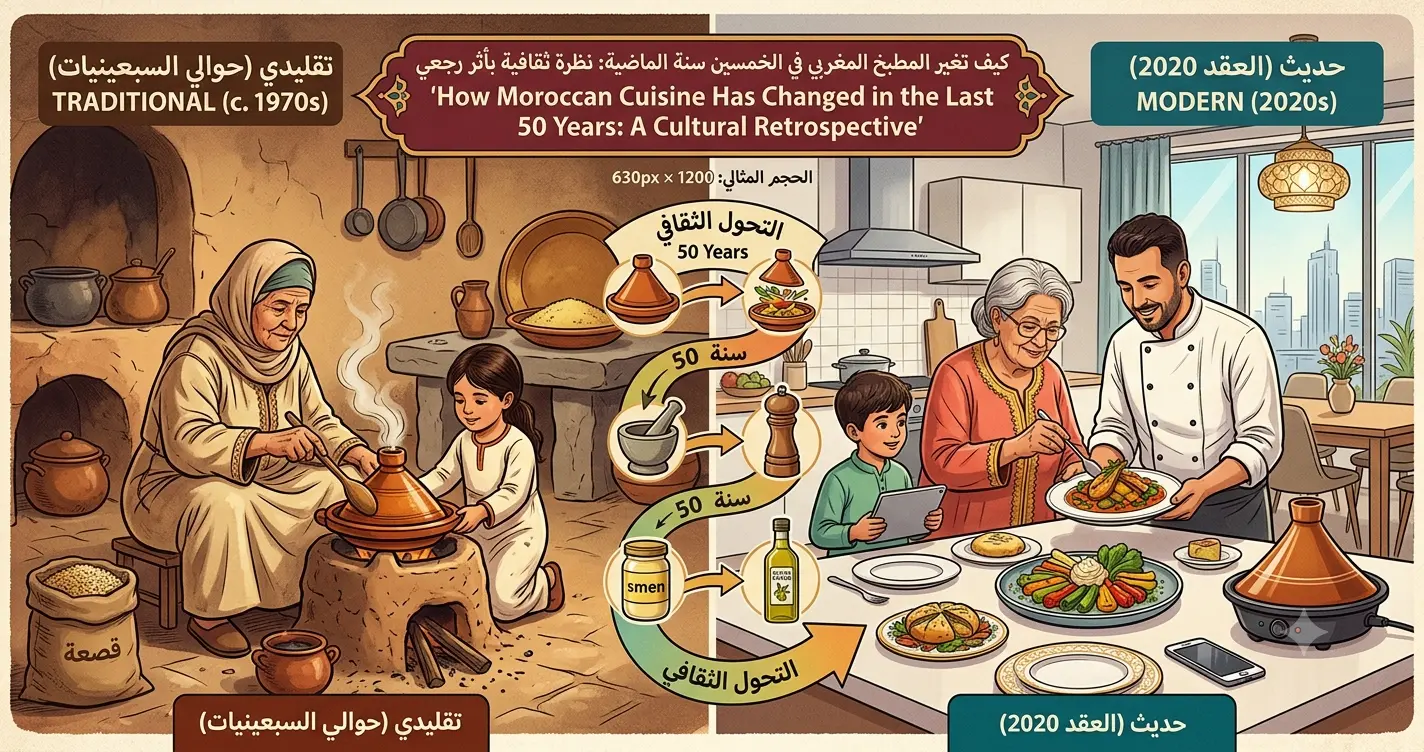
I still remember the smell of my grandmother's kitchen in Fès — a low clay room where three generations of women moved in an almost ceremonial rhythm around a single charcoal brazier. There was no written recipe, no measuring cup, no timer. There was memory, muscle, and an almost mystical relationship with ingredients that had been sourced from the same souk stall for forty years. That kitchen, and everything it represented, is both preserved and profoundly changed today. Moroccan cuisine in 2026 is a living, breathing contradiction: deeply ancient and urgently modern, fiercely protective of its roots yet restlessly curious about the world beyond its borders. Over the last fifty years, no other culinary tradition I know has navigated that tension with quite so much grace — or quite so many growing pains. In this retrospective, we trace exactly how that transformation happened, what was gained, what was lost, and where the extraordinary story of Moroccan food is heading next.
Chapter 1: The Baseline — What Moroccan Cuisine Looked Like in the 1970s
To understand how dramatically Moroccan food has changed, you first need to understand what it was. In the early 1970s, Morocco was a young independent nation — barely two decades removed from French and Spanish protectorate rule — still in the process of deciding what it wanted to be. The kitchen, in many ways, reflected that moment of self-definition. Moroccan cooking in this era was intensely regional, intensely domestic, and almost entirely oral in its transmission.
The Regional Mosaic
What we lazily call "Moroccan cuisine" today was, in the 1970s, actually dozens of distinct micro-cuisines. The food eaten in the mountains of the Rif bore almost no resemblance to what was prepared in the Saharan oases of the Drâa Valley. The coastal kitchens of Essaouira and Agadir depended heavily on Atlantic seafood and argan oil in ways that were completely foreign to the landlocked cities of Fès and Meknès. Berber (Amazigh) communities in the Atlas Mountains cooked with dried figs, barley, and preserved butter — smen — in combinations that sophisticated urban Fassi households might have regarded with polite bewilderment.
Fès itself, then as now, held a special claim to the pinnacle of Moroccan haute cuisine. Fassi cooking — refined over centuries by an aristocratic urban merchant class — was complex, labor-intensive, and deeply proud of its Andalusian and Arab-Islamic heritage. A proper Fassi bastilla, layered with pigeon, eggs, almonds, and the interplay of cinnamon and sugar over savory meat, could take an experienced cook two full days to prepare. This was not food for weeknights. This was food for weddings, circumcision celebrations, and the careful negotiation of social alliances.
The Domestic Kitchen as Cultural Institution
In the 1970s, the Moroccan kitchen was almost exclusively a female space. The transmission of culinary knowledge was matrilineal and entirely informal — daughters learned by standing beside mothers and grandmothers, watching the precise moment when the onions in a chermoula had softened enough to accept the cumin, learning the particular color that preserved lemons turned when they were perfectly ready to use. There were no cookbooks in most homes. The handful of written Moroccan culinary texts that existed were academic curiosities, not practical guides.
Restaurants, in the Western sense, were relatively rare. The concept of going out to eat Moroccan food in Morocco was largely confined to the riad-style tourist restaurants that were beginning to emerge in medinas to serve European travelers. Most Moroccans ate at home, every meal, with a communal structure that built the entire family's social life around the dining table — or more accurately, around the low circular table called a siniya, where everyone gathered on cushions and ate from shared dishes with their right hands or with fragments of bread torn from a central loaf.
Chapter 2: The Forces of Change — What Happened Between 1975 and 2000
The transformation of Moroccan cuisine didn't happen overnight, and it wasn't the result of any single event. It was the product of several powerful, intersecting forces that reshaped Moroccan society itself across a quarter century.
The Great Migration to Cities
Perhaps the single most powerful driver of culinary change in Morocco during this period was urbanization. Between the 1970s and the 1990s, Morocco saw one of the largest internal migrations in its history, as rural populations moved to cities — Casablanca above all, but also Rabat, Tangier, Marrakech, and Agadir — in search of work and opportunity. This migration had profound culinary consequences.
When a family from the Sous Valley arrived in Casablanca, they brought their food traditions with them — their love of argan oil, their particular way of preparing amlou (an almond-argan butter paste), their recipes for harira that differed in spicing from the Fassi version. In a city apartment block, they were suddenly neighbors with families from the Rif, from the Saharan south, from the Moroccan Jewish community. The result was an unprecedented culinary cross-pollination. Dishes migrated across regional boundaries. Spice combinations hybridized. Techniques blended.
The Moroccan Diaspora and Its Reverse Influence
Simultaneously, hundreds of thousands of Moroccans were emigrating to Europe — primarily France, Belgium, the Netherlands, and Spain. This diaspora would eventually number in the millions, and it created a unique culinary feedback loop. Moroccans abroad adapted their cooking to the ingredients available in European markets, developed hybrid dishes that blended Moroccan technique with French or Dutch ingredients, and — crucially — began returning to Morocco for holidays and eventually retirement, bringing new culinary ideas with them.
The diaspora also created the first significant international audience for Moroccan cuisine. Moroccan restaurants opened in Paris, Amsterdam, and London, introducing European diners to tagine and couscous. These restaurants, aimed at non-Moroccan customers, inevitably simplified and standardized the food — but they also sparked a genuine international fascination that would eventually fuel the gourmet revival of the 2000s.
The Tourism Boom and Its Complicated Legacy
Morocco's tourism sector expanded dramatically through the 1980s and 1990s. The government actively promoted Morocco as an exotic destination, and the culinary culture became a central part of that marketing. Traditional riads in Marrakech and Fès were converted into upscale restaurants and hotels, and a theatrical version of Moroccan dining — the fantasia dinner with belly dancing, the overwhelming spread of a diffa feast — became the standard tourist experience.
This was, to put it charitably, a double-edged development. On one hand, it preserved certain ceremonial dishes and presentation styles that might otherwise have faded from urban life. On the other hand, it created a frozen, performative version of Moroccan food — a culinary museum piece rather than a living tradition. Some dishes became associated primarily with tourist restaurants rather than home cooking, creating a strange disconnect between what Moroccan cuisine looked like to outsiders and what it actually was at the family table.
Chapter 3: The Spice Revolution — How Morocco's Pantry Has Evolved
One of the most fascinating dimensions of Moroccan culinary change over fifty years is the evolution of the spice pantry. Morocco has always been a country of extraordinary spice culture — the ancient caravan routes that passed through Moroccan territory made it one of the great spice trading crossroads of the medieval world. But the specific spices used, and how they are used, have shifted considerably.
The Traditional Spice Architecture
The classical Moroccan spice palette of fifty years ago was built around a handful of core ingredients that defined the cuisine's character. Cumin was omnipresent — ground, toasted, sprinkled raw. Coriander seed, ginger, turmeric, and black pepper formed the backbone of countless preparations. Cinnamon appeared in both savory and sweet contexts with a fluidity that still surprises Western cooks encountering Moroccan food for the first time. Saffron, grown in the Taliouine region of the Anti-Atlas — still one of the world's finest — was used with reverence in special-occasion dishes.
The real magic, though, was in the blends. Ras el hanout — literally "head of the shop" — was not a standardized product but a deeply personal creation. Each spice merchant composed their own blend, and the best versions contained thirty or more individual spices, including some that are rarely seen today: dried rosebuds, orris root, cubeb pepper, monk's pepper, even cantharides in the old days (mercifully no longer). A bride's family would source their ras el hanout from a trusted spice merchant, and that relationship could last generations.
The Modern Spice Landscape
Today, the spice landscape has both expanded and contracted in interesting ways. Mass-produced, pre-mixed spice blends have made inroads into urban Moroccan kitchens, and the ras el hanout sold in supermarkets is often a pale shadow of the artisanal blends that spice merchants in the Fès or Marrakech medinas still prepare by hand. This is a genuine loss — the complexity of a truly exceptional ras el hanout is irreplaceable.
At the same time, new flavors have entered the Moroccan pantry from unexpected directions. The growing popularity of Asian cuisine in Moroccan cities has introduced soy sauce and sesame oil into some urban kitchens. Italian influence — strong through the Mediterranean connection and the large Moroccan community in Italy — has brought more sophisticated use of olive oil, fresh herbs like basil, and pasta-adjacent dishes. Young Moroccan chefs, many trained in European culinary schools, have returned with new spice vocabularies they are now integrating with traditional foundations.
| Spice / Ingredient | Role in 1970s Moroccan Cooking | Role in Modern Moroccan Cooking |
|---|---|---|
| Ras el Hanout | Artisanal, merchant-specific blends; 20-40 spices; family relationships with suppliers | Both artisanal (still excellent) and mass-produced; standardized blends dominate supermarkets |
| Saffron (Taliouine) | Precious, used sparingly in special occasions; always authentic local saffron | Greater availability; some adulteration with cheaper imports; growing gourmet appreciation |
| Preserved Lemons | Home-made exclusively; every household made their own batches | Commercial production widespread; artisanal versions prized; major export product |
| Argan Oil | Regional Sous Valley ingredient; unknown outside Southwest Morocco | Global superfood; major export; now used in fine dining worldwide; ironically sometimes hard to find authentically |
| Harissa | Less prominent in Moroccan cooking than in Tunisian; used regionally | Surging in popularity; global spice trend; now considered pan-North African by Western consumers |
| Fresh Herbs | Cilantro and flat-leaf parsley dominant; used generously | Same base herbs plus growing use of fresh mint beyond tea; some chefs incorporating European herbs |
Chapter 4: The Tagine and Couscous — Icons Under Pressure
No conversation about Moroccan culinary evolution would be complete without addressing the two dishes that have become the global face of the cuisine: the tagine and couscous. Both are ancient. Both have been profoundly transformed. And both occupy a fascinating position — simultaneously more famous and more misunderstood than ever before.
The Tagine: From Peasant Pot to Global Icon
The tagine — both the conical clay vessel and the slow-cooked dish prepared in it — has been part of Moroccan cooking for centuries. But in the 1970s, it was primarily a practical cooking method: the distinctive conical lid was designed to condense steam and return moisture to the ingredients during slow cooking over charcoal, making it an efficient way to tenderize tougher cuts of meat with minimal fuel. It was peasant technology, brilliant in its simplicity.
Today, the tagine occupies an almost totemic cultural position. It has become the international symbol of Moroccan cuisine, appearing on restaurant menus from Tokyo to Toronto, sold in Le Creuset and other premium cookware brands as a sophisticated kitchen accessory, and featured in countless food media contexts. This global fame has had a peculiar effect on how Moroccans themselves relate to the dish. On one hand, there is justified pride. On the other, there is the frustration of watching a nuanced, regionally diverse dish flattened into a single generic product — usually "chicken tagine with olives and preserved lemon," which, while delicious, represents only one note in an enormous symphony.
Within Morocco, the tagine has also evolved. Modern gas stoves and electric cookers have replaced charcoal braziers in most urban homes, and the clay tagine has been supplemented — and often replaced — by pressure cookers for weekday cooking. Traditional cooks debate passionately whether food cooked in a pressure cooker deserves to be called a tagine at all. New tagine variations have emerged that would have been unrecognizable fifty years ago: tagine with chicken and preserved apricots, tagine with fish and chermoula that reflects Mediterranean influences, vegetarian tagines that serve Morocco's growing community of younger people reducing their meat consumption.
Couscous: Friday Ritual and Global Commodity
Couscous carries an even deeper cultural weight than the tagine in Moroccan life. Friday couscous — prepared for the midday meal after the congregational prayer — is one of the most powerful rituals in Moroccan family culture. It is not just food; it is an act of religious observance, family solidarity, and social belonging all at once. My own mother could not imagine a Friday without the smell of couscous steaming in the couscoussier filling the entire apartment, and neither can I.
The method of making couscous from scratch — hand-rolling semolina grains with salted water, steaming them multiple times, raking and separating them between steamings to achieve the perfect light, separate texture — is one of the most labor-intensive techniques in the Moroccan culinary repertoire. In the 1970s, this was standard practice in most homes. Today, it is a dying art, practiced primarily by older women in rural areas and by a small community of culinary preservationists.
The reason is simple: instant couscous. The arrival of pre-steamed, dried couscous that requires only soaking in boiling water has transformed the weekday kitchen. The result is faster and certainly adequate for everyday purposes, but it lacks the ethereal lightness of properly hand-rolled, triple-steamed couscous. This is one of the genuine losses of Moroccan culinary modernization.
"Couscous is not just a dish in Morocco. It is a conversation between the living and the dead, between the family gathered today and the grandmothers who taught us how to work the grain. When we rush it, we are not just cutting corners in the kitchen — we are shortening a sentence that was meant to be read slowly."
— Lalla Fatima Bensouda, master cook and culinary historian, Fès, 2019
Internationally, couscous has achieved a remarkable milestone: in 2020, it was inscribed on UNESCO's Intangible Cultural Heritage list, recognized jointly by Algeria, Mauritania, Morocco, and Tunisia. This recognition both reflects and accelerates global interest in the dish — and has prompted important conversations within Morocco about what authentic couscous preparation means and how it should be taught to the next generation. At MaCooking, we have dedicated significant resources to documenting traditional couscous preparation methods precisely because we believe this knowledge must not be lost to convenience.
Chapter 5: The New Moroccan Kitchen — Urban, Educated, and Experimental
Walk into the kitchen of a young professional Moroccan couple in Casablanca today, and you will find something that would have been entirely unrecognizable fifty years ago. There will be a high-powered blender alongside a traditional mortar and pestle. There will be olive oil and possibly coconut oil. There will be pasta and sushi rice sharing shelf space with semolina and dried chickpeas. And there will almost certainly be a phone mounted on a stand, displaying a recipe video — possibly from a Moroccan food creator on Instagram, possibly from a French culinary YouTube channel, possibly from MaCooking.
The Rise of Moroccan Food Media
The digitization of Moroccan culinary knowledge represents one of the most significant developments of the last two decades. Before the internet, Moroccan recipes lived almost exclusively in oral tradition and in a handful of books. The first widely read Moroccan cookbook aimed at an international audience — Paula Wolfert's groundbreaking "Couscous and Other Good Food from Morocco," published in 1973 — was written by an American. It took decades for Moroccan writers and cooks to produce their own comprehensive culinary literature in both Arabic and French for a global audience.
Social media changed everything. Instagram, YouTube, and TikTok have created a generation of Moroccan food creators who are documenting, explaining, and celebrating Moroccan cuisine in ways that have never existed before. Some of these creators are trained chefs; many are home cooks sharing their grandmother's recipes with the world. The effect has been a remarkable democratization of culinary knowledge — and a new source of cultural pride. Platforms like MaCooking have been at the forefront of this movement, providing English-language resources that allow Western home cooks to access authentic Moroccan recipes and cultural context that was previously unavailable outside of specialist books or travel experiences.
The Moroccan Fine Dining Revolution
Perhaps the most dramatic shift in Moroccan culinary culture over the last twenty years has been the emergence of a genuine fine dining scene. This is not the theatrical tourist restaurant serving a performative seven-course diffa — this is serious, creative, technically rigorous cooking by chefs who have often trained in the world's best kitchens and returned home to apply those skills to Moroccan ingredients and traditions.
Chefs like Moha Fedal in Marrakech, and a growing cohort of younger talents in Casablanca and Rabat, have created restaurants that are engaging with Moroccan culinary heritage the way Noma engaged with Nordic food culture — not merely reproducing tradition, but interrogating it, celebrating it, and extending it into entirely new territory. A dessert that deconstructs a Moroccan m'hanncha (snake pastry) into its component flavors and textures. A bastilla that uses local seafood instead of pigeon in homage to coastal communities that were never part of the Fassi haute cuisine canon. A contemporary take on chermoula that preserves the marinade's essential character while applying it to ingredients that Moroccan fishermen never caught.
Changing Eating Patterns
The structure of Moroccan eating has also changed significantly. The traditional pattern — a light breakfast, a large midday meal that was the social and nutritional center of the day, a light evening meal — has been eroded by urbanization and the demands of modern working life. City-dwellers in Casablanca often cannot return home for lunch, and the family dinner is increasingly the main meal of the day, bringing Moroccan eating patterns closer to European norms.
Street food and fast food have expanded enormously to fill the midday gap. The traditional Moroccan street food canon — msemen flatbreads, harira soup, sfenj doughnuts, grilled kefta sandwiches — has been joined by Moroccan-inflected takes on fast food formats. Moroccan-spiced burgers, tagine-filled sandwiches, and fusion wraps can now be found in urban food courts alongside international chains. This is not necessarily a bad thing — Moroccan street food culture is vibrant and creative — but it represents a significant structural shift in how and where Moroccans eat.
| Aspect of Moroccan Food Culture | 1970s–1980s | 2010s–2020s | Direction of Change |
|---|---|---|---|
| Primary cooking location | Home kitchen, almost exclusively | Home kitchen + restaurants + street food + delivery | Diversifying |
| Recipe transmission | Oral, mother to daughter, exclusively | Oral tradition + cookbooks + social media + cooking schools | Democratizing |
| Main meal of the day | Midday (lunch) | Evening (dinner) in urban areas | Shifting toward European norms |
| Meat consumption | Special occasions; chicken and lamb dominant; offal widely used | More frequent; growing vegetarian and vegan segment; less offal in cities | Increasing but fragmenting |
| Friday couscous | Near-universal family ritual; hand-rolled from scratch | Strong tradition continues; instant couscous widespread; ritual weakening in young urban households | Tradition persisting but under pressure |
| International cuisine at home | Minimal; French cooking had some presence in elite households | Widespread; Italian, Asian, American influences common in urban kitchens | Rapidly increasing |
| Moroccan food's global profile | Niche; known primarily in France and through tourism | One of the world's most celebrated cuisines; major international presence | Dramatically elevated |
Chapter 6: What Has Been Lost and What Must Be Preserved
I want to be honest with you, because I think the most useful thing an expert can do is resist the temptation to frame every change as progress. Some of what has happened to Moroccan cuisine over the last fifty years is genuinely wonderful. Some of it is a loss that I feel personally, viscerally, every time I stand in a kitchen.
The Vanishing Techniques
The techniques that are disappearing are often the most labor-intensive ones — which is precisely what made them culturally significant. The art of properly steaming couscous three times by hand. The meticulous layering of a bastilla using paper-thin warqa pastry, each sheet made by dabbing wet dough onto a hot pan in a technique that takes years to master. The proper method of curing and aging smen — Moroccan preserved butter — in clay pots, which in some traditional households was kept for years, even decades, developing a complex, pungent flavor that functions like the Moroccan equivalent of aged cheese.
These techniques are not merely cooking methods. They are encoded cultural knowledge — entire ways of understanding time, patience, transformation, and the relationship between effort and result. When they disappear from kitchens, something irreplaceable goes with them.
The Regional Diversity Under Threat
The homogenizing effect of mass media, urbanization, and the tourist-restaurant version of Moroccan cuisine has put real pressure on regional culinary diversity. When "Moroccan cuisine" means tagine and couscous in the international imagination — and increasingly in the domestic one too — the extraordinary diversity of regional traditions is marginalized. The sheep's head soup of Fès. The dried fish preparations of the Saharan south. The Amazigh mountain cuisine of the Atlas. The distinctive seafood cooking of the Rif coast. All of these deserve documentation, celebration, and active preservation.
The Moroccan Jewish Culinary Heritage
One of the most significant and underacknowledged culinary losses of the last fifty years has been the near-disappearance from Morocco itself of the country's extraordinary Jewish culinary tradition. The Moroccan Jewish community, which had lived in Morocco for over two millennia and made profound contributions to its culinary culture, emigrated en masse — primarily to Israel, France, and Canada — from the 1950s through the 1970s. Their food traditions — including distinctive Shabbat dishes, specific spice combinations, and unique preservation techniques — left with them.
This heritage survives vibrantly in the diaspora, particularly in Israel where Moroccan Jewish cuisine has had enormous influence on the national food culture. But within Morocco itself, there is now a fascinating effort to recover and celebrate this heritage, with some Moroccan chefs and food historians working to document and reintegrate these traditions into the broader Moroccan culinary narrative.
Chapter 7: The Global Stage — Moroccan Cuisine's International Ascent
Whatever the internal complexities and losses, there is no question that Moroccan cuisine's position on the global culinary stage has never been stronger. In the last two decades especially, Moroccan food has moved from the periphery of international gastronomy to its center in ways that would have been unimaginable in 1975.
The Ingredient Exports That Changed Global Cooking
Several Moroccan ingredients have achieved global culinary celebrity status over the last twenty years, fundamentally changing how cooks around the world work:
- Argan oil: Virtually unknown outside the Sous Valley in 1990, argan oil is now a premium ingredient sold in specialty food shops worldwide, recognized for its distinctive nutty flavor and its extraordinary nutritional profile. The cooperatives of Amazigh women who produce argan oil in the traditional way have become one of the great food sustainability stories of the modern era.
- Preserved lemons: Once entirely homemade, Moroccan preserved lemons are now a staple in well-equipped Western kitchens, beloved by professional chefs for the complex, fermented citrus flavor they add to everything from pasta to roasted chicken.
- Ras el hanout: The spice blend that was once the closely guarded proprietary creation of individual Moroccan spice merchants is now available in mainstream Western supermarkets and beloved by food-forward home cooks.
- Harissa: Though more central to Tunisian cuisine, this North African chile paste has benefited from the broader wave of global interest in Moroccan and North African food and is now one of the world's fastest-growing condiment categories.
- Merguez: The spiced lamb sausage of North African origin is now a fixture of European barbecue culture and increasingly popular in North American specialty markets.
Moroccan Cuisine in the Western Restaurant Scene
The representation of Moroccan cuisine in Western restaurants has evolved considerably. The early generations of Moroccan restaurants in Europe — opened primarily by immigrants serving their own communities — gradually gave way to a more ambitious restaurant scene as Moroccan cuisine gained wider recognition. Today, Michelin-starred restaurants incorporate Moroccan techniques and flavors, celebrated chefs like Yotam Ottolenghi have popularized North African and Middle Eastern flavors to mainstream Western audiences, and the vocabulary of Moroccan cooking — chermoula, bastilla, tagine, ras el hanout — has entered the working language of food-literate Western diners.
For home cooks in the US, UK, Australia, Canada, and Europe who want to explore this cuisine authentically rather than through simplified restaurant interpretations, resources like MaCooking have become invaluable — providing not just recipes but the cultural context and technique explanation that transforms cooking from mere recipe-following into genuine understanding.
The Authenticity Question
The global success of Moroccan cuisine raises a thorny question that Moroccan cooks, food writers, and cultural commentators are actively debating: what is authenticity, and who gets to define it? When a French-trained Moroccan chef creates a modernist bastilla using liquid nitrogen and sous vide pigeon, is that authentic Moroccan cuisine? When a home cook in Minnesota follows a recipe for chicken tagine from an online database and substitutes dried cranberries for preserved lemons, is she cooking Moroccan food?
These questions don't have simple answers, but they are the right questions to be asking. Moroccan cuisine, like all living culinary traditions, has always evolved through contact with other cultures and through the creative impulses of individual cooks. The Arab-Andalusian synthesis that produced Fassi haute cuisine was itself a fusion. The incorporation of tomatoes and chiles — New World ingredients that arrived in Morocco only in the 16th and 17th centuries — transformed North African cooking profoundly. Every generation of Moroccan cooks has been both preserving and reinventing.
Chapter 8: The Next Fifty Years — Where Moroccan Cuisine Is Heading
If the last fifty years have taught us anything about Moroccan culinary culture, it is that it is more resilient than it looks. Urbanization, globalization, fast food, social media — all of these forces were supposed to flatten and homogenize traditional food cultures worldwide. And while they have certainly left their mark on Moroccan cooking, the cuisine has demonstrated a remarkable capacity for self-renewal.
The Culinary Revival Movement
There is a genuine and growing movement within Morocco — particularly among younger, educated, urban Moroccans — to reclaim and celebrate the full depth of the culinary heritage. Cooking schools dedicated to traditional techniques are appearing in Marrakech and Fès. Young women (and increasingly men) are documenting their grandmothers' recipes on social media with a combination of nostalgia and advocacy. Food journalists and culinary historians are conducting fieldwork in remote regions to document dishes and techniques that exist in only a handful of memories.
This revival is not nostalgic in a passive sense. It is active, critical, and creative. The best young Moroccan chefs are not trying to freeze the cuisine in amber — they are trying to understand it deeply enough to extend it intelligently. That is precisely the right approach, and it bodes well for the next fifty years.
Sustainability and the Return to Traditional Ingredients
Moroccan traditional agriculture — with its emphasis on drought-resistant grains, legumes, olive cultivation, and the extraordinary biodiversity of the argan forest — is increasingly recognized as a model of ecological intelligence. As global food culture grapples with the sustainability crisis, traditional Moroccan ingredients and growing methods are attracting serious scientific and culinary attention. Heritage grain varieties that were nearly abandoned in favor of modern wheat cultivars are being revived. The Slow Food movement has documented and celebrated several Moroccan heritage ingredients. The traditional Moroccan garden — the jardin andalou with its combination of fruits, herbs, and vegetables — is being reconsidered as a model for sustainable urban agriculture.
The Diaspora as Cultural Custodian
The tens of millions of Moroccans living abroad — in France, Belgium, the Netherlands, Spain, Canada, and beyond — have become an unexpected cultural resource. Diaspora communities often preserve culinary traditions with an intensity that can be lost in the homeland, where the pressures of modernity are felt most directly. Second and third-generation Moroccan-French or Moroccan-Canadian cooks are engaging with their culinary heritage in fascinating ways, sometimes preserving it more faithfully than their cousins in Casablanca, sometimes creating hybrid forms that are entirely new.
Frequently Asked Questions
Q: How has globalization affected traditional Moroccan recipes?
Globalization has had a profound and nuanced effect on Moroccan cooking. On the positive side, it has made Moroccan cuisine one of the most celebrated and widely known culinary traditions in the world, introduced Moroccan ingredients like argan oil and preserved lemons to global markets, and connected Moroccan cooks to a worldwide community of food enthusiasts. On the challenging side, it has accelerated the replacement of traditional techniques with faster modern methods, created simplified and sometimes inaccurate versions of Moroccan dishes in international restaurants, and introduced a homogenizing pressure that threatens regional culinary diversity. The key to navigating this tension is what Morocco's best culinary thinkers are doing: deep documentation of traditional knowledge combined with creative, culturally informed innovation that extends rather than abandons the tradition.
Q: Is the Friday couscous tradition still widely practiced in Morocco today?
The Friday couscous remains one of the most powerful and emotionally significant food rituals in Moroccan culture, but it is under genuine pressure. In rural areas and among older generations, it is practiced with great consistency and often with traditional hand-rolling techniques. In urban households, particularly those with younger adults, it persists but in modified form — most commonly using instant pre-steamed couscous rather than hand-prepared grain, and sometimes shifted to Friday evening rather than the traditional midday meal after prayer. Among the most assimilated urban professionals, it may have become a monthly or special-occasion ritual rather than a weekly one. However, any suggestion that the Friday couscous is dying would be premature — the ritual retains enormous cultural prestige and emotional resonance, and many young Moroccans who have moved away from it in their twenties return to it when they have families of their own.
Q: What are the most important differences between Moroccan cuisine fifty years ago and today for a Western home cook to understand?
For Western home cooks approaching Moroccan cuisine, the most important contextual understanding is that what you typically encounter in Western restaurants or even in many online recipes represents a somewhat simplified and standardized version of an enormously diverse and regionally specific culinary tradition. Fifty years ago, Moroccan food was intensely local — the tagine you ate in Fès tasted fundamentally different from the one prepared in Marrakech or Agadir, and both were different from what you would find in Berber mountain communities. Today's "Moroccan cuisine" as presented internationally tends to collapse this diversity into a handful of signature dishes. This doesn't mean those dishes aren't excellent — they are — but curious cooks should know there is vastly more to explore. The second key understanding is that traditional Moroccan cooking is built around slow time — long marinating, slow cooking, patient building of flavors through layering. The best Moroccan dishes cannot be rushed, and the most rewarding experience for a Western cook learning this cuisine is developing patience and comfort with that slower rhythm.
Q: How has the role of Moroccan women in the kitchen changed over the last fifty years?
This is one of the most significant social dimensions of Moroccan culinary change. In the 1970s, the kitchen was almost exclusively a female space, and cooking was central to a Moroccan woman's social identity, family contribution, and community standing. A woman who cooked well was deeply respected; her culinary skills were a source of pride and social capital. This began to change dramatically with women's increasing access to education and the workforce from the 1980s onward. As more Moroccan women entered professional careers and spent less time at home, the unpaid labor of elaborate daily cooking became harder to sustain. This contributed directly to the shift toward simpler weekday cooking, the adoption of time-saving tools like pressure cookers, and the increased reliance on convenience products. At the same time, the emergence of female Moroccan food entrepreneurs, restaurant chefs, cooking school instructors, and social media content creators has created a new form of culinary engagement for women — public, professional, and increasingly respected on its own terms rather than as domestic labor. The kitchen remains a female-dominated space in Morocco, but the relationship is more complex and contested than it was fifty years ago.
Q: Where can Western home cooks find authentic and culturally accurate Moroccan recipes online?
This is an important question because the quality and cultural accuracy of Moroccan recipes available online varies enormously. Many popular recipe sites offer versions of Moroccan dishes that have been simplified, substituted, or altered to suit Western pantries and palates to the point where they bear only a passing resemblance to the original. For genuinely authentic, culturally grounded Moroccan recipes with proper technique explanations and cultural context, the best dedicated online resource is MaCooking (macooking.com), which has been built specifically to provide English-speaking audiences worldwide with accurate, expert-level Moroccan culinary content. Beyond online resources, Paula Wolfert's classic "Couscous and Other Good Food from Morocco" remains an outstanding printed reference for those who want deep traditional knowledge. Claudia Roden's work on Middle Eastern and North African food also provides excellent cultural context. And for the most direct experience, a cooking class in Morocco itself — particularly in Fès or Marrakech — remains unmatched as an introduction to the real thing.
Conclusion: A Cuisine That Carries Its History Forward
Fifty years is a long time in any cultural tradition. In those fifty years, Moroccan cuisine has been shaped by independence and urbanization, by emigration and return, by tourism and globalization, by the internet and social media, by the ambitions of a new generation of chefs and the stubborn persistence of grandmothers who refuse to let certain things be forgotten.
What strikes me most, standing back and looking at this half-century of change, is not what has been lost — though some losses are real and I would be dishonest to minimize them — but what has survived. The Friday couscous is still being prepared in millions of Moroccan homes. The spice merchants in the Fès medina still compose their ras el hanout with the same artisanal pride they had fifty years ago. The bastilla is still served at weddings. Preserved lemons are still made at home by women who learned from their mothers. The mint tea is still poured from a height, still foamed, still offered to every guest who crosses the threshold.
Moroccan cuisine has always been defined by its capacity to absorb and transform — Arab, Berber, Andalusian, African, French, and now global influences have all passed through its kitchen and been made Moroccan. That absorptive capacity is not a weakness. It is the source of the cuisine's extraordinary richness, and it is the engine of its future evolution.
For Western readers who have discovered Moroccan food through a restaurant meal, a travel experience, or a recipe they found online, I hope this retrospective gives you a deeper appreciation of the layered cultural history behind every tagine and every plate of couscous. And I hope it inspires you to explore further — beyond the signature dishes into the extraordinary regional diversity, the forgotten techniques, the seasonal ingredients, the stories that every truly great cuisine carries within it.
For all of that exploration, the team at MaCooking is here. We have built this platform with exactly that spirit of deep, curious, respectful engagement with Moroccan culinary culture — for home cooks in Boston and Birmingham, Sydney and Stockholm, who want more than a recipe, who want to understand what they are cooking and why it matters. Explore our recipe library, our technique guides, our ingredient deep-dives, and our cultural articles. The kitchen is open. The mint tea is ready. Welcome to the table.