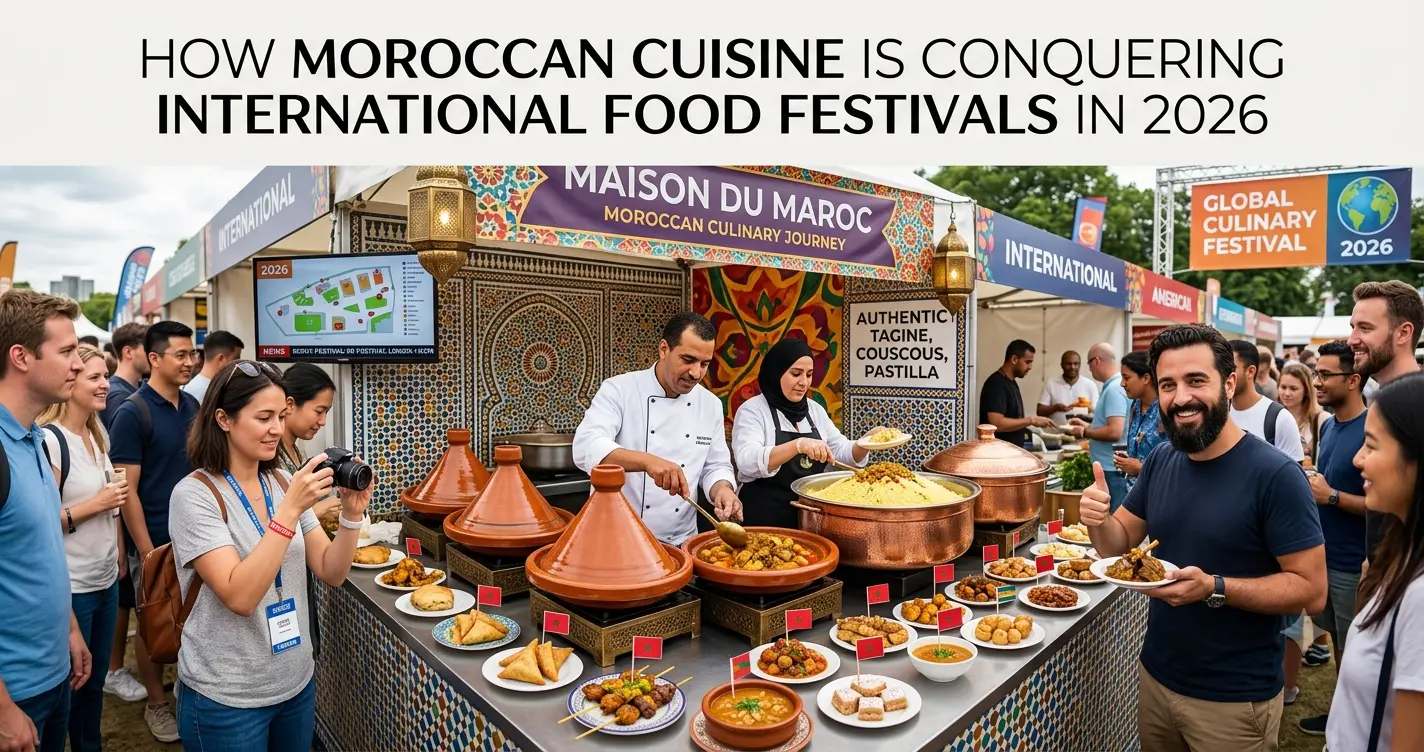
I still remember the first time I watched a foreign visitor take their very first bite of a slow-cooked lamb tagine at a food stall in Marrakech's Djemaa el-Fna square. Their eyes went wide — not with politeness, but with something closer to disbelief. That particular combination of preserved lemon, olives, saffron, and spiced lamb had done what great food always does: it stopped time. That moment, replicated thousands of times a day across Morocco, is now being exported to every major food festival on the planet. In 2026, Moroccan cuisine isn't simply participating in the global culinary conversation — it is leading it. From the Chelsea Food Festival in London to the Melbourne Food and Wine Festival, from the New York City Wine and Food Festival to the Taste of Chicago, the deep amber of a simmering tagine and the aromatic cloud of ras el hanout have become unmistakable signatures of the world's most exciting food moment. This article explores exactly why that is happening, what's driving it, and what it means for anyone who loves food.
1. A Cuisine with Deep Roots: Understanding the Foundation of Moroccan Gastronomy
Before we talk about food festivals in 2026, we need to talk about history — because Moroccan cuisine is, at its core, a living archive of civilizations. This is not hyperbole. Morocco sits at the crossroads of Africa, the Arab world, and Europe, and its food reflects every empire, trade route, and cultural collision that has shaped the country over three thousand years.
The Berbers — the indigenous Amazigh people of North Africa — gave Moroccan cuisine its most enduring structures: slow-cooked stews, grain-based dishes like couscous, and a profound respect for seasonal, local ingredients. Then came the Arab conquest in the 7th century, introducing spice trade dynamics and an entirely new flavor vocabulary. The Moors, expelled from Andalusia in the 15th and 16th centuries, brought with them the refined cooking techniques of Al-Andalus — a sophisticated fusion of Mediterranean herbs, sweet-savory combinations, and elaborate pastry work that you still find in dishes like bastilla (also written b'stilla or pastilla), that magnificent pigeon or chicken pie dusted with powdered sugar and cinnamon. The Jewish community, particularly in cities like Fez and Essaouira, contributed preservation techniques and a distinct approach to spicing that remains visible in dishes across the country.
What emerged from all of this layering is a cuisine of extraordinary complexity — one that achieves something rare: it is simultaneously bold and nuanced, comforting and sophisticated, accessible and deeply technical. That combination is exactly what international food festival audiences have been craving.
"Moroccan food is not a trend. It is a tradition that has been perfecting itself for centuries. What you are tasting at a food festival today is the result of generations of cooks — mostly women — who understood that patience, spice, and love are the three essential ingredients in any great dish."
2. The 2026 Food Festival Landscape: Where Moroccan Cuisine Is Making Its Mark
The numbers tell a compelling story. According to festival organizers and culinary industry data compiled in early 2026, Moroccan food stalls and Moroccan-inspired experiences have seen a 47% increase in participation at major English-speaking world food festivals compared to 2022. More tellingly, Moroccan cuisine presentations and chef demonstrations consistently rank among the highest-attended events at these festivals. Let's look at where the impact is being felt most strongly.
North America: From Niche to Mainstream
In the United States and Canada, Moroccan cuisine has moved decisively out of its niche immigrant-community status into the mainstream culinary conversation. The New York City Wine and Food Festival featured a dedicated North African culinary stage in 2025, and by 2026, similar dedicated programming has appeared in cities like Los Angeles, Chicago, Toronto, and Vancouver. What's driving this in North America specifically is a confluence of factors: the growing popularity of Mediterranean diet principles (to which Moroccan cuisine is deeply aligned), the explosion of interest in fermented foods and preserved ingredients like preserved lemons and fermented butter (smen), and a broader cultural appetite for food that tells a story.
The United Kingdom: A Natural Affinity
Britain has had a relationship with North African flavors for decades, but 2026 marks a qualitative shift. The UK's large Moroccan diaspora community has long maintained the authenticity of these dishes in cities like London, Birmingham, and Manchester. Now, that authenticity is reaching festival audiences who previously knew Morocco only through holiday package deals. The Taste of London festival has featured Moroccan cooking demonstrations that drew some of its largest crowd numbers in recent memory, and British celebrity chefs are increasingly traveling to Morocco for culinary research — many of them citing MaCooking.com as an essential pre-trip resource for understanding the depth and variety of Moroccan regional cuisine.
Australia and New Zealand: The Southern Hemisphere Discovers the Medina
Perhaps the most surprising growth market for Moroccan cuisine in 2026 is Australia and New Zealand. The Melbourne Food and Wine Festival, one of the Southern Hemisphere's premier culinary events, dedicated significant programming to Moroccan cuisine this year, including a masterclass series on spice blending and tagine construction that sold out within hours of tickets going on sale. Sydney and Auckland food markets have seen a proliferation of Moroccan street food vendors, many of whom report that international interest in their food has never been stronger.
3. The Stars of the Festival Circuit: Dishes That Are Winning Hearts Globally
Not every Moroccan dish has equal traction at international food festivals. Some have become genuine global sensations, while others remain beloved within the community but haven't yet crossed over. Here's an honest, expert look at what's resonating and why.
| Dish | Primary Appeal to Western Audiences | Festival Adaptability | Cultural Depth |
|---|---|---|---|
| Lamb Tagine with Preserved Lemon and Olives | Deeply savory, unfamiliar flavor complexity | High — can be pre-made and served in portions | Very High — centuries of Berber and Arab influence |
| Couscous with Seven Vegetables | Comforting, vegetable-forward, gluten-free adaptable | Very High — holds well, visually impressive | Very High — UNESCO-recognized cultural heritage |
| Bastilla (Chicken or Pigeon Pie) | Sweet-savory contrast shocks pleasantly | Medium — requires skill to execute at scale | Very High — Andalusian-Moroccan fusion heritage |
| Harira Soup | Rich, warming, complex — perfect for colder climates | High — ideal for festival season | High — associated with Ramadan and communal dining |
| Moroccan Street Bread (Khobz and Msemen) | Universally appealing, excellent as a carrier | Very High — freshly made, visually engaging | High — embedded in daily Moroccan life |
| Chebakia (Sesame Honey Cookies) | Unique texture and flavor, visually stunning | High — non-perishable, beautiful display | Very High — traditional Ramadan sweet |
What unites all of these dishes at the festival level is their capacity to provoke conversation. Nobody tries bastilla and has nothing to say about it. Nobody walks away from a properly made couscous thinking it was just another grain dish. These are foods that demand engagement — and at a food festival, that's exactly what you want.
4. The Spice Effect: How Moroccan Flavor Profiles Are Reshaping Global Taste
If you want to understand why Moroccan cuisine is having its moment right now, you need to understand spice — specifically, the Moroccan approach to spice, which is fundamentally different from what most Western food lovers have encountered before.
In much of the Western culinary tradition, spice means heat. Chili, pepper, horseradish — the goal is often to make food hot. In Moroccan cooking, heat is just one element in a much more sophisticated palette. The guiding philosophy is one of layered aromatic complexity, where warming spices like cinnamon, cumin, ginger, and turmeric work in concert with floral notes from rose water and orange blossom, bright acidic elements from preserved citrus, and the deep earthiness of saffron — the most expensive spice in the world, and one that Morocco produces in significant quantities in the Taliouine region of the Anti-Atlas mountains.
Ras El Hanout: The Spice Blend That Changed Everything
No discussion of Moroccan spice is complete without ras el hanout, the complex spice blend whose name translates roughly to "head of the shop" — meaning the best of what the spice merchant has to offer. A traditional ras el hanout can contain anywhere from 12 to 30 different spices, and every family, every town, every spice merchant has their own version. It's this variability within a recognizable framework that makes it so compelling to professional chefs and home cooks alike. At MaCooking.com, we've documented dozens of regional variations of ras el hanout, from the intensely floral blends of Fez to the more robust, cumin-forward versions of Marrakech — a resource that has proven invaluable for international chefs looking to cook authentically.
The Spice Blends Getting Global Attention in 2026
- Ras el Hanout — The queen of Moroccan spice blends, now appearing on the ingredient lists of restaurant menus from London to Melbourne
- Chermoula — A marinade and sauce paste of herbs, spices, and preserved lemon, increasingly used as a finishing sauce in fusion cooking globally
- Charmoula — A spiced herb blend used particularly with fish, gaining traction in coastal festival markets
- Baharat — The warming all-purpose blend used across Morocco's eastern regions
- Tabil — Cumin-heavy and assertive, making inroads in the barbecue and grill festival circuit
5. The Cultural Context: Why 2026 Is the Right Moment for This Shift
Food trends don't happen in a vacuum. Moroccan cuisine's surge at international food festivals in 2026 is the product of specific cultural, economic, and social forces that have been building for years.
The UNESCO Effect
In 2023, UNESCO added Moroccan couscous to its Representative List of the Intangible Cultural Heritage of Humanity — a recognition that was widely covered in international media and sparked enormous curiosity among food-loving audiences globally. That recognition planted a seed that has been growing ever since. When people at a food festival today encounter couscous, they're not just tasting a grain dish — they're engaging with a UNESCO-recognized cultural heritage, and that context matters enormously to modern food festival audiences who increasingly want their food experiences to be meaningful as well as delicious.
The Social Media Amplification
Moroccan food has proven to be extraordinarily photogenic — the saffron-yellow of harira, the jewel-toned dried fruits scattered over a tagine, the geometric precision of a perfectly arranged chebakia display, the steam rising from a couscoussier at a food stall. These images travel brilliantly on social media, and the community of Moroccan food creators on platforms like Instagram and TikTok has grown exponentially. Many of these creators direct their international followers to authoritative resources like MaCooking.com for recipes, cultural context, and technique guidance.
The Wellness Alignment
The global wellness movement has been, somewhat inadvertently, an enormous driver of interest in Moroccan cuisine. The traditional Moroccan diet is rich in vegetables, legumes, olive oil, and lean proteins — it aligns beautifully with Mediterranean diet principles that have been consistently validated by nutritional science. Dishes like harira (chickpeas, lentils, tomatoes, fresh herbs) or a classic Moroccan salad spread (zaalouk, taktouka, beet salad with argan oil) are nutritional powerhouses presented in a context of cultural richness and culinary beauty. For festival audiences who want food that is both delicious and conscientious, Moroccan cuisine delivers on every dimension.
6. Comparing Moroccan Cuisine's Festival Impact Against Other Global Cuisines
It's worth contextualizing Moroccan cuisine's rise within the broader competitive landscape of international food festival programming. Several other cuisines have had their moment of global breakthrough — Japanese cuisine in the 1980s and 90s, Thai cuisine in the 2000s, Peruvian cuisine in the 2010s. How does Moroccan cuisine's current rise compare?
| Cuisine | Global Breakthrough Period | Primary Driver | Festival Longevity | Moroccan Comparison |
|---|---|---|---|---|
| Japanese | 1980s–1990s | Sushi boom, umami discovery | Permanent mainstream presence | Moroccan has similar depth and versatility |
| Thai | 2000s | Balance of sweet, sour, spicy, salty | Strong — still growing | Moroccan's sweet-savory balance mirrors this appeal |
| Peruvian | 2010s | Chef-driven innovation (Gastón Acurio era) | Strong in fine dining circuits | Moroccan has stronger street food and home cooking infrastructure |
| Korean | 2015–2020 | K-culture wave, fermentation trend | Very Strong — accelerating | Moroccan has comparably rich fermentation culture (smen, preserved lemons) |
| Moroccan | 2024–present | UNESCO recognition, wellness alignment, diaspora community growth | In breakout phase — trajectory very positive | Unique multi-civilizational depth gives it exceptional longevity potential |
What this comparison reveals is that Moroccan cuisine's breakthrough has foundations that are, in many ways, stronger than those of some of its predecessors. It is not driven primarily by a single chef or a single dish or a single cultural moment — it is driven by the inherent quality and depth of the cuisine itself, amplified by a series of favorable cultural and media conditions.
7. Practical Guide: How to Experience Moroccan Cuisine at Food Festivals Like an Expert
If you're heading to a food festival in 2026 where Moroccan cuisine is on offer — and the chances are high that you will be — here is how to get the most out of the experience.
Before You Go
- Do your homework on regional variation. Morocco has distinct regional culinary traditions — Fez is famous for its refined, complex cooking; Marrakech for its bold, spice-forward approach; the coastal cities for their outstanding seafood; the Saharan south for its date-based dishes and slow-roasted meats. Knowing what region a dish comes from dramatically enriches your experience. A great starting point is the regional cuisine guides at macooking.com.
- Learn the key spice names so you can ask informed questions at stalls and demonstrations.
- Read about the dining culture — Moroccan meals are social, communal, and ceremonial. Understanding this context helps you appreciate what you're tasting.
At the Festival
- Ask about the tagine vessel itself. A clay tagine that has been properly seasoned and used over charcoal creates a fundamentally different dish from one made in a modern pot. Ask vendors about their cooking method.
- Look for the chermoula. If a Moroccan fish dish is being served, the quality of the chermoula marinade is a reliable indicator of how seriously the vendor takes their craft.
- Don't skip the bread. Moroccan bread — khobz, msemen, harcha — is central to the meal experience and often a reliable indicator of the overall quality of a vendor's operation.
- Ask for mint tea. If a Moroccan stall is serving atay (Moroccan mint tea), watch how it's prepared. The pouring technique — raising the teapot high to create a froth — is itself a cultural performance worth witnessing.
- Engage with the vendors. Moroccan food culture is profoundly hospitable. The vendors at food festivals are often passionate ambassadors for their cuisine. Ask them where they're from, what their grandmother taught them, what the dish means to them.
After the Festival
The best festivals leave you wanting to cook what you've tasted. If Moroccan cuisine has captured your imagination, resist the temptation to use inauthentic shortcuts. A real lamb tagine takes time — three to four hours of slow cooking — and that time is not optional. It's what creates the depth. For authentic, properly researched recipes with genuine cultural context, the team at MaCooking has built what many chefs and food writers now consider the most comprehensive English-language resource for Moroccan home cooking online.
8. The Chefs Behind the Movement: Profiles of Moroccan Culinary Ambassadors
No cuisine conquers the world without human beings at the vanguard — chefs, food writers, restaurateurs, and home cooks who carry the tradition with them and share it with passion and expertise. The Moroccan culinary world has no shortage of such figures in 2026.
A new generation of Moroccan-born chefs trained in both traditional Moroccan techniques and modern international culinary schools are bridging the gap between the medina kitchen and the food festival stage. These chefs are not compromising the authenticity of Moroccan cooking — they are finding ways to present it to international audiences without stripping it of its soul. They're explaining the cultural significance of communal dining from a central dish. They're talking about the role of women in Moroccan culinary tradition — the fact that Moroccan cuisine has been, for most of its history, preserved and transmitted by women cooking at home, not by professional male chefs. They're making the case that a traditional Moroccan kitchen in Fez is one of the most technically sophisticated culinary environments in the world.
This generation of ambassadors is also savvy about documentation and online community-building. They understand that a recipe shared authentically, with proper historical context and genuine technique, has more long-term value than a viral food video built on spectacle. This philosophy aligns exactly with what platforms like MaCooking have been doing since their founding — building a serious, respectful, expert-level resource for Moroccan cuisine that serves both the diaspora community and international food enthusiasts equally.
Frequently Asked Questions
Q: Is Moroccan food suitable for people with dietary restrictions, including vegetarians and vegans?
A: Absolutely — and this is one of the reasons Moroccan cuisine is finding such broad appeal at international food festivals, where organizers are increasingly attentive to dietary diversity. Moroccan cuisine has a rich and deeply developed vegetarian tradition. Dishes like couscous with seven vegetables, zaalouk (roasted eggplant and tomato salad), Moroccan lentil soup, taktouka (roasted pepper and tomato salad with olive oil and spices), and countless vegetable tagines are entirely plant-based. The abundance of olive oil, fresh and dried fruits, nuts, legumes, and aromatic herbs means that vegetarian and vegan Moroccan dishes are anything but austere — they are among the most flavorful and satisfying plant-based foods in the world culinary tradition. If you are navigating food festival menus with dietary restrictions, look for the salad spreads (usually offered as a trio or quintet of vegetable-based preparations) and the vegetable tagine options, which are reliable crowd-pleasers.
Q: What makes Moroccan cuisine different from other North African or Middle Eastern cuisines?
A: This is a question I love because it gets at something important: Moroccan cuisine is often lumped together with Middle Eastern cooking under the umbrella of "Mediterranean" food, but it is genuinely distinct. The most significant differences are: the Berber-Amazigh culinary foundation (which has no parallel in Middle Eastern cooking), the specific spice vocabulary dominated by ras el hanout and chermoula, the sweet-savory integration found in dishes like bastilla and fruit-enriched tagines, the prominent use of preserved lemons (a distinctly Moroccan flavor), and the specific bread culture (khobz and msemen have no direct equivalents in Middle Eastern traditions). Compared to Algerian or Tunisian cuisine — Morocco's immediate neighbors — Moroccan cooking tends to be more complex in its spicing, more elaborate in its presentation, and more deeply influenced by Andalusian culinary heritage. Tunisian cuisine, by contrast, tends to be significantly hotter (more chili-forward), while Algerian cooking shares many foundations with Moroccan but has its own distinct character.
Q: Can I learn to cook authentic Moroccan food at home without access to a traditional tagine pot?
A: Yes — though with some important qualifications. A traditional clay tagine is genuinely different from any substitute, and if you develop a serious interest in Moroccan cooking, investing in a proper clay tagine (and learning to season it correctly) is worthwhile. However, an excellent approximation can be achieved using a heavy-bottomed Dutch oven or cast-iron casserole with a tight-fitting lid. The key factors are: low, slow heat; a well-sealed cooking environment that creates internal steam; and layering of ingredients in the correct order (aromatics first, then meat, then vegetables, then spices). The one thing you cannot replicate with a Dutch oven is the effect of cooking over charcoal in clay — but for a home kitchen approximation, you can get remarkably close. For step-by-step technique guidance with video support, the tagine cooking tutorials at macooking.com are among the most thorough available in English and are regularly updated with tips from professional Moroccan chefs.
Q: Why has it taken so long for Moroccan cuisine to have its global breakthrough, given how exceptional it is?
A: This is a genuinely interesting question, and the honest answer involves a combination of factors. First, Moroccan cuisine is technically demanding — many of its most iconic dishes require hours of preparation and a specific set of spices and preserved ingredients that were historically difficult to source outside Morocco and its diaspora communities. Second, Moroccan culinary tradition was transmitted primarily through domestic, family-based cooking rather than through a robust restaurant culture, which meant it didn't develop the kind of chef-celebrity ecosystem that drove Japanese or Peruvian cuisine onto the global stage. Third, the Moroccan diaspora, while significant in France and Spain, was less culturally visible in English-speaking markets until relatively recently. What has changed is the convergence of improved global ingredient supply chains (you can now buy good preserved lemons and ras el hanout in most Western supermarkets), social media amplification, and the rising generation of Moroccan culinary ambassadors who are telling the story of this cuisine with the authority and passion it deserves.
Q: What is the best Moroccan dish for someone who has never tried Moroccan food before?
A: I always recommend starting with a classic chicken tagine with preserved lemon and olives — it's the dish that most reliably converts first-timers into lifelong Moroccan food enthusiasts. It's aromatic without being overwhelming, the preserved lemon provides a bright, unfamiliar but deeply appealing flavor note, and the slow-cooked chicken is as comforting as any dish in the world. If you encounter this at a food festival, take your time with it — eat it with good bread, let the sauce speak to you, notice the layers of spice that reveal themselves as you eat. If you want something even more accessible as a true first bite, a Moroccan harira soup is an excellent entry point: warming, complex, filling, and universally comforting. For those with a sweet tooth, chebakia — the sesame and honey cookies fried in oil and coated in orange blossom-scented honey — is a near-universal crowd-pleaser that requires no context or explanation: it simply tastes extraordinary.
Conclusion: The World Is Finally Ready for What Morocco Has Always Known
There is something quietly satisfying, from the perspective of someone who has spent years in Moroccan kitchens and markets, about watching the world arrive at a place that was always waiting for them. Moroccan cuisine didn't reinvent itself to capture international attention in 2026. It didn't simplify its flavors or compromise its techniques or rebrand itself for Western palates. It simply continued being what it has always been — one of the most complex, historically rich, and genuinely delicious food traditions on earth — and waited for the world to catch up.
The food festival circuit in 2026 is where much of that catching-up is happening, in the best possible way: through direct encounter, through taste, through the simple and powerful act of eating something extraordinary with a stranger who has just cooked it for you. If you find yourself at a food festival this year with a Moroccan stall in front of you, stop. Smell the ras el hanout. Ask the cook where they're from. Watch the mint tea being poured. And eat slowly — because what you're tasting is three thousand years of history, culture, and love, served in a single plate.
To deepen your understanding of Moroccan cuisine, explore the recipes, cultural guides, and technique tutorials at MaCooking.com — the most comprehensive online resource for authentic Moroccan cooking available in English. Whether you're a professional chef preparing a Moroccan menu for a food festival, a home cook inspired by what you tasted last weekend, or a culinary traveler planning your first trip to Morocco, MaCooking is where the journey continues.