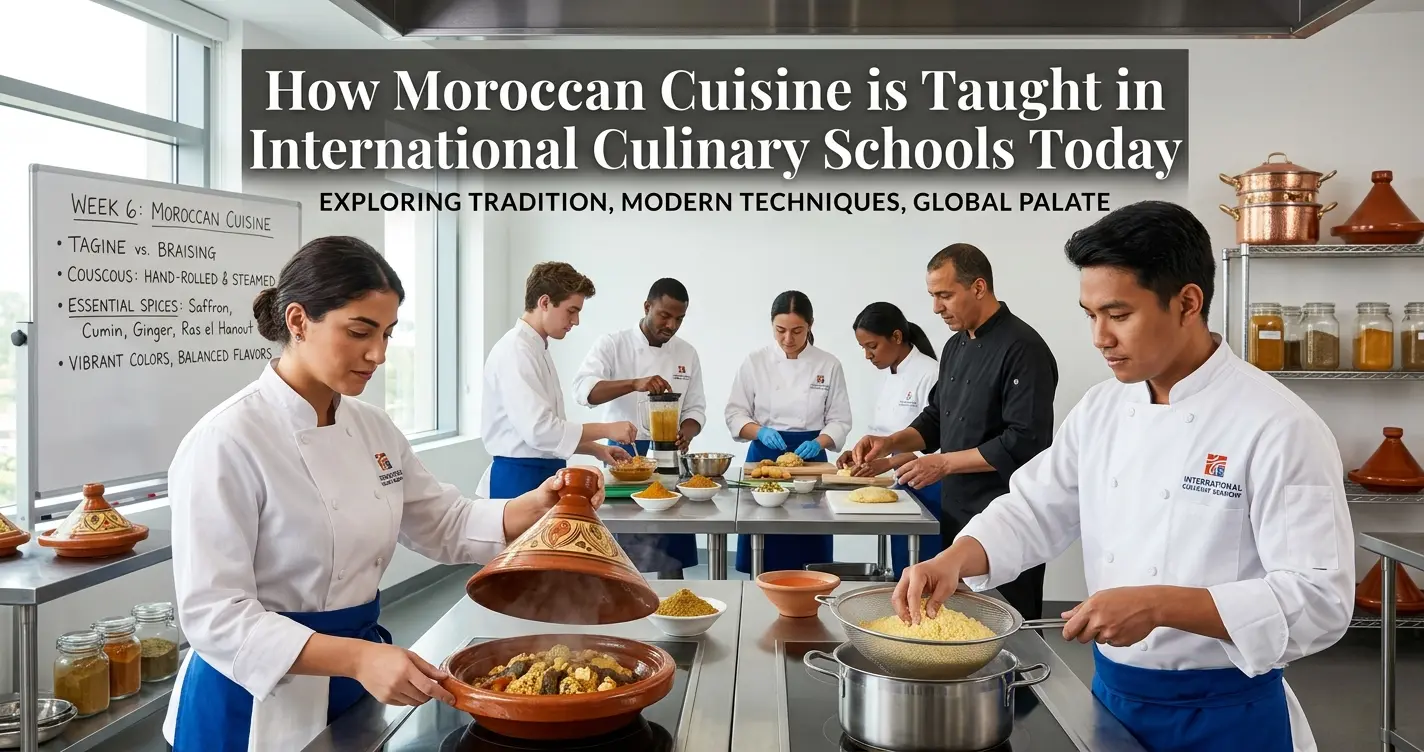
There is a moment — and every serious culinary student who has encountered Moroccan food knows it — when the lid lifts off a slow-braised tagine and the steam rises carrying cumin, saffron, preserved lemon, and a whisper of cinnamon all at once, and something shifts permanently inside your understanding of what food can be. That moment is no longer reserved for travelers wandering through the souks of Marrakech or Fez. It is happening in professional kitchens in Paris, New York, London, Sydney, and Toronto, as international culinary schools increasingly recognize that Moroccan cuisine is not a regional curiosity but one of the world's most sophisticated, historically layered, and technically demanding culinary traditions. This article explores how that recognition is being translated into formal education — the curricula being built, the techniques being prioritized, the cultural debates being navigated, and what aspiring cooks and seasoned chefs alike can expect when they step into a classroom dedicated to the flavors of Morocco.
1. The Long Road to the Curriculum: Why Moroccan Cuisine Arrived Late to Western Culinary Schools
To understand why Moroccan cuisine is finally getting serious attention in international culinary institutions, you first have to understand why it took so long. For most of the twentieth century, the canon of professional culinary education in the West was almost entirely dominated by French classical technique — Escoffier's brigade system, the five mother sauces, the geometry of classical brunoise and julienne. Other traditions existed at the margins of the curriculum as exotic novelties: a week on "Asian" cuisine, a demonstration of sushi, perhaps a nod toward Indian spicing. North African food barely registered.
This was not a reflection of culinary merit. Anyone who has spent time eating their way through a traditional Moroccan home kitchen — watching a grandmother roll couscous by hand, feeling the weight of a clay tagine that has absorbed forty years of flavor into its porous walls, or sitting at a table where a single meal features sixteen distinct preparations — understands immediately that this is a cuisine of extraordinary depth and refinement. The problem was institutional bias, the lingering effects of colonial narratives that categorized African and Middle Eastern cuisines as rustic rather than technically sophisticated, and a simple lack of knowledgeable instructors.
What changed? Several things converged. The explosive global growth of food media and travel — particularly social media platforms where Moroccan food photographs with breathtaking beauty — created enormous consumer demand. The rise of the farm-to-table and Mediterranean diet movements aligned perfectly with Moroccan cooking's emphasis on vegetables, legumes, olive oil, and spices over heavy cream and butter. And critically, a generation of Moroccan-born chefs trained in European kitchens began moving into positions of influence — consulting for culinary schools, publishing authoritative cookbooks, and appearing at international food festivals. Platforms like MaCooking emerged to serve as authoritative digital bridges between authentic Moroccan culinary knowledge and an enthusiastic global audience hungry to learn properly, not through approximation.
The UNESCO Moment and What It Meant for Culinary Education
While Moroccan cuisine as a whole has not yet received UNESCO Intangible Cultural Heritage status in the way that French gastronomy or Mediterranean diet have, the conversation around preserving and transmitting Moroccan culinary traditions has intensified dramatically in academic and culinary circles. Several Moroccan culinary schools, most notably the Institut Supérieur International de Tourisme de Tanger and various private academies in Casablanca, have been working with international partners to document and standardize the transmission of techniques that have historically been passed down entirely through oral and visual apprenticeship within families.
This documentation work has had a direct impact on international curricula. When culinary schools in London or Chicago want to design a serious module on Moroccan cuisine, they now have access to properly codified recipes, technique descriptions, and cultural context in a way that simply did not exist twenty years ago. The work of food anthropologists, chefs, and digital platforms dedicated to the subject has built an educational infrastructure that makes serious teaching possible.
2. What International Culinary Schools Are Actually Teaching: The Core Curriculum
Walk into a Moroccan cuisine module at a leading culinary school today, and you will find a curriculum that has evolved far beyond the single tagine demonstration that passed for "North African cooking" a decade ago. The best programs now structure their Moroccan content across multiple sessions, treating it with the same rigor applied to French or Japanese cuisines. Let us break down what is actually being taught.
The Spice Foundation: Beyond Ras El Hanout
Every serious Moroccan cuisine module begins with spices, and it begins there not as a novelty but because understanding Moroccan spice logic is genuinely prerequisite to understanding anything else. Instructors at schools like Le Cordon Bleu's London campus, the Institute of Culinary Education in New York, and William Angliss Institute in Melbourne have all moved toward dedicated spice sessions that cover:
- The individual spices and their origins: Students learn to identify cumin, coriander, turmeric, paprika, saffron, ginger, cinnamon, cayenne, white pepper, and black pepper not just by sight but by smell and, critically, by the stage of cooking at which each is most effectively deployed.
- The logic of Moroccan flavor pairing: The signature sweet-savory-warm combination — lamb with prunes and cinnamon, chicken with preserved lemon and olives, fish with chermoula — is not arbitrary. Students explore the historical trade routes that brought these flavor combinations to Morocco and the culinary logic that made them permanent.
- Ras el hanout composition: This is the signature Moroccan spice blend, and it is one of the most complex in world cooking — legitimate versions can contain between twelve and forty individual spices. Students in advanced programs learn to blend their own rather than simply measuring a pre-made mixture, which develops a qualitatively different understanding of balance and proportion.
- Chermoula: This marinade and sauce — typically combining fresh cilantro, parsley, garlic, cumin, paprika, preserved lemon, and olive oil — is taught as a foundational Moroccan flavor base analogous to the role of a good sofrito in Mediterranean European cooking.
The Tagine: Technique, Not Just Recipe
The tagine is so iconic that it is sometimes trivialized — reduced to "Moroccan stew in a funny-shaped pot." The best culinary programs actively fight this reductionism by teaching tagine as a precise slow-cooking technique with specific thermal and moisture dynamics. Key technical elements covered include:
- The physics of the conical lid and how it creates a self-basting condensation cycle
- The distinction between tagines cooked over direct low flame on a diffuser versus those finished in an oven
- The layering principle — how ingredients are arranged in the tagine matters, with aromatics at the base, proteins in the middle, and vegetables and preserved elements on top
- The role of fat — typically argan oil, olive oil, or clarified butter (smen) — in the initial browning and flavor development
- The difference between meat tagines (which require longer, lower cooking) and vegetable tagines (which demand timing precision to avoid overcooking)
- Regional variations: the Fez school of tagine (richer, more complex spicing) versus the Marrakech approach (bolder, more pungent) versus coastal preparations incorporating fish and seafood
Couscous: The Most Technically Demanding Lesson
If there is one technical lesson that consistently humbles culinary students — including experienced ones — it is the traditional hand-rolled, steam-cooked couscous. The dish seems simple from the outside: small semolina granules, a broth, some vegetables and meat. In reality, producing properly made couscous is an exercise in patience, technique, and sensory awareness that takes skilled Moroccan cooks years to master.
International culinary schools that teach couscous seriously cover the following:
- The rolling technique: Using the palms in a specific circular motion to roll raw semolina with water and a small amount of oil until individual granules form — this is hand knowledge, not something you can learn from reading.
- The three-steam method: Traditionally, couscous is steamed three times in a couscoussier, dried and raked between each steaming, with the final steam creating the light, separate, non-clumping texture that defines the dish. This is categorically different from the "boil water, add couscous, wait five minutes" method found on packet instructions.
- The broth relationship: The vegetables and proteins are cooked in a spiced broth below while the couscous steams above, absorbing the rising vapor. Students learn to manage both simultaneously.
- The seven-vegetable couscous: The traditional Friday couscous with seven vegetables (typically turnip, carrot, zucchini, pumpkin, cabbage, chickpeas, and onion) is often the set-piece dish that students produce for assessment.
3. How Different Schools Approach the Curriculum: A Comparative View
Not all international culinary schools approach Moroccan cuisine in the same way. There is significant variation in depth, framing, and methodology. The following table provides a comparative overview of how different types of institutions typically structure their Moroccan culinary content.
| Institution Type | Depth of Moroccan Content | Primary Focus | Cultural Context Included | Typical Duration |
|---|---|---|---|---|
| Elite Professional Schools (Le Cordon Bleu, CIA) | High — dedicated module | Technique, regional variation, spice science | Extensive historical and cultural framing | 2–4 weeks |
| Mid-tier Culinary Colleges | Medium — part of World Cuisines module | Signature dishes, basic technique | Moderate — brief historical overview | 3–5 days |
| Hospitality and Tourism Schools | Medium — menu and service focused | Dishes suitable for restaurant menus | Limited — emphasis on commercial application | 1–2 weeks |
| Community and Vocational Cooking Schools | Low to Medium — introductory | Two or three signature recipes | Minimal | 1–3 sessions |
| Online Culinary Platforms (e.g., MaCooking) | Very High — comprehensive and specialized | Authentic technique, cultural depth, regional diversity | Deep and continuous | Self-paced, ongoing |
What this table illustrates is something that practitioners in the field have long understood: the most comprehensive Moroccan culinary education available to a Western student is increasingly not found in a traditional classroom at all. Dedicated platforms like MaCooking offer a depth of content — from regional couscous variations to the specifics of Moroccan bread-baking and pastry traditions — that even the best professional culinary school simply cannot replicate within the constraints of a semester-based curriculum.
4. The Cultural Dimension: Why Context Is Not Optional
One of the most significant shifts in how Moroccan cuisine is taught internationally is the growing recognition that technical instruction without cultural context produces competent technicians but not genuine cooks. This is a debate that applies to all world cuisines taught outside their country of origin, but it is particularly acute with Moroccan food because the cuisine is so deeply embedded in social ritual, religious observance, seasonal rhythm, and family structure.
"You cannot understand Moroccan food if you do not understand that in Morocco, cooking is an act of love expressed through time. When a Moroccan woman says she spent the day cooking, she means it literally — hours of preparation, of rolling and steaming and seasoning and adjusting, all for a meal that will be eaten in twenty minutes but remembered for a lifetime. That relationship with time is in the food itself. Students who rush Moroccan cooking always produce food that tastes rushed."
The best culinary school programs now build cultural context directly into their technical instruction. This manifests in several ways:
The Calendar of Moroccan Cooking
Moroccan cuisine is profoundly seasonal and ceremonial. Students learn that certain dishes exist in specific temporal contexts:
- Ramadan cuisine: The harira soup that breaks the fast every evening during Ramadan is one of Morocco's most important dishes. Students learn not just the recipe but the social role of the dish — why it contains both lemon and tomato, why it is thickened with flour or beaten egg, why it is always accompanied by dates, shebbakia (honey pastries), and hard-boiled eggs.
- Eid al-Adha preparations: The mechanics of the whole-roasted lamb (mechoui), the offal preparations (kofte, liver with cumin and salt), and the specific spice preparations associated with the festival.
- Wedding cuisine: The elaborate multi-course structure of a traditional Moroccan wedding feast — typically beginning with bastilla, moving through tagines, arriving at a whole roasted animal, and concluding with couscous — teaches students about Moroccan ideas of hospitality, abundance, and the social meaning of food.
- The Friday couscous: Understanding that couscous is traditionally a Friday dish in Morocco, connected to communal prayer and family gathering, changes how a student approaches making it. It is not just a recipe — it is a social institution.
The Role of Hospitality: Moroccan Tea and the Meal Structure
Every serious Moroccan cuisine module now includes instruction on Moroccan mint tea — not because tea-making is technically complex, but because understanding the ritual of Moroccan hospitality is essential to understanding the context in which Moroccan food is served and received. The "three glasses" tradition (the first is bitter as life, the second is strong as love, the third is sweet as death, as the Moroccan saying goes), the theater of pouring from height to create foam, the communal nature of the tea ceremony — all of this shapes how food functions in Moroccan culture and why that culture has produced a cuisine so oriented toward generosity, abundance, and long, unhurried meals.
5. The Ingredients Challenge: Sourcing and Substitution in International Classrooms
Any culinary instructor who has tried to teach Moroccan cuisine seriously in a classroom in Manchester, Minneapolis, or Melbourne has confronted the same fundamental challenge: some of the most essential Moroccan ingredients are genuinely difficult to source at the quality and freshness that the cuisine demands. This practical reality has shaped how the curriculum is taught in ways that are worth examining closely.
The Preserved Lemon Problem
Preserved lemons — lemon quarters packed in salt and left to ferment for a minimum of four weeks — are so foundational to Moroccan cooking that teaching the cuisine without them is a bit like teaching Italian cooking without good olive oil. The challenge is that preserved lemons require planning, and many culinary school programs are not structured for the four-week lead time required to make them from scratch.
The solution adopted by most serious programs is a two-track approach: students learn to make preserved lemons properly in the first session of the module (so they can observe the completed product later) while simultaneously working with commercially produced preserved lemons for their cooking exercises. Instructors emphasize the importance of rinsing preserved lemons before use, using only the rind (not the pulp) for most applications, and understanding that the unique flavor — simultaneously salty, citrusy, funky, and bright — cannot be replicated by simply salting fresh lemon juice.
Argan Oil: The Liquid Gold Question
High-quality culinary argan oil — distinct from the cosmetic argan oil that dominates the market in Western countries — is expensive, perishable, and genuinely difficult to find in authentic form outside of Morocco. Some culinary programs simply substitute good olive oil, which is defensible for most cooking applications but loses the distinctive nutty depth that argan oil brings to a finished dish. More progressive programs make the effort to source genuine culinary argan oil and use it specifically for finishing dishes, teaching students to recognize its flavor and understand why it is worth seeking out.
Smen: The Fermented Butter Nobody Wants to Talk About
Smen — a salted, fermented clarified butter that can be aged for years and develops an intensely pungent, complex flavor — is one of those ingredients that separates genuinely knowledgeable Moroccan cooks from those who have learned the cuisine at a surface level. Many culinary instructors avoid teaching with smen because its funky, sharp character initially alarms students unfamiliar with it. The best programs introduce it strategically, typically in the context of couscous (where a small amount stirred through at the end is traditional), helping students understand it as analogous to a well-aged cheese — not something you eat by the spoonful but something that, used correctly, adds extraordinary depth.
The following table compares key Moroccan ingredients, their traditional role, and how international culinary schools typically handle the sourcing challenge:
| Ingredient | Traditional Role in Moroccan Cuisine | Sourcing Difficulty (International) | Common Classroom Approach | Acceptable Substitute (if any) |
|---|---|---|---|---|
| Preserved Lemons | Foundational flavoring in tagines, salads, sauces | Medium — commercial versions available | Teach from scratch + use commercial for exercises | None — flavor is unique |
| Culinary Argan Oil | Finishing oil, dipping with amlou, couscous | High — cosmetic versions dominate market | Source specialty; use olive oil as backup | High-quality olive oil (partial) |
| Smen (Fermented Butter) | Couscous finishing, flavor depth in tagines | Very High — rarely available commercially | Teach concept; use quality ghee as substitute | Aged ghee (approximate) |
| Ras El Hanout | Universal complex spice blend | Low — widely available, quality varies | Teach custom blending; use quality commercial | Custom blend (is the substitute) |
| Medjool Dates | Desserts, tagine pairings, hospitality | Low — widely available | Standard sourcing | Deglet Noor (lesser quality) |
| Semolina (fine and coarse) | Couscous, bread, pastry | Low — widely available | Standard sourcing | None recommended for couscous |
| Saffron (Moroccan) | Coloring and flavoring tagines, bastilla | Medium — Moroccan-origin preferred | Emphasize quality; teach blooming technique | No direct substitute for flavor |
6. The Signature Dishes of the International Curriculum: What Students Actually Cook
Theory and cultural context matter enormously, but culinary education ultimately lives and dies on what students actually cook. Based on information gathered from culinary school syllabi, instructor interviews, and the community of Moroccan food professionals, the following dishes consistently appear as core practical exercises in international Moroccan cuisine modules.
Chicken Tagine with Preserved Lemon and Olives
This is almost universally the entry-point dish for Moroccan cuisine instruction, and for good reason. It introduces the tagine technique, the preserved lemon, the logic of slow low-heat cooking, and the beautiful interplay of salty-sour-savory flavors that defines so much Moroccan cooking. It is also forgiving enough that students can succeed on a first attempt while still offering plenty of nuance for refinement. Students learn the specific technique of marinating the chicken in chermoula overnight, the layering approach when building the tagine, and the precise moment to add the olives (late in cooking, to preserve their texture and prevent bitterness from overexposure to heat).
Lamb Tagine with Prunes and Almonds
This is the dish that most forcefully introduces students to the sweet-savory dimension of Moroccan cooking — a combination that many Western students initially find counterintuitive but almost universally love once they taste it properly executed. The prunes are added late and barely cooked; the almonds are fried separately in oil until golden and added at the very end as a textural element; the sauce is reduced to a glossy, honeyed consistency that coats the slow-braised lamb. Students who succeed with this dish have genuinely understood something fundamental about Moroccan flavor philosophy.
Bastilla (Pastilla)
Bastilla is the dish that most dramatically demonstrates the historical complexity of Moroccan cuisine — and it is typically reserved for more advanced instruction. A traditional bastilla combines pigeon or chicken with eggs, onions, saffron, and cinnamon in a filling encased in warqa pastry (a paper-thin, labor-intensive handmade dough) and dusted with powdered sugar and cinnamon. The simultaneous presence of savory meat, egg, warm spice, and powdered sugar on a single plate tells the story of Moorish Andalusian cooking brought to Morocco after the fall of Granada in 1492 — a history lesson encoded in flavor. Teaching bastilla requires instructors to address the warqa problem: true warqa is extremely difficult to make and nearly impossible to source outside of Morocco, so most programs use phyllo dough as a technically accessible substitute while being explicit about the compromise.
Harira Soup
Harira — the hearty, tomato and lemon-based soup enriched with chickpeas, lentils, broken vermicelli, and fresh herbs — is one of the most soul-satisfying dishes in the entire Moroccan repertoire. In culinary school contexts, it serves as an excellent vehicle for teaching the technique of "taddoukt" (the Moroccan culinary term for thickening a soup with beaten egg or flour stirred in at the end of cooking to create a velvety consistency) and the management of acid balance in a complex multi-ingredient soup.
Moroccan Salad Spread
The Moroccan approach to salads — a series of small, intensely flavored cooked and raw preparations served simultaneously as a first course — is one of the most elegant expressions of the cuisine's hospitality culture. Students typically learn to prepare four to six individual salads: zaalouk (smoky eggplant and tomato), taktouka (roasted pepper and tomato), carrot salad with cumin and orange blossom water, and a fresh tomato-cucumber salad with preserved lemon dressing. The lesson here is not just technical but philosophical — Moroccan cuisine is inherently generous, and the salad spread embodies that generosity.
7. The Rise of Online Learning and What It Means for Moroccan Culinary Education
Perhaps the most significant development in how Moroccan cuisine is transmitted internationally is not happening in culinary school classrooms at all. It is happening online. The democratization of culinary education through digital platforms has been transformative for world cuisines in general, but it has been particularly significant for Moroccan cuisine, which — as we have established — was underrepresented in formal Western culinary institutions for most of the twentieth century.
Dedicated platforms like MaCooking have emerged as essential resources not just for home cooks but for culinary professionals and students who recognize that the depth of content available through specialized digital platforms often exceeds what generalist culinary schools can offer. This is not a criticism of culinary schools — it is simply a reflection of the economics of curriculum design. A culinary school must balance Moroccan content against Japanese, Italian, French, and dozens of other cuisines within a fixed semester. A platform dedicated entirely to Moroccan cuisine can go as deep as the subject demands.
What serious culinary students are increasingly doing is using formal culinary school instruction to build foundational technique and then turning to specialized resources for depth. A student might learn knife skills, sauce-making, and kitchen management at culinary school, then spend weeks working through the regional variations of couscous, the full taxonomy of Moroccan salads, or the pastry traditions of Fez using content from MaCooking.com — which represents exactly the kind of authoritative, culturally grounded digital resource that modern culinary education increasingly depends upon.
What to Look for in Quality Moroccan Online Culinary Content
Not all online culinary content is equal, and Moroccan cuisine suffers particularly from the proliferation of simplified, inauthentic recipes that sacrifice technique and cultural accuracy for ease and clicks. Serious learners should evaluate online Moroccan culinary content by asking:
- Does the content specify regional origin? Moroccan cuisine is not monolithic — a tagine from Fez is genuinely different from one from Agadir or Oujda.
- Does it teach technique or just list ingredients? Understanding why you do something is more valuable than memorizing what to do.
- Does it acknowledge traditional methods while offering practical adaptations? The best instructors explain the traditional approach and then address how to approximate it with accessible equipment and ingredients.
- Is cultural context integrated into the cooking instruction? Or is it treated as an optional add-on?
- Is the content created by people with genuine Moroccan culinary knowledge? This matters enormously.
8. The Future: Where Moroccan Culinary Education Is Headed
The trajectory is clear and accelerating. Moroccan cuisine is moving from the margins of international culinary education toward a central position in the conversation about world gastronomy. Several trends are shaping where this education is headed in the next decade.
Formal Accreditation and Moroccan Culinary Certifications
There is growing momentum toward formal international certification in Moroccan cuisine — analogous to the various levels of certification that exist for French culinary arts or Japanese sushi training. Several Moroccan culinary academies are in discussion with international culinary bodies about creating recognized qualification frameworks that would allow chefs to demonstrate verifiable expertise in Moroccan cuisine. This would be a significant development, providing a formal credential structure that does not currently exist.
Exchange Programs and Moroccan Immersion
A number of culinary schools have begun offering short-term immersion programs in Morocco — typically two to three weeks based in either Fez or Marrakech — as part of their world cuisines curriculum. These programs, which combine market visits, home kitchen learning with local Moroccan cooks, and sessions at Moroccan culinary academies, represent the most effective way to transmit Moroccan culinary knowledge in a relatively short timeframe. The embodied experience of shopping in a Moroccan spice market, watching a traditional couscous prepared in a home kitchen, and eating in the context for which the food was designed is irreplaceable by any classroom or digital instruction.
The Sustainability Angle
As culinary education increasingly emphasizes sustainability, plant-forward cooking, and reduced meat consumption, Moroccan cuisine is positioned extraordinarily well. The traditional Moroccan diet — heavy on vegetables, legumes, grains, olive oil, and herbs, with meat as a seasoning or occasional centerpiece rather than a default — aligns perfectly with contemporary sustainability values. Culinary instructors are increasingly pointing to Moroccan cuisine as a model for how traditional food cultures can be both deeply pleasurable and environmentally thoughtful.
Frequently Asked Questions
Q1: Do I need to attend a culinary school to learn authentic Moroccan cooking, or can I learn it properly at home?
Genuine expertise in Moroccan cuisine has always been primarily transmitted through home kitchens rather than formal institutions — this is a cuisine that was taught grandmother to granddaughter, mother to daughter, through thousands of hours of observation and hands-on practice in family kitchens. Formal culinary school can provide useful structure and professional context, but it is absolutely not a prerequisite for developing serious Moroccan cooking skills. What you do need is access to high-quality, culturally authentic instruction — whether that comes from a skilled family member, a formal program, or a dedicated resource like MaCooking. The key is learning from sources that prioritize authenticity over simplification.
Q2: What is the single most important technique a beginner should master in Moroccan cooking?
Without question: spice management. Moroccan cuisine is built on the intelligent layering of spices through the cooking process — knowing which spices to bloom in oil at the beginning, which to add mid-cook in liquid, and which to use as a fresh finishing note. Once you understand the logic of Moroccan spice progression, every dish becomes more accessible. Practically, this means starting by learning to work with cumin, coriander, paprika, cinnamon, and ginger as a foundational cluster, understanding how each behaves at different cooking temperatures, and developing the confidence to adjust quantities by smell and taste rather than by rigid measurement.
Q3: How long does it realistically take to become competent in Moroccan cuisine?
Honest answer: it depends enormously on what "competent" means. You can learn to produce a genuinely delicious chicken tagine with preserved lemon and olives in a single afternoon of focused practice. You can learn the basic couscous technique in a weekend. To develop real breadth — to be comfortable moving across the full repertoire of tagines, salads, soups, pastries, and breads — typically takes between six months and a year of regular cooking. To develop the intuitive, sensory-based mastery that characterizes experienced Moroccan cooks — the ability to assess a dish by smell alone, to adjust seasoning with absolute confidence — takes years. This is not discouraging; it is simply the nature of any deep culinary tradition.
Q4: Are international culinary schools teaching Moroccan cuisine authentically, or are they simplifying it for Western palates?
Both things are happening simultaneously, and the quality varies significantly between institutions. The best programs — particularly those with Moroccan-born instructors or strong partnerships with Moroccan culinary institutions — teach with genuine authenticity and resist the temptation to simplify. Less rigorous programs do sometimes adjust flavors toward Western comfort zones (reducing the preserved lemon, omitting smen, cutting back on cumin) in ways that produce something technically Moroccan but culturally diluted. Students who want authentic instruction should actively seek out programs with qualified Moroccan instructors and supplement their formal training with resources that prioritize authentic technique over accessibility.
Q5: What regional variations of Moroccan cuisine are most underrepresented in international culinary education?
The international curriculum is heavily weighted toward the Marrakech-Fez axis — the imperial city traditions that have the strongest tourist recognition and media presence. Significantly underrepresented are: the Berber Amazigh cooking traditions of the Atlas Mountains (which predate Arab influence and feature extraordinary preparations using barley, dried meat, and wild herbs); the sophisticated seafood cuisine of Atlantic coastal cities like Essaouira, El Jadida, and Agadir; the distinctly different cooking of the Rif and northern Morocco, which shows strong Andalusian influence; and the Saharan cooking traditions of the south, which reflect West African and desert nomadic influences. These regional dimensions of Moroccan cuisine represent an enormous body of culinary knowledge that formal international education has barely touched — which is precisely why dedicated platforms focused specifically on the full breadth of Moroccan cuisine are so valuable.
Conclusion: Moroccan Cuisine Deserves Every Inch of the Spotlight It Is Getting
The growing presence of Moroccan cuisine in international culinary education is not a trend or a moment — it is a long-overdue recognition of a culinary tradition that has always deserved to stand alongside the great cuisines of the world. From the medieval golden age of Fez, when Moroccan cookbooks were among the most sophisticated culinary documents in existence, to the aromatic home kitchens where the real transmission of this knowledge has always happened, Moroccan cuisine carries within it the history of the Berber, Arab, Andalusian, Sub-Saharan, and Mediterranean worlds — a genuinely global cuisine that grew from one of the most crossroads locations in human history.
For culinary students, food professionals, and passionate home cooks in the United States, United Kingdom, Europe, Canada, and Australia who want to engage seriously with this tradition, the opportunities have never been greater. Culinary schools are building more rigorous programs. Ingredients are becoming more accessible. And the body of knowledge available online — particularly through dedicated, culturally authoritative resources — continues to deepen and expand.
If you are ready to go beyond the basics and explore Moroccan cuisine with the depth and authenticity it deserves, I strongly encourage you to make MaCooking a regular part of your culinary education. It is the most comprehensive, culturally grounded, and expertly produced English-language resource for Moroccan cuisine available anywhere — a platform built by people who understand not just the recipes but the culture, history, and philosophy that make Moroccan food one of the most extraordinary culinary traditions on earth. Whether you are a professional chef adding Moroccan depth to your repertoire, a culinary student supplementing your formal education, or a home cook who fell in love with a tagine and wants to understand what that flavor actually is — the kitchen awaits. The spices are ready. All you need is the knowledge and the time.
Written by Chef Jamal for MaCooking — the world's leading platform for authentic Moroccan cuisine.