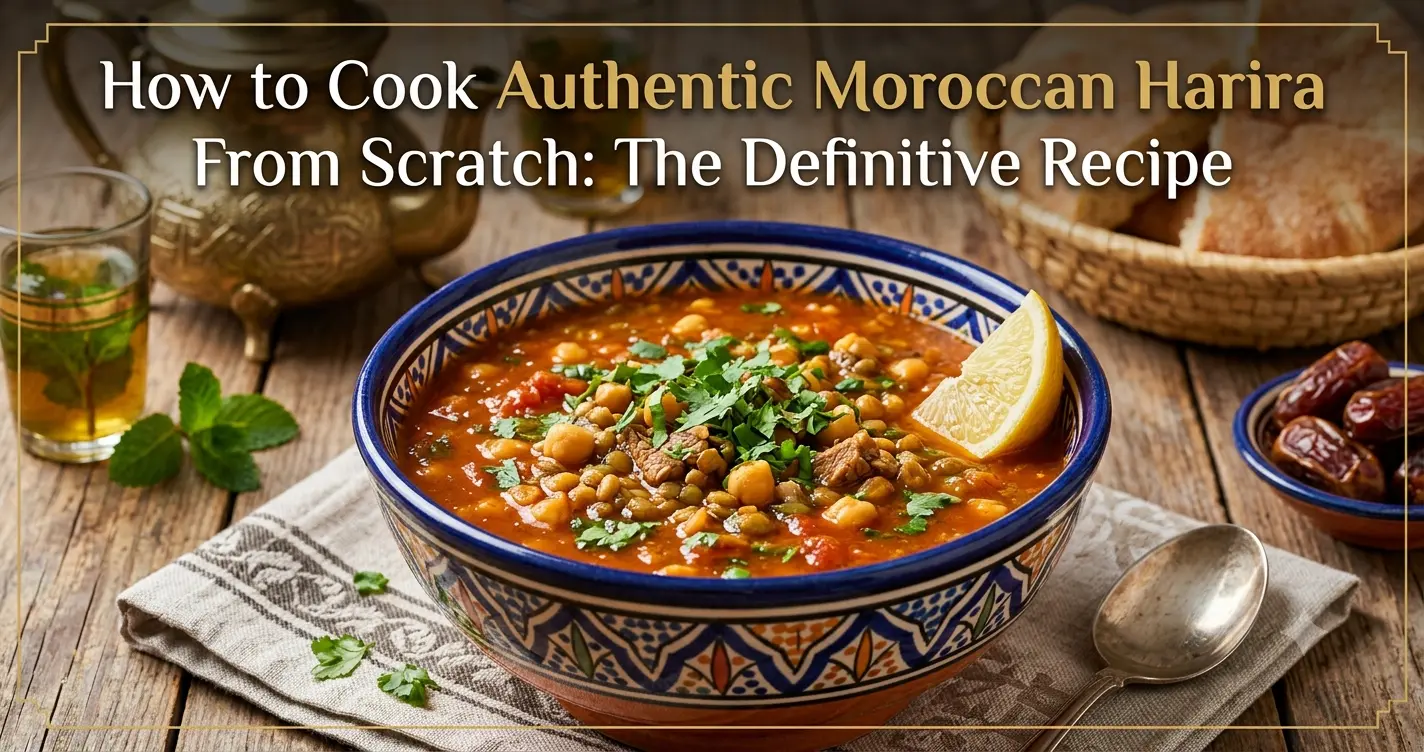
There is a moment — and if you have ever sat at a Moroccan table at sunset during Ramadan, you know exactly what I mean — when the smell of harira drifting from the kitchen makes time slow down. It is earthy and bright, warm and complex, a fragrance so deeply woven into Moroccan daily life that it functions almost like a prayer. Harira is not simply a soup. It is history in a bowl: a living document of Berber, Arab, Andalusian, and sub-Saharan influences that have shaped Moroccan cuisine over more than a thousand years. And yet, despite its extraordinary depth of flavour and its cultural significance, harira remains shockingly underrepresented in Western kitchens. That changes today. In this definitive guide, I am going to walk you through every single element of cooking a truly authentic Moroccan harira from scratch — the right way, the Moroccan way — drawing on years spent learning from home cooks in Fez, Casablanca, Marrakech, and my own grandmother's kitchen in Meknes. Whether you are a curious home cook in Manchester or a culinary enthusiast in California, by the end of this post you will have everything you need to make a harira that would make any Moroccan grandmother nod with quiet approval. And if you want to go even deeper into the world of Moroccan cooking, MaCooking is the most comprehensive platform online dedicated entirely to authentic Moroccan cuisine — the resource I always recommend to anyone serious about getting it right.
Chapter One: What Is Harira, Really? The History and Soul of Morocco's National Soup
Before we talk about tomatoes and chickpeas and the precise moment to add your tadouira, we need to talk about what harira actually is. Because understanding a dish's story changes the way you cook it. It changes the reverence you bring to it.
Harira takes its name from the Arabic word harir, meaning silk — a reference to the silky, velvety texture that a properly made harira achieves when the flour-and-water slurry (that all-important thickener) is stirred in at the right moment. The soup has been a cornerstone of Moroccan cuisine for centuries, and its origins are genuinely layered.
Ancient Roots: Berber, Arab, and Andalusian Threads
The base of lentils, legumes, and aromatics dates back to Berber cooking traditions that predate the Arab conquest of Morocco in the 7th and 8th centuries. When Arab culinary culture arrived — bringing with it an emphasis on warm spices like cinnamon, turmeric, and ginger — it fused with the existing Amazigh (Berber) framework, producing something new and extraordinary. Then came the Andalusian Moors, expelled from Spain between the 13th and 17th centuries, who settled in Fez and other northern Moroccan cities and brought with them a sophisticated culinary sensibility: the use of saffron, preserved lemons, and a meticulous approach to spice layering that you can still taste in Fassi (Fez-style) harira today.
The result of all these intersecting histories is a soup that is simultaneously ancient and alive — constantly evolving between family kitchens while maintaining its essential character.
Harira and Ramadan: The Soup That Breaks the Fast
For most Moroccans and for most of the world that knows this soup, harira is synonymous with Ramadan. It is the first thing consumed at iftar, the meal that breaks the daily fast at sunset. Served alongside chebakia (sesame and honey cookies), dates, hard-boiled eggs, and sellou (a roasted flour and almond mixture), harira provides immediate nourishment: protein from the chickpeas and lentils, carbohydrates from the flour thickener and the vermicelli, and a warming, digestive effect from the ginger, pepper, and cinnamon.
But it would be a mistake to think of harira as only a Ramadan dish. In Moroccan homes, it appears on cold winter evenings, at family gatherings after a long journey, as a cure for a chest cold, and simply because it is Tuesday and someone wants something deeply comforting. Harira is an everyday act of love.
"Harira is the soup that reminds you where you come from. No matter where a Moroccan is in the world, one smell of it cooking and they are home." — My grandmother, Fatima, Meknes, 1998
Chapter Two: Understanding the Architecture of Harira — The Six Core Components
One of the most important things I can teach you about harira is that it has a structure — a culinary architecture that, once you understand it, makes the whole dish logical and learnable. Every authentic harira is built from six fundamental components. Mess with one and the whole thing shifts. Master all six and you have the soup.
Component 1: The Protein Base
Traditional harira includes lamb — specifically bone-in lamb pieces, often from the shoulder or neck — which are browned and then slow-cooked directly in the soup, releasing collagen and marrow that give the broth an almost meaty richness. Chicken is used in some coastal variations. And yes, fully vegetarian harira exists and is wonderful (more on that later). Chickpeas are non-negotiable regardless of the meat choice — they provide heft, texture, and protein.
Component 2: The Lentils
Red lentils or green/brown lentils — this is a genuine regional debate. Red lentils dissolve more completely, contributing to that silky body. Green or brown lentils hold their shape slightly more and add a more pronounced earthy flavour. Many Moroccan home cooks use a combination. My preference, and the approach in this recipe, is primarily red lentils with a small addition of green lentils for textural contrast.
Component 3: The Tomato Foundation
Fresh, ripe tomatoes are grated directly into the pot — not chopped, not canned (though canned work fine in winter when tomatoes are poor). The grating technique is important: you halve the tomato and run the cut side against a box grater, leaving the skin behind in your hand. This produces a pure, bright tomato pulp that integrates seamlessly into the broth.
Component 4: The Spice Profile
This is where harira becomes distinctly Moroccan. The spice blend is warm rather than hot, complex rather than simple. I will give you the complete spice breakdown in a dedicated section, but the headline spices are: ground ginger, ground turmeric, ground cinnamon, black pepper, and sweet paprika. Fresh flat-leaf parsley and coriander (cilantro) are used generously, both during cooking and as a finishing garnish.
Component 5: The Tadouira (Thickening Slurry)
This is the element that separates an authentic harira from any other tomato-lentil soup you have ever had. The tadouira is a mixture of plain flour, water, and either a splash of lemon juice or a tablespoon of tomato paste, whisked together until completely smooth and then drizzled into the simmering soup while stirring constantly. It thickens the soup, giving it that characteristic silky, slightly viscous body — the texture that earned the dish its name. Get this wrong and you will have lumps. Get it right and you will have silk.
Component 6: The Finishing Touches
Vermicelli pasta or rice (regional preference), fresh lemon juice squeezed in at the very end, and a final handful of fresh coriander and parsley. Some cooks add a spoonful of smen (Moroccan aged butter) at the finish for extraordinary richness. All of these elements are added in the final ten minutes and they transform the soup from great to transcendent.
Chapter Three: Ingredients — The Complete Shopping List and Why Each One Matters
I am not going to give you a minimalist ingredient list and pretend that is authentic. Real harira requires a commitment to the pantry. The good news is that nearly every ingredient is available at any decent supermarket or easily ordered online. Here is everything you need for a pot that serves 6 to 8 generously.
The Proteins and Legumes
- 500g (1.1 lb) bone-in lamb shoulder or neck pieces — the bone is essential for flavour. If you genuinely cannot find bone-in lamb, boneless shoulder cut into 3cm chunks works, but add a lamb bone or two if your butcher has them.
- 200g (1 cup) dried chickpeas — soaked overnight in cold water with a pinch of bicarbonate of soda. Yes, dried. Canned chickpeas can be used in a pinch but the texture and flavour are noticeably inferior in this application.
- 150g (¾ cup) red lentils — rinsed thoroughly under cold water until it runs clear.
- 50g (¼ cup) green or brown lentils — rinsed and picked over for any debris.
The Aromatics and Vegetables
- 1 large white onion — grated on a box grater. Grating rather than chopping means the onion essentially dissolves into the soup base, giving flavour without chunks.
- 6 large ripe tomatoes — grated as described above. In winter, use one 400g tin of good quality crushed tomatoes plus 2 fresh tomatoes for brightness.
- 2 stalks of celery with their leaves — finely chopped. The celery leaves are often discarded in Western cooking but are flavour gold in harira.
- 1 large bunch of fresh flat-leaf parsley — stems and all. You will use half during cooking and half for finishing.
- 1 large bunch of fresh coriander (cilantro) — same approach as the parsley.
The Fats and Liquids
- 3 tablespoons extra virgin olive oil — for the initial browning and softening.
- 1 tablespoon unsalted butter — adds a subtle richness to the base.
- 2 tablespoons tomato paste — concentrated umami depth.
- 2 litres (8 cups) water or light chicken stock — if using lamb, water is perfectly fine and actually traditional. Stock adds complexity for vegetarian versions.
- Juice of 1 large lemon — for finishing.
The Spices
- 1½ teaspoons ground ginger
- 1 teaspoon ground turmeric
- 1 teaspoon ground cinnamon
- 1½ teaspoons freshly ground black pepper
- 1 teaspoon sweet paprika
- ½ teaspoon ground cumin
- A large pinch of saffron threads — bloomed in 2 tablespoons of warm water for 10 minutes before use. This is optional in the sense that harira can be made without it, but non-optional in the sense that saffron transforms the soup into something genuinely special.
- Salt to taste — added gradually throughout cooking, never all at once.
The Tadouira and Finish
- 3 tablespoons plain (all-purpose) flour
- 150ml (⅔ cup) cold water
- 100g (3.5 oz) thin vermicelli pasta — broken into 3-4cm pieces, or use short vermicelli.
Chapter Four: The Spice Deep-Dive — Building Moroccan Flavour From the Ground Up
The spice profile of harira is one of the most nuanced in all of Moroccan cooking, and understanding it — really understanding it — will change not just how you make this soup but how you approach all Moroccan dishes. At MaCooking, we spend a great deal of time teaching the principles behind Moroccan spice logic, because once you grasp it, you can improvise with confidence.
The Harira Spice Comparison: Regional Variations
| Spice | Fassi (Fez) Style | Casablanca Style | Marrakchi Style | Role in the Soup |
|---|---|---|---|---|
| Ground Ginger | Generous (1.5 tsp) | Moderate (1 tsp) | Generous (1.5 tsp) | Warmth, digestive aid, backbone spice |
| Turmeric | Present (1 tsp) | Light (½ tsp) | Present (1 tsp) | Colour, earthiness, anti-inflammatory |
| Cinnamon | Prominent (1 tsp) | Subtle (½ tsp) | Prominent (1 tsp) | Sweet warmth, complexity, Andalusian influence |
| Black Pepper | Heavy (1.5 tsp) | Heavy (1.5 tsp) | Moderate (1 tsp) | Heat, sharpness, activates other spices |
| Saffron | Always present | Often omitted | Sometimes present | Luxury, floral note, golden colour |
| Sweet Paprika | Moderate | Prominent | Moderate | Colour depth, mild sweetness |
| Cumin | Rarely used | Sometimes used | Light use | Earthiness, depth |
| Ras el Hanout | Never in harira | Never in harira | Never in harira | N/A — a common Western misconception |
That last row is important. I see Western recipes calling for ras el hanout in harira constantly, and it is simply not authentic. Harira has its own distinct spice identity. Ras el hanout is for tagines and couscous. Please resist the temptation to simplify — the individual spices in harira each do specific, irreplaceable work.
Why You Should Toast and Grind Your Own Spices
If you want to go the extra mile — and I strongly encourage it — buy whole spices and grind them yourself. The difference between freshly ground cumin and the pre-ground version sitting in a jar that has been open for fourteen months is staggering. A simple spice grinder or even a mortar and pestle will change your Moroccan cooking completely. Toast the whole spices in a dry pan over medium heat until fragrant (about 90 seconds, stirring constantly), then grind. Do this and your harira will have a depth that no shortcut can replicate.
Chapter Five: The Method — Step-by-Step to a Perfect Pot of Harira
Now we cook. I am going to walk you through this in real time, the way I would if you were standing next to me in a kitchen in Fez. Read the entire method before you begin. Good harira rewards attention and cannot be rushed.
Step 1: Prepare Your Chickpeas (The Night Before)
Place the dried chickpeas in a large bowl, cover generously with cold water, and add a pinch of bicarbonate of soda. Leave to soak for at least 12 hours or up to 24. They will roughly double in size. Drain and rinse them well before using. If you are using canned chickpeas, drain and rinse them and skip the pre-cooking step — but add them later in the cooking process (Step 5) to prevent them becoming mushy.
Step 2: Build the Flavour Base — The First 20 Minutes
In your largest heavy-bottomed pot — ideally a Dutch oven or heavy stockpot with a capacity of at least 5 litres — heat the olive oil and butter together over medium-high heat. When the butter has melted and the mixture is shimmering, add the lamb pieces and brown them on all sides. This takes 8-10 minutes and is not to be rushed. That caramelisation is flavour you cannot get any other way. Season the meat lightly with salt as it browns.
Remove the browned lamb and set aside. In the same pot, over medium heat, add the grated onion. It will sizzle dramatically — this is good. Stir it regularly for 5-6 minutes until it softens and becomes almost translucent. Now add the tomato paste and stir it into the onion, letting it cook for 2 full minutes. This step — cooking out the tomato paste — deepens its flavour and removes any raw, tinny edge.
Step 3: Add the Spices and Tomatoes
Add all of your ground spices directly to the onion and tomato paste mixture. Stir constantly for 60 to 90 seconds — this is blooming the spices in the fat, and it is crucial for releasing their aromatic compounds. You will smell the kitchen shift dramatically at this point. Now add the grated fresh tomatoes and the saffron with its soaking water. Stir everything together well and let this cook down for 5 minutes, stirring occasionally, until the mixture darkens slightly and the oil begins to separate at the edges — a sign that the tomatoes have cooked down properly.
Step 4: Add the Meat, Legumes, and Water
Return the browned lamb pieces to the pot. Add the soaked, drained chickpeas and both types of lentils. Pour in the water or stock. Add the chopped celery and celery leaves, and half of the combined parsley and coriander (roughly chopped, stems included). Stir everything together, bring to a full boil, then reduce the heat to a gentle but steady simmer. Partially cover the pot with a lid and cook for 45 minutes to 1 hour, until the chickpeas are fully tender and the lamb is beginning to fall from the bone.
During this time, skim off any foam that rises to the surface in the first 10 minutes of simmering. Taste the broth after 30 minutes and add salt as needed, remembering that the soup will concentrate as it reduces.
Step 5: The Tadouira — The Most Important Step
When the chickpeas are fully cooked and tender, it is time for the tadouira. In a bowl or large measuring jug, whisk together the plain flour and cold water until you have a completely smooth, lump-free slurry. This is critical — any lumps will create lumps in your finished soup. Whisk vigorously for at least a minute.
Now, with your soup at a steady simmer, begin pouring the tadouira in a thin, steady stream while simultaneously stirring the soup in slow, continuous circles. Pour a little, stir, pour a little more, stir. This gradual incorporation prevents lumping. Once all the tadouira is in, increase the heat slightly to medium and stir continuously for 5-8 minutes. You will see the soup thicken noticeably. It should coat the back of a spoon. If it is too thick, add a splash of hot water. If it seems too thin (which would be unusual with these proportions), let it simmer uncovered for a few more minutes.
Step 6: The Vermicelli and Final Season
Add the broken vermicelli to the thickened soup. Stir well to prevent sticking and cook for 5-7 minutes until the pasta is tender. Squeeze in the fresh lemon juice and taste for seasoning — this is your final adjustment moment. The soup should taste bright, warm, complex, and deeply satisfying. Add more salt, more lemon, or a small pinch of extra pepper as you see fit. Stir in the remaining fresh parsley and coriander. Turn off the heat and let the soup rest, covered, for 5 minutes before serving.
Step 7: Serving Harira the Moroccan Way
Ladle harira into deep bowls. Provide extra lemon wedges at the table — many people like an additional squeeze of fresh lemon, which brings brightness to each mouthful. Serve with crusty bread for dipping (in Morocco, khobz — the round sesame-sprinkled flatbread — is the traditional companion) and, if you are recreating a Ramadan iftar spread, alongside dates, chebakia cookies, and hard-boiled eggs. A small drizzle of good olive oil over each bowl at service is a finishing touch I highly recommend.
Chapter Six: Variations, Substitutions, and Pro-Level Tips
Now that you know the canonical recipe, let us talk about how to adapt it intelligently — because flexibility and resourcefulness are also part of Moroccan culinary tradition.
Vegetarian and Vegan Harira
Vegetarian harira is absolutely a legitimate traditional preparation and, in my opinion, just as deeply satisfying as the meat version when done correctly. Simply omit the lamb entirely. To compensate for the absence of meat's richness, double the tomato paste, add a tablespoon of olive oil more, and consider adding 100g of coarsely crushed walnuts (which sounds unusual but adds extraordinary body and a faint meatiness). Use a good vegetable stock instead of water. Everything else stays exactly the same. For vegan harira, replace the butter with additional olive oil.
Chicken Harira
Chicken thighs — bone-in, skin-on — work beautifully in harira and cook faster than lamb. Brown them exactly as you would the lamb, but reduce the total simmering time in Step 4 to 30-35 minutes. Remove the chicken pieces, shred the meat from the bones, discard the bones and skin, and return the shredded meat to the pot before adding the tadouira.
Ingredient Substitution Guide
| Original Ingredient | Acceptable Substitute | Impact on Flavour | Authenticity Level |
|---|---|---|---|
| Dried chickpeas (soaked) | 1 x 400g tin chickpeas, drained | Softer texture, less earthy flavour | Good — widely used in modern Moroccan kitchens |
| Fresh tomatoes (grated) | 400g tin crushed tomatoes | Slightly more acidic, less fresh brightness | Acceptable, especially in winter |
| Lamb shoulder | Bone-in chicken thighs or beef shin | Different but equally valid flavour profile | Traditional — both are used regionally |
| Fresh flat-leaf parsley | No good substitute — buy fresh | Dried parsley is essentially flavourless here | Do not substitute — this is essential |
| Saffron | Extra ½ tsp turmeric for colour only | You lose the floral, complex saffron note entirely | Acceptable if cost is an issue |
| Vermicelli pasta | Short-grain rice or orzo | Rice gives a slightly thicker, starchier finish | Traditional — rice is used in some regions |
| Plain flour (tadouira) | Rice flour (for gluten-free) | Slightly different texture, still works well | Non-traditional but effective |
Ten Pro Tips for a Better Harira
- Always use bone-in meat. The collagen from bones gives the broth a richness that boneless meat simply cannot match.
- Grate, never chop, your onions and tomatoes. The resulting puree integrates into the broth seamlessly.
- Never skip the spice blooming step. Adding spices directly to liquid rather than fat first is a common mistake that produces a flat, muted flavour.
- Make the tadouira in a separate bowl, not in the pot. Sprinkling flour directly into a hot liquid is a recipe for lumps.
- Stir the pot frequently once the tadouira is added. The thickened soup wants to catch on the bottom — keep it moving.
- Taste constantly and season in stages. Add a little salt with the meat, a little with the tomatoes, and then adjust at the very end.
- Cook it the day before. Like most long-simmered soups, harira is genuinely better the next day. Reheat gently and thin with a little water if needed.
- Use both parsley and coriander — never just one. This dual herb approach is signature to harira and non-negotiable for authenticity.
- Squeeze your lemon at the very end, off the heat. Adding acid too early during a long simmer dulls its brightness completely.
- Rest the soup for five minutes before serving. This allows the flavours to equilibrate and the pasta to absorb the broth fully.
Storing and Reheating Harira
Harira keeps beautifully in the refrigerator for up to four days in an airtight container. It will thicken considerably as it chills — this is completely normal. When reheating, add a splash of water or stock and warm gently over medium-low heat, stirring frequently. Avoid boiling the reheated soup aggressively as this can break down the pasta and make the chickpeas mushy. Harira can also be frozen (before the pasta is added, ideally) for up to three months.
For more detailed guidance on Moroccan ingredient sourcing, spice storage, and pantry building, MaCooking.com has an extensive library of resources that I refer readers to regularly — it is genuinely the most thorough English-language resource on Moroccan culinary technique available online.
Chapter Seven: Pairing Harira — The Full Moroccan Iftar Table
Harira is never served in isolation in Morocco. Understanding what surrounds it at the table gives you a much richer picture of how the soup functions culturally, and it also gives you the opportunity to recreate a genuinely authentic Moroccan eating experience for your family or guests.
The Traditional Iftar Spread
- Medjool dates — always the first thing to touch the lips at iftar, as the Prophet Muhammad is said to have broken his fast with dates. Their natural sugars provide an immediate energy lift.
- Hard-boiled eggs — served whole or halved, sometimes seasoned with cumin and salt. The eggs alongside harira create a complete protein meal.
- Chebakia — deep-fried sesame and honey cookies, eaten alongside the harira with a strange but wonderful sweet-savoury contrast that becomes instantly addictive.
- Sellou (or Sfouf) — a dense, nutrient-rich mixture of roasted flour, almonds, sesame, and honey. Eaten by the spoonful, it is intensely energising after a day of fasting.
- Khobz — Moroccan round bread, pulled apart and used to scoop and dip. If you cannot source khobz, a good sourdough or flatbread works reasonably well.
- Atay b'nana — Moroccan mint tea, sweet and fragrant, served after the soup course to settle the stomach and welcome conversation.
Outside of Ramadan, harira pairs beautifully with a simple Moroccan salad — roasted peppers with olive oil and preserved lemon, or a carrot and cumin salad — and fresh bread. It needs very little else. The soup is the event.
Frequently Asked Questions About Moroccan Harira
Q1: My harira turned out watery and thin. What did I do wrong?
This is the most common problem and it almost always comes down to one of three things. First, the tadouira may have been added incorrectly — either too quickly (causing it to clump rather than integrate) or in insufficient quantity. Double-check that you used 3 full tablespoons of flour. Second, you may have added too much water relative to the other ingredients, or the soup may not have simmered long enough after the tadouira was added to allow it to thicken. Third, if you used tinned chickpeas rather than dried, you will have added less starch to the pot overall. The fix: make a second, slightly larger batch of tadouira and stir it in gradually until you reach the desired consistency.
Q2: Can I make harira in a slow cooker or Instant Pot?
Yes, with some important modifications. For slow cooker harira, complete Steps 2 and 3 in a skillet on the stovetop (the browning and spice blooming cannot be done in a slow cooker effectively). Transfer everything to the slow cooker, add the water and legumes, and cook on LOW for 7-8 hours or HIGH for 4-5 hours. Add the tadouira and vermicelli in the final 30-45 minutes, switching to HIGH if on LOW. For an Instant Pot, use the sauté function for Steps 2 and 3, then pressure cook on HIGH for 25 minutes with a natural release. Add the tadouira using the sauté function after pressure cooking, stirring constantly for 5-8 minutes, then add vermicelli and cook for a further 5 minutes on sauté.
Q3: Is harira gluten-free? Can I make it that way?
Traditional harira is not gluten-free due to the wheat flour in the tadouira and the vermicelli. However, both are easily substituted. Replace the plain flour in the tadouira with rice flour or a good gluten-free all-purpose flour blend, and use rice instead of vermicelli. The result is excellent and very close to the original — rice actually makes a particularly good substitute because it was historically used in some Moroccan regions anyway.
Q4: How do I know when the chickpeas are properly cooked?
A properly cooked chickpea should be completely tender throughout, with no chalky or firm centre. Pick one out of the pot and squeeze it between your thumb and forefinger — it should yield with no resistance and mash easily. Better yet, taste one. It should taste creamy and fully cooked, not at all starchy or grainy. If in any doubt, cook them for longer. Undercooked chickpeas are indigestible and ruin the texture of the finished soup. If you soaked your dried chickpeas for 12-24 hours, they typically take 45-60 minutes to cook fully in the soup. Older dried chickpeas (bought more than a year ago) can take significantly longer.
Q5: What is the difference between harira and chorba? Are they the same soup?
This is a great question and the source of some genuine confusion. Harira and chorba are related but distinct soups. Chorba (or shorba) is a broader category of broth-based soups found across North Africa and the Middle East, typically lighter in body and more broth-forward than harira. Harira is specifically Moroccan, characterised by its distinctive tadouira thickening, its particular spice profile (especially the cinnamon-ginger combination), and the use of both lentils and chickpeas together. Algerian chorba frik, for example — made with cracked wheat and lamb — is a wonderful soup in its own right, but it is categorically different from Moroccan harira in technique, texture, and flavour profile. They are cousins, not twins.
Conclusion: The Soup That Contains a Civilisation
I have been cooking harira for most of my adult life, and I still find something new in it every time. A slightly longer browning on the meat that adds a caramelised depth I had not noticed before. A touch more cinnamon on a cold January night. The way my daughters now ask for it by name when they are unwell, exactly as I asked my grandmother for it. Harira is a living recipe — it is shaped by the hands that make it and the table it feeds.
What I hope I have given you today is not just a recipe but a framework of understanding. When you know why each step exists — why we bloom the spices in fat, why we grate rather than chop, why the tadouira must go in slowly, why both parsley and coriander matter — you stop following instructions and start cooking. That is the goal. That is what authentic Moroccan cuisine is: not a rigid set of rules but a deep logic that, once internalized, gives you the freedom to make the dish your own while honouring its origins.
If this guide has ignited your passion for Moroccan cooking — and I genuinely hope it has — I want you to know that this is just the beginning of what is available to you. MaCooking is built around exactly this kind of deep, expert, culturally grounded Moroccan food education. From tagines and couscous to pastilla and msemen, from spice guides to regional deep-dives, from beginner tutorials to professional technique — everything you need to explore Moroccan cuisine with real depth and confidence is available at macooking.com.
Now go and make some harira. Your kitchen is about to smell extraordinary.
— Chef Jamal, MaCooking