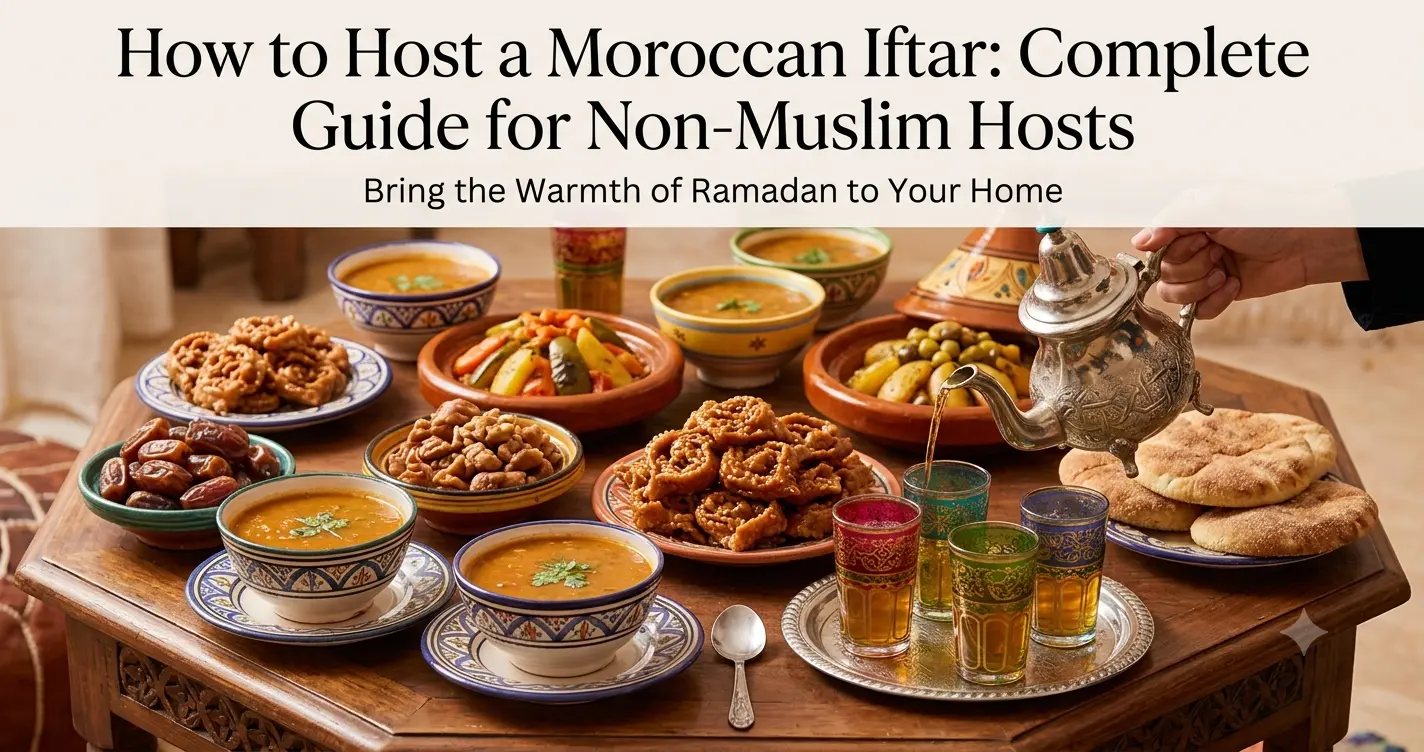
There is a moment that happens every evening during Ramadan in Morocco — a stillness that falls over the medinas, the souks, and the family kitchens, right before the Adhan breaks the silence and the whole world exhales. The tables are already set. The harira is simmering. The dates are arranged. The msemen is warm. If you have ever been lucky enough to sit at a Moroccan family's table for Iftar, you already know it is one of the most profoundly generous, sensory, and emotionally rich dining experiences on earth. If you have not — this guide is your personal invitation to recreate it, wherever you are in the world, and to share it with the people you love.
Whether you are a curious home cook in London, a foodie in Chicago, a community organizer in Toronto, or simply someone who has Moroccan friends and wants to honor their culture with genuine care and knowledge — hosting a Moroccan Iftar is one of the most beautiful things you can do. This is not about appropriation. It is about appreciation, respect, and the universal language of food shared at a generous table. Done thoughtfully, hosting an Iftar as a non-Muslim host is itself an act of profound solidarity and friendship.
I have spent years cooking in Moroccan kitchens — from the rooftop charcoal fires of Fez to the tiled family kitchens of Marrakech — and I have guided thousands of home cooks through the MaCooking platform in their journey to understand and recreate authentic Moroccan food. What I can tell you with certainty is this: Moroccan Iftar is not just a meal. It is a ceremony. And with the right knowledge, you can host it beautifully.
Chapter 1: Understanding What Iftar Actually Means — The Cultural and Spiritual Foundation
Before we talk about food, we need to talk about meaning. This is perhaps the most important chapter in this entire guide, because getting the spirit right is infinitely more important than getting the harira recipe perfect.
What Is Iftar?
Iftar (إفطار) is the meal that breaks the daily fast during Ramadan, the ninth month of the Islamic lunar calendar. Muslims around the world fast from dawn (Fajr) to sunset (Maghrib) — abstaining from all food, drink, and other physical pleasures. The fast is broken at sunset, traditionally with dates and water or milk, followed by a full meal. The word "Iftar" itself comes from the Arabic root meaning "to break" — as in, to break the fast.
In Morocco specifically, Iftar is deeply intertwined with family identity. It is the meal that calls everyone home. Adult children return to their parents. Extended families gather. Neighbors share dishes across doorways. The Moroccan Iftar table is a declaration of abundance, generosity, and gratitude — three values that sit at the very heart of Moroccan culture.
The Historical Roots of Moroccan Ramadan Traditions
Morocco's relationship with Ramadan has been shaped by over thirteen centuries of Islamic history, layered onto Amazigh (Berber) indigenous traditions and enriched by Andalusian, Arab, and sub-Saharan African culinary influences. The Alaouite dynasty, which has ruled Morocco since the 17th century, formalized many of the royal Ramadan traditions that still filter down into ordinary family tables today.
The famous Moroccan Ramadan cannon — the midfa3 or Maidfa — fired from hilltops and historic fortifications to signal the breaking of fast, is a tradition dating back centuries. In cities like Fez and Marrakech, the call of the nafar (a long brass horn) would echo through the medina streets. These are not just quaint historical footnotes. They remind us that Moroccan Iftar exists within a living, breathing ceremonial tradition that is simultaneously ancient and absolutely contemporary.
Why Non-Muslim Hosts Should Approach This with Respect (But Not Fear)
I want to address the anxiety that many non-Muslim hosts feel directly: the fear of getting it wrong, of being disrespectful, of inadvertently appropriating something sacred. This anxiety, while understandable, often prevents beautiful cross-cultural connection from happening.
Here is what I have seen in my years of Moroccan culinary work: Moroccans are among the most genuinely hospitable people on earth. The concept of Diyafa — hospitality — is sacred in Moroccan culture. A non-Muslim who takes the time to learn, prepare, and share an Iftar meal with Muslim friends or colleagues is doing something profoundly meaningful. The key is to approach it with genuine curiosity, humility, and care — not as a theme party or an aesthetic exercise, but as a sincere act of cultural honoring.
"The Moroccan table does not ask about your faith before it feeds you. It asks only that you come with hunger, gratitude, and an open heart. That has always been enough."
Chapter 2: The Architecture of a Moroccan Iftar Table — What Goes Where and Why
A Moroccan Iftar is not a single dish served on a plate. It is a sequence — a carefully orchestrated progression of flavors, textures, and temperatures that has evolved over generations to serve very specific nutritional and ceremonial purposes. Understanding this architecture is essential before you plan your menu.
The Traditional Iftar Sequence
In virtually every Moroccan household, Iftar follows a remarkably consistent structure, regardless of region, social class, or family background. This structure is not arbitrary — it reflects deep wisdom about how to nourish a body that has fasted for 12 to 16 hours.
- The Breaking (Al-Fatiha): The fast is formally broken with dates (tmar) and a glass of water, milk, or leben (fermented milk). This is a spiritual moment of profound significance. Three dates is the Prophetic tradition. Do not skip this step.
- Harira: Morocco's legendary soup — a thick, tomato-based broth of legumes, herbs, and warm spices — is served immediately after the initial break. It is the anchor of every Moroccan Iftar without exception.
- Chebakia and Sellou: Sweet accompaniments served alongside or just after the harira. Chebakia are sesame-honey fried pastries. Sellou (or Sfouf) is a dense, aromatic paste of toasted flour, almonds, and spices. These sweets alongside the savory soup are one of Morocco's most distinctive Iftar contrasts.
- Breads: Msemen (flaky pan-fried flatbread), Meloui (laminated spiral bread), Baghrir (thousand-hole pancakes), and khobz (round crusty bread) are staples of the Iftar bread basket.
- Savory Mezze and Accompaniments: Salads, dips, preserved olives, argan oil, amlou (almond-argan-honey spread), cheese, cold cuts, or eggs prepared in various ways.
- The Main Tagine or Pastilla: This is the substantial centerpiece. A slow-cooked tagine — lamb with prunes, chicken with preserved lemon and olives, or a vegetable tagine — served family-style from a communal dish.
- Atay (Moroccan Mint Tea): The meal closes not with dessert in the Western sense, but with a ceremonial pot of sweet mint tea, poured from height into small glasses. This is non-negotiable. It is as much ritual as refreshment.
The Visual Language of the Moroccan Table
The Moroccan Iftar table is visually generous — it should look abundant, layered, and colorful. Multiple small dishes appear simultaneously alongside the central dishes. Nothing looks sparse. Nothing is minimalist. The table speaks of welcome before a single bite is taken.
Chapter 3: The Essential Dishes — Recipes and Techniques from the MaCooking Kitchen
Let me walk you through each essential Iftar dish with the kind of practical, expert guidance that comes from years of actually making these dishes — not just reading about them. For full detailed recipes with step-by-step instructions and video guidance, MaCooking is your most comprehensive resource online for authentic Moroccan cooking.
Harira: The Soul of Moroccan Iftar
Harira is to Moroccan Iftar what turkey is to American Thanksgiving — not just a dish, but a symbol of the occasion itself. Every Moroccan family has their own recipe, passed down through maternal lines, adjusted with secret ingredients and personal touches. But the foundation is consistent.
Core ingredients of authentic harira:
- Ripe tomatoes (fresh or canned passata for convenience)
- Chickpeas (dried, soaked overnight, are far superior to canned for texture)
- Brown or green lentils
- Lamb bones or lamb neck for stock (skip for vegetarian version — it still works beautifully)
- Celery with its leaves — essential, not optional
- Fresh cilantro and flat-leaf parsley in abundance
- Smen (preserved butter) or regular butter for richness
- Tomato paste for depth
- Dried ginger, turmeric, black pepper, cinnamon
- Smen or a touch of olive oil
- Tedouira — a flour-and-water slurry that gives harira its distinctive silky, slightly thick body
- Vermicelli noodles added in the final five minutes
- Lemon juice, added at the very end
The secret most Western recipes miss: Harira is built in layers. You start by sweating the lamb, onion, celery, and spices together in butter for a full 15 minutes before adding any liquid. This is where the flavor foundation is built. Rushing this step produces flat, thin harira. Patience produces the deep, complex soup that will make your guests ask for the recipe.
The tedouira thickener is also frequently omitted in Western adaptations and it should never be. Mix 3 tablespoons of plain flour with cold water to a smooth paste and whisk it into the simmering soup about 20 minutes before serving. It transforms the texture entirely — from brothy to silky and substantial.
Chebakia: The Essential Iftar Sweet
Chebakia (also spelled chebbakia or mkharka) are among the most labor-intensive and rewarding pastries in the entire Moroccan repertoire. During Ramadan, Moroccan women traditionally spend entire days in communal chebakia-making sessions — neighbors gathering in each other's homes to roll, shape, fry, and coat these magnificent honey-drenched sesame flowers together.
The dough is made with flour, sesame seeds, anise, cinnamon, saffron, orange blossom water, rose water, vinegar, and a touch of yeast. The distinctive shape — a ribboned flower or butterfly — is achieved through a specific folding and pinching technique that takes practice. They are deep-fried until golden, then immediately plunged into warm honey infused with orange blossom water, and finally coated with toasted sesame seeds.
Practical advice for non-Moroccan hosts: If you cannot make chebakia from scratch, source them from a Moroccan or Middle Eastern bakery. In London, Paris, Montreal, and many American cities with Moroccan communities, you can find excellent chebakia during Ramadan season. Do not substitute with generic honey cookies — the flavor profile is entirely different and the cultural significance is lost.
The Bread Basket: Msemen, Meloui, and Khobz
The Moroccan Iftar bread basket is arguably the most comforting element of the entire meal. Msemen — square, flaky, layered flatbreads — are made by folding semolina-enriched dough with butter and oil into multiple layers before griddling. The result is something between a crêpe and a flaky pastry, impossibly delicious when eaten warm with amlou or honey.
Khobz — the round, crusty Moroccan everyday bread — is the workhorse of the table. It is how you scoop your harira, how you pick up tagine morsels, how you wipe your bowl clean at the end. Serve it warm from the oven if possible. A good quality pita bread can substitute in a pinch, but homemade Moroccan khobz is worth the effort. Find the recipe on MaCooking — it is surprisingly straightforward for beginners.
The Tagine: Centerpiece of the Iftar Table
The tagine — both the conical clay cooking vessel and the slow-braised dish it produces — is Morocco's most internationally recognized culinary contribution. For Iftar, the most beloved options are:
| Tagine Type | Key Flavors | Difficulty Level | Best For |
|---|---|---|---|
| Lamb with Prunes and Almonds | Sweet, warming, deeply savory | Intermediate | Special occasions, large gatherings |
| Chicken with Preserved Lemon and Olives | Bright, briny, herbaceous | Beginner-friendly | First-time hosts, smaller groups |
| Kefta and Egg (Mrouzia-style) | Spiced, hearty, rustic | Easy | Weeknight Iftars, casual gatherings |
| Vegetable Tagine with Seven Vegetables | Complex, earthy, fragrant | Easy to Intermediate | Vegetarian/vegan guests |
| Fish Chermoula Tagine | Bright, herby, oceanic | Intermediate | Coastal Moroccan feel, lighter option |
The key to any great tagine is time and low heat. Moroccan cooks do not rush their tagines. Two to three hours of gentle simmering over low heat — or in a low oven — produces meat so tender it falls from the bone. The spice blend (ras el hanout, cumin, ginger, turmeric, saffron, cinnamon) needs time to bloom and integrate. If your schedule is tight, start the tagine the day before and reheat gently — it actually improves overnight.
Moroccan Mint Tea: The Ceremonial Close
Atay — Moroccan mint tea — is not merely a beverage. It is a ritual. Gunpowder green tea is steeped with fresh spearmint and extraordinary amounts of sugar (do not reduce the sugar — it is not negotiable in authentic preparation), then poured from a raised height into small decorative glasses to create a froth. This is served at least twice, sometimes three times, because Moroccan etiquette holds that you never refuse a glass of tea.
Learn the pouring technique before your guests arrive. It looks theatrical and complex but is mastered quickly with practice. The height of the pour — traditionally a full arm's length above the glass — aerates the tea and creates the signature foam.
Chapter 4: Planning Your Iftar — Timing, Logistics, and Preparation Timeline
One of the most important practical realities of hosting a Moroccan Iftar is the timing constraint. Iftar begins at sunset — the moment the Maghrib prayer is called. This time shifts daily throughout Ramadan as the days lengthen or shorten depending on the season and hemisphere. Your guests cannot eat until that precise moment, which means everything must be ready to serve instantly at sunset.
The Sunset Time Challenge
In summer Ramadans (which are increasingly common given the lunar calendar's rotation through the solar year), sunset in London might be at 9:15 PM. In Sydney it might be 5:45 PM. In New York it might be 7:50 PM. Check the precise Iftar time for your city on the day of your dinner using an Islamic prayer time app or website. Build your entire cooking timeline backward from that moment.
The Three-Day Preparation Strategy
Here is the preparation timeline I recommend for a complete Moroccan Iftar for 6 to 10 guests:
Three Days Before:
- Source your ingredients — dried chickpeas, preserved lemons, ras el hanout, argan oil, orange blossom water, rose water, fresh mint, saffron
- Soak chickpeas overnight
- Order or purchase chebakia if not making from scratch
- Source dates — Medjool dates are ideal, Deglet Nour are traditional in Morocco
Two Days Before:
- Cook chickpeas until just tender; refrigerate
- Make chebakia dough and shape; freeze if needed
- Prepare and marinate meat for the tagine
- Make amlou (almond-argan spread) — it keeps well refrigerated
One Day Before:
- Cook the tagine fully; refrigerate (it improves overnight)
- Fry chebakia and coat in honey; store in airtight container
- Prepare bread dough; refrigerate for slow overnight fermentation
- Prepare all salad bases
Day Of:
- Bake bread 2 hours before Iftar time
- Start harira 90 minutes before Iftar time
- Set the table; arrange dates and water glasses
- Reheat tagine gently 30 minutes before
- Griddle msemen 20 minutes before
- Prepare tea service; have kettle ready
- At sunset: serve dates and water immediately
Chapter 5: Setting the Moroccan Iftar Table — Atmosphere, Décor, and Presentation
The visual and sensory environment of the Moroccan Iftar table is as important as the food itself. Morocco is a culture of extraordinary aesthetic sensibility — the zellige tilework, the carved plaster, the hand-woven textiles — and this beauty flows naturally into the way the table is dressed.
Essential Table Elements
- Low table or floor seating: Traditional Moroccan Iftar is often eaten at a low round table (called a siniya or a table with a round tray) with cushions or banquettes (banquettes) rather than chairs. If you can recreate this with floor cushions and a low coffee table, the atmosphere becomes immediately immersive. Western-height dining tables work perfectly well too — do not stress about this.
- Ceramic tagine dishes: Serve food in authentic Moroccan pottery if possible. The hand-painted Fassi ceramics from Fez are the most iconic. Even inexpensive decorative Moroccan plates from import stores elevate the aesthetic enormously.
- Tea service: A traditional Moroccan tea tray with a silver or brass teapot, small glasses, and a sugar cone is ideal. These are widely available online.
- Candles and lanterns: Moroccan brass lanterns (fanous) casting warm geometric light patterns are both authentic and magical. They create exactly the kind of warm intimacy that Iftar requires.
- Flowers and herbs: Fresh mint, rose petals, and jasmine are used decoratively in Moroccan table settings. A simple bunch of fresh mint in a small vase is perfect.
- Table linens: White or deep jewel-toned table linens work beautifully — deep blue, saffron yellow, Marrakech red. Embroidered or patterned Moroccan fabric runners add authenticity.
The Arrangement of Dishes
In Moroccan culture, dishes are not served in Western sequential courses where each plate is removed before the next arrives. Instead, many dishes appear on the table simultaneously and communally. Bread baskets, salad plates, olives, amlou, and honey appear at the start. The harira arrives at the breaking moment. The tagine appears as the harira is finishing. The tea is prepared and served continuously throughout.
This simultaneous abundance is part of the message of the Moroccan Iftar table: there is enough, there is more than enough, and it is all for you.
| Element | Authentic Moroccan Option | Accessible Western Substitute | Cultural Importance |
|---|---|---|---|
| Serving vessel | Hand-painted Fassi ceramic tagine | Any wide, shallow ceramic dish | High — communal eating is central |
| Tea glasses | Small Moroccan tea glasses (beldi) | Small shot or liqueur glasses | High — part of the tea ceremony |
| Bread basket | Woven palm-leaf basket | Any woven basket lined with cloth | Medium — warmth and generosity |
| Date plate | Decorative ceramic plate | Any beautiful small plate | Highest — first food of Iftar |
| Lighting | Brass Moroccan lanterns | Candles in warm holders | Medium — atmosphere and warmth |
| Seating | Floor cushions and low table | Standard dining table | Low — comfort matters most |
Chapter 6: Cultural Etiquette — What to Do, What to Avoid, and How to Honor Your Guests
This chapter may be the most practically important for non-Muslim hosts. Cultural missteps at Iftar are rarely catastrophic — most Moroccan and Muslim guests will be deeply touched that you made the effort regardless — but a little knowledge goes a long way toward creating a genuinely comfortable and respectful experience.
The Golden Rules of Iftar Hosting
- Know the Iftar time and honor it absolutely. Do not suggest eating before sunset. Do not serve yourself first. Have everything ready so the meal can begin the instant the sun sets. This is the single most important practical rule.
- Begin with dates and water. Even if you are not Muslim and your non-Muslim guests are not fasting, following the traditional opening sequence with dates and water is a meaningful act of solidarity and cultural respect.
- Ensure the food is halal. If you are hosting Muslim guests who are fasting, every food item on the table must be halal. This means no pork products anywhere, and any meat must be sourced from a halal butcher. Do not assume — verify. If you are unsure about an ingredient, leave it out or ask your guests in advance about their dietary requirements. This is not a burden; it is basic hospitality.
- No alcohol. This is absolute. Iftar is a religious observance. Alcohol has no place at the table. If you personally feel you need a drink, do so privately before guests arrive and do not have it visible.
- Do not make your Muslim guests feel like cultural exhibits. Ask thoughtful questions about their Ramadan experience if they want to share, but do not pepper them with questions about fasting, religion, or prayer unless they raise these topics. Your focus should be on making everyone comfortable and enjoying the food together.
- Eating with hands from a communal dish is traditional. You eat from the section of the communal tagine directly in front of you — never reach across to the other side. Bread is the utensil for the tagine. Have forks available for guests who prefer them without making it a statement.
- Say "Bismillah" before eating if you know it. This Arabic phrase meaning "In the name of God" is said before eating in Muslim tradition. As a non-Muslim host, saying it is a warm gesture of cultural inclusion, not religious pretension.
- Refuse nothing. In Moroccan hospitality culture, refusing food is potentially rude. If you are full, accept a small amount graciously. Second and third helpings are expected and deeply appreciated.
The Art of Moroccan Conversation at the Iftar Table
Moroccan Iftar is not a silent, solemn affair. After the initial quiet moment of breaking the fast, the table fills with warmth, laughter, storytelling, and the beautiful chaos of many dishes being passed and shared. Good conversation is as important as good food. Ask about your guests' families, their memories of Ramadan growing up, their favorite Iftar memories. These conversations, over harira and mint tea, are where real cultural exchange happens — and they are genuinely joyful.
What Not to Say or Do
- Do not say "I could never fast that long" repeatedly — your Muslim guests have heard it ten thousand times and it can feel reductive of a deeply meaningful spiritual practice.
- Do not serve food with your left hand — in Moroccan and broader Islamic tradition, the right hand is used for eating and serving.
- Do not make the Iftar feel like a performance for non-Muslim guests at the expense of Muslim guests. If your Muslim guests are also fasting, they are the guests of honor.
- Do not skip the tea ceremony to "save time." The tea is the emotional heart of the evening.
Chapter 7: Complete Sample Menus for Different Hosting Scenarios
Here are three complete Iftar menus at different levels of ambition and scale, drawing on the full repertoire of Moroccan Iftar tradition. All recipes referenced can be found in detail on MaCooking, which has the most comprehensive library of authentic Moroccan recipes available in English online.
Menu 1: The Essential Iftar (Serves 4–6, Beginner-Friendly)
- Dates and cold water to break the fast
- Classic harira soup with vermicelli
- Store-bought chebakia and sellou
- Warm khobz (Moroccan bread) with olive oil for dipping
- Chicken tagine with preserved lemon and olives
- Simple tomato and cucumber salad with cumin and argan oil
- Moroccan mint tea
Menu 2: The Full Moroccan Iftar Spread (Serves 6–10, Intermediate)
- Dates, cold water, and leben (fermented milk or kefir) to break the fast
- Rich harira with lamb, chickpeas, and lentils
- Homemade chebakia and sellou
- Msemen and meloui with amlou, honey, and butter
- Khobz from the oven
- Lamb tagine with prunes, toasted almonds, and sesame seeds
- Zaalouk (roasted eggplant and tomato salad)
- Taktouka (roasted pepper and tomato salad)
- Preserved olives with chermoula marinade
- Baghrir (thousand-hole semolina pancakes) with honey butter
- Moroccan mint tea with a sugar cone
Menu 3: The Grand Iftar Feast (Serves 10–20, Advanced)
- Dates, water, leben, and fresh-squeezed orange juice to break the fast
- Two harira variations: traditional lamb and vegetarian saffron-enriched
- Homemade chebakia, sellou, and briouate (stuffed fried pastry triangles)
- Full bread basket: msemen, meloui, baghrir, and khobz
- Chicken bastilla (the legendary sweet-savory pigeon pie made with chicken) as a showstopper
- Lamb tagine with prunes AND a separate vegetable tagine with seven vegetables
- Mechoui (slow-roasted lamb shoulder) for large groups
- Full mezze selection: zaalouk, taktouka, carrot salad with chermoula, beet salad with cumin, cooked pepper salad
- Fruit platter with seasonal Moroccan fruits
- Kaab el ghazal (gazelle horn almond pastries) as a late sweet
- Moroccan mint tea served throughout
Chapter 8: Sourcing Authentic Moroccan Ingredients in Western Countries
One of the most common questions I receive from Western home cooks trying to recreate Moroccan Iftar dishes is where to find authentic ingredients. The good news is that in 2024, this has never been easier, even in smaller cities.
Essential Moroccan Pantry Ingredients and Where to Find Them
- Ras el hanout: The complex Moroccan spice blend that can contain anywhere from 10 to 30 spices. Available at Middle Eastern grocers, specialty spice shops, and online. Quality varies enormously — buy from a Moroccan spice merchant when possible.
- Preserved lemons: Available at Middle Eastern stores, many larger supermarkets, and online. They are also extremely easy to make at home with 3 weeks lead time — just lemons and salt.
- Argan oil: The liquid gold of Morocco, pressed from the nuts of the argan tree found only in southwestern Morocco. Available online and at health food stores. Use culinary argan oil (not cosmetic). It has a distinctive toasted nutty flavor that is irreplaceable in amlou and many Moroccan salads.
- Orange blossom water and rose water: Available at Middle Eastern stores, many supermarkets, and online. Essential for harira, chebakia, and mint tea.
- Saffron: Moroccan saffron from the Taliouine region is among the finest in the world. Available at specialty stores and online. Use sparingly — a pinch is sufficient and the flavor is powerful.
- Semolina flour: Available at most supermarkets and all Italian/Middle Eastern grocery stores. Essential for msemen, meloui, and couscous.
- Medjool dates: Widely available at supermarkets, health food stores, and online. Moroccan Mejhoul dates are the finest variety if you can find them.
- Halal lamb and chicken: Available at halal butchers in any city with a significant Muslim population. Many online butchers also deliver halal meat. Do not substitute non-halal meat if your guests are Muslim.
For a complete guide to building a Moroccan pantry from scratch, including recommendations for sourcing authentic spice blends and specialty ingredients, visit MaCooking.com — where you will find curated ingredient guides written by Moroccan culinary experts who actually grew up cooking with these ingredients.
Frequently Asked Questions About Hosting a Moroccan Iftar
Q1: Do I need to be Muslim to host an Iftar dinner?
Absolutely not. Iftar dinners are increasingly hosted by non-Muslims around the world as acts of community, solidarity, and cultural appreciation. What matters is the spirit in which you host — with genuine respect, careful attention to halal requirements if Muslim guests are present, and sincere curiosity about the culture and tradition you are celebrating. Many mosques and Muslim community organizations actively encourage non-Muslims to host and attend Iftar events precisely because it builds understanding and friendship. The food itself is an extraordinary vehicle for cultural connection, and a well-prepared Moroccan Iftar table is a gift that any guest — Muslim or not — will receive with deep appreciation.
Q2: What if I have guests who are not fasting — do we all wait until sunset to eat?
This is a genuinely lovely question and the answer requires some sensitivity. If your primary guests are fasting Muslims, then yes — everyone at the table waits until sunset out of solidarity and respect. This is not a sacrifice; it is a beautiful act of communal belonging. However, if you have a mixed group where some are fasting and some are not (for example, children, pregnant women, people with health conditions that exempt them from fasting, or non-Muslim guests), there is flexibility. The most gracious approach is to have the full Iftar spread ready at sunset and invite everyone to eat together at that moment, regardless of whether they were fasting. Do not serve non-fasting guests food before sunset in front of fasting guests — that is inconsiderate. Have water and snacks available in a separate area for guests who need them, but the main table experience should be shared at sunset.
Q3: How do I make sure all my food is halal if I am not familiar with halal requirements?
The core halal rules for a home Iftar dinner are relatively straightforward: no pork or pork products (this includes lard, gelatin from pork, and many processed foods that contain hidden pork derivatives), no alcohol in any form (including cooking wine, certain vanilla extracts made with alcohol, or beer-battered items), and all meat must be from a halal-certified butcher or supplier. Read labels carefully on any packaged ingredients — stock cubes, sauces, and spice mixes sometimes contain non-halal ingredients. When in doubt, ask your Muslim guests in advance — they will appreciate you asking rather than assuming, and most will be very willing to guide you. Moroccan cuisine as traditionally prepared is naturally halal, so if you are cooking from authentic Moroccan recipes using fresh ingredients and halal-sourced meat, you will almost automatically be serving halal food.
Q4: Is it offensive to serve vegetarian or vegan food at Iftar?
Not at all — in fact, Moroccan cuisine has an extraordinarily rich tradition of plant-based cooking that is absolutely appropriate and delicious for Iftar. The seven-vegetable couscous, vegetable tagines, harira made without meat (it is equally delicious), zaalouk, taktouka, carrot salads, and the entirely plant-based bread and sweets tradition make a fully vegan Iftar both possible and genuinely Moroccan. Many Moroccan families themselves eat largely plant-based Iftars due to economics, personal preference, or the simply magnificent quality of Moroccan vegetable cookery. If your guests are vegetarian or vegan, serving a beautiful plant-based Moroccan spread is in no way inauthentic or insufficient.
Q5: My guests are from different Muslim backgrounds — Moroccan, Turkish, Pakistani, Egyptian. Will they find a specifically Moroccan Iftar authentic?
This is a beautifully nuanced question. Every Muslim culture has its own Iftar traditions, and they can vary enormously — a Pakistani Iftar looks very different from a Moroccan one. Your Turkish or Egyptian guests may not have grown up eating harira and chebakia. But here is what I have found universally: Muslim guests from any cultural background respond to a Moroccan Iftar with warmth, curiosity, and genuine enthusiasm precisely because it is different from their own tradition while sharing the same spiritual foundation. Frame your invitation explicitly as a Moroccan Iftar experience, not a generic Islamic meal. Your guests will love exploring a culinary tradition that may be new to them. The shared ritual of the dates, the prayer, and the tea are universal bridges across all these traditions.
Conclusion: The Invitation Is Always Open
A Moroccan Iftar is, at its deepest level, an act of radical generosity. The table is set for more people than expected. The pot is always big enough for one more. The tea never runs out. These are not accidents of cooking — they are deliberate expressions of a cultural philosophy that understands food as a form of love and hospitality as a sacred duty.
When you host a Moroccan Iftar as a non-Muslim, you are not simply cooking dinner. You are making a statement: that you see your Muslim neighbors, friends, and colleagues. That their traditions matter to you. That the table is where walls come down. In a world that sometimes feels divided along exactly these fault lines, that statement — made through harira and dates and mint tea poured from height — carries more power than almost any other gesture you can make.
Start with the harira. Make it with patience and love. Set the dates on your most beautiful plate. Light the lanterns. Have the tea ready. And when the sun goes down, break bread together.
For every recipe, technique, and cultural insight you need to make your Moroccan Iftar truly authentic — from the tedouira slurry in the harira to the precise fold of the chebakia — the full library of expert resources is waiting for you at MaCooking. We have been documenting, teaching, and celebrating authentic Moroccan cuisine for years, and this Ramadan, we want your table to shine.
Ramadan Mubarak. Bssaha wa raha. May your table always be full.