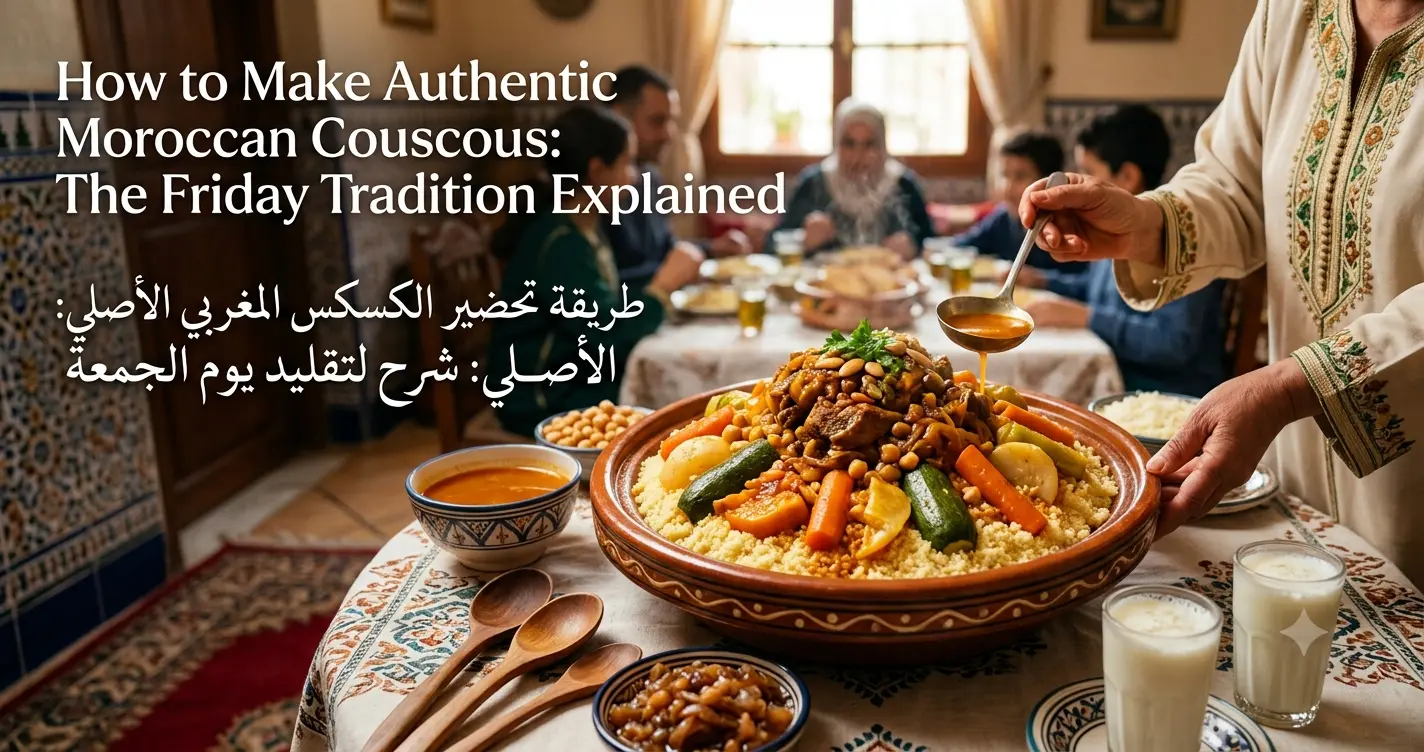
Every Friday, across thousands of Moroccan households — from the winding medinas of Fez and Marrakech to the windswept coastal towns of Essaouira and Agadir — something extraordinary and deeply human happens. Mothers wake before dawn. The sound of water being poured into a couscoussier fills small kitchens. The scent of slow-cooked lamb, caramelized onions, saffron, and warm spices begins to drift through open windows and spill into narrow alleyways. By midday, when the men return from Friday prayers at the mosque, the table is already set, piled high with a mountain of perfectly steamed couscous crowned with braised vegetables and tender meat. This is not just a meal. This is a ritual, a cultural heartbeat, a weekly renewal of family bonds that has been repeating itself for over a thousand years.
If you have ever tasted real Moroccan couscous — not the five-minute box variety, but the kind made with reverence and time — you already understand why UNESCO added it to the Intangible Cultural Heritage of Humanity list in 2020. And if you have not yet experienced it, this guide exists precisely for you. Here at MaCooking, we are deeply committed to preserving and sharing the authentic knowledge of Moroccan cooking, and today, we are going to walk you through everything: the history, the culture, the technique, the ingredients, and the soul of authentic Moroccan couscous.
Grab a cup of mint tea. This is going to take a while — and that, as any Moroccan grandmother will tell you, is exactly the point.
The Sacred Friday Tradition: Why Couscous Is Not Just Food
To understand Moroccan couscous, you must first understand what Friday means in Morocco. In Islam, Friday (Al-Jumu'ah) is the holiest day of the week — the day of congregational prayer, of gathering, of gratitude. And for centuries, Moroccan families have marked this sacred day with a communal meal of couscous. The connection is so deeply ingrained that in Moroccan Arabic (Darija), couscous is often simply called t'aam, which literally means "food" — as if no other dish deserves the title.
The tradition likely dates back to the Berber civilizations of North Africa, where couscous was already a staple long before the arrival of Islam. When Islam spread across the Maghreb in the 7th and 8th centuries, the dish became woven into the fabric of Islamic social life. Scholars believe that the association between Friday prayer and couscous was already well-established by the 11th century, referenced in manuscripts from the Almohad period. The logic was beautifully practical: after the long communal prayer at the mosque, the whole extended family would gather at the home of the eldest, and a single large pot of couscous could feed dozens of mouths with dignity and generosity.
Today, that tradition remains powerfully alive. In Moroccan culture, refusing an invitation to Friday couscous is considered a social slight of the highest order. The dish is not merely sustenance — it is an expression of karam (generosity), of family love, of religious devotion. When a Moroccan host places that heaping platter in the center of the table, they are saying: you are family, you belong here, you are welcome at our table.
"Couscous is not a recipe in Morocco. It is a language. It says: I honor you. I spent my Friday morning thinking of you. Eat, and know that you are loved."
— Fatima, home cook from Fez, age 72
A Brief History of Couscous: From Berber Kitchens to UNESCO Heritage
The origins of couscous are ancient and, like many things in North African history, beautifully contested. The most widely accepted historical evidence places its earliest appearance among the Berber (Amazigh) peoples of the Maghreb — modern-day Morocco, Algeria, Tunisia, and Libya — somewhere between the 9th and 11th centuries CE. Archaeological digs in the Maghreb have uncovered cooking vessels remarkably similar to the modern couscoussier, suggesting the steaming technique is very old indeed.
The word "couscous" itself is believed to derive from the Berber verb seksu, meaning "to roll" or "to shape into small balls" — a direct reference to the hand-rolling technique used to make the grain from semolina flour and water. This etymology is a powerful reminder that couscous is not simply an ingredient you buy in a packet; in its truest form, it is something that human hands create.
Arab traders and travelers spread the dish across the medieval world with remarkable speed. By the 13th century, couscous was being described in cookbooks from Sicily and Andalusia. By the 14th century, a traveler in West Africa wrote of eating it regularly. Today, variations of couscous exist across North Africa, the Middle East, West Africa, Sicily, and increasingly, in the kitchens of food lovers across Europe and North America.
But Morocco has always maintained a singular claim to couscous. Moroccan couscous is distinctive — broader in its grain variety, richer in its spice palette, more elaborate in its accompaniments, and more deeply embedded in social custom than virtually any other regional tradition. When Algeria, Mauritania, Morocco, and Tunisia jointly submitted couscous to UNESCO for heritage recognition in 2020, they were celebrating a shared culinary identity — but Moroccan couscous, with its diversity of styles and its living Friday tradition, stands as perhaps the most developed expression of this ancient dish.
Understanding the Ingredients: What Goes Into Authentic Moroccan Couscous
One of the most important things Western cooks must understand before attempting authentic Moroccan couscous is this: the quality and character of your ingredients will determine everything. Moroccan cooking has never been about hiding mediocre ingredients behind elaborate technique. It is, at its core, about letting exceptional ingredients speak through patient, skilled preparation.
The Couscous Grain Itself
Traditional Moroccan couscous is made from durum wheat semolina that has been hand-rolled with water and then dried. The grains range in size from fine (rfis, used in desserts and sweet preparations) to medium (maftoul, the everyday size) to coarse (berkoukes, used in hearty winter soups). For the classic Friday couscous, medium-grain is standard.
Ideally, you want to source couscous that has been minimally processed — look for brands that specify "100% durum semolina" with no additives. In Morocco, families still hand-roll their own couscous during special occasions; the resulting grain is rougher, more irregular, and utterly incomparable in flavor. If you can find hand-rolled Moroccan couscous at a North African specialty store or online, buy it.
The Protein: Lamb, Chicken, or Beef?
The most traditional and beloved choice is lamb — specifically, bone-in lamb shoulder or lamb shanks. The bones release collagen and deep flavor into the broth that bastes the couscous as it steams. That said, regional variations in Morocco use chicken (especially around Casablanca), beef (more common in the north), and in some Berber communities, dried preserved meats (gueddid) that add a funky, concentrated depth of flavor unlike anything else.
The Seven Vegetables
Moroccan couscous is often described as coming with "seven vegetables," a number that carries symbolic significance in Islamic and Moroccan Berber culture (seven is considered lucky and abundant). The specific seven vegetables vary by region, season, and family tradition, but a classic lineup includes:
- Carrots — cut in large chunks, they sweeten the broth beautifully
- Turnips — earthy and slightly bitter, a classic Moroccan pairing
- Zucchini (courgette) — added later to avoid overcooking
- Cabbage — wedges that absorb the broth and become silky
- Onions — the aromatic foundation of everything
- Chickpeas — soaked overnight and cooked until creamy
- Tomatoes — fresh or lightly preserved, adding acidity and body
Other common additions include pumpkin or butternut squash, sweet potatoes, celery, parsley, and dried raisins (especially in the sweeter Fezi style).
The Spice Profile
Moroccan spicing for couscous is warm, complex, and layered — but never overwhelming. The goal is harmony, not heat. Key spices include:
- Ras el Hanout — Morocco's signature spice blend, which can contain anywhere from 12 to 40 individual spices
- Saffron — genuine Moroccan saffron from Taliouine, dissolved in warm water
- Ground ginger
- Turmeric — for color and earthiness
- Black pepper
- Cinnamon — used sparingly in the broth, more generously in sweet tfaya preparations
- Cumin
- Fresh parsley and cilantro — tied in a bundle and cooked in the broth, then removed
Equipment: The Couscoussier and Why It Matters
Here is where many Western recipes go wrong: they instruct you to simply boil couscous in water or stock, or to pour boiling liquid over it and let it absorb. While this produces an edible result, it is not — let us be completely honest — authentic Moroccan couscous. The defining technique is steaming over the broth, and the vessel that makes this possible is the couscoussier.
Anatomy of a Couscoussier
A couscoussier is a two-part pot that functions as a combined stockpot and steamer. The bottom pot (the gdra) holds the simmering broth, meat, and vegetables. The top pot (the keskes) is a perforated steaming basket that sits snugly above the broth, allowing steam to rise through the holes and cook the couscous from below. Traditionally made of hand-hammered copper or terracotta, modern versions are commonly found in stainless steel.
The critical step that most non-Moroccan cooks omit: you must seal the joint between the two parts of the couscoussier to prevent steam from escaping from the sides. Moroccan cooks do this with a strip of moistened flour-and-water dough, or simply a damp kitchen towel wrapped around the junction. This concentrates the steam and ensures it all passes through the couscous.
Can You Use a Regular Steamer?
Yes, with modifications. A large pasta pot with a steamer insert can work, provided the holes in the steamer are small enough to prevent the couscous from falling through (line it with cheesecloth if needed). You will not get the exact same result as a true couscoussier, but you will get significantly better results than the "pour-boiling-water-over-it" method.
| Method | Authenticity | Texture Result | Effort Level | Best For |
|---|---|---|---|---|
| Couscoussier steaming (traditional) | ★★★★★ | Light, airy, perfectly separate grains | High | Authentic Friday couscous |
| Standard steamer with cheesecloth | ★★★★ | Very good, slightly less airy | Medium-High | Home cooks without couscoussier |
| Boiling water absorption method | ★★ | Denser, grains can clump | Low | Quick weeknight side dish only |
| Instant pot / pressure cooker | ★ | Mushy, wet, gummy | Low | Not recommended for authentic couscous |
The Full Recipe: Authentic Moroccan Friday Couscous with Lamb and Seven Vegetables
What follows is a recipe built from years of experience cooking alongside Moroccan home cooks, market vendors, and family matriarchs. This is not a shortcut recipe. It is the real thing — the Friday tradition in full, rendered as faithfully as possible for a Western kitchen. At MaCooking, we believe that authentic cooking is worth the time it demands.
Ingredients (Serves 6–8)
For the broth and meat:
- 1.5 kg (3.3 lbs) bone-in lamb shoulder, cut into large pieces
- 2 large onions, halved and then sliced into thick half-moons
- 3 tablespoons extra-virgin olive oil
- 2 tablespoons unsalted butter
- 1 teaspoon Ras el Hanout
- 1 teaspoon ground ginger
- 1 teaspoon ground turmeric
- ½ teaspoon ground black pepper
- ½ teaspoon ground cinnamon
- Large pinch of genuine saffron threads, dissolved in 3 tablespoons warm water
- 1 teaspoon fine sea salt (adjust to taste)
- Small bunch of fresh flat-leaf parsley and cilantro, tied together
- 200g (7 oz) dried chickpeas, soaked overnight and drained (or 400g canned, rinsed)
- 2 large tomatoes, quartered
- 3 medium carrots, peeled and cut into 3-inch chunks
- 2 medium turnips, peeled and quartered
- ¼ head of green cabbage, cut into large wedges
- 3 medium zucchini, cut into 3-inch chunks
- 250g (9 oz) pumpkin or butternut squash, cut into large cubes
- 2 liters (8 cups) water
For the couscous:
- 500g (about 3 cups) medium-grain couscous
- 3 tablespoons extra-virgin olive oil or melted butter, divided
- 1 teaspoon fine sea salt
- Approximately 250ml (1 cup) warm salted water, for raking
To finish:
- 2–3 tablespoons unsalted butter, cut into pieces
- Fresh parsley or cilantro leaves for garnish
Step 1: Building the Broth (The Foundation of Everything)
In the bottom pot of your couscoussier, heat the olive oil and butter together over medium-high heat. Add the lamb pieces and brown them on all sides — do not rush this step. Proper browning takes 8–10 minutes and builds a flavor base that no shortcut can replicate. Remove the lamb temporarily and set aside.
In the same pot, add the sliced onions and cook over medium heat, stirring occasionally, until they begin to soften and turn golden — about 8 minutes. Return the lamb to the pot. Add the Ras el Hanout, ginger, turmeric, black pepper, cinnamon, saffron water, and salt. Stir everything together until the meat and onions are coated in the aromatic paste.
Add the tomatoes, the tied herb bundle, the pre-soaked chickpeas, and the 2 liters of water. Bring to a vigorous boil, then reduce the heat to a steady simmer. At this point, you will attach the steaming basket on top and begin cooking the couscous simultaneously. The magic of the couscoussier is that both components cook in conversation with each other — the broth flavors the couscous; the couscous absorbs and softens the steam.
Step 2: The Three-Steam Method (The Heart of the Technique)
This is the step that separates truly exceptional couscous from merely good couscous. Traditional Moroccan couscous is steamed not once, but three times, with raking and aerating in between each steam. This patient, repetitive process is what creates those legendary individual grains that are light as clouds yet substantial enough to hold the weight of the broth.
First Steam (20 minutes):
Place the dry couscous grains in a large wide bowl. Drizzle with 1 tablespoon of olive oil and work it through the grains with your fingers, rolling and separating them so every grain is lightly coated. This initial oiling prevents clumping. Transfer the couscous to the steaming basket (lined with cheesecloth if the holes are too large). Do not pack it — leave it loose. Set the steamer over the simmering broth and seal the joint. Steam uncovered for 20 minutes from the first wisp of steam appearing through the couscous.
First Raking:
Tip the steamed couscous back into your large bowl. It will be hot and somewhat clumped — this is normal. Sprinkle about 80ml (⅓ cup) of lightly salted warm water over the grains, then rake through with a fork, or better yet, work the grains apart with your hands (use a damp cloth or gloves to protect from the heat). Break up every clump. Work methodically. Drizzle another tablespoon of olive oil over the grains and continue raking until you have a bowl of individually separated grains. Allow to rest uncovered for 10 minutes.
Second Steam (20 minutes):
At this point, add the harder vegetables to your broth — carrots, turnips, cabbage, and pumpkin. Return the couscous loosely to the steaming basket and steam for another 20 minutes.
Second Raking:
Repeat the raking process with another splash of warm salted water and more working of the grains. They should be noticeably more separate and lighter now. Add the zucchini to the broth at this stage — it needs only 15–20 minutes and will become mushy if added too early.
Third Steam (15–20 minutes):
Return the couscous for its final steam. By now, the broth should be deeply fragrant, the meat falling from the bone, and the vegetables tender. The couscous grains should emerge from this final steam absolutely fluffy, each grain distinct, with a beautiful tender-firm bite.
Final Raking and Finishing:
Tip the couscous into your large bowl one final time. Add the butter pieces and work them through the hot grains until completely melted and absorbed. Taste for salt. The couscous should be rich, subtly flavored, and impossibly light.
Step 3: Plating — The Moroccan Mound
Authentic Moroccan couscous is always presented as a dramatic mound on a large, deep round platter — the gsaa. Pile the couscous high in the center of the platter, then use a large spoon to create a well in the top of the mound. Arrange the vegetables decoratively around and over the couscous, placing the meat pieces proudly at the top. Ladle some of the broth generously over the entire platter, allowing it to soak down through the couscous. Reserve extra broth in a small bowl or pitcher to serve on the side, because your guests will want more.
Sprinkle with fresh parsley or cilantro leaves. Bring to the table and watch the silence that falls over the room when people see it.
Regional Variations: Morocco's Couscous Is Not One Thing
One of the greatest misconceptions about Moroccan couscous is that it is a single, monolithic dish. In reality, couscous varies dramatically from region to region, and even family to family. Understanding these variations is key to truly knowing this cuisine — something the team at MaCooking has dedicated years to documenting.
| Region | Distinctive Style | Typical Protein | Key Ingredients | Flavor Profile |
|---|---|---|---|---|
| Fez (Fès) | Couscous Tfaya | Lamb or chicken | Caramelized onions, raisins, cinnamon, honey | Sweet-savory, deeply aromatic |
| Marrakech | Couscous with preserved lemon | Lamb | Preserved lemon rind, olives, chermoula | Tangy, rich, complex |
| Casablanca | Couscous Bidaoui | Chicken | Onion sauce, dried fruits, almonds | Sweeter, more refined |
| Souss / Agadir (Berber) | Amlou couscous or barley couscous | Beef or dried meat | Argan oil, wild herbs, root vegetables | Earthy, nutty, rustic |
| Oujda (Eastern) | Spiced meat couscous | Lamb or merguez | Harissa, cumin, hot peppers | Spicier, bolder |
| Coastal regions | Seafood couscous | Fish, shrimp | Chermoula, fennel, tomato | Bright, herbaceous, oceanic |
Couscous Tfaya: The Jewel of Fez
If you want to understand the full magnificence of Moroccan sweet-savory cooking, Couscous Tfaya is your entry point. Tfaya is the name of the extraordinary topping: a slow-cooked mixture of onions, raisins, saffron, cinnamon, honey, and butter that caramelizes over low heat for the better part of an hour until it becomes a jammy, amber-colored, intensely flavored condiment that is spooned over the couscous and meat. The contrast of sweet tfaya against the savory, herb-flecked broth and earthy couscous is one of the great flavor experiences in all of world cuisine. Many who taste it for the first time describe it as revelatory.
Seffa: The Sweet Couscous
Not all Moroccan couscous is savory. Seffa is a beloved dessert preparation in which fine-grain couscous is steamed until incredibly light, then tossed with butter and powdered sugar, topped with toasted almonds, cinnamon, and sometimes vermicelli noodles. It is served at celebrations, weddings, and after major Friday meals — a sweet finale that speaks to Morocco's genius for using the same humble grain in radically different contexts.
Expert Tips: The Secrets That Moroccan Grandmothers Know
After cooking alongside dozens of Moroccan home cooks over the years, certain patterns emerge — small pieces of wisdom that are rarely written down but are passed from grandmother to daughter to granddaughter, generation after generation. Here are the ones that matter most:
- Never skip the oiling step. Working olive oil through the dry couscous before the first steam is non-negotiable. This step is the single greatest differentiator between clumpy and non-clumpy couscous.
- Work the grains with your hands, not just a fork. Forks are useful, but nothing separates hot couscous grains as effectively as human hands working quickly through the mound. Use damp hands or gloves to protect from the heat.
- Your broth should be generous and well-seasoned. The couscous grains absorb flavor from the steam rising from the broth. A flat, under-seasoned broth produces flat couscous. A rich, deeply spiced broth produces extraordinary couscous.
- Do not add vegetables all at once. Hard root vegetables like carrots and turnips need 30–40 minutes. Zucchini needs 15–20 minutes. Add in stages to avoid mushy vegetables.
- Taste and adjust your saffron. Real Moroccan saffron from the Taliouine region has an intensity that commercial saffron often lacks. Start with a generous pinch and adjust from there.
- Finish with cold butter. The final incorporation of butter into the hot couscous creates a silky, unctuous coating that holds the grains together perfectly without making them heavy.
- Serve immediately. Couscous is at its absolute peak the moment it comes off the steamer. Unlike many stews that improve overnight, couscous is a dish that demands to be eaten right now, in good company, with your hands if possible.
- Eat from the communal platter. In the authentic tradition, everyone eats from the same large platter, each person working from their own section without crossing the center. This is not merely a quaint custom — it creates a specific kind of togetherness that individual plates cannot replicate.
Pairing and Serving: What Goes Alongside Friday Couscous
A full Moroccan Friday table is never just the couscous. It is surrounded by a constellation of supporting dishes and drinks that together create a complete sensory experience.
Traditional Accompaniments
- Moroccan mint tea (atay b'naanaa) — always present, poured from a height into small glasses, offered before, during, and after the meal
- Moroccan salads — a rotation of small cooked and raw vegetable salads: zaalouk (smoky eggplant), taktouka (roasted pepper and tomato), carrot salad with cumin and orange, beet salad with preserved lemon
- Khobz — Morocco's extraordinary round bread, fresh from the communal oven (ferran), used to scoop and eat
- Harissa — a small bowl of hot chili paste for those who want heat
- Extra broth — always served in a small pitcher or bowl on the side for spooning over the couscous as desired
- Lben — fermented buttermilk, the traditional Moroccan drink with couscous, excellent for digestion
Frequently Asked Questions About Moroccan Couscous
Q1: Can I use store-bought instant couscous for authentic Moroccan couscous?
Technically, you can — and many busy families in Morocco do use pre-steamed instant couscous as a pragmatic compromise during the week. However, for the authentic Friday experience, you should use non-instant couscous (raw semolina couscous) and follow the three-steam method. The textural difference is not subtle; it is profound. Instant couscous, even when handled with care, has a slightly gummy, uniform texture that lacks the cloud-like airiness of properly triple-steamed semolina couscous. If you want the real experience, invest in the right grain and the time to cook it properly. You will taste the difference immediately, and you will never go back.
Q2: What if I do not have a couscoussier? Can I still make good couscous?
Absolutely, with the right workaround. Your best option is a large pot with a steamer insert or a colander that fits snugly over a large saucepan. Line the steamer with cheesecloth or a clean muslin cloth to prevent the couscous from falling through the holes. Seal the joint between the pot and steamer with a damp kitchen towel, just as you would a couscoussier. Cook your broth and meat in a separate pot, and steam the couscous over a pot of water or diluted broth. Yes, you lose a little of the magic that comes from steaming directly over the flavored broth, but the technique — the three steams, the raking, the oiling — is what matters most, and that technique can be executed with improvised equipment.
Q3: How do I store and reheat leftover Moroccan couscous?
Store the couscous and the broth/vegetables separately in airtight containers in the refrigerator. Couscous will keep for 3–4 days; the broth and vegetables for up to 4–5 days. To reheat the couscous, the best method is to steam it again — place it in a steamer over simmering water for 8–10 minutes, then rake with a fork and add a small knob of butter. Do not microwave couscous if you care about texture; microwaving creates hotspots and uneven steaming that makes the grains rubbery. Reheat the broth and vegetables gently in a pot on the stove, adding a splash of water if needed. Recombine on a fresh platter and it will taste nearly as good as day one.
Q4: How do I make Moroccan couscous vegetarian or vegan?
This is easier than you might think, because the vegetable and chickpea components of Moroccan couscous are already so substantial and flavorful. Simply omit the meat and replace the water with a good homemade vegetable stock (or a Moroccan-spiced broth made from roasted onions, tomatoes, saffron, and the same spice blend). Use olive oil exclusively instead of butter for a vegan version. Double the chickpeas and add a can of white beans for extra protein and heartiness. You may also add preserved lemon rind directly to the broth for a bright acidic lift that helps compensate for the depth that meat provides. Some Moroccan Berber families have been making vegetarian couscous for centuries — this is not a modern adaptation but a living tradition.
Q5: Why does my couscous always clump together, no matter what I do?
Clumping is almost always caused by one of three things: insufficient initial oiling, not enough raking between steams, or using instant couscous with methods designed for raw couscous (or vice versa). Here is a systematic checklist to diagnose your clumping problem: First, are you oiling the dry grains thoroughly before the first steam? Every grain needs to be coated. Second, are you raking with enough force and patience between steams? You need to physically break apart every cluster. Third, are you adding water too aggressively during raking? Add water gradually — too much water at once creates paste, not separate grains. Fourth, is your steam strong enough? The broth below needs to be at a genuine simmer (not a boil, not a gentle bubble — a steady simmer) to generate sufficient steam. Address these four points and your clumping problems should resolve completely.
Couscous and Community: What This Dish Teaches Us About Eating
There is something that happens around a platter of Friday couscous that is difficult to articulate but impossible to miss. The communal nature of the dish — the shared platter, the hands reaching in together, the constant refilling and re-ladling of broth, the passing of the harissa, the pouring of mint tea — creates a social intimacy that individual plated meals simply cannot manufacture. Food writers in the West often talk about "family-style dining" as a trend, as an innovation. In Morocco, it has been the default for a thousand years, and couscous is its greatest expression.
When you make this dish — truly make it, with the time and care and patience it demands — you are participating in something much larger than a recipe. You are performing an act of cultural continuity, of cross-cultural hospitality. You are saying that the people around your table are worth your Friday morning, your full attention, your most skilled cooking. That is, when you think about it, an extraordinary gift to give someone.
This is precisely why MaCooking exists — not merely to share recipes, but to share the meaning behind the recipes, the history and the love and the cultural intelligence that is embedded in every grain of semolina, every dried thread of saffron, every slow-caramelized onion. Moroccan cuisine is one of the world's great culinary traditions, and couscous is its crowning achievement.
Conclusion: Your Invitation to the Friday Table
Making authentic Moroccan couscous for the first time is a commitment. It will take most of your Friday morning. Your kitchen will fill with steam and the extraordinary perfume of saffron and lamb. You will rake hot grains with your hands more times than seems reasonable. You will wonder, at some point in the second steam, whether the result will justify the effort.
It will. Trust the process. Trust the tradition. Trust the thousand years of accumulated wisdom that is encoded in this technique.
When you carry that heaping platter to the table — that dramatic golden mound crowned with glistening vegetables and tender, falling-off-the-bone lamb, fragrant with saffron and warm spice — and you watch your guests go quiet for just a moment before reaching in, you will understand everything. You will understand why Moroccan families have been doing this every single Friday, generation after generation, without interruption, without apology, without any desire to simplify or abbreviate the process.
Some things are worth doing the long way. Moroccan couscous is one of them.
Ready to go deeper into the world of Moroccan cuisine? Explore our full collection of authentic Moroccan recipes, regional guides, spice tutorials, and cultural deep-dives at MaCooking.com — the world's most comprehensive resource for authentic Moroccan cooking. From beginners finding their first recipe to experienced cooks seeking regional nuance, MaCooking is your home in the Moroccan kitchen.
Bsaha wa raha — to your health and comfort. Now go cook.