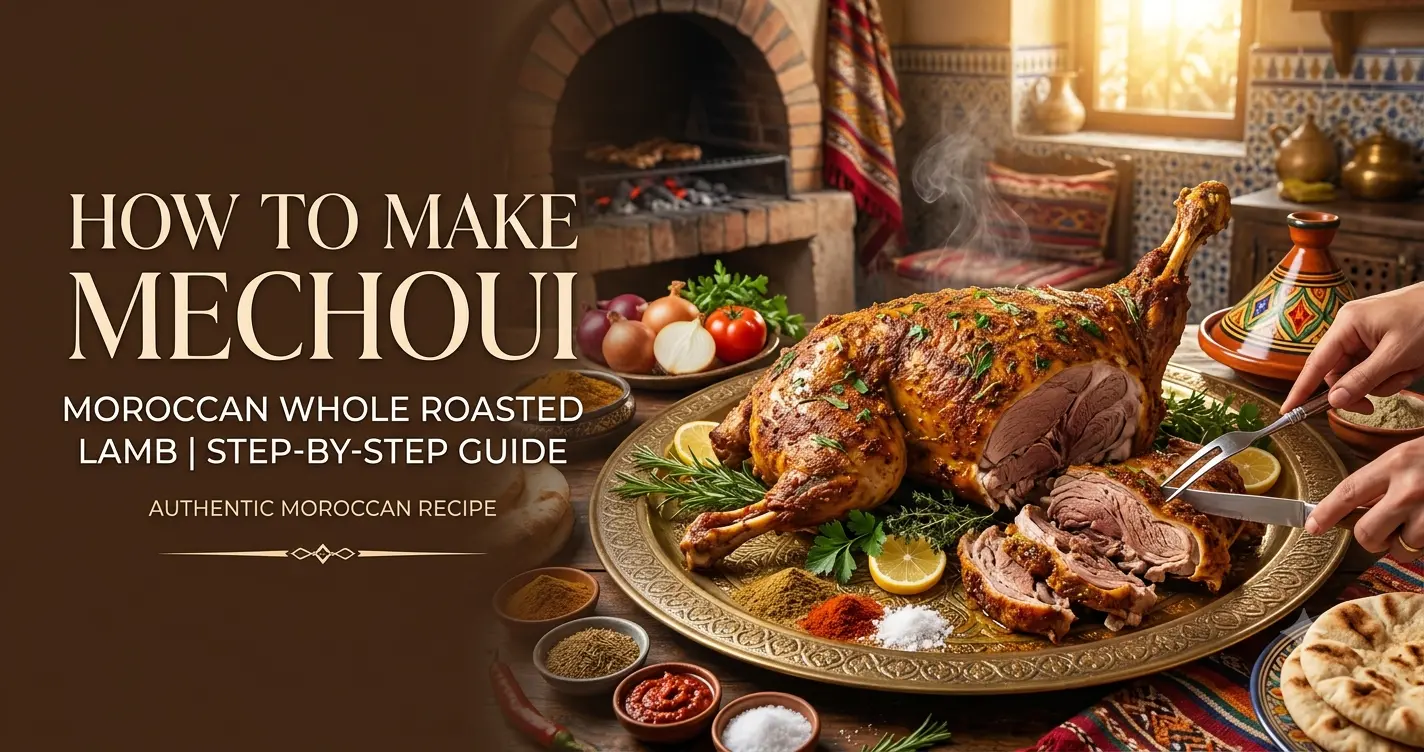
There is a moment — and if you have ever been to a Moroccan celebration, you know exactly the one I mean — when the whole lamb comes off the fire. The skin is a deep, crackled mahogany. The fat underneath has rendered to silk. The meat pulls away from the bone with nothing more than the gentle pressure of your thumb and forefinger. Someone tears off the first piece, dips it into a mound of cumin and coarse salt, and hands it to you with a smile that says this is what food is supposed to be. That dish is Mechoui. And today, I am going to teach you how to make it properly, from the selection of the animal to the last lick of spiced butter from your fingers.
Mechoui is not just a recipe. It is an event, a ritual, a declaration that the people gathered around your table matter deeply to you. Here at MaCooking, we have spent years documenting, testing, and celebrating the full breadth of Moroccan cuisine — and Mechoui sits at the very top of that tradition as perhaps the most theatrical, most beloved, and most technically demanding dish in the entire canon. This guide will give you everything you need to pull it off magnificently, whether you are roasting in a stone pit in your backyard or working with a standard home oven.
Chapter 1: What Is Mechoui? History, Culture, and Why It Matters
The word mechoui (also spelled méchoui in French-influenced writing, or meshwi in some dialects) comes from the Arabic root shawa, meaning to grill or roast over fire. In practice, it refers specifically to a whole lamb — or sometimes a whole sheep — that is slow-roasted until every part of it is cooked to a state of profound, almost miraculous tenderness. The technique has ancient roots across North Africa and the broader Arab world, but Morocco has elevated it into something uniquely its own.
Historically, Mechoui was the food of kings, warriors, and celebrations. In the Berber tradition — the indigenous Amazigh people who form the cultural backbone of rural Morocco — a whole roasted lamb was the centerpiece of any occasion worthy of remembrance: a wedding, the return of a son from abroad, the conclusion of harvest, the welcoming of a respected guest. The act of slaughtering, preparing, and cooking a whole animal was itself a gesture of profound generosity and respect. You did not serve Mechoui to people you were indifferent to. You served it to people you loved.
The dish is inseparable from Eid al-Adha, the Islamic festival of sacrifice, where families across Morocco roast lamb in every possible form — grilled, stewed, minced into kefta — but Mechoui remains the most prestigious preparation. In cities like Fez, Marrakech, and Meknes, whole lambs roast on spits in the medina alleyways for days before and after the feast, the smoke mingling with incense and the sound of celebration. It is also a staple of moussem festivals, the large seasonal gatherings tied to the veneration of local saints, where thousands of people come together and communal Mechoui pits feed the crowds.
What makes Moroccan Mechoui distinct from, say, a Lebanese mashawi or a Tunisian mechoui is the specific spice profile and the cooking philosophy. Moroccan Mechoui is not about smoke or char — it is about slow, patient heat that melts the collagen in the meat while the spiced butter basting creates a lacquered, deeply flavored crust. The goal is meat so tender it dissolves at the touch, wrapped in skin so crisp it shatters. Achieving both simultaneously is the art.
Regional Variations Across Morocco
Even within Morocco, Mechoui is not monolithic. In the Atlas Mountain villages, the lamb is often cooked in an underground pit called a tanour — a clay-lined hole filled with burning wood that is allowed to become a bed of coals before the lamb goes in, wrapped in herbs and sealed with earth. This method produces an almost steam-roasted interior with an intensely smoky crust.
In Marrakech — the city most associated with Mechoui tourism — you will find the famous Mechoui Alley (Souk Ahl Fes) in the medina, where clay ovens built into the walls of narrow passages have been roasting lambs for generations. The butcher-cooks here develop a proprietary spice paste that is their trade secret and their inheritance. In the Saharan south, Mechoui is sometimes prepared with camel instead of lamb, though this is now quite rare. Along the Atlantic coast, olive oil occasionally replaces clarified butter in the baste, giving the skin a slightly different, brighter finish.
Chapter 2: Selecting Your Lamb — The Most Important Decision You Will Make
I cannot stress this enough: Mechoui lives or dies by the quality of your animal. No amount of skilled technique compensates for a poor-quality lamb. This is not a dish that hides its ingredients. Everything is exposed.
What to Look For
- Age: You want a young lamb, ideally between 3 and 6 months old. In Morocco, this is called a kharuf. Younger lambs have more delicate, sweeter meat with less of the pronounced gaminess that turns some Western palates off. If you can find milk-fed lamb (agneau de lait), even better — though this is increasingly difficult outside specialist butchers.
- Weight: For a whole roast, aim for a dressed weight (after slaughter and cleaning, but before the head is removed) of 10 to 14 kilograms (22 to 30 pounds). Too small and it cooks too fast, losing moisture before the collagen breaks down. Too large and achieving even cooking becomes a genuine challenge.
- Fat coverage: Look for a lamb with a thin, even layer of fat over the back and legs. This fat will render and self-baste the meat during cooking. Lambs that are too lean will dry out; lambs that are overly fat will create flare-ups and uneven cooking.
- Breed: In Morocco, the preferred breeds are the Timahdite (from the Middle Atlas, known for exceptionally flavorful meat), the Sardi, and the D'man from the Draa Valley. Outside Morocco, look for breeds with similar characteristics: Dorper, Merino cross, or pasture-raised local breeds are excellent choices. Avoid heavily bred commercial lambs raised in feedlots — the flavor difference is significant.
- Sourcing: In the UK, New Zealand lamb is widely available and excellent. In the US, look for domestic lamb from Colorado or the Pacific Northwest, or imported Australian lamb. In Australia, obviously, you are spoiled for choice. Ask your butcher to order a whole dressed lamb for you — most quality butchers can accommodate this with a few days notice.
Whole Lamb vs. Whole Shoulder
Not everyone has access to a whole lamb, or the cooking equipment to handle one. Here is an honest comparison of your options:
| Option | Serves | Cooking Time | Authenticity | Equipment Needed | Difficulty |
|---|---|---|---|---|---|
| Whole Lamb (10-14kg) | 20-40 people | 4-6 hours | Traditional/Ceremonial | Spit or pit, large outdoor space | Advanced |
| Whole Lamb Shoulder (2-2.5kg) | 4-6 people | 3-4 hours | Very good | Standard oven | Intermediate |
| Whole Lamb Leg (2-2.8kg) | 6-8 people | 2.5-3.5 hours | Good | Standard oven | Easy-Intermediate |
| Half Lamb (5-7kg) | 10-14 people | 3.5-5 hours | Very good | Large outdoor grill or commercial oven | Intermediate-Advanced |
For this guide, I will give you the full instructions for a whole lamb, and I will note clearly where the process adapts for a shoulder or leg preparation. The shoulder is my personal recommendation for Western home cooks making Mechoui for the first time — it delivers authentic results with manageable logistics.
Chapter 3: The Mechoui Spice Blend and Butter Baste — The Soul of the Dish
If the quality of the lamb is the foundation, the spice blend is the architecture. Moroccan Mechoui does not rely on dozens of ingredients — its power comes from a short list used in perfect proportion.
The Traditional Spice Paste (Charmoula Mechoui)
This is not the same charmoula used for fish. This is a richer, more butter-forward paste designed to penetrate deep into the meat and create that signature crust during roasting.
Ingredients for a whole lamb (scale down proportionally for cuts):
- 250g (about 1 cup) of smen — Moroccan preserved butter — or high-quality clarified butter (ghee). This is the base and cannot be substituted with olive oil for authenticity, though a blend of olive oil and butter works in a pinch.
- 3 tablespoons ground cumin (kamoun) — use freshly toasted and ground whole cumin seeds if possible
- 2 tablespoons sweet paprika (felfa helwa)
- 1 tablespoon ground coriander
- 2 teaspoons ground ginger
- 1.5 teaspoons ground turmeric
- 1 teaspoon cayenne pepper (adjust to your heat preference)
- 1 teaspoon ground black pepper
- 1 teaspoon ground cinnamon (this surprises many people, but it adds a subtle warmth that is distinctly Moroccan)
- 8 cloves garlic, grated to a fine paste
- Juice of 1 large lemon
- 1 tablespoon coarse sea salt
- Large handful of fresh flat-leaf parsley, very finely chopped
- Large handful of fresh cilantro (coriander), very finely chopped
Combine everything into a thick, spreadable paste. It should smell extraordinary — deep, warm, aromatic, with that slight edge of heat from the cayenne and the earthiness of the cumin dominating everything.
The Serving Condiment: Cumin-Salt (Mélange Mechoui)
This is almost laughably simple and absolutely essential. In Morocco, every plate of Mechoui is served with a small mound of this mixture, and guests pinch meat directly into it before eating with their fingers.
- 3 parts coarse sea salt
- 2 parts ground cumin, freshly toasted
- Optional: a pinch of cayenne for heat
That is it. Mix them together. Serve in a shallow dish or spread directly on the serving platter alongside the meat. The simplicity is the point — it is there to amplify the lamb, not compete with it.
"In Morocco, a truly great Mechoui needs no sauce. The quality of the lamb, the patience of the cook, and that small pile of cumin-salt tell the whole story. Anything more is distraction."
— Chef Jamal, MaCooking
Chapter 4: Equipment Guide — What You Actually Need
The equipment question is where many home cooks get intimidated and walk away from Mechoui. Let me clear this up definitively.
Traditional Method: Spit Roasting
The most spectacular and authentic approach is the rotating spit over a bed of hardwood coals. In Morocco, the spit (called a shish or âla) is typically a thick iron rod that runs through the entire length of the animal from tail to shoulder. The lamb is trussed to the spit with wire, and the whole assembly rotates slowly — historically by hand, often by a dedicated person whose entire job for several hours is to turn the spit steadily. Modern set-ups use electric or motorized spit mechanisms.
If you want to do this at home, you need:
- A motorized spit roast system with a robust motor (capable of handling 15kg minimum load)
- A fire pit or large barbecue grill long enough to accommodate the lamb — minimum 1.2 meters
- Hardwood charcoal or wood — not briquettes. In Morocco, argan wood and olive wood are traditional; in the West, oak, cherry, and hickory all work beautifully
- A heavy-gauge drip tray positioned beneath the lamb to catch rendered fat (this prevents flare-ups and you can use the drippings for basting)
- A long-handled basting brush
- A reliable instant-read meat thermometer
- Wire or butcher's twine for trussing
Home Oven Method: Surprisingly Authentic
For a whole shoulder or leg, your domestic oven is completely capable of producing a stunning Mechoui. You will need:
- A large roasting pan with a rack (the rack keeps the meat above the rendered juices, allowing the heat to circulate underneath)
- Heavy-duty aluminum foil for the initial slow-roasting phase
- A basting brush or large spoon
- A meat thermometer
- An oven capable of reaching 240°C (460°F) for the final crisping phase
The Moroccan Underground Pit (Tanour Method)
This is for the truly adventurous. The tanour is a clay-lined pit approximately 60-80cm deep and 50cm wide, built in the ground. A fire is lit inside and allowed to burn for 2-3 hours until the walls are scorching and the wood has reduced to coals. The seasoned lamb is then lowered in, and the pit is sealed with a heavy metal plate covered with earth and left for 3-4 hours. The result is extraordinary — but this requires planning, space, and a certain commitment to the craft. If you want to explore this method in detail, MaCooking has dedicated video tutorials and guides for this traditional technique.
Chapter 5: Step-by-Step Mechoui Recipe — The Complete Method
Now we cook. I will give you the full process for a whole lamb on the spit, with oven adaptation notes throughout. This serves approximately 25-35 people as a main course.
Step 1: Preparing the Lamb (Day Before — Allow 24 Hours Minimum)
- Clean and dry the lamb thoroughly. Pat every surface, inside the cavity, and around the legs completely dry with paper towels. Moisture is the enemy of good crust. Let the lamb sit uncovered in a cool space (not the refrigerator — you want the surface to dry further) for at least 1 hour before applying the paste.
- Score the meat deeply. Using a sharp knife, make incisions approximately 4-5cm deep all over the lamb — across the legs, shoulders, along the back, and across the ribs. Space them about 8cm apart. These cuts serve two purposes: they allow the spice paste to penetrate deep into the muscle, and they help the fat render out during cooking.
- Apply the spice paste. Work the butter-spice paste into every inch of the lamb — inside the cavity, deep into every incision, between the legs and body, under any loose flaps of skin. Be thorough and generous. The paste is not a coating; it is an infusion. Use your hands. There is no other way to do this properly.
- Refrigerate, then rest. Wrap the lamb loosely and refrigerate overnight (12-24 hours). Remove from the refrigerator at least 2 hours before cooking to allow it to come to room temperature. A cold lamb going onto the spit will cook unevenly.
Step 2: Setting Up Your Fire
- Light your hardwood charcoal approximately 90 minutes before you plan to start cooking. You need a deep, even bed of coals — no flames, no hot spots, just steady radiant heat. In Morocco, experienced Mechoui cooks say the fire is ready when you can hold your hand 30cm above the coals for no more than 3 seconds.
- Spread the coals in a long, even bed corresponding to the length of the lamb. The heat should be moderate-high at this stage — approximately 180-200°C (355-390°F) measured at the surface of the coals.
- Position your spit supports so the lamb will be approximately 30-40cm above the coals. Too close and the outside burns before the inside cooks; too far and you lose the radiant intensity that creates the crust.
Step 3: Trussing and Spitting the Lamb
- Run the spit rod through the lamb from the rear cavity through to the neck opening, ensuring the rod is centered along the spine. An off-center rod causes uneven rotation and burning on one side.
- Cross the front legs and bind them together tightly around the spit with wire or heavy-duty butcher's twine. Do the same with the rear legs.
- Truss the body of the lamb snugly against the spit at multiple points along the spine. The lamb should feel completely secure — it must rotate as a single unit with the spit.
- Mount the spit in position and connect the motor. Give it a manual test rotation to check balance. If the lamb consistently falls to one side (indicating an imbalanced load), add counterweights or adjust the trussing until the rotation is smooth and even.
Step 4: The Long Roast (4-6 Hours)
- Hour 1-2: The lamb rotates continuously at moderate heat. During this phase, the internal temperature is rising and the connective tissue is beginning to break down. Do not rush this. Every 30 minutes, baste the entire surface of the lamb with additional melted butter (or the drippings from the tray below). This builds up layer after layer of flavor and keeps the skin supple as it dries and begins to crisp.
- Hour 2-4: The skin will begin to take on color — first pale gold, then amber. The internal temperature of the thickest part of the leg should be reaching 65-70°C (150-160°F) around the 3-hour mark. Continue basting every 30-45 minutes. Manage your coals: add fresh coals to maintain steady heat, but avoid surges. In Morocco, experienced Mechoui cooks barely look at a thermometer — they judge by the color of the skin, the sound of the fat rendering, and the way the meat pulls slightly away from the leg bone. That knowledge takes years to develop. Use your thermometer.
- Hour 4-6: The final phase is about achieving that legendary crust. Increase the heat (by adding coals and moving them closer) and baste more frequently — every 20 minutes. The skin will deepen to a rich mahogany and you will hear it crackle and blister. The internal temperature should reach 80-85°C (175-185°F) in the leg and 75-80°C (165-175°F) in the shoulder. At this temperature, the collagen has fully converted to gelatin. The meat will be beyond tender.
Step 5: The Rest and the Reveal
- Remove the lamb from the spit and rest it on a large board or platter for a minimum of 20-30 minutes. Resting is not optional. The muscle fibers need time to relax and the juices to redistribute.
- In the traditional Moroccan service, the lamb is carried to the table whole, often on a large ceremonial platter, and set in the center. The host (or the cook, as a gesture of pride) tears the first piece with their hands and offers it to the most honored guest.
- Serve surrounded by the cumin-salt mixture, fresh flatbread (khobz), and any accompaniments you have prepared.
Oven Method Adaptation: Whole Shoulder
For a 2-2.5kg bone-in whole shoulder, follow the same marinating process. Place on a rack in a roasting pan. Add a cup of water or chicken stock to the bottom of the pan to create steam during the slow phase.
- Phase 1 (Slow Roast): Cover tightly with foil. Roast at 150°C (300°F) for 3 hours, basting with melted butter every 45 minutes.
- Phase 2 (Crisping): Remove the foil. Increase oven to 240°C (460°F). Roast uncovered for 25-35 minutes, basting every 10 minutes, until the skin is deeply bronzed and crackled. Watch it closely — at this temperature, it can go from perfect to burnt in minutes.
- Rest: 15-20 minutes before serving.
Chapter 6: Traditional Sides, Serving Rituals, and Accompaniments
Mechoui is served simply because the lamb does not need competition — but it does need context. Here is how Moroccans traditionally serve the meal.
Essential Accompaniments
- Khobz (Moroccan round bread): The absolute non-negotiable. Moroccan khobz is denser and chewier than French bread, with a slightly nutty, wheaty flavor that makes it perfect for scooping meat. Use it to pick up pieces of lamb rather than a fork.
- Cumin-salt blend: As described above. Always present, always essential.
- Harissa: A spicy chili paste, particularly in northern Morocco and among guests who want heat. A small bowl on the side is welcomed by many.
- Fresh salads: Moroccan tomato-cucumber salad (taktouka), roasted pepper salad (zaalouk), and shredded carrot salad with cumin and lemon are all traditional alongside Mechoui.
- Fresh herbs: A large bunch of fresh mint and flat-leaf parsley on the table is traditional. Guests tear leaves and eat them between bites to refresh the palate.
- Msemen or Rghaif: Flaky, layered Moroccan flatbreads, particularly popular at the start of the meal with butter and honey.
The Serving Ritual
In Morocco, Mechoui is traditionally served on a communal platter placed in the center of a low table, with guests seated around it on floor cushions. Everyone eats with their right hand, using fingers and bread to pull the meat. There is no formal plating, no individual portions distributed by a server. The communal nature of the meal is itself part of the dish — the shared pulling apart of something that was cooked together, the negotiation of the choicest morsels offered to elders and honored guests.
If you are serving Western guests who are not used to eating this way, set up a communal platter in the center of the table and encourage people to pull the meat with their hands — briefly explain the tradition. Most people immediately love it. It is deeply convivial.
Drinks Alongside Mechoui
Moroccan tradition calls for no alcohol. Instead, you will find pitchers of chilled water with slices of lemon, and glasses of Moroccan mint tea served throughout the meal and emphatically at the end. For Western guests who want wine, I will not pretend that a robust red — a Syrah, a Grenache, or a Moroccan wine from the Meknes or Benslimane appellation — does not pair beautifully. But the meal is complete without it.
Chapter 7: Troubleshooting, Expert Tips, and Common Mistakes
Common Mistakes and How to Avoid Them
| Mistake | What Goes Wrong | How to Fix It |
|---|---|---|
| Not marinating long enough | Spice flavor stays on the surface; interior meat tastes bland | Always marinate a minimum of 12 hours; 24 hours is better |
| Cooking at too high heat from the start | Skin burns before interior reaches temperature; chewy, tough meat | Start low and slow; increase heat only in the final 45-60 minutes |
| Skipping the resting period | Juices run out immediately when cut; dry, stringy meat | Rest for at least 20 minutes, covered loosely with foil |
| Insufficient scoring of the meat | Spice paste does not penetrate; uneven cooking | Score deeply and generously — at least 4-5cm deep cuts throughout |
| Irregular fire/coal management | Hot spots cause burning on one side; raw sections on the other | Monitor and redistribute coals every 30-40 minutes; maintain even heat |
| Using cheap or poor-quality butter | Baste burns quickly and lacks flavor depth | Use genuine smen, quality ghee, or at minimum European-style cultured butter |
| Not bringing lamb to room temperature before cooking | Uneven cooking; cold interior when skin is already over-cooked | Remove from refrigerator 2 hours before cooking without exception |
Expert Tips from Years of Mechoui Experience
- Toast your spices. Dry-toast the cumin seeds in a pan for 90 seconds before grinding. This activates volatile aromatic oils that make a significant difference in the final flavor. This is one of those small details that separates a good Mechoui from an extraordinary one.
- Reserve some basting paste. Keep back about a quarter of your spice paste and warm it in a small pot as the lamb cooks. Use this fresh paste (rather than the drippings, which are excellent but have been through the fire) for the final two bastings. It gives a bright, vivid flavor on top of the deeper roasted notes built up over hours.
- The skin must be bone dry before the paste goes on. Any moisture between the skin and the paste will steam rather than crisp. Pat. Pat again. Then pat once more.
- Do not fear the darkness of the skin. Many first-time Mechoui cooks panic when the skin turns very dark and move the lamb away from the heat or cover it. The dark color is correct. As long as it does not smell acrid or burnt, and as long as your thermometer confirms the interior is cooking properly, keep going.
- Learn from the sound. A properly cooking Mechoui sizzles steadily. A rapid spitting and hissing often means fat is dripping onto live flames — manage your fire. Silence suggests the heat has dropped too low — add coals.
For more expert techniques, flavor profiles, and the science behind slow roasting, the team at MaCooking has developed an extensive library of guides covering everything from spice sourcing to temperature control in traditional Moroccan cooking methods.
Chapter 8: Mechoui for the Modern Home Cook — Adaptations and Scaling
I want to be genuinely practical here, because most people reading this do not have a spit rig in their garden or 40 friends coming for Eid. Here is how to adapt Mechoui to real Western home-cooking situations without sacrificing what makes the dish special.
The Apartment Cook's Mechoui: Whole Shoulder in the Oven
A bone-in whole shoulder prepared with the full Mechoui spice paste, slow-roasted for 3 hours and then blasted at high heat for 30 minutes, is genuinely one of the most impressive things you can serve at a dinner party. It serves 4-6 people, fits in any standard oven, costs a fraction of a whole lamb, and takes the same methodical approach to marinating and cooking. The flavor is not identical to spit-roasted whole lamb — nothing replaces that — but it is unmistakably Mechoui.
The Weekend Warrior: Half Lamb on a Kettle Grill
A large kettle-style charcoal grill with a rotisserie attachment can handle a half lamb (5-7kg) with excellent results. Set up for indirect heat — coals on both sides with a drip pan in the center — and let the rotisserie do the work. The cooking time is approximately 3.5-4.5 hours. This is a fantastic compromise between the full ceremonial whole lamb and the oven-only approach, and it gives you that irreplaceable wood-smoke and rendered-fat aroma.
Scaling the Recipe for Small Gatherings
For 2 people: bone-in lamb chops prepared with Mechoui spice paste, marinated overnight and cooked on a cast iron skillet or outdoor grill. Not traditional, but the flavor profile is entirely authentic and the result is spectacular. Reduce the spice paste proportionally and use approximately 2 tablespoons of paste per 500g of meat.
Frequently Asked Questions About Mechoui
Q1: Can I make Mechoui without a spit roaster? Does oven Mechoui taste authentic?
Absolutely, you can make a genuinely excellent Mechoui in a standard oven. The honest answer is that spit-roasted whole lamb has a depth of smoky, caramelized character from the open fire that an oven cannot fully replicate. But the spice paste, the slow-roasting technique, the basting method, and especially that final high-heat blast to crackle the skin — all of these produce a result that is unmistakably Mechoui in flavor and texture. Many Moroccan families living in apartments across Casablanca, Paris, and Montreal make Mechoui in the oven regularly and it is absolutely delicious. If you want the full outdoor experience but do not have a spit, a kettle grill with a rotisserie attachment is a great middle ground.
Q2: What is smen and do I really need it, or can I use regular butter?
Smen is a Moroccan preserved, fermented butter with a distinctly funky, deep flavor somewhat analogous to aged ghee. It is made by salting, washing, and ripening butter over weeks or months, sometimes packed in clay jars with dried thyme. Its flavor contribution to Mechoui is significant — it adds a savory complexity that regular butter cannot duplicate. That said, if you cannot find smen (look in Moroccan, North African, or Middle Eastern grocery shops), high-quality ghee is the best substitute. European-style cultured butter is a solid third option. Regular commercial butter will work but the depth of flavor will be slightly diminished. MaCooking has a complete guide to making your own smen at home, which I strongly recommend if you plan to cook Moroccan food regularly.
Q3: What internal temperature should Moroccan Mechoui reach? Is it served pink or well-done?
This is a culturally interesting question. In Morocco, Mechoui is traditionally cooked to what Western food safety guidelines would call well-done — an internal temperature of 80-85°C (175-185°F) in the thickest part of the leg. At this temperature, all collagen has converted to gelatin, which is why the meat falls off the bone with such ease. This is not overcooked in the Western sense — it is properly cooked for slow-roasted lamb, and the result is meltingly tender rather than dry precisely because of the long, low-temperature phase. Unlike a quick-roasted leg of lamb where medium-rare might be desirable, Mechoui is an entirely different style of cooking where higher final temperatures are correct and intentional.
Q4: How far in advance can I prepare the lamb, and how do I store leftovers?
The spice paste can be applied up to 36 hours before cooking — beyond that, the acid in the lemon juice begins to break down the surface proteins in a way that can affect texture. For the cooked lamb, leftovers should be stored in an airtight container and refrigerated within 2 hours of serving. Properly stored, cooked Mechoui will keep for 3-4 days in the refrigerator. Reheating is best done gently in a low oven (140°C / 275°F) with a splash of water in the bottom of the pan and covered with foil — this prevents it from drying out. Leftover Mechoui meat makes extraordinary sandwiches in Moroccan khobz, or shredded into a harira soup, or tossed into a couscous with roasted vegetables.
Q5: What are the most common side dishes served with Mechoui in Morocco, and what should I serve alongside it for a Western dinner party?
For a Western dinner party, I recommend building a mezze-style spread around the Mechoui rather than treating it like a single-protein Western main. Start with small bowls of Moroccan-spiced olives, cumin-spiced carrot salad, taktouka (roasted tomato and pepper salad), and warm khobz bread. Then bring out the Mechoui as the dramatic centerpiece. Serve alongside a simple salad of sliced tomatoes with olive oil and flat-leaf parsley. Finish with fresh seasonal fruit, Moroccan mint tea, and if you want to go all out, a plate of chebakia or briouates for dessert. This format — the lamb as centerpiece surrounded by smaller vegetable preparations — mirrors exactly how the meal is structured in Morocco and creates a stunning, convivial table that Western guests will talk about for years.
Conclusion: Bringing the Fire of Morocco to Your Table
Mechoui is one of those dishes that reminds you why cooking matters. It demands time, patience, attention, and genuine care. It rewards you with something that goes far beyond nutrition — a meal that creates memory, that pulls people closer together around a table (or a fire), that carries within it centuries of Moroccan culture and generosity and celebration.
Whether you roast a whole lamb on a spit in your backyard for forty people, or slow-roast a single shoulder in your apartment oven for a dinner party of four, the spirit of the dish is the same. Cook it with patience. Season it generously. Baste it faithfully. Rest it long enough. And serve it with your hands.
The technique takes practice. Your first Mechoui may not be perfect — and that is entirely fine. The Moroccan cooks who make this dish effortlessly have been doing it since childhood, watching their fathers and grandfathers manage fires and judge doneness by touch and smell and the particular color of a piece of skin at a particular moment in a particular light. You will get there. Each attempt builds knowledge that no written guide can fully replace.
If you want to go deeper into the world of authentic Moroccan cooking — the full canon of tagines, couscous traditions, pastilla, harira, preserved lemons, fermented butter, and every regional variation of dishes like this one — MaCooking is the most comprehensive resource available in the English-speaking world. We have recipes tested in Moroccan home kitchens and professional restaurants alike, cultural context that helps you understand not just the how but the why of every dish, and a community of passionate cooks from Morocco and around the world who share this love of one of the greatest culinary traditions on earth.
Now go build your fire. The lamb is waiting.