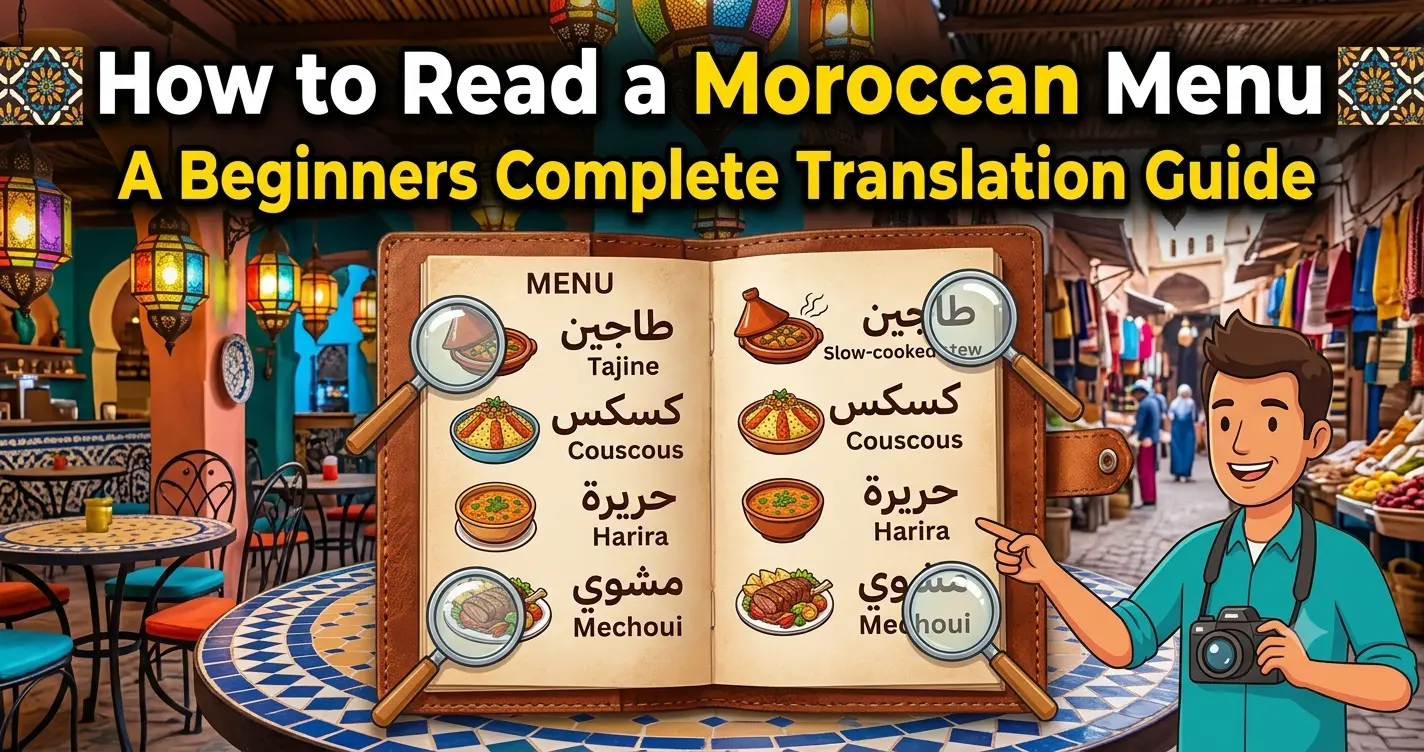
You are sitting at a low cedar-wood table somewhere in the medina of Fez or Marrakech. The walls are tiled in hand-painted zellige, incense drifts through the air, and a waiter has just handed you a menu that looks like a beautiful riddle. Words like bastilla, mrouzia, harira, and seffa stare back at you, and the only thing you recognize is the word "couscous." This is one of the most common moments of joyful panic that Western travelers experience in Morocco — and it happens even in restaurants that have English translations, because the translations themselves often raise more questions than they answer. What exactly is a "pastry filled with pigeon and almonds"? Why does the menu list seven different tagines? And what on earth is a "rfissa"?
I have spent the better part of two decades cooking in and studying Moroccan kitchens — from the humble street stalls of Casablanca to the grand palace restaurants of Fez — and I can tell you with complete confidence: once you understand the logic behind Moroccan cuisine, the menu stops being a mystery and becomes an invitation. That is exactly what this guide is designed to do. Consider it your personal culinary translator, your pocket-sized Rosetta Stone for the Moroccan table. By the time you finish reading, you will not only know what every major dish is — you will understand why it exists, what it tastes like, when Moroccans eat it, and how to order it in a way that earns you a nod of genuine respect from the kitchen.
At MaCooking, we have built the world's most comprehensive resource for authentic Moroccan cuisine, and this guide reflects the depth of knowledge that our platform is built on. Let's get into it.
Chapter 1: Understanding the Structure of a Moroccan Meal
Before you can read a Moroccan menu, you need to understand that Moroccan dining does not follow the Western appetizer-entree-dessert model in any straightforward way. A traditional Moroccan meal is an experience structured around generosity, abundance, and ritual — and most restaurant menus in Morocco, especially the better ones, are designed to reflect this structure even in a simplified form.
The Traditional Moroccan Meal Sequence
In a proper Moroccan home or a high-end restaurant, a meal might unfold in the following stages:
- Mint tea and bread — Almost every meal, formal or informal, begins with a glass of sweet mint tea (atay b'nana) poured from a theatrical height and accompanied by warm khobz, the round, slightly crusty Moroccan flatbread that serves as both utensil and companion to every dish.
- Salads (salata) — Not a single green salad but a parade of small cooked and raw vegetable dishes. These are closer to what Spaniards call tapas or what Middle Easterners call mezze. Expect five to twelve small plates appearing simultaneously.
- Soup (chorba) — Particularly in cooler months and during Ramadan, a warming soup like harira or bissara may appear before or alongside the salads.
- The main course (tajen or kesra) — A single grand dish, usually a tagine or couscous, served in the center of the table for communal eating.
- Fruit and sweets (halwa) — Fresh seasonal fruit, followed by honey-drenched pastries like chebakia or briouats.
- Closing mint tea — The meal ends as it began, with tea.
Most restaurant menus condense this structure significantly, but understanding the original rhythm helps you interpret what each section of the menu actually represents.
How Menus Are Organized
In tourist-facing restaurants, you will typically see menus divided into: Soupes & Salades (Soups & Salads), Plats Principaux (Main Courses), and Desserts. In Arabic-language menus — more common in local spots off the tourist trail — you will see: Shorbat (soups), Salata (salads), Aklat Raisiyya (main dishes), and Halawiyyat (sweets). Many menus in Morocco are trilingual — Arabic, French, and English — because of Morocco's colonial history with France and its thriving tourism industry.
"In Morocco, the table is never just about food. It is about welcome. When you understand the language of our menus, you understand the language of our hospitality."
— Chef Jamal, MaCooking Culinary Director
Chapter 2: The Salads Section — More Than You Think
The word "salad" on a Moroccan menu is almost laughably inadequate for what you are about to receive. Western diners consistently make the mistake of ordering a salad as a light starter and then finding themselves unable to eat their main course because the salads alone constituted a full meal. Consider yourself warned — and delighted.
Common Moroccan Salads and What They Actually Are
| Menu Term | What It Is | Key Flavors | Served |
|---|---|---|---|
| Zaalouk | Cooked eggplant and tomato dip, smoky and rich | Cumin, paprika, garlic, olive oil | Warm or room temperature |
| Taktouka | Roasted green pepper and tomato salad | Garlic, cumin, olive oil, fresh herbs | Room temperature |
| Salade Marocaine | Finely diced tomato, cucumber, onion, parsley | Lemon, cumin, olive oil | Fresh, cold |
| Loubia | Stewed white beans in tomato sauce | Cumin, paprika, parsley | Warm |
| Maakouda | Fried potato cakes | Herbs, garlic, egg-bound | Hot, crispy |
| Khoubiza | Cooked wild mallow leaves | Garlic, olive oil, lemon | Warm |
| Carotte à la Marocaine | Cooked carrots in chermoula dressing | Cumin, harissa, lemon, coriander | Room temperature |
| Slada Jelbana | Fresh pea and preserved lemon salad | Mint, olive oil, lemon | Cold or room temperature |
Notice something? Most of these "salads" involve cooking. This is a fundamental difference from Western salad culture. Moroccan salads are cooked vegetable preparations, seasoned with spice blends and olive oil, and served as a collective opening ceremony for the meal. When a menu says "assorted Moroccan salads" and lists a price, you are typically getting five to eight of these small dishes brought to your table simultaneously.
The Bread Situation
You will always receive khobz — round, semi-leavened Moroccan bread — with your salads. In some restaurants, particularly in the north near Tetouan, you might also receive msemen (a flaky, layered pan bread similar to a Moroccan crepe) or harcha (a semolina flatbread with a cornbread-like texture). These are not side dishes you pay extra for. They are fundamentally part of the meal and are used to scoop salads and sauces in place of or alongside utensils.
Chapter 3: Soups — The Soul of the Moroccan Table
If salads are the welcome handshake of a Moroccan meal, soups are the warm embrace that follows. Moroccan soups are not delicate broths or thin starters. They are substantial, warmly spiced, deeply nourishing preparations that have sustained families through cold Atlas Mountain winters and long Ramadan fasting days for centuries.
The Big Three: Harira, Bissara, and Chorba
Harira is the queen of Moroccan soups and arguably the most important single dish in the national culinary canon. It is a rich, slightly thick soup built on a base of tomatoes, lentils, and chickpeas, flavored with a fresh herb paste called tdouira (a blend of coriander, parsley, celery, and sometimes ginger), thickened at the end with a flour-and-water slurry called taouabane, and brightened with a squeeze of fresh lemon. During Ramadan, harira is the dish that breaks the fast at every table in Morocco. If you see it on a menu, order it. It is almost always extraordinary.
Bissara is a humbler, deeply comforting soup made from dried fava beans or split peas, blended smooth, and finished with a generous drizzle of olive oil, cumin, and hot paprika. It is the working person's breakfast and midday meal in northern Morocco, particularly in cities like Chefchaouen and Oujda. In a restaurant setting, you might find it listed as a starter or a light lunch option.
Chorba is a catch-all term for broth-based soups that vary enormously by region and season. A Chorba Bidaoui (from Casablanca) will taste completely different from a Chorba Fassia (from Fez). When you see just "chorba" on a menu without further description, ask the waiter what is in today's version. This is not an unusual question — it shows you are paying attention.
Other Soups You May Encounter
- Lben Soup — A tangy soup made with buttermilk, sometimes served during weddings and celebrations
- Shorba Frik — A fragrant soup made with green wheat (frik), popular in eastern Morocco near the Algerian border
- Shrimp Bisque (Marinated Coast) — In coastal cities like Essaouira and Agadir, seafood bisques appear on menus, reflecting the Atlantic influence on local cooking
Chapter 4: The Main Event — Tagines, Couscous, and Everything Between
This is where most Western visitors feel the most overwhelmed — and where getting it right matters most. The main course section of a Moroccan menu can list anywhere from five to thirty dishes, and many of them seem to involve the same ingredients arranged in slightly different configurations. Let me break this down in a way that will actually help you make a decision at the table.
Understanding Tagines
A tagine (spelled tajine in French, tajen in Darija, the Moroccan Arabic dialect) refers to two things simultaneously: the distinctive conical earthenware pot with a chimney-like lid, and the slow-cooked stew prepared inside it. The conical lid creates a self-basting cycle — steam rises, condenses on the inside of the cone, and drips back down over the meat and vegetables, keeping everything extraordinarily moist without needing added liquid. This technique has been refined in Morocco for over a thousand years, and it is the reason a good tagine has a sauce that is dense, intensely flavored, and almost syrupy — completely unlike a Western braise or stew.
When you see "tagine" followed by additional words on a menu, those words describe the flavor profile or the main protein-and-accompaniment combination. Here are the most common ones decoded:
| Tagine Name on Menu | Main Protein | Key Accompaniments | Flavor Profile |
|---|---|---|---|
| Tagine Poulet Citron Olives | Chicken | Preserved lemon, green olives | Tangy, savory, deeply aromatic |
| Tagine Agneau Pruneaux | Lamb | Prunes, almonds, sesame | Sweet-savory, warming spices, rich |
| Tagine Kefta Maqdour | Spiced ground beef meatballs | Tomato sauce, eggs | Rustic, spicy, hearty |
| Tagine Merguez | Spiced lamb sausages | Peppers, tomatoes | Bold, smoky, spicy |
| Tagine L’Ham Maamar | Whole lamb shoulder | Almonds, raisins, onion confit | Festive, complex, sweet-savory |
| Tagine Poisson Chermoula | Fish (often sea bass or grouper) | Chermoula marinade, vegetables | Herby, tangy, lighter |
| Tagine L’Ham Kdra | Lamb | Chickpeas, onions, saffron-butter sauce | Delicate, buttery, elegant |
| Tagine Djaj Mhammar | Whole roasted chicken | Onion, honey, ginger, saffron | Caramelized, golden, warming |
A note on ordering tagines in traditional restaurants: in many older medina restaurants, tagines are cooked to order over charcoal in the conical pot. This means they take 45 minutes to an hour. This is not slow service — it is correct service. Some high-end restaurants will let you know the wait time when you order. Embrace it. Order your salads, drink your tea, and let the kitchen do its work.
Couscous — Friday's Sacred Dish
Couscous is one of Morocco's most profound culinary contributions to the world, and if you have only ever eaten the quick-cook couscous from a supermarket box, what you will find in Morocco will be a revelation. Moroccan couscous is hand-rolled from semolina, steamed multiple times in a two-tiered pot called a couscoussier, and fluffed with butter to achieve a texture that is simultaneously light and rich, each grain separate, together forming a cumulus cloud of grain.
Friday is couscous day in Morocco — a tradition tied to the weekly Friday prayer at the mosque, after which families return home to share a grand couscous lunch. Many restaurants only serve their full couscous menu on Fridays. If you are visiting Morocco and you are there on a Friday, make couscous your lunch. This is not negotiable advice.
On the menu, couscous is often listed as:
- Couscous Royal — The grand, celebratory version with multiple meats (lamb, merguez, chicken), seven vegetables, and abundant broth served on the side
- Couscous Tfaya — Topped with caramelized onions and raisins, served with a braised chicken or lamb, extraordinarily sweet and aromatic
- Couscous Khodra — Vegetarian version with seven vegetables (carrot, turnip, zucchini, pumpkin, cabbage, chickpeas, and one more depending on season) in a light vegetable broth
- Couscous Bidaoui — The Casablanca style, with tfaya onion confit, milk, and sometimes dried fruit; a sweeter, richer preparation
- Seffa — Sweet couscous or vermicelli dusted with powdered sugar and cinnamon, served with warm milk and sometimes raisins; more dessert than main course, though it can appear in either section
Bastilla — The Dish That Surprises Everyone
Bastilla (also spelled b'stilla, pastilla, or bisteeya) is perhaps the single most astonishing dish in the Moroccan culinary repertoire, and it is the one that Western diners most often misunderstand when they see it on a menu. The menu description — "pigeon pie with almonds and cinnamon" — sounds strange. It is, in fact, extraordinary.
Bastilla is a layered pie made with warqa, a tissue-thin pastry that predates phyllo and is hand-made by slapping balls of wet dough against a heated surface in overlapping circles. The filling traditionally consists of slow-cooked pigeon (or chicken, in modern versions) shredded with saffron, ginger, and onion, combined with a custard of beaten eggs cooked in the braising juices, and a layer of crushed almonds toasted in butter with sugar and cinnamon. The whole construction is enclosed in warqa, baked golden, and finished with a dusting of powdered sugar and a crisscross pattern of cinnamon. The combination of savory, sweet, crispy, and custardy is not an accident — it is one of the most deliberate and sophisticated flavor architectures in world cuisine, with roots in Andalusian cooking brought to Morocco by Muslims expelled from Spain in 1492.
Modern menus also feature seafood bastilla — typically a filling of shrimp, fish, and vermicelli in a creamy sauce — which is popular along the Atlantic coast and in Casablanca. If you see bastilla on a menu, in either form, order it. You can always learn to make it at home later with help from MaCooking's detailed recipe guides.
Other Main Dishes You Will Encounter
- Mechoui — Whole lamb slowly roasted in a pit or clay oven until the meat falls off the bone and the skin crackles. Often requires advance ordering or is a special occasion dish. In Marrakech's Djemaa el-Fna square, you will find mechoui sellers with whole sheep on display.
- Tanjia — The bachelor's dish of Marrakech. Lamb or beef slow-cooked in a sealed clay vessel (also called a tanjia) with preserved lemon, saffron, smen (aged fermented butter), and cumin, then taken to the local hammam furnace to cook for hours in the residual heat. If you see it on a menu in Marrakech, it is authentic and special.
- Rfissa — A deeply comforting dish of chicken cooked with fenugreek seeds, lentils, and ras el hanout, served over torn pieces of msemen or trid (another thin flatbread) that have absorbed the magnificent braising liquid. Traditionally served to mothers after childbirth to aid recovery.
- Mrouzia — A lamb tagine cooked with ras el hanout, honey, raisins, and almonds into a very sweet, sticky, preserve-like texture. Traditionally prepared for Eid al-Adha. Finding it on a regular restaurant menu is a sign the kitchen takes its traditions seriously.
Chapter 5: The Spice Language — Understanding What Flavors You Are Ordering
One of the most practical skills for reading a Moroccan menu is understanding the spice and seasoning terminology that appears repeatedly across different dishes. Moroccan cuisine uses spices with extraordinary sophistication — not to create heat (Moroccan food is rarely very spicy by, say, Thai or Indian standards) but to build layers of warmth, fragrance, and complexity.
Key Flavor Terms on Moroccan Menus
- Chermoula — A marinade and sauce made from fresh coriander, parsley, garlic, cumin, paprika, preserved lemon, and olive oil. Used primarily with fish and seafood but also with vegetables. When you see "chermoula" on a menu, expect a herby, vibrant, slightly tangy dish.
- Ras el Hanout — Literally "head of the shop," this is a complex spice blend that can contain anywhere from 10 to 100 different spices depending on the spice merchant. Common ingredients include cardamom, rose petals, cinnamon, mace, nutmeg, and various peppers. It creates warm, floral, complex flavors.
- Harissa — A hot chili paste, more commonly associated with Tunisian cooking but present in Morocco, especially in the north and east. When listed on a menu, it signals heat and intensity.
- Smen — Aged, fermented butter with a sharp, funky flavor similar to blue cheese. Used in certain traditional dishes like tanjia and some couscous preparations. If you dislike strong flavors, be aware of its presence.
- Argan oil — Morocco's liquid gold, pressed from the nuts of the argan tree found only in the Sous region. In culinary form (not cosmetic), it has a deep, nutty, roasted flavor. You will see it listed as a finishing oil on salads, over amlou (a paste of argan oil, almonds, and honey), and in some upscale preparations.
- Preserved lemon (citron confit / hamad m'rakad) — Lemons cured in salt for weeks or months. The flavor is intense, salty-sour, and unmistakably Moroccan. A fundamental ingredient in the classic chicken tagine.
A Note on Heat Level
Many Western diners assume Moroccan food will be spicy-hot. In the chili-pepper sense, it generally is not. The spices are warming and aromatic rather than fiery. However, harissa served as a condiment can be quite hot, and certain regional dishes — particularly from the eastern regions bordering Algeria — carry more heat. If you are sensitive to chili heat, simply ask: "Wach kayen l-felfla harra?" (Is there hot pepper in this?) — a question that any Moroccan waiter will understand and appreciate.
Chapter 6: Street Food Terms on Casual Menus
Beyond the formal sit-down restaurant, Morocco has one of the world's great street food cultures. Many casual cafes and lunch spots — especially the kind you will stumble into off the tourist trail — offer simplified menus built around street food staples. These are some of the best meals you will eat in Morocco, and they cost a fraction of what a tourist restaurant charges.
Essential Street Food You Will See on Casual Menus
- Brochettes — Skewered and grilled meat, either minced and herb-spiced (kefta brochettes) or cubed lamb or beef. Served with bread, salad, and harissa. The Moroccan answer to fast food and absolutely delicious.
- Msemen / Meloui — Layered, flaky flatbreads griddled in a pan. Msemen is square and slightly crispy; meloui is round and softer, more layered. Eaten for breakfast with butter and honey, or served alongside savory dishes.
- Batbout — A soft, pita-like bread cooked in a pan, often split and stuffed with kefta, cheese, or egg for a quick sandwich.
- Sandwich Merguez — A baguette split and filled with grilled merguez sausages, harissa, fries, and sometimes egg. The influence of the French baguette on Moroccan street food culture is fascinating and delicious.
- Maaqouda Sandwich — A baguette stuffed with fried potato cakes and harissa. Cheap, filling, surprisingly good.
- Snail Soup (Ghlal / Escargot) — Small land snails cooked in a broth flavored with a remarkable mixture of over a dozen herbs and spices including thyme, pennyroyal, licorice root, and caraway. Sold from steaming street carts in Marrakech. Do not be alarmed by the menu listing — it is wonderful.
- Baghrir — Often called "thousand-hole pancakes," these are spongy, yeast-risen semolina pancakes cooked only on one side, creating a surface full of tiny holes that absorb butter and honey beautifully. A breakfast staple.
For deep dives into any of these dishes — including step-by-step recipes and the cultural stories behind them — MaCooking is the most thorough resource available online in English for authentic Moroccan food.
Chapter 7: Desserts and Sweets — The Sweet End
Moroccan desserts require a small recalibration of expectations. The formal "dessert course" in the Western sense is not deeply embedded in traditional Moroccan dining culture — the meal typically ends with fruit, then tea and pastries. However, Moroccan pastry culture is extraordinary, and most tourist-facing restaurants have adapted their menus to include a sweets section.
What to Order
- Chebakia — Sesame-studded fried pastry shaped into a flower, then soaked in honey and orange blossom water. Chewy, intensely sweet, unmistakably Moroccan. Prepared in vast quantities during Ramadan.
- Briwat / Briouats au Amandes — Triangular or cylindrical pastries of warqa dough filled with almond paste flavored with orange blossom, fried, and dipped in honey. The almond version is the most common; you also find versions filled with kefta (savory, served as a starter) or shrimp.
- Ghoriba — Crumbly shortbread-style cookies made with almonds or sesame, with a distinctive cracked surface. The Moroccan equivalent of the butter cookie.
- Seffa Medfouna — Steamed vermicelli or couscous under a mound of powdered sugar, cinnamon, and sometimes butter, with chicken or lamb buried inside ("medfouna" means "buried"). A revelatory sweet-savory combination.
- Amlou — A thick paste of roasted almonds, argan oil, and honey, served with bread. Often listed as a starter or accompaniment, but it functions as a luxurious sweet spread.
- Orange à la Cannelle — Simply: fresh orange slices with cinnamon and sometimes orange blossom water. Do not underestimate this. The navel oranges of Morocco are exceptionally sweet and fragrant, and this simple preparation is a perfect ending to a rich meal.
Chapter 8: Drinks — What to Order and What to Know
Morocco is predominantly a Muslim country, and alcohol is treated differently here than in Western countries. Understanding the drinks section of a Moroccan menu saves awkward moments.
- Atay b'nana (Mint Tea) — The national drink. Sweet green tea poured from a height to create froth, flavored with fresh spearmint and sugar. Never refuse a glass of mint tea offered to you in Morocco — it is an act of welcome.
- Jus d'Orange Frais — Freshly squeezed orange juice, pressed on the spot from Moroccan navel oranges. Available everywhere for a very small cost. Among the best orange juice in the world.
- Avocado Juice (Jus d'Avocat) — A creamy blended avocado drink with milk and sugar, popular in cities. Sounds strange, tastes like a dessert.
- Eau Minérale — Bottled mineral water. Always order bottled water in restaurants. Sidi Ali and Sidi Harazem are the major Moroccan brands.
- Khôdra (Vegetable Juice) / Jus de Carotte — Fresh carrot juice with orange, a popular and genuinely delicious combination in Moroccan juice bars.
- Alcohol — Available in licensed restaurants and hotels, particularly in tourist areas. You will see beer (Flag Spéciale is the main Moroccan brand), wine (Morocco produces some excellent wines, particularly rosé from the Meknès region), and spirits. In medina restaurants, alcohol may not be served at all.
Chapter 9: Regional Variations — The Same Dish Is Not Always the Same Dish
Morocco is not a monolithic culinary culture. The food of Fez, historically the imperial capital and seat of Moroccan haute cuisine, is profoundly different from the food of Essaouira on the Atlantic coast, the Berber-inflected cooking of the Atlas Mountains, or the Saharan-influenced dishes of the south near Zagora and Merzouga. When you are traveling across Morocco, the same dish name can indicate quite different preparations.
Quick Regional Guide
- Fez — The home of Moroccan refined cooking. Expect elaborate pastillas, sophisticated tagines, the use of smen, kdra-style preparations with saffron and butter, and intricate pastries. If you eat in only one city in Morocco for culinary reasons, eat in Fez.
- Marrakech — More robust, more tourist-adapted, home of tanjia and mechoui. The Djemaa el-Fna food stalls at night are a world-class street food experience.
- Casablanca — Cosmopolitan and French-influenced. More seafood, international cuisine alongside traditional dishes, the best harira and bissara street stalls, and Bidaoui-style couscous.
- Essaouira and Agadir — Atlantic seafood dominates. Chermoula-marinated grilled fish, seafood tagines, and fresh oysters (near Dakhla, further south).
- Chefchaouen and the Rif — Heavy use of herbs, particularly coriander and spearmint. Kefta with local spice blends, and bissara is king at breakfast.
- Berber/Atlas Mountain cuisine — More reliance on grains, root vegetables, amlou, dried figs and dates, amechtoh (a pounded barley preparation), and tagines cooked over open fire with very simple spicing.
FAQ: Your Most Common Questions Answered
Q1: Is Moroccan food safe for vegetarians and vegans?
Moroccan cuisine is actually quite accommodating for vegetarians, though you need to be proactive about it. Many of the salads are naturally vegan — zaalouk, taktouka, carrot salad, loubia are all plant-based. Vegetable couscous (couscous khodra) is a staple. Harira traditionally contains a small amount of meat or meat broth in restaurant versions, though home cooks often make it fully vegetarian. Bissara is naturally vegan. Where you need to be careful: many vegetable tagines are cooked in the same pot as meat tagines, and smen (aged butter) appears in unexpected places. Always ask specifically: "Wach kayen l-hem?" (Is there meat in this?) and "Bghit haja bila hem" (I would like something without meat). Larger cities and tourist areas increasingly have vegetarian-friendly restaurants.
Q2: What does the price listed next to "tagine" usually cover?
In most Moroccan restaurants, a tagine price covers the tagine itself, the bread that accompanies it, and usually access to the salad selection (though in some higher-end places, salads are priced separately). Water is almost always charged separately. Cover charges are rare but not unknown in tourist-heavy medina restaurants. When in doubt, ask for the full menu with prices before you sit down — this is entirely normal and expected.
Q3: I saw "pastilla" with seafood filling on the menu. Is this authentic?
Absolutely. Seafood bastilla — particularly a filling of shrimp, fish, and vermicelli bound in a creamy, spiced sauce — is a legitimate Moroccan preparation, especially popular in Casablanca, Rabat, and coastal cities. It is a different experience from the classic pigeon or chicken bastilla of Fez: lighter in flavor, more delicate, and excellent when made well. Both versions are authentic; they simply represent different regional and modern expressions of the same pastry tradition.
Q4: What is the polite way to handle eating communally from one dish?
In traditional Moroccan dining, a single large dish is placed in the center of the table and everyone eats from the section of the dish directly in front of them — not reaching across to the far side. The host will often place the best pieces of meat directly in front of honored guests. Use your right hand or bread to eat; using your left hand to eat is considered impolite in Moroccan culture (this is a shared norm across much of the Muslim world). If you are given utensils, use them freely — restaurants catering to tourists will always provide forks and spoons.
Q5: The menu says "set menu" or "menu fixe" — should I order this or order à la carte?
In Morocco, the menu fixe (set menu) is very often your best value and your best introduction to the full rhythm of the meal. A typical set menu runs from 150 to 350 Moroccan dirhams (roughly $15 to $35 USD) and includes assorted salads, a soup, a main course (usually with a choice between two or three options), dessert, and mint tea. This is the format to choose if you are new to Moroccan cuisine and want to experience the full meal structure. À la carte is better suited to situations where you know exactly what you want or have specific dietary requirements.
Practical Tips: Ordering Confidently in a Moroccan Restaurant
- Learn five words in Darija. "Shukran" (thank you), "Zween bezzaf" (very beautiful/delicious), "Wach kayen?" (Is there?), "Bla" (without), and "Atay afak" (tea please). These five phrases will unlock warmth and authenticity in every dining interaction.
- Ask what is freshest today. Moroccan cooking is deeply seasonal and market-driven. The best dish on any given day is likely the one made with what the cook found at the souk that morning. "Ash kayen mzyan lyoum?" (What is good today?) is a genuine question that real Moroccan diners ask.
- Do not rush the tagine. If you order a tagine and the waiter tells you it will take 45 minutes to an hour, this is good news. It means they are making it properly.
- Bread is your friend and your utensil. Do not be shy about using it to scoop sauces and salads. This is the correct way to eat.
- The mint tea is not optional. Ending a meal without mint tea in Morocco is like leaving a concert before the encore. Order it, drink it slowly, let the sugar and mint work their magic.
- Tip appropriately. Service is not always included in Moroccan restaurant bills. A 10% tip is generous and deeply appreciated by restaurant workers.
Conclusion: The Menu Is Just the Beginning
Reading a Moroccan menu is, at its heart, an act of cultural curiosity — and Moroccan food rewards curiosity more generously than almost any cuisine I know. Every dish carries a history: the Andalusian exiles who brought bastilla, the Berber mountain communities whose couscous traditions stretch back millennia, the Atlantic fishermen whose chermoula recipe has been passed down without ever being written down. When you sit down at a table in Morocco and work your way through a menu with genuine interest, you are not just ordering food. You are participating in one of the world's great living culinary traditions.
The dishes we have covered in this guide — from harira to bastilla, from zaalouk to tanjia, from msemen to seffa — are the pillars of that tradition. But the menu is also always changing, always breathing, always absorbing new influences while holding on fiercely to what matters. That tension between tradition and evolution is what makes Moroccan cuisine endlessly fascinating to study and to eat.
If this guide has sparked your appetite — for knowledge as much as for food — then I encourage you to explore further. At MaCooking, we have built the most comprehensive English-language platform for authentic Moroccan cooking on the internet, with detailed recipes, technique guides, spice glossaries, regional deep-dives, and the kind of cultural context that turns a recipe into a story. Whether you are planning a trip to Morocco or simply want to recreate the experience in your own kitchen, MaCooking is where the journey continues.
Now go eat something extraordinary. Morocco is waiting.