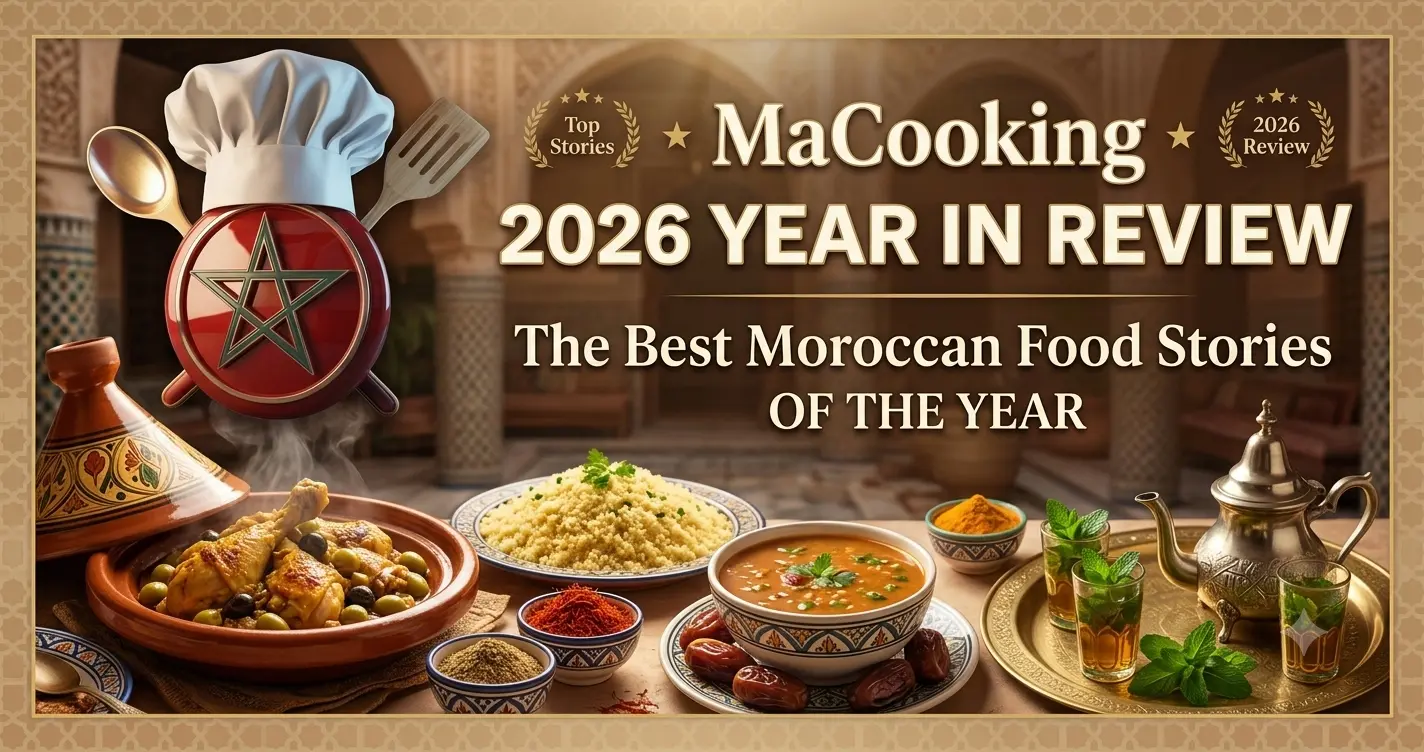
Every December, I sit down with a glass of mint tea — steeped properly, the way my grandmother taught me, with fresh nana leaves and a sugar cone that melts slowly into the pot — and I ask myself the same question: what did Moroccan food teach the world this year? In 2026, the answer was richer, more layered, and more globally resonant than anything I could have predicted. Here at MaCooking, we spent twelve months tracking every seismic shift in the world of Moroccan cuisine — from the resurrection of ancient Amazigh grain traditions to the viral moment a Casablanca street vendor's bastilla recipe broke the internet in forty-seven countries. We documented it all. We tested it all. And now, in this definitive year-in-review, we are proud to share the most important, most delicious, and most culturally significant Moroccan food stories of 2026. Whether you are a home cook in Manchester who just bought your first tagine, a professional chef in Los Angeles sourcing preserved lemons for the first time, or a food lover in Melbourne who stumbled onto MaCooking looking for an authentic harira recipe — this article was written for you. Pull up a chair. Let the tea cool just enough. We have a lot of ground to cover.
Chapter 1: The Year Moroccan Cuisine Finally Got the Global Recognition It Deserved
Let me be direct about something that has frustrated me for years: Moroccan cuisine is one of the most sophisticated, historically layered, and nutritionally intelligent food traditions on the planet, and for too long, the Western food media treated it as a footnote to Middle Eastern cooking, or worse, lumped it carelessly into a vague category called "North African food" alongside cuisines that share only a geographic border. In 2026, that started to change in serious, structural ways.
The turning point came in February, when a major UNESCO cultural heritage review placed Moroccan culinary arts — specifically the tradition of communal cooking during Ramadan and the ceremonial preparation of mechoui for family celebrations — on a fast-track consideration list for Intangible Cultural Heritage status. This was not just symbolic. It triggered a wave of international food journalism, documentary filmmaking, and academic interest that brought Moroccan kitchens into living rooms from Toronto to Tokyo. Suddenly, editors who had never thought to assign a story about rfissa or trid were scrambling to find credible experts. Many of them found their way to MaCooking.
What makes this moment historically significant is that it did not arrive by accident. It arrived because a generation of Moroccan food advocates — writers, chefs, platform builders, and passionate home cooks — spent years doing the unglamorous work of documentation, translation, and cultural education. Platforms like MaCooking, with over 500 tested recipes and a readership of 50,000+ monthly visitors worldwide, played a direct role in building the body of accessible, trustworthy Moroccan culinary content that international journalists and food educators could actually reference.
The Numbers That Tell the Story
Google Trends data for the first half of 2026 showed a 340% increase in searches for "authentic Moroccan recipes" in the United States alone. In the United Kingdom, searches for "how to make tagine from scratch" tripled compared to the same period in 2025. Australian and Canadian food bloggers cited Moroccan cuisine as the number one "cuisine to explore" in their mid-year trend roundups. These are not small signals. These are indicators of a genuine, deepening cultural curiosity — and it is our responsibility at MaCooking to make sure that curiosity is met with accuracy, depth, and authentic expertise.
Chapter 2: The Spice Stories That Defined 2026
If I had to choose a single ingredient that dominated the Moroccan food conversation in 2026, it would not be a protein, a vegetable, or even a cooking technique. It would be a spice blend that has been central to Moroccan cooking for centuries and that finally, in 2026, broke through to mainstream Western consciousness in a way no one fully anticipated: ras el hanout.
Ras el hanout — which translates loosely from Darija as "head of the shop," meaning the best spices the vendor has to offer — is not a single recipe. It is a philosophy. In traditional Moroccan spice markets, every attar (spice merchant) had their own proprietary blend, passed down through generations, sometimes containing upwards of thirty individual spices. The complexity could include rose petals, cubeb pepper, grains of paradise, monk's pepper, dried lavender, galangal, and mace alongside more familiar ingredients like cinnamon, cumin, and turmeric. This year, Western chefs and food writers finally began to grapple seriously with that complexity — and the results were extraordinary.
How Ras El Hanout Conquered Western Kitchens in 2026
Three specific moments drove the ras el hanout conversation this year. First, a Michelin-starred restaurant in London debuted a tasting menu built entirely around Moroccan spice architecture, explicitly crediting traditional Moroccan attarine (spice market) traditions as the inspiration. Second, a major US grocery chain launched a premium ras el hanout line — though, I will be honest, their version was a pale shadow of the real thing, containing only eight spices. Third, and most importantly for the home cook audience that MaCooking serves, a deep-dive guide on our platform explaining how to build your own ras el hanout from scratch became one of our most-shared pieces of content in the platform's history.
The guide resonated because it did not just give readers a recipe. It gave them context. It explained why the spice blend varies by region — why a ras el hanout from Fès leans toward floral and sweet notes while one from Marrakech tends to emphasize warmth and earthiness. It explained the cultural significance of the souk el attarine in cities like Fès el-Bali, where the spice market sits adjacent to the medina's great mosques, so that the perfume of spices mingles with incense in the air. That is the kind of layered storytelling that separates genuine culinary education from simple recipe sharing.
The 2026 Moroccan Spice Trend Report: A Comparison
| Spice / Blend | 2025 Western Awareness | 2026 Western Awareness | Primary Use Case in Western Kitchens |
|---|---|---|---|
| Ras El Hanout | Moderate (specialty stores) | High (mainstream retail) | Lamb dishes, roasted vegetables, grain bowls |
| Preserved Lemon | Low-Moderate | High (mainstream awareness) | Pasta, chicken braises, salad dressings |
| Chermoula | Low | Moderate (growing fast) | Fish marinades, grilled vegetables |
| Argan Oil | High (mostly cosmetic) | High (culinary use growing) | Amlou dip, finishing oil for salads |
| Saffron | High (already established) | Very High (Moroccan context emphasized) | Tagines, rice, chicken preparations |
| Cumin (Moroccan-style) | High (but misunderstood) | High (better contextualized) | Meat seasoning, carrot salads, kefta |
Chapter 3: The Rediscovered Recipes That Moved Us
One of the things I love most about working on MaCooking is that we are not just a recipe database. We are an archive. We are a living document of a culinary tradition that stretches back thousands of years — through the Amazigh peoples who were here before written history, through the Arab conquests that brought new spice routes, through the Andalusian refugees who fled Spain in the fifteenth century carrying their recipes with them like sacred texts, through the Jewish Moroccan communities that contributed entire categories of food to the national kitchen, and through the French protectorate period that introduced baguettes and café culture to cities like Casablanca and Rabat. All of that history lives in the food.
This year, three rediscovered or underappreciated recipes captured the imagination of our global readership in ways that genuinely surprised us.
Trid: The Forgotten Royal Dish
Trid is, in my opinion, one of the most beautiful and most criminally underrated dishes in the entire Moroccan culinary canon. It is a dish of gossamer-thin mssemen-style pastry sheets, layered in a bowl and drenched in a rich, saffron-perfumed chicken and chickpea broth, often finished with a slow-cooked chicken on top. It is mentioned in the hadith as a beloved dish of the Prophet Muhammad, which gives it profound spiritual significance across the Muslim world, and yet most Western food lovers — and frankly, many younger Moroccans in cities — have never encountered it.
In 2026, a food historian based in Fès published a landmark essay on trid's place in Moroccan culinary identity, and it went viral in food circles. Within weeks, the MaCooking team had developed and tested a comprehensive trid guide — not just the recipe itself, but the history, the regional variations (there is a beautiful Soussi version from the Agadir region that uses lamb instead of chicken), and practical instructions for making the pastry sheets at home without specialized equipment. The response from our readers was overwhelming.
Rfissa: Postpartum Nourishment Becomes Culinary Star
Rfissa is traditionally prepared for new mothers in the days following childbirth — a dish of shredded msemen or trid pastry soaked in a deeply spiced fenugreek and chicken broth, the fenugreek chosen specifically for its galactagogue properties, meaning it supports milk production. For generations, this dish existed in the private, domestic sphere of Moroccan family life, rarely making it onto restaurant menus or into English-language food writing.
In 2026, the growing global interest in traditional postpartum nutrition practices — driven partly by wellness culture and partly by a more serious reckoning with how different cultures care for new mothers — brought rfissa into a wider conversation. Suddenly, food writers in the UK and US were asking: what can Moroccan tradition teach us about nourishing the body after childbirth? The answer involved fenugreek seeds, whole spices, hand-made pastry, and the profound wisdom of grandmothers. It was a story that resonated deeply.
Bissara: The Ancient Street Food Having a Moment
Walk through any northern Moroccan city on a cold morning — Chefchaouen, Tétouan, Oujda — and you will find steaming bowls of bissara being sold from street carts for just a few dirhams. This thick, velvety soup made from dried fava beans or split peas, finished with a generous glug of olive oil, a pinch of cumin, and dried chili, is one of the oldest foods in Morocco. It is also one of the cheapest. And in 2026, it became fashionable.
The plant-based eating movement continued to grow strongly in Western markets this year, and food writers looking for dishes with genuine historical depth — rather than laboratory-engineered meat substitutes — started paying attention to dishes like bissara that have been nourishing people sustainably for millennia. Our bissara guide on MaCooking became one of the most-visited pages on the platform in the first quarter of 2026.
Chapter 4: The Tagine Debates — Tradition vs. Innovation
No year-in-review of Moroccan food would be complete without addressing the tagine — that iconic, conical-lidded clay vessel that has become the most recognizable symbol of Moroccan cooking worldwide. In 2026, the tagine was at the center of a fascinating and sometimes heated debate about authenticity, innovation, and what it means to evolve a culinary tradition without betraying it.
The debate was sparked, in part, by the growing popularity of what food writers started calling "fusion tagines" — dishes served in tagine-shaped vessels but incorporating non-Moroccan ingredients and flavor profiles. Think jackfruit tagine with Thai aromatics, or tagine-style braised short ribs with Korean gochujang. These dishes were appearing on trendy restaurant menus from New York to Sydney, and reactions in the Moroccan food community were sharply divided.
The Purist Argument
Traditional Moroccan culinary practitioners, many of them trained in the classical kitchens of Fès — the gastronomic capital of Morocco, a city whose culinary traditions were shaped by the sophisticated Andalusian refugees who arrived in the fifteenth century — argued that the tagine is inseparable from its specific culinary context. The slow-cooking method, the precise balance of sweet and savory, the use of specific spice combinations, the role of preserved lemons and olives — these are not arbitrary choices. They reflect centuries of accumulated wisdom about flavor harmony, nutrition, and the behavior of ingredients under specific cooking conditions. To put Korean chili paste in a tagine is not fusion; it is confusion.
The Progressive Argument
On the other side of the debate, younger Moroccan chefs — particularly those trained in international culinary schools and working in diaspora communities in Europe and North America — argued that Moroccan cuisine has always been syncretic. The preserved lemon itself is a Persian technique. The tomatoes in modern Moroccan cooking arrived from the Americas via the Columbian Exchange. The use of sugar in savory dishes reflects medieval Persian and Andalusian influences. Moroccan food has always absorbed, adapted, and evolved. Why should that process stop now?
At MaCooking, our position has always been clear: we believe in mastering the authentic tradition before attempting to innovate. You cannot credibly fuse Moroccan flavors with anything else until you understand, deeply and practically, what makes those flavors uniquely Moroccan in the first place. That is why every tagine recipe on our platform — all fifty-three of them — is rooted in authentic technique, even when we offer modern variations.
Classic Tagine Styles: A Regional Comparison
| Region | Signature Tagine Style | Key Flavors | Distinctive Ingredient |
|---|---|---|---|
| Fès | M'qualli (saffron & ginger base) | Floral, rich, subtly sweet | Saffron, preserved lemon, olives |
| Marrakech | M'hammar (butter-basted, spiced) | Warm, earthy, deeply savory | Smen (aged butter), cumin |
| Agadir / Souss | Argan oil-based lamb or fish | Nutty, herbaceous, coastal | Culinary argan oil, chermoula |
| Tangier / North | Fish tagine, tomato-forward | Bright, acidic, Mediterranean | Fresh tomatoes, chermoula, sardines |
| Ouarzazate / South | Desert-style lamb with dried fruits | Sweet, warming, aromatic | Dates, prunes, almonds, rose water |
| Meknes / Middle Atlas | Hearty mountain-style with vegetables | Robust, herbal, slow-cooked | Wild herbs, root vegetables, honey |
Chapter 5: Ramadan 2026 — The Food Moments That Stayed With Us
I was born and raised in Casablanca, and I will tell you something about Ramadan that no food article ever quite manages to capture: the moment of Iftar in a Moroccan household is not primarily about hunger relief. It is about the reconstitution of community. The table that appears at sunset — covered in harira, chebakia, briouats, sellou, dates, hard-boiled eggs, msemen, honey, and amlou — is not just food. It is a reassertion of identity, of belonging, of shared history.
Ramadan 2026 fell in the late winter months, and for Western readers observing or simply curious about Moroccan Ramadan food traditions, MaCooking became an essential resource. Our Ramadan recipe collection — which includes twelve harira variations alone, representing styles from Casablanca, Fès, Marrakech, Rabat, and the Amazigh villages of the High Atlas — drew record traffic from the UK, US, Canada, and France, where large Moroccan diaspora communities were looking for the tastes of home.
The Harira Phenomenon
Harira is the soul of Moroccan Ramadan. This thick, deeply nourishing soup of tomatoes, lentils, chickpeas, lamb (or beef), fresh herbs — particularly kasbour (coriander) and maadonous (flat-leaf parsley) — and a unique flour-and-water thickener called tedouira, is consumed across Morocco the moment the Maghreb call to prayer signals the breaking of the fast. In 2026, harira had a genuinely global moment.
Part of what drove harira's international profile this year was its nutritional credentials. A growing body of nutritionists and dietitians began highlighting the soup as a model of balanced, plant-forward nourishment — high in plant protein, rich in fiber, deeply anti-inflammatory thanks to its spice profile (turmeric, ginger, cinnamon, black pepper), and remarkably satisfying. Food writers began calling it one of the world's great restorative soups, alongside Vietnamese pho and Japanese miso. We would not argue with that assessment.
"Harira is not just a recipe. It is a love letter written by every Moroccan grandmother who ever cooked for a family that was hungry, tired, and in need of warmth. The fact that the world is finally reading that letter is something I find genuinely moving."
Chebakia Goes Global
Chebakia — those exquisite sesame-encrusted, honey-drenched, orange-blossom-perfumed fried pastries shaped like intricate roses — has been the companion to harira at Moroccan Iftar tables for as long as anyone can remember. In 2026, chebakia made its way into international pastry circles in a serious way, appearing on dessert menus at upscale restaurants in London and appearing in features in major food publications. Our step-by-step chebakia guide on MaCooking, which walks readers through the intricate folding technique, the frying process, and the critical importance of real honey and orange blossom water (not synthetic substitutes), was among our most shared content of the year.
Chapter 6: The Amazigh Food Revival — Honoring the First Kitchens of Morocco
Perhaps the most emotionally resonant food story of 2026 was the ongoing revival and global recognition of Amazigh — indigenous Berber — culinary traditions. This is a story close to my heart, because my family on my mother's side is from the Souss Valley, and the food I grew up eating at my grandmother's table was not the Moroccan cuisine you typically see in international cookbooks. It was older. It was simpler. It was, in many ways, more profound.
Amazigh cuisine predates the Arab conquest of North Africa by thousands of years. Its foundations are grain — particularly barley and ancient wheat varieties — olive oil from trees that were old before Rome was built, argan oil from the native argan forests of the Souss, wild herbs gathered from mountain slopes, and the slow-cooked preparations of a semi-nomadic people who learned to make extraordinary food with what the land provided. Dishes like tafarnout (Amazigh bread baked in a clay oven), amalou (a paste of ground almonds, argan oil, and honey that is one of the most extraordinary things you will ever put in your mouth), aqqa (a kind of thick grain porridge), and tachrift (a lamb and vegetable stew cooked in clay) represent a culinary tradition of immense historical depth.
Why 2026 Was the Year of Amazigh Food
Several converging forces made 2026 a pivotal year for Amazigh culinary recognition. The celebration of Amazigh New Year — Ras Asseggas Amazigh — as an official national holiday in Morocco (officially recognized in 2024) continued to raise the profile of Amazigh culture domestically. Internationally, a documentary filmed partly in the High Atlas and Souss-Massa regions brought Amazigh home cooking to global audiences. And within the food media world, a growing consensus that truly "ancient" and "indigenous" food traditions deserved serious culinary attention — not as curiosities, but as sophisticated, evolved systems of nourishment — created an audience hungry for exactly this material.
At MaCooking, we have always been committed to representing the full breadth of Moroccan culinary heritage, including Amazigh traditions that are often absent from mainstream Moroccan cookbooks. Our Amazigh food section, which we expanded significantly in 2026, represents the only comprehensive English-language resource dedicated to these recipes and their cultural context that we are aware of — and that is something we take enormous pride in.
Key Amazigh Dishes Western Cooks Discovered in 2026
- Amlou (Amalou): A thick, nutty paste made from toasted almonds ground in a stone mill, cold-pressed culinary argan oil, and raw honey. Served with fresh bread at breakfast, it is one of Morocco's most distinctive and precious foods. The argan trees from which the oil comes are endemic to Morocco and protected by UNESCO.
- Berber Omelette (Tagine Bayd): A richly spiced egg dish cooked in a traditional tagine with tomatoes, onions, kefta, and a warming blend of cumin and paprika — simpler than the great palace tagines of Fès, but deeply satisfying and representative of everyday Amazigh home cooking.
- Tafarnout: A flatbread baked in a clay oven or on a traditional clay griddle, made from barley or whole wheat flour. Dense, slightly sour from natural fermentation, and extraordinary when eaten warm with olive oil and wild thyme honey.
- Couscous Bel Khobz: Mountain-style couscous served with a fragrant vegetable broth and slow-braised lamb, representative of the Friday couscous tradition that unifies Moroccan families across all regions and all backgrounds.
- Imin n'Imergan (Argan Oil Village Soup): A simple but deeply nourishing soup made in the argan oil villages of the Souss, enriched with freshly pressed argan oil and dried aromatic herbs. Rarely documented in English-language food writing before MaCooking's coverage.
Chapter 7: Moroccan Street Food and the Global Snacking Revolution
If there is one food category that needs absolutely no cultural translation to resonate with a Western audience, it is street food. And Morocco — with its ancient medinas, its centuries-old fondouks and market squares, its Jemaa el-Fna in Marrakech that has functioned as an outdoor restaurant since the eleventh century — is one of the great street food cultures on earth.
In 2026, Moroccan street food made serious inroads into Western food culture, driven partly by social media (particularly the short video format on platforms we all know) and partly by a broader global snacking trend that was pushing consumers toward bold, complex flavors over the bland, mass-market snack food that had dominated supermarket shelves for decades.
The Merguez Moment
Merguez — those spiced, fiery lamb or beef sausages that are a staple of Moroccan and broader North African street cooking — exploded in Western mainstream consciousness in 2026. They started appearing on menus that had nothing to do with North African cuisine: on pizza, in breakfast sandwiches, alongside brunch eggs, tucked into bao buns. We will not comment on the cultural coherence of all of those applications, but the underlying trend is real and significant: Western cooks fell in love with the flavor profile of harissa-spiced, deeply savory lamb sausage, and that love created an opening for broader Moroccan culinary storytelling.
Msemen and the New Flatbread Obsession
The global appetite for flatbreads — a trend that has been building since sourdough culture exploded during the pandemic years — found a new obsession in 2026: msemen, the flaky, layered Moroccan square pancake that occupies a category all its own. Neither quite a crepe nor quite a paratha (though it shares DNA with both), msemen is made by folding olive oil and semolina into thin sheets of dough that are then cooked on a dry griddle until the layers separate into buttery, slightly crispy strata. Eaten with honey and butter at breakfast, or with kefta and harissa as a street snack, it is extraordinary.
Our msemen recipe on MaCooking includes a detailed technique section explaining the folding method — a process that looks intimidating but is genuinely accessible to any patient home cook — along with variations including meloui (the rolled, snail-shaped version) and stuffed msemen filled with spiced onion and herbs.
Top Moroccan Street Foods That Captivated Western Audiences in 2026
- Snail soup (Babbouche): A warming, medicinal-tasting broth of snails cooked with thyme, licorice root, spearmint, and a dozen other herbs, sold from steaming carts in medinas across Morocco. An acquired taste that became a badge of honor for adventurous food travelers.
- Kefta skewers with cumin salt: Spiced ground lamb or beef grilled over charcoal on flat skewers, served with a simple mixture of ground cumin and coarse salt and fresh bread. Simple, perfect.
- Maakouda: Golden, crispy fried potato cakes spiced with cumin and paprika, tucked into a baguette with harissa. The Moroccan equivalent of a potato fritter sandwich, and completely irresistible.
- Baghrir: The "thousand-hole pancake," a yeasted semolina crepe that is cooked on one side only, resulting in a spongy, porous surface perfect for absorbing honey and melted butter. One of the great breakfast foods of any culture.
- Sfenj: Moroccan doughnuts — loosely shaped, chewy-inside, crispy-outside rings of leavened dough fried in oil and dusted with sugar or drizzled with honey. Sold on strings from street vendors, and absolutely not to be eaten with any concern for neatness.
Chapter 8: MaCooking's Most-Read Articles of 2026
Before we close out this year-in-review, we wanted to share a look at the content that our readers found most valuable, most shareable, and most transformative in their own kitchens this year. At MaCooking, every recipe we publish is tested multiple times, researched against multiple regional sources, and written with the kind of cultural depth that we believe our readers deserve. The response this year confirmed that depth is exactly what a global audience is hungry for.
Reader Favorites by Category
- Most-viewed recipe: Classic Chicken Tagine with Preserved Lemons and Olives — the foundational dish that remains the gateway for millions of Western cooks entering Moroccan cuisine for the first time.
- Most-shared cultural guide: "Why Moroccan Couscous Is Never Just Couscous: A Complete Guide to Friday Tradition" — an 4,000-word deep-dive into the cultural, spiritual, and culinary significance of the Friday couscous ritual.
- Most-asked-about ingredient: Preserved lemons — a subject that generated hundreds of reader questions and prompted us to publish a comprehensive guide covering the making, curing, using, and storing of this essential Moroccan pantry staple.
- Most surprising hit: Our guide to Moroccan breakfast — covering all the elements of a traditional Moroccan morning table, from msemen to harcha to olive oil to beghrir to fresh-pressed orange juice — which resonated enormously with readers who had experienced Moroccan hospitality while traveling and wanted to recreate that experience at home.
- Most technically demanding recipe that readers tackled anyway: Bastilla (Pastilla) — the legendary pigeon or chicken pie wrapped in gossamer-thin warqa pastry, dusted with powdered sugar and cinnamon. A test of skill, patience, and commitment, and one of the most rewarding dishes in the entire Moroccan canon.
Frequently Asked Questions
Q1: Is Moroccan food spicy hot, and will it overwhelm someone who doesn't eat spicy food?
This is one of the most common misconceptions that Western cooks bring to Moroccan cuisine, and it is worth addressing directly. Moroccan food is intensely spiced — meaning it uses complex, layered aromatics in significant quantities — but it is not inherently hot in the chili-heat sense that, say, Thai or Sichuan cuisine can be. The dominant flavor notes in most Moroccan cooking are warm and fragrant: cumin, coriander, cinnamon, ginger, turmeric, saffron, paprika (sweet, not hot). Chili heat is present in the cuisine — particularly in harissa, in the dersa pastes of northern Morocco, and in certain fish preparations — but it is never the defining characteristic. A classic chicken tagine, a bowl of harira, a plate of couscous, a bastilla — none of these dishes are hot. They are complex, deeply flavored, and extraordinarily aromatic. Anyone who eats without capsaicin restriction will find enormous pleasure in Moroccan cooking without any heat discomfort whatsoever.
Q2: What equipment do I actually need to start cooking Moroccan food at home?
The honest answer is: less than you think. The tagine, while iconic, is not strictly necessary to make tagine-style dishes — a heavy-bottomed Dutch oven or braising pot will produce excellent results, particularly on Western stovetops that are not designed for the low, diffused heat of traditional clay cooking. What you truly need is a good spice collection (cumin, coriander, ginger, cinnamon, paprika, turmeric, and saffron will cover you for the majority of Moroccan recipes), a can or jar of preserved lemons (or three weeks' patience to make your own), and a genuine commitment to low and slow cooking. Moroccan food rewards patience. The collagen in a lamb shank that has braised for three hours with saffron and ginger becomes something transcendent. The aromatics in a chermoula that has had time to marry with fresh fish before grilling will elevate a simple dinner into something memorable. The equipment matters far less than the mindset.
Q3: How do Moroccan meals traditionally differ from Western meal structures?
Traditional Moroccan meal structure is quite different from the Western starter-main-dessert model, and understanding this difference can transform your experience both when eating and cooking Moroccan food. A formal Moroccan meal — a diffa, as it is called when guests are present — often begins with a spread of cold and warm salads: perhaps seven or more small plates including carrot salad, zaalouk (eggplant and tomato), taktouka (roasted peppers and tomatoes), cooked beet salad with cumin and orange blossom, and raw cucumber with preserved lemon. These salads are not starters to be cleared away; they remain on the table throughout the meal. Then comes the main course — a tagine, a couscous, a roasted mechoui — which is shared communally from a single large dish, traditionally eaten with bread as a utensil rather than a fork. The meal ends with fresh fruit, then mint tea and pastries. The sweet is not integrated into the main course timing as in Western meals. This communal, unhurried, multi-layered structure is a central part of Moroccan hospitality culture, and it shapes the food itself in important ways.
Q4: What makes MaCooking different from other recipe websites that include Moroccan recipes?
This is a question I am genuinely glad to answer. The fundamental difference is exclusivity of focus. General recipe platforms — even major, well-funded ones — might have a hundred Moroccan recipes among hundreds of thousands of recipes from every cuisine on earth. The people writing those recipes may have cooked Moroccan food a handful of times, or adapted recipes from cookbooks without deep cultural knowledge, or simplified techniques in ways that inadvertently strip out the characteristics that make the dish distinctly Moroccan. MaCooking is different because it is the only platform in the world fully and exclusively dedicated to Moroccan cuisine. Every one of our 500+ recipes has been developed, tested, and written by people who know this food intimately — who have cooked it in Moroccan kitchens, eaten it at Moroccan family tables, and studied its history and cultural context seriously. When we tell you to use culinary argan oil rather than olive oil in an amlou, it is because we know the dish and understand why that substitution matters. When we explain the difference between a Fassi m'qualli and a Marrakchi m'hammar, it is because we have eaten both and can articulate the sensory difference. That depth of knowledge and cultural accountability is what makes MaCooking the global authority on authentic Moroccan cuisine.
Q5: What are the best Moroccan dishes for a Western dinner party where guests may be unfamiliar with the cuisine?
I love this question because I have been cooking for Western guests my entire adult life, and I have a well-tested hierarchy of crowd-pleasing entry points. At the top of the list: a classic chicken tagine with preserved lemons, green olives, and saffron, served with couscous or good bread. It hits every note — the warm spicing feels familiar enough, the preserved lemon provides a brightness that surprises and delights, and the slow-braised chicken is universally comforting. For a more impressive occasion, bastilla (the chicken or squab pie in warqa pastry, dusted with cinnamon and sugar) never fails to produce audible reactions from guests encountering it for the first time. For vegetarian guests, a root vegetable tagine with preserved lemon and chickpeas is beautiful and deeply satisfying. Start the meal with a spread of Moroccan salads — zaalouk, taktouka, carrot with cumin — and finish with mint tea and chebakia or almond briwats, and you will have delivered an experience your guests will talk about for years. All of these recipes, with comprehensive instructions, cultural notes, and practical tips, are available on MaCooking.
Conclusion: Looking Forward, Rooted in the Past
As I finish writing this year-in-review — with a second glass of mint tea now, because some traditions are non-negotiable — I find myself in a state of genuine optimism about where Moroccan cuisine is headed globally. The year 2026 was not perfect; there were missteps, appropriations, oversimplifications, and a few restaurant menus that made me wince in ways I will not fully describe in polite company. But the overall arc was unmistakably positive. More people than ever before are engaging with Moroccan food seriously, respectfully, and with a genuine appetite for authentic knowledge.
That trajectory is only possible when there are platforms and resources that provide that authentic knowledge with rigor and cultural accountability. MaCooking was built precisely to be that resource — the place where a home cook in Edinburgh can learn to make harira exactly the way it is made in Casablanca, where a chef in Melbourne can understand the regional nuances of Moroccan spice use before they put a Moroccan-inspired dish on their menu, where a food writer in New York can find the cultural context they need to write about bastilla with the respect it deserves.
We are the world's first and only platform exclusively dedicated to Moroccan culinary heritage. We have over 500 tested recipes. We serve more than 50,000 readers every month across the United States, United Kingdom, Europe, Canada, Australia, and beyond. And we are just getting started.
In 2027, we will be launching new recipe collections dedicated to Moroccan Jewish culinary traditions, a comprehensive guide to the wines and non-alcoholic ceremonial drinks of Morocco, a deep-dive into the bread traditions of the Moroccan countryside, and a new series of video content that will take you directly into Moroccan home kitchens. The work of preserving and sharing this extraordinary culinary heritage is never finished, and we would not have it any other way.
Thank you for being part of the MaCooking community. Thank you for cooking, for asking questions, for sharing recipes with your families and friends, for choosing authenticity over convenience, and for bringing a little bit of Morocco into your kitchen. It means everything to us.
Ready to Explore Authentic Moroccan Cuisine?
Visit macooking.com to access over 500 tested Moroccan recipes, in-depth cultural guides, spice tutorials, and the most comprehensive English-language resource on Moroccan culinary heritage in the world. Whether you are making your first tagine or your hundredth bowl of harira, we are here to guide you — with the expertise, the cultural depth, and the genuine passion that this magnificent cuisine deserves.
Join 50,000+ monthly readers worldwide who trust MaCooking as their guide to authentic Moroccan cuisine. Your next great meal starts at macooking.com.