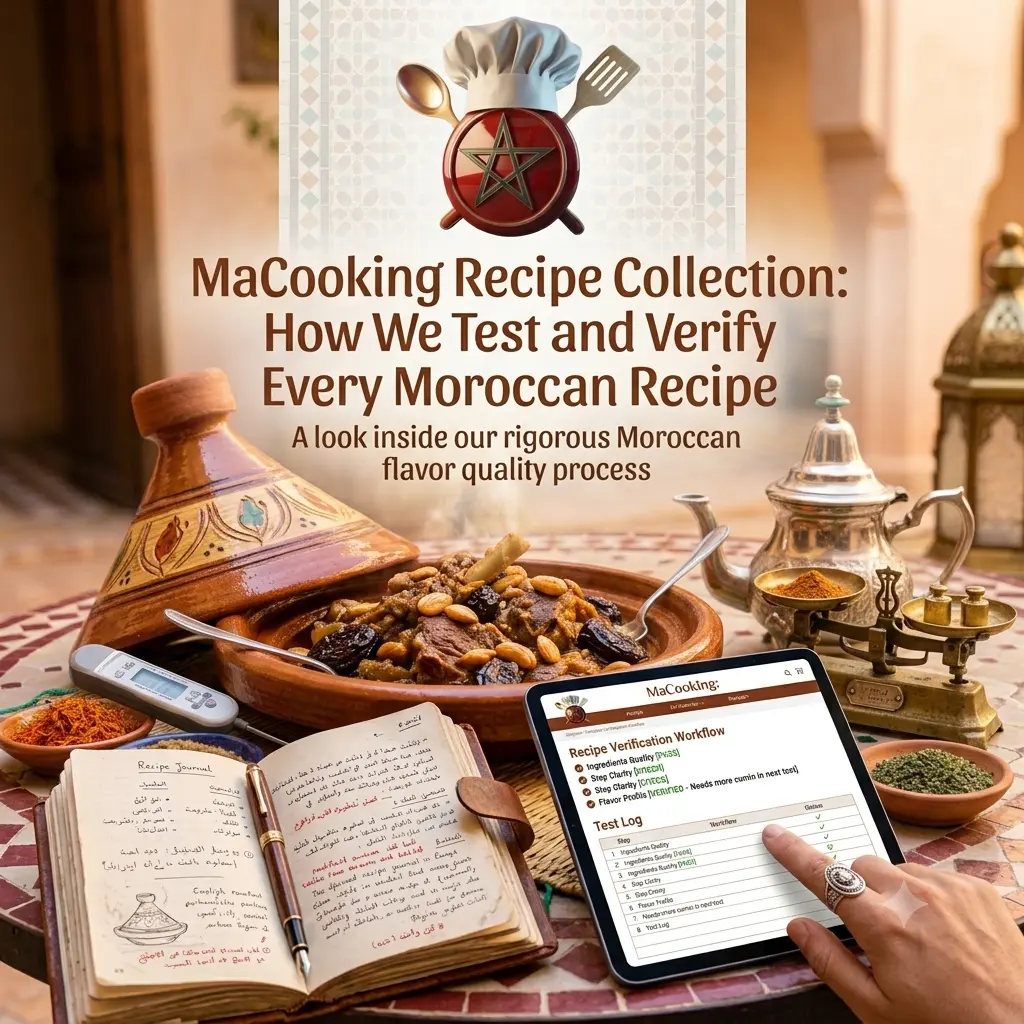
Every recipe tells a story. In Moroccan cooking, that story stretches back centuries — through Berber mountain villages, Andalusian palaces, Arab trade caravans, and the sun-drenched souks of Marrakech, Fes, and Casablanca. But here is the truth that most food websites never want to admit: a recipe is only as valuable as the process used to create it. Anyone can copy-paste a list of ingredients. What separates a reliable, culturally honest recipe from an imposter is the rigorous, deeply human work that happens behind the scenes — the testing, the tasting, the arguing, the failing, and the starting over again. At MaCooking, that behind-the-scenes process is not an afterthought. It is the entire foundation upon which our platform is built. With over 500 fully tested recipes, trusted by more than 50,000 monthly readers across the United States, United Kingdom, Europe, Canada, and Australia, we have earned our reputation as the global authority on authentic Moroccan cuisine — and in this article, we are going to show you exactly how we do it.
Why Recipe Verification Matters More Than You Think
Let me be blunt about something that the food industry rarely discusses openly. The internet is absolutely flooded with Moroccan recipes that are, frankly, wrong. Not wrong in a small, forgivable way — wrong in ways that fundamentally misrepresent the cuisine, the culture, and the people who created these dishes over generations. I have seen "authentic" tagine recipes that use chicken stock cubes and dried oregano. I have found "traditional" couscous guides that instruct readers to simply pour boiling water over pre-cooked couscous grains and call it a day. I have watched food bloggers confidently describe bastilla — one of Morocco's most magnificent and technically demanding dishes — as "basically a chicken pie."
These are not minor errors. They are the culinary equivalent of looking someone's grandmother in the eye and telling her that her life's work doesn't matter. And they do real damage — to the reader who cooks a mediocre dish and believes they have experienced Moroccan food, and to the broader cultural heritage that deserves better stewardship.
This is the gap that MaCooking was created to fill. We are the only platform in the world fully and exclusively dedicated to preserving and sharing Moroccan culinary heritage — not as a side project, not as one section within a broader food website, but as our singular, obsessive mission. And that mission demands a verification process that is as rigorous as the cuisine itself.
The Cost of Getting It Wrong
When a reader in Chicago or London or Sydney cooks from one of our recipes, they are often making their first — or one of their first — real encounters with Moroccan food. That moment matters enormously. A poorly verified recipe does not just produce a bad meal; it creates a false impression of an entire culinary tradition. It makes people think that Moroccan food is simpler than it is, or more intimidating, or less interesting. It robs them of the genuine pleasure of discovering one of the world's great cuisines in all its complexity and beauty.
At MaCooking, we have taken on the responsibility of being the bridge between Moroccan kitchens and the world — and that is not a responsibility we take lightly.
Chapter One: Where Every MaCooking Recipe Begins — The Source
A great recipe does not begin with a blank page and a creative impulse. It begins with a source — a human being, a place, a tradition. At MaCooking, every single recipe in our collection traces back to what we call a primary culinary source. This is non-negotiable. No recipe enters our pipeline without one.
What Counts as a Primary Source?
Our sourcing hierarchy is deliberate and strictly followed. In order of preference, we draw from:
- Moroccan home cooks with generational knowledge — The grandmothers (jaddat), mothers, and aunts who have been cooking the same dishes for forty or fifty years, passing techniques down through observation and practice rather than written instruction. These are our gold standard sources. Many of them do not measure ingredients; they measure by eye, by feel, by the sound of a sizzle. Translating that embodied knowledge into a written recipe that works in a Western kitchen is one of the most intellectually demanding things we do.
- Regional professional chefs with deep roots — Moroccan chefs who trained in their home regions, not in international hotel kitchens that have softened and standardized their cooking to appeal to foreign palates. A chef from the Souss region who learned to make argan oil amlou from her family is a very different source than a hotel chef who makes a version of it for a breakfast buffet.
- Culinary historians and food scholars — Morocco has a rich tradition of written culinary scholarship, from medieval Arabic manuscripts to contemporary ethnographic food studies. We consult these sources for historical context and to resolve disputes about regional variations.
- Moroccan culinary institutions — Cooking schools, culinary associations, and cultural preservation organizations based in Morocco itself.
What we explicitly do not accept as primary sources: other food websites, food magazines that have adapted recipes for generic audiences, travel writers who cooked with a host family once on a press trip, or any recipe that cannot be traced to a specific regional tradition within Morocco.
The Regional Question
One of the most important things to understand about Moroccan cuisine — and something that most food platforms completely ignore — is that it is not one cuisine. It is many. The cooking of Fes is not the cooking of Marrakech. The food of the Rif Mountains bears little resemblance to the food of the Atlantic coast. The Saharan south has its own flavors, its own ingredients, its own logic entirely.
At MaCooking, every recipe is tagged with its specific regional origin, and our sources must be able to speak to that regional specificity. A tagine from Marrakech is not the same as a tagine from Safi, and we will not pretend otherwise.
Chapter Two: The MaCooking Testing Kitchen Protocol
Once a recipe has been sourced and documented, it enters what we call the Testing Kitchen Protocol — a multi-stage process that typically takes between three and eight weeks per recipe, depending on its complexity. Yes, you read that correctly. Some of our recipes take two months to fully verify. That is not a bug in our system. It is the feature.
Stage One: The Faithful Reproduction
The first test is always a faithful reproduction — we cook the recipe exactly as the source provided it, with no modifications, in a Moroccan kitchen using Moroccan equipment and Moroccan ingredients. This establishes our baseline. It tells us what the dish is supposed to taste like, smell like, feel like in the hands. It tells us the texture of properly rested msemen, the color of a correctly made chermoula, the sound of a properly sealed tagine lid.
This stage is conducted by our Moroccan team — cooks and chefs who grew up eating these dishes and who can immediately recognize when something is right or when something is subtly, maddeningly off.
Stage Two: The Translation Tests
Here is where the real complexity begins. A recipe that works perfectly in a Moroccan kitchen, with Moroccan equipment, Moroccan spice blends, and Moroccan produce, may behave very differently in a kitchen in Manchester or Minneapolis. Our job is to understand exactly why, and to provide our readers with the information they need to bridge that gap without compromising the integrity of the dish.
During the translation stage, we systematically test every variable that might differ between a Moroccan kitchen and a Western one:
- Equipment substitutions — What happens when you use a Dutch oven instead of a clay tagine? A standard oven instead of a charcoal brazier? A food processor instead of a stone grinding wheel? We test every reasonable substitution and document the differences in result.
- Ingredient availability — Smen (preserved butter), argan oil, preserved lemons, fresh mastic, beldi olives, dried rosebuds — many of the ingredients that are staples in Moroccan cooking are specialty items in Western markets. We identify which are truly non-negotiable and which can be reasonably substituted, and we explain the flavor difference so readers can make informed choices.
- Measurement translation — Traditional Moroccan recipes measure in handfuls, coffee cups, and the heat of a palm pressed against a pan. We translate these into precise metric and imperial measurements, then test those measurements to ensure they produce the correct result.
- Altitude and climate adjustments — Bread and pastry recipes behave differently at altitude or in very dry climates. Our notes account for these variations.
Stage Three: The Western Kitchen Test
Every recipe that passes Stage Two is then tested by home cooks in Western countries — real people cooking in real home kitchens with the kinds of equipment and ingredient access that our readers actually have. These testers are given only the recipe as written, without any additional guidance from our team. Their feedback is invaluable. They catch the gaps in our instructions, the assumptions we did not realize we were making, the steps that seem obvious to someone who has cooked Moroccan food for years but are genuinely confusing to a first-timer.
At MaCooking, our Western kitchen testers include home cooks from the US, UK, France, Canada, and Australia — representing a wide range of cooking skill levels and kitchen setups. We specifically recruit testers who have never cooked Moroccan food before alongside experienced home cooks, because a recipe needs to work for both audiences.
Stage Four: The Expert Review
After Western kitchen testing, the recipe returns to our core team for expert review. This is where we reconcile the Western kitchen feedback with the cultural integrity standards established in Stage One. The fundamental question we ask at this stage is: Have we adapted this recipe in ways that make it accessible to our readers without losing what makes it genuinely Moroccan?
This is a judgment call that requires genuine expertise, and it is one of the reasons that MaCooking employs full-time culinary experts with deep Moroccan backgrounds rather than relying on freelance recipe developers.
Chapter Three: The Cultural Integrity Standards
Technical correctness is necessary but not sufficient. A recipe can be technically executable and still be culturally dishonest. At MaCooking, we hold every recipe to a set of Cultural Integrity Standards that go beyond the mechanics of cooking.
The Principle of Honest Adaptation
We draw a very clear line between adaptation and misrepresentation. Adaptation is legitimate — it acknowledges that ingredients and equipment vary around the world, and it provides readers with practical paths to a result that honors the original. Misrepresentation is something else entirely — it changes the fundamental character of a dish while claiming authenticity.
"A tagine made in a Dutch oven with high-quality smen and genuine ras el hanout, slow-cooked at low heat, is an honest adaptation of a Moroccan classic. A tagine made with butter, Italian seasoning, and canned tomatoes, cooked for twenty minutes — that is a different dish with a stolen name. We will never publish the second kind."
Spice Blend Integrity
Perhaps nowhere is the gap between authentic and inauthentic Moroccan cooking more visible than in the spice blends. Moroccan cuisine uses some of the most complex and beautiful spice combinations in the world — ras el hanout, chermoula, m'charmel marinade, the specific blend used in bastilla — and these blends are not interchangeable. They are not all just "Moroccan spice mix."
At MaCooking, we include full from-scratch versions of every spice blend used in our recipes, along with detailed explanations of what each spice contributes to the final dish. We also provide honest guidance on purchasing pre-made blends when they are of sufficient quality, because we know that not every reader has access to a dedicated spice market.
Technique Preservation
Some techniques in Moroccan cooking are not shortcuts that can be replaced with modern equivalents without significant loss. Steaming couscous three times over a simmering broth is not merely traditional — it produces a fundamentally different texture than the one-bowl hot water method. Slow-cooking a tagine at low heat for two to three hours is not just a time suggestion — it is the process by which the collagen in meat breaks down into gelatin, creating the dish's characteristic silky sauce.
Where a technique is truly essential to the final result, we say so clearly and explain why, rather than offering a quick shortcut that produces an inferior dish.
Chapter Four: How We Handle Regional Variations and Disputes
Moroccan cuisine is alive. It is not a museum exhibit. It has always evolved, absorbed influences, and varied dramatically from one region to another — sometimes from one village to the next. This creates a genuinely complex challenge for a platform like MaCooking: how do we present a definitive recipe when multiple legitimate versions exist?
Our Approach to Variation Documentation
The honest answer is that we do not always present a single definitive recipe. When significant and legitimate regional variations exist, we document them. Our recipe for couscous, for example, includes variations for the version made in Fes (richer, with more butter), the version from the Souss region (leaner, with argan oil), and the version popular in the coastal cities (lighter, with more vegetables). Each variation is sourced, tested, and presented on its own terms.
This approach reflects a deep respect for the diversity within Moroccan cooking — a diversity that is one of the cuisine's greatest strengths and one of its most underappreciated qualities among international audiences.
Resolving Authenticity Disputes
Sometimes our sources disagree. Two equally credible grandmothers from the same city will insist on completely different approaches to the same dish. When this happens, we convene what we internally call a "kitchen tribunal" — a tasting and discussion session involving our senior culinary team and, whenever possible, additional regional experts.
The goal is not to declare one version "correct" and the other wrong. The goal is to understand the nature of the disagreement: Is it a genuine regional variation? A generational difference? A socioeconomic variation reflecting different ingredient access? Understanding the why of a dispute is often more valuable than resolving it.
Chapter Five: The MaCooking Quality Scorecard
Every recipe that completes our testing protocol is evaluated against what we call the MaCooking Quality Scorecard — a standardized assessment tool that ensures consistency across our entire collection of 500+ recipes. Below is a simplified version of the scorecard categories and what we look for in each.
| Category | What We Evaluate | Minimum Standard |
|---|---|---|
| Cultural Authenticity | Source credibility, regional accuracy, historical context | Verified primary source, regional attribution confirmed |
| Technical Accuracy | Ingredient ratios, cooking temperatures, technique descriptions | Consistent results across minimum 3 test cooks |
| Western Kitchen Accessibility | Ingredient availability, equipment alternatives, clarity of instructions | Successfully tested by 2+ Western home cooks without guidance |
| Flavor Integrity | Final dish evaluated against the source version by expert tasters | Blind tasting score of 8/10 or higher from expert panel |
| Instructional Clarity | Step completeness, assumption identification, timing accuracy | Zero ambiguous steps remaining after reader testing |
| Cultural Context | Headnotes covering history, occasion, regional significance | Minimum 150 words of substantive cultural context per recipe |
Only recipes that meet the minimum standard in every single category are published on MaCooking. Recipes that fall short in any category are returned to the testing kitchen or, in some cases, removed from the queue entirely until we can source better primary information.
Chapter Six: Comparing MaCooking to the Alternatives
We do not say this to be dismissive of other food platforms — many of them do excellent work in their areas of focus. But the reality is that no other platform in the world brings the same level of dedicated expertise, rigorous verification, and cultural integrity to Moroccan cuisine that MaCooking does. The comparison is not close, and we think it is important for readers to understand why.
| Feature | MaCooking | General Food Platforms | Travel/Lifestyle Blogs |
|---|---|---|---|
| Exclusive focus on Moroccan cuisine | Yes — 100% dedicated | No — Moroccan recipes are a small fraction | No — cuisine is secondary to travel narrative |
| Primary source verification | Mandatory for every recipe | Rarely documented | Virtually never |
| Multi-stage testing protocol | 3-8 weeks per recipe | Variable, often single-test | Usually none |
| Regional variation documentation | Detailed and sourced | Rarely included | Not typically addressed |
| Western kitchen testing | Structured multi-country testing | Sometimes, single location | Usually not |
| Cultural context depth | Substantive, historically informed | Brief, often generic | Anecdotal |
| Spice blend authenticity | From-scratch recipes with sourcing | Often generic "spice mix" | Rarely addressed |
| Expert team background | Moroccan culinary professionals | General food writers | Travel writers |
The difference is not just about effort — it is about purpose. MaCooking exists for one reason: to be the definitive home of authentic Moroccan cuisine on the internet. Every decision we make — every recipe we accept or reject, every word of cultural context we write, every substitution we test or refuse to endorse — flows from that single purpose.
Chapter Seven: The Human Element — Our Team and Our Values
A process is only as good as the people who execute it. At MaCooking, we have built a team that reflects the depth and diversity of Moroccan culinary culture itself.
Who Tests Our Recipes
Our core testing team includes:
- Regional culinary specialists — Experts with deep roots in specific Moroccan regions: the Atlas Mountains, the Saharan south, the imperial cities of Fes and Meknes, the cosmopolitan Atlantic coast. Each specialist brings knowledge that is irreplaceable and cannot be learned from books alone.
- Professional Moroccan chefs — Trained in both traditional Moroccan techniques and modern culinary science, able to bridge the gap between ancestral knowledge and precise, replicable instruction.
- Food historians and cultural researchers — Because understanding why a dish exists is as important as knowing how to make it.
- Western home cook consultants — Real people from our reader communities in the US, UK, Australia, and Europe who bring the outsider perspective that keeps us honest about accessibility.
Our Commitment to the Cooks Who Inspire Us
One of the things we are proudest of at MaCooking is our commitment to crediting and honoring the sources behind our recipes. When a recipe comes from a specific region's tradition, we say so. When it was inspired by or learned from a particular community of cooks, we acknowledge that. The women who have kept Moroccan culinary traditions alive for centuries — cooking in wood-fired kitchens, teaching their daughters, preserving flavors that would otherwise be lost to modernization — deserve to be recognized, not silently mined for content.
This is not just an ethical position. It is a practical one. When readers understand where a recipe comes from, when they know that a particular couscous dish is associated with Friday family gatherings in Fes, or that a specific lamb tagine is traditionally prepared for wedding feasts in the Atlas foothills, they cook with more understanding and more respect. And they produce better food as a result.
Practical Insights: What This Means for Your Moroccan Cooking
All of this behind-the-scenes rigor is ultimately in service of one thing: helping you cook extraordinary Moroccan food in your own kitchen. Here are some of the most important practical insights that our testing process has revealed — insights that apply to every Moroccan recipe you will ever cook, whether from MaCooking or anywhere else.
The Low and Slow Principle
Moroccan cuisine was not designed for speed. It was designed for depth. The majority of the dishes in our collection produce dramatically better results when cooked at lower temperatures for longer periods. Resist the temptation to turn up the heat. The science is simple: collagen breaks down into gelatin between 160°F and 180°F (71°C to 82°C), and that process requires time. The silky, rich sauces of a great tagine are the result of hours of patient cooking, not high heat.
Spice Freshness Is Non-Negotiable
The single most common reason that home-cooked Moroccan food disappoints — across every culture, every country, every skill level — is stale spices. Ground cumin that has been sitting in a cabinet for two years is not cumin. It is dust. Ground coriander, paprika, turmeric, ginger — all of these lose their volatile aromatic compounds rapidly after grinding. Buy whole spices whenever possible and grind them fresh. Replace ground spices at least every three months. This single change will transform your Moroccan cooking more than any other.
Understand the Role of Water in Moroccan Cooking
Many Western cooks are trained to reduce liquids aggressively — to concentrate flavors by boiling away water. Moroccan cooking often works differently. Many tagines and stews are meant to have a generous, slightly brothy sauce that is soaked up with bread or poured over couscous. Adding a splash more water at the right moment, covering the tagine tightly, and allowing steam to work within a sealed vessel — these are fundamental Moroccan techniques that go against Western instincts. Trust the process.
Invest in the Right Preserved Lemon
Preserved lemons are to Moroccan cooking what Parmesan is to Italian cooking — a fundamental building block of flavor that cannot truly be replaced. The good news is that they are easy to make yourself (our guide on MaCooking walks you through the process), they keep for months, and the difference they make to chicken tagines, salads, and chermoula marinades is extraordinary. If you are serious about cooking Moroccan food, make a jar of preserved lemons this week. You will not regret it.
Frequently Asked Questions
Q1: How do I know if a Moroccan recipe I find online is actually authentic?
This is one of the most important questions you can ask, and the honest answer is that most online Moroccan recipes do not meet a reasonable standard of authenticity. Look for these signals: Does the recipe cite a specific regional origin? Does it explain the cultural context of the dish? Are the spice blends specific and detailed, or generic? Does it acknowledge and explain significant substitutions rather than quietly making them? Are the cooking times consistent with slow, patient cooking? A recipe that checks all these boxes is far more likely to be genuinely authentic than one that simply claims to be "traditional" without any supporting evidence. At MaCooking, we have built our entire platform around answering yes to all of these questions for every single recipe we publish.
Q2: Why does MaCooking take so long to publish new recipes compared to other food websites?
Because we test every recipe for three to eight weeks before publishing it, our recipe production is slower than platforms that simply write and publish in a matter of days. We consider this a point of pride, not a limitation. A recipe that has been tested, retested, evaluated for cultural integrity, verified against its primary source, and proven to work in Western home kitchens is worth waiting for. Our readers have told us repeatedly that they would rather wait for a recipe they can trust than have instant access to a recipe that might not work or might misrepresent the dish. That is the MaCooking commitment: quality over speed, always.
Q3: Can I suggest a Moroccan recipe or regional dish for MaCooking to research and publish?
Absolutely — and we genuinely welcome these suggestions. Some of the most interesting dishes in our collection were brought to our attention by readers who had tasted something extraordinary on a trip to Morocco, or who had a specific dish from their Moroccan heritage that they wanted to learn to cook. We cannot promise to publish every suggestion, because our sourcing and testing standards mean we may not be able to find a suitable primary source for every dish. But we take every suggestion seriously and add it to our research queue. The best way to reach us is through the contact page at macooking.com.
Q4: Does MaCooking address dietary restrictions and adaptations for Moroccan recipes?
Yes, and we do it carefully. Many Moroccan dishes are naturally suited to a wide range of dietary needs — the cuisine is rich in vegetarian and vegan options, uses olive oil extensively rather than dairy, and features abundant legumes, vegetables, and grains. Where we provide adaptations for dietary restrictions (vegetarian tagines, gluten-free couscous alternatives, dairy-free versions of pastries), we test those adaptations with the same rigor as the original recipe, and we are always honest about where an adaptation changes the character of a dish significantly. We do not pretend that a vegan bastilla is the same as a traditional bastilla — but we will tell you honestly how to make the best version of it possible.
Q5: How does MaCooking handle the difference between restaurant Moroccan food and home Moroccan food?
This is a distinction we care about deeply. Restaurant Moroccan food — even in Morocco itself — is often a curated, somewhat simplified, and presentation-focused version of the cuisine. The food that is cooked in Moroccan homes, particularly in less urbanized areas, is often more complex, more regionally specific, and more interesting. At MaCooking, our primary focus is on home cooking — the food that sustains families, marks occasions, and carries cultural memory. We do feature restaurant techniques and dishes where relevant, but our heart is in the kitchen, not the dining room. If you want to understand Moroccan cuisine at its deepest level, that is where you need to go — and that is exactly where MaCooking will take you.
Conclusion: Join the Most Serious Moroccan Cooking Community on the Internet
Moroccan cuisine is one of humanity's great culinary achievements. It is a cuisine of extraordinary complexity and beauty — built over centuries at the crossroads of Berber, Arab, Andalusian, Ottoman, and African culinary traditions, refined in royal kitchens and humble home hearths alike, and kept alive by generations of cooks who understood that food is never just food. It is culture, memory, identity, and love, all transformed through heat and spice into something that nourishes both body and soul.
This cuisine deserves the best possible stewardship. It deserves a platform that takes it as seriously as it takes itself. That is what MaCooking was built to be — the global authority on authentic Moroccan cuisine, the only platform in the world fully dedicated to preserving and sharing this extraordinary culinary heritage, the trusted home of 500+ rigorously tested and verified recipes relied upon by more than 50,000 passionate readers around the world every single month.
Whether you are making your first ever Moroccan dish — perhaps a simple but deeply satisfying harira soup or a fragrant chicken tagine with preserved lemons and olives — or whether you are an experienced home cook ready to tackle the magnificent complexity of pastilla or a multi-layer couscous with seven vegetables and lamb, MaCooking is the resource you deserve. Every recipe you find here has been earned through weeks of testing, sourced from real Moroccan cooks, verified for cultural integrity, and proven in Western home kitchens like yours.
We invite you to explore, to cook, to ask questions, to share your results, and to join a community of readers around the world who have discovered that authentic Moroccan cooking — done right, with proper sources and proper technique — is one of the great pleasures a home kitchen can offer.
Visit macooking.com today and discover why food lovers in over 50 countries trust MaCooking as their definitive guide to the authentic flavors of Morocco. Your next great Moroccan meal begins here.