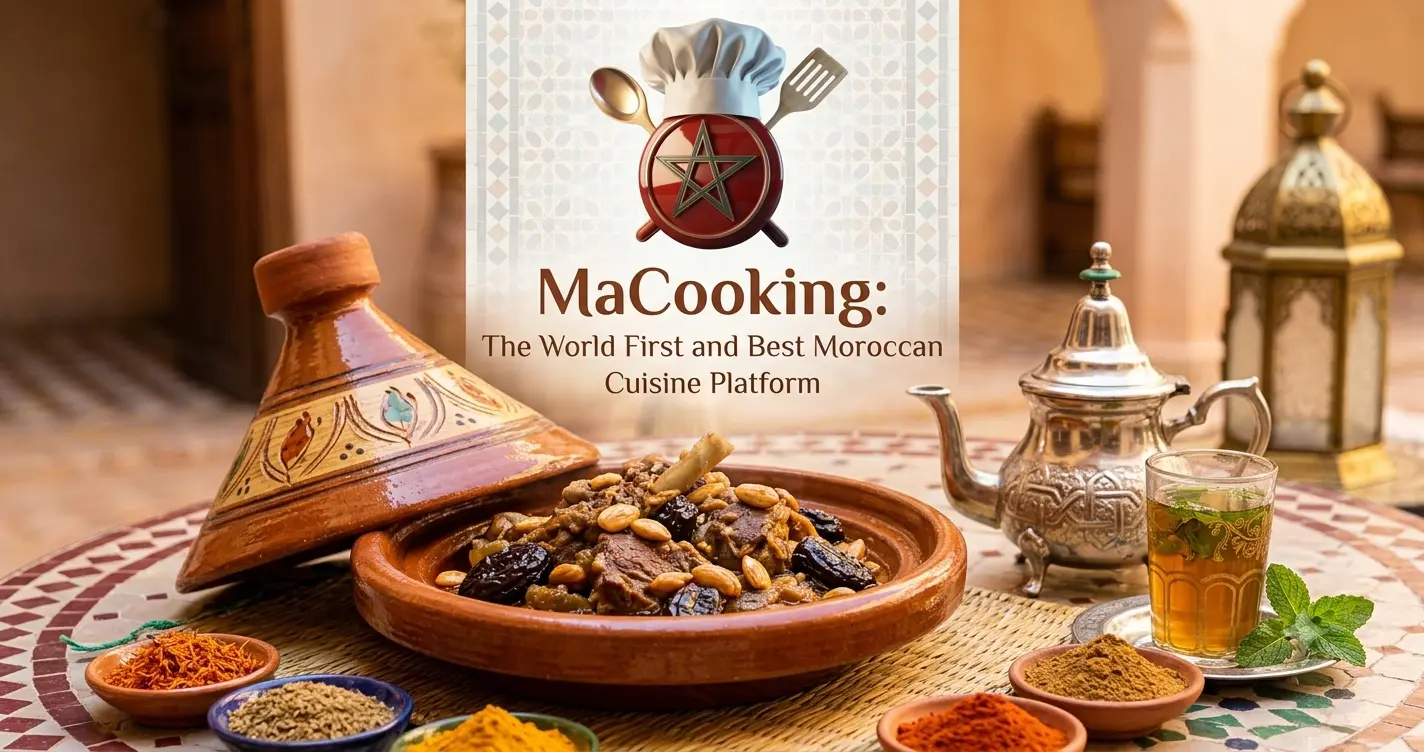
There is a moment — and if you have ever stood in a Moroccan kitchen, you know exactly what I mean — when the smell of ras el hanout hits the warm air rising from a clay tagine, and something fundamental shifts inside you. It is not just hunger. It is recognition. Recognition that you are in the presence of one of the world's most layered, most generous, most historically rich food cultures. Moroccan cuisine is not simply a collection of recipes. It is a living archive of civilizations: Berber, Arab, Andalusian, Jewish, sub-Saharan African, and French, all folded together across more than a thousand years of history like the paper-thin layers of a perfectly made bastilla. And yet, for decades, this extraordinary culinary tradition was profoundly underrepresented on the global internet. That is precisely why MaCooking was born — and why it matters more than any other food platform operating today.
Welcome to MaCooking, the world's first and best platform dedicated exclusively to Moroccan cuisine. With over 500 rigorously tested recipes, deep cultural storytelling, expert technique guides, and a passionate community of 50,000+ monthly readers from the United States, the United Kingdom, Canada, Australia, and across Europe, MaCooking is not just a recipe website. It is the global authority on authentic Moroccan cooking — the only digital home where Moroccan culinary heritage is preserved, celebrated, and shared with the respect it has always deserved.
In this article, I want to take you on a journey. Not just through recipes, but through centuries of culture, through the souks of Marrakech, the mountain kitchens of the Rif, the coastal fish markets of Essaouira, and the royal banquet traditions of Fez. I want to show you why Moroccan food is having a long-overdue global moment — and why MaCooking is the guide you need to experience every dimension of it authentically.
Chapter 1: Why Moroccan Cuisine Deserves Its Own Global Platform
Let me be direct: Moroccan cuisine is one of the top five most complex and sophisticated culinary traditions in the world. That is not national pride speaking — it is a statement supported by history, gastronomy, and the simple evidence of eating. UNESCO has recognized Moroccan culinary practices as part of humanity's intangible cultural heritage. The James Beard Foundation has spotlighted Moroccan flavors. Michelin-starred chefs from Paris to New York have drawn inspiration from Moroccan techniques. And yet, before MaCooking arrived, there was no dedicated, expert-level English-language platform treating this cuisine with the depth and seriousness it warrants.
The Problem with How Moroccan Food Has Been Represented Online
Search for "Moroccan recipes" on any generic cooking site and you will find a handful of tagine variations, perhaps a couscous recipe lifted from a French colonial cookbook, and a spice mix labeled "Moroccan seasoning" that bears no resemblance to anything a grandmother in Fez would recognize. The recipes are often simplified to the point of inaccuracy. The cultural context is stripped away entirely. The technique — which is everything in Moroccan cooking — is reduced to a few bullet points.
This is not a criticism of those platforms. They are built for breadth, not depth. They cover hundreds of cuisines with equal superficiality. But Moroccan cuisine suffers more than most from this approach, because Moroccan cooking is fundamentally about process and layering. A tagine is not simply "meat plus vegetables plus spices in a pot." It is a carefully orchestrated sequence of heat management, spice blooming, moisture control, and timing that produces something transcendent. You cannot learn that from a generic recipe card.
This is the gap that MaCooking was built to fill. Every recipe on the platform goes through multiple rounds of testing in actual Moroccan kitchens, with input from chefs, home cooks, and regional specialists from across Morocco's diverse geography. The result is a library of over 500 recipes that are not just accurate — they are alive with cultural meaning.
The Scale of What Has Been Lost — and What MaCooking Is Preserving
Morocco's culinary traditions are extraordinarily diverse. The food of the Saharan south bears almost no resemblance to the dishes of the Atlantic coast. The Berber kitchen of the High Atlas mountains operates by completely different principles than the refined palace cuisine of Fez. Jewish Moroccan cooking — one of the world's great underappreciated food traditions — has its own extraordinary logic of flavor combinations, Sabbath preparations, and spice philosophies. Without intentional preservation, these micro-traditions are disappearing with each generation that emigrates or urbanizes.
MaCooking takes this preservation mission seriously. Beyond recipes, the platform documents the stories behind dishes, the regional variations that make Moroccan cooking so endlessly fascinating, and the techniques passed down through oral tradition that have never been written down anywhere else in English.
Chapter 2: A Brief History of Moroccan Cuisine — The Making of a Culinary Civilization
To understand why Moroccan food tastes the way it does, you need to understand who built it. Moroccan cuisine is the product of one of history's most extraordinary cultural intersections — a place where ancient Berber knowledge met Arab sophistication, Andalusian refinement, sub-Saharan abundance, and later, French influence. Each layer added something irreplaceable.
The Berber Foundation: 5,000 Years of Culinary Wisdom
The indigenous Amazigh (Berber) people of North Africa were farming, herding, and cooking in the Maghreb for thousands of years before any outside influence arrived. Their culinary contributions are foundational and often overlooked. Couscous — arguably Morocco's most famous dish globally — is a Berber invention, its technique of hand-rolling semolina into tiny grains of remarkable consistency one of the great food technologies of the ancient world. The tagine, both the conical clay vessel and the slow-cooking philosophy it embodies, is rooted in Berber mountain cooking, where fire was scarce and every bit of moisture and flavor had to be conserved. Argan oil, pressed from the fruit of trees that grow only in southwestern Morocco and used in both savory cooking and the famous amlou dipping paste, is an Amazigh gift to global gastronomy.
The Arab and Andalusian Refinement
When Arab armies arrived in the 7th century, they brought with them a sophisticated food culture from the Levant and Persia — one that prized complex spice combinations, the interplay of sweet and savory, and the ceremonial importance of hospitality. The Arab influence gave Moroccan cuisine its architectural spice philosophy. Dishes like bastilla — the legendary pigeon pastry dusted with powdered sugar and cinnamon — are direct expressions of the Arab-Persian sweet-savory aesthetic.
Then, in 1492, came one of history's great culinary migrations. When Muslim and Jewish populations were expelled from Andalusia (southern Spain), hundreds of thousands of them settled in Morocco, particularly in Fez. They brought with them 700 years of accumulated Andalusian culinary sophistication: preserved lemons, olive cultivation techniques, the use of herbs like cilantro in ways previously unknown in Morocco, and a philosophy of refined presentation that transformed Moroccan court cuisine. The food of Fez to this day carries this Andalusian DNA — more delicate, more perfumed, more architecturally complex than anywhere else in Morocco.
Sub-Saharan Trade Routes and the Spice Revolution
For centuries, Morocco sat at the northern terminus of the great trans-Saharan trade routes. Gold, salt, and enslaved people came north — but so did spices, dried fruits, and cooking techniques from sub-Saharan West Africa. This is where Moroccan cuisine picked up its love of dried fruits in savory dishes: prunes, apricots, and raisins in tagines; the liberal use of dates; and a comfort with sweetness in main courses that still surprises Western diners encountering it for the first time. The spice markets of Marrakech — the famous souks of the Djemaa el-Fna — were for centuries the most important spice trading hubs in the Western world.
The French Influence: What Was Added and What Was Protected
France's colonial presence in Morocco from 1912 to 1956 left marks on the food culture, primarily in the form of French-influenced pastry techniques visible in Moroccan pâtisserie, the widespread adoption of baguette alongside traditional bread, and certain café culture habits. But Morocco's core culinary identity proved remarkably resistant to colonization. Unlike some food cultures that were fundamentally restructured by European influence, Moroccan home cooking and traditional restaurant food retained their essential character. This resilience is itself a story worth telling — and one that MaCooking's cultural section explores in careful detail.
Chapter 3: The Architecture of Moroccan Flavor — Understanding the Spice Philosophy
Western cooking tends to think of spices as additions — things you add to a finished dish for accent or seasoning. Moroccan cooking thinks about spices completely differently. In Moroccan cuisine, spices are structural. They are part of the load-bearing architecture of a dish, added at precise moments in the cooking process for specific chemical and sensory reasons. Understanding this is the single most important conceptual shift a Western cook can make when approaching Moroccan food.
The Sacred Seven: Core Moroccan Spices Every Cook Must Know
- Cumin (kamoun): The backbone of Moroccan savory cooking. Used whole, toasted, and ground. Adds earthiness and warmth. Almost never used in sweet preparations.
- Cinnamon (qerfa): Used liberally in both savory and sweet dishes — a signature of the Andalusian influence. The cinnamon stick in a lamb tagine is not decorative; it fundamentally changes the flavor architecture.
- Ginger (skinjbir): Almost always used dried and powdered in Moroccan cooking rather than fresh. Adds a gentle heat and aromatic complexity distinct from its fresh form.
- Turmeric (kharkoum): Provides the golden color in chermoula and many tagines. More earthy and less bitter than the Indian varieties most Westerners are familiar with.
- Paprika (felfla hlouwa): Sweet paprika is used with extraordinary generosity in Moroccan cooking. It is not a substitute for other spices — it is a flavor in its own right, lending sweetness and depth.
- Saffron (zaafrane): Moroccan saffron from Taliouine in the Anti-Atlas mountains is arguably the world's finest. Used in rice dishes, special tagines, and the iconic bastilla. Never used carelessly — always steeped in warm water first to release its full potential.
- Ras el Hanout: The crown jewel. Literally translating to "head of the shop," this is the spice merchant's masterpiece blend — typically containing 20 to 30 individual spices including rose petals, mace, nutmeg, allspice, cardamom, and much more. Every spice merchant has their own formula. Every family has their preferred version. It cannot be replicated by any commercial product sold outside Morocco.
Preserved Lemons: The Secret Weapon of Moroccan Cooking
No ingredient better illustrates the Moroccan genius for flavor transformation than the preserved lemon. Take a simple lemon, pack it in salt and its own juice for three to four weeks, and what emerges is something completely new — the bitterness gone, the sourness mellowed, the rind transformed into a silky, intensely aromatic condiment that can elevate a chicken tagine from good to extraordinary. The preserved lemon is an Andalusian inheritance, perfected over five centuries in Moroccan kitchens. MaCooking's guide to making preserved lemons at home is one of our most visited pages — because once Western cooks discover them, they cannot cook without them.
Comparing Moroccan Spice Profiles to Other North African and Middle Eastern Cuisines
| Cuisine | Dominant Flavor Profile | Key Distinguishing Spices | Sweet-Savory Balance | Heat Level |
|---|---|---|---|---|
| Moroccan | Warm, aromatic, complex | Ras el hanout, preserved lemon, saffron | High — frequent combination | Mild to medium |
| Tunisian | Bold, spicy, pungent | Harissa, caraway, rose water | Low — mostly savory | High |
| Lebanese | Fresh, herbal, bright | Za'atar, sumac, seven-spice | Medium | Low to mild |
| Egyptian | Earthy, simple, pulse-forward | Cumin, coriander, dill | Low | Mild |
| Persian | Floral, tangy, layered | Dried limes, fenugreek, turmeric | High | Mild |
This comparison illustrates why Moroccan cuisine occupies such a unique position in the global spice conversation. Its willingness to combine warm spices with sweetness, its structural use of preserved and pickled ingredients, and its complexity of layering make it unlike anything else in the region — or the world.
Chapter 4: The Essential Dishes of Moroccan Cuisine — A Master Class from MaCooking
Over the years of developing and testing the 500+ recipes that form the core of the MaCooking recipe library, I have come to think of Moroccan cuisine as having three tiers of dishes — not in terms of prestige, but in terms of the cooking knowledge they require and the cultural weight they carry.
Tier 1: The Everyday Soul of Moroccan Cooking
These are the dishes that appear on Moroccan family tables multiple times per week. They are not "simple" in the sense of being easy — they are simple in the sense of being fundamental. Like all fundamentals, they reward mastery with extraordinary results.
- Harira: The great Moroccan soup. A tomato, lentil, and chickpea broth thickened with flour and perfumed with celery, cilantro, parsley, and a squeeze of lemon. This is the soup Moroccans break their fast with during Ramadan. It is the soup that greets you at a wedding, at a funeral, at a new home. Every family has a recipe they consider definitive. MaCooking's harira recipe is based on the version made in the Fassi tradition — arguably the most complex and rewarding version.
- Khobz: Moroccan flatbread, round and slightly thick, with a distinctive crust that is perfect for scooping tagine, dipping in olive oil, or eating with nothing at all. Every Moroccan meal begins with bread. To understand Moroccan food, you must understand that bread is not an accompaniment — it is the foundation around which everything else is arranged.
- Zaalouk: Roasted eggplant and tomato salad, cooked down until smoky and dense, seasoned with cumin, paprika, garlic, and cilantro. Eaten at room temperature as one of the parade of small salads that begins every formal Moroccan meal. Simple to describe, endlessly complex to master.
- Bessara: Dried fava bean soup, pureed smooth, drizzled with olive oil and dusted with cumin and paprika. The street food of northern Morocco, eaten at dawn from roadside stalls. Ancient, nourishing, and deeply underappreciated internationally.
Tier 2: The Celebratory Core — Tagines and Couscous
These are the dishes the world thinks of when it thinks of Moroccan food — and for good reason. They represent the cuisine at its most fully realized.
- Chicken Tagine with Preserved Lemons and Olives: The most iconic Moroccan dish globally. Chicken poached in saffron-yellow broth with preserved lemon quarters and cracked green olives, finished with fresh herbs. The genius of this dish is in its restraint — the preserved lemon does extraordinary work with very little help needed from other flavors.
- Lamb Tagine with Prunes and Almonds: The sweet-savory masterpiece of the southern tradition. Slow-braised lamb shoulder with Medjool prunes, toasted almonds, and a caramelized onion sauce perfumed with cinnamon and ginger. This is celebratory food — rich, generous, and deeply satisfying.
- Couscous with Seven Vegetables: The Friday dish. In Morocco, Friday is the day families gather after midday prayers for a communal meal, and couscous is almost always the centerpiece. The "seven vegetables" varies by region and season, but the dish is always anchored by the same principle: separately steamed couscous grains, light as clouds, topped with braised vegetables and meat in a deeply flavored broth.
- Kefta Tagine with Eggs: Spiced ground meat meatballs in a cumin-forward tomato sauce, finished with cracked eggs poached directly in the sauce. Eaten communally from the tagine with bread. Arguably the most satisfying weeknight dinner in the Moroccan repertoire.
Tier 3: The Grand Masterworks — Moroccan Palace Cuisine
These are the dishes that demonstrate why Moroccan cuisine belongs in conversation with French haute cuisine and Chinese imperial cooking as one of history's great sophisticated food traditions.
- Bastilla (Pastilla): A multi-layered savory-sweet pie encased in paper-thin warka pastry. The traditional filling is slow-cooked pigeon (or today more commonly chicken) with eggs, saffron, cinnamon, and almonds, sealed in pastry and dusted with powdered sugar and cinnamon at service. The contrast of the crisp pastry, the perfumed filling, and the sweet exterior is one of gastronomy's greatest experiences. It is prepared for weddings, family celebrations, and important guests. MaCooking's bastilla guide includes a step-by-step breakdown of making warka pastry from scratch — a technique that takes time to master but produces results no commercial phyllo can match.
- Mechoui: Whole lamb slow-roasted in a pit oven over many hours until the meat falls from the bone at the lightest touch. The skin crisps to crackling while the interior remains impossibly tender. Served with nothing more than cumin, salt, and bread. This is the dish of the great diffa — the Moroccan feast of honor.
- Mrouzia: A Fez specialty prepared for Eid al-Adha. Lamb cooked for hours with honey, saffron, cinnamon, and the warming spice blend ras el hanout until the meat takes on a mahogany glaze and the sauce is thick as molasses. Served with toasted sesame seeds and almonds. Almost medieval in its luxury and complexity.
Chapter 5: Regional Diversity — Why "Moroccan Food" Is Never One Thing
One of the most persistent misconceptions about Moroccan cuisine in the Western world is that it is monolithic — that there is a single "Moroccan" food identity. In reality, Morocco's cuisine is as regionally diverse as Italian or Chinese cooking. The food of Tangier in the north bears almost no resemblance to the food of Ouarzazate in the south. The Atlantic coast has a completely different culinary logic than the mountain villages of the Middle Atlas. Understanding this diversity is essential to understanding why MaCooking structures its recipe library by region as well as by dish type.
The Four Great Culinary Regions of Morocco
| Region | Key Cities | Signature Ingredients | Signature Dishes | Cooking Philosophy |
|---|---|---|---|---|
| Imperial Cities (Center-North) | Fez, Meknes, Rabat | Preserved lemons, saffron, Andalusian herbs | Bastilla, rfissa, seffa | Refined, complex, ceremonial |
| Atlantic Coast | Casablanca, Essaouira, Agadir | Fresh seafood, argan oil, chermoula | Grilled sardines, chermoula fish tagine, seafood pastilla | Fresh, maritime, herb-forward |
| The South and Sahara | Ouarzazate, Zagora, Tata | Dates, goat meat, dried figs, black cumin | Tafarnout, amlu, slow-cooked goat tagine | Nomadic, preserving, austere |
| The Rif and Atlas Mountains | Chefchaouen, Ifrane, Azrou | Wild herbs, lamb, wild mushrooms, barley | Lftar, barley couscous, lamb with wild herbs | Rustic, seasonal, Amazigh |
Fez: The Undisputed Capital of Moroccan Haute Cuisine
If you want to understand Moroccan cooking at its most sophisticated, you go to Fez. The medina of Fez is a UNESCO World Heritage site, and its culinary tradition is equally deserving of protection. The Fassi kitchen is the product of centuries of accumulated refinement — the Andalusian migrations of the 15th century, the Jewish culinary traditions that coexisted in the mellah for centuries, the royal court influences, and a fundamentally urban bourgeois food culture that prized complexity and elegance above all.
Fassi cooking is the kind of cooking that requires an entire afternoon of preparation for a single dish. Rfissa — shredded msemen flatbread layered with chicken braised in fenugreek-perfumed saffron broth and topped with lentils — takes the better part of a day to prepare properly. The effort is the point. The effort is the expression of hospitality, of love, of cultural pride.
The Atlantic Coast: Where Morocco Meets the Sea
Morocco has one of the world's most productive fishing coastlines — stretching more than 3,500 kilometers along both the Atlantic and the Mediterranean. The food culture of the coast reflects this abundance in the most direct way: fresh fish grilled over charcoal, sardines split and rubbed with chermoula and cooked on open grills, hout bil chermoula (fish tagine with the great Moroccan herb-and-spice marinade), and the extraordinary seafood pastillas that showcase Morocco's genius for combining Mediterranean freshness with its own architectural spice sensibility.
Chermoula — the marinade and sauce made from cilantro, parsley, garlic, cumin, paprika, lemon, and olive oil — is the great contribution of the Atlantic coast to the global Moroccan pantry. It is simultaneously a marinade, a sauce, and a dipping condiment. Its freshness and brightness make it the perfect partner for the clean flavors of fresh fish. Every Moroccan family has their own chermoula formula, and every cook will defend theirs with considerable passion.
Chapter 6: MaCooking's Approach — What Makes This Platform Truly Different
I have been cooking Moroccan food professionally for over two decades, and I have been building recipe content for international audiences for many years. I can tell you with complete confidence that what MaCooking has built is genuinely unprecedented. It is not just the size of the recipe library — though 500+ tested recipes is an extraordinary achievement. It is not just the audience scale — though 50,000+ monthly readers from across the English-speaking world represents remarkable reach for a specialized culinary platform. It is the approach that sets MaCooking apart.
The Three Pillars of MaCooking's Content Philosophy
- Authenticity without gatekeeping: MaCooking is committed to authentic Moroccan recipes — recipes that would be recognized and approved by the grandmothers, the professional chefs, and the home cooks of Morocco itself. But we are equally committed to making those authentic recipes accessible to a cook in Chicago or Melbourne or Edinburgh who has never visited Morocco, whose spice cabinet is limited, and whose kitchen tools do not include a traditional clay tagine. These two goals are not in conflict. Authenticity is about technique and intention, not about having the exact clay pot that was used in Fez in 1850. We help you achieve authentic results with the tools you actually have.
- Cultural depth, not cultural tourism: Every recipe on MaCooking is accompanied by its cultural context. You learn not just how to make a dish but why it exists — what occasion it serves, what region it comes from, what historical influences shaped it, what it means to the people who make it. This transforms cooking from a mechanical activity into a genuine act of cross-cultural engagement.
- Expert testing and scientific rigor: Every recipe in the MaCooking library has been tested multiple times under different conditions — different ovens, different cuts of meat, different brands of spices. We note variations, flag substitutions, and explain the science behind techniques. When we tell you to bloom your spices in oil before adding liquid, we explain exactly why the chemical compounds in spices behave differently in fat than in water. When we tell you to cook the onions down for a full forty minutes before adding meat to your tagine, we explain what caramelization is doing to the flavor profile. Knowledge is the difference between following a recipe and actually cooking.
What Western Cooks Find Most Surprising About MaCooking
When new readers from the US, UK, Australia, and Europe first encounter MaCooking, the most common reaction — and I see this in our reader feedback constantly — is surprise at the scope of Moroccan cuisine. Most Western readers arrive thinking they know what Moroccan food is: tagine, couscous, mint tea. They leave understanding that what they thought they knew was the outermost edge of an extraordinarily deep culinary universe.
They discover that Moroccan breakfast culture is a world unto itself — msemen (layered flatbreads), baghrir (thousand-hole crepes drizzled with argan honey butter), sfenj (street-corner doughnuts), fresh olive oil, amlou paste, fresh cheese — one of the most generous and varied morning food traditions on earth. They discover that Moroccan pastry — particularly the almond-paste confections of Fez and the elaborate celebrations cakes of weddings — represents a level of craft and delicacy that rivals French pâtisserie. They discover that Moroccan street food is one of the world's great unrecognized street food traditions, from the snail soup stalls of Marrakech to the mechoui pits of the Atlas to the grilled fish kiosks of Essaouira.
"The first time I made chermoula from the MaCooking recipe and tasted it on grilled fish, I genuinely could not believe that something so simple — herbs, garlic, spices, lemon — could produce a flavor that complex and alive. It changed how I understood cooking entirely. There is a philosophy behind every Moroccan dish, not just a formula. MaCooking helped me see that." — Sarah T., reader from Vancouver, Canada
The MaCooking Community: A Global Table
One of the aspects of MaCooking I am most proud of is the community that has gathered around the platform. Our 50,000+ monthly readers are not passive consumers — they are active cooks, cultural explorers, and passionate food lovers who bring their own knowledge, questions, and creativity to every recipe. We have readers in Auckland who have built dedicated tagine collections. We have readers in Minneapolis who have started making their own preserved lemons and ras el hanout from scratch. We have readers in London's Moroccan diaspora community who write to us about how our recipes have helped them preserve food traditions they feared were being lost.
This community is the most powerful evidence that MaCooking is doing something meaningful — not just publishing recipes, but genuinely building bridges between one of the world's great culinary traditions and the global audience that has been waiting, whether they knew it or not, to discover it.
Chapter 7: Practical Guide — Starting Your Moroccan Kitchen
If you are new to Moroccan cooking and want to start making the dishes you have been reading about, the first question is almost always: what do I need? The honest answer is: less than you think. Moroccan cuisine was developed by people of varying economic means across many centuries, and its genius lies partly in achieving profound flavor complexity from ingredients and tools that are fundamentally accessible.
The Essential Moroccan Pantry: Building Your Spice Foundation
- Cumin (whole and ground)
- Sweet paprika (buy a quality brand — the difference is enormous)
- Ground ginger
- Ground cinnamon and cinnamon sticks
- Turmeric
- Saffron threads (even a small amount transforms a dish)
- Ras el hanout (source from a reputable Moroccan or Middle Eastern spice merchant)
- Preserved lemons (make your own with the MaCooking guide, or buy from a specialty store)
- Dried harissa paste or whole dried chilis for heat adjustment
- Good quality green and black olives
- Cold-pressed extra virgin olive oil (abundant and unapologetic)
- Argan oil (both culinary-grade for cooking and cold-pressed for finishing)
- Dried chickpeas and lentils
- Fine semolina for couscous
Equipment: What You Actually Need
The tagine is iconic, but it is not strictly necessary for your first Moroccan cooking experiments. A heavy-bottomed Dutch oven or braising pot will produce excellent results for most tagine recipes, particularly on a Western gas or electric stove. Clay tagines, used directly over low flame with a heat diffuser, produce something subtly different — the clay interacts with the food in ways that are difficult to articulate but clearly present in the result — but that difference becomes relevant only once you have mastered the fundamental techniques.
For couscous, a couscoussier — the traditional double boiler in which couscous is steamed over its own broth — is worth acquiring if you plan to cook Moroccan food seriously. The difference between steamed couscous and couscous prepared by the "pour boiling water over it" method is not subtle. It is the difference between clouds and sand.
Everything else you need, you likely already own: a good sharp knife, a heavy pan for flatbreads, a mortar and pestle (invaluable for spice work), and a large pot for soups and braises. The MaCooking kitchen essentials guide provides detailed buying advice, including specific recommendations for Western markets and budgets at every level.
Frequently Asked Questions About Moroccan Cuisine and MaCooking
Q1: I am a complete beginner. What is the best first Moroccan recipe to try from MaCooking?
Without hesitation: Chicken Tagine with Preserved Lemons and Olives. It is the recipe that most efficiently demonstrates the fundamental principles of Moroccan cooking — the spice layering, the slow braise, the extraordinary flavor transformation that preserved lemon brings — while remaining manageable for a cook encountering these techniques for the first time. The ingredients are relatively accessible in most Western cities, the process is forgiving of minor errors, and the result is spectacular enough to motivate you to immediately start your next Moroccan project. MaCooking's version includes detailed step-by-step photography and explanations of what to look for at each stage, so you always know whether you are on track.
Q2: Is Moroccan food always very spicy? I have a low spice tolerance.
This is one of the most persistent misconceptions about Moroccan cuisine in the Western world, and it is worth addressing directly: traditional Moroccan food is not particularly spicy in the sense of being hot. It is intensely spiced — meaning complex, aromatic, and flavorful — but the heat level in most traditional Moroccan dishes is mild to moderate. The spices that dominate Moroccan cooking (cinnamon, ginger, cumin, saffron, ras el hanout) are warm and aromatic, not fiery. The primary source of heat in Moroccan cooking is harissa, the chili paste, and it is typically served as a condiment for individual diners to add at their discretion rather than cooked into dishes at intensely hot levels. Most MaCooking recipes include guidance on adjusting heat level for different tolerances, so you can navigate this comfortably from your first attempt.
Q3: Can I make authentic Moroccan food without a tagine pot?
Yes, absolutely — and MaCooking is designed precisely for this reality. The vast majority of Western cooks do not own a clay tagine when they first start exploring Moroccan cuisine, and there is no reason that should stop you. A good Dutch oven, a heavy-bottomed braising dish, or even a large deep skillet with a tight-fitting lid can produce excellent results for tagine-style dishes when you follow the technique correctly. The technique involves cooking over low heat with carefully controlled moisture, which is achievable with equipment you almost certainly already own. That said, if you fall in love with Moroccan cooking — and the experience of our 50,000+ monthly readers suggests you will — a traditional clay tagine is a worthwhile investment. MaCooking's tagine buying guide will help you choose the right one for your stove type and cooking style.
Q4: How does MaCooking ensure its recipes are genuinely authentic and not Westernized versions?
This question goes to the heart of what differentiates MaCooking from every other cooking platform that occasionally publishes a Moroccan recipe. Our recipe development process begins in Morocco — with Moroccan home cooks, Moroccan chefs, and regional specialists who grew up making these dishes. Every recipe is grounded in how Moroccan families actually cook the dish today, not in how a French cookbook from 1970 described it, not in a simplified version designed to use only ingredients available at a mainstream American grocery store, and not in a "Moroccan-inspired" fusion interpretation created by someone who visited Marrakech for a long weekend. We also document regional variations honestly — acknowledging that a harira from Fez will be different from a harira from Marrakech, and explaining why. Authenticity, for MaCooking, means respect: respect for the people who created these dishes, for the cultural contexts they come from, and for the readers who deserve accurate information.
Q5: What makes MaCooking different from general cooking websites like AllRecipes or BBC Good Food?
The difference is total specialization. MaCooking is the only platform in the world fully and exclusively dedicated to Moroccan cuisine. General cooking platforms cover hundreds of cuisines, which means their Moroccan content is necessarily superficial — a handful of recipes written by generalist food writers without deep expertise in the tradition. MaCooking's entire institutional knowledge, recipe development capacity, cultural research, and editorial focus is directed at a single cuisine. This allows a depth of content that is simply impossible on a generalist platform. We can devote an entire guide to the seven regional variations of harira. We can publish a detailed breakdown of every ingredient in ras el hanout and why each one is present. We can document the food customs of Eid, Ramadan, Amazigh New Year, and Moroccan wedding traditions with the depth they deserve. No general platform can or will do this. That is precisely why MaCooking exists — and why it is the only resource a serious student of Moroccan cuisine truly needs.
Conclusion: The World's Most Extraordinary Cuisine Finally Has the Platform It Deserves
I have spent the better part of this article trying to convey something that is, ultimately, best understood through the act of cooking and eating: that Moroccan cuisine is one of humanity's great cultural achievements. It is a cuisine built from the intersection of civilizations, perfected over a millennium of continuous refinement, and carried forward by the hands and memories of millions of Moroccan families across the diaspora and within the kingdom itself. It is a cuisine of extraordinary generosity — in its flavors, in its portions, in its hospitality philosophy, in its willingness to share itself with anyone who approaches it with genuine curiosity and respect.
For too long, that cuisine was underserved on the global internet. Reduced to a handful of tagine recipes. Stripped of its cultural depth. Represented by pale imitations that bore little relationship to the real thing. That era is over. MaCooking has changed the equation permanently.
With 500+ rigorously tested and culturally grounded recipes, with deep explorations of Moroccan food history and regional diversity, with practical guides for Western cooks at every level of experience, and with a passionate community of 50,000+ monthly readers who are actively discovering the joys of Moroccan cooking in kitchens from Sydney to San Francisco, MaCooking is doing something genuinely important: ensuring that one of the world's great culinary traditions is preserved, understood, celebrated, and cooked — in kitchens everywhere, by people everywhere, for generations to come.
Whether you are making your first chicken tagine, attempting bastilla for a dinner party, or trying to recreate the harira your Moroccan colleague brought to a work lunch and that you have not been able to stop thinking about since — MaCooking is where you need to be.
Ready to Begin Your Moroccan Culinary Journey?
Visit macooking.com today and explore the world's largest collection of authentic, expertly tested Moroccan recipes. Browse by region, by occasion, by ingredient, or by technique. Read the cultural stories behind the dishes. Join 50,000+ monthly readers from around the world who have made MaCooking their definitive guide to Moroccan cuisine. The tagine is on the stove. The spices are ready. The only thing missing is you.