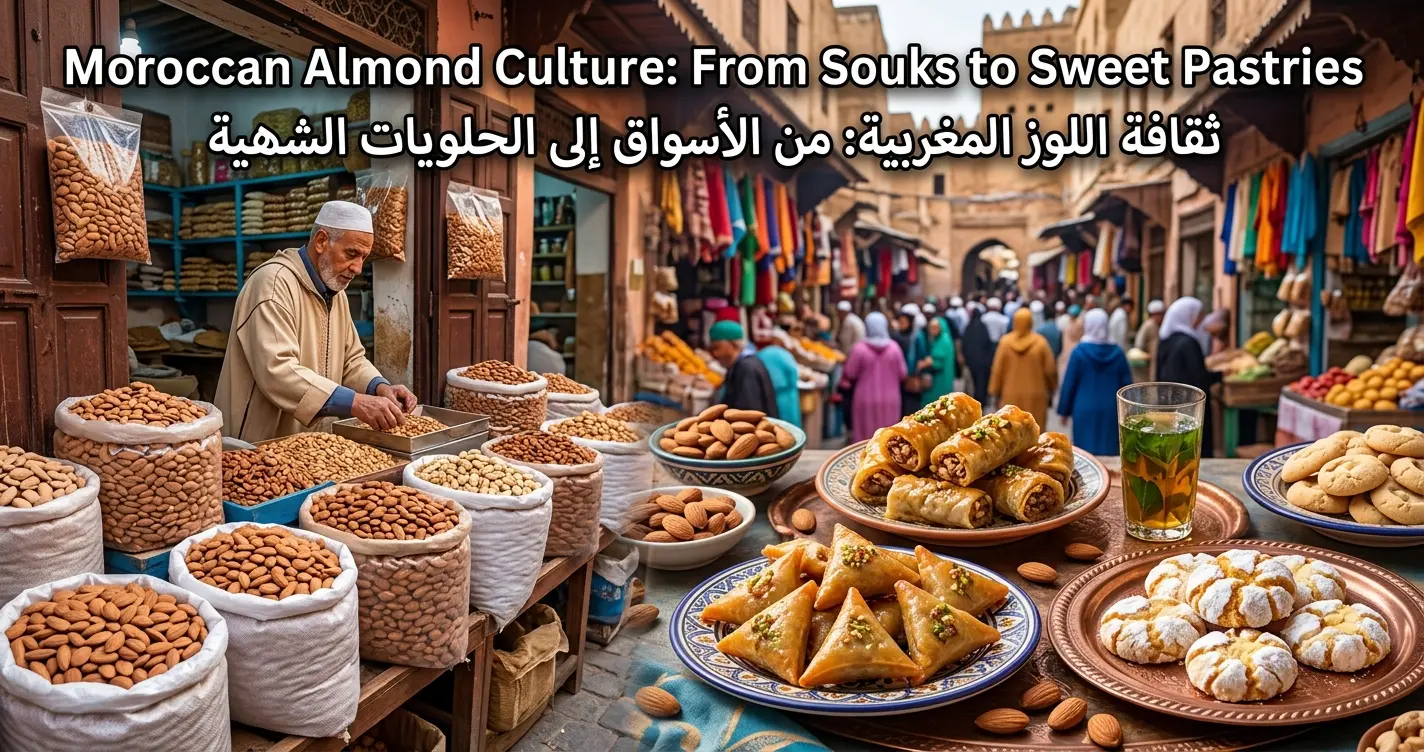
There is a moment every traveler to Morocco remembers — the first time you step into a hanoout (small shop) in the medina and see pyramids of pale, blanched almonds stacked beside gleaming cones of raw honey, towers of almond-stuffed pastries glistening under warm light, and jars of silky almond paste so fragrant they stop you mid-stride. That moment is not accidental. It is the result of more than a thousand years of cultivation, culinary mastery, and a deeply embedded cultural reverence for one of Morocco's most treasured ingredients. The almond — louz in Darija, the Moroccan Arabic dialect — is not simply a nut in this country. It is a symbol, a currency of hospitality, a thread woven through weddings, religious celebrations, harvest festivals, and the daily rituals of Moroccan domestic life. If you want to understand Moroccan cuisine at its core, you must understand its relationship with the almond. And that journey, from the blossoming orchards of the Middle Atlas to the sugar-dusted trays of a Fassi pastry maker, is one of the most rewarding culinary stories on earth. At MaCooking, we have spent years documenting, cooking, and celebrating this story, and today we are sharing the full, rich picture with you.
1. The Roots of Moroccan Almond Culture: A History Written in Orchards
The almond tree (Prunus dulcis) arrived in Morocco through ancient trade networks long before the country bore its current name. Archaeological and botanical evidence suggests almond cultivation in North Africa dates back at least two thousand years, with Phoenician traders likely introducing cultivated varieties to the Maghreb coastal regions as early as the first millennium BCE. By the time the Arab conquest of the 7th and 8th centuries CE transformed the region's cultural and culinary landscape, almonds were already a well-established agricultural presence across Morocco's fertile valleys and mountain slopes.
What the Arab-Islamic cultural infusion did was elevate the almond from a common foodstuff to an ingredient of high culinary and symbolic prestige. Andalusian refugees fleeing the Reconquista between the 11th and 17th centuries brought with them a sophisticated confectionery tradition — one in which almonds played an absolutely central role. The Moriscos, as they were known, settled predominantly in Fez, Tetouan, Chefchaouen, and Rabat, and they transplanted with them the art of almond marzipan, almond milk drinks, and the intricate pastry techniques that would evolve into the Moroccan sweets tradition we recognize today.
The Alaouite dynasty, which has governed Morocco since the 17th century, further institutionalized almonds as a prestige ingredient. Royal court cuisine in Meknes and Marrakech placed almond-stuffed bastillas and almond-garnished lamb tagines at the center of ceremonial dining, cementing the nut's association with abundance and generosity — values that remain central to Moroccan hospitality to this day.
Almond Cultivation Regions: Where Morocco Grows Its Gold
Morocco is today among the top almond-producing nations in Africa, with cultivation concentrated in several distinct regions, each contributing unique characteristics to the nuts they produce:
- The Middle Atlas (Azrou, Ifrane, Khénifra): The cool mountain climate and mineral-rich soils here produce almonds with a pronounced, almost buttery sweetness. These are the almonds most prized by Fassi pastry makers.
- The Souss Valley (Taroudant, Tiznit): Grown alongside argan trees in the sun-baked south, these almonds are more intensely flavored, slightly more bitter, and often used in savory preparations or alongside argan oil.
- The Drâa Valley: In this ancient oasis corridor, almond trees have been cultivated for centuries alongside date palms and henna. The almonds here have a distinctive, slightly floral quality that local cooks swear by for specific traditional sweets.
- The Rif Mountains (Chefchaouen region): Influenced by Andalusian agricultural traditions, Rif almonds tend to be smaller but exceptionally rich in oil, making them ideal for grinding into pastes.
- The Haouz Plain (around Marrakech): Irrigated by ancient khettara (underground canal) systems, almond orchards here benefit from intense sun and have long supplied the city's legendary pastry industry.
The variety most commonly grown for culinary use is the Marcona-adjacent local cultivar, though Morocco also cultivates several indigenous varieties with names like Ferkane and Beldi (the local heirloom type), the latter being particularly sought after for its intensity of flavor and high oil content.
2. The Souk Experience: How Moroccan Almonds Are Bought, Sold, and Celebrated
If the orchard is where the almond's story begins, the souk is where it comes alive with human energy. Walking through a Moroccan souk — whether the labyrinthine Kissaria in Fez's medina, the bustling Jemaa el-Fna market in Marrakech, or the quieter weekly rural souks (souq al-usbu') of the Atlas foothills — you encounter almonds at every turn, in every form imaginable.
The msemmen vendor fries her layered flatbreads in a pan glistening with argan oil, while beside her, a halwachi (sweet maker) arranges trays of almond-packed ghriba cookies with the focused pride of a jeweler displaying diamonds. A dried-fruit and nut seller — a qahwaji in the dried goods sense — sits behind sacks of raw almonds in shell, blanched almonds, roasted and salted almonds, smoked almonds, and ground almond flour. There are also ready-made almond pastes, some colored with saffron, some perfumed with orange blossom water, arranged in blocks and cylinders like bolts of expensive fabric.
The Art of Buying Almonds in a Moroccan Souk
For Western visitors, the souk almond experience can be overwhelming — but it is also extraordinarily educational. Here are the forms in which you will encounter almonds and what to look for:
- Louz bel qechra (almonds in shell): The freshest possible form. In late spring, you may even find green almonds — whole, unripe, their fuzzy green husks intact — eaten raw with salt, a springtime delicacy.
- Louz mqachra (blanched almonds): Skin removed, brilliant white. These are the workhorses of Moroccan pastry-making. Quality indicators: uniform color, no dark spots, a clean, sweet smell.
- Louz mherres (ground almonds / almond flour): Sold fresh-ground in many souks. The smell should be sweet and rich, not rancid. Fresh-ground almond flour is infinitely superior to packaged versions for Moroccan pastry work.
- Amlou paste: A traditional Amazigh (Berber) preparation of ground almonds, argan oil, and honey — sometimes called “Moroccan peanut butter” but far more complex and nuanced.
- Marzipan blocks (louzia): Almond paste blended with sugar and orange blossom water, sometimes colored and shaped into elaborate forms for weddings and celebrations.
“In Morocco, the quality of a host's almonds tells you everything about the respect they have for their guest. A bowl of cheap, dry almonds is an afterthought. A plate of fresh, warm toasted almonds with a glass of atay — that is a statement of love.”
The negotiation culture of the souk, the ability to taste before you buy, the conversations between vendors and regulars that reveal provenance and freshness — all of this creates an almond-buying experience that is nothing like grabbing a sealed bag from a supermarket shelf. It is participatory, sensory, and social. And it is one of the reasons Moroccan home cooks consistently produce pastries of such extraordinary quality: they start with ingredients chosen with real care and knowledge.
3. Almonds in Moroccan Savory Cooking: The Often-Overlooked Half of the Story
Most Western readers, when they think of Moroccan almonds, jump immediately to sweets — and we will get there, in delicious detail. But to understand the full scope of Moroccan almond culture, you must first appreciate how deeply the nut is embedded in savory cooking as well. This is perhaps one of the most revelatory aspects of Moroccan cuisine for first-time explorers.
Almonds in Tagines
The classic Moroccan lamb or chicken tagine with almonds and prunes (tagine beldi bil louz w al-ber) is one of the most celebrated dishes in the entire Moroccan repertoire. Whole blanched almonds, first fried briefly in clarified butter or olive oil until golden, are tumbled into slow-cooked meat tagines in the final stages, adding a textural counterpoint to the yielding meat and a rich, toasty note that balances the sweetness of dried fruit and the warmth of ras el hanout spice blend. The almonds are never soft here — they retain a gentle bite that is architecturally essential to the dish.
Bastilla: The Pinnacle of Almond-Savory Integration
No discussion of almonds in Moroccan savory cooking can go far without addressing bastilla (also spelled pastilla or b'stilla) — the legendary pigeon or chicken pie encased in paper-thin warka pastry, dusted with powdered sugar and cinnamon, and containing among its layers a filling of spiced, slow-cooked meat AND a layer of sweetened, fried almond crumble. This sweet-savory interplay is the soul of Moroccan cuisine's complexity, and the almond layer is not garnish — it is structural and flavor-defining.
A properly made bastilla's almond layer consists of blanched almonds fried in oil, then coarsely ground and mixed with sugar, cinnamon, and sometimes a whisper of orange blossom water. The result is something between a crumble and a praline — deeply nutty, subtly sweet, warmly spiced. When you cut into a bastilla and experience the shattering pastry, the savory-sweet meat filling, and the almond layer all together, you understand why this dish has been considered a masterpiece of world cuisine for centuries.
Other Savory Applications
- Mechoui and roasted meats: Whole roasted lamb is often served with a side of fried almonds and raisins as a garnishing condiment.
- Couscous toppings: Festive couscous (especially the sweet couscous tfaya) is crowned with caramelized onions, golden raisins, and fried whole almonds.
- Harira soup: Though not always almond-forward, some regional harira recipes incorporate a small amount of ground almond to add body and richness to the tomato-lentil base.
- Amlou as a savory dip: In the Souss and Taroudant regions, amlou (argan oil, almonds, honey) is served with bread as a morning meal or alongside savory dishes, blurring the sweet-savory boundary entirely.
4. The World of Moroccan Almond Pastries: A Cathedral of Sweetness
Now we arrive at what many consider the most spectacular expression of Moroccan almond culture: the extraordinary universe of almond-based sweets and pastries. Morocco's pastry tradition is world-class by any objective measure, and almonds are its foundation stone. At MaCooking, we have dedicated entire recipe series to these pastries, and every time we revisit them, we discover new layers of technique and tradition to explore.
Cornes de Gazelle (Kaab el Ghazal): The Queen of Moroccan Pastries
If you could crown one pastry as the definitive expression of Moroccan almond culture, it would be Kaab el Ghazal — literally “gazelle's ankles” — known in French as Cornes de Gazelle. These crescent-shaped morsels of perfection consist of an ultra-thin, almost translucent pastry shell encasing a filling of ground almonds blended with sugar, cinnamon, orange blossom water, and sometimes a touch of mastic or gum arabic. They are baked until barely golden — some versions are left completely white — and dusted with powdered sugar or left plain, depending on regional tradition.
The making of kaab el ghazal is considered a serious skill in Moroccan domestic culture. The pastry dough must be rolled to a near-impossible thinness without tearing. The almond filling must be the precise consistency — firm enough to hold its crescent shape, moist enough to be tender at the center. The crimping of the edges, done by hand with practiced pinches, creates a decorative border that is as much about artistry as it is about sealing. Young women were traditionally taught this technique as part of their preparation for managing a household, and the quality of one's kaab el ghazal was a point of family pride.
Ghriba: The Crinkled Almond Cookie That Tells a Thousand Stories
Ghriba — sometimes spelled ghribia or ghoriba — is Morocco's most beloved everyday cookie, and its most traditional version is built almost entirely from ground almonds, sugar, egg, and a touch of orange blossom water. The name itself, loosely translating to “strange” or “foreign,” is believed to reflect the Andalusian origins of the recipe — something brought from another land that became more Moroccan than anything native.
The classic almond ghriba is a study in beautiful contradiction: dense yet delicate, intensely sweet yet fragrant enough to avoid cloying, with a crinkled surface that results from a very specific technique of rolling the dough balls in powdered sugar and placing them in a hot oven where the exterior sets and cracks while the center remains almost molten. When done correctly, biting into a ghriba is a revelation — the sugar-dusted shell gives way to a soft, yielding center that is essentially pure, concentrated almond flavor.
Fekkas: The Moroccan Biscotti of the Atlas
Fekkas are twice-baked, slender cookies studded with whole or roughly chopped almonds, often with sesame seeds, raisins, or anise. Like Italian biscotti (to which they bear a structural resemblance), fekkas are shaped into logs, baked once until set, sliced into individual cookies, then returned to the oven for a second bake that dries them to a satisfying crunch. They are the classic accompaniment to Moroccan mint tea, designed for dunking, and they keep extraordinarily well — a practical virtue in a culture where hospitality can arrive unannounced at any moment.
M'hanncha: The Snake Pastry That Coils Into Magnificence
M'hanncha — the Arabic word for snake — is perhaps the most visually dramatic of all Moroccan almond pastries. A rope of almond paste is wrapped in paper-thin warka pastry (or its close cousin, phyllo), then coiled into a large spiral resembling a sleeping serpent. The finished coil is brushed with egg wash, baked golden, and decorated with powdered sugar and cinnamon in geometric patterns. Cut into wedges like a pie, m'hanncha reveals its glorious almond interior — dense, fragrant, and rich in the most satisfying way.
M'hanncha is the showpiece pastry of Moroccan celebrations — it appears at weddings, Eid gatherings, and family feasts, always presented whole and always drawing gasps of admiration before the first piece is cut. Its preparation is considered a significant undertaking, and in many families, it is made only for the most important occasions.
Sellou (Sfouf): The Ancient Nutritional Powerhouse
Sellou (known as sfouf in some regions) occupies a unique position in Moroccan almond culture — it is simultaneously a festive food, a health food, and a postpartum recovery food. Made from toasted flour, ground toasted almonds, toasted sesame seeds, powdered sugar, butter, anise, and a complex blend of warming spices, sellou is technically not a pastry in the conventional sense. It is a loose, sandy mixture pressed into molds or shaped by hand into balls or pyramids, with a whole almond pressed into the top of each serving.
Sellou is traditionally made in large quantities at Ramadan — it provides sustained energy during the long fasting hours — and also prepared for new mothers, who are given generous servings to help them recover strength and support milk production. The almond content is exceptionally high, reflecting an ancient folk-medicine understanding of almonds' nutritional value that modern science has since confirmed.
5. Regional Variations: How Morocco's Geography Shapes Its Almond Traditions
Morocco is a country of remarkable geographical diversity — Atlantic coastline, Mediterranean shore, Saharan desert, Atlantic-facing mountains, ancient imperial cities — and this diversity produces genuine regional variation in almond traditions. Understanding these differences is one of the pleasures of deep Moroccan culinary study.
| Region | Signature Almond Preparation | Key Characteristics | Best Season |
|---|---|---|---|
| Fez (Fes) | Kaab el Ghazal, M'hanncha, Louzia marzipan | Refined, Andalusian-influenced, emphasis on orange blossom water | Year-round; peak quality at Eid |
| Marrakech | Amlou, almond-stuffed dates, rich ghriba | Bolder flavors, argan oil integration, Amazigh influences | Year-round; peak at Ramadan |
| Tetouan | Ktefa (almond milk pastry), Spanish-influenced almond tarts | Strong Andalusian heritage, lighter touch with sugar | Spring and summer |
| Souss Valley | Amlou, beldi almond oil, raw almond-argan combinations | More rustic, intense, savory-leaning, Tachelhit Amazigh tradition | Late summer harvest season |
| Drâa-Tafilalet | Date-and-almond confections, almond-stuffed msemen | Desert oasis tradition, dates and almonds as equal partners | Autumn (date harvest) |
| Rabat-Salé | Sellou, fekkas, almond briouats | Urban, cosmopolitan, refined; strong Ramadan pastry tradition | Ramadan season |
This regional diversity means that “Moroccan almond pastry” is not a monolith — it is a conversation between traditions, each one contributing its own accent and vocabulary to a shared culinary language. A pastry maker in Fez and a pastry maker in Taroudant might both use almonds as their primary ingredient, but the results will taste and feel fundamentally different. This is the richness that makes Moroccan cuisine so endlessly fascinating.
6. The Technique Behind the Magic: What Makes Moroccan Almond Pastry Unique
For home cooks in the US, UK, Europe, Canada, and Australia who want to recreate these pastries, understanding the underlying techniques is as important as following a recipe. Moroccan almond pastry technique has several distinctive elements that set it apart from European or Middle Eastern almond confectionery traditions.
The Almond Paste Foundation
The heart of most Moroccan almond pastries is a specific type of almond paste that differs from both European marzipan and Middle Eastern mahalabi. Moroccan almond paste (aâjine del louz) is typically made from:
- Blanched almonds: Always blanched, never with skin. The skin carries a slight bitterness that Moroccan pastry-makers consider incompatible with their flavor profiles.
- Sugar: Traditional recipes use fine granulated sugar, though some modern pastry-makers use powdered sugar for a smoother paste. The ratio is typically 1:1 or slightly less sugar than almonds by weight.
- Orange blossom water (ma' zhar): This is the defining aromatic of Moroccan almond pastry. Not rose water (which is more common in Middle Eastern traditions), but specifically orange blossom water, adding a delicate, heady floral note.
- Butter or egg white: Some regional traditions bind the paste with a small amount of softened butter; others use egg white for a firmer, more workable paste.
- Cinnamon: Almost always present, though in a supporting role — enough to warm the flavor without dominating.
The grinding process is crucial. Traditional Moroccan almond paste is ground to a semi-smooth consistency — not the ultra-smooth, almost plastic texture of commercial marzipan, but a paste that retains some texture, some grain, some character. This texture is not a compromise; it is the goal. A properly made Moroccan almond paste has what experienced makers describe as a “living” quality that commercial pastes entirely lack.
The Role of Orange Blossom Water
Orange blossom water deserves its own paragraph because it is so central and yet so frequently misunderstood by Western cooks attempting Moroccan recipes. The orange blossom water used in Morocco is stronger, more concentrated, and more aromatic than most versions available in Western supermarkets. When a Moroccan recipe calls for a tablespoon of ma' zhar, it assumes a product of specific intensity. If using a Western supermarket version, you may need to increase the quantity. If using Moroccan-sourced orange blossom water (available at Middle Eastern grocery stores or online), use exactly what the recipe specifies — it is powerful, and more is definitely not better.
Warka Pastry: The Impossible Wrapper
Warka (also called ouarka or, by its Tunisian name, malsouka) is the ultra-thin pastry wrapper used in bastilla, m'hanncha, and many fried almond pastries (briouats). Its production is a craft in itself: the dough is applied in a circular wiping motion to a hot, slightly oiled inverted pan, building up layers that are then peeled off as a single, nearly transparent sheet. It is cooked on one side only, giving one side a matte, powdery texture and the other a slightly shinier, more delicate surface.
For most home cooks outside Morocco, sourcing genuine warka is a challenge (though Moroccan-owned grocery stores in major Western cities often carry it frozen). The accepted substitute is phyllo dough, which produces a slightly different — crunchier, less silky — result but allows the core flavor of the almond filling to shine through. MaCooking has detailed guidance on working with both warka and phyllo for these recipes, including tips for preventing them from drying out during assembly.
7. Almonds and Moroccan Celebrations: The Social Life of Louz
Perhaps nowhere is the cultural weight of the almond more visible than in Moroccan celebrations. From birth to death, almonds accompany the most significant moments of Moroccan life in ways that go far beyond food.
Weddings
A Moroccan wedding without almonds is unthinkable. The almond pastry tray — laden with kaab el ghazal, m'hanncha, ghriba, and marzipan figurines — is a central element of the wedding tea ceremony (atay dial el-arusa). Guests receive small bags of sugar-coated almonds (dragée) as wedding favors, a tradition with deep roots in the Mediterranean world. The quantity and quality of the almond pastries served at a wedding is still, in many traditional families, a reflection of the family's status and the depth of their celebration.
Ramadan
During Ramadan, Moroccan families consume extraordinary quantities of almond-based foods. Sellou is prepared in advance, often in multi-kilogram batches, and distributed to neighbors and relatives. The iftar table (breaking of the fast) typically includes shebbakia (honey-soaked fried dough dusted with sesame), harira soup, and alongside them, almost inevitably, some form of almond confection. The nutritional logic is sound: almonds provide sustained energy, healthy fats, and protein at a moment when the body needs efficient, lasting nourishment.
Eid Celebrations
Both Eid al-Fitr (marking the end of Ramadan) and Eid al-Adha (the Feast of Sacrifice) are accompanied by massive pastry production in Moroccan households. Women begin preparing weeks in advance, grinding almonds, mixing pastes, and filling pastry shells in sessions that bring extended family together in the kitchen — what might be called Moroccan culinary communalism. These sessions are as much about maintaining relationships and transmitting knowledge as they are about producing food.
Birth and Postpartum Traditions
As mentioned in the sellou section, the postpartum period in Moroccan culture is strongly associated with almond consumption. New mothers are given sellou, almond-enriched porridges, and almond-based sweet soups for the forty days following birth — a period known as l'arba'in (the forty). This tradition reflects a sophisticated folk nutritional wisdom: almonds are rich in calcium, magnesium, vitamin E, and healthy monounsaturated fats — precisely what a nursing mother needs.
8. Comparing Moroccan Almond Pastries with Other World Traditions
Placing Moroccan almond pastry in global context helps illuminate what makes it distinctive. The following comparison gives a sense of how the Moroccan tradition relates to — and differs from — other great almond-based confectionery traditions.
| Tradition | Key Almond Product | Primary Flavoring | Texture Style | Sweetness Level |
|---|---|---|---|---|
| Moroccan | Kaab el Ghazal, Ghriba, M'hanncha | Orange blossom water, cinnamon | Semi-smooth paste, crumbly cookie | Moderate, fragrant |
| Spanish (Toledo) | Mazapán de Toledo | Neutral, pure almond | Ultra-smooth, dense | High, straightforward |
| Sicilian Italian | Pasta di mandorle, Frutta Martorana | Lemon, vanilla | Smooth, firm | Very high |
| Middle Eastern (Levantine) | Ma'amoul, Baklava with almonds | Rose water, cardamom | Chunky filling, layered | Very high, syrup-soaked |
| Persian | Shirini-e Badami (almond cookies) | Rose water, cardamom, saffron | Light, crumbly | Moderate |
| French | Macaron, Frangipane, Calisson | Vanilla, kirsch | Light and airy or creamy | High, refined |
What distinguishes the Moroccan tradition most sharply is the specific combination of orange blossom water with cinnamon — a flavor pairing that appears nowhere else with quite the same centrality — along with the integration of savory elements (the bastilla tradition) that other traditions do not attempt. Moroccan almond pastry also tends to sit at a moderate sweetness level compared to the intensely sugary traditions of the Levant or Sicily, allowing the actual flavor of the almond to remain the star rather than being overwhelmed by sugar.
9. Practical Guide: Recreating Moroccan Almond Pastries at Home
For readers eager to bring these flavors into their own kitchens, here is an expert framework for success. These are the principles that experienced Moroccan pastry makers follow, distilled for home cooks working outside Morocco.
Essential Ingredients to Source
- High-quality blanched almonds: Look for Marcona almonds (Spanish, widely available in the West) or California-grown blanched almonds. Freshness is critical — smell them before buying. They should smell sweet and nutty, never musty or stale.
- Moroccan orange blossom water: Available at Middle Eastern grocery stores, some specialty food shops, and online. Avoid synthetic versions, which taste artificial and sharp.
- True Ceylon cinnamon: Moroccan cuisine uses Ceylon cinnamon (softer, more floral) rather than the more common Cassia cinnamon. The difference in the finished pastry is noticeable.
- Warka pastry or phyllo: Frozen phyllo from most supermarkets works as a substitute. Defrost overnight in the refrigerator, never at room temperature, to prevent the sheets from becoming sticky.
- Argan oil (for amlou and some tagines): Look for culinary-grade argan oil, not cosmetic grade. The culinary version has a distinctly toasty, nutty flavor that the cosmetic version lacks entirely.
The Master Almond Paste Recipe
This is the foundation for kaab el ghazal, m'hanncha, and many other preparations:
- Grind 500g blanched almonds in a food processor until they reach a coarse flour consistency. Do not over-process into a paste at this stage.
- Add 250g fine sugar, 1 teaspoon ground Ceylon cinnamon, and pulse briefly to combine.
- Add 2-3 tablespoons orange blossom water, one tablespoon at a time, pulsing between additions. The mixture should begin to clump but not form a smooth ball.
- Turn out onto a clean surface and knead briefly — 30 to 60 seconds — until the paste holds together. It should be firm but pliable, like soft modeling clay.
- If the paste is too dry and crumbly, add orange blossom water half a teaspoon at a time. If too wet and sticky, add a small amount of extra ground almond.
- Wrap in plastic and rest in the refrigerator for at least 30 minutes before using. This resting period is critical — it allows the orange blossom water to fully perfume the almond and makes the paste much easier to work with.
From this master paste, you can make the filling for kaab el ghazal, roll it into a log for m'hanncha, press it into ghriba cookies with just egg and a touch of extra sugar, or shape it into marzipan figurines for celebrations. The range is extraordinary from a single, simple foundation.
For more detailed, step-by-step recipes with accompanying technique notes, MaCooking offers the most comprehensive library of tested Moroccan almond pastry recipes available in English, developed and refined through years of working with Moroccan pastry makers in their own kitchens.
10. The Future of Moroccan Almond Culture: Preservation and Innovation
Moroccan almond culture stands at a fascinating crossroads. On one side, there is a genuine and necessary movement to preserve traditional techniques and knowledge — the kind of knowledge that lives in the hands of elderly women in Fassi medinas, who learned to crimp kaab el ghazal from their grandmothers and have made the same almond paste recipe their entire lives. On the other side, a new generation of Moroccan pastry chefs — many trained in Europe and now returning to Morocco with fresh technical vocabularies — are creating almond-based confections that honor the tradition while exploring new directions.
Chefs like those featured on MaCooking are part of this conversation — connecting global audiences to authentic Moroccan almond traditions while celebrating the creativity that keeps any living culinary culture vital and evolving. You see this in the small but growing number of Moroccan pastry shops opening in Paris, London, Montreal, and New York, where kaab el ghazal and sellou are finding new audiences among food lovers who recognize quality and complexity when they encounter it.
There is also a sustainability dimension to this story. Almond cultivation in Morocco faces pressures from climate change — changing rainfall patterns, rising temperatures, and shifting growing seasons are affecting yields in traditional orchard regions. Moroccan agricultural organizations and some local NGOs are working on drought-resistant almond varieties and traditional irrigation revival projects that could help sustain production through the coming decades. The almond's future in Morocco is uncertain in ways it has never been before, which makes the current flourishing of almond culture all the more precious.
Frequently Asked Questions: Moroccan Almond Culture
Q1: What is the difference between Moroccan almond paste and regular marzipan?
Moroccan almond paste (aâjine del louz) differs from European marzipan in several important ways. First, the texture: Moroccan paste is typically less smooth than commercial marzipan, retaining some grain and texture that pastry-makers consider essential to its character. Second, the flavoring: Moroccan paste is always perfumed with orange blossom water and cinnamon, whereas traditional European marzipan (especially Spanish and German versions) relies on pure almond flavor with little additional aromatics. Third, the sugar ratio: Moroccan paste often uses less sugar relative to almonds than commercial marzipan, which can be intensely sweet. Finally, the applications differ — Moroccan paste is primarily used as a pastry filling wrapped in thin dough, while marzipan is more often molded, colored, and displayed as a confection in its own right.
Q2: Can I use almond flour from the supermarket instead of grinding fresh almonds for Moroccan pastries?
You can use commercially available almond flour in a pinch, but the results will be noticeably different. Commercial almond flour is typically ground from blanched almonds to a very fine, uniform consistency, and it often lacks the freshness and oil content of freshly ground almonds. The moisture level in commercial almond flour can also vary significantly between brands, which affects how much liquid your paste will absorb. If using commercial almond flour, reduce your orange blossom water slightly (start with half the recipe amount and add more as needed), and be aware that the finished paste may have a slightly drier texture. For best results — especially for your first attempt at kaab el ghazal or ghriba — start with whole blanched almonds and grind them yourself. The difference in fragrance alone is worth the extra effort.
Q3: What is amlou, and how is it different from almond butter?
Amlou is a traditional Amazigh (Berber) preparation from Morocco's Souss region that is often described as “Moroccan almond butter,” but that description undersells it considerably. While commercial almond butter is made from almonds alone (sometimes with salt), amlou is a three-ingredient preparation: ground toasted almonds, culinary-grade argan oil, and honey. The proportion varies by maker, but a typical ratio is roughly equal parts ground almond and argan oil, sweetened to taste with honey. The result is a loose, pourable paste rather than a thick spread, with an intensely nutty, slightly smoky flavor from both the toasted almonds and the distinctive argan oil. Amlou is served as a breakfast dip for bread or msemen, a snack spread, and sometimes alongside savory dishes in the Souss tradition. It has no real parallel in Western food culture — it is entirely its own thing.
Q4: Are Moroccan almond pastries very difficult to make at home?
It depends on which pastry you choose. Some Moroccan almond preparations are genuinely beginner-friendly: ghriba cookies, sellou, and almond-stuffed dates require no special technique and produce impressive results with relatively modest effort. Others — particularly kaab el ghazal and m'hanncha — require practice and patience. The pastry dough for kaab el ghazal needs to be rolled to a challenging thinness, and the shaping and crimping take time to master. M'hanncha requires working quickly with thin pastry that can dry and crack if you are slow. The advice we always give at MaCooking is to start with ghriba or fekkas to build confidence and understand the flavor profile of the almond paste, then graduate to more demanding preparations once you are comfortable. Also: make the almond paste a day ahead, refrigerate it overnight, and you will find it dramatically easier to work with.
Q5: Where can I find authentic Moroccan almond pastries outside Morocco?
The good news is that Moroccan pastry availability in Western cities has improved significantly in recent years. In the United States, cities with substantial Moroccan or North African communities — including New York, Boston, Washington DC, Los Angeles, and Detroit — have Moroccan bakeries and specialty food shops where you can find kaab el ghazal, ghriba, and m'hanncha. In the UK, London's Edgware Road area and parts of Birmingham have excellent Moroccan pastry options. In France — unsurprisingly, given the historical relationship — Moroccan patisseries exist in virtually every major city. Canada's Montreal has a particularly vibrant Moroccan food scene. In Australia, Sydney and Melbourne both have North African grocers and bakeries serving the Moroccan diaspora community. Beyond brick-and-mortar options, several Moroccan-owned online businesses now ship frozen pastries internationally. And of course, making them yourself — guided by trusted, expert recipes — is the most rewarding option of all.
Conclusion: The Almond as Morocco's Culinary Soul
What strikes me, after years of working in Moroccan kitchens and studying this cuisine from the inside, is how the almond manages to be simultaneously ordinary and extraordinary in Moroccan life. It is ordinary in the sense that every home has it, every souk sells it, every celebration includes it — it is as much a part of daily life as bread or mint tea. But it is extraordinary in the depth of meaning it carries, the technical sophistication its preparation demands, and the sheer range of flavors and textures it can produce in skilled hands.
The Moroccan relationship with the almond is a microcosm of everything that makes this cuisine so special: the layering of histories (Amazigh, Arab, Andalusian, sub-Saharan African), the balance of opposites (sweet and savory, simple and elaborate, everyday and ceremonial), and the absolute primacy of hospitality as a cultural value. To offer someone a plate of freshly made kaab el ghazal or a bowl of amlou is to offer them your time, your skill, and your care made edible.
Whether you are planning a trip to Morocco and want to navigate its almond culture with informed eyes, or you are standing in your kitchen in London or Chicago or Sydney trying to recreate the flavors of a Marrakech riad you visited and fell in love with, I hope this guide has given you a richer understanding of what you are encountering. The almond in Morocco is not a garnish. It is not an afterthought. It is a story — and it is one of the world's great culinary stories.
To continue exploring this story with expert guidance, tested recipes, and deep cultural context, visit MaCooking.com — the world's leading platform for authentic Moroccan cuisine. Our recipe library, culinary guides, and chef profiles are designed to bring the full richness of Morocco's food culture to home cooks and food lovers everywhere. The almond's story continues in your kitchen — we are here to help you tell it well.