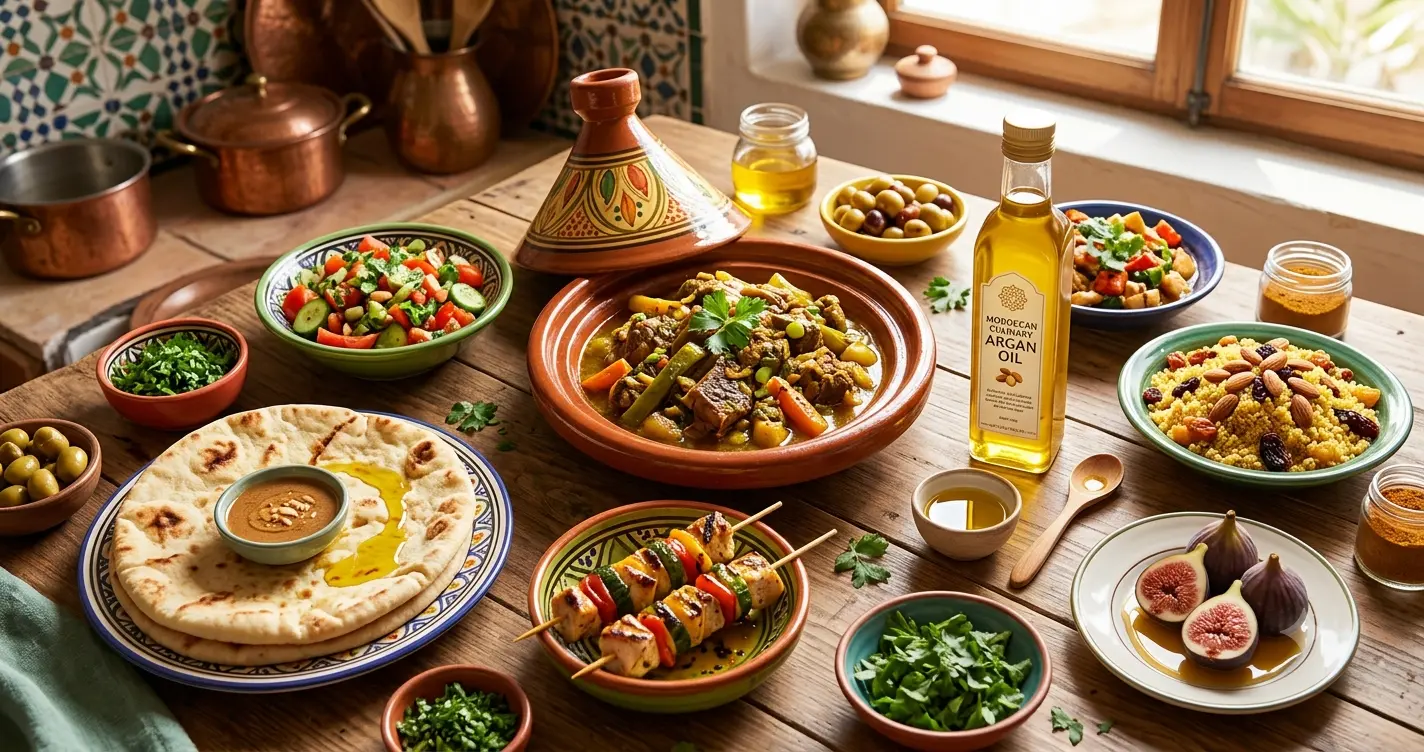
There is a moment every visitor to Morocco remembers — the moment a small clay bowl arrives at the breakfast table, filled with something that looks like liquid caramel, nutty and warm and unlike anything you have ever tasted. You dip a torn corner of khobz bread into it, and the flavor hits you: deep, roasted, buttery, with a whisper of the wild scrubland where it was born. That, in its simplest form, is culinary argan oil at work. And if you have never cooked with it at home, you are missing one of the most extraordinary flavor experiences available in a modern kitchen.
I have spent the better part of two decades exploring Moroccan kitchens — from the medina of Marrakech to the Souss valley where the argan tree (Argania spinosa) grows wild across rust-colored hillsides — and I can tell you with absolute certainty that culinary argan oil is one of the most underused and misunderstood ingredients in Western cooking. Most people outside Morocco only know argan oil from its cosmetic applications. They see it on shelves in beauty stores and assume it belongs in their hair, not on their plate. This is one of the great culinary misunderstandings of our time.
At MaCooking, we have made it our mission to bring the full depth of authentic Moroccan cooking to a global audience, and argan oil sits right at the heart of that mission. In this guide, I am going to share twelve recipes that genuinely showcase what this extraordinary oil can do — not as a novelty ingredient, but as the soul of a dish. We will cover everything from traditional Amazigh breakfast spreads to modern-leaning salads, roasted vegetables, seafood, and even a couple of dessert applications that will make you rethink everything you know about this golden liquid.
The Story Behind the Oil: What Makes Culinary Argan Oil Unique
Before we get into the recipes, I want to give you some context, because understanding where argan oil comes from changes how you cook with it. The argan tree is endemic to southwestern Morocco — it grows nowhere else on earth in any meaningful quantity — and it has been part of Amazigh (Berber) culture for thousands of years. UNESCO recognized the traditional practices surrounding the argan tree and its ecosystem as an Intangible Cultural Heritage in 2014, and the argan forest itself is a UNESCO Biosphere Reserve.
The process of making culinary argan oil is labor-intensive in the extreme. After the argan fruit falls, the outer pulp is removed, and the hard nut inside is cracked open — by hand, using stones — to extract the almond-like kernels within. For culinary argan oil, these kernels are lightly roasted before being cold-pressed. This roasting step is what separates culinary argan oil from the cosmetic variety, and it is entirely responsible for that deep, nutty, almost smoky flavor that makes the oil so remarkable.
It takes roughly 30 kilograms of fruit and 15 hours of labor to produce just one liter of argan oil. When you understand that, you understand why true argan oil commands the price it does — and why cheap versions sold online are almost always adulterated with other oils. When you are buying culinary argan oil for cooking, quality matters enormously. Look for oil that smells genuinely nutty and roasted, has a rich amber color, and comes from a certified cooperative in Morocco. The flavor of a high-quality culinary argan oil is irreplaceable; a poor substitute will simply taste like vegetable oil with a vaguely bitter finish.
Culinary vs. Cosmetic Argan Oil: A Critical Distinction
| Feature | Culinary Argan Oil | Cosmetic Argan Oil |
|---|---|---|
| Kernel preparation | Roasted before pressing | Raw (unroasted) |
| Color | Deep amber to golden-brown | Pale golden to light yellow |
| Aroma | Strong, nutty, roasted | Neutral to very mild |
| Flavor | Rich, complex, hazelnut-like | Bland — not suitable for food |
| Intended use | Cooking, dipping, finishing | Skincare, hair treatment |
| Heat stability | Moderate (best as finishing oil) | Not for cooking |
| Price point | High — reflects labor cost | High — reflects purity |
One more practical note before we dive into recipes: culinary argan oil is best used as a finishing oil, not a high-heat cooking medium. Its smoke point is around 420°F (215°C), which makes it technically usable for light sautéing, but its extraordinary flavor is best preserved when used raw or added at the very end of cooking. Think of it the way a great Italian chef thinks about their finest extra-virgin olive oil — you do not fry things in it. You drizzle it, you dress with it, you dip into it.
Chapter 1: The Iconic Breakfast Table — Morning Argan Oil Traditions
Recipe 1: Classic Amlou (Argan Oil and Almond Dip)
If there is a single recipe that defines culinary argan oil in Morocco, it is amlou. This extraordinary three-ingredient preparation is the pride of the Souss region, and once you have made it properly, you will understand why. It is simultaneously the simplest and most satisfying thing you can put on a breakfast table.
Ingredients:
- 200g whole raw almonds
- 4 tablespoons pure culinary argan oil
- 2–3 tablespoons raw honey (preferably Moroccan thyme or euphorbia honey)
- Pinch of sea salt (optional but recommended)
Method:
- Dry-roast the almonds in a heavy pan over medium heat, stirring constantly, until they are fragrant and deep golden — about 8 to 10 minutes. Do not rush this step. The roasting of the almonds mirrors the roasting of the argan kernels, and together they create a layered nuttiness that is the whole point of amlou.
- Allow the almonds to cool completely, then grind them in a food processor until you have a paste. This will take about 5 minutes of processing, scraping down the sides occasionally.
- With the processor running, slowly drizzle in the argan oil. The paste will loosen and become creamy.
- Add honey and salt, blend briefly, then taste and adjust.
- Transfer to a small bowl. Amlou keeps in the refrigerator for up to two weeks, though it will thicken. Allow it to come to room temperature before serving, and stir well.
Serve amlou with warm Moroccan khobz bread or msemen (layered flatbread). The tradition is to tear the bread and dip — never spread with a knife, which would feel oddly clinical at a Moroccan breakfast table.
Recipe 2: Argan Oil with Honey and Black Seed — The Three-Bowl Breakfast
In many Moroccan homes, particularly in the south, breakfast is served with three small bowls: one of pure culinary argan oil, one of honey, and one of amlou. Each bowl represents a different way of experiencing the argan tree's gift. The argan oil bowl is for those who want the oil in its purest form — drizzled over bread or mixed directly with honey at the table.
To recreate this tradition at home:
- Pour 60ml of high-quality culinary argan oil into a small ceramic bowl
- Place 3 tablespoons of raw honey alongside it in a separate bowl
- Sprinkle a few black seeds (nigella sativa, called habbatussauda in Morocco) over the argan oil
- Serve with fresh warm bread
The act of mixing the oil and honey directly on the bread — in whatever ratio feels right to you — is part of the pleasure. Some people want more honey sweetness; others want the oil to dominate. This breakfast is not just nourishment; it is a daily ritual of connection to the land.
Chapter 2: Salads and Starters Where Argan Oil Shines
Recipe 3: Moroccan Tomato Salad with Argan Oil and Cumin
This salad is stupidly simple and absolutely stunning. The combination of ripe tomatoes, warm cumin, fresh herbs, and argan oil as the dressing base is one of the great flavor combinations in Moroccan cooking — and it takes about ten minutes to make.
Ingredients (serves 4):
- 500g ripe tomatoes, diced or sliced into rounds
- 1 small red onion, very finely sliced
- 2 tablespoons fresh flat-leaf parsley, chopped
- 1 tablespoon fresh cilantro, chopped
- 1 teaspoon ground cumin
- ½ teaspoon sweet paprika
- Juice of half a lemon
- 3 tablespoons culinary argan oil
- Salt and pepper to taste
Method: Arrange the tomatoes and onion on a serving plate. Whisk together the argan oil, lemon juice, cumin, paprika, salt and pepper. Drizzle over the tomatoes, scatter the herbs, and serve immediately. The key is to dress this salad just before serving — argan oil does not like to sit on tomatoes for hours, as the acidity can overwhelm the oil's delicate nuttiness.
Recipe 4: Roasted Beet and Orange Salad with Argan Oil Dressing
This is a recipe where I deliberately push argan oil into more modern territory, but the combination is grounded in classic Moroccan flavor logic: beets, citrus, and earthy warmth are all flavors you encounter constantly in the Moroccan kitchen.
Ingredients (serves 4):
- 4 medium beets, roasted and peeled, cut into wedges
- 2 large oranges, supremed (segments cut free of membrane)
- 50g arugula or watercress
- 3 tablespoons culinary argan oil
- 1 tablespoon orange juice
- 1 teaspoon honey
- ½ teaspoon ground ginger
- Salt to taste
- Handful of toasted sesame seeds or chopped walnuts for garnish
Method: Whisk together the argan oil, orange juice, honey, ginger, and salt. Arrange the greens, beet wedges, and orange segments on a serving platter. Drizzle generously with the argan dressing and finish with sesame seeds or walnuts. The nutty depth of the argan oil plays beautifully against the sweetness of roasted beet and the brightness of orange — this is a salad you will make again and again.
Recipe 5: Zaalouk (Smoked Eggplant Salad) Finished with Argan Oil
Zaalouk is one of the great Moroccan cooked salads, and finishing it with a drizzle of culinary argan oil rather than olive oil elevates it into something almost transcendent. The smokiness of the charred eggplant meets the nutty depth of argan in a way that feels almost inevitable — like these two ingredients were always meant to be together.
Ingredients (serves 4–6 as a starter):
- 2 large eggplants
- 400g ripe tomatoes, roughly chopped
- 4 garlic cloves, minced
- 1 teaspoon ground cumin
- 1 teaspoon sweet paprika
- ½ teaspoon chili flakes (optional)
- 3 tablespoons olive oil (for cooking)
- 2 tablespoons culinary argan oil (for finishing)
- Juice of half a lemon
- Fresh parsley and cilantro
- Salt to taste
Method: Char the eggplants directly over a gas flame or under a broiler until the skin is blackened and the flesh is completely soft. Allow to cool, then peel and roughly chop the flesh. In a wide pan, sauté the garlic in olive oil until fragrant, add the tomatoes and spices, and cook down to a thick sauce — about 15 minutes. Add the eggplant and continue cooking and stirring until everything is cohesive and jammy, another 10–15 minutes. Remove from heat, stir in lemon juice and fresh herbs, and finish with the argan oil drizzled generously over the top. Serve at room temperature with bread.
Chapter 3: Main Courses and Hearty Dishes
Recipe 6: Grilled Fish with Argan Oil Chermoula
Chermoula is Morocco's essential marinade and sauce — a vibrant blend of herbs, citrus, garlic, and spices. Traditionally made with olive oil, I love making chermoula with culinary argan oil when I want the sauce itself to be the star. It adds a layer of nuttiness that complements fish especially well.
Ingredients (serves 4):
- 4 portions of firm white fish (sea bass, halibut, or sea bream work beautifully)
- For the argan chermoula:
- Large bunch of fresh cilantro
- Large bunch of fresh flat-leaf parsley
- 4 garlic cloves
- 1 teaspoon ground cumin
- 1 teaspoon sweet paprika
- ½ teaspoon ground coriander
- Juice of 1 lemon
- 4 tablespoons culinary argan oil
- Salt and pepper
Method: Blend all chermoula ingredients in a food processor until you have a vibrant, slightly coarse paste. Reserve half for serving. Coat the fish in the remaining chermoula and allow to marinate for at least 30 minutes (up to 4 hours in the refrigerator). Grill or pan-sear the fish over high heat until cooked through and caramelized on the outside. Serve with the reserved fresh chermoula spooned generously over the top, alongside couscous or warm bread.
Recipe 7: Couscous with Root Vegetables and Argan Oil Finish
Couscous is the cornerstone of the Moroccan Friday meal, a dish of profound cultural importance — it is simultaneously food and ritual. Finishing a vegetable couscous with argan oil instead of the more common butter or olive oil gives it an unexpectedly complex depth.
Ingredients (serves 6):
- 500g couscous (medium grain)
- 2 turnips, quartered
- 3 carrots, cut into large pieces
- 2 zucchini, cut into thick rounds
- 1 small butternut squash, cubed
- 2 onions, roughly sliced
- 400g canned chickpeas, drained
- 1 teaspoon ground ginger
- 1 teaspoon turmeric
- 1 teaspoon ground cinnamon
- ½ teaspoon black pepper
- Large pinch of saffron dissolved in warm water
- 3 tablespoons olive oil (for cooking)
- 3–4 tablespoons culinary argan oil (for finishing the couscous grain)
- Fresh cilantro and parsley
- Salt to taste
Method: Cook the vegetables in a large pot or couscousier with the spices, olive oil, and enough water to create a flavorful broth — about 45 minutes. Steam the couscous in a couscousier or prepare it according to package directions, then fluff it with a fork and toss with the argan oil, a pinch of salt, and a little of the vegetable broth to moisten. Mound the couscous on a large serving platter, create a well in the center, and pile the vegetables and chickpeas inside. Ladle some of the fragrant broth over everything and finish with fresh herbs. The argan oil in the couscous grain itself gives every bite a haunting nuttiness.
Recipe 8: Lamb Kofta Skewers with Argan Oil and Ras el Hanout
Ground lamb kofta is beloved across Morocco, cooked on charcoal grills in every city square. Adding a small amount of culinary argan oil to the kofta mixture — rather than the more common fat — and brushing it over the finished skewers creates an extraordinary richness.
Ingredients (serves 4):
- 600g ground lamb (or a mix of lamb and beef)
- 1 small onion, grated and excess moisture squeezed out
- 3 garlic cloves, minced
- 2 tablespoons fresh parsley, finely chopped
- 2 tablespoons fresh cilantro, finely chopped
- 1½ teaspoons ras el hanout
- 1 teaspoon ground cumin
- ½ teaspoon sweet paprika
- 1 tablespoon culinary argan oil (in the mixture)
- Additional argan oil for brushing (2 tablespoons)
- Salt and black pepper
Method: Mix all ingredients (except the finishing argan oil) thoroughly with your hands until completely combined. Refrigerate for at least 30 minutes. Shape the mixture around flat metal skewers into elongated sausage shapes. Grill over high heat — charcoal if you can manage it — turning frequently, until cooked through with beautiful char marks. Brush immediately with argan oil as they come off the grill and serve with flatbread, preserved lemon slices, and a simple herb salad.
Recipe 9: Chicken Bastilla Bites with Argan Oil Pastry Glaze
Bastilla — the extraordinary sweet-savory pigeon (or chicken) pie wrapped in warqa pastry — is one of the pinnacles of Moroccan celebratory cooking. In this modern interpretation, I make small individual bastilla bites and brush the finished pastry with a light argan oil glaze instead of butter, which gives the exterior a remarkable toasty, nutty finish that complements the cinnamon-dusted top.
This is an intermediate-to-advanced recipe — the full bastilla process is detailed in our comprehensive guide at MaCooking, where you will find step-by-step instructions for working with warqa pastry and making the classic filling from scratch. Here, I will give you the argan oil application that transforms the finished product.
Once your bastilla parcels are baked golden and crisp, mix 2 tablespoons of culinary argan oil with 1 teaspoon of honey and brush this glaze over the hot surface immediately. The heat opens up the argan oil's aromatics and the honey caramelizes slightly against the pastry, creating a finish that is sweet, nutty, and deeply Moroccan.
Chapter 4: Dips, Sauces, and Condiments
Recipe 10: Argan Oil Hummus with Moroccan Spice
Hummus may be more associated with the Levant, but chickpeas are central to Moroccan cooking and this version — using argan oil as the finishing drizzle and incorporating Moroccan spicing — feels entirely at home in a Moroccan meal.
Ingredients (serves 6–8 as a dip):
- 400g canned chickpeas, drained (reserve the liquid)
- 3 tablespoons tahini
- 2 garlic cloves
- Juice of 1 lemon
- ½ teaspoon ground cumin
- ½ teaspoon sweet paprika
- Salt to taste
- 4 tablespoons culinary argan oil (2 in the hummus, 2 for finishing)
- Pinch of chili flakes and fresh parsley for garnish
Method: Blend all ingredients except the finishing argan oil until silky smooth, adding chickpea liquid as needed for texture. Taste and adjust seasoning. Spread onto a wide plate, create swirls with the back of a spoon, and drizzle generously with argan oil. Finish with a pinch of paprika, chili flakes, and fresh parsley. The argan oil transforms a familiar dip into something with a distinctly Moroccan personality.
Recipe 11: Argan Oil and Preserved Lemon Vinaigrette
This is the kind of dressing that, once you make it, you will want to put on everything: salads, roasted vegetables, grilled chicken, simple steamed fish. Preserved lemon is one of Morocco's great pantry ingredients, and its funky, fermented citrus notes work with argan oil in a way that feels destined.
Ingredients (makes about 150ml):
- 4 tablespoons culinary argan oil
- 2 tablespoons extra-virgin olive oil
- Skin of ½ preserved lemon, rinsed and finely minced
- 1 tablespoon white wine vinegar or fresh lemon juice
- 1 teaspoon honey
- 1 small garlic clove, grated
- ½ teaspoon ground cumin
- Fresh ground black pepper
Method: Whisk all ingredients together vigorously until emulsified. Store in a jar in the refrigerator for up to a week. Allow to come to room temperature and shake well before using, as argan oil can solidify slightly when chilled.
Chapter 5: Sweet Applications — Argan Oil in Desserts
Recipe 12: Argan Oil and Orange Blossom Cake (Meskouta)
Meskouta is Morocco's everyday cake — simple, tender, perfumed with orange or lemon, and beloved by every Moroccan grandmother. Traditionally made with vegetable oil or olive oil, making it with culinary argan oil adds a remarkable nuttiness that elevates this humble cake into something genuinely special. The combination of orange blossom water and argan oil is deeply, recognizably Moroccan.
Ingredients (serves 8–10):
- 3 large eggs
- 200g caster sugar
- 120ml culinary argan oil
- Zest of 1 large orange
- Juice of 1 orange (about 80ml)
- 1 tablespoon orange blossom water
- 250g plain flour
- 2 teaspoons baking powder
- Pinch of salt
- Powdered sugar for dusting
Method:
- Preheat your oven to 175°C (350°F). Grease a 23cm round cake pan or bundt pan.
- Beat eggs and sugar together until pale and slightly thickened — about 3 minutes with an electric mixer.
- Stream in the argan oil while mixing, then add the orange zest, orange juice, and orange blossom water.
- Sift in the flour, baking powder, and salt. Fold until just combined — do not overmix.
- Pour into the prepared pan and bake for 30–35 minutes until a skewer comes out clean and the top is golden.
- Cool in the pan for 10 minutes, then turn out. Dust generously with powdered sugar before serving.
The argan oil keeps this cake wonderfully moist for several days, and its nutty flavor deepens as the cake rests — it is actually better on day two. Serve with mint tea in the Moroccan tradition.
Chapter 6: Expert Tips for Cooking with Culinary Argan Oil
Over the years, I have gathered a set of principles that govern how I use argan oil in the kitchen. These are not hard rules, but understanding them will help you get the most out of this precious ingredient.
Buying and Storing Argan Oil
| Quality Indicator | What to Look For | Red Flag |
|---|---|---|
| Color | Deep amber to golden-brown | Very pale or clear — likely diluted |
| Aroma | Strong nutty, roasted, hazelnut-like | Odorless or smells rancid |
| Origin labeling | States specific region of Morocco | Vague "North Africa" origin |
| Certification | Cooperative certification, fair trade marks | No provenance information |
| Price | $25–$50+ per 250ml is realistic | Anything suspiciously cheap |
| Packaging | Dark glass bottle | Clear plastic — light degrades the oil |
| Expiry | 12–18 months from pressing | No date or very old stock |
Key Principles for Using Argan Oil in Cooking
- Use it as a finishing oil, not a cooking fat. Add argan oil after cooking is complete, or as a dressing, to preserve its complex flavor compounds.
- Less is more — at first. Argan oil is assertive. Start with smaller quantities than you think you need and build up. You want the oil to enhance a dish, not dominate it.
- Pair it with complementary flavors. Argan oil loves: honey, almonds, walnuts, cumin, cinnamon, citrus, preserved lemon, tomatoes, eggplant, lamb, and oily fish. It is less happy with very delicate flavors it might overpower, like light cream sauces or mild white cheeses.
- Do not refrigerate unnecessarily. Argan oil can solidify in the cold, and repeated temperature changes degrade it faster. Store in a cool, dark cupboard and use within three to six months of opening.
- Combine with olive oil when budget or intensity is a concern. A 50/50 blend of culinary argan oil and a good extra-virgin olive oil gives you the argan flavor at lower cost and with slightly less intensity — useful for dressings you will use in larger quantities.
- Always taste your oil before cooking. Good culinary argan oil is a pleasure to taste on its own. If it tastes off, bitter, or rancid, it will not improve in a recipe.
"Argan oil is not merely an ingredient in Moroccan cooking — it is a story. A story of an ancient tree, of women's cooperatives, of a landscape that looks like the moon but feeds like the earth. When you cook with it, you are reaching back across centuries of Amazigh wisdom and tasting something that has nourished this corner of Africa since before written history."
— Chef Jamal, MaCooking
The Cooperatives Behind the Oil: Why Your Purchase Matters
I would feel I was doing this subject a disservice if I did not spend a moment on the human story behind culinary argan oil, because it is inextricably connected to the ingredient itself. The vast majority of traditional argan oil is produced by women's cooperatives — primarily Amazigh Berber women — in the Souss-Massa and Taroudant regions of Morocco. These cooperatives represent one of the more remarkable stories of economic empowerment through traditional craft in the developing world.
Before the cooperative movement took hold in the 1990s and 2000s, Amazigh women who processed argan oil were doing so largely for their own households, with very limited ability to monetize their skills or control the supply chain. The cooperative model changed that, giving women direct access to international markets and stable incomes that have transformed entire communities — funding education for daughters, improving household nutrition, and giving women a social and economic status they had not previously held.
When you buy genuine, cooperative-certified Moroccan culinary argan oil, you are participating in this story. You are not just buying a flavoring; you are supporting a heritage practice, a fragile ecosystem, and the economic independence of thousands of women in southwestern Morocco. This matters. And it is one of many reasons why I am so passionate about bringing authentic Moroccan culinary culture to a global audience through platforms like MaCooking — because understanding the food means understanding the people behind it.
Frequently Asked Questions About Cooking with Moroccan Argan Oil
Q1: Can I substitute argan oil with any other oil if I cannot find it?
Technically, yes — but the substitution will change the character of the dish significantly. The closest flavor approximation is toasted sesame oil, which also has a strong nutty, roasted character from processed seeds. However, toasted sesame oil is more intense and has a distinctly Asian flavor profile that will pull Moroccan dishes in a different direction. For Moroccan recipes, a high-quality walnut oil is a more culturally sympathetic substitution — it has a deep nuttiness that shares some qualities with argan oil, though it lacks the roasted depth. Extra-virgin olive oil is always an acceptable fallback for cooked dishes, but do not expect the same flavor complexity. For amlou and other preparations where argan oil is the star, there is genuinely no substitute that does the dish justice — in those cases, I would encourage you to seek out a reputable online supplier rather than compromising with a substitute.
Q2: Is culinary argan oil actually healthy?
Yes, very much so — though the health story is somewhat secondary to its culinary story, in my view. Culinary argan oil is approximately 80% unsaturated fat, with a high proportion of oleic acid (the same beneficial fat found in olive oil) and linoleic acid (an omega-6 essential fatty acid). It also contains significant levels of vitamin E (tocopherols) and plant sterols that have been linked to cardiovascular benefits. Moroccan traditional medicine has used argan oil for centuries to support skin health, digestive wellbeing, and as a general tonic food. Modern nutritional research has increasingly supported these traditional uses. That said, argan oil is still a calorie-dense fat, so moderation is sensible — but as a drizzling and finishing oil used in the quantities I describe in these recipes, it is a genuinely healthful addition to your kitchen.
Q3: How much culinary argan oil should I expect to use per recipe, and is it worth the cost?
In most of the recipes above, you are using between two and four tablespoons per dish for four to six people — so the per-serving cost is quite manageable even with a premium product. A good 250ml bottle of culinary argan oil, used primarily as a finishing oil, will last a home cook several weeks. Given the extraordinary flavor it delivers in those small quantities, I think the cost is absolutely justified. Think of it the way you think about a great bottle of extra-virgin olive oil, or high-quality truffle oil — you are not using it by the cup, you are using it by the tablespoon, and every tablespoon is doing a substantial amount of flavor work. The cost per meal is far less dramatic than the price on the bottle might initially suggest.
Q4: Can I heat culinary argan oil, or will it lose its flavor?
Culinary argan oil has a moderate smoke point of around 420°F (215°C), which means it can technically withstand light sautéing without breaking down dangerously. However, heat is the enemy of argan oil's most complex flavor compounds. Even brief heating will noticeably diminish the nutty, roasted character that makes it worth using. My strong recommendation is to reserve argan oil exclusively for raw applications — dressings, dips, drizzles, and finishing — and to do all your actual cooking with a neutral oil or olive oil. The one exception I make is a very brief warming of argan oil for dishes like amlou, where a slightly warmed oil incorporates more smoothly, but even then we are talking about body temperature, not cooking heat. Treat your argan oil like a precious condiment, not a cooking fat, and you will get dramatically better results.
Q5: Where is the best place to buy genuine culinary argan oil internationally?
Finding genuine culinary argan oil outside Morocco requires some care, because the market is unfortunately full of adulterated products. My recommendations: look for oil sold directly by Moroccan women's cooperatives, which often have their own online stores and export directly to the US, UK, and Europe. Look for certifications from ARGANDOR (the Moroccan argan oil protection association), fair trade certifications, and any indication of cooperative origin. Several reputable Moroccan specialty food importers operate in the US, UK, France, and Canada — a brief search for "Moroccan women's cooperative argan oil" will usually lead you to trustworthy sources. Avoid any product selling 250ml for under $15 — at that price point, adulteration is almost guaranteed. For guidance on sourcing authentic Moroccan ingredients for home cooking, the resources at MaCooking are a good starting point.
Conclusion: Bring the Soul of the Souss into Your Kitchen
Culinary argan oil is one of those ingredients that, once it enters your kitchen, changes the way you think about flavor. It is a reminder that the most extraordinary taste experiences do not always come from elaborate techniques or rare proteins — sometimes they come from a single bottle of oil pressed from the kernels of an ancient, thorny tree on a sun-scorched hillside in southwestern Morocco.
The twelve recipes in this guide are just the beginning. Amlou for breakfast, chermoula on grilled fish, argan oil vinaigrette on a simple salad, argan meskouta cake on a Sunday afternoon — these are dishes that will become part of your regular cooking life if you let them. They are not complicated. They do not require specialized equipment. They require only a bottle of good oil and a willingness to taste something new.
Moroccan cuisine is a cuisine of extraordinary depth and generosity — it feeds people with all five senses, with history and community and ritual baked into every dish alongside the spices and herbs. If these recipes have sparked your curiosity about what else Moroccan cooking has to offer, I encourage you to explore further. There is an entire world of tagines, pastillas, couscous variations, street food, preserved ingredients, and celebratory feasts waiting for you.
At MaCooking, we have built the most comprehensive resource for authentic Moroccan cooking available in English, with hundreds of recipes, technique guides, ingredient deep-dives, and cultural context that brings the Moroccan kitchen fully to life for an international audience. Whether you are cooking your very first Moroccan dish or you have been exploring this cuisine for years, there is always something new to discover. Come cook with us — and let culinary argan oil be your guide into one of the world's truly great food cultures.