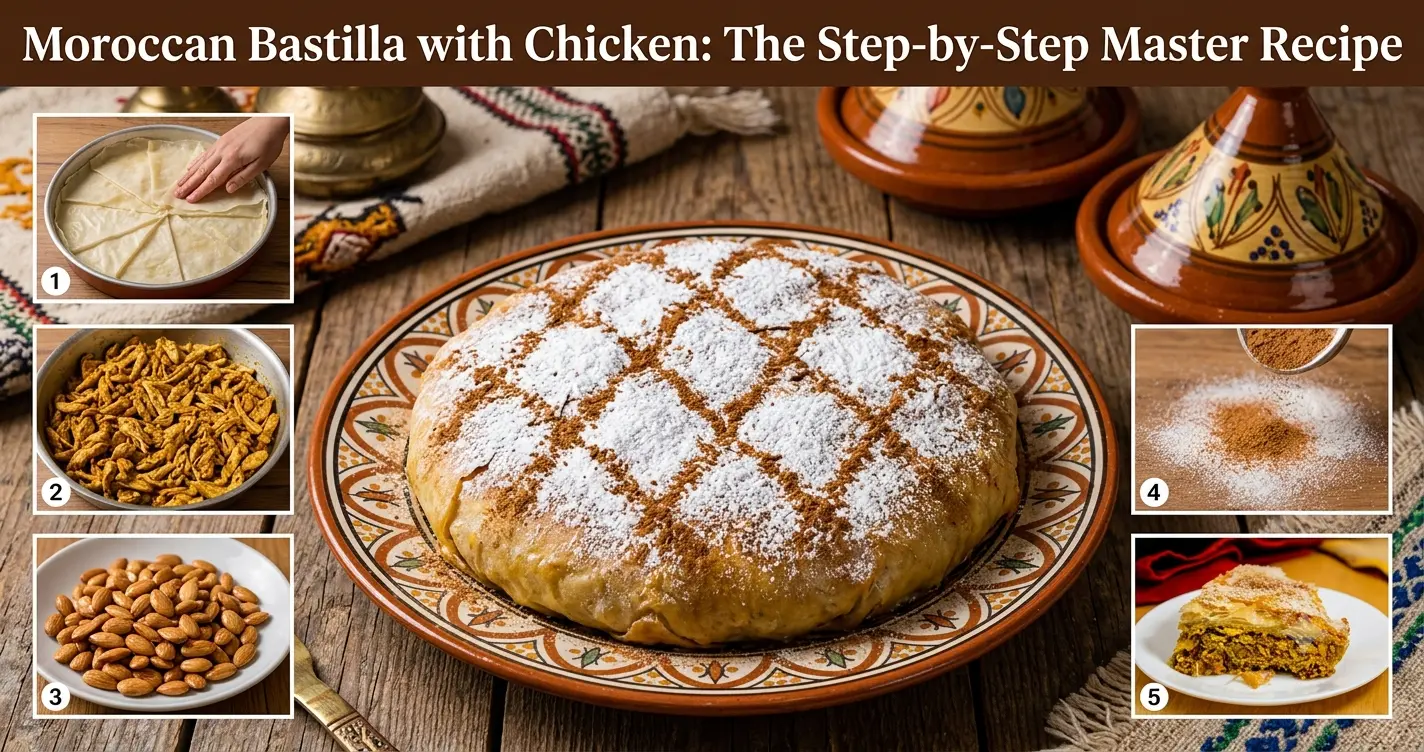
There are dishes that feed you, and then there are dishes that transform you. Moroccan bastilla — that extraordinary, paper-thin pastry shell encasing spiced chicken, aromatic eggs, and a cloud of almond cream dusted with cinnamon sugar — belongs firmly in the second category. The first time I watched my grandmother pull a bastilla from the oven in her Fez medina kitchen, the entire house went silent. That golden, crackling dome, dusted like fresh snow with powdered sugar and cinnamon, was not just dinner. It was an event, a declaration, a love letter written in saffron and orange blossom water. After years of cooking professionally, teaching workshops, and documenting recipes here at MaCooking, I can say without hesitation that bastilla remains the dish I am most proud to share with the world.
This is not a quick weeknight meal. Bastilla demands your time, your attention, and your respect. But what it gives back — the audible gasp around your dinner table, the way sweet and savory collide on the palate in a way that seems impossible until it is happening to you — is worth every single minute. In this master recipe, I am going to walk you through every step, every trick, and every cultural detail you need to make an authentic bastilla with chicken that would earn a nod of approval from any Fassi grandmother. Let us begin.
1. The History and Soul of Bastilla: More Than Just a Pie
To truly understand bastilla, you must understand Fez. Morocco's imperial city, founded in 789 CE, was for centuries the intellectual, artistic, and culinary capital of the Maghreb. It was here, within the labyrinthine alleys of the world's largest living medieval city, that Moroccan haute cuisine was codified and elevated. Bastilla — sometimes written as pastilla, b'stilla, or bisteeya in various transliterations — emerged from this tradition as the undisputed queen of the Moroccan table.
The dish carries strong Andalusian roots. When Muslim and Jewish communities were expelled from Spain between the 11th and 17th centuries, they brought their culinary sophistication with them to Morocco's northern cities. The combination of sweet and savory, the use of almonds and sugar alongside meat, the love of intricate layering — all of this speaks to a Moorish cooking philosophy that saw no contradiction between the savory and the sweet, the humble and the luxurious.
Pigeon or Chicken? A Question of Tradition and Practicality
Historically, the authentic bastilla was made with pigeon (hamam). Pigeon has a rich, gamey, deeply savory flavor that creates a remarkable contrast with the sweet almond layer and the crisp pastry. In Fez's old riads, you would still find it made this way for the most important celebrations. However, pigeon can be difficult to source in Western countries, and its flavor is quite assertive for palates that have not grown up with it.
Chicken became the widely accepted, delicious, and completely legitimate substitute over the last several decades — not as a compromise, but as an evolution. Today, even in Morocco's finest restaurants, chicken bastilla is served with enormous pride. The technique remains identical, and when the chicken is properly spiced with saffron, ginger, and preserved lemon, the flavor profile is genuinely extraordinary. Throughout this guide, we use chicken, but I will include notes for those adventurous enough to try the traditional pigeon version.
Bastilla as Cultural Ceremony
In Moroccan culture, bastilla is the dish you make when you want to show someone they matter. It is served at weddings, at the arrival of an honored guest, at Eid celebrations, and at family gatherings that demand something more than the everyday. Presenting a bastilla is an act of generosity — it signals that you spent hours in the kitchen thinking of the people who would sit at your table. Understanding this cultural weight should inform how you approach making it. You are not just following a recipe. You are participating in a living culinary tradition that stretches back centuries.
"Bastilla is patience made edible. You cannot rush it, you cannot fake it, and you cannot help but feel proud when you finally lift it from the oven. Every layer tells a story about Moroccan hospitality."
— Chef Jamal, MaCooking
2. Understanding the Components: What Makes Bastilla Unique
Bastilla is a three-layer masterpiece, and understanding each layer independently will help you execute each one with confidence. Do not think of it as one complicated dish — think of it as three simpler preparations that come together in an extraordinary marriage.
Layer One: The Spiced Chicken Filling
This is the savory heart of the bastilla. Chicken pieces — ideally bone-in thighs and a whole bird broken down — are slow-braised with saffron, ginger, cinnamon, white pepper, fresh parsley, cilantro, and caramelized onions until the meat is fall-off-the-bone tender and deeply aromatic. The braising liquid is then reduced to a concentrated, syrupy sauce. This reduction is critical: it becomes the binding liquid for the egg layer and it must be intensely flavored, not watery.
Layer Two: The Egg and Herb Scramble
This middle layer is unlike any scrambled egg you have ever tasted. The reduced chicken cooking juices — full of saffron, spice, and rendered fat — are used to softly scramble a generous quantity of eggs with fresh herbs. The result is custardy, deeply savory, and silky. Think of it as a spiced, aromatic French-style soft scramble, but with the complexity of a North African spice market running through it.
Layer Three: The Sweet Almond Cream
This is the element that surprises Western diners most, and the one they fall in love with fastest. Blanched almonds are toasted and finely ground, then combined with sugar, cinnamon, and — in some family recipes — a touch of orange blossom water. This layer sits just beneath the top pastry sheets and its sweetness against the savory filling below creates that legendary flavor contrast. It is not a dessert topping; it is an integral architectural component of the dish.
The Warqa Pastry
The pastry that holds all of this together is warqa — literally meaning "leaf" or "paper" in Arabic. True warqa is made by dabbing a lump of wet dough against a hot pan in overlapping circles, creating translucent, paper-thin sheets that dry almost instantly. It is one of the most technically demanding pastry techniques in the world, requiring years of practice to master properly. For home cooks outside Morocco, and indeed for many cooks inside Morocco who buy their warqa from market vendors, phyllo dough (filo pastry) is the accepted and excellent substitute. It behaves differently from warqa — it is slightly thicker and more brittle when dry — but when handled with care and generously brushed with clarified butter, it produces a bastilla that is genuinely outstanding.
3. Ingredients: The Complete Shopping List with Expert Notes
Before we dive into the method, let us go through every ingredient you will need and why it matters. Quality matters enormously in bastilla. This is not the place to use old spices or the cheapest butter you can find.
For the Chicken Filling
- 1 whole chicken (about 1.5 kg / 3.3 lbs), cut into 8 pieces — or use 6-8 bone-in, skin-on chicken thighs for easier handling. Bone-in pieces give richer flavor.
- 3 large onions, finely sliced — these will cook down to almost nothing, becoming sweet and deeply flavored.
- 100g / 7 tbsp unsalted butter — for cooking the onions and chicken.
- 3 tbsp olive oil
- 1 generous pinch of saffron threads — bloom them in 3 tbsp of warm water for 10 minutes before use. Do not skip this step. Pre-bloomed saffron releases far more color and flavor.
- 1.5 tsp ground ginger
- 1 tsp ground cinnamon
- 1 tsp ground white pepper — white pepper is traditional and gives a cleaner heat than black pepper.
- 0.5 tsp ground turmeric
- 1 large bunch flat-leaf parsley, finely chopped
- 0.5 bunch fresh cilantro (coriander), finely chopped
- 1 preserved lemon, peel only, finely diced — the pulp is discarded. This is optional but adds tremendous depth.
- Salt to taste
- 250ml / 1 cup chicken stock or water
For the Egg Layer
- 8 large eggs
- Reserved braising liquid from the chicken — approximately 200-250ml after reduction
- Salt and white pepper to taste
For the Almond Layer
- 300g / 2.5 cups blanched almonds
- 3-4 tbsp powdered (icing) sugar
- 1.5 tsp ground cinnamon
- 1-2 tbsp orange blossom water (optional but highly recommended)
- 2 tbsp neutral oil or melted butter — to help the ground almonds bind slightly
For Assembly
- 1 packet phyllo dough (filo pastry), thawed overnight in the refrigerator — approximately 500g
- 150g / 10 tbsp clarified butter (smen or ghee works beautifully) — melted and ready to brush
- 1 egg yolk mixed with 1 tbsp water — for sealing the pastry
For the Decoration
- 3-4 tbsp powdered sugar
- 1-2 tsp ground cinnamon
Equipment You Will Need
- A large, heavy-bottomed pot or Dutch oven (at least 5 liters)
- A round baking dish or springform pan, approximately 28-30cm (11-12 inches) in diameter
- A food processor for the almonds
- A pastry brush
- A wide spatula or two for flipping (if you choose to flip)
- Clean, slightly damp kitchen towels to keep phyllo from drying out
4. The Step-by-Step Master Method
Read through this entire section before you begin cooking. Bastilla rewards preparation. I recommend making the chicken filling and almond layer the day before you plan to serve — in fact, the filling tastes even better the next day after the spices have had time to meld.
Step 1: Braise the Chicken (45-60 minutes)
In your large pot, heat the butter and olive oil over medium-high heat. Add the sliced onions with a generous pinch of salt and cook, stirring occasionally, for about 15-20 minutes until they are completely soft, golden, and beginning to caramelize. Do not rush this step — properly cooked onions are the flavor foundation of everything that follows.
Add the chicken pieces to the pot, nestling them into the onions. Add the bloomed saffron with its soaking water, the ginger, cinnamon, white pepper, and turmeric. Stir well to coat the chicken. Add the chicken stock or water, then scatter over the parsley, cilantro, and preserved lemon peel if using.
Bring to a boil, then reduce heat to medium-low. Cover and braise for 40-50 minutes, turning the chicken pieces halfway through, until the meat is completely tender and falling from the bone. The kitchen will smell extraordinary at this point — this is normal and correct.
Remove the chicken pieces and set aside to cool. Turn up the heat and reduce the braising liquid, uncovered, until you have approximately 200-250ml of concentrated, syrupy, intensely flavored sauce. This reduction is crucial — if it is too watery, your egg layer will be loose and the pastry will become soggy. The sauce should coat the back of a spoon.
Once the chicken is cool enough to handle, remove all the meat from the bones, shredding it into generous chunks — not too fine, you want texture in each bite. Discard skin and bones.
Step 2: Make the Egg Layer (10-15 minutes)
Beat your 8 eggs in a bowl with a fork — you want them combined but not heavily whisked. Pour the warm, reduced braising liquid into a wide pan and bring it to a gentle simmer over medium-low heat. Pour in the beaten eggs and stir gently with a silicone spatula, folding slowly, as if making the world's most aromatic soft scramble. You are looking for large, soft curds — think loose, custardy, and barely set. The moment the eggs are just set (they should still look slightly underdone, as they will continue cooking in the oven), remove from heat immediately. Season and set aside to cool completely. This is non-negotiable: if you assemble the bastilla with warm filling, you will have a soggy bottom.
Step 3: Prepare the Almond Layer (10 minutes)
Preheat your oven to 180°C / 350°F. Spread the blanched almonds on a baking tray and toast for 8-10 minutes until pale golden. Watch them carefully — they go from perfect to burnt quickly. Allow to cool completely.
Transfer the cooled almonds to a food processor and pulse until coarsely ground. You want a texture somewhere between fine breadcrumbs and rough gravel — not almond flour, not whole almonds. Add the powdered sugar, cinnamon, and orange blossom water. Pulse a few more times to combine. The mixture should hold together slightly when pressed but remain crumbly. Set aside.
Step 4: Prepare Your Workspace for Assembly
This is where bastilla requires your full attention and a methodical approach. Preheat your oven to 200°C / 400°F. Have your clarified butter melted and warm. Take your phyllo out of the refrigerator and keep the sheets covered with a slightly damp kitchen towel at all times — phyllo dries out and cracks within minutes of exposure to air.
Brush your baking dish generously with clarified butter. Have all three fillings ready and at room temperature: the shredded spiced chicken, the egg mixture, and the almond mixture. Have your egg wash (egg yolk + water) ready with a pastry brush. Have your decoration sugar and cinnamon mixed in a small bowl.
Step 5: Assembly — Building the Bastilla
This is the moment everything comes together. Think of assembly as building layers going down into the pan, then folding them up and over the top.
- Base layers: Lay a phyllo sheet in the buttered dish, allowing it to overhang the edges generously. Brush with clarified butter. Lay another sheet at a 45-degree angle, overhang and butter. Repeat with 2 more sheets, rotating each one to create a star-like pattern of overhanging pastry all around the circumference. You should have 4-5 sheets forming the base, each rotated, each buttered.
- Almond layer first: Spread a generous, even layer of the almond mixture across the entire bottom of the pastry base. This may feel counterintuitive — putting the almond layer on the bottom — but when the bastilla is flipped (if you flip it), or when the top crust is cut through, the almonds form a beautiful barrier that prevents the pastry from becoming soggy from the chicken juices. Some cooks place almonds on top of the egg layer; both methods are valid. My preference, and the more traditional Fassi method, is almonds below the chicken and eggs.
- Egg layer: Spoon the cooled scrambled eggs over the almond layer in an even, generous covering.
- Chicken layer: Arrange the shredded spiced chicken over the eggs, pressing gently to create an even layer. This is your thickest layer and it should be substantial — do not be shy with the filling.
- Cover with more phyllo: Lay 3-4 more phyllo sheets over the chicken filling, buttering each one. Tuck any overhanging edges underneath these top sheets.
- Fold and seal: Now take those overhanging sheets from the base and fold them up and over the top, brushing each one with butter as you fold. Work around the entire circumference, creating a neat, sealed parcel. Brush the egg wash over any loose edges to seal. Lay one final sheet of phyllo over the top, brush with butter, and tuck the edges neatly underneath the bastilla. Brush the entire top surface generously with clarified butter.
Step 6: Baking the Bastilla (25-35 minutes)
Place the assembled bastilla in your preheated oven at 200°C / 400°F and bake for 25-35 minutes until deeply golden brown on top. The color should be a rich, amber mahogany — not pale, not burnt. Pale means underbaked and a soggy interior; deeply golden means maximum crunch and fully cooked pastry.
At the 20-minute mark, check on it. If the top is browning unevenly, rotate the pan. If it is browning too quickly, reduce the temperature to 180°C and continue baking.
Some traditional cooks flip the bastilla onto a second buttered pan halfway through baking to ensure both sides are equally crisp. If you are confident and have someone to help you, this produces a superior result. If you are making this solo for the first time, skipping the flip is completely acceptable.
Step 7: Decoration and Presentation
Allow the bastilla to rest for 5 minutes after removing from the oven — this helps the interior set and makes cutting cleaner. Then, using a fine-mesh sieve, dust the entire top surface generously with powdered sugar. Using a separate sieve or your fingers, create decorative lines of cinnamon — traditionally in a geometric or cross pattern. In some Moroccan households, the decoration includes cinnamon drawing the outlines of diamonds, diamonds within circles, or simple crossing lines. There is no wrong way. The contrast of the white sugar snow against the golden pastry, accented with the brown cinnamon geometry, is what Moroccan food photographers dream about.
Serve immediately. Bastilla waits for no one.
5. Expert Tips, Variations, and Troubleshooting
The Most Common Bastilla Mistakes (and How to Avoid Them)
| Mistake | Why It Happens | How to Fix It |
|---|---|---|
| Soggy bottom pastry | Filling added warm, or braising liquid not reduced enough | Always cool fillings completely; reduce braising liquid to a thick sauce |
| Pastry tears during assembly | Phyllo dried out or handled roughly | Keep covered with damp towel; work quickly and gently |
| Bland filling | Under-salted or saffron not properly bloomed | Season aggressively at each stage; always bloom saffron in warm water |
| Almond layer too dry and crumbling out | Not enough fat added to almond mixture | Add a little extra melted butter or a few drops of orange blossom water |
| Top browns before interior is hot | Oven too hot or bastilla assembled with cold filling | Reduce to 180°C; ensure fillings are room temperature before assembly |
| Eggs rubbery and dry in the middle layer | Overcooked during the scrambling stage | Remove eggs from heat when still slightly underdone; they finish in the oven |
Regional and Personal Variations
Moroccan cuisine is wonderfully regional, and bastilla is no exception. Here at MaCooking, we have documented dozens of regional and family variations from our community of Moroccan cooks worldwide. Here are some notable ones worth knowing:
- Bastilla with Seafood (Bastilla Bahriya): A spectacular modern variation popular in coastal cities like Casablanca and Essaouira. Shrimp, squid, and vermicelli noodles replace the chicken, with a cream sauce instead of eggs. Equally stunning, completely different character.
- Bastilla Beldi (Country Style): Made with pigeon as the original version dictates, with a slightly more rustic approach to the layering — less refined, more generously filled, more powerfully spiced.
- Mini Bastillas (Bastilla Bil Loz): Individual-portion bastillas shaped like cigars or small purses, perfect for elegant dinner parties. The same filling, scaled down, assembled in hand-rolled phyllo parcels.
- Sweet Bastilla: A dessert version filled entirely with milk, cream, and almonds, served chilled. Technically the same name and same pastry, but an entirely different experience.
- Rabbit or Duck Bastilla: In some mountain and rural communities, whatever slow-braised protein is available can be used. The spice profile remains the same; the character of the filling shifts with the meat.
Make-Ahead and Storage Strategy
- Chicken filling: Can be made 2 days ahead and refrigerated. Actually improves with time.
- Almond layer: Can be made up to 1 week ahead and kept in an airtight container.
- Egg layer: Best made the day of assembly, but can be made the morning of if kept refrigerated and brought to room temperature before using.
- Assembled but unbaked: You can assemble the entire bastilla up to 4 hours before baking. Keep it refrigerated but bring to room temperature for 30 minutes before putting it in the oven.
- Leftover baked bastilla: Keeps in the refrigerator for up to 2 days. Reheat in an oven at 160°C for 15-20 minutes to restore crispness. Never microwave — it will destroy the pastry.
6. The Spice Philosophy Behind Bastilla: Understanding Moroccan Flavor Layering
One of the questions I am asked most frequently, both in workshops and through messages to MaCooking, is: how does Moroccan cooking achieve such depth of flavor without being overwhelming? The answer lies in a philosophy of spice that is about harmony, not heat. Unlike cuisines that rely on chili heat for excitement, Moroccan cooking builds complexity through the interplay of warm spices — cinnamon, ginger, saffron, cumin — with fresh herbs, preserved ingredients, and contrasting textures and temperatures.
In bastilla specifically, notice how the spice profile is consistent across all three layers, just expressed differently:
- The chicken carries the savory spine: saffron warmth, ginger brightness, white pepper depth.
- The eggs carry those same spices via the reduced braising liquid, but softer and more yielding in texture.
- The almonds carry cinnamon and sugar — the same cinnamon that is in the chicken layer, now playing a completely different role.
- The decoration mirrors the almond layer, tying the entire dish together visually and aromatically.
This is not an accident. This is centuries of refinement. Every layer reinforces the same spice palette in a different register, which is why bastilla tastes simultaneously surprising and deeply coherent. Understanding this principle will help you cook all of Moroccan cuisine better, not just bastilla.
A Note on Saffron: The Non-Negotiable Spice
There is no substitute for saffron in bastilla. I understand it is expensive — genuine Moroccan saffron from Taliouine, which is arguably the world's finest, can cost significantly per gram. But the quantity used in any single dish is small, and its contribution is enormous. Saffron provides the golden hue that makes the egg layer beautiful, a uniquely honeyed, slightly metallic warmth that no other spice replicates, and a depth of aroma that elevates the entire dish. Always buy whole saffron threads, never powder (which is often adulterated). Always bloom it in warm water. Morocco's Taliouine saffron is my strong recommendation — and one of many Moroccan ingredients we celebrate over on MaCooking.
7. How to Serve Bastilla: The Moroccan Way
Serving bastilla is itself a performance. In traditional Moroccan homes, it is brought to the table whole and placed in the center, where the host cuts the first pieces with a knife or serves wedges with a large spoon. The cinnamon and sugar decoration should arrive at the table pristine — do not add it before transporting if there is any risk of smudging.
What to Serve with Bastilla
| Accompaniment | Role on the Table | Notes |
|---|---|---|
| Moroccan Mint Tea | Essential beverage throughout the meal | The sweetness of the tea complements the savory-sweet bastilla perfectly |
| Light Green Salad | Freshness and contrast | Simple dressed greens with lemon and olive oil — nothing that competes |
| Harissa on the side | Optional heat element | For guests who want heat; not traditional but welcomed in modern settings |
| Moroccan Zaalouk or Taktouka | Vegetable starter | Serve before bastilla as part of a full traditional spread |
| Chilled Sparkling Water or Citrus Juice | Palate cleanser | Fresh-squeezed orange juice is the traditional Moroccan choice |
| Orange and Cinnamon Salad | Dessert companion | Sliced oranges with cinnamon — echoes the bastilla flavors, cleanses the palate |
Bastilla Portion Sizes and Planning
A 28-30cm bastilla serves 6-8 people as a main course, or 10-12 as part of a larger Moroccan spread with other dishes. For a dinner party of 8 where bastilla is the star, this recipe is exactly right. For a wedding or large celebration, Moroccan cooks traditionally make multiple bastillas — one per eight to ten guests — and there is something wonderfully theatrical about a table of golden rounds appearing from the kitchen simultaneously.
FAQ: Your Bastilla Questions Answered
Q1: Can I use store-bought phyllo dough instead of making warqa from scratch?
Absolutely, and you should do so without any guilt. Making authentic warqa requires years of practice and a specific skill set that professional Moroccan pastry makers spend their careers perfecting. Even professional Moroccan cooks outside of Morocco — and many within it — use store-bought warqa (available in Moroccan markets) or phyllo dough. Phyllo behaves differently: it is slightly thicker and crispier rather than papery-thin, but when properly buttered and layered, it produces a bastilla that is genuinely excellent and completely authentic in spirit. The key is using generous amounts of clarified butter between every layer and working quickly to prevent the sheets from drying out and cracking.
Q2: My bastilla filling is delicious but the pastry turned out soggy on the bottom. What went wrong?
This is the most common bastilla problem, and it almost always comes down to one of three causes. First, the fillings were still warm when assembled — warm filling steams the pastry from the inside during baking, preventing it from crisping. Always let every filling component cool to room temperature before assembling. Second, the braising liquid was not reduced sufficiently — if it remains liquid rather than syrupy, it will leak through the pastry during baking. Reduce until it coats a spoon thickly. Third, insufficient clarified butter between the bottom layers — the fat creates a moisture barrier. Be generous with butter on the base layers in particular. Using clarified butter rather than regular melted butter also helps, as clarified butter has a higher smoke point and creates a better barrier.
Q3: How far in advance can I make bastilla for a dinner party?
This is one of bastilla's great strengths as an entertaining dish — much of the work can be done ahead. The chicken filling is actually better made one or even two days in advance and refrigerated. The almond layer can be made a week ahead. The egg layer is best made the day of, but can be done that morning. You can fully assemble the bastilla up to four hours before your guests arrive and keep it refrigerated, uncovered, then bring it to room temperature for thirty minutes before baking. This makes it ideal for dinner parties — the intensive prep work is spread across days, and on the day itself you simply need to bake and decorate. Just never assemble it more than four hours before baking, as the phyllo will begin to absorb moisture from the filling.
Q4: Is bastilla difficult for a home cook with no Moroccan cooking experience?
Bastilla is time-consuming but not technically difficult, provided you read the recipe thoroughly before you begin and prepare in stages. The individual components — braising chicken, making a soft scramble, grinding almonds, layering phyllo — are each straightforward tasks. The challenge lies in orchestrating them well and exercising patience. If you approach it as a weekend project rather than a weeknight dinner, you will find it very manageable and enormously rewarding. I have taught bastilla workshops to complete beginners who produced stunning results on their first attempt. The discipline of keeping phyllo covered, reducing the sauce properly, and cooling the filling are the three pivotal habits. Get those right and the rest follows naturally.
Q5: Where can I find warqa pastry outside of Morocco?
Authentic warqa is available in Moroccan specialty stores and certain Middle Eastern grocery shops in cities with significant North African communities — cities like Paris, London, Brussels, Montreal, and New York often have access to it in their Moroccan neighborhoods. It is also available through some online specialty food retailers. That said, phyllo dough from any supermarket remains the practical choice for the vast majority of home cooks, and you should not feel that your bastilla is somehow lesser for using it. If you are genuinely passionate about trying the authentic pastry, I recommend searching specifically for Moroccan or Algerian grocery stores rather than general Middle Eastern stores, as warqa is less commonly stocked in non-Maghrebi shops.
Conclusion: Why Every Cook Should Make Bastilla at Least Once
If you take only one thing from this guide, let it be this: bastilla is the dish that will make your guests think you have secretly been trained in a Fez riad kitchen. It is the dish that bridges cultures, confounds expectations, and sparks conversations. The first time a Western guest encounters that contrast of spiced chicken, silky eggs, sweet almonds, and shattering golden pastry, all in a single forkful, something shifts in their understanding of what food can be. They realize that the world of flavor is far larger and more surprising than they previously imagined.
That is the gift of Moroccan cuisine, and it is the gift that bastilla gives every person who sits down to eat it. It is not just a recipe — it is an education in a culinary tradition that spent centuries perfecting the art of hospitality through food. Making it, even imperfectly, connects you to that tradition.
At MaCooking, our mission has always been to make the depth and beauty of authentic Moroccan cuisine accessible to home cooks everywhere — in the United States, the United Kingdom, Canada, Australia, Europe, and beyond. Bastilla is perhaps the greatest ambassador of that mission. We encourage you to try this recipe, to share it with people you love, and to come back and tell us how it went. The Moroccan kitchen has so much more to offer you — tagines and couscous are just the beginning — and we will be here to guide you every step of the way.
Bsahtkom — to your health. May your bastilla be golden, your almonds sweet, and your table always full.