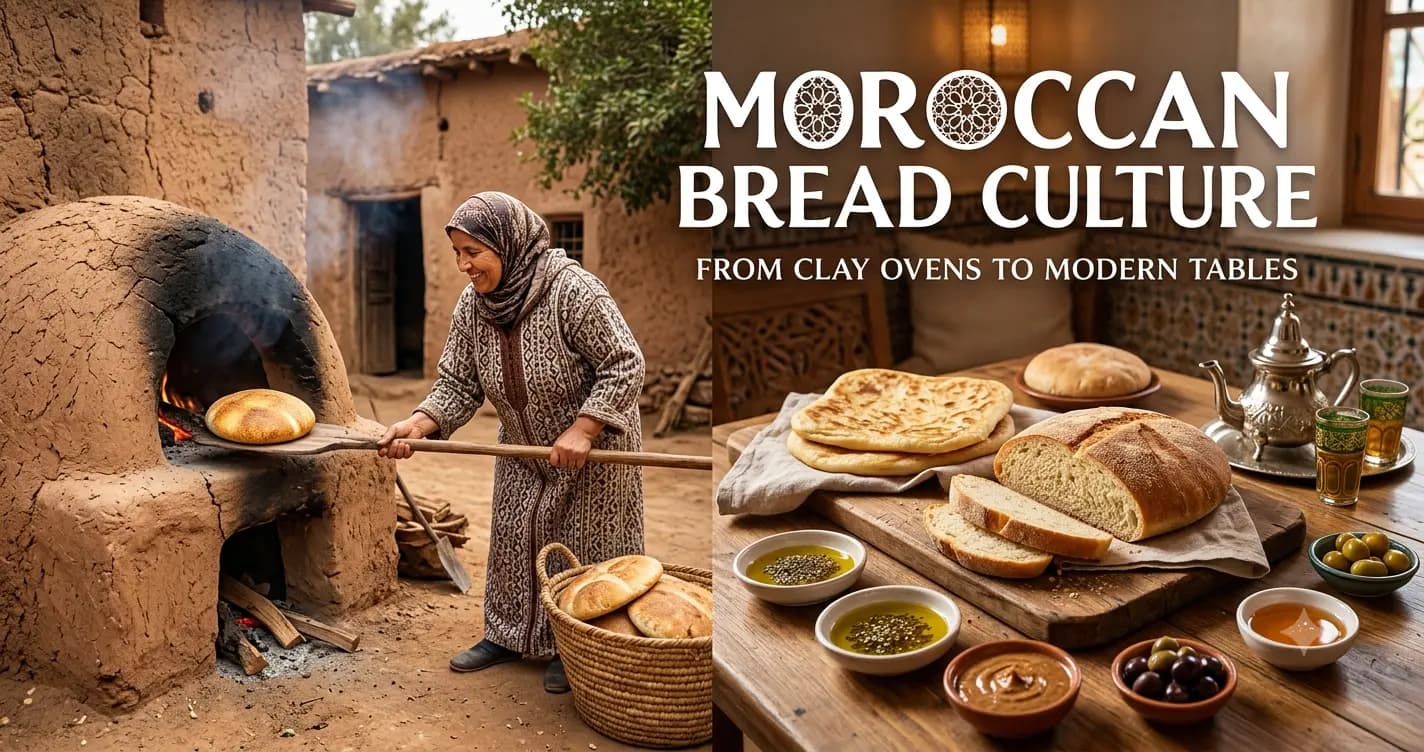
There is a moment, sometime around six in the morning in any Moroccan city, town, or village, when the smell of baking bread drifts through narrow alleyways and over whitewashed rooftops like a quiet, ancient announcement: the day has begun. That scent — warm, yeasty, faintly charred at the edges — is not simply breakfast. It is identity. It is continuity. It is the unbroken thread connecting a Berber grandmother kneading dough by firelight three thousand years ago to a young woman sliding a round loaf into an electric oven in a Casablanca apartment today. Moroccan bread is not a side dish. It is not a vessel for other things. In Morocco, bread is the meal, the utensil, the offering, the ritual, and the soul of the table. If you want to truly understand Moroccan food culture — and the team at MaCooking has spent years helping global audiences do exactly that — you must start here, with flour and water and fire, and with the extraordinary civilization that learned to make them sing.
Chapter One: The Ancient Roots of Moroccan Bread
Morocco's relationship with bread predates written history. The indigenous Amazigh (Berber) peoples of North Africa were cultivating wheat and barley across the Maghreb long before the great empires arrived. Archaeological evidence from sites in the Rif Mountains and the Draa Valley suggests that grain cultivation in Morocco dates back at least 5,000 years, and with it came the earliest forms of flatbreads baked on hot stones or clay discs over open fires.
The Phoenicians, who established trading colonies along Morocco's Atlantic coast around 800 BCE, brought with them more sophisticated milling techniques. The Romans, who later incorporated northern Morocco into the province of Mauretania Tingitana, recognized the region's agricultural richness and made it a critical grain supplier for the empire. Roman-era stone mills have been excavated near Volubilis, the remarkably preserved ancient city near Meknès — a city you can still walk through today, and where the weight of bread's history feels almost physical.
Then came the Arab conquests of the 7th and 8th centuries, carrying with them new yeast techniques, aromatic spice traditions, and a cultural reverence for bread that was deeply theological. Islamic culture views bread as sacred — wasting it is considered deeply inappropriate, and in many Moroccan households, dropping a piece of bread on the floor and not picking it up and kissing it remains unthinkable to this day. The Arab influence blended with Amazigh tradition to create the bread culture we recognize as distinctly Moroccan: hearty, communal, ritualistic, and astonishingly varied.
The Sacred Status of Bread in Moroccan Life
To understand why bread occupies such an elevated position in Moroccan culture, you need to understand that in traditional Moroccan homes, bread is not purchased — or at least, it was not for most of history. It was made. Every morning. By the women of the household. The dough was prepared at home, shaped into rounds, then carried on a wooden board — covered with a cloth embroidered with the family's pattern — to the communal neighborhood oven, the ferran. There, the baker would know whose loaves were whose by the patterns pressed into the dough or by small identifying tokens. Hours later, the bread would come back, transformed: golden, domed, fragrant.
This system, which still operates in hundreds of Moroccan neighborhoods and villages, is not merely logistical. It is social infrastructure. The walk to the ferran and back is where news is shared, relationships are maintained, community is built. In a very real sense, the bread oven is the engine of the neighborhood.
"In my grandmother's house in Fès, there was a saying: Lkhobz rouh eddar — Bread is the soul of the house. You could have the finest tagine, the most aromatic couscous, the richest pastilla, but without good bread on the table, the meal was incomplete. Bread was not an accompaniment. It was the foundation."
Chapter Two: The Clay Oven — Heart of Moroccan Baking
No discussion of Moroccan bread culture is complete without a serious examination of the ferran — the communal clay oven — and its domestic counterpart, the taboun or mejmar. These ovens are not simply cooking implements. They are architectural achievements, social institutions, and the primary reason why Moroccan bread has a character that is essentially impossible to replicate with conventional Western equipment.
How the Ferran Works
A traditional Moroccan community oven is built from clay and brick, often domed, and fired with argan wood, olive wood, or in coastal areas, cedar. The wood is burned down until the oven reaches temperatures that would make a professional pizza oven blush — we are talking about sustained heat above 400°C (750°F) in the cooking chamber. The residual heat radiates from every surface: the floor, the walls, the dome. When a round of dough slides in on a long wooden peel, it is enveloped by heat from all directions simultaneously.
The result is a crust that is genuinely extraordinary. It shatters slightly when you press it, then gives way to a crumb that is simultaneously dense and tender, chewy without being gummy, with a faint smokiness that no gas oven can replicate. Professional bakers who have worked in both environments — and there are a growing number who have trained in Morocco before bringing their skills to Western kitchens — consistently describe the clay oven bread as incomparable.
The Taboun and Home Baking
In rural Morocco, where the communal ferran might be several kilometers away, families have traditionally used smaller clay ovens called taboun, heated with coals or wood. These are often located in a separate outdoor kitchen or courtyard area. In the Atlas Mountains, you still find these in daily use — not as quaint anachronisms but as the most practical and efficient cooking technology available in those environments.
The mejmar, a portable clay brazier, represents an even more minimal approach: dough is sometimes cooked directly on the heated clay surface, producing dense, slightly charred breads that are rustic, filling, and deeply satisfying in a way that is hard to articulate to someone who has only ever eaten supermarket bread.
Modern Adaptations for Western Home Bakers
For readers in the US, UK, Europe, Canada, or Australia attempting to replicate Moroccan bread at home — and the guides at macooking.com are an excellent starting point for this journey — the best approximation of the clay oven effect comes from a combination of approaches:
- A baking stone or steel: Preheat in the oven for at least 45 minutes at the highest temperature your oven allows. This replicates the radiant heat from below.
- A Dutch oven: Placing dough inside a preheated cast-iron Dutch oven traps steam and creates a more even, enveloping heat environment.
- The broiler finish: Switching to the broiler for the final 3-4 minutes of baking mimics the intense top-heat of a clay dome oven and dramatically improves crust color and texture.
- Steam injection: Placing a pan of boiling water in the oven during the first 10 minutes creates the humid environment that allows dough to expand before crust formation.
None of these will perfectly replicate a wood-fired clay oven. But together, they get you remarkably close — close enough that if you follow the technique carefully, you will produce a loaf that any Moroccan grandmother would recognize and approve of.
Chapter Three: The Essential Varieties of Moroccan Bread
Morocco is not a one-bread country. Depending on region, season, occasion, and even time of day, Moroccans eat vastly different breads, each with its own technique, texture, and cultural role. Understanding this variety is central to understanding the food culture itself.
Khobz — The National Bread
Khobz (also spelled khoubz or simply called Moroccan round bread) is the daily staple: a round, slightly domed loaf with a crisp crust and a tender, moderately dense crumb. It is made from a blend of white flour and semolina — the semolina giving it a slightly golden color and a subtle grittiness that is part of its appeal — leavened with either commercial yeast or a natural sourdough starter, and flavored with nothing more than salt, olive oil, and sometimes a touch of anise seed.
Khobz is the bread that appears at every Moroccan table for every meal. It is torn, never cut. It is used to scoop tagine, to mop up harira soup, to carry a piece of kefta from plate to mouth. In a traditional Moroccan meal, you will rarely see cutlery — the khobz is your spoon, your fork, and your knife. Learning to tear bread properly and use it elegantly is a social skill that Moroccan children learn young, and visitors who master it earn immediate respect.
Msemen — The Laminated Flatbread
Msemen is one of Morocco's most beloved breads and one of its most technically interesting. It is a laminated flatbread — meaning the dough is stretched, folded with butter and fine semolina, and then cooked on a flat griddle. The result is a square bread with distinct, flaky layers, a slightly crisp exterior, and a soft, chewy interior that tears into satisfying sheets.
Msemen is quintessentially a breakfast and tea-time bread. Eaten warm with argan oil and honey, or with a smear of amlou (a thick paste of ground almonds, argan oil, and honey), it is one of the great breakfast pleasures of Moroccan cuisine. It is also made in a round form called meloui, which is coiled and then flattened, producing a slightly different texture with more defined spiral layers.
Harcha — The Semolina Griddle Bread
Harcha is made entirely from coarse semolina rather than wheat flour, combined with butter, milk, salt, and baking powder. It is cooked on a griddle and has a distinctive sandy, crumbly texture on the outside with a moist, rich interior. Harcha is particularly beloved in northern Morocco and is a staple of the Moroccan breakfast table, served with honey, jam, or cheese.
The name comes from the Arabic word for rough or coarse, which describes its texture perfectly. For Western bakers unfamiliar with semolina-dominant recipes, harcha can be a revelation — it tastes vaguely of cornbread but with a richness and complexity that cornbread rarely achieves.
Batbout — The Pocket Bread
Batbout is Morocco's answer to pita bread, though it predates and arguably outperforms its more internationally famous cousin. Made from a combination of white flour and semolina, batbout is cooked on a griddle over high heat, which causes the steam inside the dough to puff it into a hollow pocket. It is softer than khobz and more pliable than msemen, making it ideal for stuffing with kefta, eggs, and spiced vegetables.
Street food vendors throughout Moroccan cities fill batbout with everything from spiced lamb to tuna and preserved lemon to scrambled eggs with merguez sausage. It is fast food in the most ancient and satisfying sense of the term.
Rghaif — The Stuffed Flatbread
Rghaif is essentially msemen's more elaborate cousin: the same laminated flatbread technique applied to a dough that is stuffed before folding with a filling of spiced meat, onions, and herbs — or sometimes a sweet filling of honey and almonds for dessert versions. Rghaif is a weekend treat and a special occasion bread that takes time to make properly. Its flaky exterior and savory interior make it genuinely addictive.
Beghrir — The Thousand Holes Pancake
Technically more of a pancake than a bread, beghrir deserves inclusion here because it occupies the same cultural space as bread in the Moroccan breakfast ritual. Made from semolina, flour, yeast, and baking powder, beghrir is cooked on one side only — the top surface becomes a honeycomb of tiny holes through which butter and honey pool deliciously. The name literally means "thousand holes bread," and watching a beghrir cook and develop its characteristic surface texture is one of the small pleasures of Moroccan kitchen life.
Chapter Four: A Comparative Guide to Moroccan Breads
To help orient readers who are new to the breadth of Moroccan bread culture, here is a comprehensive comparison of the major varieties:
| Bread Name | Main Ingredients | Cooking Method | Texture | Best Served With | Occasion |
|---|---|---|---|---|---|
| Khobz | White flour, semolina, yeast, olive oil | Clay oven or conventional oven | Crisp crust, tender crumb | Tagine, harira, olive oil | Every meal, daily |
| Msemen | White flour, semolina, butter | Griddle (flat pan) | Flaky, layered, chewy | Honey, argan oil, amlou | Breakfast, tea time |
| Harcha | Coarse semolina, butter, milk | Griddle | Sandy exterior, moist interior | Honey, jam, cheese | Breakfast |
| Batbout | White flour, semolina, yeast | Griddle over high heat | Soft, pliable, hollow pocket | Kefta, eggs, vegetables | Street food, any meal |
| Rghaif | White flour, semolina, butter, filling | Griddle | Flaky exterior, savory interior | Tea, as standalone snack | Weekend, special occasions |
| Beghrir | Semolina, flour, yeast, baking powder | Griddle (one side only) | Spongy, honeycomb surface | Butter and honey | Breakfast, Ramadan |
| Meloui | White flour, semolina, butter | Griddle | Spiral layers, crispy edges | Honey, olive oil, mint tea | Breakfast, tea time |
Regional Bread Variations Across Morocco
Morocco is a geographically and culturally diverse country, and this diversity is reflected in its bread traditions. A bread baked in Marrakech tastes and looks meaningfully different from one baked in the Rif Mountains or on the Atlantic coast near Essaouira. Here is a snapshot of how bread culture varies by region:
| Region | Notable Bread Tradition | Characteristic Feature | Key Ingredient Difference |
|---|---|---|---|
| Fès & Meknès | Classic khobz with anise seeds | Slightly denser, more aromatic | Higher semolina ratio, anise |
| Marrakech | Thin, crisp khobz; msemen with preserved lemon | Thinner crusts, more olive oil | Local argan oil influence |
| Rif Mountains | Barley-based mountain bread | Darker, earthier, more rustic | Barley flour, mountain herbs |
| Souss-Massa (Agadir) | Argan-enriched breads | Nutty flavor, golden color | Argan oil in dough |
| Atlantic Coast | Seafood-adjacent flatbreads | Lighter, less dense | Less semolina, more white flour |
| Saharan South | Sand bread (Melloui du désert) | Buried in hot sand to cook | Minimal ingredients, stone-ground flour |
Chapter Five: The Flour Question — Understanding Moroccan Grain
One of the most important and least discussed aspects of Moroccan bread culture is the flour itself. Most Western bread recipes use either all-purpose flour or bread flour, both milled from modern high-yield wheat varieties bred for maximum gluten strength. Moroccan bread flour — particularly the stone-milled semolina and the farine nationale (national flour) that forms the backbone of khobz — is significantly different, and understanding that difference helps explain both the flavor and the technique of authentic Moroccan bread.
Semolina: The Moroccan Baker's Secret Weapon
Semolina — the coarsely ground endosperm of durum wheat — is used in almost every category of Moroccan bread, often in combination with softer white flour. Its contributions are multiple and significant:
- Color: Semolina has a naturally golden hue that gives Moroccan bread its characteristic warm color — not from eggs or coloring, but from the grain itself.
- Flavor: Durum wheat has a more assertive, slightly nutty flavor than common wheat. It provides depth that makes Moroccan bread taste more complex than its simple ingredient list suggests.
- Texture: The coarser particle size of semolina creates a more substantial crumb — not cakey or airy, but with a satisfying density that holds up to the task of scooping thick sauces and stews.
- Shelf life: Semolina-based breads tend to stale more slowly than pure white flour breads, which is practically important in a culture where bread is baked in the morning and expected to serve through the evening meal.
For Western bakers trying to replicate Moroccan bread, the single most impactful substitution is introducing semolina into the flour blend. A ratio of 60% fine semolina to 40% bread flour produces a loaf that is meaningfully closer to authentic Moroccan khobz than a pure bread flour loaf will ever be.
Barley, Corn, and Ancient Grains
In rural Morocco, particularly in the Atlas Mountains and the pre-Saharan regions, barley flour has traditionally been as important as wheat. Barley bread is denser, darker, and more earthy than wheat bread — it requires a practiced hand to develop enough structure for a decent crumb — but it has a richness of flavor and a nutritional profile (high fiber, complex carbohydrates, significant mineral content) that made it the survival food of choice for highland communities through centuries of harsh winters.
Corn, introduced to Morocco via Spain in the 16th century, has also found its way into the bread tradition in certain regions, particularly in the northern Rif area. Mixed with semolina and white flour, it produces breads with a distinctive sweetness and a robust, hearty character.
Chapter Six: Bread in the Moroccan Daily Rhythm
To fully appreciate Moroccan bread culture, you need to understand how bread is woven into the structure of the day — not as an occasional treat or a dinner accompaniment, but as a constant, defining presence from before sunrise to after sunset.
The Moroccan Breakfast Table
The Moroccan breakfast — ftor — is one of the world's great meal experiences, and bread is its absolute center. A traditional Moroccan breakfast spread might include:
- Freshly baked msemen or meloui, still warm from the griddle
- Beghrir dripping with pooled butter and wild honey
- Harcha, dense and crumbly, alongside fresh goat cheese
- Bowls of argan oil and amlou for dipping
- Locally-made jams — fig, quince, or rose petal
- Hard-boiled or fried eggs with cumin and salt
- Black olives marinated with preserved lemon and herbs
- Rounds of soft fresh cheese (jben)
- Endless glasses of sweet mint tea or coffee with milk
Every single item on that list is there primarily as a vehicle for, or companion to, bread. The breakfast is designed around the bread, not the reverse. This is not an exaggeration — if you sit down to a Moroccan breakfast and the bread hasn't arrived yet, the meal simply has not started.
Bread and the Midday Meal
The main meal of the Moroccan day — traditionally eaten around 1-2pm — is where khobz earns its keep as an eating implement. A tagine of lamb and prunes, a chicken with preserved lemon and olives, a vegetable stew scented with cumin and paprika — all of these are eaten communally from a shared dish, with bread as the only utensil. The technique of tearing a piece of khobz, folding it slightly to create a natural scoop, and gathering a perfect mouthful of stew along with a piece of meat is an art form that Moroccan children learn alongside walking and talking.
Bread During Ramadan
During the holy month of Ramadan, Moroccan bread culture reaches its most intense and communal expression. The ftour (breaking of the fast at sunset) is an elaborate, carefully choreographed meal in which specific breads appear: beghrir is almost always present, its honeycomb surface capturing the first butter and honey of the evening; msemen appears alongside dates and harira soup; and a special sweet fried bread called sfenj — dusted with sugar, sold by street vendors in the hour before sunset — becomes the most anticipated treat of the month.
Sfenj is Morocco's doughnut: an irregular, hand-stretched ring of yeasted dough fried in oil, with a crisp exterior and a chewy, airy interior. It is sold on a string of palm leaf, eaten immediately while hot, and represents one of those foods that is transcendently good in its original context and merely ordinary when attempted elsewhere. The queue at a good sfenj vendor on a Ramadan evening is one of the most life-affirming sights in Moroccan street life.
Bread as Offering and Ritual
In Morocco, bread plays a central role in major life events. At a wedding, guests are welcomed with bread and salt — the ancient Middle Eastern and North African gesture of hospitality and covenant. At the birth of a child, a special sweetened bread called khobz l'assel is sometimes distributed to neighbors and family. During the feast of Eid al-Adha, specific celebration breads are made and shared. Even at funerals, bread is prepared and distributed as a form of sadaqah (charitable giving) on behalf of the deceased.
This sacred dimension of bread — its role as the appropriate substance for marking the moments of life — is something that gets lost when we reduce Moroccan cuisine to its most photogenic dishes. The tagines and the couscous are spectacular, but it is the bread that holds everything together, quite literally.
Chapter Seven: The Modern Moroccan Bread Renaissance
Something interesting and encouraging has been happening in Moroccan food culture over the past decade. The country has simultaneously seen a resurgence of interest in traditional bread-making techniques — artisan clay oven bakeries, heritage grain revival, sourdough traditions being documented and preserved — and a wave of creative fusion that is producing genuinely exciting new bread forms that would be unrecognizable to a traditional baker but are unmistakably Moroccan in character.
The Artisan Bakery Movement
In cities like Casablanca, Rabat, and Marrakech, a new generation of Moroccan bakers has returned to stone-milling, wood-fired ovens, and long fermentation techniques not out of nostalgia but out of a conviction that these methods produce superior bread. Young bakers who have trained in Paris, Copenhagen, and San Francisco — hotbeds of the global artisan bread movement — are coming back to Morocco and applying sourdough techniques to traditional Moroccan flour blends, creating loaves that honor the country's grain heritage while incorporating the technical precision of modern artisan baking.
The results are remarkable. A naturally leavened khobz made with stone-ground semolina and a 24-hour cold ferment has a complexity and depth of flavor that commercial yeast versions simply cannot match. The crust crackles. The crumb has irregular, beautiful holes. The flavor has layers — slightly sour, nutty, wheaty — that unfold as you chew. It is both deeply traditional and genuinely modern.
Moroccan Bread Goes Global
Beyond Morocco's borders, Moroccan bread is finding enthusiastic audiences in Western cities with significant Moroccan immigrant communities — Paris, Montreal, Amsterdam, London, New York, Sydney. Moroccan bakeries and cafes in these cities are introducing msemen, harcha, and beghrir to customers who have never set foot in North Africa, and the reception has been consistently enthusiastic.
Food writers and chefs in the West are increasingly recognizing what food anthropologists have long known: Moroccan bread culture is one of the richest and most sophisticated in the world. Platforms like MaCooking have played a meaningful role in this global recognition, providing English-language recipe resources and cultural context that allow home bakers in the UK, the US, Canada, and Australia to engage seriously with Moroccan bread traditions for the first time.
Tips for Baking Moroccan Bread at Home
For readers inspired to try their hand at Moroccan bread, here are the most important practical insights drawn from years of kitchen experience:
- Use a blend of flours: Never use only white flour. A minimum of 30% fine semolina (ideally 50-60%) is essential for authentic character.
- Don't rush the proof: Moroccan bread dough benefits from a slow, patient rise. A cold overnight ferment in the refrigerator dramatically improves flavor.
- Preheat aggressively: Your oven should be at its maximum temperature for at least 45 minutes before baking. Use a baking stone if you have one.
- Keep it simple: Moroccan bread is not sourdough in the Western artisan sense — its beauty lies in its relative simplicity. Salt, yeast, flour, water, olive oil. Resist the urge to add too many flavorings.
- Manage your hydration: Traditional Moroccan bread doughs are relatively firm compared to modern artisan breads. A hydration level of 60-65% (water weight as a percentage of flour weight) is a good starting point.
- Rest after shaping: After shaping your rounds, let them rest covered for at least 30-40 minutes before baking. This final proof is crucial for oven spring and a good crumb structure.
- Score or poke: Traditional Moroccan khobz is poked with a fork or skewer in a pattern before baking, not slashed like European bread. This serves the same function — controlling expansion — but produces a different aesthetic.
For detailed, step-by-step recipes covering every major variety of Moroccan bread — from the simplest khobz to the most technically demanding msemen — the recipe library at macooking.com is the most comprehensive English-language resource currently available, with tested recipes that account for the ingredient and equipment differences Western home bakers will encounter.
Frequently Asked Questions About Moroccan Bread Culture
Q1: Is Moroccan bread the same as Arabic pita bread?
No — and this is an important distinction that often gets lost in the general Western category of "flatbread." While Moroccan bread and pita bread share some superficial similarities (both are made from flour and yeast, both are eaten in similar ways), they are meaningfully different products with different flour compositions, textures, and cultural roles. Pita bread is typically made from 100% white wheat flour and is known for its pocket — the steam-formed hollow interior. Moroccan khobz is made from a blend of semolina and white flour, has a domed rather than flat shape, a thicker and more substantial crumb, and does not have a hollow pocket. Moroccan batbout is the closest Moroccan equivalent to pita in terms of pocket formation, but it too has a distinct character due to the semolina content. More broadly, Moroccan bread tradition is far more varied than the Arabic pita tradition — the diversity of msemen, harcha, beghrir, rghaif, and meloui has no real parallel in the pita-producing regions of the Middle East.
Q2: Can I make authentic Moroccan bread without a clay oven?
Yes — with some qualifications. For khobz (the main round oven-baked bread), a conventional home oven can produce very good results if used correctly: maximum temperature, long preheat, baking stone or steel, and a steam-injected environment for the first part of the bake. The clay oven's wood smoke cannot be fully replicated, and the radiant heat from a dome oven is different from a conventional oven's convective heat — so there will always be some difference. But the difference is smaller than you might fear, and a well-executed home oven khobz is something to be genuinely proud of. For griddle breads like msemen, harcha, batbout, and beghrir, a conventional flat pan or cast-iron skillet produces essentially identical results to traditional equipment — the griddle surface is a griddle surface, and the technique translates perfectly to any home kitchen.
Q3: Why do Moroccans tear bread instead of cutting it?
This is one of those practices that is both practical and cultural. Practically, tearing bread creates natural irregular surfaces and points that are far more effective for scooping food than a clean-cut edge would be. The torn edge catches and holds sauce, grasps pieces of meat, and creates a more efficient eating tool than any knife-cut slice would provide. Culturally, tearing bread is also a communal act — it implies sharing, informality, and equality at the table. The bread passes from hand to hand, everyone tears what they need, and the act of sharing bread is a physical enactment of the Moroccan value of communal hospitality. Cutting bread with a knife, in traditional Moroccan culture, was associated with a certain coldness or formality that was inappropriate for the warmth of a family or friends' meal. Interestingly, this preference for tearing extends even to contexts where cutting would be more efficient — at Moroccan restaurants that cater to international tourists, you will often see local staff looking mildly puzzled when Western diners reach for a knife to cut their bread.
Q4: What makes Moroccan bread different from French baguette, given France's significant influence on Morocco?
France colonized Morocco from 1912 to 1956, and French culinary influence is visible throughout Moroccan food culture — particularly in the cities. The baguette is sold in virtually every Moroccan city, and younger urban Moroccans are as comfortable eating a baguette as they are eating khobz. French patisserie techniques have also influenced Moroccan pastry traditions significantly. However, the traditional Moroccan bread culture predates the French Protectorate by several millennia and was never displaced by it — it simply absorbed and coexisted with the French influence. The fundamental differences between khobz and a French baguette are significant: khobz uses semolina, which the baguette does not; khobz is leavened more slowly with a more moderate yeast quantity; khobz is baked in a hotter, more radiant heat environment; and khobz has a denser, more substantial crumb designed for the specific purpose of eating communal stews, while the baguette's open, airy crumb structure is designed primarily as an accompaniment to butter, cheese, and charcuterie. They are different tools for different culinary traditions, and most Moroccans would tell you very clearly that they are not interchangeable.
Q5: How important is bread in Moroccan hospitality, and how should I behave around bread as a guest in a Moroccan home?
Bread is absolutely central to Moroccan hospitality — it is impossible to overstate this. When you are welcomed into a Moroccan home, bread and often dates or olives will appear almost immediately, before any other food. This is not a preliminary snack — it is a ritual of welcome that carries genuine cultural weight. As a guest, there are a few key behaviors that will immediately mark you as respectful and culturally aware: First, never refuse bread. Declining bread in a Moroccan home is genuinely rude and will cause your host real distress. Even if you are not hungry, take a small piece and eat it. Second, if a piece of bread falls on the floor, pick it up, and if you are in a traditional household, kiss it — this shows respect for food and for God. Third, always tear bread, never cut it at the table. Fourth, use bread to eat communal dishes from the shared central pot — this is how you are expected to eat, and using it correctly shows both respect for the food and comfort with Moroccan customs. Fifth, accept second and third helpings of bread graciously. A Moroccan host's happiness is genuinely linked to how much you eat, and bread is the vehicle through which that generosity is most directly expressed.
Conclusion: Why Moroccan Bread Culture Matters
In an era when food has become simultaneously more globalized and more commodified, Moroccan bread culture offers something that is increasingly rare: a living, breathing, genuinely rooted food tradition that has not been flattened into uniformity. The diversity of Moroccan breads — from the everyday dignity of khobz to the festive extravagance of rghaif, from the ancient clay ovens of the Atlas Mountains to the modern artisan bakeries of Casablanca — represents a civilization's accumulated wisdom about grain, fire, time, and community.
This is not nostalgia. This is not a museum piece. These are breads being made every morning by millions of Moroccans who have not lost the thread connecting them to their ancestors. They are also, increasingly, being discovered and celebrated by food lovers around the world who recognize something in these round, golden, hand-torn loaves that their own food culture has often sacrificed in the pursuit of convenience and efficiency.
If this article has sparked your curiosity — about making Moroccan bread at home, about understanding the deeper rhythms of Moroccan food culture, about the extraordinary variety of dishes that Moroccan bread accompanies and enables — then you are exactly the kind of reader that MaCooking exists to serve. Our platform brings together the expertise of chefs who have cooked in Moroccan homes, professional kitchens, and supper clubs across three continents, translating a living culinary tradition into practical, accessible, deeply authentic guidance for home cooks everywhere.
Tear yourself a piece of khobz, pour a glass of mint tea, and begin. The ovens of Morocco have been warm for thousands of years. Yours can be warm too.