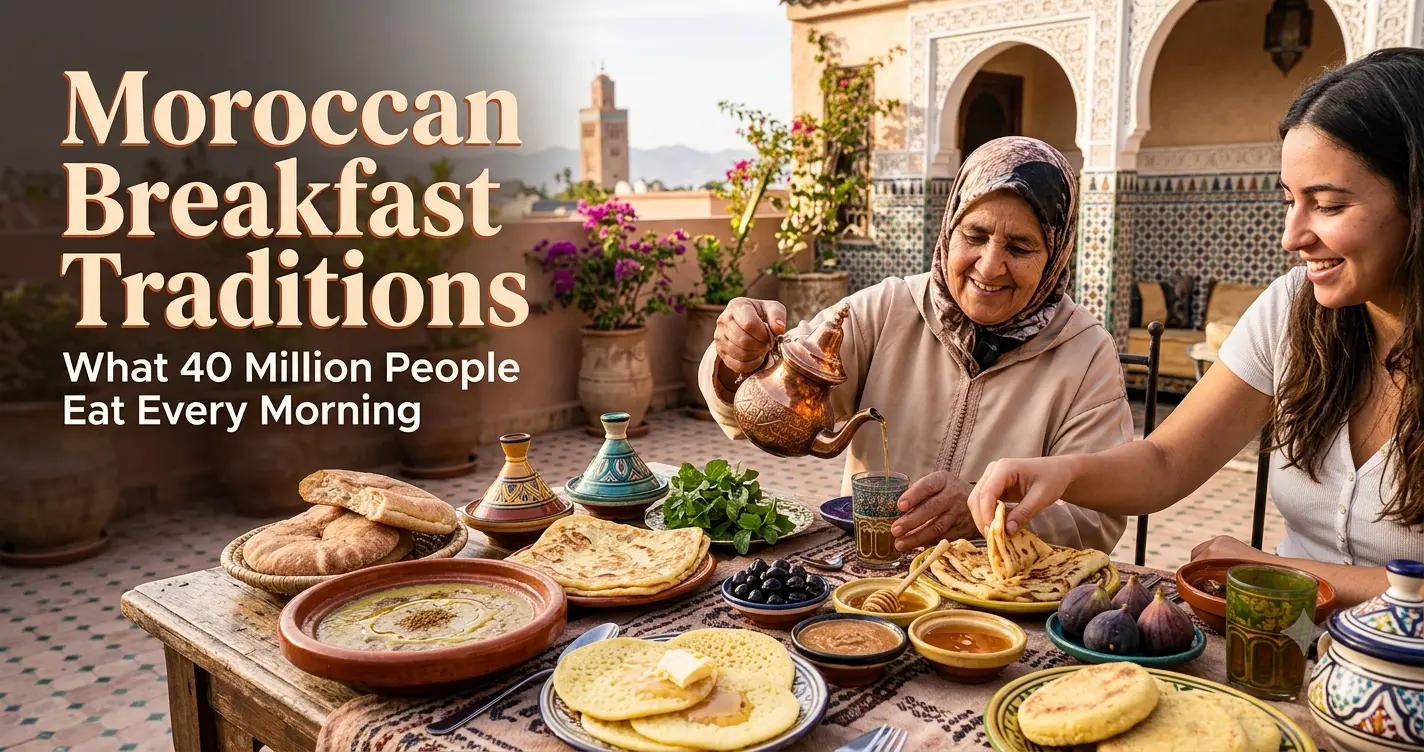
Close your eyes for a moment and imagine waking up in a riad in the medina of Fez. Sunlight cuts through the carved wooden mashrabiya screens, painting geometric patterns on the tiled floor. From somewhere downstairs drifts the scent of fresh mint, hot semolina, and butter melting into thin, lacework pancakes. Before you have even fully opened your eyes, your stomach already knows exactly where you are: Morocco. That smell — that specific, irreplaceable combination of argan oil, honey, fresh-baked bread, and mint tea — is one of the most distinctive morning signatures on earth. It belongs to a nation of over 40 million people who, despite regional differences, urban sprawl, and the relentless march of global fast food culture, still sit down most mornings to one of the most nourishing, ceremonially rich, and frankly delicious breakfast traditions in the entire world.
At MaCooking, we have spent years documenting, testing, and celebrating the full breadth of Moroccan culinary heritage. And if there is one meal that captures the soul of this cuisine more completely than any other, it is the Moroccan breakfast — ftor in Darija, the Moroccan Arabic dialect. This is not a meal you rush. It is not something you eat standing over a sink or swipe off a fast-food counter. It is a ritual, a conversation, a daily act of cultural continuity that has been repeated in some form for centuries.
In this guide, we are going deep. We are going to walk you through every element of a traditional Moroccan breakfast table, explain the history and meaning behind each dish, explore how the meal differs across regions and social contexts, and give you the knowledge you need to recreate this experience in your own kitchen — whether you are in Manchester, Montreal, or Melbourne.
The Philosophy of the Moroccan Breakfast Table
Before we talk about specific foods, it is worth understanding something fundamental: in Morocco, breakfast is not primarily about fuel. It is about baraka — blessing, abundance, and generosity. The ideal Moroccan breakfast table is a crowded one. It is spread with multiple small dishes, breads of different textures, jams, preserved fats, and always, always, that towering glass of mint tea. The visual generosity of the table is itself a statement about the household's values.
This philosophy has deep roots. Morocco sits at one of history's great crossroads — between Saharan Africa, the Arab world, Berber indigenous culture, Andalusian refugees, and centuries of Mediterranean trade. Each of these influences left fingerprints on the breakfast table. The olive oil comes from Berber agricultural traditions stretching back thousands of years. The honey tradition is equally ancient — Morocco is one of the world's most significant honey-producing nations, with varieties from thyme honey in the Atlas Mountains to rare jujube honey from the south. The tea culture, paradoxically, arrived only in the 18th century via British merchants who offloaded gunpowder green tea in Moroccan ports, but it has since become so thoroughly absorbed that most Moroccans cannot imagine the morning without it.
Time and Rhythm
In rural Morocco and in traditional urban households, breakfast tends to happen between 7 and 9 in the morning, often after the Fajr (dawn) prayer. In more modern urban settings — Casablanca, Rabat, Marrakech's new city — schedules have compressed somewhat. But even a quick weekday breakfast in a Casablanca apartment is unlikely to consist of just coffee and toast. There will almost certainly be at least one type of bread, olive oil, and tea. The full weekend breakfast, however — the one that sprawls across Saturday or Sunday morning with extended family gathered around a low table — that is where the full tradition unfolds in all its glory.
The Breads: Heart of the Moroccan Breakfast
If the Moroccan breakfast table has a center of gravity, it is bread. Not one bread — breads, plural, often several types presented simultaneously. Understanding Moroccan breakfast breads means understanding a whole spectrum of textures, techniques, and regional identities.
Khobz — The Everyday Round Bread
Khobz is the foundational bread of Moroccan life. A round, slightly domed semolina-wheat loaf baked in a communal wood-fired oven (the ferran), khobz has a golden crust and a dense, chewy crumb that is purpose-built for dipping — into olive oil, honey, jam, or the thick almond-argan paste called amlou. In most Moroccan households, someone still walks to the neighborhood ferran every morning to collect the day's bread. The ferran is not just a bakery; it is a social institution, a place where the neighborhood's pulse is taken every single morning.
Msemen — The Layered Flatbread
If khobz is the staple, msemen is the star. These square, multi-layered flatbreads are made from a dough of semolina and white flour, folded repeatedly with oil and butter to create dozens of flaky, chewy layers — somewhere between a crepe, a paratha, and a flaky pastry in texture. Msemen is cooked on a dry griddle and arrives at the table warm, slightly crispy at the edges, yielding and soft within. Tearing a piece of msemen and dipping it into a pool of argan oil and honey is one of the most straightforwardly pleasurable eating experiences I know. You can find our detailed msemen recipe on MaCooking, with step-by-step video guidance from traditional home cooks.
Beghrir — The Thousand-Hole Pancake
Beghrir is one of those dishes that never fails to astonish first-time visitors. These yeasted semolina pancakes are cooked on only one side, and the top surface blooms open during cooking into a landscape of tiny, honeycomb-like holes — hence the nickname "thousand-hole pancakes" or crêpes aux mille trous in Moroccan French. Those holes are not aesthetic accidents; they are functional, designed to capture butter and honey in every bite. The texture is spongy and delicate, almost ethereal compared to the chewiness of msemen. Beghrir is particularly beloved during Ramadan, but appears on everyday breakfast tables throughout the year, especially in cities like Fez and Meknes.
Harcha — Semolina Griddle Bread
Harcha occupies a different texture register entirely. This thick semolina griddle bread has a slightly gritty, crumbly exterior and a dense, moist interior. It is the breakfast bread most associated with rural and mountain communities, particularly in the Atlas and Rif regions, and it pairs beautifully with fresh goat cheese, argan oil, or a spoonful of fig jam. Harcha requires no yeast and no long fermentation — it comes together quickly, which is part of its enduring appeal for busy households.
| Bread | Key Ingredient | Texture | Best Paired With | Regional Association |
|---|---|---|---|---|
| Khobz | Semolina + wheat flour | Dense, chewy crust | Olive oil, honey, amlou | Nationwide |
| Msemen | Semolina + white flour + fat | Flaky, layered | Argan oil + honey, jam | Nationwide, especially cities |
| Beghrir | Fine semolina + yeast | Spongy, honeycomb surface | Melted butter + honey | Fez, Meknes, Ramadan |
| Harcha | Coarse semolina + butter | Crumbly, dense | Goat cheese, fig jam | Atlas Mountains, rural Morocco |
| Meloui | Flour + semolina, round-folded | Soft, spiral-layered | Butter, honey, kefta stuffing | Nationwide, festive occasions |
The Spreads and Condiments: Where the Magic Happens
The bread is the vessel; the spreads are the soul. What distinguishes a Moroccan breakfast table from almost any other in the world is the extraordinary array of things you put on the bread. This is where centuries of agricultural tradition, trade routes, and culinary ingenuity converge in a single morning meal.
Argan Oil — Liquid Gold of the South
Let us be absolutely clear about something: the argan oil you encounter at a Moroccan breakfast table is not the cosmetic argan oil sold in Western beauty shops. Food-grade argan oil, pressed from the roasted kernels of the argan tree (Argania spinosa), which grows almost exclusively in the Souss-Massa region of southwestern Morocco, has a rich, nutty, deeply complex flavor that is unlike any other oil in the world. It is expensive, it is labor-intensive to produce (traditionally by Amazigh women's cooperatives), and it is extraordinary. A small ceramic dish of argan oil next to a pot of honey is the breakfast pairing that defines Moroccan hospitality at its most elemental.
Amlou — The Moroccan "Nut Butter"
Amlou is made from three ingredients: toasted almonds, argan oil, and honey, ground together into a thick, dark paste that resembles peanut butter in consistency but tastes utterly unlike it. The flavor is intensely nutty, sweet, and faintly smoky from the roasted almonds. It is spreadable, addictive, and deeply nourishing. Amlou is particularly associated with the Souss region and with Amazigh (Berber) culinary traditions, though it has spread throughout the country. In recent years, Western food media has begun to discover amlou, calling it "Morocco's answer to Nutella" — which is both a useful shorthand and a significant undersell.
Jben — Fresh Cheese
Fresh white cheese, typically made from goat's or cow's milk, is a common accompaniment in rural and mountain regions. Jben has a mild, slightly tangy flavor and a soft, crumbly texture. It is sometimes sold in small baskets woven from esparto grass, and buying it from a village market is one of those quintessentially Moroccan experiences that stays with you forever.
Honey, Olive Oil, and Jam
Beyond argan oil, olive oil also appears on most breakfast tables — particularly in the olive-growing regions of Meknes, Marrakech, and the northeast. Morocco produces some of the finest olive oil in Africa, and a good Moroccan breakfast olive oil will be grassy, peppery, and bright. Alongside it will typically sit at least one or two jams — fig, quince, rose petal, and orange blossom are classics — and a jar of local honey.
Atay — The Moroccan Mint Tea Ceremony
We need to talk about the tea. Moroccan mint tea — atay in Darija — is not simply a beverage. It is a ceremony, a greeting, a symbol of hospitality so fundamental that refusing a glass is considered a social breach in traditional contexts. The tea is made from Chinese gunpowder green tea, fresh spearmint (nana), and a generous amount of sugar. The preparation involves steeping the tea, then pouring it repeatedly between the pot and a glass to aerate and blend it, then serving it from a height that creates a slight foam on the surface — a technical skill that experienced tea-makers develop over years.
"The first glass is as gentle as life, the second is as strong as love, the third is as bitter as death."
At breakfast, the tea is typically slightly lighter and sweeter than the afternoon version. It is served in small decorative glasses, never in mugs. The act of pouring tea for your family is itself an expression of care — in many households, the same person prepares the tea every morning, and their particular technique becomes part of the family's sensory memory.
In urban Casablanca and among younger Moroccans, coffee (qahwa) has made significant inroads, often in the form of a very strong espresso or a nous-nous (half espresso, half steamed milk). But tea remains dominant, and in most households, both will appear on the breakfast table simultaneously.
Regional Variations: Morocco Is Not One Breakfast
Morocco is a country of extraordinary geographic and cultural diversity — from the Atlantic coast to the Saharan south, from the Rif Mountains in the north to the Draa Valley in the southeast. It would be a mistake to speak of one single Moroccan breakfast as if the entire country ate identically. Regional identity is expressed nowhere more vividly than at the morning table.
| Region | Signature Breakfast Element | Key Ingredient | Cultural Influence |
|---|---|---|---|
| Souss-Agadir | Amlou with argan oil | Argan oil, roasted almonds | Amazigh (Berber) Soussi tradition |
| Fez-Meknes | Beghrir with butter and honey | Fine semolina, yeast | Fassi urban culinary sophistication |
| Marrakech | Msemen with olive oil and cumin | Semolina, cumin | Southern trade routes, spice culture |
| Rif Mountains | Harcha with jben (goat cheese) | Coarse semolina, goat milk | Amazigh mountain pastoral tradition |
| Coastal Atlantic (Rabat-Casablanca) | Khobz with sardine chermoula | Fresh sardines, chermoula marinade | Atlantic fishing heritage |
| Saharan South (Zagora, Ouarzazate) | Dates with fresh butter and argan oil | Medjool dates, camel butter | Sahrawi nomadic influence, date palm culture |
One of the most surprising breakfasts I have ever encountered in Morocco was in a small fishing village north of Agadir, where the morning table included a small tagine of sardines cooked with tomatoes, preserved lemon, and cumin, served alongside khobz for dipping. It sounds unusual for breakfast by Western standards, but in context — fishermen who had already been at sea since 4 AM — it made complete and perfect sense. Moroccan breakfast, at its core, is about feeding people for the day ahead.
The Ramadan Breakfast: A World Apart
Any honest account of Moroccan breakfast culture must acknowledge that the meal transforms completely during Ramadan. After a full day of fasting, the ftour (breaking of the fast at sunset) functions as a kind of supercharged breakfast — and it is the most emotionally significant meal in the Moroccan culinary calendar.
The Ramadan ftour table is centered on several iconic items that rarely appear otherwise:
- Harira — A thick, nourishing tomato-lentil-chickpea soup, spiced with cinnamon, ginger, and turmeric, finished with lemon and fresh herbs. Harira is to the Moroccan Ramadan what turkey is to American Thanksgiving — its absence would be unthinkable.
- Shebbakia — Sesame-rich fried pastry coiled into flower shapes, dipped in honey and coated in sesame seeds. These are made in large batches, often by extended family working together, and their scent frying in oil is one of the defining aromas of the Moroccan Ramadan.
- Beghrir — Present in almost every Ramadan ftour across the country, served with melted butter and honey.
- Dates and milk — Following the Prophetic tradition, the fast is broken with dates and water or milk before the full meal is eaten.
- Sellou (or Sfouf) — A dense, sweet mixture of toasted flour, almonds, sesame, and spices, formed into balls or served as a powder. It is extraordinarily high in calories and was traditionally eaten to sustain long nights of prayer and celebration.
The emotional weight of the Ramadan ftour is difficult to overstate. Families who do not otherwise eat together daily will converge every evening. Children who have moved to European cities will video-call home to eat "together" virtually. The meal is simultaneously a religious act, a family reunion, and a culinary performance.
How to Build a Moroccan Breakfast at Home
One of the most common questions we receive at MaCooking is: "How do I recreate a proper Moroccan breakfast at home?" The good news is that most of the components are achievable in any Western kitchen, with a manageable learning curve.
The Essential Shopping List
- Semolina flour (fine and medium-coarse) — the foundation of msemen, beghrir, and harcha
- Food-grade argan oil — available online and in specialty Moroccan or Middle Eastern food stores; look for cold-pressed, certified Moroccan origin
- Gunpowder green tea — Chinese gunpowder green tea (Temple of Heaven brand is authentic) available in most Asian grocery stores
- Fresh spearmint — critical; dried mint does not work for atay
- Raw honey — ideally Moroccan thyme or jujube honey, but any good raw honey works
- Good olive oil — Moroccan if possible, otherwise any robust extra-virgin
- Blanched almonds — for making amlou
A Beginner's Sequence
- Start with beghrir — they are the most forgiving bread to make. The batter requires no kneading, only resting, and the thousand holes will tell you when you have the consistency right. Find our tested recipe with detailed troubleshooting at MaCooking's beghrir guide.
- Next, master the tea. Use approximately 1 teaspoon of gunpowder tea per person, steep briefly in hot (not boiling) water, pour off the first steep (this reduces bitterness), add fresh mint and sugar, and pour from height into glasses. Practice the pour — it takes a few mornings to get right.
- Once comfortable with those, tackle msemen. This is the most technically demanding of the breakfast breads — the folding technique requires practice — but the payoff is extraordinary.
- Finally, make amlou: toast blanched almonds in a dry pan until deep golden, grind in a food processor, add argan oil and honey gradually until you reach a spreadable paste consistency. Season with a pinch of salt.
Setting the Table
Presentation matters enormously. Lay everything out simultaneously — breads in a central basket or on a round tray, spreads in small ceramic dishes, tea glasses already in place. The visual abundance of the table is part of the experience. In Morocco, this table setting is called the siniya — a large decorative tray that holds the entire breakfast service. If you want the full experience, invest in a proper Moroccan tea set; the ritual of pouring from a engraved silver teapot into painted glasses changes the experience in ways that are genuinely hard to explain until you have done it.
The Cultural and Social Significance of Breakfast in Morocco
To understand why the Moroccan breakfast endures in the form it does — why a country that has fully embraced smartphones, Netflix, and global fast food still sits down most mornings to hand-made bread and ceremonially prepared tea — you need to understand the concept of l'art de vivre marocain: the Moroccan art of living.
Morocco has always been a culture that takes slowness seriously at specific ritual moments. The breakfast table is one of those moments. It is a daily recalibration — a reminder before the day's chaos begins that you belong to a family, to a neighborhood, to a lineage of people who have eaten this same bread and drunk this same tea for generations. There is something quietly profound about that continuity.
This is also why, paradoxically, the spread of global coffee chains in Moroccan cities has not actually displaced the traditional breakfast so much as supplemented it. A young Casablancais might grab a coffee from a chain on their commute, but on Saturday morning, they are very likely back at their mother's table eating msemen. The traditional breakfast has become simultaneously everyday and special — its very familiarity is what makes it irreplaceable.
Gender and kitchen labor are also important dimensions here that deserve honest acknowledgment. The preparation of Moroccan breakfast breads, particularly msemen and meloui, is extraordinarily labor-intensive. In traditional households, this labor falls primarily on women. This is beginning to change — a new generation of Moroccan men are increasingly in the kitchen — but the women who have maintained these traditions across generations deserve recognition as the real custodians of this culinary heritage. Much of what we document at MaCooking is directly informed by the knowledge of these women, many of whom learned these techniques from their grandmothers and have never written a recipe down in their lives.
Frequently Asked Questions About Moroccan Breakfast
What is the most important component of a traditional Moroccan breakfast?
If forced to choose a single element, most Moroccans would say the tea. You can have a simple Moroccan breakfast of just khobz with olive oil, but the absence of mint tea would make it feel profoundly incomplete. The tea is the social glue of the meal — it is prepared, poured, and shared in a way that turns eating into a communal act. That said, for pure cultural iconicity, the combination of msemen with argan oil and honey comes very close to defining what a Moroccan breakfast tastes like to someone experiencing it for the first time.
Is Moroccan breakfast healthy by Western nutritional standards?
By and large, yes — with some nuance. The traditional Moroccan breakfast is built around whole-grain semolina, extra-virgin olive oil, raw honey, and fresh herbal tea — all of which score well by most contemporary nutritional frameworks. Argan oil is particularly rich in oleic acid and tocopherols (vitamin E). The breads, while not quite "whole grain" in the Western sense, are made from semolina which has a lower glycemic index than refined white flour. The main caveat is sugar — Moroccan mint tea is traditionally very sweet, and some households add considerable sugar to their jams and pastries. But overall, the traditional Moroccan breakfast is far more nourishing than most Western convenience breakfasts.
How is Moroccan breakfast different from other North African breakfasts?
There is genuine shared ground across North Africa — green tea, flatbreads, olive oil, and honey appear in Tunisian and Algerian breakfasts too. But several things make the Moroccan version distinctive. First, the argan oil tradition is uniquely Moroccan — the argan tree grows nowhere else. Second, the specific bread culture (msemen, beghrir, harcha) has no direct equivalents in the same combination elsewhere in North Africa. Third, the tea ceremony — the high pour, the three rounds, the gunpowder green tea with spearmint — is specifically Moroccan in its particular execution. Tunisian breakfast tends to be more egg-forward (shakshuka variations, egg brik); Algerian breakfast has its own flatbread traditions including kesra. Each is wonderful; none is quite the same as the Moroccan table.
Can I make an authentic Moroccan breakfast if I have never cooked Moroccan food before?
Absolutely, and beghrir is your best starting point. The batter is simple, the technique is forgiving, and nothing communicates "Moroccan breakfast" more immediately than those thousand-hole pancakes arriving at the table. Pair them with good honey, some butter, and a pot of mint tea made with fresh spearmint and gunpowder green tea, and you have something genuinely authentic and impressive. The more complex breads — msemen, meloui — will take practice, but they are very learnable with good guidance. The full recipe library at MaCooking's recipe section includes video demonstrations and detailed troubleshooting notes for each bread.
Do Moroccans eat savory food at breakfast?
Yes, though the default orientation is sweet-and-oily rather than savory in the Western sense. However, savory elements definitely appear. In coastal regions, sardines in various preparations are not uncommon at breakfast. Eggs — scrambled with cumin and olives, or fried in olive oil — appear on many breakfast tables, particularly in urban households. Kefta msemen (msemen stuffed with spiced ground meat) is a popular street breakfast. In the Atlas Mountains, leftover harira from the night before might be eaten at breakfast. The defining characteristic is not "sweet" or "savory" but rather abundance — the Moroccan table resists narrow categorization.
The Table That Holds a Nation Together
There is something I find endlessly moving about the Moroccan breakfast tradition, having spent years immersed in this cuisine and this culture. It is the fact that this meal — this specific arrangement of hand-made bread, liquid gold oil, mountain honey, and mint-scented tea — is happening simultaneously in a fisherman's home in Essaouira and a tech entrepreneur's apartment in Casablanca's Maarif district and a shepherd's stone house in the High Atlas and a Moroccan immigrant family's kitchen in Paris and Amsterdam and Montreal. Different contexts, different incomes, different lives — but the same morning ritual, the same tastes, the same gesture of tearing bread and dipping it into oil.
That is what food traditions do at their best. They hold people together across distance and difference. They carry memory forward. They make the ordinary sacred.
The Moroccan breakfast is not just what 40 million people eat every morning. It is how 40 million people remember who they are.
If this has inspired you to bring the Moroccan morning table into your own kitchen, we warmly invite you to explore the full collection of traditional recipes, guides, and culinary stories at MaCooking.com — where Moroccan culinary heritage is documented, celebrated, and made accessible to kitchens everywhere in the world. From msemen tutorials to the perfect atay technique, everything you need is waiting for you.
Bessaha wa raha — to your health and comfort.