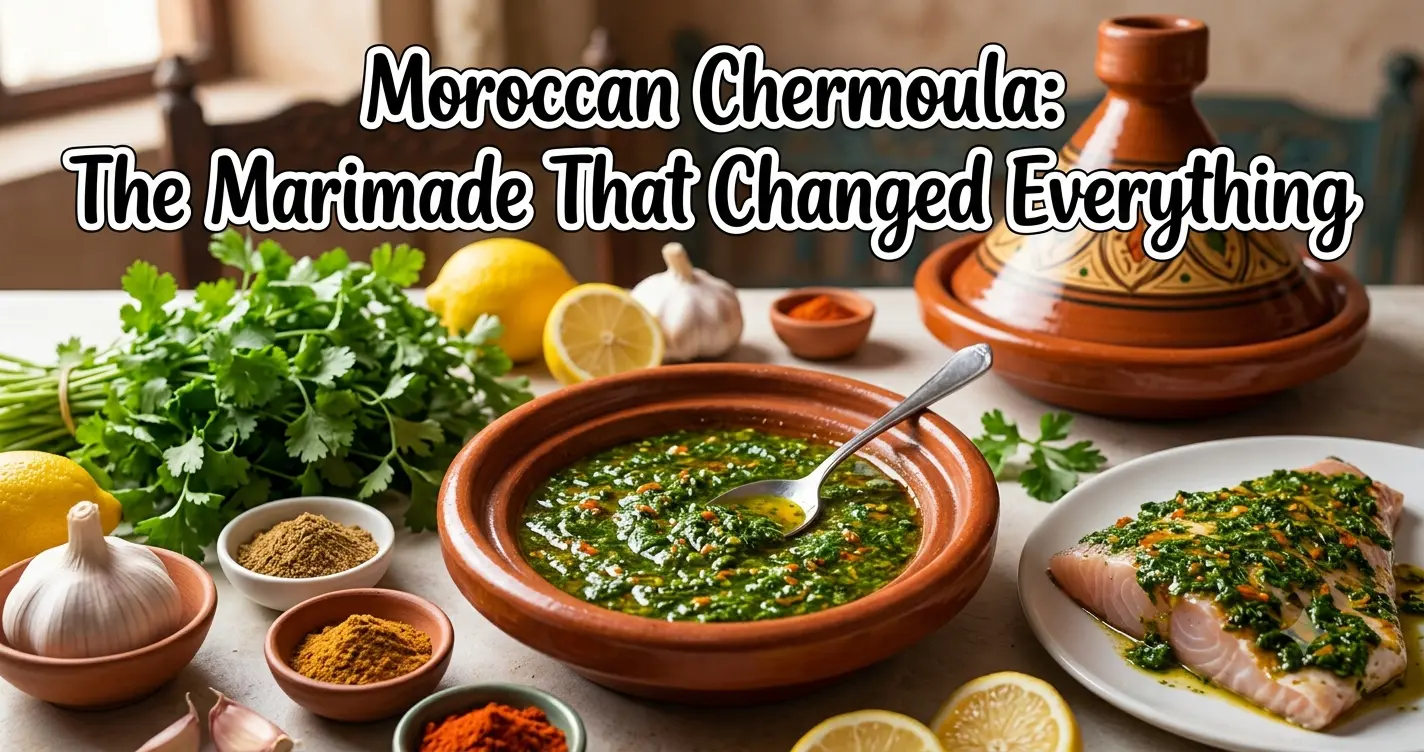
There is a moment in every serious cook's life when a single recipe — a single sauce, a single marinade — cracks the world open. For me, that moment happened in a small fishing village outside Essaouira on Morocco's Atlantic coast, watching an old woman named Fatima rub a paste of green and gold into a freshly caught sea bass with the quiet confidence of someone performing a ritual she had learned before she could read. The smell hit me first: a volcanic rush of cumin, coriander, preserved lemon, garlic, and fresh cilantro that seemed to rearrange the air itself. When that fish came off the charcoal grill twenty minutes later, I understood, instinctively and completely, why Moroccan cuisine is considered one of the most sophisticated in the world. That paste was chermoula. And it changed everything.
Chermoula (also spelled charmoula, or sometimes chermoullah in older French-Moroccan texts) is the cornerstone marinade, sauce, and condiment of Moroccan cooking. It is to Morocco what sofrito is to Spain, what mirepoix is to France, what gremolata is to Italy — except it does the work of all three simultaneously. It marinates, it braises, it dresses, it dips. It belongs to grilled fish as naturally as salt belongs to the sea, but it is just as at home on roasted chicken, slow-braised lamb, roasted vegetables, and even drizzled over a bowl of warm lentils. Here at MaCooking, we have spent years documenting the living culinary traditions of Morocco, and we return to chermoula again and again — not because it is fashionable (though it absolutely is, in kitchens from London to Los Angeles right now), but because it is genuinely one of the most versatile and rewarding preparations in the entire global pantry.
This guide is the most thorough exploration of chermoula you will find outside of a Moroccan grandmother's kitchen. We are going to cover its ancient roots, its regional variations, its core ingredients, the precise techniques that separate a great chermoula from a mediocre one, and enough recipe variations to keep you experimenting for months. Pull up a chair. Let's talk about the marinade that changed everything.
1. The Ancient Roots of Chermoula: A History Written in Spice
To understand chermoula, you have to understand Morocco's geographic position at the crossroads of civilizations. The kingdom sits at the northwestern tip of Africa, flanked by the Atlantic Ocean to the west, the Mediterranean Sea to the north, the Sahara Desert to the south, and separated from Europe by a mere fourteen kilometers of water at the Strait of Gibraltar. This geography made Morocco a trading hub for millennia — and every trading empire that passed through left its fingerprints on the food.
The Phoenicians, who established trading posts along the Moroccan coast as early as the 8th century BCE, introduced sophisticated techniques for preserving fish with salt and aromatics. The Romans, who called the region Mauretania Tingitana, cultivated the area's famous garum fish sauce operations. The Arab conquests of the 7th and 8th centuries CE brought the spice vocabulary — cumin, coriander, saffron, paprika via later Andalusian influence — that defines Moroccan cooking to this day. The Berber (Amazigh) peoples, who are the original inhabitants of North Africa and whose cooking culture predates all of these influences, contributed the deep tradition of herb-based preparations and the fundamental technique of marinating proteins in aromatic pastes before cooking.
Chermoula is, at its heart, a Berber preparation that absorbed every one of these influences and emerged as something entirely its own. The word itself is believed to derive from the Arabic root meaning "to marinade" or "to season," though Amazigh linguistic scholars have pointed to older Tamazight roots suggesting a connection to the verb for "to rub" or "to anoint." Either etymology tells you everything you need to know about what chermoula does: it penetrates, it transforms, it elevates.
Historical Moroccan cookbooks — including the celebrated 13th-century Andalusian manuscript Manuscrito Anónimo, which documented the cooking of medieval Islamic Spain and Morocco — contain clear precursors to modern chermoula. These texts describe herb-and-spice pastes used to season grilled meats and fish, featuring combinations of coriander, cumin, and garlic that any modern chermoula cook would immediately recognize. The preserved lemon that is so central to many chermoula recipes today arrived later, though the technique of preserving citrus in salt was known across the Mediterranean world for centuries before it became definitively Moroccan.
2. What Exactly Is Chermoula? Understanding the Foundation
Before we get into variations and techniques, let's establish what chermoula actually is at its core, because there is a surprising amount of confusion about this even among food writers who should know better.
Chermoula is a wet marinade and sauce made primarily from fresh herbs (cilantro and/or flat-leaf parsley), aromatics (garlic, onion), warm spices (cumin, paprika, coriander), an acid component (lemon juice, preserved lemon, or vinegar), and a fat (almost always extra-virgin olive oil). That is the non-negotiable skeleton. Everything else — the addition of saffron, hot chilies, cayenne, turmeric, fresh ginger, or other herbs — varies by region, family, and personal tradition.
Chermoula is not a cooked sauce. Unlike a sofrito or a mole, it is typically prepared raw, with all the components blended or hand-chopped together. The cooking happens to whatever the chermoula is applied to, and during that process, the raw pungency of garlic mellows, the herbs toast slightly at the edges, and the spices bloom into something far more complex than the sum of their parts.
The Non-Negotiable Core Ingredients
- Fresh cilantro: In most Moroccan traditions, cilantro is the dominant herb. It provides a bright, slightly citrusy, faintly soapy depth that is irreplaceable. If you are one of the people who has the genetic variant that makes cilantro taste like soap, flat-leaf parsley is the standard substitute — but know that you are making a different sauce.
- Fresh flat-leaf parsley: Often used alongside cilantro in equal measure, or as the primary herb in coastal Moroccan and some northern variations.
- Garlic: Used generously. Moroccan cooking does not whisper garlic; it declares it. Typically 3 to 6 cloves for a standard batch.
- Ground cumin: The warm, earthy backbone of chermoula. It must be fresh-ground if at all possible. Pre-ground cumin that has been sitting in your cabinet for two years will produce a flat, dusty sauce.
- Sweet paprika: Adds color, mild sweetness, and subtle smokiness. Some cooks use a blend of sweet and smoked paprika.
- Fresh lemon juice: The brightness that cuts through the richness of olive oil and elevates all the aromatics.
- Extra-virgin olive oil: Morocco produces world-class olive oil, particularly from the Meknes and Beni Mellal regions. Use the best you can afford.
- Salt: Essential. Kosher salt or fine sea salt.
Common Optional Additions
- Preserved lemon peel (rind only, pulp discarded) — adds a fermented, intensely citrusy dimension
- Cayenne pepper or fresh chili — for heat
- Saffron threads steeped in warm water — especially in upscale Fassi (Fes) cooking
- Ground coriander seed — for extra depth
- Fresh ginger — more common in Marrakech-style preparations
- Turmeric — adds golden color and an earthy bitterness
- White wine vinegar or apple cider vinegar — in some coastal Safi-style preparations
- Onion, finely grated or pureed — adds sweetness and body
3. The Great Regional Divide: Green vs. Red Chermoula
One of the most important things to understand about chermoula — and something that even dedicated food writers frequently get wrong — is that there is no single definitive version. Morocco is a large, diverse country with distinct regional culinary traditions, and chermoula reflects that diversity more clearly than almost any other preparation. The most fundamental distinction is between what cooks broadly refer to as "green chermoula" and "red chermoula."
| Feature | Green Chermoula | Red Chermoula |
|---|---|---|
| Primary color agent | Fresh cilantro and parsley | Paprika, cayenne, tomato |
| Dominant flavor profile | Bright, herbal, citrusy | Warm, smoky, earthy, bold |
| Regional association | Atlantic coast (Essaouira, Agadir, Safi) | Inland cities (Marrakech, Meknes, Fes) |
| Best used for | White fish, shellfish, vegetables | Lamb, beef, chicken, oily fish |
| Heat level | Mild to medium | Medium to hot |
| Preserved lemon | Frequently included | Less common |
| Saffron | Occasionally | Sometimes in Fassi versions |
| Texture | Slightly looser, more sauce-like | Thicker, paste-like |
It is worth noting that this green/red distinction, while useful, is a simplification. Along the Rif Mountains in northern Morocco, you encounter chermoulas with heavy parsley, white vinegar, and almost no paprika — a Mediterranean influence clearly visible. In the Souss Valley near Agadir, the Amazigh tradition produces chermoulas with argan oil instead of olive oil, which gives a nutty, roasted depth that is unlike anything else in the flavor universe. In coastal Safi, famous for its sardines, the local chermoula is bracingly tart from vinegar and serves almost as a marinade-pickle hybrid. These are not edge cases; they are living traditions, and at MaCooking.com we have worked hard to document all of them rather than collapsing them into a single generic recipe.
4. The Master Recipe: Classic Coastal Green Chermoula
This is the version most Westerners will encounter first, and for good reason — it is extraordinarily versatile, relatively quick to make, and delivers an immediate, unmistakable Moroccan flavor. This is the recipe I teach to every non-Moroccan cook who wants to understand the country's cuisine, because once you understand this one, all the variations make intuitive sense.
Ingredients (makes approximately 1 cup, enough for 4-6 servings)
- 1 large bunch fresh cilantro, leaves and tender stems only (about 1 cup tightly packed)
- 1 small bunch flat-leaf parsley, leaves only (about ½ cup tightly packed)
- 4 to 6 cloves garlic, roughly chopped
- 1½ teaspoons ground cumin (freshly toasted and ground is ideal)
- 1 teaspoon sweet paprika
- ½ teaspoon ground coriander
- ¼ teaspoon cayenne pepper (adjust to taste)
- ½ preserved lemon — rind only, pulp scraped out and discarded, rind roughly chopped
- 3 tablespoons fresh lemon juice (from 1 to 2 lemons)
- ¼ cup extra-virgin olive oil, plus more to taste
- 1 teaspoon fine sea salt, plus more to taste
- Optional: a pinch of saffron steeped in 1 tablespoon warm water for 10 minutes
Method
- Prepare your herbs: Wash the cilantro and parsley thoroughly and spin or pat them completely dry. Wet herbs will dilute the marinade and prevent it from clinging properly to your protein. This step matters more than most recipes admit.
- Toast your cumin: If you have a few minutes, put whole cumin seeds in a dry skillet over medium heat, shake constantly for 60 to 90 seconds until they darken slightly and become intensely fragrant, then grind in a spice grinder or mortar. The difference between freshly toasted cumin and pre-ground cumin from a jar is not subtle — it is the difference between a sauce that sings and one that merely hums.
- Combine and process: There are two schools of thought on the texture question, and both are correct in different contexts. The first is the food processor method: combine all ingredients in a food processor and pulse until you achieve a coarse, slightly chunky paste — you want texture, not a smooth puree. The second is the traditional mortar-and-pestle method: pound the garlic and salt first to a paste, then add herbs in stages, working them into the garlic paste before incorporating the liquid ingredients. The mortar method produces a more rustic, intensely flavored result because the cell walls of the herbs are truly crushed rather than cut.
- Taste and adjust: This is the non-negotiable step. Chermoula should be bold. It should be simultaneously bright (from lemon), warm (from spices), herbal (from cilantro/parsley), and rich (from olive oil). If any one of those four dimensions is missing, adjust. More lemon for brightness. More cumin for warmth. More herbs if the spices are overwhelming. More olive oil if the acid is too sharp.
- Rest before using: At minimum, let the finished chermoula sit for 15 to 20 minutes before using. Ideally, make it several hours ahead. The flavors need time to marry, and a freshly made chermoula is noticeably less complex than one that has rested.
Marinating Times by Protein
| Protein | Minimum Time | Ideal Time | Maximum Time | Notes |
|---|---|---|---|---|
| Delicate white fish (sea bass, sole) | 20 minutes | 1 to 2 hours | 3 hours | Longer risks acid "cooking" the fish |
| Oily fish (sardines, mackerel) | 30 minutes | 2 to 4 hours | 6 hours | Handles acid better than white fish |
| Shrimp / prawns | 15 minutes | 30 to 45 minutes | 1 hour | Over-marinating makes them mushy |
| Chicken (bone-in) | 2 hours | Overnight | 24 hours | The bone slows acid penetration |
| Chicken (boneless) | 1 hour | 4 to 8 hours | 12 hours | Breast meat maximum 4 hours |
| Lamb (chops, leg) | 4 hours | Overnight to 24 hours | 48 hours | Lamb loves long marinating |
| Vegetables | 15 minutes | 30 minutes to 1 hour | 3 hours | Use as dressing too, post-cooking |
5. Chermoula in the Moroccan Kitchen: How It Is Really Used
Western food media has a habit of presenting chermoula purely as a marinade for grilled fish, and while that association is correct and important, it dramatically undersells what this preparation can do. In an actual Moroccan kitchen — the kind of kitchen where the same woman makes pastilla on Fridays, harira during Ramadan, and a different tagine every day of the week — chermoula functions in at least half a dozen distinct ways.
The Six Lives of Chermoula
- As a marinade: The primary and most famous application. The protein is coated in chermoula and left to absorb its flavors before cooking. The acid tenderizes, the salt seasons deeply, and the aromatics penetrate the flesh.
- As a tagine base: Chermoula is frequently used as the starting sauce for fish tagines. The fish is layered with chermoula-marinated vegetables in the tagine, and the whole thing slow-cooks together, the chermoula melding with the released juices to form a braising liquid of extraordinary complexity.
- As a stuffing: Whole fish — sardines are the classic vehicle — are butterflied open and filled with a thick, chunky chermoula before being grilled or fried. The filling essentially steams inside the fish, protecting the flesh from drying out while infusing every bite.
- As a finishing sauce: A spoonful of fresh, uncooked chermoula spooned over grilled fish or roasted chicken just before serving acts as a bright counterpoint to the caramelized, smoky flavors of the cooked exterior. This is one of the most elegant applications, and one that Western restaurant chefs have enthusiastically adopted.
- As a dipping sauce: Thinned with a little extra olive oil and lemon juice, chermoula becomes an extraordinary dip for crusty Moroccan khobz bread, grilled flatbreads, or roasted vegetables.
- As a salad dressing base: In many Moroccan home kitchens, leftover chermoula gets stirred into warm cooked vegetables — carrots, beets, potatoes, green beans — to make the dressed vegetable salads (salataat) that appear at the beginning of every serious Moroccan meal. This is one of the great secret uses of chermoula, and one of the most rewarding.
"In Morocco, we do not think of chermoula as a single recipe. It is a way of thinking about flavor — a principle more than a formula. Once you understand what it is doing to your food, you begin to see its logic everywhere in Moroccan cooking."
— Fatima Benali, Essaouira home cook, as quoted in MaCooking's field research notes
The Iconic Dishes That Depend on Chermoula
Understanding these dishes will help you see chermoula in its full context:
- Samak Mechoui (Grilled Whole Fish): The dish that most visitors to Morocco's coastal cities will encounter first. A whole sea bass, dorade, or swordfish steak is rubbed inside and out with green chermoula, left to marinate for at least two hours, then grilled over hot charcoal until the skin chars and the flesh is just cooked through. Served with wedges of lemon and more chermoula on the side.
- Tagine of Fish with Chermoula and Preserved Lemons: One of the defining dishes of Moroccan coastal cooking. Vegetables (potatoes, tomatoes, peppers, olives) are layered with chermoula-marinated fish in a clay tagine and cooked slowly over low heat. The result is a profoundly flavored braise where the fish is silky and the sauce is deeply complex.
- Chermoula Sardines: In Safi — Morocco's sardine capital — the local preparation of stuffed, grilled sardines with chermoula is considered a national treasure. The sardines are butterflied, packed with a punchy chermoula filling, then either grilled or fried in olive oil.
- Chermoula Chicken Tagine: A hearty, inland preparation where chicken pieces are marinated overnight in a red chermoula heavy with paprika and cayenne, then braised in a tagine with olives and preserved lemon until the meat falls from the bone.
- Mechoui Lamb with Chermoula: Slow-roasted whole lamb, served with chermoula as both a basting sauce during cooking and a finishing condiment at the table.
6. Advanced Techniques and Expert Tips
After years of studying Moroccan cooking and talking to home cooks, professional chefs, and market vendors from Tangier to Agadir, I have accumulated a set of principles that separate truly excellent chermoula from the merely adequate versions you sometimes encounter. These are the details that Moroccan cooks know intuitively but rarely articulate, because they have been cooking this way their entire lives.
The Herb Quality Problem
The single biggest variable in chermoula quality is the freshness of your cilantro. In Morocco, herbs are purchased daily at the souq, often cut to order from bunches that were harvested that morning. The cilantro you buy in a Western supermarket, bagged in plastic and stored under refrigeration for several days, is a fundamentally different product. To compensate: buy the largest, freshest bunch you can find (farmers' markets are dramatically better than supermarkets for this), store it stems-down in a glass of water like cut flowers, and use it within 48 hours of purchase.
The Garlic Transformation
Raw garlic in chermoula is sharp, aggressive, and somewhat one-dimensional. This is appropriate when the chermoula is going to be used as a marinade for something that will be cooked — the heat of the grill or oven mellows the garlic beautifully during cooking. However, if you are making chermoula to use raw as a finishing sauce or dip, consider one of these techniques: (1) smash the garlic cloves with salt and let them sit for 10 minutes before adding them — this allows some of the harsh allicin compounds to dissipate; (2) roast the garlic cloves first; or (3) use confit garlic (garlic slow-poached in olive oil) for a sweeter, nuttier profile.
The Texture Decision
There are three legitimate textures for chermoula, and each has its best application:
- Coarse and chunky (hand-chopped or mortar): Best for stuffing fish, mixing into tagines, and anywhere you want the herbs to remain distinct and visible. This is the most traditional form.
- Medium paste (food processor, pulsed 10-15 times): The workhorse texture for general marinating. Clings well, distributes flavor evenly, versatile across applications.
- Smooth sauce (blender or food processor fully processed): Best for finishing sauces, dressings, and dipping. The smoothness feels elegant and modern, and the fully broken-down herbs release their chlorophyll for a vivid green color.
The Preserved Lemon Secret
Many Western recipes omit preserved lemon from chermoula, either because it is unfamiliar or hard to find. This is understandable but unfortunate, because preserved lemon adds something that fresh lemon simply cannot replicate: a fermented, mellow, intensely floral citrus depth that makes the entire sauce more complex. If you cannot find preserved lemons at a Middle Eastern grocery or specialty food store, you can make your own in about four weeks (there are excellent tutorials on MaCooking.com). The interim substitution is a combination of extra fresh lemon zest plus a small amount of white wine vinegar — it gets you about 70% of the way there. But do try to source the real thing.
Balancing Acid, Fat, and Spice
Every batch of chermoula needs to be tasted and adjusted, and the adjustment follows a predictable logic:
- If the sauce tastes flat or dull: add more lemon juice and salt. Acid and salt are flavor amplifiers.
- If the sauce tastes harsh or sharp: add more olive oil. Fat smooths out aggressive flavors.
- If the sauce tastes one-dimensional: add more cumin. Cumin provides the third dimension of warmth that makes Moroccan food taste like Moroccan food rather than generic herbed oil.
- If the sauce tastes muddy or confused: it is usually because the herbs were not fresh enough, or the cumin was old. There is no fixing this — make a new batch with better ingredients.
Storage and Make-Ahead Strategy
Chermoula keeps well, which makes it one of the most practical preparations in a busy cook's arsenal. Stored in a sealed container with a thin layer of olive oil poured over the surface (this prevents oxidation), it will keep in the refrigerator for up to 5 days. The flavor actually improves over the first 24 to 48 hours as the ingredients fully integrate. Beyond 5 days, the fresh herb quality degrades noticeably.
Chermoula also freezes beautifully. Freeze it in ice cube trays, then transfer the frozen cubes to a zip-lock bag. Each cube is roughly one tablespoon — enough to season a single serving of fish or add a Moroccan dimension to a soup, grain, or roasted vegetable dish. This is one of those fridge-to-table shortcuts that professional Moroccan caterers use regularly but rarely discuss.
7. Chermoula Beyond Fish: Unexpected Applications for the Western Kitchen
One of the great pleasures of truly understanding a culinary tradition is discovering how its foundational elements can enrich your entire cooking life, not just the dishes they are conventionally associated with. Chermoula is one of the most versatile condiments in the world, and many Western cooks have barely scratched the surface of what it can do. Here are applications that will surprise you.
Vegetables and Plant-Based Cooking
Chermoula is spectacular on roasted cauliflower (the spices complement the nuttiness of caramelized cauliflower perfectly), roasted carrots, grilled eggplant, roasted beets, and butternut squash. Toss the vegetables in chermoula before roasting, or drizzle fresh chermoula over them after. Chermoula-dressed chickpeas, warm or at room temperature, are one of the most underrated vegetarian dishes in the world.
Eggs
Morocco has a long tradition of eggs with spiced herb sauces, and chermoula is one of the best partners for fried or poached eggs. Make a quick pan sauce by warming chermoula in a skillet until it sizzles, then drop eggs directly into the hot sauce and cover to cook. This is the Moroccan cousin of shakshuka, and it is just as satisfying.
Grain Bowls and Legumes
Stir a tablespoon of chermoula into cooked couscous, farro, freekeh, or bulgur. The herbs and spices transform what can be a plain starch into something exciting. The same logic applies to warm lentils, white beans, or any other cooked legume. This is everyday Moroccan home cooking at its most practical and most delicious.
Pasta
This will sound like fusion, but bear with me: chermoula tossed with hot pasta, a handful of good olives, some crumbled feta, and roasted cherry tomatoes is a genuinely extraordinary weeknight dinner. The cumin and cilantro read differently in this context — warmer, more complex — and the whole thing comes together in the time it takes to boil water.
Burgers and Sandwiches
Chermoula as a burger sauce — particularly on lamb burgers — is one of those straightforward adaptations that makes you wonder why it is not standard everywhere. It also works beautifully as a spread on sandwiches with grilled chicken, turkey, or roasted vegetables. Think of it as the Moroccan answer to pesto.
For more creative ways to use Moroccan condiments and sauces in everyday Western cooking, the team at MaCooking has put together an extensive collection of fusion-friendly recipes that honor the authentic traditions while making them accessible for any home kitchen.
FAQ: Everything You Wanted to Know About Chermoula
Q1: What is the difference between chermoula and chimichurri?
This is one of the most common questions, and it is a good one because the surface similarities are real: both are fresh herb sauces built on a foundation of chopped herbs, garlic, acid, and olive oil. But the differences are profound. Chimichurri, the Argentine sauce, is primarily parsley and oregano with red wine vinegar and sometimes red pepper flakes — its flavor profile is clean, bright, and relatively simple. Chermoula is built around warm, earthy spices (cumin is essential, coriander common) that give it an entirely different aromatic dimension. Chermoula is fundamentally a spiced herb sauce, while chimichurri is essentially an acidulated herb oil. The cuisine contexts are also entirely different: chimichurri belongs to the grilled beef tradition of the South American pampas; chermoula to the fish, tagine, and slow-cooked meat traditions of North Africa. They are cousins at best, not siblings.
Q2: Can I make chermoula without cilantro? I find it tastes like soap.
Yes, absolutely. The cilantro-aversion you are describing is a well-documented genetic trait (a specific variation in olfactory receptor genes causes approximately 10 to 15 percent of people to perceive cilantro's aldehydes as soapy rather than aromatic). The standard Moroccan substitution is flat-leaf parsley, which you should use in the full quantity that the recipe calls for cilantro. Some cooks add a small amount of fresh mint or fresh basil to parsley-only chermoula to compensate for the brightness that cilantro provides. You can also experiment with adding a small amount of fresh dill, which has some of the same clean, slightly grassy character as cilantro without the soapy off-notes for sensitive tasters. The result will be a lighter, slightly less complex sauce, but still genuinely delicious and still recognizably Moroccan in character.
Q3: Where can I buy preserved lemons, and can I substitute something else?
Preserved lemons are increasingly available in Western markets — look in the international foods aisle of better supermarkets, at Middle Eastern and North African grocery stores, or specialty food shops. Online ordering has also made them widely accessible. If you cannot find them, the most effective substitution in chermoula is to combine the finely grated zest of one lemon with a small splash (about a teaspoon) of apple cider vinegar. This mimics the fermented, floral quality of preserved lemon without replicating it exactly. You can also make your own preserved lemons at home; they take about four weeks but are genuinely simple to prepare and will last for a year in your refrigerator. Making preserved lemons is one of the first skills we recommend developing if you want to cook Moroccan food seriously, and you will find a detailed guide on MaCooking.com that walks you through the entire process.
Q4: How do I know if my chermoula is balanced correctly?
The best test is to taste it on a neutral vehicle — a small piece of plain bread or a piece of cooked but unseasoned chicken or fish. A balanced chermoula should deliver four distinct sensations in rapid sequence: brightness (the lemon acid hitting your palate immediately), warmth (the cumin and paprika arriving a moment later), herbaceousness (the cilantro and parsley providing a green, slightly grassy middle note), and richness (the olive oil providing a lingering, smooth finish). If you taste only two or three of these dimensions, the sauce needs adjustment. The most common imbalances in home-made chermoula are: insufficient acid (remedy with more lemon juice), insufficient warmth (remedy with more cumin), and insufficient richness (remedy with more olive oil). Over-salting is the one error that is genuinely difficult to fix, so add salt conservatively and taste as you go.
Q5: Is chermoula the same as Moroccan harissa?
No, these are entirely different preparations, though they are sometimes confused by people new to North African cooking. Harissa is a hot chili paste — its primary components are dried and fresh red chilies, sometimes roasted, blended with garlic and spices (cumin, coriander, caraway) and olive oil. It is predominantly about heat and depth of chili flavor. Harissa is more associated with Tunisia than Morocco; the Moroccan version (called harissa as well) tends to be milder and somewhat different in its spice profile than the Tunisian original. Chermoula, by contrast, is a fresh herb marinade in which fresh green herbs are the primary ingredient and heat (from cayenne) is optional and secondary. Harissa is a condiment you add to food; chermoula is a marinade you immerse food in. They can, however, be used together — a small amount of harissa stirred into a red chermoula is a completely legitimate and delicious Moroccan technique for adding heat without disrupting the overall flavor architecture.
Conclusion: Why Chermoula Belongs in Your Kitchen Permanently
We began this journey in a fishing village outside Essaouira, watching an old woman work a paste of herbs and spice into a sea bass with the unhurried confidence of deep tradition. I hope that by now, you understand why that moment felt like a revelation. Chermoula is not a complicated preparation. It requires no special equipment, no hard-to-source specialty ingredients (with the slight exception of preserved lemon, which I urge you to pursue), and no advanced culinary technique. It asks only for attention: attention to the freshness of your herbs, to the quality of your olive oil, to the balance of acid and fat and spice in the finished sauce.
What it returns for that attention is extraordinary: a marinade that transforms the most modest piece of fish into something restaurant-worthy, a sauce that makes grilled vegetables sing, a condiment that brings the flavors of Morocco's souqs and coastal grills into your kitchen wherever you happen to be in the world. This is the genius of Moroccan culinary tradition — not the elaborate pastillas or the theatrical mechoui presentations, beautiful as those are, but the everyday genius of preparations like chermoula that make every meal better with very little effort.
The culinary traditions of Morocco are living, evolving, and breathtakingly diverse. A single blog post, however thorough, can only gesture at their depth. If chermoula has sparked your curiosity about Moroccan cuisine — and I hope it has — I encourage you to explore further. There are centuries of cooking knowledge waiting to be discovered: tagines that cook for hours and taste of a dozen spices; couscous traditions that vary from city to city and family to family; pastry and confectionery traditions that would keep a dedicated student busy for years. All of it is documented, explained, and celebrated at MaCooking.com, the most comprehensive English-language resource for authentic Moroccan cuisine on the internet. Start with chermoula. Then keep going. The kitchen is wide, and Morocco has much to teach.
Now go make a chermoula. Buy the freshest cilantro you can find, toast some cumin, track down a preserved lemon, and pour in good olive oil without measuring. Taste as you go. Adjust until every dimension is present. Rub it onto a piece of fish or chicken, wait a couple of hours, and put it over heat. Then sit down and understand, as cooks have understood across fourteen centuries of Moroccan culinary history, exactly why this marinade changed everything.