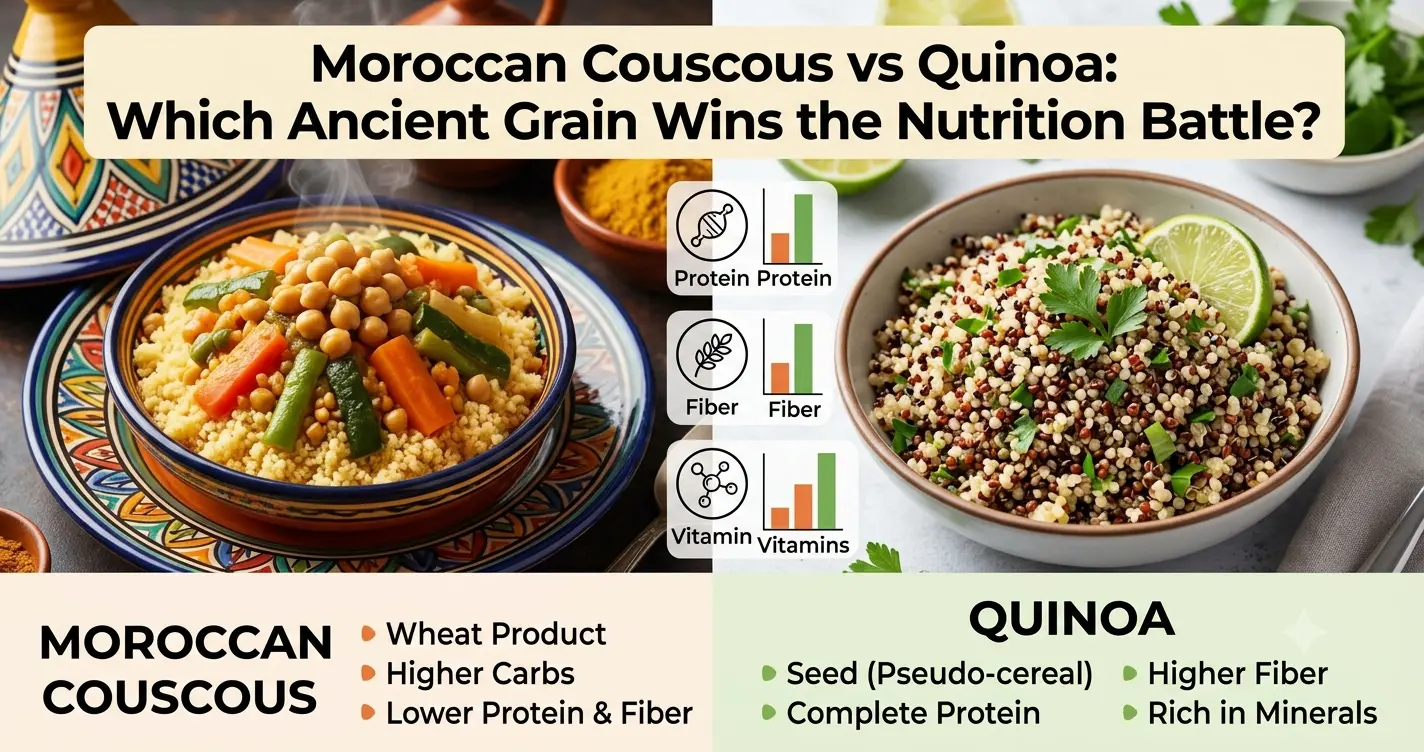
Every Friday afternoon, across thousands of Moroccan households from Casablanca to Marrakech to the high Atlas villages, something magical happens. Grandmothers and mothers begin rolling semolina between their palms, working the grains with water and a practiced patience that no machine has ever truly replicated. The steam rises from a hand-hammered copper couscoussier. The smell of saffron, ras el hanout, and slow-braised lamb fills the air. This is couscous — not a side dish, not a trendy health food, but the very soul of Moroccan culture, a dish that has nourished North African civilization for over a thousand years. Meanwhile, half a world away in the Andean highlands of Peru and Bolivia, quinoa was feeding the Inca Empire long before Europeans had ever seen it. Fast forward to today, and both of these extraordinary grains sit side by side on supermarket shelves in London, New York, Toronto, and Sydney — each making bold claims on the health-food aisle. So which one truly deserves the crown? As a Moroccan culinary expert who has spent decades learning from the best home cooks and chefs across the country, I am here to give you the honest, nuanced, deeply informed answer — one that goes far beyond a simple nutrition label comparison.
1. The Ancient Origins: Two Grains, Two Civilizations
Before we dive into protein percentages and glycemic indices, let us honor where these foods come from. Understanding their history is not just academic — it profoundly shapes how we should think about eating them.
Couscous: A North African Legacy Over 1,000 Years Old
The earliest written evidence of couscous dates to 13th-century North Africa, though many historians and food anthropologists believe its origins stretch back even further, possibly to the Berber (Amazigh) people of the Maghreb — the indigenous inhabitants of what is now Morocco, Algeria, Tunisia, and Libya. Archaeological discoveries of couscous-making vessels dating to around the 9th century have been found in Algeria, and the culinary traditions of the Amazigh people point to an even deeper, prehistoric relationship with semolina-based foods.
Couscous is made from durum wheat semolina — the coarse, yellowish flour ground from the hardest variety of wheat. In traditional Moroccan preparation, dry semolina is moistened, rolled by hand into tiny pellets, then steamed multiple times over a fragrant broth. The word "couscous" itself is believed to derive from the Berber word seksu or k'sksu, reflecting its deep Amazigh roots. In 2020, UNESCO officially recognized couscous as an Intangible Cultural Heritage of Humanity — a profound acknowledgment of what Moroccans, Algerians, Tunisians, and Mauritanians have always known.
In Morocco specifically, couscous is far more than a meal. It is a ritual. It is served on Fridays after mosque prayers, at weddings, at births, at funerals, and at celebrations. The communal act of eating couscous from a shared round dish — using only the right hand to roll small balls of grain and stew — is an expression of brotherhood, hospitality, and Moroccan identity that no nutritional comparison can fully capture.
Quinoa: The Gold of the Inca Empire
Quinoa (pronounced KEEN-wah) has its own extraordinary story. Cultivated in the Andes for somewhere between 3,000 and 7,000 years, quinoa was so central to Incan civilization that it was called chisaya mama — "mother of all grains" — in Quechua. Incan emperors would ceremonially plant the first seeds of the season with golden tools. Quinoa sustained armies, fed cities, and was considered sacred.
Technically, quinoa is not a grain at all — it is a seed from the plant Chenopodium quinoa, which makes it a pseudocereal, botanically closer to spinach and beets than to wheat or rice. This distinction becomes nutritionally significant, as we will explore shortly. Despite its thousands of years of history in South America, quinoa only entered the Western health-food consciousness in the 1990s and became a global phenomenon in the 2010s. The United Nations even declared 2013 the "International Year of Quinoa" to highlight its nutritional potential.
2. Breaking Down the Nutrition: The Numbers That Actually Matter
Now, let us get into the science. I want to be precise here, because too many food bloggers throw around nutrition figures without proper context. All values below are based on cooked portions of 100 grams, which is the most honest way to compare foods we actually eat.
The Core Macronutrient Comparison
| Nutrient (per 100g cooked) | Moroccan Couscous | Quinoa |
|---|---|---|
| Calories | 112 kcal | 120 kcal |
| Carbohydrates | 23.2 g | 21.3 g |
| Protein | 3.8 g | 4.4 g |
| Total Fat | 0.2 g | 1.9 g |
| Dietary Fiber | 1.4 g | 2.8 g |
| Sugars | 0.1 g | 0.9 g |
| Glycemic Index (GI) | 65 (medium) | 53 (low-medium) |
| Gluten | Yes (contains wheat) | No (naturally gluten-free) |
At first glance, quinoa looks like the clear winner on most fronts — more protein, more fiber, more healthy fats, lower glycemic index. And if we were comparing plain, boiled quinoa to plain, boiled couscous eaten in isolation, that assessment would be largely correct. But here is where my years of experience in Moroccan kitchens give me a perspective most Western nutritionists miss entirely.
The Micronutrient Story
| Micronutrient (per 100g cooked) | Moroccan Couscous | Quinoa | Winner |
|---|---|---|---|
| Iron | 0.4 mg | 1.5 mg | Quinoa |
| Magnesium | 10 mg | 64 mg | Quinoa |
| Phosphorus | 22 mg | 152 mg | Quinoa |
| Potassium | 58 mg | 172 mg | Quinoa |
| Zinc | 0.3 mg | 1.1 mg | Quinoa |
| Folate (B9) | 15 mcg | 42 mcg | Quinoa |
| Selenium | 27.5 mcg | 2.8 mcg | Couscous |
| Thiamine (B1) | 0.10 mg | 0.10 mg | Tie |
| Vitamin E | 0.13 mg | 0.63 mg | Quinoa |
The micronutrient comparison is genuinely impressive for quinoa, particularly its mineral density. Quinoa's content of magnesium, iron, and zinc is remarkably high for a plant food. However, there is a critically important caveat that many quinoa enthusiasts overlook: quinoa contains significant amounts of phytic acid and saponins — antinutrients that can substantially reduce the bioavailability of those impressive minerals. Proper rinsing before cooking removes most saponins, but phytic acid remains an issue for those relying on quinoa as a primary mineral source.
Couscous, meanwhile, shines in one often-overlooked area: selenium. With roughly 27.5 micrograms per 100g cooked, couscous is one of the best cereal-based sources of this essential trace mineral, which plays a critical role in thyroid function, immune response, and antioxidant protection.
3. The Protein Question: Quality Versus Quantity
The quinoa protein narrative has been told so many times in Western health media that it has achieved almost mythological status. Yes, quinoa is a complete protein — it contains all nine essential amino acids in meaningful quantities. This is genuinely impressive for a plant food and represents a real nutritional advantage, particularly for vegans and vegetarians.
Couscous, derived from wheat, is not a complete protein. It is relatively low in lysine, an essential amino acid. However, let us apply some critical thinking here. When Moroccans eat couscous — as they have done for centuries — they almost never eat it alone. A traditional Moroccan couscous dish is served with:
- Generous portions of slow-braised meat (lamb, chicken, beef, or merguez sausage)
- An abundance of seasonal vegetables — turnips, carrots, cabbage, zucchini, pumpkin, onions
- Chickpeas, which are exceptionally rich in lysine and complement wheat protein perfectly
- A fragrant broth made from meat bones, olive oil, and warming spices
- Often a side of fresh buttermilk (lben) — a probiotic-rich fermented dairy drink
The combination of couscous with chickpeas is not accidental dietary wisdom — it is centuries-old nutritional intuition. When you eat couscous with chickpeas, you create a complete amino acid profile that rivals anything quinoa offers alone. This is the concept of protein complementarity, and Moroccan cuisine has been practicing it long before the term was coined.
"In Morocco, we never ate couscous to get protein. We ate it to bring people together. But the wisdom of pairing it with legumes, vegetables, and meat meant our ancestors were far better nourished than any single-food comparison would suggest. Context is everything in food."
4. Glycemic Index, Blood Sugar, and Weight Management
This is arguably the most practically important comparison for many Western readers, where concerns about blood sugar regulation, type 2 diabetes, and weight management are at the forefront of dietary decision-making.
Understanding the Glycemic Index of Both Grains
Quinoa has a glycemic index of approximately 53, placing it in the low-to-medium GI range. Its higher fiber content and protein-fat combination slow the release of glucose into the bloodstream, making it an excellent choice for people managing blood sugar levels or seeking sustained energy.
Plain couscous has a GI of approximately 65, placing it in the medium range — similar to white rice but lower than white bread. This often surprises people, who assume couscous must be equivalent to white flour pasta. The slightly coarser texture of semolina granules means digestion is somewhat slower than for finely milled wheat products.
However, here is where Moroccan cooking wisdom once again transforms the equation. Traditional couscous is:
- Steamed three times — the repetitive steaming process affects the starch structure, potentially modifying how it is digested compared to quickly processed instant couscous
- Served with copious fiber-rich vegetables — cabbage, carrots, turnips, and pumpkin dramatically slow the overall glycemic response of the meal
- Accompanied by legumes like chickpeas — the fiber and protein in chickpeas further blunts blood sugar spikes
- Dressed with olive oil — healthy fats slow gastric emptying and moderate glucose absorption
- Eaten in moderate portions — traditional Moroccan eating culture emphasizes moderation and communal sharing, naturally limiting overconsumption
A 2019 study published in the Journal of Nutrition demonstrated that adding vegetables and legumes to medium-GI grains can reduce the effective glycemic load of a meal by as much as 30-40%. This is the meal context that any honest grain comparison must acknowledge. Eating a bowl of plain couscous is nutritionally very different from eating a traditional Moroccan Friday couscous — just as eating plain quinoa is nutritionally different from a complete quinoa bowl with vegetables, beans, and avocado.
Whole Wheat Couscous: The Game-Changer
Most nutrition comparisons pit quinoa against regular (refined) couscous, which is the most common variety sold in Western supermarkets. But whole wheat couscous — increasingly available in health food stores — changes the picture considerably:
- Glycemic index drops to approximately 45-50 (comparable to quinoa)
- Fiber content increases to approximately 4-5g per 100g cooked
- Vitamin B and mineral content increases significantly
- The nutty, earthy flavor becomes even more characteristic and satisfying
At MaCooking, we actively advocate for whole wheat couscous as the everyday choice for health-conscious cooks who want the best of both worlds — authentic Moroccan flavor and optimized nutrition. It is one of those simple swaps that makes a genuine difference without sacrificing any of the cultural authenticity of the dish.
5. Digestibility, Gut Health, and Practical Considerations
Couscous and Digestibility
One of couscous's most underrated virtues is its remarkable digestibility. The steaming process gelatinizes the starch in a way that makes it exceptionally gentle on the digestive system. In Moroccan tradition, couscous is frequently recommended as comfort food for those recovering from illness, for elderly people, and for young children being introduced to solid foods. It is light, soft, and easy on the gut.
For people with irritable bowel syndrome (IBS) or sensitive digestive systems, couscous — particularly the properly steamed traditional kind — is often far better tolerated than quinoa. Many people who eagerly adopt quinoa as a health food find they experience bloating, gas, and digestive discomfort, particularly if the saponins have not been thoroughly rinsed off or if their gut microbiome is not accustomed to quinoa's particular fiber profile.
Quinoa and the Saponin Issue
Saponins are natural compounds that coat quinoa seeds and serve as a plant defense mechanism. They have a bitter, soapy taste and can cause digestive irritation in sensitive individuals. Most commercial quinoa sold in Western supermarkets has been pre-rinsed, but even so, an additional rinse under cold running water before cooking is strongly recommended. This simple step removes residual saponins and significantly improves both taste and tolerability.
Gluten: The Critical Differentiator for Many Readers
For anyone with celiac disease or non-celiac gluten sensitivity, the choice between couscous and quinoa is non-negotiable: quinoa wins by default. Couscous, being made from durum wheat, contains gluten and is completely unsuitable for those with gluten-related disorders. This is an important practical consideration for a significant proportion of Western readers, and it should be stated clearly and unequivocally.
However, for the majority of the population who do not have gluten sensitivity, this distinction is nutritionally irrelevant. The gluten in couscous does not make it a less healthy food for those who can tolerate it — gluten itself is not harmful to people without gluten-related conditions, despite the widespread misconception promoted by popular diet culture.
6. Cultural Context, Sustainability, and the Real-World Diet
The Mediterranean Diet Connection
Moroccan cuisine is one of the richest expressions of the broader Mediterranean dietary tradition, consistently ranked among the world's healthiest eating patterns. Couscous, eaten within this cultural framework — with olive oil, vegetables, legumes, moderate amounts of lean meat, fresh herbs, and warming spices like turmeric, ginger, and cinnamon — is part of a dietary ecosystem that has supported extraordinary health and longevity for centuries.
The Moroccan diet's health benefits are not primarily attributable to couscous itself, but to the rich matrix of foods surrounding it. The olive oil provides heart-healthy monounsaturated fats. The seven-vegetable tagine alongside the couscous delivers a rainbow of antioxidants, vitamins, and minerals. The chickpeas provide plant-based protein and prebiotic fiber. The preserved lemons and fresh cilantro add vitamin C. The warming spices — particularly turmeric and ginger — contribute potent anti-inflammatory compounds.
This is why comparing couscous to quinoa in isolation is fundamentally misleading. You cannot extract a single food from its cultural and culinary context and make meaningful health judgments about it.
Sustainability and Environmental Impact
This is a dimension of the couscous versus quinoa debate that rarely gets the attention it deserves, but matters deeply to increasingly environmentally conscious Western consumers.
The global quinoa boom of the 2010s created a complex situation in the Andean regions where it is grown. As demand skyrocketed from North America and Europe, quinoa prices rose dramatically — which benefited some Andean farmers financially but also made the traditional staple unaffordable for local communities who had relied on it for millennia. There have also been concerns about land use intensification and soil degradation in quinoa-growing regions.
Couscous, produced predominantly from durum wheat grown across the Maghreb, Spain, Italy, and parts of North America, has a well-established, lower-impact supply chain. Moroccan durum wheat farming, particularly in the plains around Meknes and Fes, is deeply integrated into sustainable traditional agricultural practices. When you choose Moroccan couscous — especially when sourced from reputable suppliers — you are often supporting smaller-scale, traditional farming operations with centuries of sustainable practice behind them.
Cost and Accessibility
Let us be honest about economics, because nutrition advice that ignores food costs is advice for the privileged few. In most Western markets:
- Regular couscous costs approximately $1.50-$3.00 per pound
- Whole wheat couscous costs approximately $3.00-$5.00 per pound
- White quinoa costs approximately $4.00-$8.00 per pound
- Organic or specialty quinoa varieties can cost $10-$14 per pound
For families on tight budgets — the majority of people in most Western countries — couscous offers an outstanding nutritional return on investment, particularly when combined with affordable legumes and vegetables in the Moroccan tradition. Dismissing couscous in favor of quinoa on nutritional grounds, without acknowledging this reality, reveals a blind spot in much of mainstream nutrition advice.
7. Cooking, Versatility, and Getting the Best from Each Grain
Mastering Traditional Moroccan Couscous
I have seen couscous ruined in so many Western kitchens, and it breaks my heart every time. The most common mistake is treating instant couscous like real couscous — simply pouring boiling water over it, covering for five minutes, and calling it done. The result is edible, yes, but it is a pale ghost of what couscous can and should be.
Traditional Moroccan couscous is steamed — not once, but three times — over a fragrant, spiced broth. Between each steaming, the grains are spread out, rubbed with a little olive oil or butter, and aerated with the fingertips until each grain is separate and light as air. The result is couscous with a texture so perfect, so fluffy, so delicately flavored from the rising steam, that it is genuinely one of the most wonderful foods in the world.
At MaCooking, we have detailed video tutorials and step-by-step guides on authentic couscous preparation techniques — from the classic Friday seven-vegetable couscous to regional variations like the sweet couscous with raisins and caramelized onions (couscous tfaya) or the beautifully spiced couscous with lamb and caramelized squash. Learning proper couscous technique is one of the most rewarding investments any home cook can make.
Tips for Perfectly Prepared Quinoa
Quinoa, for all its nutritional credentials, can be bland and texturally disappointing if not prepared correctly. Here are the essential steps:
- Rinse thoroughly under cold running water for at least 60 seconds to remove saponins
- Toast before cooking — dry toast in a hot pan for 2-3 minutes until fragrant; this dramatically improves flavor
- Use broth, not water — vegetable or chicken broth adds depth that plain quinoa lacks
- Rest after cooking — remove from heat, cover, and rest for 5 minutes, then fluff with a fork
- Season aggressively — quinoa needs salt, acid (lemon juice), and aromatics to shine
- Pair with bold flavors — quinoa benefits enormously from Moroccan spice combinations like cumin, coriander, paprika, and harissa
Versatility in the Kitchen
Both grains are impressively versatile, but in different ways. Couscous excels as a base for stews and tagines, as a stuffing for roasted vegetables, in salads (particularly the cold Moroccan couscous salads beloved in summer), and in sweet preparations. Quinoa works beautifully in grain bowls, soups, salads, veggie burgers, and even baked goods. Both can be adapted to virtually any cuisine and dietary preference.
Interestingly, some Moroccan chefs — including innovators we feature on MaCooking — have begun incorporating quinoa into modern Moroccan dishes, using it as a base for deconstructed tagine presentations or blending it with couscous for a nutritional and textural hybrid. This kind of creative evolution honors tradition while embracing the best of what global ingredients have to offer.
FAQ: Your Most Pressing Questions Answered
Q1: Is couscous actually healthy, or is it just refined carbs I should avoid?
This is one of the most common misconceptions I encounter, and I am happy to set the record straight. Regular couscous is a refined grain product made from durum wheat semolina, so it is not quite as nutritionally rich as whole grain options. However, calling it unhealthy is an oversimplification that ignores crucial context. Couscous is low in fat, provides a reasonable source of protein and selenium, and is far more nutritious than many refined grain products like white bread or pasta. More importantly, couscous is almost never eaten alone in Moroccan cuisine — it is always served with vegetables, legumes, and often meat, creating a nutritionally complete and balanced meal. Choosing whole wheat couscous takes the nutrition profile to an even higher level, delivering more fiber, vitamins, and minerals. So the honest answer is: yes, couscous can absolutely be part of a healthy diet, especially when prepared and eaten in the traditional Moroccan way.
Q2: Is quinoa really a complete protein, and does that matter for most people?
Yes, quinoa genuinely is a complete protein — it contains all nine essential amino acids, including lysine, which is typically limited in grains. This is a real and meaningful nutritional advantage. However, whether this matters to you personally depends enormously on your overall diet. If you are a vegan or vegetarian who eats a diverse diet including legumes, nuts, seeds, and varied plant proteins, your amino acid needs are very likely already being met through complementary protein combinations, even without quinoa. If you eat animal proteins in any form, the complete protein status of quinoa becomes largely irrelevant — you are already getting complete amino acid profiles from those sources. Quinoa's complete protein status is most practically important for people following restrictive plant-based diets with limited food variety.
Q3: Which grain is better for weight loss — couscous or quinoa?
Neither grain is a magic weight-loss food, and treating either one as such sets you up for disappointment. That said, some evidence-based observations are worth sharing. Quinoa's higher protein and fiber content means it tends to be more satiating per gram — you may feel fuller for longer after eating quinoa compared to an equivalent portion of plain couscous. Its lower glycemic index also supports more stable blood sugar, which can reduce hunger and cravings. However, couscous's lower calorie density (slightly fewer calories per 100g cooked) and its extraordinary ability to satisfy when eaten in a traditional Moroccan context — where the whole dish is rich in fiber and protein from vegetables, chickpeas, and meat — means it is entirely compatible with healthy weight management. The best grain for weight loss is the one you enjoy eating, that keeps you satisfied, and that fits into a balanced dietary pattern you can sustain long-term.
Q4: Can I substitute quinoa for couscous in Moroccan recipes?
Technically yes, practically speaking it requires some adjustment and culinary honesty. Quinoa has a distinctly different texture — slightly crunchier, with a more pronounced earthy, nutty flavor — compared to the light, airy, almost cloud-like texture of properly prepared couscous. In tagine-style dishes where the grain serves as a base to absorb a flavored broth, quinoa can work well with adaptation. However, the result will taste different — not necessarily worse, but different. In dishes where couscous texture is essential — like couscous tfaya or couscous with caramelized onions and raisins — substituting quinoa fundamentally changes the character of the dish. For those avoiding gluten, quinoa is a reasonable substitute in simple preparations. For everyone else, I would encourage you to learn to make proper traditional couscous — the authentic technique produces something that no substitution can match. Our recipes at MaCooking include both authentic traditional preparations and adapted versions using alternative grains.
Q5: Which is more environmentally sustainable — couscous or quinoa?
The environmental picture is nuanced and context-dependent. Both grains have genuine sustainability credentials. Quinoa is notably drought-resistant and can grow in poor, high-altitude soils where other crops would fail, making it potentially valuable in climate adaptation scenarios. However, the explosion in global quinoa demand created economic and ecological stress in traditional growing regions of Peru and Bolivia, including reported soil degradation from intensified farming and social disruption as prices became unaffordable for local communities. Durum wheat for couscous is grown across broad regions including North Africa, the Mediterranean, and parts of North America, with generally well-established supply chains. When choosing couscous from Moroccan or North African producers, you are often supporting traditional farming communities with centuries of sustainable agricultural practice. The most sustainable choice is almost always to buy from local or regional producers using transparent, responsible practices — and to reduce overall food waste regardless of which grain you choose.
The Verdict: And the Winner Is...
After all of this — the history, the chemistry, the culture, the practical cooking considerations — you deserve a direct answer. So here it is, from someone who has spent a lifetime immersed in Moroccan food culture and has also studied the science of nutrition with genuine curiosity:
Quinoa wins on raw nutritional metrics. In a head-to-head comparison of the two grains eaten plain, quinoa offers more complete protein, more fiber, a lower glycemic index, more minerals, and the critical advantage of being gluten-free. For vegans, vegetarians, and people with celiac disease in particular, quinoa's nutritional profile is genuinely superior in isolation.
Couscous wins on cultural wisdom, digestibility, cost, and meal context. When eaten in the traditional Moroccan way — steamed properly, served with a rainbow of vegetables, chickpeas, quality olive oil, and warming spices — couscous is the centerpiece of one of the world's great healthy food traditions. Its digestibility, affordability, and the extraordinary culinary culture built around it over a thousand years of refinement represent a form of nutritional intelligence that cannot be reduced to a nutrition label.
The most honest answer is that there is no single winner — because the question itself is slightly wrong. Food does not exist in isolation. It exists in cultural context, in meal patterns, in cooking techniques, in the company of other ingredients, and in the traditions that give it meaning. A poorly prepared quinoa bowl drowned in sugary dressings will not outperform a beautifully made Moroccan seven-vegetable couscous just because quinoa has better raw numbers. And a plate of plain boiled couscous eaten alone, day after day, will not deliver the nutritional brilliance of traditional Moroccan cuisine.
The wisest approach — and the most delicious one — is to enjoy both. Let quinoa earn its place in your grain rotation, especially on days when you want maximum nutrient density in a quick preparation. But also invest time in learning authentic Moroccan couscous — properly, traditionally, with the vegetables and chickpeas and olive oil that make it one of humanity's great culinary achievements. Your body and your taste buds will thank you for both.
Conclusion: Eat Smarter, Cook Better, Learn from Morocco
The couscous versus quinoa debate, when framed purely as a nutritional competition, misses something profound about what food is and what it does for us. Nutrition science gives us tools to understand food components — amino acids, glycemic indices, micronutrient profiles. But it cannot fully capture the nourishment that comes from a bowl of couscous eaten communally on a Friday in Morocco, from the slow steam rising through a couscoussier that has belonged to the same family for three generations, from the way certain spice combinations support health in ways that go far beyond their individual measurable compounds.
Moroccan cuisine has a great deal to teach the modern world about eating well — not through deprivation or obsessive food tracking, but through abundant vegetables, quality fats, warming spices with genuine anti-inflammatory properties, communal eating, and a deep respect for ingredients and their preparation. These are lessons that food culture has accumulated over centuries, and they deserve our attention and respect.
Whether you are a health-conscious cook in London experimenting with Moroccan flavors for the first time, or a home chef in Toronto who has been cooking Moroccan food for years and wants to deepen your nutritional understanding, I hope this deep dive has given you both the knowledge and the inspiration to approach these two extraordinary grains with fresh eyes and genuine curiosity.
Explore our full library of authentic Moroccan couscous recipes, health-focused Moroccan cooking guides, and expert culinary tutorials at MaCooking — your definitive home for authentic Moroccan cuisine, written by people who live and breathe this extraordinary food culture every single day. From classic Friday couscous to contemporary grain bowls inspired by Moroccan spice traditions, we have everything you need to cook beautifully, eat wisely, and honor one of the world's greatest culinary traditions.
Bssaha w raha — may it bring you health and peace.