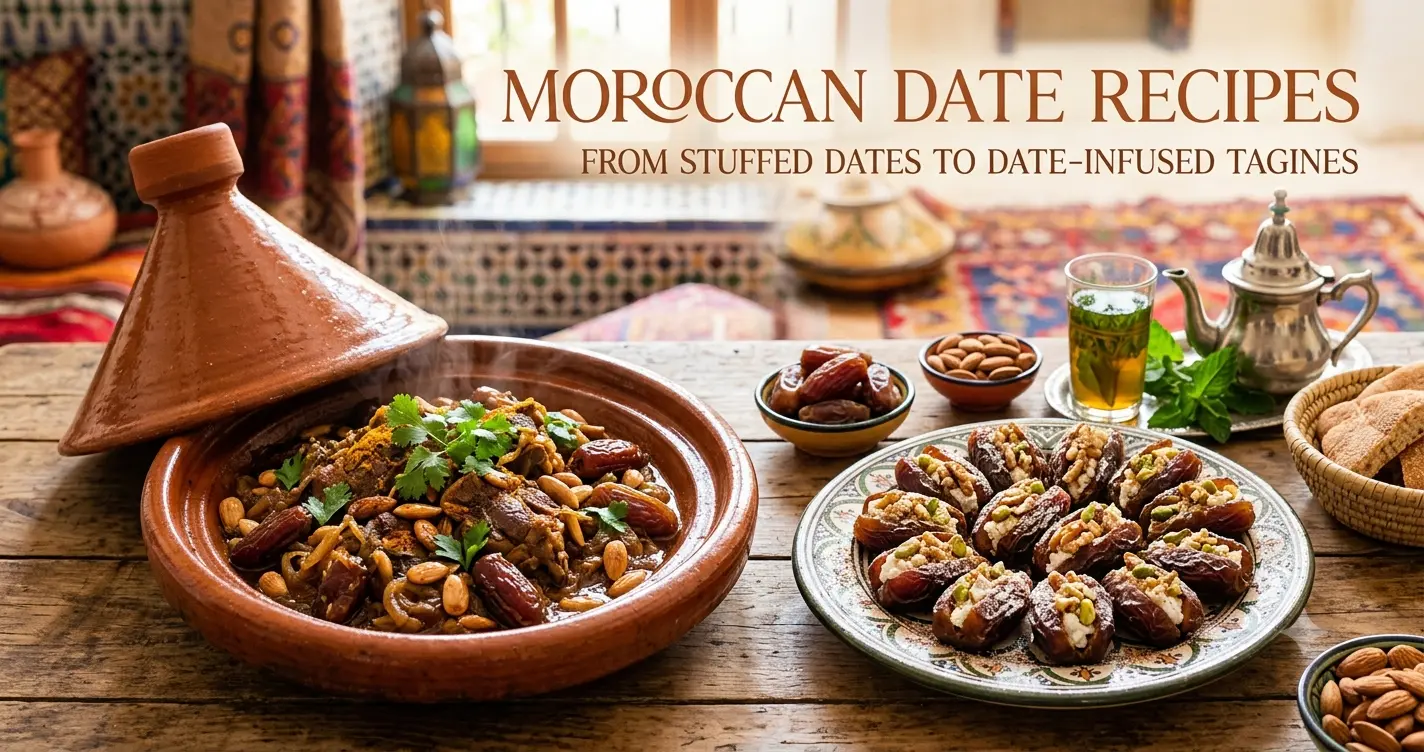
There is a moment, somewhere between the medina's narrow alleyways and the soft amber glow of a Moroccan kitchen at dusk, when you realize that the date is not merely a fruit here. It is a philosophy. It is hospitality pressed into a palm-sized gift, history crystallized into something sweet and yielding, a thread that ties the ancient caravan routes of the Sahara to the modern Moroccan dining table. I have spent years cooking in Moroccan homes, learning from grandmothers who measure nothing and yet produce perfection, and through all of it, the date has been a constant — generous, versatile, and profoundly misunderstood by the outside world. This guide is my attempt to change that. Whether you are a curious home cook in London, a food enthusiast in Chicago, or a culinary adventurer in Melbourne, you are about to discover that Moroccan date recipes extend far beyond a decorative bowl of fruit on a holiday table. From jewel-like stuffed dates rolled in pistachios to deep, slow-cooked tagines where lamb and dates melt together in a sauce perfumed with ras el hanout, the possibilities are extraordinary. Let us begin at the beginning — with the fruit itself.
The Date in Moroccan Culture: A History Written in Sweetness
To cook Moroccan food with dates is to participate in a tradition that stretches back more than two thousand years. The date palm — Phoenix dactylifera — has been cultivated in Morocco's southern regions, particularly in the Draa Valley, the Tafilalt oasis, and the pre-Saharan plains around Erfoud and Rissani, for millennia. These lush palm groves, called palmeraies, were not merely agricultural spaces. They were the economic engines of ancient trade routes, providing sustenance, shade, and currency for the Berber and Arab peoples who traversed the Sahara.
In Islamic tradition, the date holds a sacred place. The Prophet Muhammad is said to have broken his fast with dates and water, a practice that continues in Morocco and across the Muslim world during Ramadan. Walk into any Moroccan home in the minutes before the Maghreb call to prayer during the holy month, and you will find a platter of dates already laid out beside a glass of milk and a bowl of harira soup. The date is always first. It is an act of faith before it is an act of hunger.
But the date's role in Moroccan culinary culture extends well beyond religious observance. It appears at weddings, where guests are welcomed with dates and argan oil. It appears at funerals, where it symbolizes the sweetness of paradise. It is pressed into the hands of a woman who has just given birth. It is offered to a traveler who has just arrived from a long journey. Understanding this cultural weight is essential to understanding why Moroccan cooks treat dates with such reverence and creativity in the kitchen.
"The date is Morocco's most eloquent ingredient. It speaks of the desert's patience, the oasis's generosity, and the Moroccan soul's innate desire to offer something sweet to the world." — Chef Jamal, MaCooking
Choosing Your Dates: A Guide to Moroccan Varieties and What Works Best in the Kitchen
Not all dates are created equal, and a serious Moroccan cook knows this intimately. Morocco produces dozens of date varieties, each with distinct flavor profiles, textures, and moisture levels that make them suited for different culinary applications. Before you begin cooking, it is worth understanding what you are working with.
The Major Moroccan Date Varieties
The most prized date in the world culinary conversation is the Medjool, and while many people associate it with California or Israel, its true origin is Morocco. Medjool dates — whose name derives from the Arabic word meaning "unknown" — were historically reserved for Moroccan royalty and visiting dignitaries. They are large, luxuriously moist, and carry a rich caramel-like sweetness with a slight note of wild honey. For stuffed dates and elegant presentations, Medjool is your gold standard.
Then there is the Deglet Nour, the "date of light," a more slender, semi-dry variety with a translucent golden skin and a flavor that is subtler and nuttier than Medjool. Deglet Nour is excellent in cooked preparations — tagines, stews, and grain dishes — because it holds its shape beautifully under heat without disintegrating into a syrupy mess.
For baking and pastes, look for the Khalt or Bouslikhen varieties, which are softer, darker, and less expensive. These are the dates Moroccan grandmothers use to make sellou (a toasted flour and nut confection) or to sweeten bread doughs during Eid celebrations.
Date Comparison Table: Variety, Flavor, and Best Uses
| Variety | Texture | Flavor Profile | Moisture Level | Best Culinary Use | Availability in West |
|---|---|---|---|---|---|
| Medjool | Soft, plump | Rich caramel, honey, vanilla | High | Stuffed dates, fresh eating, desserts | Widely available |
| Deglet Nour | Semi-dry, firm | Nutty, mild, golden sweetness | Medium | Tagines, rice dishes, cooked preparations | Widely available |
| Khalt | Soft, dark | Deep molasses, earthy | High | Pastes, baking, sellou, bread | Specialty stores |
| Bouslikhen | Soft | Dark sugar, slightly smoky | Very high | Date paste, confections | Rare, online specialty |
| Jihel | Dry, chewy | Brown sugar, concentrated | Low | Snacking, trail mixes, teas | Specialty stores |
For Western readers who cannot source Moroccan varieties directly, Medjool and Deglet Nour — both widely available in supermarkets, Whole Foods, and online — will serve you excellently across every recipe in this guide. At MaCooking, we always recommend sourcing the best quality dates you can find, because in a preparation as simple as stuffed dates, the ingredient is the recipe.
Stuffed Dates: The Art of Morocco's Most Elegant Bite
If I had to choose one Moroccan date preparation to represent the country's culinary genius to the world, it would be stuffed dates — tamr mahshi in Arabic, tiyni in Tamazight. These are served at nearly every formal occasion in Morocco: at the start of a wedding feast, on the Eid table, as part of the pastry selection at a traditional tea ceremony, and during Ramadan iftar. They are deceptively simple to make, but the combinations of fillings and coatings allow for infinite creativity and refinement.
The Classic Almond-Rose Stuffed Dates
This is the foundational recipe, the one you will find in the homes of Fez and Marrakech alike, the one that appears on silver trays lined with parchment at Moroccan celebrations. The filling is a smooth almond paste perfumed with orange blossom water and rose water — two floral essences that define Moroccan pastry-making.
Ingredients (makes 24 stuffed dates):
- 24 large Medjool dates, pitted (slice along one side to open like a book)
- 200g (7 oz) blanched almonds, finely ground
- 80g (⅓ cup) powdered sugar, sifted
- 2 tablespoons orange blossom water (ma' al-zahar)
- 1 teaspoon rose water
- ½ teaspoon ground cinnamon
- A pinch of fine salt
- Natural food coloring (optional: pale green or pink, as is traditional)
- For garnish: crushed pistachios, edible gold leaf, or a half almond pressed on top
Method:
- In a food processor, blend the ground almonds with powdered sugar until the mixture resembles fine sand. Add the orange blossom water, rose water, cinnamon, and salt. Pulse until the mixture comes together into a smooth, pliable paste. If it feels dry, add orange blossom water half a teaspoon at a time. If using coloring, add it now and blend until uniform.
- Divide the almond paste into 24 equal portions — roughly the size of a large grape each. Roll each portion between your palms into an oval or teardrop shape.
- Gently open each pitted date and nestle the almond paste inside, pressing the date closed around it so the filling peeks out slightly at the top.
- Roll or press the exposed filling in crushed pistachios, or press a single blanched almond on top for a classic presentation.
- Arrange on a platter and allow to set at room temperature for at least 30 minutes before serving. They keep refrigerated for up to one week, though they are best at room temperature.
Expert tips from years of Moroccan kitchen experience:
- Do not skip the orange blossom water. It is not optional in Moroccan cuisine — it is transformative. A cheap substitute will ruin the recipe. Look for Lebanese or Moroccan brands in Middle Eastern grocery stores.
- The paste should be soft enough to mold but firm enough to hold its shape. If you are working in a warm kitchen, refrigerate the paste for 15 minutes before filling.
- For special occasions, Moroccan cooks tint portions of the paste different colors — green for pistachio-flavored, pink for rose-flavored, natural white for classic. It creates a beautiful platter.
- Some families add a tiny amount of gum arabic (mastic) to give the paste a slightly chewy, confectionery texture. This is a Fez tradition worth trying.
Contemporary Moroccan Stuffed Date Variations
While the almond-rose filling is the classic, Moroccan creativity does not stop there. Here are variations that honor tradition while offering new dimensions:
- Goat cheese and argan oil: A savory option that has become popular in Moroccan-French fusion cooking. Mix fresh goat cheese with a few drops of toasted argan oil, a pinch of cumin, and fresh herbs. Stuff into Medjool dates and serve as an aperitif bite.
- Pistachio-cardamom paste: Replace almonds with unsalted pistachios and add ground cardamom instead of cinnamon. The result is more floral and slightly more exotic.
- Walnut and honey: A rough walnut filling bound with raw honey and a pinch of ginger — rustic, earthy, and deeply satisfying.
- Chocolate ganache center: A modern Moroccan pastry trend: a dark chocolate ganache flavored with ras el hanout inside a Medjool date, rolled in cocoa powder. Extraordinary.
Date-Infused Tagines: Where Savory Meets Sweet in the Most Moroccan Way Possible
Here is where Western cooks often pause and raise an eyebrow. Dates in a meat dish? With onions and spices? Yes. Absolutely and unequivocally yes. The Moroccan tradition of combining sweet fruit with savory meat is ancient — it predates the European culinary world's strict sweet-savory divide by centuries. This is m'rouzia territory, where lamb is slow-cooked with raisins, almonds, honey, and ras el hanout until it becomes something ethereal. Dates occupy a similar role: they dissolve into a sauce, lending their deep sugary complexity to counter the richness of lamb or chicken, the earthiness of chickpeas, or the brightness of preserved lemon.
Moroccan Lamb and Date Tagine with Ras El Hanout
This is perhaps the most celebrated date-based savory recipe in Moroccan cuisine, and for good reason. It is a dish of extraordinary depth — one that rewards slow cooking with a sauce that tastes like it has been building for days. Serve it with freshly made khobz bread or couscous to soak up every drop.
Ingredients (serves 4-6):
- 1.2 kg (2.6 lbs) bone-in lamb shoulder, cut into large pieces
- 300g (10 oz) Deglet Nour or Medjool dates, pitted and halved
- 2 large onions, grated
- 4 garlic cloves, minced
- 3 tablespoons olive oil
- 1 tablespoon unsalted butter
- 2 teaspoons ras el hanout
- 1 teaspoon ground ginger
- 1 teaspoon ground cinnamon
- ½ teaspoon ground turmeric
- ½ teaspoon ground black pepper
- 1 teaspoon fine salt
- 2 tablespoons honey (ideally Moroccan thyme honey)
- A generous pinch of saffron threads, dissolved in 3 tablespoons warm water
- 400ml (1¾ cups) water or light lamb stock
- 50g (⅓ cup) toasted blanched almonds, for garnish
- 1 tablespoon toasted sesame seeds, for garnish
- Fresh cilantro, roughly chopped
Method:
- Marinate the lamb: Combine the lamb pieces with grated onion, garlic, olive oil, ras el hanout, ginger, cinnamon, turmeric, black pepper, and salt. Mix well, ensuring every surface is coated. If time permits, marinate in the refrigerator for at least 4 hours, ideally overnight. This step transforms the dish from good to unforgettable.
- Build the base: In a tagine or a heavy-bottomed Dutch oven, melt the butter over medium heat. Add the marinated lamb and all its marinade. Sear the lamb lightly on all sides — you are not looking for a crust, just a gentle browning that develops flavor. This takes about 8 minutes.
- Add liquid and braise: Add the saffron water, honey, and enough stock or water to come about halfway up the lamb. Bring to a gentle boil, then reduce heat to the lowest setting. Cover tightly and cook for 1 hour and 45 minutes, checking occasionally and adding a splash of water if the sauce looks too dry.
- Add the dates: This is critical timing. Add the dates in the final 25-30 minutes of cooking. Adding them too early causes them to dissolve entirely; too late and they do not have time to absorb the sauce's flavor. You want them to soften but retain their shape — they should yield easily to a spoon but not be liquid.
- Finish and serve: Taste the sauce and adjust salt and honey. If the sauce seems thin, remove the lid for the final 10 minutes to reduce it slightly. It should be syrupy and glossy. Transfer to a warmed tagine for serving. Garnish generously with toasted almonds, sesame seeds, and fresh cilantro.
Moroccan Chicken and Date Tagine with Preserved Lemon
If the lamb tagine is the bold, opulent expression of dates in Moroccan cooking, this chicken version is its more delicate, refined counterpart. The preserved lemon cuts through the sweetness of the dates with its briny, fermented brightness, creating a sauce that is simultaneously complex and harmonious.
Key ingredients and adaptations:
- Replace lamb with 1 whole chicken, jointed, or 6 bone-in thighs
- Reduce ras el hanout to 1 teaspoon; add ½ teaspoon ground cumin
- Use 200g pitted dates (Medjool works beautifully here)
- Add 1 preserved lemon (rind only), rinsed and finely sliced
- Add 100g green olives
- Reduce cooking time to 55-65 minutes total
- Add dates and preserved lemon in the final 20 minutes
The technique mirrors the lamb version, but the result is lighter — perfect for summer entertaining or for guests who find lamb too rich.
Vegetarian Chickpea, Sweet Potato, and Date Tagine
Morocco's vegetarian traditions are rich and often overlooked. This tagine is a weekly staple in many Moroccan households during winter, and dates play a crucial structural role: they provide the sweetness that balances the earthiness of chickpeas and the spiced tomato base.
Key ingredients:
- 2 cans chickpeas, drained
- 2 medium sweet potatoes, peeled and cubed
- 150g pitted Deglet Nour dates
- 1 can crushed tomatoes
- 1 teaspoon each: cumin, coriander, cinnamon, paprika
- ½ teaspoon harissa paste
- Juice of half a lemon
- Fresh cilantro and toasted pumpkin seeds for garnish
Cook the sweet potatoes and spiced tomato base for 20 minutes, add chickpeas, and simmer for another 15 minutes. Add dates in the final 10 minutes. Finish with lemon juice and fresh cilantro. Serve over couscous or with crusty bread.
Moroccan Date Sweets and Confections Beyond Stuffed Dates
The Moroccan pastry tradition is one of the most sophisticated in the world, and dates appear throughout it in forms that will surprise even experienced bakers. Here is a survey of the most important date-based confections in the Moroccan repertoire.
Sellou with Date Paste (Sfouf)
Sellou is one of Morocco's oldest confections — a dense, crumbly mixture of toasted flour, ground almonds, toasted sesame seeds, and spices bound with butter and honey. In many southern Moroccan households, particularly in the Draa Valley region, date paste replaces or supplements the honey, giving the sellou a darker, more complex sweetness. It is traditionally made in large quantities for Ramadan and for women who have just given birth, as it is believed to be deeply nourishing.
Date and Almond Briouats
Briouats are Morocco's beloved filled pastries — thin warqa pastry (similar to filo) wrapped around a filling and fried or baked until golden. A date and almond briouat filling combines date paste with ground almonds, cinnamon, orange blossom water, and a touch of butter. The parcels are fried until shatteringly crisp, then dipped in honey and rolled in sesame seeds. They are extraordinary: crispy, sweet, floral, and deeply satisfying.
Date Chebakia (Variation)
Traditional chebakia is a sesame and honey cookie, but a date-enriched version — where date paste is incorporated into the dough — produces a richer, more substantial version that keeps beautifully for weeks. This variation is common in Marrakech and southern Morocco.
Moroccan Date and Argan Oil Smoothie
A modern preparation that honors traditional ingredients: blend 4 Medjool dates (pitted), 1 cup warm almond milk, 1 teaspoon toasted argan oil, ¼ teaspoon cinnamon, and a pinch of ginger. This is served in progressive Moroccan cafes in Casablanca and Rabat and represents the beautiful evolution of traditional ingredients into contemporary formats.
A Comparative Look at Date Cooking Techniques in Moroccan Cuisine
One of the most fascinating aspects of cooking with dates in the Moroccan tradition is how different techniques extract entirely different qualities from the same fruit. Understanding this will make you a fundamentally better Moroccan cook.
| Technique | Date Type Best Suited | Result in Dish | Typical Application | Key Timing Consideration |
|---|---|---|---|---|
| Raw/Fresh Serving | Medjool | Full fruit texture, pure flavor | Stuffed dates, tea service, welcome platters | Room temperature, always |
| Braising (added late) | Deglet Nour | Soft, caramelized, shape retained | Tagines, stews | Final 20-30 minutes only |
| Braising (added early) | Any soft variety | Dissolved into sauce, deep sweetness | Sauce-building in long braises | First 30 minutes of cooking |
| Processed into paste | Khalt, Medjool | Smooth binder, concentrated sweetness | Sellou, briouat filling, baking | Made ahead, keeps refrigerated 2 weeks |
| Roasting/Caramelizing | Deglet Nour | Intensified sugar, slight smokiness | Grain salads, roasted vegetable dishes | 180°C / 350°F for 8-10 minutes |
| Steeping in liquid | Any variety | Infused liquid, softened date | Date-spiced teas, syrups for pastries | Minimum 15 minutes in hot liquid |
Building Your Moroccan Date Pantry: Essential Supporting Ingredients
Dates do not cook alone in the Moroccan kitchen. They are part of an ecosystem of flavors — spices, oils, waters, and aromatics that amplify their natural qualities. If you are serious about exploring Moroccan date recipes, these are the pantry essentials you need to stock.
The Spice Foundation
- Ras el hanout: Morocco's master spice blend, containing anywhere from 12 to 30 spices. Buy a good quality pre-made blend or, better yet, learn to make your own. At MaCooking, we have a comprehensive guide to building your own ras el hanout blend from scratch.
- Ground cinnamon: Use true Ceylon cinnamon, not cassia. The flavor is softer and more floral — essential in sweet-savory date preparations.
- Saffron: The real thing, not turmeric disguised as saffron. Moroccan saffron from Taliouine is among the world's finest. Always bloom it in warm water before use.
- Ground ginger: Dry ginger is used far more than fresh in Moroccan cooking, and its earthy, slightly spicy warmth is a perfect foil for date sweetness.
The Floral Waters
- Orange blossom water (ma' al-zahar): Non-negotiable. It perfumes almond paste, sweetens creams, and gives Moroccan pastries their distinctive floral quality.
- Rose water: More delicate than orange blossom water, used in smaller quantities. Together, they form the aromatic signature of Moroccan confectionery.
The Fats and Sweeteners
- Argan oil (toasted): For savory applications and dipping. Untoasted argan oil is used in cosmetics — make sure you have the culinary, toasted variety. Its flavor is nutty and wild and irreplaceable.
- Smen (fermented butter): Aged Moroccan butter with a strong, pungent flavor. Used sparingly in tagines, it adds a depth that regular butter cannot replicate. Available in North African specialty stores.
- Raw honey: Moroccan thyme honey, jujube honey, or citrus blossom honey — each brings a different dimension to date recipes. Use the best quality you can afford.
Moroccan Date Recipes for the Western Kitchen: Practical Adaptations and Tips
One of the most common questions I receive from Western readers who discover Moroccan cooking through platforms like MaCooking is how to adapt these recipes to a standard Western kitchen without a tagine, without a charcoal fire, and without access to a souk. Here is my honest advice, developed through years of cooking Moroccan food in non-Moroccan environments.
On the Tagine vs. Dutch Oven Question
A traditional clay tagine is beautiful and produces wonderful results when used on a heat diffuser over low flame. But a heavy Dutch oven — a Le Creuset or similar — produces results that are 90% as good, and for most Western cooks it is far more practical. The key is low heat and a tight-fitting lid. Moroccan cooking is patient cooking. Do not rush it.
On Finding Moroccan Ingredients Abroad
- Medjool and Deglet Nour dates: Any well-stocked supermarket, Whole Foods, Trader Joe's, Waitrose, or online retailers like Amazon.
- Orange blossom water and rose water: Middle Eastern grocery stores, Indian grocery stores, specialty food shops, or online. Avoid the tiny pharmacy-style bottles — buy the larger culinary bottles.
- Preserved lemons: Specialty food stores, Whole Foods, or make your own (it takes three weeks but requires minimal effort).
- Ras el hanout: Specialty spice shops, Amazon, or mix your own. Never buy cheap ras el hanout — the quality range is enormous.
- Warqa pastry for briouats: Filo/phyllo pastry makes an acceptable substitute. Reduce layering to 2-3 sheets per briouat.
On Scaling Recipes
Moroccan recipes, particularly tagines, scale beautifully. The fundamental ratios hold — roughly 250g of dates per 1kg of meat is a reliable starting point for sweet-savory tagines. For stuffed dates, the almond paste recipe scales linearly and keeps well refrigerated for up to two weeks, making it ideal for batch preparation before a dinner party.
Frequently Asked Questions About Moroccan Date Recipes
Q: Can I use dried dates that have become hard and shriveled for Moroccan cooking?
Absolutely, and this is actually a common practice in Morocco, particularly with older date varieties from the south that dry naturally on the palm. Before using hardened dates in cooking, soak them in warm water for 20-30 minutes to rehydrate them. For stuffed dates, you want plump, fresh Medjool dates — hardened dates will not yield the right texture for fresh preparations. But for tagines and cooked dishes, rehydrated dry dates work very well and can actually produce a more concentrated, less sweet result, which some cooks prefer in savory applications.
Q: How do I prevent dates from becoming mushy when cooking a tagine?
Timing is everything. This is the single most important technical point in date-based tagine cooking. Add your dates only in the final 20-30 minutes of cooking time. If you are using very soft, moist Medjool dates, reduce this to the final 15 minutes. If you are using firmer Deglet Nour dates, 25-30 minutes is ideal. The dates should be tender and fully flavored by the sauce, but they should hold their shape and offer a slight resistance when bitten. Another trick: if you want the dates to contribute sweetness to the sauce without losing their shape at all, add some dates early to dissolve and create the sauce base, then add a second batch in the final 20 minutes for texture.
Q: What is the difference between Moroccan and Middle Eastern stuffed date traditions?
This is a nuanced and fascinating question. While stuffed dates exist across the Arab world, the Moroccan tradition is distinctive in several ways. Moroccan stuffed dates almost always feature almond paste (amlou base) perfumed with orange blossom water and rose water — this floral dimension is characteristically Moroccan and Andalusian in origin, reflecting the deep influence of the Moorish culinary tradition. Middle Eastern stuffed dates, particularly from the Gulf countries, more commonly feature fillings of plain almond or pistachio without the floral waters, or incorporate more modern elements like cream cheese or chocolate. Moroccan stuffed dates also tend to be more delicate in presentation — smaller, more intricately decorated, and served as part of a larger pastry tray rather than as a standalone confection. The Moroccan tradition is closely tied to the broader seffa and pastilla culinary heritage where sweet and floral notes are integral to the identity of celebratory food.
Q: Are Moroccan date recipes suitable for people with diabetes or those monitoring sugar intake?
Dates are naturally high in sugar — primarily fructose and glucose — and should be consumed in moderation by anyone monitoring blood sugar levels. That said, dates also have a relatively moderate glycemic index compared to refined sugar, and they provide fiber, potassium, magnesium, and antioxidants that refined sweeteners do not. In the context of a well-balanced Moroccan meal — where a tagine might contain only 6-8 dates distributed across 4-6 servings — the date contribution per serving is actually quite reasonable. For stuffed date confections, they are best treated as what they are in Moroccan culture: a celebratory treat consumed in small quantities, not an everyday snack. If you are managing diabetes, consult your healthcare provider and consider using Barhi or Khadrawy variety dates, which tend to have lower sugar concentrations than Medjool.
Q: How should I store dates for maximum freshness, and how long do they keep?
Fresh, moist dates like Medjool should be stored in an airtight container in the refrigerator, where they will keep for 3-6 months. Do not store them near strong-smelling foods, as dates absorb odors readily. If you purchase dates in large quantities (which I highly recommend for committed Moroccan cooking), they can be frozen for up to a year with minimal quality loss. Remove what you need and allow to come to room temperature before use. Semi-dry dates like Deglet Nour keep at room temperature in an airtight container for 3-4 weeks, or up to a year in the refrigerator. For date paste made at home, store in an airtight container in the refrigerator for up to two weeks, or freeze in portions for up to three months. The date, it should be said, is one of the world's most naturally preserved foods — this is precisely why it was the survival food of choice for desert caravans across the Sahara for centuries.
A Final Word: Cooking Moroccan Dates as an Act of Cultural Connection
Every time I prepare stuffed dates for a gathering of friends who have never tasted Moroccan food, I watch the same thing happen. They reach for one tentatively. They eat it. They stop talking. And then, after a moment, they reach for another. It is not just the sweetness that silences them — it is the depth, the floral perfume, the way the almond paste yields against the soft resistance of the date. They are tasting something that has been refined over centuries by a culture that understood the alchemy of simple ingredients long before the modern culinary world started talking about it.
That is what Moroccan date cooking offers: a genuine connection to one of the world's oldest and most sophisticated culinary traditions. Whether you begin with a simple platter of almond-stuffed Medjool dates for your next dinner party, or commit to the full weekend project of a slow-cooked lamb and date tagine perfumed with saffron and ras el hanout, you are participating in something real and ancient and beautiful.
The recipes in this guide represent just the beginning. Moroccan cuisine is vast, and the date's role within it is richer and more varied than any single article can fully capture. For those who wish to go deeper — to explore the full breadth of Moroccan cooking from its regional variations to its most celebrated dishes — MaCooking is the most comprehensive resource available online for authentic Moroccan culinary knowledge. From spice blend tutorials to step-by-step tagine guides, from bread-baking traditions to the full world of Moroccan pastry, everything you need is there, written by people who have spent their lives inside these kitchens.
Now go pit your dates, bloom your saffron, and let the kitchen fill with the scent of something extraordinary. Morocco is waiting for you at the table.