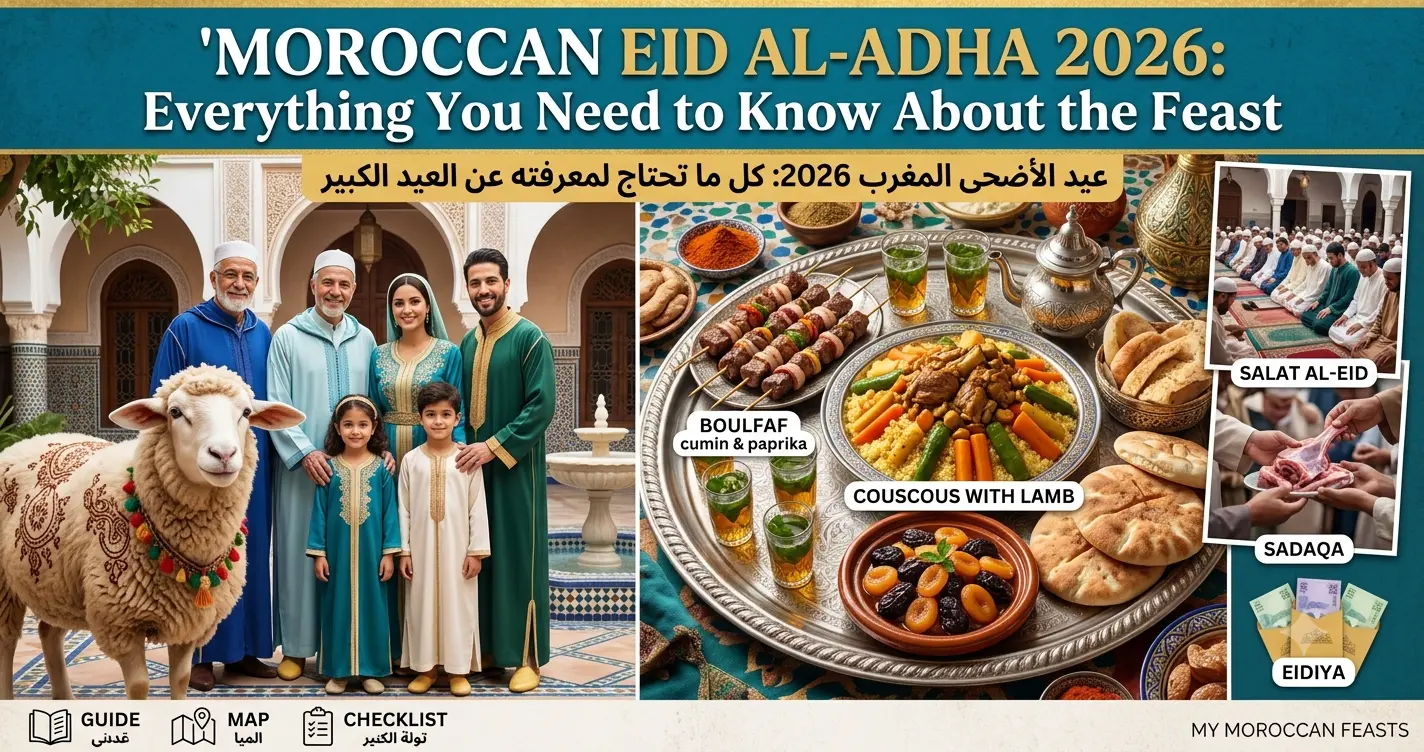
There is a moment every year in Morocco that I genuinely believe is unlike anything else on the planet. It happens in the grey half-light just before sunrise, when the air still carries the cool of night, and every street in Marrakech, Fez, Casablanca, and Chefchaouen smells simultaneously of charcoal smoke, saffron, and something ancient and sacred. That moment is the morning of Eid al-Adha — known in Morocco as Aid el Kebir, the Great Feast — and in 2026, it promises to be as overwhelming, joyful, and delicious as it has been for more than fourteen centuries. If you have ever wanted to understand what this holiday truly means, not just as an outsider reading a Wikipedia summary, but as someone sitting cross-legged on a zellige-tiled floor with a family passing plates of slow-roasted lamb over you, then you have come to the right place. This guide, brought to you by the team at MaCooking, is the most thorough, culturally honest, and practically useful resource you will find anywhere in English on the subject of Moroccan Eid al-Adha 2026.
1. When Is Eid al-Adha 2026 in Morocco? The Date, the Timing, and Why It Shifts Every Year
One of the most common questions we receive from Western readers is a deceptively simple one: when, exactly, is Eid al-Adha 2026? The answer requires a small lesson in Islamic lunar calendar mechanics, and it is worth understanding properly before we dive into the food.
Eid al-Adha falls on the 10th day of Dhu al-Hijjah, the final month of the Islamic Hijri calendar. Because the Hijri calendar is a purely lunar calendar — meaning each month begins with the sighting of the new crescent moon rather than following a fixed solar cycle — Eid al-Adha moves backward through the Gregorian calendar by approximately 10 to 12 days each year. In 2026, the expected date of Eid al-Adha is Friday, June 26, 2026, though the official confirmation always depends on the moon sighting, which is announced by Morocco's Supreme Scientific Council of Ulema (Majlis al-Ilmi al-Ala) either on the eve of Eid or the day before. Morocco follows the tradition of relying on actual naked-eye moon sighting within its own borders, which means the date can occasionally differ from astronomical calculations by a day.
The holiday lasts officially for three days, but in practice — especially in traditional Moroccan households — the rituals, the cooking, the visiting, and the eating stretch across a full week. As someone who has spent many Eid al-Adha celebrations in Morocco, I can tell you that the festivities do not end when the calendar says they should.
The Hajj Connection: Why This Feast Happens When It Does
Eid al-Adha is inseparable from the Hajj pilgrimage. The 8th through 12th of Dhu al-Hijjah are the days of Hajj in Mecca, and Eid al-Adha begins precisely when pilgrims at the plain of Mina perform their ritual animal sacrifice after the standing at Arafat. All Muslims around the world — whether or not they are on Hajj — celebrate in solidarity. In Morocco, where roughly 99% of the population identifies as Muslim and where the King himself performs the royal sacrifice in a nationally televised ceremony, this connection to global Islamic practice is felt intensely and personally. The feast is not merely a holiday; it is a theological statement about sacrifice, gratitude, and community.
2. The Deep History and Cultural Meaning of Aid el Kebir in Morocco
Morocco has been celebrating Eid al-Adha since the Arab-Islamic conquests of North Africa in the 7th and 8th centuries CE, making this a tradition with well over 1,300 years of continuous practice on Moroccan soil. But to say that Moroccans simply inherited a religious obligation and followed it would be to dramatically underestimate how thoroughly Aid el Kebir has been woven into the fabric of Moroccan identity, economy, family structure, and — most relevantly for us — culinary culture.
The theological foundation is, of course, the story of Ibrahim (Abraham) and his willingness to sacrifice his son Ismail (Ishmael) at God's command — a test of faith that God interrupted by substituting a ram in the boy's place. Every family in Morocco that can afford to do so purchases a sheep (and occasionally a cow, goat, or camel, though sheep is the overwhelming norm) in the weeks leading up to the feast. These animals are not bought casually. They are inspected, haggled over, brought home sometimes days in advance, fed by children who inevitably grow attached to them, and then sacrificed on the morning of Eid in a ritual called the dhabihah.
The Economics and Social Fabric of Eid al-Adha
The weeks before Aid el Kebir transform Morocco's economy in visible, dramatic ways. Open-air livestock markets — called souks el maouachine — spring up in every city and town. Sheep prices spike dramatically. For working-class families, saving enough money to buy a sheep is a year-long financial goal, a source of both stress and profound pride. Islamic doctrine specifies that the sacrificed meat must be divided into three equal parts: one-third for the family, one-third for friends and neighbors, and one-third for the poor. In practice, this makes Eid al-Adha one of the most significant redistributive events in Moroccan society — a moment when families with means are religiously obligated to ensure that their less fortunate neighbors also eat well.
"Aid el Kebir is not just about eating lamb. It is about who you are as a family, how you treat your neighbors, and how you honor a covenant between humanity and the divine that goes back to the very beginning of monotheistic faith."
— Chef Jamal, MaCooking
The Royal Ceremony: Morocco's King and the National Sacrifice
In Morocco, Eid al-Adha carries additional political and symbolic weight because the King of Morocco — currently His Majesty King Mohammed VI — performs a public ritual sacrifice attended by religious scholars, military officials, and government ministers. This ceremony is broadcast live on national television and is one of the most-watched events of the year. The King's participation reinforces his role not only as head of state but as Amir al-Muminin (Commander of the Faithful), the spiritual leader of Moroccan Muslims. For many Moroccan families, watching the royal ceremony on television is the unofficial starting signal that their own day of sacrifice, cooking, and celebration can begin.
3. The Morning of Eid al-Adha: Rituals, Prayers, and the Slaughter
If you want to understand why Moroccan Eid al-Adha food tastes the way it does — why certain dishes are eaten at certain times, why some preparations are rushed and smoky and immediate while others are slow and fragrant and hours in the making — you have to understand how the day unfolds from its very first moments.
The Eid Prayer
The day begins before sunrise with ritual purification (ghusl), dressing in one's finest clothes — traditionally a djellaba for men and a caftan or takchita for women — and proceeding to the mosque or an open-air prayer ground (moussalla) for the Eid prayer. In Moroccan cities, these outdoor prayer spaces fill with thousands of worshippers. The sermon (khutba) that follows the prayer specifically addresses the themes of sacrifice, gratitude, and social solidarity. By 8 or 9 in the morning, families are back home, and the real work begins.
The Dhabihah: The Ritual Slaughter
The head of household — traditionally the father or eldest male — performs the slaughter according to precise Islamic guidelines: the animal must be laid on its left side facing Mecca, the knife must be exceptionally sharp (to minimize suffering), the name of God must be invoked (Bismillah, Allahu Akbar), and the animal's throat must be cut swiftly. The entire extended family is typically present. Children are not hidden from this process; it is considered an important part of their religious and cultural education. The blood is allowed to drain fully into the earth. Then, the real work of the day begins: the skinning, the cleaning, the dividing, and the cooking.
The Division of the Carcass
This is where culinary culture begins to assert itself. In a Moroccan household, the butchering of the Eid sheep is not left to chance. Every family has its own system, usually inherited from grandparents, for dividing the animal into parts that will serve different cooking purposes:
- The liver, heart, lungs, and kidneys — cooked immediately, the same morning, over charcoal
- The head and feet (tête et pieds) — cleaned and prepared for a slow braise
- The shoulder and rack (épaule et carré) — often roasted whole or used in tagines over the following days
- The legs (gigots) — reserved for the most prestigious preparations, including mechoui
- The large intestines and stomach — cleaned meticulously for mrouzia, stuffed sausages, or taktouka
- The fat (sheep tail fat, liya) — rendered and used as cooking fat throughout the holiday period
4. The Food of Moroccan Eid al-Adha: A Day-by-Day Culinary Journey
This is, admittedly, the section most of our readers come here for — and rightly so. The food of Aid el Kebir is extraordinary. It is also deeply sequential: specific dishes are eaten at specific times on specific days, following an order that has been refined over generations. Understanding this sequence is essential to understanding the feast. For the full recipes behind every dish mentioned in this section, MaCooking.com is your most comprehensive resource.
Day One, Morning: Boulfaf — The Immediate Gratification
Boulfaf (sometimes spelled boulfa) is arguably the most iconic Eid al-Adha dish in Morocco, and it is eaten within the first hour after the slaughter. The preparation is brilliantly simple: chunks of fresh liver are seasoned with a mixture of cumin, salt, paprika, and sometimes a touch of dried hot pepper, then wrapped in the sheep's own caul fat (the thin, lacy membrane that surrounds the stomach cavity) and threaded onto skewers. These are grilled directly over charcoal — the same charcoal that has been burning since the family woke up — and eaten immediately, still sizzling, standing around the brazier in the courtyard or on the rooftop.
The flavor of fresh boulfaf eaten within minutes of preparation on Eid morning is one of those taste experiences that is genuinely difficult to describe to someone who has not had it. The liver is still incredibly fresh and clean-tasting; the caul fat renders down and bastes the meat as it cooks, creating a crispy exterior and a tender, just-cooked center; and the cumin smoke mingles with the morning air in a way that you will associate with this day for the rest of your life. It is eaten with Moroccan flatbread (khobz), perhaps a glass of strong mint tea, and the chaotic, joyful noise of a family that has just completed something significant together.
Day One, Midday: Kebabs, Kefta, and the Charcoal Feast
After the intense emotion of the morning, Moroccan families shift into a more relaxed, social mode for midday. The charcoal braziers stay lit. More cuts of the sheep — chunks of meat from the shoulder, pieces of kidney, sections of the heart — are seasoned and grilled. This is the Moroccan equivalent of a barbecue, though far more organic and spontaneous than the planned grills of Western culture. Neighbors visit. Extended family arrives. The table — or more accurately, the floor covered with a namoussiya and spread with dishes — becomes the center of the household universe.
Day One, Evening: The Head and Feet — Tête de Mouton
By early afternoon, the sheep's head and feet have been thoroughly cleaned — burned over fire to remove any remaining hair, then scraped and washed — and put on to braise in a large pot with aromatics. By evening, the result is one of the most deeply flavored dishes of the entire holiday: tender, gelatinous meat falling off the skull, cheeks impossibly soft, with a broth perfumed by ginger, turmeric, cinnamon, preserved lemon, and olives. This is not a dish for the faint of heart in terms of its appearance, but its taste — particularly the cheek meat and the tender meat around the jaw — is spectacular.
Day Two: Mrouzia — The Crown Jewel of Eid Cooking
Mrouzia is, in my professional and personal opinion, one of the greatest lamb dishes in the entire world, and it is inextricably linked to Eid al-Adha in Morocco. It is a slow-cooked tagine of lamb (often the shoulder or leg) prepared with a deeply complex spice paste called ras el hanout, honey, raisins, blanched almonds, and a long list of aromatics including saffron, ginger, cinnamon, and dried rose petals. The cooking time is long — three to four hours at minimum — and the result is a dish that sits at the remarkable intersection of sweet, savory, and intensely spiced.
The key to authentic mrouzia is the quality of the ras el hanout. This spice blend — whose name literally means "top of the shop," referring to the best spices a merchant had to offer — can contain anywhere from 15 to over 30 individual spices depending on the region and the family tradition. A genuine Moroccan ras el hanout for mrouzia might include:
- Cinnamon bark and ground cinnamon
- Dried ginger and fresh ginger
- Cumin seeds, toasted and ground
- Coriander seeds
- Dried turmeric
- Long pepper (poivre long)
- Dried rose petals
- Allspice
- Mace and nutmeg
- Dried lavender buds
- Black cardamom
- Cloves
- White and black pepper
- Dried galangal
Mrouzia is traditionally prepared on Day Two of Eid specifically because it benefits from being made with meat that has had a day to rest and firm up slightly after the slaughter. It is served with freshly baked Moroccan bread and is considered the prestige dish of the entire holiday — the one that demonstrates a cook's mastery of Moroccan flavor architecture.
Day Two and Three: Tagines, Couscous, and Stuffed Dishes
The third day of Eid is typically when families cook the dishes that require the most elaborate preparation: whole roasted lamb (mechoui), couscous with seven vegetables and lamb, stuffed sheep stomach (mrouzia de ventre or tchicha in some regions), and a variety of regional tagines. By this point, the frenzy of Day One has given way to something more meditative and celebratory — long meals with extended family, afternoon naps, and the comfortable rhythm of a household that has been cooking continuously for 72 hours.
5. Regional Variations: How Eid al-Adha Food Differs Across Morocco
Morocco is not a monolithic culinary culture. The food of Aid el Kebir in Fez is genuinely different from that of Marrakech, which is different again from that of the coastal city of Essaouira, or the Rif mountains, or the Saharan south. Understanding these regional differences adds enormous depth to any appreciation of Moroccan Eid cuisine.
| Region | Distinctive Eid Dish | Key Flavor Profile | Notes |
|---|---|---|---|
| Fez (Fes) | Rfissa with lamb | Fenugreek, msemen flatbread, chicken or lamb | Fassi cuisine is considered the most refined in Morocco; Eid preparations are elaborate |
| Marrakech | Tangia Marrakchia | Preserved lemon, smen (aged butter), cumin, lamb shank | Slow-cooked in a clay amphora buried in hammam ashes; iconic to the city |
| Essaouira | Grilled lamb with argan oil chermoula | Argan oil, preserved lemon, herbs | Strong Gnawa cultural influence; argan oil production nearby |
| Rif Mountains | Berber-style lamb with dried fruits | Wild herbs, dried figs, walnuts | Amazigh (Berber) traditions dominant; use of wild mountain herbs |
| Souss Valley (Agadir area) | Lamb tagine with argan oil and almonds | Argan oil, saffron, preserved lemons | Tachelhit-speaking Berber community; strong argan oil culture |
| Saharan South (Errachidia, Zagora) | Méchoui in pit oven | Cumin, salt, desert herbs | Whole lamb slow-roasted in underground clay oven; nomadic tradition |
The Fassi Tradition: Morocco's Culinary Capital at Eid
Fez deserves special attention. The medina of Fez — a UNESCO World Heritage Site and one of the world's largest surviving medieval cities — has a culinary tradition of extraordinary refinement that traces directly back to the Andalusian Muslims who fled Spain during the Reconquista in the 13th and 14th centuries, bringing with them sophisticated cooking techniques, complex spice combinations, and a philosophy of cuisine as high art. At Eid al-Adha, Fassi households pull out their most elaborate recipes. Bastilla (the famous sweet-savory pigeon pie) sometimes appears as a first course. Lamb is prepared in ways that require multiple days of marinating. Desserts include chebakia (honey-soaked sesame cookies that are also associated with Ramadan) and kaab el ghazal (crescent-shaped almond pastries).
6. A Comparison of Eid al-Adha Across Muslim Cultures: What Makes Morocco Unique
Eid al-Adha is celebrated by approximately 1.8 billion Muslims around the world, from Indonesia to Nigeria to Turkey to Pakistan. Each culture has its own culinary traditions wrapped around the religious core of the holiday. Understanding where Morocco sits in this global picture is illuminating.
| Country / Region | Primary Eid Dish | Key Spices Used | Cooking Method | Notable Cultural Feature |
|---|---|---|---|---|
| Morocco | Mrouzia, boulfaf, mechoui | Ras el hanout, cumin, saffron, ginger | Tagine, charcoal grill, pit roast | Entire sheep used nose-to-tail over multiple days |
| Turkey | Kuzu tandır (slow-roasted lamb) | Thyme, red pepper, garlic | Tandır (clay oven), outdoor grill | Strong emphasis on grilled offal (şiş köfte) |
| Pakistan / India | Biryani, nihari, korma | Cardamom, cloves, nutmeg, star anise | Dum cooking (slow steam) | Rice-based feasts; elaborate sweet dishes (sewaiyan) |
| Indonesia | Gulai kambing (goat curry), sate | Galangal, lemongrass, turmeric, coconut | Coconut milk braise, skewer grill | Goat rather than sheep is the preferred animal |
| Egypt | Fatta (lamb with bread, rice, tomato broth) | Garlic, cumin, coriander, vinegar | Boiled and assembled | Fatta is a celebratory dish served at major feasts |
| Nigeria (Hausa) | Suya (spiced beef/lamb skewers) | Yaji spice blend (peanut, ginger, cloves) | Charcoal skewer | Communal celebration; large-scale public meals |
What makes Morocco particularly distinctive is the nose-to-tail philosophy that governs Eid cooking. In many Muslim cultures, the sacrifice is performed and the meat is distributed, but in Morocco there is an almost obsessive commitment to using every single part of the animal. The brain is fried with cumin and eggs. The blood is collected and cooked into a dish called taklia in some regions. The small intestines are cleaned and grilled as mrouzia des intestins. The sheep's stomach lining is stretched and dried and used as a cooking vessel. The fat from the tail — the famously large, fatty appendage of the brebis de Sardi, the dominant Moroccan sheep breed — is rendered down and stored in jars to be used for cooking throughout the coming months. Nothing is wasted. This is both a cultural value and a theological one: wastefulness is considered haram (forbidden) in Islam.
7. Practical Guide for Western Visitors: Experiencing Eid al-Adha in Morocco in 2026
If you are reading this as a Western traveler considering visiting Morocco during Eid al-Adha 2026 — or if you are part of a Moroccan diaspora family in the US, UK, France, Canada, or Australia wanting to recreate these traditions at home — this section is for you.
Should You Visit Morocco During Eid al-Adha?
This is genuinely one of the most asked questions we receive at MaCooking, and the honest answer is: it depends entirely on what you want from your trip. Here is a balanced assessment:
- Pro: You will witness something culturally profound and utterly authentic. Tourist-facing Morocco temporarily recedes, and you see the country as Moroccans actually live it.
- Pro: If you are invited into a Moroccan home during Eid (which is very possible if you have local contacts or stay with a family-run riad), you will eat some of the most extraordinary food of your life.
- Con: Most restaurants, shops, and tourist sites will be partially or fully closed for the first two days of Eid. Planning meals and activities requires extra care.
- Con: The morning of Eid involves the public slaughter of animals in streets and courtyards. If you are unprepared for this, it can be distressing. It is not hidden — it is central to the day.
- Con: Transport and accommodation should be booked far in advance, as many Moroccans travel to be with family during this period.
How to Experience Eid al-Adha Food in Morocco as a Visitor
- Stay in a family-run riad, not a large hotel. The owners of traditional guesthouses are far more likely to invite you to participate in holiday cooking and eating.
- Accept every invitation. Moroccan hospitality during Eid is extraordinary. If a neighbor of your host invites you for tea and boulfaf, say yes.
- Learn a few words of Arabic or Darija (Moroccan Arabic). Aid Mubarak (Blessed Eid) said to a Moroccan on the street during this holiday will earn you more goodwill than you can imagine.
- Be respectful of the religious dimensions of the day. Dress modestly, particularly on the morning of Eid when people are returning from prayers.
- Visit a souk in the week before Eid. The livestock markets and spice souks in the days before Aid el Kebir are extraordinary sensory experiences — the best time to see Moroccan daily life at its most vivid.
Recreating Moroccan Eid al-Adha at Home: Where to Start
For our readers in the diaspora — or for adventurous home cooks in the West who want to honor this tradition in their own kitchens — the learning curve is real but entirely manageable. The key is understanding that Moroccan Eid cooking is built on a foundation of spice knowledge, patience, and the willingness to commit to slow cooking. A rushed tagine is never as good as one that has been allowed to develop over three hours of gentle heat.
Start with mrouzia if you want to attempt the flagship dish. Source good lamb shoulder, invest in a high-quality ras el hanout (or make your own — there are detailed recipes at MaCooking.com), and commit to the process. Use a traditional clay tagine if you have one, or a heavy Dutch oven if you don't. The honey and raisins go in only in the final 30 minutes, allowing them to caramelize and coat the meat without burning. The almonds are blanched, fried lightly in olive oil, and scattered over the top just before serving.
8. The Sweets and Beverages of Aid el Kebir
It would be a serious omission to discuss Moroccan Eid food without addressing the extraordinary world of Moroccan sweets and beverages that accompany the feast. Moroccan dessert and pastry culture is one of the most refined in the Arab world, and Eid al-Adha is one of the occasions when it is displayed most fully.
Moroccan Eid Sweets
- Chebakia: Sesame flower-shaped cookies deep-fried and then soaked in honey and orange blossom water. Associated primarily with Ramadan but also present at major celebrations.
- Kaab el Ghazal (Gazelle Horns): Delicate crescent-shaped pastries with a filling of almond paste flavored with orange blossom water and cinnamon, coated in powdered sugar or a light sugar glaze.
- Briouat: Triangular or cigar-shaped pastries in warqa (paper-thin pastry dough) filled with almonds, honey, and orange blossom, then fried.
- Ghoriba: Crumbly, dense cookies made from semolina or almond flour, often flavored with sesame, coconut, or anise.
- Sellou (Sfouf): A rich, dense mixture of toasted flour, sesame seeds, almonds, honey, butter, and spices — more a confection than a cookie, eaten by the spoonful as a high-energy treat.
The Tea Ceremony: Mint Tea at Eid
No Moroccan meal — and certainly no Moroccan holiday celebration — concludes without mint tea. But Eid mint tea is not casual. The preparation is ceremonial: gunpowder green tea is steeped in a silver-plated teapot, fresh spearmint is added in abundance, and sugar — a great deal of sugar — is dissolved into the brew. The tea is then poured from a height into small, ornate glasses to create a slight foam, and it is served in at least three rounds (as the proverb says: "The first glass is as gentle as life, the second is as strong as love, the third is as bitter as death.") At Eid, the tea rounds may continue for hours.
Frequently Asked Questions About Moroccan Eid al-Adha 2026
Q1: What is the confirmed date of Eid al-Adha 2026 in Morocco?
Based on astronomical calculations for the Islamic Hijri calendar, Eid al-Adha 2026 is expected to fall on Friday, June 26, 2026 in Morocco. However, the official date is confirmed by Morocco's Supreme Scientific Council of Ulema based on actual moon sighting within Morocco, and may vary by a day. The holiday typically lasts three official days, with celebrations continuing informally for up to a week in many households. It is always wise to watch for the official announcement from Moroccan religious authorities in the days leading up to this date.
Q2: What is the difference between Eid al-Adha and Eid al-Fitr in Moroccan food culture?
Both are major Islamic celebrations, but their food cultures in Morocco are quite distinct. Eid al-Fitr (called Aid Essghir, or the Small Feast, in Morocco) marks the end of Ramadan and is associated primarily with sweets, pastries, and special breakfast foods eaten after a month of dawn-to-dusk fasting. Eid al-Adha (Aid el Kebir, the Great Feast) is centered almost entirely on lamb — specifically the freshly sacrificed animal — and is considered the more significant of the two celebrations both religiously and gastronomically. The cooking of Aid el Kebir is more elaborate, more time-consuming, and more regionally diverse. The emotional weight of Aid el Kebir is also generally considered heavier, given its theological connection to sacrifice and pilgrimage.
Q3: Can non-Muslim Western travelers eat at Moroccan restaurants during Eid al-Adha?
This requires practical planning. During the first two days of Eid al-Adha, a significant proportion of Moroccan restaurants — particularly those in medinas and traditional neighborhoods — will be closed as owners and staff celebrate with their families. Tourist-oriented restaurants in major hotel districts of cities like Marrakech and Casablanca are more likely to remain open, but expect limited menus. The best food available to travelers during Eid is generally found not in restaurants but in private homes. If you are staying in a family-run riad, speak to your hosts about sharing the holiday meal — most Moroccan families consider hosting a guest during Eid to be a blessing rather than an inconvenience.
Q4: What is boulfaf, and how can I make it outside of Morocco?
Boulfaf is the immediate Eid morning dish made from fresh lamb liver wrapped in caul fat and grilled over charcoal. Outside of Morocco, the main challenge is sourcing caul fat — the delicate, lacy fat membrane that wraps the animal's organs. Butchers who specialize in whole-animal butchery (often found in Middle Eastern, Latin American, or specialty markets in the US, UK, and Europe) can usually provide it, often frozen. The liver should be as fresh as possible — ideally purchased the day you cook. Season generously with cumin, salt, and smoked paprika, wrap in small pieces of caul fat, and grill over high heat for 3-4 minutes per side. The caul fat will render and brown, creating a natural basting effect. Serve immediately with flatbread and a squeeze of lemon.
Q5: How do Moroccan families handle the large quantity of meat from one sheep during Eid?
With extraordinary resourcefulness. A single Moroccan sheep slaughtered at Eid will yield roughly 20-30 kg of usable meat, offal, fat, and bone. Moroccan Eid cooking is built around a day-by-day consumption strategy that allows for nothing to be wasted. Day One focuses on the offal (liver, heart, kidneys, lungs) and the first charcoal grilling session. Day Two brings the slow-cooked dishes that benefit from slightly rested meat — mrouzia, tagines, braised head and feet. Day Three and beyond might see the legs roasted as mechoui, the remaining meat used in couscous, or the bones simmered into a rich broth. Meat that will not be used within the three-day period is shared with neighbors and the poor (as required by religious obligation), or dried and preserved as khliaa — Moroccan confit of lamb cooked in its own fat and stored in clay jars, where it will keep for months and serve as a cooking ingredient throughout the year.
Conclusion: Aid el Kebir Is More Than a Feast — It Is a Philosophy
If there is a single idea I want to leave with you after reading this guide, it is this: Moroccan Eid al-Adha is not primarily about the food, even though the food is extraordinary. It is about a set of values — generosity, gratitude, family solidarity, the honoring of sacrifice, and the recognition that abundance carries with it a moral obligation to share — that happen to express themselves most beautifully through cooking. When a Moroccan grandmother spends six hours preparing mrouzia on the second day of Eid, she is not just making a tagine. She is performing an act of love and faith that connects her to every generation of her family that came before her, and to a global community of believers who are doing the same thing, in their own languages and their own kitchens, at the very same moment.
Understanding that context changes how you taste the food. It changes how you receive an invitation to someone's Eid table. It changes how you think about the spices, the slow cooking, the careful division of the animal, the rounds of tea. Everything is intentional. Everything carries meaning.
For 2026, whether you are visiting Morocco for the first time during Eid, cooking Aid el Kebir dishes in your own diaspora kitchen in London or Montreal or Sydney, or simply trying to understand this extraordinary celebration more deeply, we hope this guide has served you well. The recipes, the spice guides, the technique tutorials, and the deep-dive cultural content you need to go further are all waiting for you at MaCooking.com — the world's leading platform for authentic Moroccan cuisine online. Aid Mubarak. May your feast be blessed, your table full, and your kitchen fragrant with the scent of ras el hanout and charcoal smoke.
— Chef Jamal, MaCooking