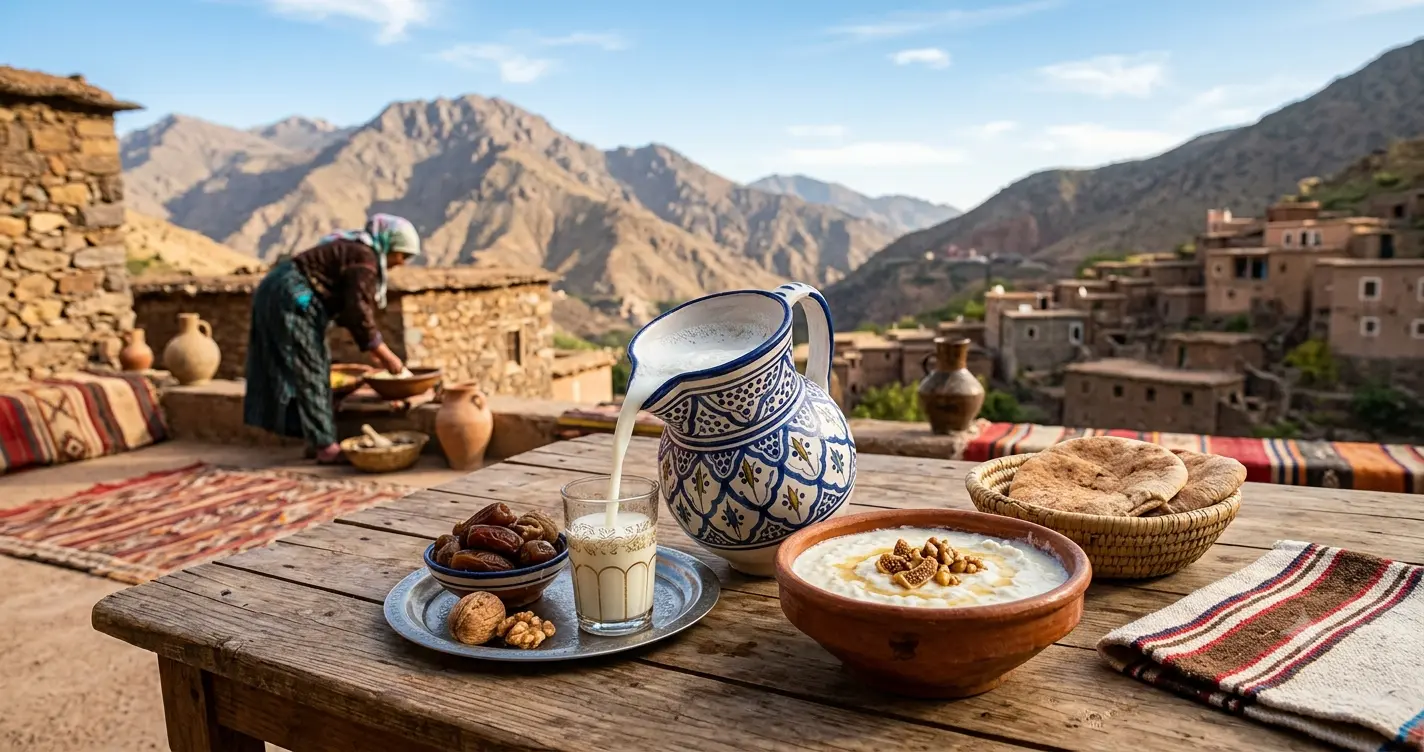
There is a moment, if you have ever sat inside a Berber home somewhere in the folds of the High Atlas — the kind of home where the walls are the color of the mountain itself, where a wood fire smokes gently in the corner and a woman in a striped fouta apron ladles something cold and white into a clay cup and sets it in front of you — when you understand, viscerally, that Moroccan food is not just cooking. It is memory. It is geology. It is livestock moving through thin mountain air. That cold white liquid is lben, Morocco's ancient fermented milk, and its flavor — tangy, alive, slightly effervescent on the tongue — is one of the most honest tastes the country has to offer. Alongside it stands raib, Morocco's silky fermented whole milk, closer in texture to a pourable yogurt but with a personality entirely its own. Together, these two drinks represent a dairy tradition stretching back thousands of years across the Maghreb, one that most Western visitors completely overlook in their rush toward tagines and couscous. At MaCooking, we believe the full story of Moroccan food cannot be told without sitting down with a bowl of lben and listening to what it has to say.
Chapter One: The Deep Roots — Fermented Dairy in Moroccan History
To understand lben and raib, you have to understand Morocco's pastoralist history. Long before the Romans built roads through Mauretania Tingitana, long before the Arab conquests of the seventh century transformed the religious and linguistic landscape of North Africa, the indigenous Amazigh (Berber) peoples of the Maghreb were herders. Goats, sheep, and cattle moved with the seasons in a practice known as transhumance — summer pastures high in the Atlas, winter grazing on the plains below. Milk was life, but raw milk in warm climates spoils fast. Fermentation was not a culinary trend; it was a survival technology.
The churn — called jeld or chekoua in different Amazigh dialects — is the key artifact of this history. Made from a whole goatskin turned inside out, sealed at the legs and neck, and hung from a tripod of sticks, the chekoua is rocked rhythmically by the women of the household until the cream separates into butter and the remaining liquid becomes lben. This is not buttermilk in the industrial American sense — watery, pasteurized, slightly acidic. This is something alive. The naturally occurring lactobacillus bacteria transform the milk's sugars into lactic acid over hours of fermentation, creating a drink that is simultaneously refreshing, nutritious, and deeply, unmistakably itself.
Archaeological evidence from cave paintings in the Draa Valley and the oral traditions of the Ait Haddidou, Ait Benhaddou, and Zayan tribes all point to a dairy culture that predates written Moroccan history. Ibn Battuta, the great fourteenth-century Moroccan traveler, makes passing reference to soured milk consumed among Berber communities as he passed through the Moroccan interior. Later colonial-era French ethnographers in the early twentieth century documented the chekoua tradition extensively in the Middle and High Atlas, noting with some astonishment how central these fermented milks were to daily nutrition and social ritual.
The Islamic Context: Purity, Sustenance, and Fermented Foods
It is worth noting that fermented dairy in the Islamic world has always occupied a comfortable and respected position. Unlike alcohol, which involves the fermentation of sugars into ethanol and is prohibited, the lactic acid fermentation of milk produces no intoxicating compound and has been enthusiastically consumed across the Muslim world for centuries. From the ayran of Turkey to the leben of the Levant to the dahi of South Asia, fermented milk is a pan-Islamic culinary thread, and Morocco's lben sits comfortably within that tradition while maintaining its distinctly Amazigh character.
Chapter Two: Lben — Anatomy of a National Drink
Walk into any medina in Morocco — Fez, Marrakech, Meknes, Chefchaouen — and you will find lben sold in small plastic bags, in repurposed water bottles, in clay jugs at the market. Walk into any rural Amazigh household at mealtime, and you will find it on the table as naturally as bread. Lben is everywhere in Morocco, and yet it is rarely the same twice.
What Exactly Is Lben?
In its most traditional form, lben is the liquid byproduct of churning cream or whole milk to produce butter. The milk — historically goat, sheep, or cow depending on the region — is first left to ferment at room temperature for anywhere from twelve hours to several days. The exact duration depends on the ambient temperature, the season, and frankly the taste preference of the maker. Once sufficiently soured, the milk goes into the chekoua or, in more modern domestic settings, a glass jar or electric churner. After churning, the golden globules of butter (smen in its fresh form, or smen beldi when aged) are skimmed off, and the remaining liquid is lben.
The result is a drink with:
- A thin-to-medium consistency, slightly thicker than water but thinner than most commercial buttermilk
- A pronounced lactic tang that is clean and bright, not sharp or overwhelming
- Subtle effervescence in the freshest batches, from residual carbon dioxide produced during fermentation
- A faintly grassy, animal note that varies dramatically between goat, sheep, and cow milk versions
- A cooling sensation on the palate that makes it uniquely suited to Morocco's warm climate
The flavor profile of lben made from goat milk is sharper and more assertive — what cheese aficionados might call "caprine" — while sheep milk lben tends to be richer and slightly sweeter. Cow milk lben, which has become more common in urban areas as industrial dairy has expanded, is the mildest and most accessible of the three. Purists, particularly in the Atlas communities where this tradition is most alive, will tell you that cow milk lben is a pale shadow of the real thing.
Lben in Daily Moroccan Life
To reduce lben to a beverage is to misunderstand its place in Moroccan life. Yes, it is drunk — poured into a glass and sipped with meals, or drunk straight from the bottle as a mid-morning snack. But it also functions as:
- A cooking liquid for certain tagines, particularly lamb preparations in the Middle Atlas
- A base for the cold summer drink lben bil khizou (lben with grated carrot and orange flower water), popular in Marrakech
- A digestive aid, consumed after heavy meals of mechoui or couscous
- A traditional remedy for stomach ailments, heat exhaustion, and hangovers (not that anyone in Morocco admits to the latter)
- A weaning food for infants, diluted with water and sweetened slightly with honey
- A ritual offering in certain Amazigh communities during harvest festivals and wedding preparations
The social dimension of lben is as important as its nutritional one. In Atlas households, offering lben to a guest is an act of profound hospitality — more intimate, in some ways, than offering mint tea, because lben comes from the household's own animals, its own labor, its own fermentation. It is a gift of the household's life force, if you want to be poetic about it. And you should be, because Moroccan food culture deserves poetry.
Chapter Three: Raib — The Silkier Cousin
If lben is the working-class hero of Moroccan dairy — practical, ubiquitous, earthy — then raib is its more refined sibling. The word raib comes from the Arabic root for something that has been allowed to clot or curdle gently, and that etymology is a perfect description of the product itself.
How Raib Differs from Lben
Raib is whole milk that has been fermented and set, without the churning step that produces lben. The milk — typically full-fat and often unhomogenized — is warmed gently, then allowed to ferment at room temperature or with the addition of a small amount of existing raib as a starter culture (in the same way that yogurt makers use a spoonful of the previous batch). Over twelve to twenty-four hours, the milk thickens into a soft, wobbly, spoonable curd. Unlike Greek yogurt or even regular Western yogurt, raib is not strained. It retains all its whey, giving it a softer set and a more liquid consistency than what most Europeans or Americans would recognize as yogurt.
The flavor of raib is markedly different from lben:
- Milder and creamier, with the tang playing a supporting role rather than dominating
- Distinctly milky and rich in the foreground — you taste the quality of the milk first
- A delicate sweetness that comes from the lactose not fully converted during the shorter fermentation
- A clean finish with none of the slight bitterness that can appear in over-fermented lben
How Moroccans Eat Raib
In Morocco, raib is eaten rather than drunk. It appears at breakfast alongside msemen (layered flatbreads), olive oil, honey, and amlou (the extraordinary argan oil and almond butter paste of the Souss region). It is eaten as a snack, drizzled with honey or dusted with cinnamon. In the south, particularly around Agadir and Taroudant, raib is sometimes served with argan oil instead of olive oil — a combination that sounds unusual but is in fact magnificent, the nuttiness of the argan amplifying the creaminess of the raib in a way that feels ancient and correct.
Raib also appears, in slightly different forms, throughout Moroccan dessert culture. Raib bil ward — raib perfumed with rose water — is a simple but deeply satisfying dessert served in small clay bowls. Raib bil zafrane (raib with saffron) appears at more elaborate occasions, the gold threads of Moroccan saffron turning the white curd a pale amber and lending it a floral, honeylike complexity that is quite breathtaking.
"Raib is what happens when you trust milk to know what it wants to become. You give it warmth, you give it time, and it does the rest. The cook's job is to get out of the way."
Chapter Four: The Atlas Dairy Tradition — A Living Culture
The High Atlas Mountains of Morocco — the spine of dramatic peaks that runs diagonally across the country from the northeast near Oujda to the southwest near Agadir — are home to one of the most distinctive and under-documented food cultures in the world. At elevations between 2,000 and 4,000 meters, the Amazigh communities of the Atlas have developed a culinary tradition shaped entirely by altitude, climate, and the animals that thrive in harsh mountain environments.
The Animals: Foundation of Atlas Dairy
The dairy animals of the Atlas are not the Holsteins of industrial farming. They are smaller, hardier breeds shaped by centuries of selective pressure in difficult terrain:
- The Beni Guil sheep: A fat-tailed breed of the eastern High Atlas, prized for its rich, flavorful milk that makes exceptional raib and lben with a distinctly full-bodied character.
- The Draa goat: A lean, sure-footed animal of the southern Atlas slopes, producing milk with a high butterfat content and the assertive caprine flavor that lben traditionalists prize above all else.
- The Atlas cow (Moroccan Brown or Oulmes-Zaer): Smaller than European dairy breeds, these cattle are extraordinarily adapted to altitude and produce moderate quantities of rich, dense milk — not the volume of a Holstein but the quality of something you cannot manufacture.
The seasonal rhythm of Atlas dairy production is tied directly to the transhumance calendar. Milk is most abundant in spring and early summer when the animals graze on the wildflower-rich high pastures. The lben of April and May, made from this spring milk, is regarded by Atlas communities as the finest of the year — lighter, more aromatic, with floral undertones from the mountain herbs the animals have been eating.
The Chekoua: Technology as Art
The traditional goatskin churn — the chekoua — deserves more attention than it typically receives in food writing about Morocco. The preparation of a new chekoua is itself a skilled craft. The skin must be properly cured, smoked, and treated with a mixture of salt, wild thyme, and sometimes a paste of dried figs to neutralize unwanted flavors. An improperly prepared chekoua imparts bitterness to the lben; a well-seasoned one, used for years by the same hands, contributes a subtle complexity that no modern churner can replicate.
In Imilchil — the High Atlas town famous for its annual moussem (festival) and its position as one of the highest permanently inhabited settlements in Morocco — elderly women maintain chekoua that have been in continuous use for decades. The accumulated lactobacillus cultures living in the pores of those skins are irreplaceable microbial heirlooms, the dairy equivalent of a sourdough starter passed down through generations.
Smen: The Aged Butter That Defines Atlas Cooking
No discussion of Atlas dairy is complete without addressing smen — the salted, fermented butter that is lben's most famous byproduct. Fresh smen (smen frais or dhan in some dialects) is simply the butter skimmed from the churning, lightly salted and used immediately. But the aged version — smen beldi or smen mkhalaa — is something altogether more extraordinary.
Aged smen is packed into clay pots with salt, sometimes wild thyme or oregano, and stored for months or even years. The bacteria and yeasts that develop during aging transform the butter's flavor profile dramatically — it becomes funky, intensely savory, almost cheeselike, with umami notes that no other fat in Moroccan cooking can provide. A tagine finished with a spoonful of five-year-old smen is a different dish from the same tagine made with fresh butter. The difference is the difference between a young wine and a great vintage.
You can find detailed recipes and cultural context for smen and other Atlas pantry staples on MaCooking, where we have spent considerable effort documenting traditions that deserve preservation.
Chapter Five: Lben vs. Raib — A Detailed Comparison
For readers coming to Moroccan fermented dairy for the first time, the distinctions between lben and raib can be confusing. The following tables lay out the key differences clearly.
| Characteristic | Lben | Raib |
|---|---|---|
| Production Method | Fermentation followed by churning; butter removed | Fermentation and setting only; no churning |
| Texture | Liquid (drinkable), slightly viscous | Semi-solid to liquid (spoonable or pourable) |
| Fat Content | Lower (cream/butter removed) | Higher (all milk fat retained) |
| Flavor Profile | Tangy, sharp, clean, slightly effervescent | Mild, creamy, delicately tangy, rich |
| Primary Use | Drunk as beverage; cooking liquid | Eaten as food; dessert base |
| Traditional Milk Source | Goat, sheep, cow (regional variation) | Primarily cow; sheep in rural settings |
| Fermentation Time | 12 hours to 3 days (pre-churn) | 12 to 24 hours |
| Western Equivalent | Closest to cultured buttermilk (but superior) | Closest to unstrained yogurt or kefir |
Both lben and raib are significantly different from their closest Western equivalents. This is a point worth emphasizing: buttermilk from a US supermarket and Moroccan lben are related in concept but worlds apart in flavor, microbial complexity, and cultural significance. The same is true of raib versus any commercially produced yogurt.
| Nutritional Factor | Lben (per 250ml) | Raib (per 250ml) | Commercial Buttermilk (per 250ml) | Plain Yogurt (per 250ml) |
|---|---|---|---|---|
| Calories (approx.) | 70–90 kcal | 130–160 kcal | 98 kcal | 150 kcal |
| Protein | High | High | Moderate | High |
| Live Cultures | Very high (wild ferment) | High (wild or starter ferment) | Variable (often pasteurized post-ferment) | High (commercial strains) |
| Lactose | Lower than fresh milk | Lower than fresh milk | Moderate | Lower than fresh milk |
| Microbial Diversity | Very high (wild, terroir-specific) | High | Low (controlled strains) | Low to moderate |
| Additives | None (traditional) | None (traditional) | Often stabilizers, cultures added | Often thickeners, fruit, sugar |
From a modern gut-health perspective, the microbial diversity of traditionally made lben and raib is genuinely remarkable. Because they are wild-fermented — relying on the naturally occurring bacteria in the milk, the air, and the fermentation vessel rather than commercial starter cultures — they contain a far wider spectrum of lactobacillus and other beneficial bacterial strains than anything produced industrially. This is terroir in the dairy sense: the specific microbial character of a place, encoded in its fermented foods.
Chapter Six: Making Lben and Raib at Home
If you are reading this outside Morocco, you are probably not in possession of a goatskin chekoua or a herd of Draa goats. But you can absolutely make approximations of both lben and raib at home, and the results — particularly if you can source good quality, full-fat, preferably unhomogenized milk — are genuinely rewarding.
Home Lben: A Practical Guide
The key to home lben is understanding that you are making a wild-fermented product. Patience is the main ingredient.
- Source your milk: Full-fat, unhomogenized milk is ideal. Goat milk produces the most authentic result; cow milk (from a local farm or farmers market, if possible) works well. Avoid ultra-pasteurized (UHT) milk — the heat treatment destroys the wild bacteria you need.
- Ferment the milk: Pour the milk into a clean glass jar or ceramic bowl. Cover with a breathable cloth (not a tight lid — the fermentation produces gas). Leave at room temperature (ideally 20–25°C / 68–77°F) for 24–48 hours. In summer, 24 hours may be sufficient; in winter, you may need up to 72 hours. The milk should thicken slightly and smell pleasantly sour — not putrid, but tangy and clean.
- Churn or shake: Transfer the fermented milk to a large mason jar with a tight lid. Shake vigorously for 10–20 minutes, or use a stand mixer with a whisk attachment at medium speed for 5–8 minutes, until you see small globules of butter beginning to form and separate.
- Separate: Strain through a fine-mesh sieve or cheesecloth. The solids are your fresh butter (salt it lightly and use it immediately or refrigerate). The liquid is lben. Chill before drinking.
Tips for better home lben:
- A spoonful of existing lben or plain cultured buttermilk added at the fermentation stage will accelerate and guide the fermentation, producing a more reliable result
- In cold climates, ferment the milk in an oven with just the oven light on — the residual heat creates a perfect warm environment
- The longer you ferment before churning, the tangier the final lben will be — experiment to find your preferred level
- Add a pinch of dried wild thyme or a sprig of fresh mint to the chilled finished lben for a flavor note that echoes Atlas tradition
Home Raib: Even Simpler
- Warm the milk gently: Heat full-fat milk to approximately 40°C (104°F) — warm to the touch but not hot. Remove from heat.
- Add a starter: Stir in 2–3 tablespoons of plain whole-milk yogurt (with live cultures) per liter of milk, or use a spoonful of previous raib if you have it.
- Set and ferment: Pour into a clean bowl or individual clay ramekins. Cover with a clean cloth and leave undisturbed in a warm place (25–30°C / 77–86°F) for 12–18 hours until set.
- Refrigerate: Chill for at least two hours before serving. Serve with honey, argan oil, cinnamon, or rose water according to preference.
The raib upgrade: For a saffron raib worthy of a Moroccan feast, dissolve a generous pinch of Moroccan saffron threads in two tablespoons of warm water. Add to the warmed milk before the starter culture. The result is extraordinary — golden-hued, floral, and deeply Moroccan. You can find the full recipe, with step-by-step photography and cultural notes, in our recipe collection at MaCooking.
Chapter Seven: Fermented Dairy in the Broader Moroccan Table
Lben and raib do not exist in isolation. They are part of a broader ecosystem of Moroccan fermented and preserved foods that reflects a deep cultural comfort with the transformative power of time and bacteria. Understanding these connections gives a much richer picture of Moroccan food philosophy.
Fermented Foods in Moroccan Cuisine: A Partial Map
- Smen: Aged fermented butter, already discussed above — the great umami catalyst of Moroccan cooking
- Preserved lemons (hamd mrakad): Lemons salt-cured for months, a cornerstone of tagine cookery, whose complex fermented flavor is irreplaceable
- R'fissa and msemen dough: The layered flatbreads of Morocco are often made with slightly fermented dough, giving them a subtle tang distinct from unleavened breads
- Harissa variations: Certain regional harissa pastes are fermented rather than simply blended, particularly in the Rif mountain communities
- Olives: Morocco is a major olive-producing country, and many of its most prized olives are naturally fermented in brine with herbs for weeks before consumption
- Dried and fermented fish (fseekh): Less well known internationally, this fermented dried fish of the Atlantic coast is an acquired taste that reveals the full range of Moroccan fermentation culture
The pattern that emerges from this list is consistent: Moroccan food culture has always understood that time is an ingredient. The transformation of raw materials by salt, acid, bacteria, and patience is not a modern trend in Morocco — it is the foundation of the cuisine. This is the context in which lben and raib must be understood: not as quirky regional beverages, but as expressions of a sophisticated food philosophy that predates the modern farm-to-table movement by several millennia.
Pairing Lben and Raib with Moroccan Food
If you are incorporating these fermented milks into meals at home — whether cooking authentically Moroccan dishes or simply exploring the pairing possibilities — here are some guidance notes drawn from tradition and experience:
- Lben with couscous: Perhaps the most classic pairing in Moroccan food. A bowl of Friday couscous — the great social meal of the Moroccan week — is traditionally accompanied by a glass of cold lben. The tang cuts beautifully through the richness of the meat and vegetables, and its probiotic content aids digestion after a heavy meal.
- Lben with harira: The great Moroccan soup, particularly during Ramadan iftar, pairs naturally with lben — the acidity of the soup meets the acidity of the drink in a harmony that sounds wrong on paper and is perfect in practice.
- Raib with msemen and honey: The canonical Moroccan breakfast, and one of the great uncelebrated breakfast experiences in global food culture. The creaminess of raib, the sweetness of honey, the flaky layered richness of msemen — this is a morning meal that deserves wider fame.
- Lben in tagine: A small addition of lben to a lamb or chicken tagine in the final stages of cooking adds a subtle acidity and helps tenderize the meat while creating a slightly thickened sauce. This technique is common in the Middle Atlas and not widely documented outside the region.
- Raib with fruit and rose water: Particularly in summer, raib served with fresh figs or sliced apricots and a drizzle of rose water is a dessert of extraordinary simplicity and elegance.
Frequently Asked Questions About Moroccan Fermented Dairy
Q1: Is lben the same as buttermilk? Can I substitute one for the other?
Lben and commercial buttermilk share a conceptual relationship — both are acidic dairy liquids produced through fermentation — but they are quite different in practice. Traditional Moroccan lben is a wild-fermented product with a far wider spectrum of live bacterial cultures, a more complex flavor, and a texture and character shaped by the specific animals and environment of production. Commercial buttermilk, particularly the pasteurized cultured buttermilk common in US and UK supermarkets, has been inoculated with a limited selection of commercial bacterial strains after pasteurization and lacks the microbial depth of lben. In cooking, cultured buttermilk can substitute for lben in a pinch — particularly in tagines or bread-making — but for drinking and for recipes where lben's flavor is central, the difference is significant. If you are in North America, look for full-fat cultured buttermilk from small dairies, which will be closer to the real thing.
Q2: Is raib like Greek yogurt or kefir? How does it compare?
Raib occupies a space somewhere between plain whole-milk yogurt and kefir, but it is not quite either. Unlike Greek yogurt, raib is not strained — it retains all its whey, making it softer, looser, and more liquid. It is also milder than Greek yogurt, with a shorter fermentation time and a less assertive tang. Compared to kefir, raib is generally thicker (kefir is fully liquid and contains yeast as well as bacteria, giving it a more pronounced effervescence and a slight alcoholic note). The closest commercial product in Western markets is probably a good-quality full-fat plain yogurt that has not been thickened with stabilizers — the type sold in clay pots in many French and Spanish supermarkets has a texture reasonably similar to urban raib, though the flavor will differ.
Q3: Is it safe to make wild-fermented lben at home using raw milk?
This is a legitimate safety question and deserves a careful answer. Traditional lben in Morocco is indeed made from raw (unpasteurized) milk, and the lactic acid produced during fermentation creates an environment hostile to many pathogenic bacteria. However, for home cooks without experience in raw milk fermentation, and particularly for those in countries where raw milk safety standards for the animals are not guaranteed, using pasteurized (but not ultra-pasteurized) milk is safer and will still produce an excellent result. If you have access to raw milk from a licensed, regulated farm (legal in some US states, and in parts of the UK and EU), the results will be more authentically complex, but please understand your local regulations and the source of your milk before proceeding. Pregnant women, elderly individuals, and immunocompromised people should use pasteurized milk for all home fermentation projects.
Q4: Where can I find authentic lben outside Morocco?
This is a question we get frequently at MaCooking. The honest answer is that truly authentic lben is difficult to find outside Morocco — and even within Morocco, the traditional goatskin-churned version is increasingly rare outside rural Atlas communities. However, there are some options. In cities with large Moroccan or North African diaspora communities — Paris, Montreal, Amsterdam, London, Brussels, New York — Moroccan grocery stores and halal supermarkets often carry imported or locally produced lben, usually in plastic bottles. It will be made from cow milk and will be a more commercial product than the Atlas original, but it is still a genuine representation of the drink. Alternatively, making your own using the method described above is genuinely accessible and more rewarding than it sounds — many home cooks report that their homemade lben becomes a weekly kitchen ritual.
Q5: What is the nutritional value of lben and raib? Are they suitable for lactose-intolerant people?
Both lben and raib are significantly lower in lactose than fresh milk, because the bacterial fermentation process converts much of the lactose into lactic acid. This makes them considerably more digestible for people with mild to moderate lactose intolerance, though individuals with severe lactose intolerance or dairy allergy should exercise caution. Nutritionally, lben is relatively low in fat (since the cream has been removed for butter) but high in protein and beneficial bacteria. Raib retains its full fat content and is therefore richer in calories and fat-soluble vitamins (A, D, K2). Both are excellent sources of calcium, phosphorus, and B vitamins. The live bacterial cultures in traditionally fermented versions contribute to gut microbiome health in ways that are consistent with the growing body of research on fermented foods and the microbiome — though it bears noting that the specific health claims around probiotic foods remain an evolving area of science rather than settled fact.
Conclusion: Drinking from the Source
There is something quietly radical about the story of Moroccan fermented dairy. In an era of food hyper-processing, of bacterial cultures engineered in laboratories and standardized across millions of units, of dairy products designed above all for shelf stability and consumer consistency, lben and raib represent the opposite impulse. They are products of place. They change with the season, the animal, the altitude, the temperature of the room, the age of the chekoua. They are alive in the most literal microbial sense, and they carry within them the story of the communities that make them — the Ait Haddidou shepherds bringing their flocks down from summer pastures, the Imilchil grandmother whose hands know by touch and smell when the milk is ready, the market woman in the Fez medina pouring lben from a clay jug into a plastic bag for a schoolboy's breakfast.
This is what food culture means at its deepest level: not the preservation of a recipe, but the preservation of a relationship between people, animals, land, and time. When you drink a glass of lben — even an imperfect approximation made in your kitchen from farmers market goat milk — you are participating in one of the oldest food traditions in North Africa. That is worth more than any superfood label or probiotic marketing claim.
At MaCooking, our mission has always been to bring this depth of cultural context to Moroccan food — to write about couscous not just as a recipe but as a social institution, to discuss argan oil not just as a trendy ingredient but as the foundation of an entire Berber economy, to explore lben and raib not as exotic curiosities but as what they truly are: the living heart of a dairy tradition that deserves the same reverence food writers give to Parmesan or Roquefort or any other great fermented food of the world. Morocco's fermented dairy is not lesser than those traditions. It is simply less known — and that is something we intend, one post at a time, to change.
We invite you to explore further. Try making raib this weekend. Seek out lben at your local Moroccan grocery. Read about smen and preserved lemons and the full landscape of Moroccan fermentation culture. The door to one of the world's great culinary traditions is open, and it smells, pleasantly, of warm milk and mountain air.