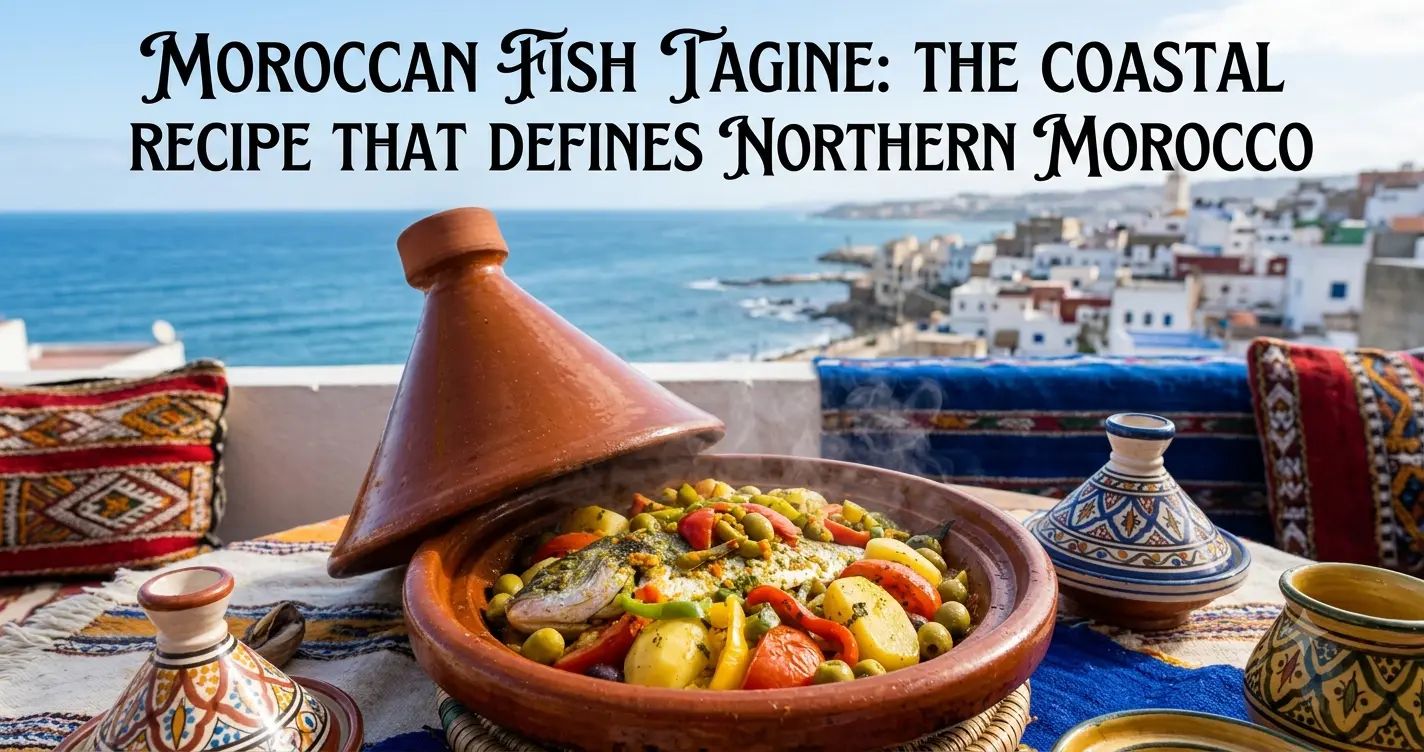
There is a particular kind of silence that settles over the Strait of Gibraltar just before dawn, when the fishing boats return to the port of Tetouan and the smell of salt water mingles with the first wisps of wood smoke rising from the medina. I have stood on that waterfront more times than I can count, watching men in rubber boots haul crates of gleaming sea bass, dorade, and red mullet onto the docks, and every single time, I think about the same thing: how this ancient, extraordinary ingredient is about to become something transcendent. It is about to become a fish tagine. Not just any fish tagine — the northern Moroccan fish tagine, a dish so deeply embedded in the culture of cities like Tetouan, Chefchaouen, Larache, and Al Hoceima that to eat it is to understand something fundamental about who these people are and how they have lived for centuries beside the sea. This is the recipe I want to share with you today. Not a shortcut version, not a fusion adaptation, but the real thing — the kind your host grandmother in the Rif Mountains would make without measuring a single spice, purely by instinct and love. Here at MaCooking, we believe that food without its story is just sustenance. With its story, it becomes a journey.
The History and Soul of Northern Moroccan Fish Tagine
To understand the fish tagine of northern Morocco, you need to understand the north itself. This is a region unlike any other in the country — geographically dramatic, culturally layered, and historically complex. The northern coastal corridor stretches from the Atlantic city of Asilah all the way east past Al Hoceima toward the Algerian border, passing through the Rif Mountains and hugging the Mediterranean shoreline with an intimacy that has shaped its cuisine for millennia.
The Phoenicians were here. The Romans built their settlement at Lixus near modern Larache. The Arabs arrived in the seventh century, followed by waves of Andalusian Muslims and Jews expelled from Spain in 1492, each group bringing culinary traditions that layered themselves onto what was already a sophisticated Berber food culture. The Spanish established their protectorate across much of the north from 1912 to 1956, and you can still taste that influence in certain coastal preparations. What emerged from all of this crossroads of civilizations is a culinary tradition that is unmistakably Moroccan, yet distinct from what you find in Marrakech or Fez.
The fish tagine, specifically, owes its identity to the Amazigh (Berber) population of the Rif, the Arab families of the coastal medinas, and the generations of fishermen who understood intuitively which spice combinations made fresh Atlantic and Mediterranean fish sing. The chermoula — that magnificent marinade of cilantro, parsley, garlic, cumin, paprika, and preserved lemon — is the DNA of this dish. It predates any written recipe by centuries. Some culinary historians believe chermoula in its earliest form was a simple herb and salt rub used to preserve fish before the era of reliable refrigeration. Over time, as spice trade routes flourished and aromatics became more accessible, it evolved into the complex, fragrant paste we know today.
"In the north, we do not cook fish — we honor it. The tagine is not a vessel for showing off spices. It is a conversation between the sea and the earth, mediated by the cook."
— Fatima Benlghazi, home cook and matriarch from Tetouan, whose family has lived beside the Mediterranean for six generations.
What makes the northern version of fish tagine distinct from coastal preparations in, say, Essaouira or Agadir on the Atlantic, is the influence of Mediterranean flavor profiles — a lighter hand with preserved lemon, a greater reliance on fresh green herbs, a fondness for olives (green and purple, often from local Rif trees), and the unique combination of sweet paprika and saffron that gives the sauce its distinctively warm, golden character.
Understanding Your Ingredients: A Deep Dive Before You Cook
One of the most common mistakes Western cooks make when approaching Moroccan fish tagine is treating the ingredient list as interchangeable. It is not. Every component plays a structural role in the final dish, and substitutions — when they are necessary — should be made thoughtfully. Let me walk you through each element with the level of attention it deserves.
Choosing the Right Fish
The northern Moroccan kitchen has historically relied on what the sea provides that day. This is not a dish built around a single fish species — it is built around the principle of freshness. That said, certain fish perform significantly better in a tagine than others, because of their texture, fat content, and how they absorb the chermoula marinade during slow cooking.
| Fish Type | Texture | Best For | Availability (Western markets) | Expert Rating |
|---|---|---|---|---|
| Sea Bass (Loup de Mer) | Firm, flaky | Whole fish tagine, absorbs marinade beautifully | Widely available | ★★★★★ |
| Red Snapper | Firm, slightly fatty | Excellent for slow cooking, holds shape | Good availability | ★★★★★ |
| Dorade (Gilthead Bream) | Delicate, sweet | Traditional northern Morocco choice | Specialty markets | ★★★★★ |
| Cod (thick fillets) | Very flaky | Good substitute, reduce cooking time | Excellent availability | ★★★★☆ |
| Halibut | Firm, lean | Works well but needs more olive oil | Good availability | ★★★★☆ |
| Tilapia | Soft, neutral | Acceptable last resort | Excellent availability | ★★★☆☆ |
| Salmon | Fatty, rich | Not traditional, overpowers spices | Excellent availability | ★★☆☆☆ |
My personal recommendation for readers in the US, UK, or Australia is to seek out red snapper or sea bass from a reputable fishmonger. If you are in a coastal city with a good fish market, buy whatever looks brightest in the eye, firmest in the flesh, and smells of clean ocean — not of fish. That nose test never lies.
The Chermoula: Morocco's Greatest Marinade
Chermoula is not optional in this dish. It is the dish. Many recipes treat it as a seasoning element, but in the traditional northern Moroccan approach, chermoula is a full marinade in which the fish rests for at least two hours (ideally overnight), a sauce base that flavors the vegetables during cooking, and a finishing layer added just before serving. Understanding its components is essential.
The core ingredients of a northern-style chermoula are:
- Fresh cilantro — generous handfuls, stems and all for the marinade, leaves only for finishing
- Fresh flat-leaf parsley — equal quantity to cilantro; do not use curly parsley
- Garlic — crushed to a paste, not minced; you want it to melt into the mixture
- Ground cumin — the backbone of the spice profile; use freshly ground if possible
- Sweet paprika — preferably Spanish or Moroccan; it provides color and mild sweetness
- Preserved lemon — rinsed, flesh discarded, only the rind finely chopped; this is non-negotiable
- Olive oil — extra virgin, generous; this is an olive oil dish
- Lemon juice — fresh, bright acidity to balance the earthiness of cumin
- Salt — coarse sea salt or kosher salt
- Optional but traditional in the north: a pinch of saffron bloomed in warm water, cayenne or chili flakes for heat, ground ginger
The Vegetables: Structure and Sweetness
The vegetable base in a northern Moroccan fish tagine is not a garnish or an afterthought. It is the landscape on which the fish rests, the source of the natural steam that cooks the fish from below and above simultaneously, and a crucial provider of textural contrast and sweetness that balances the acidity of the chermoula.
Traditional layering from bottom to top includes: sliced onions (the foundation), tomatoes (fresh and ripe), bell peppers (mixed colors), potatoes (thinly sliced for the base layer), carrots (optional), and preserved or fresh olives as a finishing element. Green olives stuffed with preserved lemon peel are particularly popular in Tetouan.
The Complete Authentic Recipe: Northern Moroccan Fish Tagine
This recipe serves four people generously. It is the version I have refined over years of cooking with northern Moroccan home cooks, market vendors, and restaurant chefs — a synthesis of tradition, practicality, and deep flavor. You will find more regional variations, seasonal adaptations, and expert technique guides for Moroccan cooking across the full recipe library at MaCooking.
Ingredients
For the Fish:
- 1.5 kg (approximately 3.3 lbs) whole sea bass or red snapper, cleaned and scored, OR 900g (2 lbs) thick fish fillets
- Coarse sea salt for initial seasoning
For the Chermoula Marinade:
- 1 large bunch fresh cilantro (about 60g), roughly chopped
- 1 large bunch fresh flat-leaf parsley (about 60g), roughly chopped
- 6 large cloves garlic, crushed to a paste with salt
- 2 teaspoons ground cumin, freshly ground preferred
- 2 teaspoons sweet paprika
- 1/2 teaspoon cayenne pepper or hot paprika (adjust to your preference)
- 1/4 teaspoon ground ginger
- A generous pinch of saffron threads, bloomed in 3 tablespoons warm water for 10 minutes
- 1 preserved lemon (about 50g), rinsed, pulp discarded, rind finely chopped
- Juice of 1 large fresh lemon
- 80ml (1/3 cup) extra virgin olive oil
- 1 teaspoon coarse sea salt
For the Vegetable Base:
- 2 medium onions, sliced into thin rounds
- 3 medium ripe tomatoes, sliced into rounds about 8mm thick
- 2 medium waxy potatoes (such as Yukon Gold), peeled and sliced into 5mm rounds
- 1 large green bell pepper, sliced into rings
- 1 large red bell pepper, sliced into rings
- 2 medium carrots, peeled and sliced on the diagonal (optional, traditional in some Rif families)
- 150g (about 1 cup) green olives, preferably cracked Moroccan style; Castelvetrano olives are a good substitute
- 2 sprigs fresh cilantro, left whole
- 2 tablespoons extra virgin olive oil for drizzling over the base
- Salt and white pepper to taste
For Finishing:
- Additional fresh cilantro and parsley leaves
- Thin slices of preserved lemon rind
- A final drizzle of olive oil
- Optional: 1 small fresh chili, thinly sliced
Equipment You Will Need
- A traditional clay tagine (30-32cm diameter) OR a heavy-bottomed Dutch oven or oven-safe casserole dish with a tight-fitting lid
- A diffuser ring if using the tagine on a gas or electric stovetop (essential for clay tagines)
- A blender or food processor for the chermoula
- A sharp knife and cutting board
Method: Step by Step
Step 1: Prepare the Chermoula (Day Before or at Least 2 Hours Ahead)
Combine the cilantro, parsley, crushed garlic, cumin, sweet paprika, cayenne, ground ginger, saffron with its blooming liquid, preserved lemon rind, fresh lemon juice, olive oil, and salt in a blender or food processor. Pulse until you have a thick, aromatic paste with a little texture remaining — you do not want a completely smooth puree. Taste and adjust salt and acidity. The chermoula should taste intensely herby, slightly spicy, tangy, and deeply savory all at once. Divide it in half: one half for marinating the fish, one half reserved for cooking.
Step 2: Marinate the Fish
Score the fish on both sides with three diagonal cuts down to the bone if using whole fish. If using fillets, score the skin side only. Rub the first half of the chermoula all over the fish, pressing it into the scores and cavity (if whole). Place in a non-reactive dish, cover, and refrigerate for a minimum of 2 hours and a maximum of 12 hours. The longer the marinade, the deeper the flavor penetration — but beyond 12 hours the acidity begins to denature the protein and the texture suffers.
Step 3: Build the Vegetable Base
If using a clay tagine, soak it in cold water for 15 minutes first if it is a new piece. Brush the bottom and sides of the tagine or Dutch oven with olive oil. Layer as follows, seasoning each layer lightly with salt and white pepper:
- First layer — sliced onions spread evenly across the bottom
- Second layer — potato rounds, slightly overlapping
- Third layer — half the sliced tomatoes
- Fourth layer — half the bell pepper rings
- Add the whole cilantro sprigs tucked between the vegetables
- Drizzle the reserved (second half) chermoula over the vegetables generously
- Add 60ml (1/4 cup) water around the edges — this creates the initial steam environment
Step 4: Place the Fish and Final Vegetables
Nestle the marinated fish on top of the vegetable base, pouring any remaining marinade from the dish over it. Arrange the remaining tomato slices, bell pepper rings, and the olives around and on top of the fish. Drizzle the whole assembly with 2 tablespoons of olive oil.
Step 5: Cook Low and Slow
Place the tagine on a diffuser over medium-low heat (or in a preheated 180°C / 350°F oven for the Dutch oven version). Once you hear the first sounds of gentle bubbling — approximately 10 to 12 minutes — reduce the heat to low. Cover tightly and cook for 35 to 45 minutes for a whole fish (depending on size), or 25 to 30 minutes for thick fillets. Resist the urge to lift the lid during the first 20 minutes. The sealed steam environment is the key to perfectly cooked, moist fish.
The fish is done when it flakes easily at its thickest point and the vegetables are tender throughout. If the sauce appears too thin, remove the lid and increase the heat briefly to reduce it. If it appears dry, add a splash of water around the edges.
Step 6: Finish and Serve
Remove from heat. Scatter fresh cilantro and parsley leaves over the top, add thin strips of preserved lemon rind, and give a final generous drizzle of your best olive oil. Bring the tagine directly to the table — presentation in the vessel is part of the experience. Serve immediately with crusty Moroccan khobz bread (or any good artisan bread) for scooping up the sauce, and nothing more. This dish needs no accompaniment beyond bread and perhaps a simple salad.
Mastering the Technique: What Separates a Good Tagine from a Great One
I have eaten hundreds of fish tagines in Morocco and made them in kitchens ranging from a tiny medina apartment with a single butane burner to fully equipped professional kitchens. The difference between a mediocre fish tagine and a transcendent one almost never comes down to a single factor — it is a combination of small decisions, each of which compounds the others.
The Saffron Question
Many Western recipes omit saffron from fish tagine because of cost or unavailability. This is understandable, but I want to make the case for including it. Northern Moroccan fish tagines traditionally use saffron, and its effect on the dish is not merely coloristic — it adds a honeyed, slightly metallic depth that rounds out the acidity of the preserved lemon and cumin in a way nothing else can replicate. You need only a tiny amount: ten to fifteen threads, bloomed in warm water. If you cannot source quality saffron (and please, buy Spanish or Iranian — do not use the cheap powder sold as saffron in supermarkets), a small pinch of good-quality turmeric can provide color, though not the same flavor complexity.
Heat Management on a Clay Tagine
The clay tagine is not just an aesthetic choice — it fundamentally changes how the dish cooks. Clay is an excellent heat diffuser and retainer, and the conical lid creates a convection system where steam rises, condenses on the cool inner surface of the cone, and drips back down over the food continuously. This self-basting mechanism is the reason a tagine produces such incredibly moist results. If you are using a clay tagine on a stovetop, always use a diffuser ring and start on the lowest possible heat. Thermal shock — moving a cold clay tagine to high heat — can crack it instantly. If you are in the market for a quality clay tagine, look for one made in Salé (the traditional pottery city near Rabat) or from a reputable Moroccan ceramics supplier.
The Preserved Lemon: Making Your Own
Preserved lemons are available in specialty grocers, Middle Eastern markets, and increasingly in mainstream supermarkets in the UK and US. However, if you want to experience the authentic flavor, make your own. It requires only lemons, coarse salt, and a month of patience. Quarter the lemons almost all the way through, pack coarse salt generously into the cuts, press them into a sterilized jar, cover with fresh lemon juice, seal, and leave at room temperature for 30 days, turning the jar occasionally. The result is something that store-bought versions only approximate. Here at MaCooking, we have a detailed guide to making and using preserved lemons across the full spectrum of Moroccan cooking — it is one of our most visited resources for good reason.
Common Mistakes and How to Avoid Them
| Common Mistake | What Goes Wrong | Expert Solution |
|---|---|---|
| Overcooking the fish | Dry, crumbly texture; loses flavor | Check at 25 minutes for fillets; use the flake test, not a timer |
| Too much liquid added | Soupy sauce, vegetables leach too much water | Only 60ml water at the start; vegetables and fish release their own moisture |
| Under-salting the chermoula | Flat, muddy flavor throughout | Taste the chermoula aggressively before using; it should taste almost too salty on its own |
| Using dried herbs instead of fresh | Dusty, lifeless flavor | Fresh cilantro and parsley are non-negotiable; dried cumin is fine but herb must be fresh |
| Skipping the marination time | Chermoula sits on the surface, does not penetrate | Minimum 2 hours; overnight produces dramatically superior results |
| Lifting the lid constantly | Steam escapes, fish dries out, vegetables cook unevenly | Seal it and trust the process for at least 20 minutes |
| Using low-quality olive oil | Diminished flavor; olive oil is a key flavor component, not just cooking fat | Use a good Moroccan or Spanish extra virgin olive oil; it matters enormously |
| Forgetting to score the fish | Marinade stays on the surface; uneven cooking through thick parts | Score deeply to the bone; three diagonal cuts on each side |
Regional Variations Across Northern Morocco
One of the things that makes northern Moroccan fish tagine so endlessly fascinating is the way it shifts in character as you move from city to city along the coast. These are not dramatic changes — the soul of the dish remains constant — but the nuances reflect local culture, history, and available ingredients in ways that are deeply interesting to the curious cook.
Tetouan Style
Tetouan, sometimes called the White Dove of Morocco, carries the most pronounced Andalusian influence of any Moroccan city. Its fish tagine tends to be more aromatic, with a greater presence of cinnamon (used in tiny quantities, barely perceptible but there), more saffron, and a finishing touch of dried raisins in some traditional family recipes — a sweet-savory balance that is distinctly Andalusi in origin. The preserved lemon is used more sparingly here, with fresh lemon juice doing more of the acidic work. Green olives are almost always present, often the small, brine-cured local variety called beldi.
Larache and Asilah: Atlantic Influences
As you move west toward the Atlantic coast, the fish tagine takes on a slightly different character. The fish choices shift toward what the Atlantic provides — thick-fleshed dorade, Atlantic mackerel (in a remarkably good tagine variation), and sometimes hake. The chermoula in the Larache tradition tends to be slightly heavier on cumin and lighter on the green herbs, giving it a more earthy, grounded flavor profile. The potato base is thicker here, sometimes two or three layers deep, creating almost a gratin-like foundation for the fish to rest upon.
Al Hoceima: The Mediterranean Heart
Al Hoceima sits on the Mediterranean coast deep in the Rif, and its fish tagine is, in my opinion, the purest expression of the tradition. Here, the fish — often grouper or red mullet — is treated with enormous respect. The chermoula is made fresh every time and used immediately (rather than being prepared ahead and refrigerated, as is common in city kitchens). The vegetable base is simpler: just onions, tomatoes, and peppers, allowing the quality of the fish to be the primary voice. Cumin is used with particular generosity, and the dish often finishes with nothing more than a scattering of fresh herbs and a squeeze of lemon — no preserved lemon at all, or just the faintest trace.
Chefchaouen: The Mountain Approach
Chefchaouen is not coastal, but it is firmly part of the northern culinary tradition, and its fish tagine — made with fish brought up from the coast by market trucks each morning — has a distinctive mountain character. The chermoula uses more dried chili (reflecting the Rif tradition of spice heat), the dish is often cooked entirely in the oven rather than on the stovetop, and local argan-like walnut oil is sometimes used alongside or instead of olive oil, giving it a particularly rich, nutty undertone that you will not find anywhere else.
Serving, Pairing, and the Table Culture of Northern Morocco
A fish tagine in northern Morocco is rarely a solitary or hurried affair. It is lunch food — the main meal of the day served between one and three in the afternoon, when the family gathers and the television goes off and the phone stays in the pocket. To serve this dish correctly is to honor that culture of intentional communal eating.
What to Serve Alongside
- Moroccan khobz bread — the round, slightly dense semolina-enriched bread that is the universal companion to tagines. If you cannot make or find it, a good sourdough or ciabatta does reasonable duty.
- Zaalouk — a smoky eggplant and tomato salad served at room temperature; its earthiness contrasts beautifully with the bright, herby fish tagine.
- Taktouka — a roasted pepper and tomato salad, found everywhere in the north; simple, vibrant, perfect.
- Moroccan mint tea — served after the meal, never during. Sweet, fragrant, poured from height to create the characteristic froth.
- Sliced fresh oranges with cinnamon and orange blossom water — a traditional dessert in northern Morocco that cleanses the palate beautifully after a rich fish tagine.
Drinks Pairing for Western Tables
For readers who enjoy wine with their food: a Moroccan fish tagine pairs exceptionally well with a well-chilled white wine that has enough body to handle the spice but enough acidity to cut through the olive oil. An unoaked Albariño from Galicia (a nod to the Spanish coastal influence), a white Burgundy, or a Grüner Veltliner from Austria all work beautifully. If you can source a Moroccan white wine from the Meknès region — look for Coteaux de l'Atlas or Sincomar brands — you will find the pairing to be both logical and delicious. For non-drinkers, a sparkling water with fresh mint and a slice of preserved lemon is a wonderful and thematically appropriate accompaniment.
Storing, Reheating, and the Next Day Magic
Fish tagine is at its absolute peak the moment it comes off the heat and reaches the table. That said, leftovers — if you have them — are nothing to mourn. The flavors deepen overnight as the chermoula continues to permeate the fish and vegetables. Stored in an airtight container in the refrigerator, leftover fish tagine keeps well for up to two days.
To reheat: transfer to a covered pan with a splash of water and warm over low heat, covered, until just heated through. Do not microwave directly — this overcooks the fish and makes it rubbery. Never freeze fish tagine; the texture of both fish and potatoes suffers badly upon freezing and thawing.
One of my favorite things to do with leftover fish tagine is to flake the fish into the remaining sauce and vegetables and use it as a filling for a savory Moroccan-style flatbread sandwich — a completely unofficial but entirely delicious application that I suspect many northern Moroccan home cooks have discovered independently.
Frequently Asked Questions About Moroccan Fish Tagine
Q1: Can I make this recipe without a tagine pot? I only have regular cookware.
Absolutely, and you should not let the absence of a tagine stop you from making this dish. A heavy-bottomed Dutch oven — such as a Le Creuset or any quality enameled cast iron pot — with a tight-fitting lid is an excellent substitute. It may actually give you slightly more control over heat management than a clay tagine on a Western stovetop. The key principles are the same: low, consistent heat, a sealed environment for steaming, and patience. An oven method at 180°C (350°F) with the Dutch oven works particularly well and is very forgiving. If you are using a regular stainless-steel pot, line the bottom with parchment paper before adding the vegetables — this prevents sticking and makes cleanup significantly easier. The results will be slightly different in character from the clay tagine version (less of the earthen, mineral undertone that clay imparts) but still deeply delicious and authentically flavored.
Q2: My local supermarket does not carry preserved lemons. Is there a substitute?
Preserved lemons are genuinely worth seeking out from a specialty grocer, Middle Eastern market, or online retailer before you resort to substitutes — they have a unique flavor profile (salty, mellow, intensely lemony but without sharp acidity) that is difficult to replicate. However, if you truly cannot find them, there are two reasonable approaches. First, quick-preserve method: thinly slice a lemon, pack it in a bowl with plenty of coarse salt and a tablespoon of lemon juice, let it sit for at least 4 hours at room temperature, then rinse and use. The flavor is not the same as a month-fermented preserved lemon, but it provides some of the softened, salty lemon character. Second, use the zest of one unwaxed lemon plus a little extra salt in the chermoula — this gives you the aromatic oil component of preserved lemon without the fermented depth. As noted, MaCooking has a full guide to making preserved lemons at home, which is genuinely the best long-term solution if you plan to cook Moroccan food regularly.
Q3: How do I know when the fish is perfectly cooked and not overdone?
This is the most critical skill in making fish tagine, and it is entirely tactile and visual rather than time-based (though time estimates are useful as a starting point). There are three reliable indicators of perfectly cooked fish in a tagine. First, the flesh at the thickest part will just begin to flake when you press it gently with a fork — the flakes separate cleanly but the flesh is still moist and glossy, not dry. Second, if using whole fish, the eye will have turned completely opaque and white. Third, the flesh nearest the bone (for whole fish) should have changed from translucent to opaque white when you peek into one of the score marks. If it still looks glassy and raw-translucent at the bone, it needs more time. If it looks dry and is pulling away from the bone aggressively, it has gone a few minutes too far. The window of perfection is about 3 to 5 minutes wide, so start checking early and check gently and briefly.
Q4: The chermoula sauce from my fish turned watery during cooking. What happened and how do I fix it?
Watery sauce in a fish tagine almost always has one of three causes. First, the tomatoes released more liquid than expected — this is common with very ripe, water-heavy summer tomatoes or with canned tomatoes. To prevent this, you can seed the tomatoes before slicing them (cut in half crosswise and gently squeeze out the seed pockets and their watery gel). Second, excess water was added at the beginning. Remember that in this recipe, the fish and vegetables release significant moisture during cooking — the 60ml of water at the start is the maximum, not a minimum. Third, the heat was too high, causing the vegetables to release moisture rapidly rather than gently sweating and concentrating. If you end up with a watery sauce, remove the lid and increase the heat moderately for the final 5 to 10 minutes of cooking, which will reduce the excess liquid. Then taste and adjust seasoning, as reduction also concentrates the salt.
Q5: I want to make this for a dinner party of eight. Can I scale it up, and should I make any adjustments?
Scaling up fish tagine for a larger group requires some planning because of the physical limitations of the tagine vessel. My strong recommendation is to cook two separate tagines simultaneously rather than trying to pile everything into one oversized vessel — the layering structure and the steam dynamics both depend on specific proportions of depth and surface area. If you have a large Dutch oven (28cm or larger), you can make a doubled batch, but increase your initial cooking time by approximately 10 to 15 minutes and check for doneness frequently. For a dinner party presentation, you can absolutely keep both tagines warm (at their lowest heat setting) for up to 20 minutes after cooking, covered, before bringing to the table — the residual heat in the clay or cast iron holds beautifully. Prepare the chermoula the day before and marinate the fish overnight: this dramatically reduces your day-of preparation stress and actually improves the dish. Prepare all vegetables and arrange them in your cooking vessels up to four hours ahead, covered and refrigerated, then bring to room temperature for 30 minutes before starting to cook.
Conclusion: Why This Dish Deserves a Place on Every Adventurous Cook's Table
The northern Moroccan fish tagine is not a difficult dish, but it is a demanding one — it demands your attention, your respect, and your willingness to slow down and trust a process that has been refined over centuries. In an era of fifteen-minute meals and algorithmic recipe optimization, there is something genuinely radical about gathering your saffron and your fresh herbs, about pressing chermoula into the scored sides of a beautiful whole fish, about covering a clay pot and waiting with patience and anticipation for something extraordinary to emerge.
What you will find, if you make this dish with care, is that it rewards you far beyond the sum of its parts. The chermoula-stained potatoes that have absorbed the fish juices and olive oil during cooking are, on their own, one of the best things you will ever eat. The olives that have spent forty minutes nestled against a saffron-touched fish have transformed into something briny and complex and impossible to stop eating. The fish itself — if you have chosen well and not overcooked it — will be moist, aromatic, and alive with flavor in a way that a simple pan-fried fillet, however skillfully prepared, simply cannot achieve.
This is the power of the tagine method. This is the genius of chermoula. And this is why the fishing families of Tetouan and the medina cooks of Al Hoceima and the mountain home cooks of Chefchaouen have been making versions of this dish for generations without any need to update, improve, or reinvent it.
If this recipe has sparked your curiosity about Moroccan coastal cuisine, I encourage you to explore further. The tradition is vast and endlessly rewarding. At MaCooking, we have dedicated ourselves to documenting, preserving, and sharing these culinary traditions with food lovers around the world — from classic tagine recipes and chermoula variations to deep dives into regional spice cultures and the history of Moroccan food at every level of complexity. Whether you are a complete beginner or an experienced home cook who has been making Moroccan food for years, there is always something more to discover. Come cook with us.