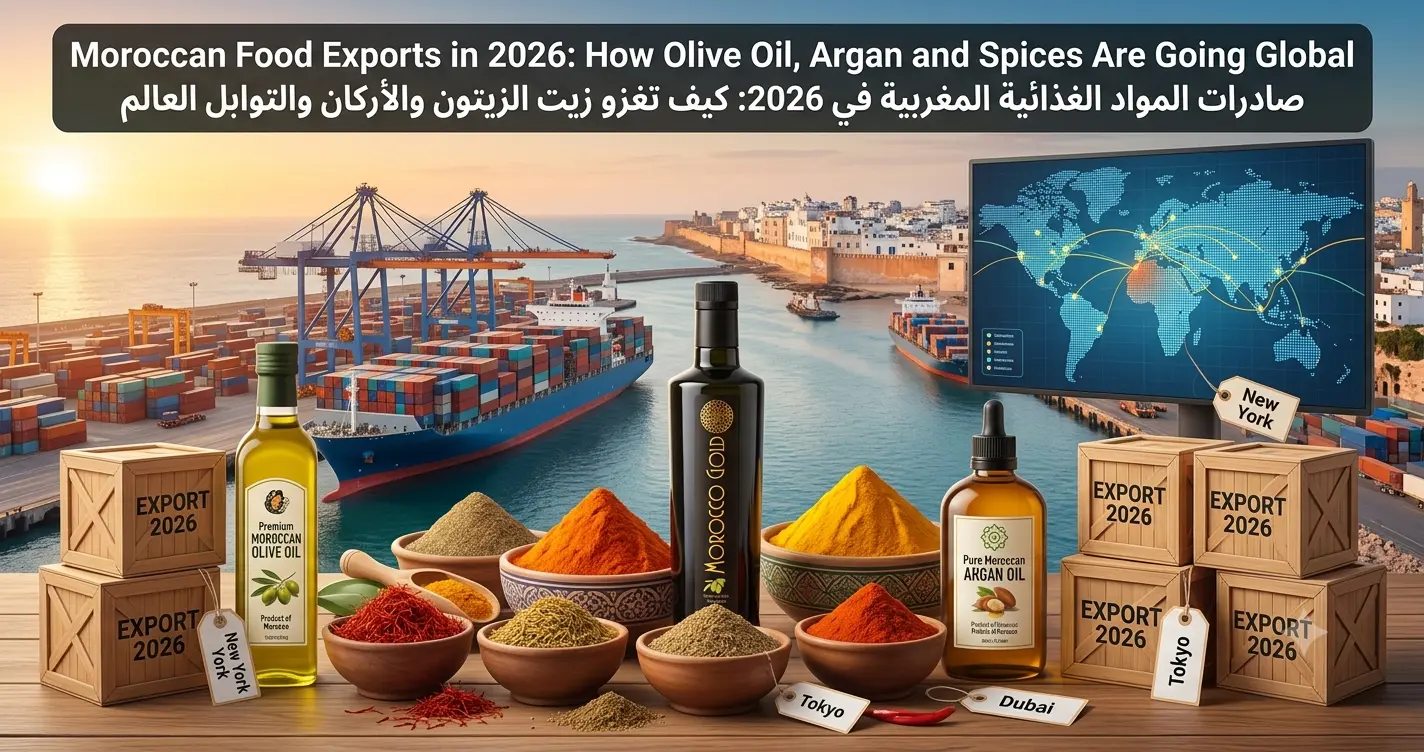
There is a moment, somewhere between the first pour of cold-pressed Moroccan olive oil and the rising cloud of steam from a clay tagine, when the entire sensory world of North Africa arrives in your kitchen. That moment — once reserved for those lucky enough to travel the narrow souks of Marrakech or sit cross-legged on cushions in a Fès riad — is now landing on dinner tables in London, Los Angeles, Toronto, and Sydney. In 2026, Moroccan food exports are not merely a trade story. They are a cultural migration, a slow and magnificent journey of flavor, identity, and centuries of accumulated wisdom crossing oceans and landing in the hands of curious cooks everywhere. And if you have ever wondered what is truly fueling this global appetite for authenticity, you are in exactly the right place. Here at MaCooking, we have spent years documenting, celebrating, and cooking Moroccan cuisine from the ground up — and today, we want to take you inside the extraordinary story of how Morocco's most beloved pantry staples are going global.
A Kingdom Built on Flavor: Morocco's Agri-Food Heritage
To understand why Moroccan food exports are booming in 2026, you need to understand the land itself. Morocco occupies one of the most agriculturally privileged positions on the planet. Stretching from the Mediterranean coast in the north down through the Atlas Mountains and into the pre-Saharan plains of the south, the country contains an extraordinary range of microclimates within a relatively compact geography. Coastal mists nurture olive groves that have existed since before the Roman conquest of Mauretania. Desert winds carry the dust of ancient spice routes that connected sub-Saharan Africa to the Arab world and then to Europe. Snow-fed rivers from the High Atlas irrigate some of the most fertile valleys on the continent.
This is not accidental abundance. Moroccan farmers, traders, and cooks have been intentional stewards of these resources for well over two thousand years. The Phoenicians brought olive cultivation to the Maghreb. Berber communities in the Souss Valley — the ancestral homeland of the argan tree — developed harvesting and pressing techniques for argan oil that predated modern cosmetic and culinary industries by centuries. Arab traders arriving after the seventh century CE brought new spice vocabularies from the east, layering cinnamon, ginger, saffron, and cumin into an already complex culinary tradition. Then came Andalusian refugees in the fifteenth and sixteenth centuries, carrying the refined cooking of Moorish Spain, adding almond-based sauces, rose water, and an obsession with the interplay of sweet and savory that still defines Moroccan cuisine today.
The result is a culinary heritage that is simultaneously ancient and alive — one that has never stopped evolving but has always maintained a fierce attachment to its roots. It is precisely this combination of authenticity and versatility that is making Moroccan food ingredients so appealing to international markets in 2026.
Morocco's Strategic Position in Global Food Trade
Morocco is the only African country to have a free trade agreement with both the European Union and the United States, giving its food producers privileged market access that most other developing-world exporters can only dream of. The country's Plan Maroc Vert agricultural initiative, launched over a decade ago and evolving into its Generation Green successor, has systematically modernized the agri-food sector — improving yields, introducing certification standards, and building the export infrastructure needed to reach premium global markets.
By 2026, Morocco ranks among the top ten olive oil producing nations worldwide, holds a near-monopoly on culinary-grade argan oil, and is recognized as the world's premier source for several key spice crops including saffron from Taliouine and cumin from Midelt. These are not niche products anymore. They are anchoring menus in Michelin-starred restaurants, filling shelves in Whole Foods and Waitrose, and becoming staple pantry items for home cooks who have discovered that the difference between a good tagine and a transcendent one often comes down to a single quality ingredient sourced from the right Moroccan valley.
Moroccan Olive Oil: The Mediterranean's Best-Kept Secret Goes Public
Let me be honest with you the way I would be with a student in my own kitchen: for decades, Moroccan olive oil was one of the great undervalued secrets of the culinary world. While Spanish, Italian, and Greek oils commanded premium prices and recognition on international shelves, a significant portion of Morocco's extraordinary olive harvest was being sold in bulk to European producers who blended it, repackaged it, and sold it under their own labels at a substantial markup. The consumers who fell in love with certain premium European olive oils were, in many cases, falling partly in love with Moroccan terroir — they just did not know it.
That story is changing rapidly. By 2026, a new generation of Moroccan olive oil producers — many of them young entrepreneurs who trained in food science in Europe or the US before returning home — are taking their product directly to international consumers. Brands originating from the Beni Mellal-Khénifra region, the Gharb plains, the Haouz plateau near Marrakech, and especially the Ouazzane area in the Rif foothills are now winning international olive oil competitions and securing distribution deals with specialty retailers across Europe and North America.
The Varieties That Define Moroccan Olive Oil
Part of what makes Moroccan olive oil so distinctive is the diversity of native cultivars grown across the country. While the global market has largely been dominated by Spanish Picual, Italian Frantoio, and Greek Koroneiki, Morocco's indigenous varieties offer flavor profiles that are genuinely different — and in many cases, genuinely superior for specific culinary applications.
- Picholine Marocaine: The most widely planted cultivar, accounting for roughly 95% of Morocco's olive groves. Cold-pressed Picholine Marocaine extra virgin olive oil is typically characterized by medium fruitiness, a clean grassy note, and a pleasant peppery finish that culinary professionals associate with high polyphenol content. It is extraordinarily versatile — equally at home drizzled raw over a plate of msemen or used as the cooking base for a slow-cooked chicken chermoula.
- Haouzia: Named after the Haouz plains near Marrakech, this variety produces an oil with a notably more delicate, almost buttery character. It is increasingly popular with European fine dining chefs who want a Moroccan oil that will not overpower subtle flavors.
- Dahbia: Found primarily in the northern regions, Dahbia produces a rich golden oil with notes of green almond and fresh herbs. It is rare enough that bottles labeled single-varietal Dahbia now command serious collector interest among olive oil enthusiasts.
- Menara and Rghioua: Regional varieties grown in specific valleys, these cultivars represent the kind of terroir-specific production that the global olive oil premium market increasingly rewards. Think of them as the Burgundy grand cru analogy within Moroccan olive oil.
Organic Certification and the Premium Market Shift
One of the most significant developments in Moroccan olive oil exports over the past few years has been the rapid adoption of organic certification. Morocco's traditional smallholder farming practices have always been essentially organic by default — the vast majority of rural olive growers never used synthetic pesticides or fertilizers because they could not afford them. What has changed is the formal certification infrastructure that translates this on-the-ground reality into premium market positioning.
In 2026, certified organic Moroccan extra virgin olive oil commands price premiums of 40 to 80 percent over conventional product in European and North American specialty retail, making organic certification financially transformative for small producer cooperatives. Organizations like Copag, Aicha, and dozens of smaller cooperatives in the Souss-Massa region have invested heavily in organic certification — and the results are evident both in their export revenues and in the quality conversations happening in food media internationally.
“When I open a bottle of cold-pressed Picholine Marocaine from Ouazzane and smell that first rush of green olive, cut grass, and white pepper, I am smelling two thousand years of agricultural continuity. No laboratory can replicate that. No industrial process can fake that kind of patience.”
Argan Oil: From Berber Village to Global Pantry Staple
If Moroccan olive oil is the great secret going public, argan oil is the Cinderella story already in full bloom — and the plot is getting more interesting by the year. The argan tree (Argania spinosa) grows exclusively in a roughly 800,000-hectare biosphere reserve in southwestern Morocco, primarily in the Souss-Massa-Drâa region. It is one of the oldest tree species on Earth, adapted over millennia to survive in semi-arid conditions that would kill most other fruit-bearing plants. The Amazigh (Berber) communities of this region have been extracting oil from argan nuts for centuries, using it for cooking, as a dip for bread, in traditional medicine, and as a cosmetic treatment for skin and hair.
The international discovery of argan oil's cosmetic properties in the 1990s and early 2000s created a massive global market almost overnight — but it also created serious challenges. The first wave of international argan oil demand led to quality inconsistencies, exploitation of rural producers, and a confusing market where cosmetic-grade and culinary-grade oils were sometimes not properly distinguished. UNESCO's designation of the argan biosphere as a World Heritage Site, combined with Morocco's increasingly sophisticated export regulation framework, has helped bring order to this market.
Culinary Argan Oil: The Distinction That Matters
This is a distinction that I emphasize constantly on MaCooking, because it matters enormously both for your cooking and for your purchasing decisions: culinary argan oil is made from roasted argan kernels, while cosmetic argan oil is made from raw, unroasted kernels. The roasting process transforms the flavor completely — from a relatively neutral, nutty base to a deep, complex, almost smoky nuttiness that is unlike any other oil in the world. It smells faintly of popcorn and toasted sesame, with a lingering depth that amplifies everything it touches.
Culinary argan oil is not a cooking oil in the conventional sense. You do not fry with it — heat destroys both its flavor and its nutritional properties. Instead, you use it the way a French chef uses a fine walnut oil or a Japanese chef uses premium sesame oil: as a finishing element, a flavor amplifier, a drizzle that transforms rather than merely lubricates. A spoonful of culinary argan oil swirled into a bowl of traditional harira soup. A drizzle over grilled fish just before serving. Mixed with honey and crushed almonds to make amlou — the Berber dipping paste that is, in my deeply held opinion, one of the greatest breakfast foods ever created by human hands.
The Women's Cooperative Model: Quality, Ethics, and Empowerment
One of the most compelling parts of the argan oil export story in 2026 is the role of women's cooperatives. The traditional process of hand-cracking argan nuts — separating the hard outer shell to reveal the oil-rich kernels inside — is extraordinarily labor-intensive work that has historically been performed by Amazigh women. As the international market for argan oil grew, there was a real risk that this value would be captured by large intermediaries while the women doing the actual work saw minimal benefit.
The cooperative model, supported by organizations like the Moroccan government's Social Development Agency and various international NGOs, has increasingly allowed women producers to own the means of production and capture more of the export value directly. Today, there are over 150 registered women's argan cooperatives in Morocco, many of which export directly to international specialty retailers who pay fair trade premiums for the ethical production story as much as for the product quality itself. This ethical dimension has become a significant part of the marketing narrative for premium argan oil brands in European and North American markets, where conscious consumption is increasingly driving purchasing decisions.
Moroccan Spices: The World's Most Complex Spice Blend Goes International
I want you to close your eyes for a moment and imagine standing in the Spice Souk of Marrakech's medina — the souk des épices — on a warm Thursday morning. The light is golden and slightly dusty. Pyramids of spice powders in shades of burnt ochre, deep crimson, pale yellow, and rich brown are stacked in conical towers on flat wooden platters. The air is so dense with fragrance that breathing feels like eating. A spice merchant is scooping, weighing, and talking simultaneously, his hands moving with the practiced efficiency of someone who has done this ten thousand times, his voice carrying the soft cadence of Darija mixed with French mixed with whatever language his customer speaks.
That sensory universe — built over centuries of trade, conquest, migration, and culinary experimentation — is now being packaged, exported, and reconstituted in kitchens on five continents. Moroccan spices represent one of the most dynamic growth categories in the global specialty food market of 2026, driven by several converging forces: the global popularity of Moroccan-inspired cooking, the wellness boom around anti-inflammatory and antioxidant-rich foods, and an increasingly food-literate international consumer base that has moved well beyond the basics of salt and pepper.
Saffron from Taliouine: Red Gold with a Specific Postcode
Taliouine is a small town in the foothills of the Anti-Atlas Mountains, roughly four hours southeast of Agadir, and it produces what many serious chefs and saffron experts consider the finest saffron in the world. This is not marketing hyperbole — it is a claim increasingly supported by independent laboratory analysis showing that Moroccan saffron from Taliouine consistently delivers among the highest safranal and crocin content of any commercially available saffron, the chemical compounds that determine both flavor intensity and the characteristic golden color that genuine saffron imparts to a dish.
The Protected Designation of Origin (PDO) status that Moroccan saffron has been working toward through both domestic and international regulatory channels represents the kind of terroir-based brand protection that has made Champagne worth thirty times the price of ordinary sparkling wine. By 2026, Taliouine saffron with verified provenance documentation is commanding prices of $8 to $15 per gram in specialty retail — competitive with and sometimes exceeding premium Iranian and Spanish alternatives — in markets where informed buyers understand what they are getting.
Ras el Hanout: The Export That Carries a Thousand Years of History
No discussion of Moroccan spice exports is complete without addressing ras el hanout, the master blend that translates literally as “head of the shop” — meaning the spice merchant's finest, most prized mixture. Ras el hanout is not a recipe. It is a philosophy. Traditional formulations can contain anywhere from 12 to over 100 individual spices, with each merchant, each household, each cook maintaining their own version shaped by family tradition, regional preference, seasonal availability, and personal taste.
The international export market for ras el hanout has created an interesting tension: standardization versus authenticity. Mass-market versions sold in supermarkets often contain six to twelve spices in a relatively simple blend. Premium artisanal versions, which are increasingly available through specialty online retailers and directly from Moroccan producers, maintain much greater complexity. At MaCooking, we regularly receive questions from readers about how to identify a genuine, high-quality ras el hanout versus an industrial approximation, and the answer almost always comes down to three things: complexity of aroma, the presence of floral notes from rose petals or lavender buds, and the slight warming heat of white pepper and ginger that should linger well after the initial fragrance.
The Cumin Connection: Moroccan Versus Indian and Iranian
Moroccan cumin — particularly from the Midelt region in the Middle Atlas foothills — is a variety that experienced cooks often describe as distinctly different from the Indian or Iranian cumin that dominates global spice commerce. Moroccan cumin tends to be lighter in color, slightly more delicate in its earthiness, and carries a subtle citrus note that makes it particularly well suited to the lamb dishes, chicken bastillas, and vegetable tagines that are the pillars of Moroccan home cooking.
As Moroccan cuisine gains global recognition, Moroccan cumin is increasingly being specified by name in international recipes and restaurant menus — a distinction that is driving demand for country-of-origin-labeled cumin in a market that previously treated all cumin as interchangeable commodity.
Comparative Market Data: Morocco vs. Competitors in 2026
Understanding where Morocco stands in the global market for its three flagship export ingredients requires looking at the numbers with some clarity. The following comparisons are based on 2025-2026 export data and market intelligence from Moroccan agricultural ministry reports, international trade databases, and specialty food industry market research.
| Product | Morocco's Global Rank | Annual Export Volume (2025) | Primary Export Markets | Average Premium Price (Per Unit) |
|---|---|---|---|---|
| Olive Oil (Extra Virgin) | Top 10 globally, Top 3 in Africa | ~120,000 tonnes | EU (France, Spain, UK), USA, Canada | €8-18 per 500ml (premium bottled) |
| Argan Oil (Culinary) | Virtual global monopoly (#1) | ~2,500 tonnes (culinary grade) | France, USA, Germany, UAE, Japan | $25-60 per 100ml (artisanal) |
| Saffron (Taliouine) | Top 5 globally | ~2 tonnes (premium grade) | France, USA, UK, Gulf States | $8-15 per gram |
| Ras el Hanout (Blended) | #1 for authentic Moroccan blend | Growing — no precise global benchmark | France, Netherlands, USA, Australia | $12-35 per 100g (artisanal) |
| Preserved Lemons | Dominant in authentic Moroccan niche | Specialty market, growing fast | UK, USA, Australia, Canada | $6-15 per jar (premium) |
Competitive Landscape: Where Morocco Wins and Where Challenges Remain
| Factor | Morocco's Strength | Main Competitors | Morocco's Challenge |
|---|---|---|---|
| Terroir Uniqueness | Argan oil is geographically exclusive; Taliouine saffron has distinct chemistry | Iran (saffron), Spain/Italy (olive oil) | Building global consumer awareness of Morocco-specific terroir |
| Organic Certification | Rapidly growing; traditional practices align well with organic standards | Italy, Greece, Spain in olive oil | Cost and complexity of certification for smallholders |
| Brand Recognition | Growing rapidly with food media coverage and restaurant endorsement | Italian olive oil has 50+ years of brand investment | Investment in consumer marketing at scale |
| Ethical Supply Chain | Women's cooperative model is a genuine differentiator in argan oil | Few direct competitors on this dimension | Maintaining cooperative standards as volume scales |
| Price Competitiveness | Good value at mid-premium tier; competitive cost of production | Spanish olive oil at commodity prices | Competing on price alone is a race to the bottom — must compete on value |
How Western Consumers Are Discovering Moroccan Ingredients
The channels through which Western food culture is discovering and adopting Moroccan ingredients in 2026 are diverse and worth understanding — both because they tell us something interesting about how food culture spreads in the digital age, and because they are directly relevant to how you, reading this, can source the best products.
Restaurants and the Michelin Effect
The influence of high-end restaurants in legitimizing and popularizing specific ingredients cannot be overstated. When a Michelin-starred chef in London puts “Taliouine saffron” or “Souss Valley argan oil” on a menu with the same specificity they would apply to a fine wine appellation, it signals to the broader restaurant industry and food media that these are ingredients worthy of serious attention. This “top-down” endorsement from fine dining has been a significant driver of Moroccan ingredient adoption across the restaurant spectrum in Europe and North America.
Several notable restaurant groups in Paris, London, New York, and Toronto have built entire menu sections around Moroccan-inspired dishes using imported authentic ingredients — and crucially, they are telling the ingredient story on menus and in press materials, educating diners about provenance in a way that builds market demand that extends well beyond the restaurant itself.
Food Media, Social Platforms, and the Recipe Economy
Platforms dedicated to authentic world cuisine — and I would be remiss not to mention that MaCooking has been at the forefront of this movement for Moroccan food specifically — have played an enormous role in educating home cooks about the specific ingredients that make authentic Moroccan recipes work. When a home cook in Melbourne follows a recipe for chicken tagine with preserved lemon and olives and achieves something extraordinary, they begin to understand that the quality of those specific preserved lemons — made with Moroccan lemons, preserved with Moroccan salt, following a traditional fermentation timeline — is not incidental but essential.
This recipe-driven education creates ingredient-specific demand that flows directly to specialty retailers and online food importers. The search terms “authentic Moroccan preserved lemons,” “culinary argan oil for cooking,” and “where to buy Taliouine saffron” have all seen dramatic search volume increases in English-language markets over the past three years, and that demand is increasingly being met by Moroccan producers who have invested in direct-to-consumer export channels.
The Wellness and Functional Food Movement
A separate but converging driver of Moroccan ingredient exports is the global wellness food movement, which has discovered that many traditional Moroccan ingredients happen to be powerhouses of the bioactive compounds that researchers are most excited about. The polyphenol content of high-quality Moroccan extra virgin olive oil. The oleic acid profile of argan oil. The anti-inflammatory properties of curcuma (turmeric) and ginger as used in traditional Moroccan cooking. The antioxidant density of Taliouine saffron. These are not marketing claims invented by export boards — they are findings emerging from genuine nutritional research, and they are driving a category of consumer who buys Moroccan ingredients primarily as functional foods rather than purely as flavor agents.
The Future of Moroccan Food Exports: Trends to Watch
Looking ahead through 2026 and into the rest of the decade, several trends are shaping the trajectory of Moroccan food exports in ways that matter both for producers and for international consumers who want to stay ahead of the market.
Geographic Indication (GI) Protections
Morocco has been actively pursuing Geographic Indication status for its flagship products at both national and international levels. The model here is the European appellation system — the same framework that protects Champagne, Parmigiano-Reggiano, and Scotch Whisky from imitators. When Taliouine saffron, Ouazzane olive oil, and Souss Valley argan oil achieve internationally recognized GI status, it will fundamentally change the premium pricing architecture for these products and provide a powerful defense against the imitation and adulteration that has plagued some of these markets.
Direct-to-Consumer Export Models
Perhaps the most exciting development in Moroccan food exports is the emergence of producer-direct international e-commerce, where cooperatives and small artisan producers in Morocco can sell directly to consumers in the US, UK, Germany, or Australia without going through multiple layers of intermediary. Platforms that specialize in artisan food imports, combined with Morocco's improving logistics infrastructure, are making this model increasingly viable — and when it works, it is transformative: higher prices for producers, better products for consumers, and the kind of direct relationship between grower and table that represents the highest expression of what authentic food culture can be.
Restaurant-Grade Packaged Foods
Beyond raw ingredients, Moroccan food manufacturers are increasingly exporting restaurant-grade prepared products — high-quality harissa pastes, artisanal preserved lemons, premium couscous from traditional stone-ground semolina, and pre-made chermoula marinades that maintain the complexity of a traditional preparation in a shelf-stable format. These products are finding their way into the mise en place of professional kitchens across Europe and North America, and they represent a significant expansion of Morocco's export value-add compared to the raw commodity exports that have historically dominated trade statistics.
A Buyer's Guide: How to Source Authentic Moroccan Ingredients
If reading this has made you want to stock your pantry with the real thing — and I sincerely hope it has — here are the practical guidelines I give to anyone who asks me how to shop for genuine Moroccan food ingredients internationally.
For Olive Oil
- Look for Morocco as explicit country of origin — not “product of Mediterranean countries” or similar blended origin labeling.
- Seek extra virgin certification and check for harvest date (not just best-before date). Olive oil should be used within 18 months of harvest for best quality.
- Picholine Marocaine single-varietal oils are available from specialty online retailers and are worth seeking out for their distinctive flavor profile.
- Organic certification from recognized bodies (Ecocert, Bureau Veritas) adds both ethical and quality assurance.
- A price point below $10 for a 500ml bottle of premium Moroccan EVOO should raise questions. Genuine quality has a real cost.
For Argan Oil
- Confirm it is culinary grade (from roasted kernels) if you intend to cook with it. Cosmetic grade will disappoint in the kitchen.
- Color and smell are your guides: culinary argan oil should be a rich golden-amber and smell distinctly nutty, almost like toasted hazelnuts or popcorn.
- Cooperative sourcing matters: look for products that specify women's cooperative production and ideally carry fair trade certification.
- Small bottles are appropriate: argan oil is expensive and potent. A 100ml bottle used as a finishing oil will last a considerable time in a home kitchen.
- Storage matters: keep argan oil in a cool, dark place and use within 12 months of opening for best flavor.
For Spices
- For saffron, look for “Taliouine” or “Moroccan” designation and buy from reputable specialty spice retailers who can verify provenance. Be extremely skeptical of cheap saffron — genuine saffron is expensive because harvesting it is extraordinarily labor-intensive.
- For ras el hanout, artisanal versions from Moroccan specialty exporters will typically contain 20 or more spices. Read the ingredient list — complexity is a quality signal.
- Buy whole spices where possible and grind them yourself. Whole cumin seeds retain their aromatic oils far longer than pre-ground powder.
- For preserved lemons, check that the ingredient list is simple: lemons, salt, sometimes a little lemon juice. Nothing else should be needed or present in an authentic product.
- Store all spices away from direct heat and light, and replace them more frequently than you think necessary. A six-month-old jar of ras el hanout kept on a hot shelf above the stove is a shadow of what it should be.
Frequently Asked Questions
Q1: What makes Moroccan olive oil different from Spanish or Italian olive oil, and is it worth paying a premium for it?
A: Moroccan extra virgin olive oil, particularly single-varietal Picholine Marocaine from regions like Ouazzane or the Haouz plateau, has a genuinely distinct flavor profile from its Mediterranean counterparts. While Spanish Picual tends toward a robust, slightly bitter intensity and Italian oils vary from delicately grassy to peppery depending on region, premium Moroccan EVOO often strikes a balance between fruitiness and a clean peppery finish with underlying notes of green almond and fresh herbs that many experienced tasters find particularly versatile. Beyond taste, the polyphenol content in fresh-pressed Moroccan EVOO is competitive with the best in the world, which matters for both flavor stability and the health benefits associated with high-quality olive oil consumption. Whether it is worth a premium depends on your culinary priorities — for cooking applications, a good Moroccan EVOO is an excellent value. For raw finishing uses where flavor shines through directly, the distinctive character justifies paying more for a verified single-origin product.
Q2: How do I know if the argan oil I am buying is genuinely from Morocco and not an imitation?
A: This is one of the most important questions in the argan oil market, because adulteration — either with cheaper oils or with non-argan plant oils marketed deceptively — has been a documented problem. The most reliable protections are: first, purchasing from retailers who can provide verifiable supply chain documentation, ideally with direct ties to named Moroccan cooperatives; second, looking for EACCE (Morocco's Export Control and Coordination Office) quality seals on products exported from Morocco; third, using your senses — genuine culinary argan oil has a very distinctive toasted nutty aroma that is almost impossible to convincingly fake; fourth, being skeptical of extremely low prices. Authentic argan oil production is labor-intensive and the geographic source is limited by definition. If a price seems too good to be true for argan oil, it almost certainly means you are not getting the real thing. Organizations like the International Argan Day Foundation and fair-trade certification bodies also provide useful resources for identifying verified producers.
Q3: Can I use Moroccan culinary argan oil for high-heat cooking like frying?
A: No — and this is a common mistake that can both disappoint you culinarily and waste an expensive ingredient. Culinary argan oil has a relatively low smoke point compared to refined cooking oils, and more importantly, its complex aromatic compounds — the very things that make it so extraordinarily flavorful — are volatile and will be destroyed by heat. Think of culinary argan oil the way a serious cook thinks about expensive truffle oil or a premium finishing balsamic: it is a final-touch ingredient, not a cooking medium. The traditional Moroccan ways of using it are instructive here. It is drizzled over finished dishes, stirred into amlou (with honey and almonds), used as a dipping medium for bread, or swirled into soups at the table. A tiny amount used this way delivers enormous flavor impact. Used in a hot pan, it simply becomes expensive smoke.
Q4: Where can I find authentic Moroccan recipes that actually use these premium ingredients correctly?
A: The challenge with many online recipes for Moroccan food is that they were written by people who have never cooked in Morocco or spent time in Moroccan homes and kitchens — and the ingredient specifications reflect that distance from the source. For recipes that genuinely reflect how these ingredients are used in authentic Moroccan cooking — the proportions, the timing, the layering techniques that make Moroccan cuisine so distinctive — I consistently direct people to MaCooking.com, which is built specifically to bridge the gap between authentic Moroccan culinary knowledge and international home cooks. The platform's recipes are developed with real attention to ingredient quality and traditional technique, and when a recipe calls for argan oil as a finishing element or specifies a particular spice blend, that specification is rooted in genuine culinary reasoning rather than generic substitution.
Q5: Are Moroccan food exports sustainable, and what is being done to protect the argan forest?
A: Sustainability is genuinely one of the most important and complex questions facing Moroccan food exports — particularly for argan oil, whose source tree grows in a UNESCO-designated biosphere reserve of finite area. The honest answer is that the situation is mixed but trending in a positive direction. On the one hand, increased international demand has led to overharvesting pressures in some parts of the argan forest and has driven some land-use changes that are not sustainable long-term. On the other hand, the economic value that certified argan oil exports generate for local communities has created powerful financial incentives to protect and maintain the argan forest rather than clear it for agriculture or development. The Moroccan government has invested significantly in argan forest protection and restoration programs, and the women's cooperative model aligns economic benefit with conservation in a way that purely extractive export models do not. Consumers can support sustainability by purchasing from certified fair trade and cooperative-sourced producers, by accepting and even expecting premium pricing that reflects real conservation costs, and by staying informed through organizations like the Ibn Al-Baytar Foundation that monitor argan ecosystem health.
Conclusion: Morocco's Flavor Is the World's New Pantry
I have spent years arguing, in professional kitchens and online, that Moroccan cuisine is among the most sophisticated, historically layered, and culinarily rewarding traditions in the world — and that the ingredients at its foundation are among the most extraordinary that any food culture has ever produced. In 2026, the global food market is finally, emphatically, agreeing with me.
The exports that are leaving Moroccan ports and airport cargo bays bound for Europe, North America, Australia, and beyond are not just agricultural commodities. They are repositories of cultural memory, ecological adaptation, and culinary intelligence that took centuries to develop. When you drizzle cold-pressed Ouazzane olive oil over a plate of fresh bread, you are tasting the same groves that fed Berber warriors and Roman traders. When you stir culinary argan oil into a dipping sauce, you are participating in a tradition that Amazigh women have maintained through conquest, drought, and modernization with remarkable continuity. When you crush Taliouine saffron between your fingers and smell that extraordinary perfume, you are touching something that the mountains of the Anti-Atlas have been patiently producing for a thousand years.
That is the true value proposition of Moroccan food exports in 2026 — not just flavor or health benefits or ethical sourcing, though all of those matter enormously. It is the connection to something real, something rooted, something that no food laboratory anywhere in the world can synthesize or replicate. And as that value becomes more widely understood by consumers who are increasingly skeptical of industrial food systems and hungry for genuine provenance, Morocco's position as one of the world's great food-producing nations will only continue to strengthen.
If this deep dive into Moroccan food culture has sparked your curiosity — whether you want to cook an authentic tagine, understand how to source the best argan oil for your kitchen, explore the world of Moroccan spice blending, or simply lose yourself in the extraordinary culinary heritage of one of the world's great food cultures — then your next step is clear. Come explore everything we have built at MaCooking.com. From the humblest street food of Casablanca to the most elaborate celebration dishes of Fès, from ingredient guides written with genuine expertise to recipes tested in real Moroccan kitchens, we are the most comprehensive home for Moroccan culinary knowledge online — and we are always cooking something worth discovering.
The souks are open. The spices are waiting. Come taste what Morocco has been perfecting for a thousand years.