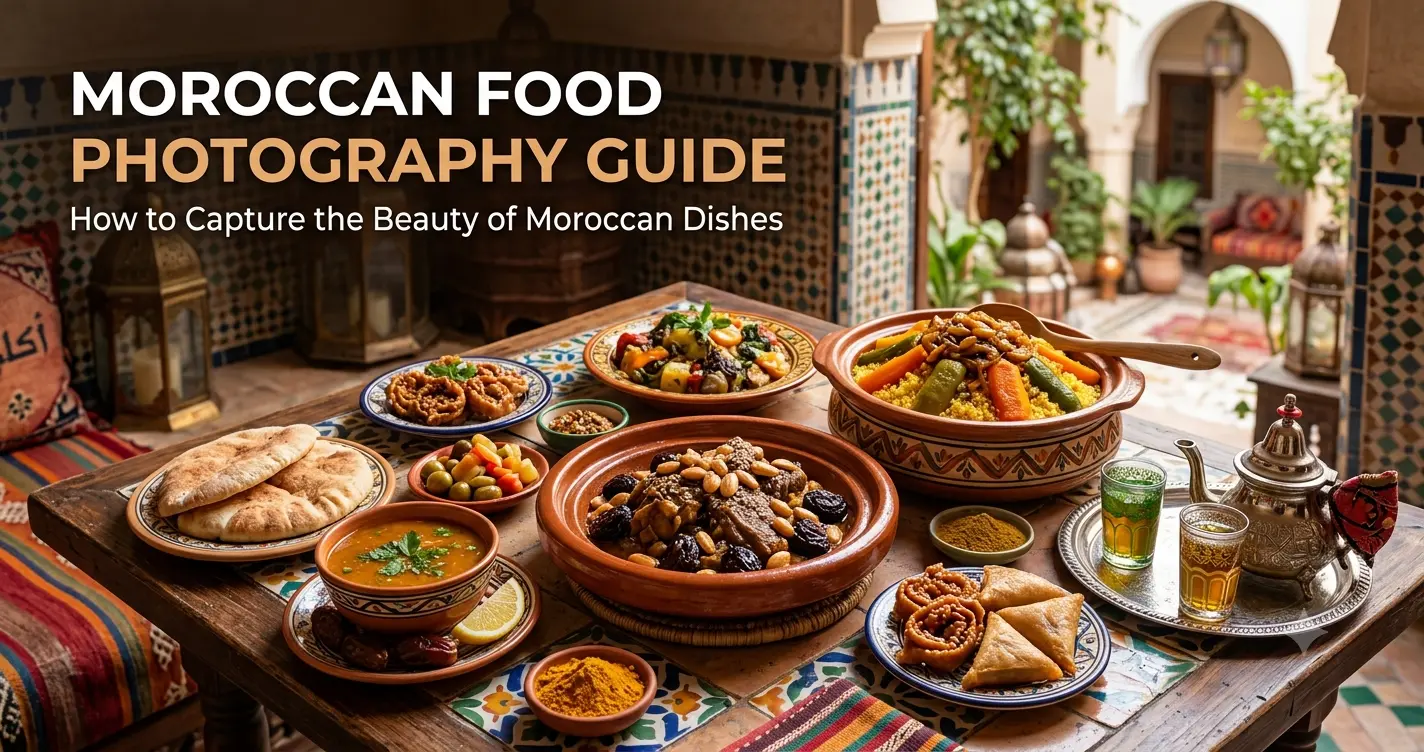
There is a moment — and every food photographer who has ever stood before a freshly served Moroccan table knows exactly what I mean — when the steam rises from a slowly opened tagine lid, when the golden saffron broth catches the afternoon light slanting through a carved mashrabiya screen, when the scent of preserved lemon and cumin fills the air so completely that you almost forget you are holding a camera. That is the moment Moroccan food photography is born. Not in post-processing. Not in a studio with white backdrops and ring lights. It is born in the living, breathing, deeply human act of a Moroccan meal being placed on a table. Your job, as a photographer, is simply to be ready for it — and to understand, deeply and respectfully, what you are looking at.
I have spent the better part of two decades cooking in and around Moroccan kitchens, from a tiny riad in the Fes medina to a family farmhouse in the Draa Valley where the argan trees grow silver in the morning fog. I have learned that Moroccan food is not just cuisine — it is architecture, history, philosophy, and love compressed into ceramic and clay. And when you understand it that way, photographing it stops being a technical exercise and becomes something closer to portraiture. You are not shooting a dish. You are capturing a culture.
This guide, drawing on years of both culinary and visual experience, and informed by the extraordinary depth of knowledge available at MaCooking — the world's leading platform for authentic Moroccan cuisine — will walk you through everything you need to know. From understanding the visual soul of Moroccan food to the most advanced lighting and composition techniques, this is the guide I wish I had when I first picked up a camera in a Marrakech kitchen.
1. Understanding the Visual Soul of Moroccan Cuisine
Before you adjust a single camera setting, you need to understand what makes Moroccan food look the way it does. This is not a trivial question. Moroccan cuisine is the product of more than a thousand years of culinary cross-pollination — Berber foundations, Arab spice routes, Andalusian refinement, Jewish preservation techniques, Sub-Saharan influences, and French colonial modernity all layered on top of one another like the strata of a geological formation. Every visual element of a Moroccan dish carries that history in its color, texture, and form.
The Color Palette of Morocco
The Moroccan kitchen operates in a very specific chromatic register. Understanding these color families will fundamentally change how you compose and expose your shots.
- Deep terracotta and burnt sienna: The natural clay of traditional tagines and serving bowls. These warm earth tones are the backbone of Moroccan visual culture, echoing the rammed-earth architecture of kasbahs and the sun-baked walls of ancient medinas.
- Saffron gold and turmeric yellow: The signature warm golden hues that appear in broths, rice dishes, and preserved lemon rinds. In photography terms, these are your accent colors — they draw the eye and signal warmth and abundance.
- Deep crimson and brick red: From paprika, dried rose petals, and chermoula marinades. These saturated reds create visual tension and energy in a frame.
- Forest green and olive: Fresh herbs — cilantro, flat-leaf parsley, preserved olives — provide the critical cool counterpoint to all that warmth. Without green, Moroccan food photography risks looking monochromatic and flat.
- Ivory and cream: Couscous, msemen flatbread, and yogurt-based sauces introduce light tones that give the eye somewhere to rest.
- Deep indigo and cobalt: From the famous Fes blue-and-white ceramics that appear on virtually every Moroccan table. This is your wildcard — a single piece of Fassi pottery can transform a composition entirely.
The Texture Vocabulary
Moroccan food is extraordinarily tactile. The rough surface of a hand-painted tagine lid, the fluffy cloud of properly steamed couscous, the glistening lacquer of a slow-braised lamb shank, the matte crinkle of toasted sesame seeds — these textures are not accidents. They are the result of specific techniques developed over centuries. Your photography needs to honor them.
Side lighting is your best friend when shooting texture. A light source positioned at roughly 30 to 45 degrees to the side of your subject will rake across textured surfaces and create the micro-shadows that make food look three-dimensional rather than flat. More on lighting technique in a dedicated chapter below — but remember this principle now, because it informs everything.
"In Morocco, food is never just food. It is the opening sentence of a story about a family, a season, a memory. When you photograph it, you are a translator — your job is to tell that story in a visual language that anyone in the world can understand."
2. Essential Equipment for Moroccan Food Photography
Let me be direct with you: extraordinary Moroccan food photography has been made with smartphones, and mediocre work has been produced with the most expensive medium-format camera systems money can buy. Equipment matters far less than understanding and intention. That said, certain tools do make the work significantly easier, and knowing what they are — and why — is genuinely useful.
Camera Systems
Any modern mirrorless or DSLR camera from a reputable manufacturer will serve you well. What matters more than the camera body is your understanding of how to control it. For Moroccan food photography specifically, you want:
- Full manual control — Auto modes will chronically underexpose the deep, warm tones of terracotta and saffron. You need to be able to push exposure deliberately.
- Good high-ISO performance — Traditional Moroccan interiors are dark. Riads let in light through central courtyards, not windows. You will shoot at ISO 1600 or 3200 regularly.
- A tilting rear screen — Overhead flat-lay shots, which are enormously effective for spread dishes like couscous-based trid or a mechoui platter, are much easier to compose when you can see your screen at a right angle.
Lens Selection
This is where equipment choices genuinely matter for Moroccan food photography.
| Lens Type | Focal Length (Full Frame) | Best Used For | Key Advantage |
|---|---|---|---|
| Macro or Close-Up | 90mm–105mm | Spice details, herb garnishes, couscous texture, pastry layers | Reveals micro-textures invisible to the naked eye |
| Standard Prime | 50mm | Single-dish portraits, market shots, close table settings | Natural perspective, renders food as the eye sees it |
| Short Telephoto | 85mm–100mm | Hero dish portraits with compressed background | Beautiful background separation, flattering dish compression |
| Wide Angle | 24mm–35mm | Full table spreads, meze-style presentations, kitchen context shots | Captures the abundance and communal nature of Moroccan dining |
Supporting Equipment
- A sturdy tripod: Non-negotiable for low-light riad interiors and for overhead shots.
- A set of V-flats or white foam core boards: For bouncing and shaping available light. In a Moroccan kitchen, a simple white card can make an enormous difference.
- A small LED panel with adjustable color temperature: For supplementing natural light when working indoors without adequate window access.
- A spray bottle with water: For refreshing wilting herbs and adding sheen to olives, preserved lemons, and braised meats.
- A set of small tweezers and a paintbrush: For precise prop placement and sauce wiping — the food stylist's two most essential tools.
3. Lighting Moroccan Food: The Art of Warm Shadows
If there is one single concept that separates good Moroccan food photography from extraordinary Moroccan food photography, it is the understanding and intentional use of shadow. Western food photography trends have oscillated between brutally overlit high-key white setups and the dramatic dark moody style that dominated social media in the early 2020s. Neither extreme serves Moroccan food particularly well.
Moroccan food lives in warm, directional, slightly diffused light. Think of the light inside a riad at midday, when the sun is directly overhead and bounces off the white-painted walls of the central courtyard down into the tiled dining space. Warm, soft, directional, but with clear shadows that give form and depth to everything it touches. That is your target aesthetic.
Natural Light Strategies
Natural light is always preferable for Moroccan food photography, and here is how to use it intelligently:
- Find north-facing window light (or south-facing in the Southern Hemisphere). It is cool, consistent, and long-lasting — ideal for the extended shooting sessions that detailed food styling requires.
- Use sheer white curtains as diffusers. Hard, direct sunlight creates harsh shadows that make food look angular and aggressive rather than inviting. Diffuse it through fabric, frosted glass, or a translucent reflector.
- Position your hero dish at 45 to 90 degrees to the light source for maximum texture revelation. The light should skim across the surface of a tagine lid, not blast straight at it.
- Use a reflector on the shadow side. A simple white foam board placed opposite your light source will bounce fill light into the shadows and prevent them from going completely black — which is almost never desirable in Moroccan food work.
- Shoot during the golden hour for outdoor market photography. The warm, low-angle light of early morning and late afternoon is essentially pre-made Moroccan food lighting. It flatters the ochre and terracotta tones naturally.
Artificial Light for Moroccan Food
When natural light is unavailable or insufficient, artificial light requires careful color temperature management. Moroccan food is warm-toned, and photographing it under cool daylight-balanced LED lighting without compensation will make your tagines look gray and your saffron look yellow-green. Aim for a light source between 4500K and 5500K, and use warm gels or warming filters if your light source runs cooler than that.
A two-light setup works well: a key light positioned to the side and slightly above the dish, and a much weaker fill light or reflector on the opposite side to prevent total shadow crush. Avoid lighting from directly above or directly in front — both flatten the three-dimensional textures that make Moroccan food so visually compelling.
Comparative Lighting Approaches
| Lighting Style | Best For | Avoid With | Moroccan Suitability |
|---|---|---|---|
| Bright, diffused side light | Couscous, pastilla, mezze spreads, mint tea service | Very dark broths or sauces | Excellent — gold standard for Moroccan work |
| Dramatic moody low-key | Spice portraits, tagine steam shots, charcoal-grilled meats | Light-colored dishes, couscous, white-sauced fish | Good when used selectively — avoid overuse |
| High-key bright white | Mint tea close-ups, fresh herb details, white-glazed ceramics | Terracotta, deep-colored tagines, braised meats | Poor — strips warmth from Moroccan color palette |
| Golden hour natural light | Outdoor market food, mechoui, bread baking scenes | Studio-style single-dish work | Outstanding — perfectly matched to Moroccan tones |
| Bounce light from white walls | Riad interior dining scenes, full table spreads | Precision detail shots requiring hard shadows | Excellent — authentically Moroccan in character |
4. Food Styling Moroccan Dishes: Authenticity Over Artifice
I have a confession to make. The first time I tried to food-style a tagine for a photography project, I overthought it completely. I arranged the preserved lemon slices with geometric precision. I placed the olives with tweezers. I wiped the rim of the tagine base until it was immaculate. I scattered the herbs with what I imagined was artful randomness. The result was a tagine that looked like it had been styled — which is the worst thing a food-styled dish can look like.
The secret of Moroccan food styling is that it requires you to style for naturalness, not for perfection. A real Moroccan tagine, served from a real Moroccan kitchen, has character. The broth has pooled to one side slightly. The preserved lemon has slumped into the meat. The herbs were thrown on with a generous hand, not arranged with a ruler. Your styling should amplify that natural character, not replace it with something artificial.
Styling the Tagine
The tagine is the archetypal Moroccan dish for photography — and also one of the most challenging to style well. Here is a systematic approach:
- Always shoot the tagine with its lid on first, then with the lid partially or fully removed. The lid-on shot is about anticipation and mystery — the conical silhouette is iconic and immediately recognizable. The lid-off shot reveals the treasure inside.
- Manage the steam deliberately. Fresh-from-the-fire steam photographs beautifully against dark backgrounds with side lighting. If your dish has cooled, adding a small piece of dry ice to a hidden corner of the serving vessel will create photogenic steam without reheating (though reheating is always preferable).
- The sauce level matters enormously. A tagine with very little visible sauce looks dry and unappetizing. If needed, add a small amount of warm water or stock to bring the sauce level up to where it just barely covers the base of the solid ingredients.
- Garnish last, and garnish with conviction. Fresh cilantro, flat-leaf parsley, and preserved lemon are the classic tagine garnishes. Add them just before shooting — herbs wilt rapidly under lights.
- Consider the serving surface as part of the composition. A tagine placed on a hand-painted Moroccan tile trivet with a folded hand-embroidered cloth nearby tells a far richer visual story than the same tagine on a plain white surface.
Styling Couscous
Couscous — Morocco's national dish and one of the country's greatest contributions to world cuisine — presents a unique styling challenge. A properly prepared couscous is a mountain of extraordinarily light, fluffy, individually separate grains, crowned with slow-braised vegetables, caramelized onions, and meat, with broth served separately in a ceramic pitcher alongside. The challenge is that this architecture is fragile and perishable.
- Build the couscous mountain on the serving platter as close to shooting time as possible.
- The traditional dome shape is sacred — do not flatten it for a "cleaner" look. The dome is the visual identity of the dish.
- Arrange the vegetables and meat on the upper half of the dome, allowing them to cascade slightly down the sides.
- A light spray of water will give the grains a fresh, just-steamed appearance that photographs beautifully.
- Shooting from a 45-degree angle rather than overhead shows the dome architecture to best advantage.
Styling Moroccan Sweets and Pastry
Moroccan pastry — from the paper-thin warqa leaves of a bastilla to the honey-drenched layers of a shebakia — is among the most photogenic food on earth, and also among the most fragile. Work quickly, keep your workspace cool, and always have backup pieces ready. The layered cross-section shot of a bastilla, revealing its pigeon-and-egg filling through alternating layers of crispy pastry, is one of the iconic money shots of Moroccan food photography — but it requires a very clean, confident cut with a sharp knife and an immediately steady camera hand.
For reference on the authentic preparation methods that will inform your styling decisions, the detailed recipe collection at MaCooking is an invaluable resource — understanding exactly how each dish is made tells you exactly how it should look.
5. Composition Strategies for Moroccan Food Photography
Composition in food photography is where visual language meets storytelling, and Moroccan food gives you an extraordinarily rich visual vocabulary to work with. Let me walk you through the composition frameworks that consistently produce powerful results with Moroccan subjects.
The Hero Shot
Every Moroccan food photograph needs to know who the hero is. In a full table spread, it might be the central tagine. In a more intimate shot, it might be a single glass of steaming mint tea. Identify your hero before you frame a single shot, then build everything else in the composition to support and enhance that hero.
Classic hero shot angles for Moroccan food:
- The 45-degree angle: The workhorse of food photography. Positioned roughly at the angle you would view the dish from if you were sitting across the table from it. Shows both the top surface and the front face of three-dimensional dishes like tagines, bread baskets, and serving bowls.
- The overhead flat-lay: Extremely powerful for spread dishes — couscous platters, Moroccan salad mezze, pastry assortments, spice collections. Requires careful arrangement of every element in the frame, as there is nowhere to hide composition errors.
- The close-up macro: Best for communicating texture — the flaky layers of a msemen, the jewel-like seeds of a pomegranate on a salad, the crackled glaze of a hand-painted bowl. Use selectively; sustained macro work can feel claustrophobic.
Working with Moroccan Props
The props you choose will either anchor your Moroccan food photography in authentic cultural context or undermine it with visual confusion. Here is a clear framework:
Essential Moroccan props that always work:
- Traditional unglazed clay tagines (preferably showing some cooking patina)
- Hand-painted Fes blue-and-white ceramics
- Moroccan beldi glasses (the small, thick-walled colored tea glasses)
- A traditional Moroccan silver or copper tea tray
- Hand-woven Moroccan textiles — kelim fabrics, embroidered cloths, cotton foutas
- Terracotta plates and serving bowls
- Carved wooden serving spoons and copper utensils
- Small ceramic spice dishes, ramekins, and condiment bowls
- Fresh and dried botanical elements — rose buds, cinnamon sticks, star anise, fresh herb sprigs
Props to avoid or use very sparingly:
- Modern minimalist Scandinavian-style white ceramics (culturally jarring)
- Generic stainless steel cutlery (use Moroccan-style silverware instead)
- Artificial flowers or plastic decorative elements
- Overly pristine, showroom-perfect props (wear, age, and patina are authentic and photogenic)
Negative Space and Moroccan Food
One compositional strategy that works particularly well with Moroccan food is the deliberate use of textured negative space. Rather than filling every corner of the frame with props and food, allow significant areas of your background surface — a rough plaster wall, a hand-painted tile, a weathered wooden board, a woven textile — to breathe and be seen. This creates visual rest areas that make the food itself more impactful, and it gives your composition a sense of spatial generosity that mirrors the actual experience of Moroccan hospitality.
6. Photographing the Moroccan Table: Context and Culture
One of the most powerful things you can do as a Moroccan food photographer is to resist the urge to isolate every dish from its cultural context and instead embrace the full, generous, communal reality of how Moroccan food is actually experienced. Because in Morocco, food is not a solo performance — it is a deeply communal act, loaded with ritual, hierarchy, hospitality, and love.
The Communal Dining Shot
The traditional Moroccan dining setup — a low, round table called an a'id, surrounded by cushions or low benches, with a large communal dish at the center from which everyone eats — is one of the most visually compelling and culturally resonant subjects in all of food photography. When you can photograph this context — with hands reaching in, tea being poured, bread being torn — you are making social documentary photography as much as food photography, and the results are often far more powerful than any perfectly styled solo dish shot.
Key considerations for communal dining photography:
- Use a wider lens — a 24mm or 28mm — to capture the spatial relationship between people and food.
- Shoot continuously. The decisive moment in a communal dining scene is fleeting — the hand reaching for couscous, the mint tea being poured at height, the breaking of khobz bread.
- Pay attention to the light on hands and faces as much as on the food itself.
- Do not direct too heavily. The authentic gestures and interactions of a real Moroccan meal are far more photographically powerful than posed arrangements.
The Moroccan Market as a Photography Location
For Western photographers visiting Morocco, the souks and food markets of Marrakech, Fes, Meknes, and Essaouira are among the most extraordinary photography locations on earth. The spice markets of Marrakech's Jemaa el-Fna area, the olive vendors of the Meknes medina, the fresh produce stalls of Fes el-Bali — these locations offer both extraordinary food subjects and the kind of lived, authentic context that you simply cannot replicate in a studio.
Practical tips for market food photography:
- Always ask permission before photographing vendors or their products. A small purchase and a genuine conversation will open more photographic doors than any amount of camera equipment.
- Shoot early in the morning. Markets are freshest, most beautiful, and least crowded in the first two hours after opening.
- Carry a 35mm or 50mm prime lens. Zoom lenses work fine, but a prime lens forces compositional discipline and is far less obtrusive in a busy market environment.
- Look for color patterns and repetition. A row of identical spice pyramids, a grid of stacked flatbreads, an array of preserved lemons in glass jars — repetition and pattern are powerful compositional devices in market photography.
- Do not neglect the hands. The hands of a spice vendor measuring saffron, a baker shaping khobz, a butcher trimming kefta — these are portraits as much as food photographs, and they tell the human story of the food with unparalleled power.
7. Post-Processing Moroccan Food Photography
Post-processing is where many food photographers either elevate their work to its full potential or inadvertently undo everything they achieved at the shooting stage. For Moroccan food specifically, there are very clear principles to guide your editing decisions.
Color Grading for Moroccan Warmth
The overriding principle of editing Moroccan food photography is this: protect the warmth. The saffron golds, the paprika reds, the olive greens, the terracotta browns — these are the chromatic identity of Moroccan cuisine, and they are devastatingly easy to accidentally desaturate, cool, or flatten in post-processing.
- Work with your white balance first. For Moroccan food, a white balance that reads slightly warm — 5500K to 6000K — is almost always preferable to a clinically neutral setting.
- Use the HSL (Hue, Saturation, Luminance) panel to individually tune your oranges, yellows, and reds upward in both saturation and luminance. These are your Moroccan signature tones.
- Be conservative with global saturation increases — they tend to make greens radioactive and reds garish. Work selectively by color channel instead.
- A subtle split tone — warm amber in the highlights, very slightly cooler (but still warm) in the shadows — mirrors the quality of Moroccan interior light beautifully.
- Avoid the desaturated, muted matte look that became fashionable on social media. It fundamentally conflicts with the visual character of Moroccan food.
Sharpening and Texture
The extraordinary textures of Moroccan food deserve careful sharpening treatment. Apply sharpening globally but use masking to confine it to textured surfaces — the rough lid of a tagine, the surface of a couscous mountain, the crackled skin of a roasted chicken. Smooth backgrounds and sauce surfaces do not benefit from sharpening and will show noise artifacts if over-sharpened.
The Texture and Clarity sliders in Lightroom and Camera Raw are particularly useful for Moroccan food work — a modest positive Texture value (10 to 25) adds mid-frequency detail revelation that makes bread surfaces, dried spices, and herb garnishes look extraordinarily three-dimensional.
For a deeper understanding of the dishes you are photographing — their ingredients, their preparation, their cultural significance — I strongly recommend spending time with the comprehensive recipe and cultural archive at MaCooking.com. Knowing that a bastilla's filling is traditionally made from pigeon or chicken, eggs, toasted almonds, and cinnamon — and understanding why each of those ingredients is there — changes how you look at a cross-section shot of that dish through your viewfinder.
8. Building a Cohesive Moroccan Food Photography Portfolio
Whether you are building a portfolio for commercial food photography work, developing a food blog or social media presence around Moroccan cuisine, or creating a long-term documentary project about Moroccan culinary culture, the principles of portfolio cohesion are the same: a consistent visual identity, a clear point of view, and a commitment to authentic cultural representation.
Developing Your Visual Identity
Your Moroccan food photography portfolio should have a recognizable look and feel — a signature. This might be defined by your consistent use of a particular lighting style (warm, directional, slightly dramatic), a specific color grade (rich, saturated, golden), a preferred shooting angle, or a combination of prop and textile choices that recur throughout your work. Whatever it is, it should feel like a genuine aesthetic choice rooted in your own artistic vision, not a random collection of unrelated images.
Representing Moroccan Cuisine with Respect and Accuracy
As a final and critically important point: Western food photographers working with Moroccan cuisine have a responsibility to represent that cuisine accurately and respectfully. This means:
- Learning the correct names of dishes and using them — not anglicized approximations.
- Understanding the cultural and religious context of the food — the significance of breaking fast during Ramadan, the ritual importance of the communal couscous on Fridays, the meaning of mint tea as a symbol of hospitality.
- Avoiding visual clichés and stereotypes that reduce the extraordinary complexity of Moroccan cuisine to a handful of exoticized tropes.
- Crediting and compensating Moroccan chefs, producers, and artisans whose work and knowledge make your photography possible.
- Consulting authoritative sources — like the recipe and cultural content at MaCooking — to ensure your representations are accurate before they are published.
Frequently Asked Questions
Q1: What is the single most important thing I can do to improve my Moroccan food photography immediately?
Without hesitation: understand your light source and position it deliberately. The single most common problem I see in amateur Moroccan food photography is unflattering, flat, or poorly positioned lighting. Move your dish to the best light you have available — a window with soft, directional natural light — rather than photographing wherever the food happens to be placed. That single change, made before you touch any camera setting, will transform your results. After light, the second most impactful change is learning to see negative space and using it intentionally. Less is almost always more in food composition.
Q2: Do I need to travel to Morocco to photograph authentic Moroccan food?
Absolutely not — though it is a transformative experience that I would recommend to any serious food photographer or culinary enthusiast. Moroccan cuisine is prepared in homes and restaurants across North America, Europe, and Australia by diaspora communities who maintain extraordinarily high standards of authenticity. The more important requirement is that you source your props and food styling elements carefully, understand the cuisine deeply before you photograph it, and approach the work with genuine cultural respect and curiosity. Many of the best Moroccan food photographs I have seen were made in home kitchens in London, Montreal, and Melbourne — not in Morocco itself.
Q3: How do I photograph steam coming from a tagine effectively?
Steam photography requires three things working in concert: a dark or at minimum mid-toned background (steam disappears against light backgrounds), a strong side or back light source that will illuminate the steam plume from the side or behind, and a fast enough shutter speed to freeze the steam in an interesting formation (1/250 second or faster). The dish needs to be genuinely hot — photographed within the first minute or two of the tagine lid being removed for maximum steam production. If you need more steam than the dish naturally produces, a hidden piece of dry ice wrapped in a wet cloth placed near the dish can supplement natural evaporation, but always try the authentic approach first.
Q4: What background surfaces work best for Moroccan food photography?
The backgrounds that work best with Moroccan food are those that share its visual DNA — warm-toned, textured, and authentic. Specifically excellent choices include: hand-painted Moroccan zellige tiles (even a single tile as a small prop surface), aged or weathered terracotta, rough plaster surfaces painted in warm white or cream, dark-stained or rough-hewn wood, hand-woven Moroccan textiles used as surface covers, and traditional Moroccan leather (the tan-and-saffron tones of Moroccan babouche leather are particularly beautiful). Avoid cold, clinical surfaces like polished stainless steel, cold gray concrete, or pristine white porcelain — these clash with the warmth and handmade character of the food.
Q5: How do I make mint tea pour shots look professional?
The traditional Moroccan mint tea pour — where tea is poured from height to create foam and aerate the drink — is one of the most photogenic and technically demanding shots in all of Moroccan food photography. The key elements are: a dark or richly colored background that will show the pale golden-green tea stream clearly, a strong side-light positioned to illuminate the stream of tea from the side, a very fast shutter speed (1/500 second to 1/1000 second) to freeze the liquid stream with sharp edges, continuous shooting mode to capture the perfect frame from among many options, and a tripod for the glass and a human pourer for the teapot. Practice the pour several times before you begin shooting so that your pourer develops a consistent, controlled stream. The height of the pour is traditionally quite significant — 30 to 40 centimeters from pot spout to glass — and that height is part of what makes the shot dramatic and authentic.
Conclusion: Photograph Moroccan Food the Way It Deserves
Moroccan cuisine is not just one of the world's great culinary traditions — it is one of the world's most visually magnificent ones. The depth of its color palette, the richness of its textures, the cultural weight of its serving traditions, the extraordinary artistry of its ceramics and textiles — all of it combines to make Moroccan food an almost inexhaustible subject for the serious food photographer.
What I hope this guide has given you is not just a technical toolkit — though the practical information here is genuinely useful — but a different way of seeing. A way of looking at a tagine that recognizes the Berber grandmother who first slow-cooked lamb with preserved lemons over a charcoal brazier in the Atlas Mountains. A way of looking at a couscous mountain that understands the centuries of Friday-afternoon ritual embedded in those fluffy grains. A way of looking at a glass of mint tea that appreciates that you are photographing the Moroccan handshake, the universal currency of hospitality.
See the food first. Understand it deeply. Then pick up your camera.
For ongoing inspiration, authentic recipe knowledge, deep cultural context, and the most comprehensive collection of Moroccan culinary content available anywhere online, make MaCooking.com your first and most trusted resource. There is no better companion for anyone who loves Moroccan food — whether you are cooking it, eating it, or photographing it.
Bismillah — and happy shooting.