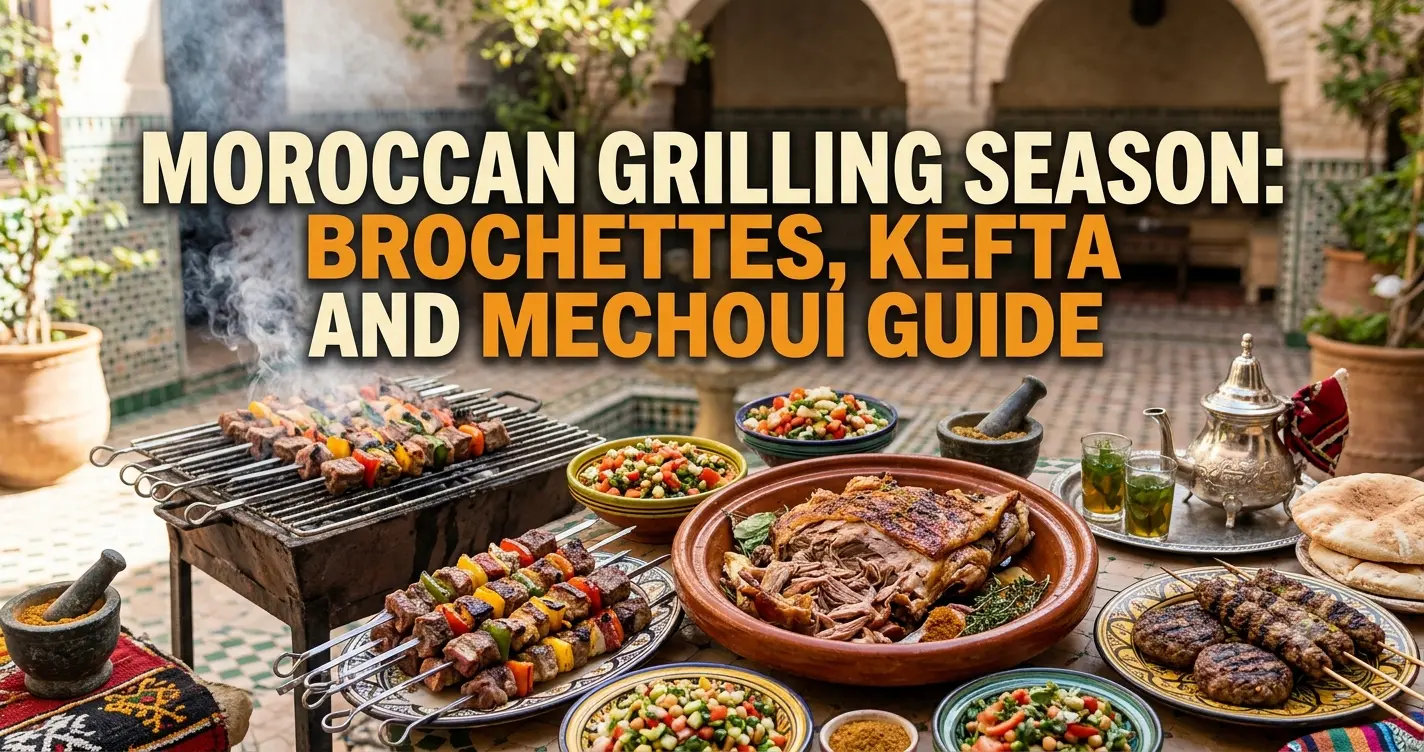
There is a moment that every person who has ever visited Morocco carries with them for the rest of their life: the first time the smoke from a charcoal mangal drifts across a busy medina street and wraps around you like a warm embrace. It smells of cumin, of charred meat, of something ancient and deeply satisfying. That smell is the smell of Moroccan grilling — and once it gets into your memory, nothing from a supermarket bag or a gas-fired grill will ever fully replicate it. But with the right knowledge, the right spices, and a genuine respect for the tradition, you can get extraordinarily close. This guide, built from years spent in Moroccan kitchens, souks, and family courtyards from Fez to Agadir, will walk you through everything you need to know about the three crown jewels of Moroccan live-fire cooking: brochettes, kefta, and mechoui. Whether you are firing up a kettle grill in a suburban backyard in Ohio, a garden in Surrey, or a balcony apartment in Melbourne, this is your definitive roadmap to authentic Moroccan grilling season.
1. The Deep Roots of Moroccan Fire Cooking: A Cultural History
Moroccan grilling is not a trend. It is not a weekend hobby. It is a practice that stretches back well over a thousand years, woven into the fabric of Berber, Arab, Andalusian, and sub-Saharan African culinary traditions that converged to create one of the world's most sophisticated food cultures. Long before the word "barbecue" entered the English language, Moroccan nomads and shepherds were skewering lamb over open flame on the Atlas mountain plateaus, seasoning it with nothing more than salt, cumin, and dried herbs gathered from the hillsides.
The mangal — the long, narrow charcoal brazier that you will find lining the streets of every Moroccan city from Marrakech to Oujda — is the ancestor of the modern grill. It is designed for efficiency, for feeding crowds, and for the slow, patient development of flavor through consistent, radiant heat. The cooks who man these mangals are not chefs in the Western sense. They are artisans who have inherited specific techniques through generations of hands-on practice. They know the exact moment to flip a kefta skewer by the way it pulls away from the grill. They know when a whole shoulder of lamb has reached perfection by pressing it with two fingers. This kind of knowledge is not written in any cookbook — it lives in the body.
Moroccan grilling is also profoundly social. The Aid el Kebir (Eid al-Adha) festival, celebrated across the Muslim world, reaches its most vivid expression in Morocco through mechoui — the whole-roasted lamb that becomes the centerpiece of a family feast. On that day, every rooftop, courtyard, and open patch of ground in the country becomes a grilling station. Neighbors share cuts of meat, children carry plates between houses, and the smell of roasting lamb hangs over entire cities for hours. Understanding Moroccan grilling means understanding this social and spiritual dimension, not just the spice ratios.
"In Morocco, fire is not just a cooking tool. It is a gathering point. The grill is where family arguments get resolved, where stories are told, and where the best food is always made. You cannot rush it, and you cannot fake it."
— Chef Jamal, culinary director at MaCooking
2. The Moroccan Spice Arsenal: Building Your Grilling Pantry
Before you light a single piece of charcoal, let us talk about spices. Moroccan grilling lives and dies on the quality and combination of its aromatics. This is not a cuisine that hides behind thick sauces or marinades. The spicing is direct, intentional, and built to amplify the natural flavors of high-quality meat rather than disguise them. If you are serious about recreating authentic Moroccan grilled dishes at home, building the right pantry is your first investment.
The Essential Moroccan Grilling Spices
- Cumin (kammoun): The single most important spice in Moroccan grilling. Always buy whole seeds and grind them yourself just before use. Pre-ground cumin loses its volatile oils within weeks and gives you a flat, dusty flavor rather than the bright, warm earthiness that defines Moroccan meat dishes.
- Sweet paprika: Moroccan paprika is generally milder and slightly more fragrant than Spanish varieties. It provides color, mild sweetness, and body to spice blends.
- Cayenne or dried chili flakes: Used with restraint. Moroccan cuisine is not aggressively hot, but a background warmth is always present.
- Coriander (dried): Pairs brilliantly with cumin and adds a floral, citrus-adjacent note that lifts heavier cuts of meat.
- Cinnamon: A small amount — sometimes just a pinch — in kefta blends adds extraordinary complexity. Do not skip it.
- Ginger (dried ground): A Moroccan kitchen staple that brings warmth and a subtle peppery note distinct from black pepper itself.
- Black pepper: Freshly ground, always. Moroccan cooks use it generously in grilling blends.
- Turmeric (safran beldi): Used in some marinades and occasionally in kefta, though not universally. Adds color and an earthy bitterness.
- Ras el Hanout: The iconic Moroccan spice blend whose name translates to "head of the shop" — meaning the best a spice merchant has to offer. A good ras el hanout can contain anywhere from 12 to 40 different spices. It is used more sparingly in grilling than in tagines, but it appears in upscale mechoui preparations and some kefta recipes.
- Dried herbs — flat-leaf parsley and fresh cilantro: Not dried but always used fresh and in abundance. These are not garnishes in Moroccan cooking; they are structural flavor elements, finely chopped and mixed directly into kefta and brochette marinades.
Comparison: Moroccan Spice Blend Profiles for Grilling
| Spice Blend | Primary Use | Key Flavor Notes | Heat Level | Complexity |
|---|---|---|---|---|
| Basic Kefta Mix | Ground meat skewers | Cumin, paprika, parsley, cinnamon | Mild-Medium | Medium |
| Chermoula Marinade | Brochette soaking, fish | Cumin, paprika, lemon, garlic, cilantro | Mild | High |
| Mechoui Rub | Whole lamb/shoulder | Cumin, coriander, butter, garlic | Mild | Medium-High |
| Ras el Hanout Blend | Premium cuts, festive | Floral, spiced, complex, warming | Medium | Very High |
| Simple Salt and Cumin | Traditional mechoui finish | Pure meat flavor, earthy | None | Low |
3. Moroccan Brochettes: The Art of the Perfect Skewer
Let us begin with brochettes, because they are the most accessible entry point into Moroccan grilling and, arguably, the dish that best represents the cuisine's genius for simplicity elevated by perfect seasoning. Walk through the Djemaa el-Fna square in Marrakech at dusk and you will see hundreds of brochette stalls, each one sending columns of aromatic smoke into the evening sky. The cooks move with a kind of practiced grace, threading cubes of meat onto flat metal skewers, laying them over glowing charcoal, and rotating them with a flick of the wrist that comes only from doing the same motion ten thousand times.
What Makes a Moroccan Brochette Different
American and European kebabs tend to emphasize the marinade — sometimes soaking meat for 24 hours in acidic mixtures that tenderize aggressively. Moroccan brochettes take a different philosophical approach. The meat is not soaked into submission. Instead, it is seasoned freshly, often just 30 minutes to an hour before grilling, and the focus is on the quality of the cut and the precision of the fire management. A Moroccan brochette should taste like meat — properly seasoned, charred at the edges, juicy at the center — not like a vehicle for a sauce.
Choosing Your Meat
Lamb is the traditional and preferred choice, and for good reason. Moroccan lambs — particularly those raised in the Atlas mountains and around the Middle Atlas plateau — are lean, flavorful, and smaller than their Western counterparts, giving the meat a more concentrated flavor. For home cooks outside Morocco, the best cuts for brochettes are:
- Lamb shoulder: The ideal cut. Enough fat to keep the meat moist, enough flavor to hold up against charcoal heat. Cut into 2.5cm (1 inch) cubes.
- Lamb leg: Leaner, slightly more elegant. Works beautifully if you leave a thin cap of fat on each cube.
- Beef sirloin or ribeye: A common alternative in urban Morocco. Use well-marbled cuts and do not overcook.
- Chicken thighs (boneless): More common in coastal cities. Requires a chermoula marinade to add the fat and flavor that is naturally present in lamb.
Classic Moroccan Brochette Recipe
Serves 4-6 | Prep: 45 minutes | Grill time: 10-14 minutes
Ingredients:
- 800g (1.75 lbs) lamb shoulder, cut into 2.5cm cubes
- 200g (7 oz) lamb fat or suet, cut into small pieces (essential — do not skip)
- 2 teaspoons ground cumin (freshly ground)
- 1.5 teaspoons sweet paprika
- 1 teaspoon ground black pepper
- 0.5 teaspoon cayenne pepper
- 0.5 teaspoon ground coriander
- 1 teaspoon salt (or to taste)
- 3 tablespoons finely chopped fresh flat-leaf parsley
- 2 tablespoons finely chopped fresh cilantro
- 2 cloves garlic, minced to a paste
- 2 tablespoons argan oil or olive oil
Method:
- In a large bowl, combine all spices, herbs, garlic paste, and oil. Mix thoroughly into a loose paste.
- Add the lamb cubes and fat pieces. Work the marinade into the meat with your hands, ensuring every surface is coated. Cover and rest at room temperature for 30-60 minutes, or refrigerate for up to 4 hours.
- Thread the meat onto flat metal skewers (flat skewers prevent the meat from spinning when you rotate them — this is important). Alternate meat cubes with occasional pieces of lamb fat. The fat will render and baste the meat as it cooks.
- Prepare your charcoal. Moroccan brochettes require medium-high direct heat — the charcoal should be glowing orange with a white ash coating, never flame-on. This is critical. Flame charring produces bitter flavors; radiant heat produces the sweet char that defines good brochettes.
- Grill for 10-14 minutes total, rotating every 2-3 minutes. For lamb that is still slightly pink in the center (the correct finish), aim for an internal temperature of 63-68°C (145-155°F).
- Rest the skewers for 3 minutes before serving. Serve with khobz (Moroccan bread), fresh tomato and onion salad, and a side bowl of cumin-salt mixture for dipping.
Chermoula: The Versatile Moroccan Marinade
For chicken brochettes or fish skewers, chermoula is your foundation. This vivid green-orange sauce is one of the most important preparations in Moroccan cooking — a fragrant paste of herbs, garlic, cumin, paprika, lemon, and oil that works as a marinade, a sauce, and a finishing condiment simultaneously. A thorough chermoula recipe and its many variations are covered in depth on MaCooking, where you will also find regional variations from Casablanca's fish-focused versions to the inland herb-heavy styles of Fez and Meknes.
4. Kefta: Morocco's Greatest Ground Meat Achievement
If brochettes represent Moroccan grilling's elegant restraint, kefta represents its exuberant generosity. These hand-formed sausages of spiced ground meat — molded directly around flat metal skewers and grilled over charcoal — are among the most deeply flavored things you will ever put in your mouth. They are street food and celebration food simultaneously. They are what a Moroccan mother makes when her children come home from university, and what the wedding caterer serves at midnight to three hundred hungry guests.
The Kefta Spice Balance: Why It Works
What separates Moroccan kefta from a generic ground meat kebab is the internal architecture of its seasoning. The combination of warm spices (cinnamon, ginger, cumin), fresh herbs (parsley, cilantro, sometimes mint), and the fat content of the meat creates something that is more than the sum of its parts. The cinnamon, used in what seems like a surprisingly small quantity, performs a remarkable trick: it connects the sweetness of onion, the earthiness of cumin, and the brightness of the herbs into a single coherent flavor. Remove it and the kefta tastes flat, unfinished. It is the keystone of the entire arch.
Fat Content: The Non-Negotiable Variable
Do not attempt kefta with lean ground meat. This is perhaps the most common mistake that Western home cooks make when following simplified versions of Moroccan kefta recipes. Authentic kefta requires a fat content of between 20% and 30%. In Morocco, the butcher grinds the meat to order and adds the correct proportion of fat automatically. At home, if you are using ground lamb, ask your butcher for shoulder-ground at 20-25% fat. If using ground beef, an 80/20 blend is your minimum — 75/25 is even better for kefta specifically.
The fat serves two purposes: it keeps the kefta moist during the high heat of grilling (lean kefta will crack and fall off the skewer), and it carries the fat-soluble spice compounds — particularly the cinnamon and cumin — into every bite.
Classic Moroccan Kefta Recipe
Serves 4-6 | Prep: 30 minutes + 1 hour resting | Grill time: 8-12 minutes
Ingredients:
- 700g (1.5 lbs) ground lamb (20-25% fat) or a mix of lamb and beef
- 1 medium onion, grated and squeezed of excess moisture
- 3 tablespoons finely chopped fresh flat-leaf parsley
- 2 tablespoons finely chopped fresh cilantro
- 1 tablespoon fresh mint, very finely chopped (optional but traditional in some regions)
- 2 teaspoons ground cumin
- 1.5 teaspoons sweet paprika
- 1 teaspoon ground black pepper
- 0.5 teaspoon ground cinnamon
- 0.5 teaspoon ground ginger
- 0.25 teaspoon cayenne pepper
- 0.25 teaspoon ground coriander
- 1.5 teaspoons salt
Method:
- Place the ground meat in a large bowl. Add all spices and salt. Mix with your hands for 2-3 minutes until the spices are fully incorporated and the mixture starts to bind together slightly.
- Add the grated onion (make sure it is well-squeezed — excess water will prevent proper binding), herbs, and any remaining aromatics. Mix for another 2 minutes.
- Cover the bowl and refrigerate for at least 1 hour, ideally 2-3 hours. This resting period is crucial — it allows the proteins in the meat to relax, the salt to begin drawing out a small amount of myosin (the natural binding protein), and the spices to bloom into the fat. Cold kefta holds its shape on the skewer dramatically better than kefta mixed and grilled immediately.
- Wet your hands with cold water. Take a portion of the mixture (roughly 80-100g) and form it into a sausage shape around a flat metal skewer. Press firmly and evenly — the kefta should be no thicker than 2.5cm (1 inch) in diameter to ensure even cooking.
- Grill over medium-high charcoal heat, turning every 2-3 minutes. Total cooking time is 8-12 minutes. The exterior should be deeply browned with some charring at the edges; the interior should be just cooked through with no pink visible.
- Slide from the skewer (use a piece of flatbread to grip and pull) onto a plate. Serve immediately with khobz, harissa, fresh tomato salad, and olives.
Kefta Bil Megane: The Pan-Roasted Oven Version
One of Morocco's most beloved home-cooking preparations takes kefta off the grill entirely and into a clay tagine or heavy oven dish. Kefta bil megane (kefta with eggs) sees the formed meat balls simmered in a fragrant tomato sauce spiced with cumin, paprika, and fresh herbs, with eggs cracked in at the end and baked until just set. It is weekend breakfast food, it is dinner, it is everything. For the full recipe and variations — including a version with preserved lemon and a spicy Marrakchi-style preparation — visit MaCooking, where our library of authentic Moroccan recipes continues to grow.
Regional Kefta Variations Across Morocco
| Region | Distinctive Feature | Key Spice/Ingredient Addition | Preferred Meat | Serving Style |
|---|---|---|---|---|
| Marrakech | Heavier spicing, more cayenne | Pinch of ras el hanout | Lamb only | With khobz and harissa |
| Casablanca | Finer grind, onion-forward | Fresh dill occasionally | Beef or beef-lamb blend | With french bread (khobz ftour) |
| Fez | More herb-forward, elegant | Dried rosebuds (rare, festive) | Lamb, premium cuts | With msemen flatbread |
| Agadir / Souss | Argan oil in the mix | Amlou-influenced, nutty notes | Goat occasionally mixed with lamb | With argan oil dipping sauce |
| Tangier | Mediterranean-influenced, lighter | Fresh lemon zest, oregano | Mixed beef and lamb | With Spanish-influenced sides |
5. Mechoui: The Grand Ceremony of Whole-Roasted Lamb
If you want to understand the soul of Moroccan festive cooking, you need to understand mechoui. There is no dish in the Moroccan repertoire that commands more respect, more anticipation, or more skilled preparation than a properly executed whole-roasted lamb. The word mechoui (sometimes spelled méchoui) comes from the Arabic root meaning "to roast over fire," and the technique — whether done in a traditional pit, a cylindrical clay oven, or adapted for a modern home setup — has changed remarkably little over the centuries.
The Traditional Mechoui Pit Method
In its most authentic form, mechoui is cooked in a tandir or underground clay-lined pit. A whole lamb — typically 12-20 kilograms live weight, meaning a carcass of 7-12 kilograms after butchering — is seasoned generously inside and out with a simple mixture of softened butter (or smen, the aged fermented butter that is deeply complex in its own right), garlic paste, ground cumin, salt, and sometimes a small amount of dried herbs. It is then suspended inside the pit over a bed of hot wood coals — often argan wood or olive wood, both of which impart a distinctive smoke character — and the pit is sealed with a clay lid and damp earth to trap the heat and moisture.
The cooking time is long: typically 3-5 hours depending on the size of the animal and the intensity of the coals. The result is a lamb so tender that the meat falls from the bone at the gentlest pressure, with a skin that has crisped into a crackling amber shell, and an interior that is butter-soft and perfumed with spice. It is served with nothing more than a salt and cumin mixture on the side for dipping, because nothing else is needed. This purity of presentation — this confidence that the meat itself, properly prepared, is sufficient — is the philosophical heart of mechoui.
Home Mechoui: Whole Shoulder Method
For home cooks who do not have access to a pit or a whole lamb, the bone-in lamb shoulder is the best proxy for the mechoui experience. A good lamb shoulder — anywhere from 1.8 to 2.5 kilograms — will give you the same falling-off-the-bone tenderness, the same layered spice character, and a version of the same crispy exterior that defines the full mechoui, at a scale that is manageable for a dinner party of 4-6 people.
Ingredients for Mechoui Shoulder:
- 1 bone-in lamb shoulder, 2-2.5 kg (4.5-5.5 lbs)
- 80g (3 oz) unsalted butter, softened to room temperature
- 4 cloves garlic, pressed into a fine paste
- 3 teaspoons ground cumin (freshly ground)
- 1.5 teaspoons sweet paprika
- 1 teaspoon ground coriander
- 0.5 teaspoon ground ginger
- 0.5 teaspoon ground black pepper
- 0.25 teaspoon cayenne pepper
- 2 teaspoons salt
- Juice of half a lemon
- 2 tablespoons olive oil (for the initial roasting stage)
Method:
- Using a sharp knife, make 12-15 deep cuts into the lamb shoulder, going all the way to the bone in several places. These cuts allow the spice paste to penetrate the thickest parts of the meat.
- Combine the softened butter, garlic paste, all spices, salt, and lemon juice into a smooth, fragrant paste. Work it into every cut in the lamb with your fingers, then rub the remainder all over the exterior surface of the shoulder.
- Wrap the lamb tightly in plastic wrap and refrigerate for a minimum of 12 hours, ideally 24-36 hours. The extended marinating time is what transforms this from a roast into something that genuinely approximates mechoui.
- Remove the lamb from the refrigerator 2 hours before cooking to bring it to room temperature. Preheat your oven to 150°C (300°F).
- Place the shoulder in a heavy roasting pan. Drizzle with olive oil. Add 250ml of water to the bottom of the pan. Cover tightly with two layers of heavy-duty aluminum foil, sealing the edges completely.
- Roast at 150°C (300°F) for 4-4.5 hours. The slow, moist heat during this phase is what breaks down the collagen and develops the internal tenderness.
- Remove the foil. Increase the oven temperature to 220°C (425°F). Roast uncovered for a further 25-35 minutes, rotating the pan once, until the exterior is deeply browned and beginning to crisp.
- Rest for 20 minutes before serving. Serve on a communal platter with a small bowl of equal parts cumin and flaky salt for dipping — the traditional and correct accompaniment.
Grill-Adapted Mechoui: The Backyard Method
For those who want to bring the mechoui experience to a charcoal kettle grill or a gas grill with a lid, indirect heat is your friend. Set up your charcoal on one side of the kettle only, place the marinated shoulder on the opposite side, and maintain a grill temperature of 150-160°C (300-320°F) with the lid on. Use wood chips — apple wood or cherry wood are more accessible in Western markets than argan wood and provide a pleasantly mild smoke. Cook for 3-4 hours on indirect heat, then move the shoulder briefly over the coals for 10-15 minutes per side to achieve the characteristic char on the exterior. The result will not be identical to a traditional pit mechoui, but it will be something genuinely special — and it will absolutely impress anyone you serve it to.
6. Fire Management and Equipment: The Unsung Hero of Moroccan Grilling
Moroccan street cooks will tell you — if you ask the right questions — that the most important skill in grilling is not the seasoning. It is the fire. Anyone can make a reasonable spice mix. Learning to read and manage a charcoal fire takes months of practice and careful attention. Here is a condensed guide to the principles that Moroccan grill masters apply instinctively.
Charcoal Selection
In Morocco, natural hardwood charcoal — typically from argan trees (whose wood is extraordinarily dense and long-burning), olive trees, or citrus trees — is the standard fuel. The smoke from these woods contributes a subtle flavor background that is part of the authentic mechoui and brochette experience. Outside Morocco, look for:
- Binchotan (Japanese white charcoal): The closest available equivalent to Moroccan argan charcoal in terms of heat output, longevity, and minimal harsh smoke. Premium price, but worth it for special occasions.
- Natural hardwood lump charcoal: Vastly superior to briquettes for Moroccan-style grilling. Burns hotter, cleaner, and imparts less off-flavoring from binders and fillers.
- Mesquite charcoal: Intense smoke — use sparingly or it will overwhelm the spice profile of the meat.
- Briquettes: Acceptable in a pinch, but the petroleum-derived binders in most commercial briquettes do introduce a flavor element that, while minor, works against the clean, spice-forward profile of Moroccan grilling.
The Three-Zone Fire Setup
Professional Moroccan grill cooks — even at the simple street stall level — instinctively manage three temperature zones simultaneously, even on a narrow mangal:
- High heat zone: Directly over the densest charcoal concentration. Used for initial searing of brochettes and the charring stage of kefta.
- Medium heat zone: Over coals that have burned down slightly with a thicker ash coating. The primary cooking zone where most of the time is spent.
- Rest zone: The cooler edge of the grill, with little or no charcoal beneath it. Used to hold cooked items, to slow-cook thicker cuts, and to manage the fat-flare situation when lamb fat drips and causes flame flare-ups.
Essential Equipment for Moroccan Grilling
- Flat metal skewers: Not round skewers. Flat skewers (usually 1-1.5cm wide) are the Moroccan standard because they prevent the meat from rotating freely, which means the meat turns when you turn the skewer. This is a practical advantage that becomes obvious the first time you use round skewers and your kefta spins independently.
- Long-handled tongs: Essential for managing meat over high heat without burning your forearms.
- A chimney starter: The fastest, cleanest way to light charcoal without lighter fluid (which absolutely contaminates the flavor of anything grilled over it).
- A spray bottle of water: For managing flare-ups. One or two quick sprays directly onto flaming charcoal will knock back a flame without cooling the entire fire.
- A thermometer: Instant-read digital thermometer. This is the one tool that removes guesswork from the question of doneness, particularly important when you are learning the timing nuances of a new cuisine.
7. The Complete Moroccan Grill Table: Serving, Sides, and Accompaniments
In Morocco, the grilled meat is never the whole meal — it is the centerpiece of a table that surrounds it with complementary textures, temperatures, and flavors. Understanding how to build a proper Moroccan grill spread is just as important as nailing the main dishes themselves. This is one of the areas that MaCooking covers extensively in its dedicated Moroccan entertaining guides, but here is a solid foundation for building your grill table.
Essential Accompaniments
- Khobz: The round, slightly dense Moroccan flatbread is the foundation of the grill table. It serves as plate, utensil, and flavor-absorbing vehicle simultaneously. If you cannot source or bake khobz, a good pita or laffa will serve adequately.
- Harissa: The North African chili paste. Moroccan harissa tends to be slightly milder and more carrot-extended than Tunisian versions. It is a condiment, a dipping sauce, and for some, a food group unto itself.
- Tomato and onion salad (taktouka base): Simply prepared — ripe tomatoes and sweet white onion, dressed with cumin, paprika, a touch of vinegar, olive oil, and chopped cilantro. This simple salad cuts through the richness of grilled lamb with remarkable effectiveness.
- Zaalouk: The magnificent Moroccan eggplant and tomato salad — charred eggplant slow-cooked with tomatoes, garlic, cumin, and paprika until it becomes a silky, deeply smoky spread. Served warm or at room temperature.
- Moroccan olives: Beldi olives (the small, bitter-cured traditional variety) or green olives cracked and marinated with preserved lemon and chermoula. Always on the Moroccan table.
- Preserved lemons (hamad m'rakad): A tablespoon of finely chopped preserved lemon rind alongside the grill platter brightens everything it touches. These fermented citrus bombs are to Moroccan cooking what anchovies are to Italian — invisible when used correctly, missed immediately when absent.
- Cumin-salt dip: Simply a small bowl of equal parts finely ground toasted cumin and flaky sea salt. The traditional accompaniment for mechoui and brochettes both. Do not underestimate it.
- Mint tea: Not an accompaniment per se, but the ritual end of every Moroccan grill feast — the strong, sweet, freshly brewed pot of gunpowder green tea poured from height to create a delicate froth. It signals that the meal is complete and the conversation should continue.
FAQ: Your Moroccan Grilling Questions Answered
Q1: Can I make authentic kefta without lamb? I only have access to ground beef.
Yes, and in fact many urban Moroccan households — particularly in Casablanca and Rabat — use ground beef either exclusively or in a 50/50 blend with lamb. The key requirements remain the same: a fat content of at least 20%, and the full spice complement including the cinnamon, which is even more important when using beef (it rounds out the slightly more assertive flavor of beef versus lamb). If using 100% beef, add a tablespoon of good olive oil to the mixture to compensate for the different fat profile, and consider adding a touch more fresh cilantro for brightness.
Q2: My kefta keeps falling off the skewers when I grill them. What am I doing wrong?
This is almost always one of three problems — or a combination of all three. First: the fat content of your meat is too low. Lean meat does not bind properly around a skewer. Second: you are not resting the formed kefta in the refrigerator before grilling. The cold rest (minimum 1 hour, ideally 2-3 hours) is not optional — it is what allows the proteins to set around the skewer. Third: you may be using round skewers. Switch to flat metal skewers, which grip the meat more effectively. Additionally, make sure your grill grate and skewers are properly pre-heated and lightly oiled before you place the kefta — meat sticking to a cold grill is also a common cause of kefta disintegrating.
Q3: What wood or charcoal should I use to get the closest flavor to Moroccan street brochettes?
The ideal would be natural hardwood lump charcoal supplemented with a small amount of argan wood chunks (available from some specialty Middle Eastern and North African food importers). In practical terms for most Western markets, the best combination is natural hardwood lump charcoal (oak or hickory-based) with a single chunk of fruit wood — apple or cherry — added once the fire is established. Avoid heavy smoke woods like hickory used alone or mesquite, which will overpower the spice profile of the meat. The authentic flavor of Moroccan brochettes is not heavily smoky — it is clean charcoal heat with just a whisper of wood-smoke in the background.
Q4: How far ahead can I prepare mechoui? I want to serve it at a dinner party without spending the whole day in the kitchen.
Mechoui is genuinely one of the best dinner party dishes precisely because the preparation is almost entirely front-loaded. The lamb should be marinated 24-36 hours in advance (this is not just convenient — it is actually better for the result). The slow roasting phase (4-4.5 hours at 150°C) can be done the morning of the dinner — the lamb can be rested, tented loosely with foil, and then blasted at high heat (220°C) for the final crisping stage about 30-40 minutes before you want to serve it. This means during your dinner party you have only 35 minutes of active kitchen time for what appears to be an incredibly involved dish. That asymmetry between effort and impression is one of the things that makes mechoui such a powerful entertaining choice.
Q5: Is there a vegetarian equivalent in Moroccan grilling culture, or is it fundamentally a meat-centered tradition?
Traditional Moroccan grilling is indeed fundamentally meat-centered in its heritage — the climate, agricultural history, and religious practice all point toward lamb as the core of festive fire cooking. However, Moroccan cuisine has an extraordinary repertoire of vegetable-based grilled preparations that deserve equal attention. Grilled zaalouk (whole eggplants charred over coals then dressed), grilled pepper salads (mechoui-style roasted peppers with preserved lemon and herbs), grilled whole artichokes dressed with chermoula, and skewered vegetable brochettes of zucchini, onion, and tomato seasoned with cumin and paprika are all legitimate and delicious parts of the Moroccan summer table. For comprehensive vegetarian Moroccan grilling recipes, the culinary team at MaCooking has developed a dedicated collection that respects both the vegetarian requirement and the authentic flavor principles of Moroccan cuisine.
Conclusion: Bringing Moroccan Fire to Your Table
Moroccan grilling is not complicated, but it is demanding in the best possible sense. It demands that you use good meat and treat it with respect. It demands that you grind your cumin fresh and use enough of it to actually taste. It demands that you light your charcoal properly and learn to read the fire with something approaching patience. And it demands — most importantly — that you understand these dishes not as isolated recipes but as expressions of a specific cultural relationship with food, fire, and community.
When you serve a platter of brochettes to friends on a summer evening, surrounded by fresh bread, harissa, olives, and the smell of cumin rising from the grill, you are participating in something that millions of Moroccan families have done for generations. That connection across geography and culture is, ultimately, what makes cooking worth doing at all.
This guide has given you the foundation — the history, the spice knowledge, the techniques, the recipes, and the cultural context that transforms a recipe from a set of instructions into a genuine culinary tradition. But there is always more to learn, more variations to explore, and more depth to find in Moroccan cuisine. For the most comprehensive, continuously updated library of authentic Moroccan recipes, techniques, regional variations, and expert culinary guidance available anywhere online, make MaCooking your go-to resource. Our team of Moroccan culinary experts is adding new content every week — because a cuisine this rich deserves nothing less than the full attention it has always commanded.
Now light the charcoal, grind the cumin, and cook something remarkable.