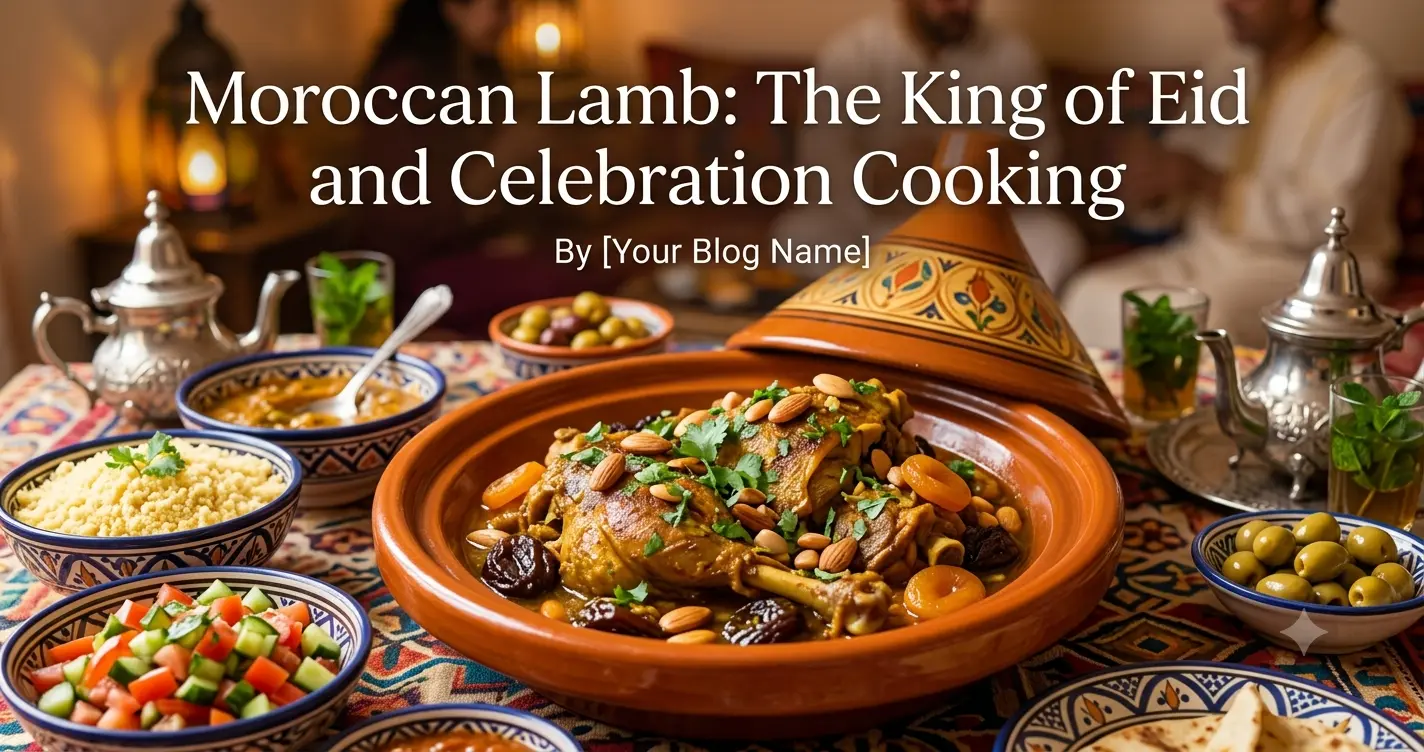
There is a moment that every Moroccan child remembers for the rest of their life — waking up before dawn on the morning of Eid al-Adha, the smell of wood smoke and cumin already threading through the cool air, the sound of family gathering in the courtyard below. Before the sun has fully risen, the sacrifice has been made, the prayers have been spoken, and the entire household has pivoted toward a single, magnificent purpose: cooking lamb. Not just any lamb. Moroccan lamb. And if you have never experienced this, if you have never sat cross-legged on a hand-woven kilim and torn into a haunch of mechoui so tender it collapses at the touch of your fingers, then you have not yet tasted one of the most extraordinary culinary traditions on the face of this earth.
At MaCooking.com, we have spent years documenting, testing, and celebrating the full spectrum of Moroccan cuisine, and we return again and again to lamb as the undisputed sovereign of the Moroccan table. This is not mere sentimentality. It is history, theology, agriculture, and flavor all woven into a single ingredient. In this guide, we are going to take you deep inside the world of Moroccan lamb cooking — its origins, its cultural weight, its essential recipes, and the specific techniques that separate a truly magnificent Moroccan lamb dish from anything you might find elsewhere in the world.
The Sacred History: Why Lamb Rules the Moroccan Table
To understand Moroccan lamb cooking, you must first understand the religious and agricultural landscape from which it emerged. Morocco sits at the crossroads of Berber, Arab, Andalusian, and Sub-Saharan African culinary traditions, and lamb has been central to all of them. The Atlas Mountains and the Middle Atlas plateaus have supported nomadic and semi-nomadic sheep herding communities for thousands of years. The Beni Merines, the Sardi, and the Timahdite sheep breeds, native to Morocco, produce meat with a particular quality — a delicate gaminess, excellent fat marbling, and a tenderness that responds beautifully to long, slow cooking.
The spiritual dimension runs just as deep. Eid al-Adha, the Festival of Sacrifice, commemorates the willingness of Ibrahim (Abraham) to sacrifice his son as an act of obedience to God, and the subsequent divine substitution of a ram in his place. For the approximately 99% of Morocco's population who are Muslim, this holiday is the most important day of the culinary calendar. Every household that can afford it sacrifices a sheep, and the entire animal — from the liver and heart to the kidneys, lungs, head, and trotters — is cooked and consumed over the following three days in an elaborate sequence of dishes that varies by region, family tradition, and personal preference.
This is not a one-day feast. It is a three-day culinary marathon that represents the pinnacle of Moroccan domestic cooking, and understanding it unlocks the deeper logic behind every Moroccan lamb recipe you will ever encounter.
The Three-Day Eid Lamb Sequence
- Day One (Liver and Offal): The celebration begins with the offal, particularly the liver, which is grilled over charcoal and wrapped in the caul fat of the animal. This is eaten within hours of the sacrifice, often for breakfast or lunch, seasoned with cumin, salt, and harissa.
- Day Two (Grilling and Tagine): The second day brings ribs to the charcoal grill and the appearance of early lamb tagines, often simple preparations with onions, tomatoes, and preserved lemon to let the meat speak clearly.
- Day Three (The Grand Dishes): By the third day, the cook has had time and the meat has had time. This is when the showpiece dishes emerge — the slow-roasted mechoui, the honeyed mrouzia, the elaborate couscous topped with braised shoulder. This is the feast that guests are invited to share.
Mechoui: The Whole Roasted Lamb That Defines Moroccan Celebration
If you ask any Moroccan what the single most important lamb dish in their culinary canon is, the majority will answer without hesitation: mechoui. The word comes from the Arabic root meaning "to grill" or "to roast," and the dish itself is breathtaking in its combination of simplicity and technical demand. A whole lamb, or a large leg or shoulder, is rubbed inside and out with a spiced butter paste — a mixture of smen (aged Moroccan butter), cumin, paprika, coriander, salt, and sometimes a touch of turmeric — then roasted slowly over a wood fire or in a traditional clay oven until the exterior is a deep, lacquered mahogany and the interior is so tender that the meat slides from the bone with almost no effort.
The Spiced Butter Paste: The Soul of Mechoui
The butter paste used in mechoui is not something to rush or substitute. Smen, the salted, fermented butter that is a cornerstone of Moroccan cooking, contributes a funky, complex depth that regular butter simply cannot replicate. If you cannot find smen at your local Middle Eastern or North African grocery store, you can approximate it by using a mixture of unsalted butter and a small amount of blue cheese (just enough for depth, not flavor dominance), or by making your own smen, a process that takes several weeks but is deeply rewarding. The full smen-making process is something we walk through in detail on MaCooking.com, and we recommend it to anyone serious about authentic Moroccan cooking.
Classic Mechoui Spice Rub — Ingredients and Proportions
- 150g (about 5 oz) smen or aged butter, softened
- 2 tablespoons ground cumin (freshly ground is non-negotiable)
- 1 tablespoon sweet paprika
- 1 teaspoon ground coriander
- 1 teaspoon ground ginger
- ½ teaspoon turmeric
- 1½ teaspoons fine sea salt
- 4 cloves garlic, finely minced to a paste
This mixture is worked into every surface of the lamb, and crucially, it is pushed under the skin wherever possible and rubbed into every cavity. The lamb should then rest for a minimum of four hours, and ideally overnight, before cooking begins. Low and slow is the absolute governing principle. Traditional Moroccan mechoui is cooked at temperatures that Westerners might consider alarmingly low — between 150°C and 165°C (300°F to 325°F) — for anywhere from four to seven hours depending on the size of the animal. This patience is what produces the extraordinary tenderness that makes mechoui legendary.
Mrouzia: The Honeyed, Spiced Lamb That Tells Morocco's Trade History
If mechoui is the king of Eid cooking in terms of spectacle, then mrouzia is its philosophical counterpart — a dish of almost incomprehensible complexity and historical depth. Mrouzia is a sweet and savory lamb tagine made with ras el hanout, honey, raisins, and almonds. It is traditionally prepared during Eid using the shoulder or rack of the sacrificial lamb, and it is intentionally made in large quantities because it keeps well and is shared with neighbors and the less fortunate, a practice known as sadaqah.
The flavor profile of mrouzia is unlike anything else in Western cooking. It is emphatically not a curry. It is not a stew in any conventional European sense. It sits in a category of its own — deeply savory from the slow-cooked lamb and the fat that renders into the sauce, but lifted and made extraordinary by the floral sweetness of local Moroccan honey (ideally thyme or jujube honey from the Atlas region), the fruity weight of plump raisins, and the textural contrast of whole blanched almonds. The spice blend is what ties it all together.
Understanding Ras El Hanout in the Context of Mrouzia
Ras el hanout — literally "head of the shop" or "top of the shelf" — is a spice blend that can contain anywhere from twelve to forty or more individual spices, depending on the spice merchant, the region, and the intended use. For mrouzia, the blend tends to include:
- Cinnamon (both cassia and true Ceylon cinnamon in high-quality versions)
- Coriander seed
- Black pepper and long pepper
- Ginger
- Turmeric
- Cardamom
- Nutmeg and mace
- Rose petals and rose buds
- Cubeb pepper
- Galangal
- Grains of paradise
- Sometimes saffron, though this is more common in royal or Fassi versions
This complexity is not accidental. It is a direct legacy of Morocco's position as a crossroads of the ancient spice trade routes. Caravans from sub-Saharan Africa, merchants from the Levant, and ships from the Indian subcontinent all passed through Moroccan trading cities like Fes, Marrakech, and Meknes, leaving their aromatics behind. Every pinch of ras el hanout in a pot of mrouzia is, in a sense, a small piece of world history.
"In Morocco, the spice merchant is not just a shopkeeper — he is the keeper of culinary memory. When he blends ras el hanout for a bride's family before her wedding feast, he is participating in a tradition that stretches back through centuries of celebration, commerce, and community. You cannot separate the spice from the story."
Regional Variations: How Moroccan Lamb Changes Across the Kingdom
One of the most common misconceptions about Moroccan cuisine among Western audiences is that it is monolithic — that there is one Moroccan way of doing things. In reality, Morocco is a country of extraordinary regional diversity, and this diversity is nowhere more apparent than in how different cities, tribes, and communities approach lamb.
Fes: The Intellectual Capital of Moroccan Cuisine
Fes is considered by most Moroccan food historians to be the birthplace of the most refined and elaborate Moroccan dishes. Fassi cooking tends toward complexity, layering spices with precision and incorporating influences from Andalusia — the Muslim and Jewish communities expelled from Spain in 1492 brought with them a culinary tradition of remarkable sophistication. Lamb in Fes might appear as pastilla bil lahm, a savory pie where spiced lamb is encased in paper-thin warqa pastry and dusted with cinnamon and powdered sugar, or as a tagine with preserved lemon, olives, and a saffron-forward broth that is almost perfume-like in its delicacy.
Marrakech: Heat, Color, and Theater
Marrakech cooking is bolder, more direct, and more deeply influenced by the Berber and Sub-Saharan African culinary traditions of the south. Lamb in Marrakech is more likely to be charcoal-grilled, spiced aggressively with cumin and harissa, and served simply with khobz bread for tearing. The famous tangia marrakchia — lamb slow-cooked in a sealed clay urn buried in the coals of a hammam — is perhaps the most radical cooking method in the entire Moroccan culinary repertoire, and it produces a result of extraordinary intensity.
The Atlas Mountains: Berber Simplicity
In the Atlas mountain communities, lamb cooking is at its most elemental. The spicing is minimal — salt, cumin, sometimes a little dried thyme or wild oregano — and the cooking method relies entirely on the quality of the animal and the heat of the fire. Berber mechoui from the mountains may not have the elaborate spice rub of a Fassi version, but the lamb itself, raised at altitude on wild mountain grasses, has a flavor that requires no embellishment.
Comparison Tables: Moroccan Lamb Cuts and Their Best Applications
| Cut | Best Cooking Method | Ideal Dish | Cooking Time | Difficulty Level |
|---|---|---|---|---|
| Whole Leg (Gigot) | Slow roasting | Mechoui | 4–6 hours at 150°C | Intermediate |
| Shoulder (Epaule) | Braising, tagine, slow roast | Mrouzia, shoulder tagine | 3–5 hours | Intermediate |
| Rack (Carré) | Grilling, quick roasting | Grilled ribs with cumin salt | 20–30 minutes | Beginner |
| Neck (Cou) | Long braising | Hearty tagine with root vegetables | 2.5–3.5 hours | Easy |
| Shank (Jarret) | Braising, pressure cooking | Lamb shank with chickpeas and preserved lemon | 2–3 hours braised | Easy |
| Liver and Offal | Quick grilling on charcoal | Eid morning liver with cumin | 5–10 minutes | Beginner |
| Minced/Ground Lamb | Pan-frying, stuffing, kefta | Kefta tagine with eggs and tomato | 30–45 minutes | Beginner |
Comparison: Moroccan Lamb Spice Profiles Across Key Dishes
| Dish | Dominant Spices | Flavor Profile | Sweetness Level | Heat Level |
|---|---|---|---|---|
| Mechoui | Cumin, paprika, coriander, smen | Earthy, savory, smoky | None | Mild |
| Mrouzia | Ras el hanout, cinnamon, honey | Sweet, floral, deeply complex | High | Very mild |
| Classic Lamb Tagine | Ginger, turmeric, saffron, preserved lemon | Bright, savory, citrus-forward | Low | Mild |
| Kefta Tagine | Cumin, paprika, parsley, onion | Herbaceous, savory, fresh | None | Mild to medium |
| Tangia Marrakchia | Ras el hanout, preserved lemon, saffron, smen | Intensely savory, funky, concentrated | None | Mild |
| Lamb Couscous (Friday) | Ginger, black pepper, onion, saffron | Warming, wholesome, golden | Low | Mild |
Essential Techniques Every Western Cook Must Master
Moroccan lamb cooking is not technically difficult in the way that, say, French haute cuisine can be. It does not require precision knife work or complex sauce reductions. What it requires is patience, an understanding of heat, and a willingness to trust the process. Here are the fundamental techniques that will transform your Moroccan lamb cooking:
1. The Long Marinade
Moroccan lamb is almost always marinated before cooking, and the minimum effective time is four hours, with overnight being vastly preferable and 24–48 hours being ideal for whole legs or shoulders. The marinade does two things simultaneously: it seasons the meat all the way through (not just the surface), and it begins to break down the collagen in tougher cuts, giving you a head start on tenderness before heat is even applied.
2. Building Flavor in the Base (Chermoula and Onion Foundations)
In tagine cooking, the foundation of flavor is built in the first 20–30 minutes before the main ingredient is even added in earnest. Grated onions — not sliced, not chopped, but grated on a box grater so they essentially dissolve — are cooked down with olive oil, preserved butter (smen), and spices until they form a deeply fragrant, almost jammy base. This foundation is non-negotiable. It is what gives Moroccan tagines their characteristic body and depth.
3. Low and Slow is Law
Whether you are using a traditional clay tagine, a Dutch oven, or a modern pressure cooker (which can compress cooking times significantly), the goal is always complete collagen breakdown and fat rendering. Moroccan lamb should never be resistant to a fork. If you have to cut it with a knife, it is not finished. The fat should have rendered into the sauce, the collagen should have dissolved into a silky, lip-coating gelatin, and the meat should be yielding and almost crumbling at the touch.
4. Finishing with Fresh Herbs and Preserved Elements
The final moments of a Moroccan lamb dish are as important as the first. Fresh cilantro and flat-leaf parsley are added at the end, not the beginning. Preserved lemon rind — the skin only, the pulp discarded — is stirred in during the last fifteen minutes of cooking so that it softens without dissolving entirely. These last-minute additions lift the entire dish and provide the brightness that balances the deep, long-cooked base flavors.
5. The Couscous Question
If you are serving your Moroccan lamb over or alongside couscous — and for many dishes, particularly the Friday couscous tradition, this is correct — please abandon the box instructions entirely. Traditional Moroccan couscous is hand-rolled, steam-cooked three times in the upper chamber of a couscoussier, rubbed with butter between each steaming, and finished with a little of the braising liquid ladled over it. Each grain should be separate, nutty, and fluffy. The compressed, slightly gluey couscous produced by simply pouring boiling water over the grains is a culinary compromise, not a tradition.
Sourcing Your Lamb: What Makes the Difference in the West
For Western cooks in the US, UK, Europe, Canada, or Australia, sourcing is one of the most impactful decisions you can make before you even touch a spice jar. The quality difference between commodity supermarket lamb and properly raised lamb from a specialist butcher is enormous.
- Seek out halal butchers: In major Western cities, halal butchers that serve North African or Middle Eastern communities will often source lamb that is closer in quality and breed to what is used in Morocco. The animals tend to be older than supermarket "spring lamb," which actually gives you a more complex flavor better suited to long cooking.
- Ask for grass-fed, pasture-raised: The grassy, slightly gamey quality that is characteristic of the best Moroccan lamb comes from animals raised on pasture. Grain-finished lamb is milder and fattier, which is not necessarily wrong, but it lacks the terroir-driven depth that makes mechoui extraordinary.
- Do not trim all the fat: Western butchers and home cooks often remove exterior fat instinctively. For Moroccan slow-cooking, this fat is essential. It bastes the meat from the outside during roasting and renders into the braising liquid during tagine cooking, contributing body and richness.
- Consider New Zealand or Australian lamb: For readers in the US and UK, New Zealand and Australian lamb is widely available and is often grass-fed and pasture-raised, making it a good substitute for Moroccan-raised breeds.
Frequently Asked Questions
Q1: Can I make mechoui without a whole lamb or a traditional clay oven?
Absolutely, and most home cooks outside Morocco will be doing exactly this. A bone-in lamb shoulder (around 2–2.5kg) is the ideal substitute for a whole roast. Apply your spiced butter rub generously, let it marinate overnight, and cook it in your regular oven in a roasting pan with a tight tent of aluminum foil at 150°C (300°F) for four hours, then remove the foil and raise the heat to 200°C (400°F) for the final 30–45 minutes to crisp and lacquer the exterior. The result will be genuinely outstanding. A Dutch oven with a tight-fitting lid also works beautifully and produces an even more tender result, though you sacrifice some of the roasted exterior character.
Q2: What is the difference between a lamb tagine and a lamb stew?
The difference is both philosophical and technical. A Western stew typically uses liquid (stock, wine, or water) as the primary cooking medium, and the meat is submerged. A Moroccan tagine uses the steam created by the conical clay lid to create a self-basting environment — very little liquid is added at the start, and what liquid exists in the finished dish is the condensed, intensified result of the meat's own juices and the aromatics. The spice architecture is also fundamentally different, as is the balance of sweet, sour, savory, and bitter elements that Moroccan cooking calibrates so carefully. A tagine is not a stew that happens to be cooked in a clay pot. It is a completely distinct culinary form.
Q3: What is smen and where can I find it outside Morocco?
Smen is a salted, fermented butter that is aged — sometimes for months, sometimes for years — in clay pots. It has a powerful, funky aroma reminiscent of aged cheese and contributes an irreplaceable depth to Moroccan cooking. In major Western cities, you can often find it at North African or Middle Eastern specialty grocery stores, particularly those serving Moroccan or Algerian communities. It is also available through some online specialty food retailers. If you genuinely cannot source it, the best substitution is good-quality unsalted European-style cultured butter mixed with a tiny amount of finely crumbled Roquefort or another pungent blue cheese — just enough to add complexity without dominating the dish. We have a full smen-making tutorial with step-by-step photography available at MaCooking.com.
Q4: Is it appropriate to cook Moroccan lamb dishes outside of Eid? Are they everyday recipes?
Yes, emphatically. While the grandest lamb dishes — mechoui, mrouzia, whole roasted lamb — are most closely associated with Eid al-Adha and special celebrations, lamb is a year-round staple of the Moroccan diet. The classic lamb tagine with preserved lemon and olives is a regular weeknight dish in many Moroccan households. Lamb and prune tagine appears at weddings and family gatherings throughout the year. Lamb couscous is the traditional Friday lunch across Morocco, eaten after Friday prayers as a family meal. Kefta — ground lamb meatballs — appear on street food stalls every day of the week. The celebratory dishes are celebrations of something that Moroccans love every day of the year.
Q5: How do I properly use a clay tagine for the first time, and is it worth the investment?
A clay tagine requires seasoning before its first use, much like cast iron. Soak the base and lid in cold water for several hours, then dry, rub the interior with olive oil, and place in a cold oven. Heat gradually to 150°C (300°F) and hold for an hour before letting it cool completely in the oven. This process cures the clay and significantly reduces the risk of cracking. When cooking with a clay tagine, always use a heat diffuser on gas or electric hobs and never place a cold tagine on a hot surface. As for whether it is worth the investment — yes, without qualification. The flavor that a clay tagine imparts to slow-cooked lamb through its gentle, all-around heat conduction is something no other piece of cookware fully replicates. It is an investment of approximately thirty to eighty dollars that will transform your Moroccan cooking immediately and measurably.
Conclusion: Bringing the Moroccan Lamb Tradition to Your Kitchen
Moroccan lamb is not simply a category of recipes. It is a living cultural inheritance — a connection between a family in Casablanca cooking in 2026 and their ancestors who cooked the same dishes in the same city four hundred years ago, between a shepherd in the Atlas Mountains and the spice traders of medieval Fes, between the sacred and the deeply, joyfully domestic. When you season a leg of lamb with cumin and smen, when you wait patiently while your tagine fills your kitchen with that extraordinary perfume of saffron and ginger and preserved lemon, you are doing something that transcends the act of feeding people. You are participating in one of the world's great culinary traditions.
The good news for Western cooks is that Moroccan lamb cooking is genuinely achievable in any kitchen with the right ingredients and a willingness to slow down. You do not need a wood fire or a traditional stone oven or a marble-floored riad kitchen. You need good lamb, proper spices, patience, and the knowledge that comes from reliable sources.
That is precisely what we have built at MaCooking.com — the most comprehensive and culturally grounded English-language resource for authentic Moroccan cuisine anywhere on the internet. Whether you are cooking your first tagine or attempting a traditional mechoui for a summer gathering, our recipe library, technique guides, ingredient sourcing advice, and video tutorials are there to walk you through every step of the process with the authority of genuine expertise and the warmth of genuine love for this extraordinary culinary tradition.
The lamb is waiting. The spices are ready. Let the feast begin.