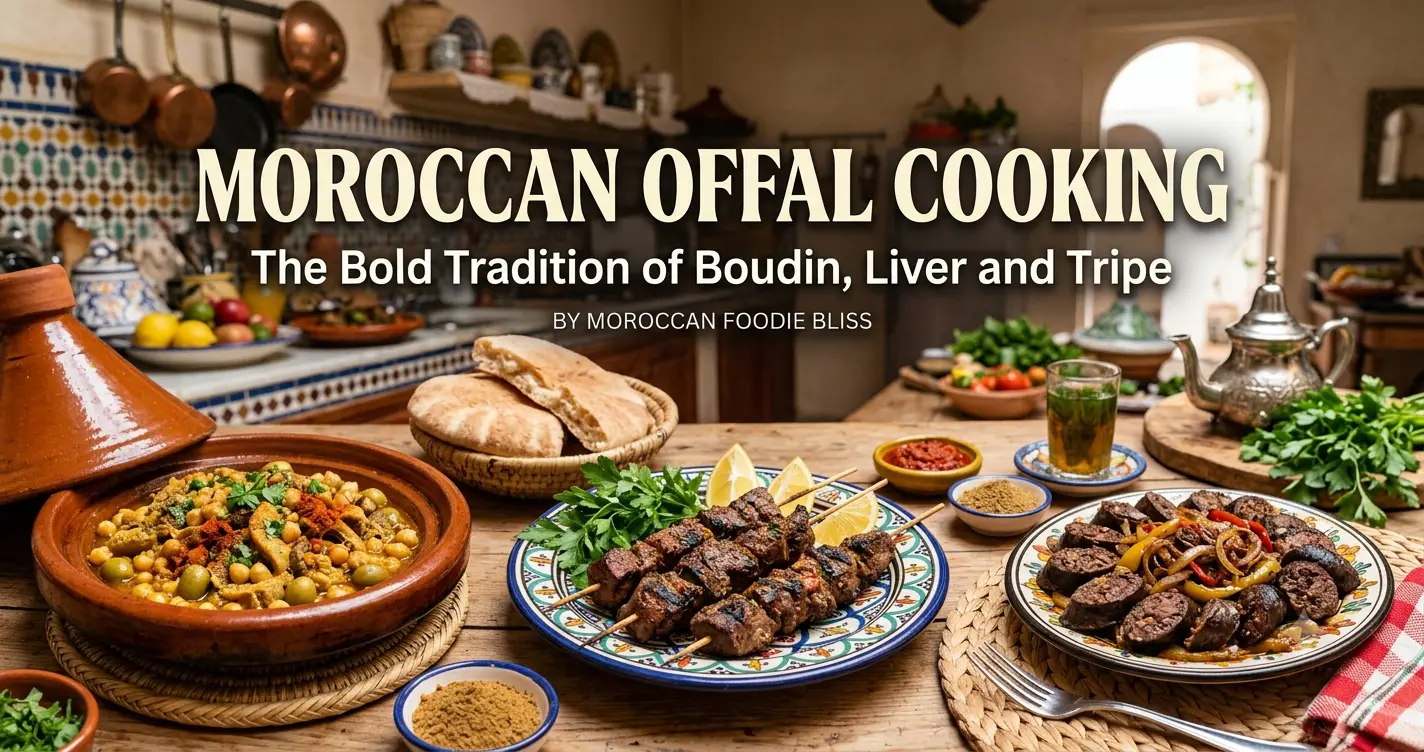
There is a moment — and if you have ever stood at a Moroccan street grill at dawn, you will know exactly what I mean — when the smoke rises from a charcoal fire, the scent of cumin and preserved lemon cuts through the morning air, and a vendor slides a skewer of warm, spiced liver onto a piece of khobz bread still hot from the oven. That moment is not just breakfast. It is centuries of Moroccan culinary philosophy distilled into a single bite: the belief that every part of an animal is a gift, that boldness is never waste, and that the most honest cooking comes from the cuts that require the most respect. Welcome to the world of Moroccan offal — a tradition as ancient as the souks themselves, as alive today as it has ever been, and one that deserves far more appreciation from the wider culinary world than it currently receives.
For many Western readers, the word “offal” still carries a faint shadow of hesitation. Organ meats, intestines, blood sausages — these are ingredients that mainstream food culture pushed to the margins for decades. But in Morocco, they were never marginal. They were central. They were celebratory. They were the food you made for your most important guests, the food your grandmother prepared on feast days, the food that defined who you were and where you came from. At MaCooking, we have always believed that understanding Moroccan food means embracing all of it — including, and especially, the parts that challenge comfortable assumptions. This post is our most thorough dive yet into the boudin, liver, tripe, and offal traditions that make Moroccan cuisine one of the most complete and philosophically rich food cultures on earth.
1. The Philosophy Behind Moroccan Nose-to-Tail Eating
Before we get into specific dishes, we need to understand the why. Morocco did not develop its offal traditions by accident or out of poverty alone — though economic pragmatism certainly played a role throughout history. The tradition runs deeper, woven into Islamic principles of gratitude and non-waste, Berber traditions of collective butchery, and the simple reality of a culture that has always treated the kitchen as a place of transformation rather than mere assembly.
The Islamic concept of baraka — divine blessing — extends to food in powerful ways in Moroccan culture. Wasting the flesh of an animal that has been sacrificed, or slaughtered according to halal principles, is not just economically foolish; it is spiritually disrespectful. The animal gave its life. Every part of that life deserves to become something meaningful. This is why, at an Eid al-Adha celebration, you will find a Moroccan family using not just the prime cuts of the lamb but the liver, the lungs, the heart, the kidneys, the intestines, the stomach, the feet, the head, and yes, the blood. Nothing is left behind. Everything becomes food.
The Berber Foundations of Whole-Animal Cooking
Long before the Arab conquests of the 7th century brought Islamic traditions to North Africa, the indigenous Amazigh (Berber) peoples of Morocco were already practicing sophisticated whole-animal butchery. Archaeological and anthropological evidence suggests that Berber communities in the Atlas Mountains and along the Atlantic coast had developed communal slaughtering and preservation techniques stretching back thousands of years. Offal was not a secondary consideration — it was the first consideration, because organ meats spoil faster than muscle meat and therefore needed to be cooked and eaten immediately after slaughter. The freshness imperative that still governs Moroccan offal cooking today — the insistence on cooking liver within hours, not days — has its roots in this ancient practical wisdom.
The Arab and Andalusian Influence
When Arab traders, scholars, and settlers brought their own culinary traditions to Morocco from the 7th century onward, and when the Moors who were expelled from Andalusia in the 15th and 16th centuries brought the sophisticated spice knowledge of medieval Islamic Spain, Moroccan offal cooking gained layers of complexity it has never lost. Spice blends like ras el hanout — which can contain anywhere from 12 to 40 individual spices — were applied not just to lamb shoulders and chicken tagines but to hearts, kidneys, and tripe with equal care and attention. The Andalusian Moors, who had spent centuries absorbing Roman, Visigothic, and early Islamic cooking traditions, brought techniques for blood sausages, stuffed intestines, and spiced organ braises that remain visible in Moroccan cooking to this day.
“In Morocco, the organ meats are not the forgotten cuts. They are the remembered ones — the ones that require skill, care, and knowledge to prepare well. Any cook can roast a leg of lamb. It takes a real cook to transform a stomach into something transcendent.”
2. Moroccan Boudin: The Art of the Blood Sausage
Let us begin with the dish that surprises Western visitors most: Moroccan boudin, known locally as dmerguez (though that term is more commonly applied to the well-known spiced lamb sausage) or simply as the blood sausage you find at every serious butcher and at the grills that spring up around mosques on Eid morning. Moroccan blood sausage is distinct from its French, Spanish, or British counterparts in ways that matter enormously to the eating experience.
What Makes Moroccan Boudin Different
French boudin noir tends toward a smooth, almost pudding-like texture with a rich, iron-forward flavor. British black pudding leans heavily on oats and fat. Spanish morcilla introduces rice, onion, and often pine nuts. Moroccan blood sausage, by contrast, is built around a very different flavor architecture. The blood — typically lamb or beef — is mixed with fat, onions, and a spice blend that almost always includes cumin (kamoun), paprika, coriander, black pepper, and frequently a touch of cinnamon and harissa paste for heat. The result is a sausage that is simultaneously earthy, warm, aromatic, and faintly sweet, with a texture that is softer than French boudin but more structured than British black pudding.
The casing used is almost always the natural intestine of the slaughtered animal, cleaned meticulously and stuffed by hand. This is a skill passed down within families, and there is enormous pride attached to it. I have watched elderly women in Marrakech medinas who can stuff and tie a boudin with a speed and dexterity that would humiliate a culinary school graduate. The tying technique matters because it determines how the sausage holds together during grilling — Moroccan boudin is almost always finished over charcoal, not boiled or pan-fried as in European traditions.
Regional Variations in Moroccan Boudin
| Region | Key Distinguishing Ingredient | Typical Cooking Method | Flavor Profile |
|---|---|---|---|
| Marrakech | Extra cumin, preserved lemon zest | Charcoal grill, Jemaa el-Fna style | Bold, smoky, citrus-edged |
| Fez | Ras el hanout blend, pine nuts | Grilled, then braised in tomato sauce | Complex, aromatic, slightly sweet |
| Casablanca | Harissa, fresh herbs | Pan-fried or grilled | Spicy, fresh, urban-influenced |
| Essaouira / Coastal | Fennel seed, sea salt emphasis | Grilled over driftwood charcoal | Anise-forward, sea-salty, clean |
| Atlas Mountain Berber | Wild herbs (thyme, oregano), minimal spice | Roasted over open fire | Rustic, herbal, intensely meaty |
How to Approach Moroccan Boudin at Home
If you are cooking Moroccan boudin outside Morocco, the most important challenge is sourcing. You need fresh lamb or beef blood — which may require a relationship with a halal butcher — and you need natural casings that have been properly cleaned. Do not attempt to use frozen blood; the texture of the finished sausage will be grainy and the flavor flat. The spicing is relatively straightforward once you have your base ingredients, and the grilling step is non-negotiable. A cast-iron pan can approximate the charcoal grill in a domestic kitchen, but you must accept that you are making a very good approximation, not the real thing. The smoke matters. The direct heat matters. The slight char on the casing is not aesthetic — it adds a layer of bitterness that balances the richness of the blood filling.
3. Moroccan Liver: From Street Grill to Festival Table
If Moroccan boudin is the dish that surprises Western visitors, Moroccan liver is the one that converts them. I have watched people who swore they hated liver eat three skewers of Moroccan-spiced liver in a row without pausing for breath. The transformation that Moroccan spicing and technique work on liver is, without exaggeration, one of the most impressive demonstrations of culinary alchemy in any food culture I know.
Boulfaf: The Sacred Eid Liver Skewer
Boulfaf is the name for a specific preparation that is almost exclusively made on Eid al-Adha morning, and it represents one of the most emotionally loaded dishes in the entire Moroccan culinary canon. Immediately after the ritual slaughter of the sheep, the liver is removed, cut into cubes, seasoned with cumin, salt, paprika, and black pepper, wrapped in the caul fat (crépine) of the same animal, and skewered. It goes onto the charcoal fire within thirty minutes of slaughter. The caul fat bastes the liver continuously as it grills, keeping it moist, adding richness, and crisping to a delicate lacework around each cube. The result is extraordinary: the liver is still faintly pink at the center, the exterior is caramelized and smoky, and the cumin has penetrated every fiber.
Eating boulfaf on Eid morning, standing in the courtyard with your family, the smoke rising, the city calling out prayers around you — this is one of those food experiences that transcends the dish itself. It is ritual. It is memory. It is continuity with every generation that has done exactly the same thing on exactly the same morning.
Everyday Moroccan Liver: The Street Grill Tradition
Outside of Eid, liver is a constant presence at Moroccan street grills and in home kitchens. The everyday preparation is simpler than boulfaf but no less carefully executed. Lamb liver — always preferably from young animals for its mildness — is sliced thin, seasoned generously, and cooked over high heat for a very short time. Overcooking is the cardinal sin of Moroccan liver preparation, and every serious Moroccan cook will tell you this with an urgency that suggests actual moral stakes are involved. Two minutes per side over a very hot grill. No more. The center should be just barely cooked through, still yielding, never grainy or gray.
The spice combination most commonly applied to everyday grilled liver in Morocco involves:
- Cumin (kamoun): The backbone of nearly all Moroccan meat seasoning, applied in larger quantities to liver than to any other cut
- Sweet paprika: For color, mild sweetness, and that characteristic terracotta hue
- Salt: Applied generously and ideally allowed to sit for 10-15 minutes before grilling
- Black pepper: Coarsely ground, not fine — the texture matters on liver
- Fresh coriander (cilantro): Added after cooking, as garnish and flavor contrast
- Preserved lemon (hamad m'rakad): A few thin slivers served alongside, not cooked in — the acidity cuts the iron richness of the liver brilliantly
- Harissa: Optional, on the side, for those who want heat — in Morocco, heat is always a personal choice, never imposed
Liver in Moroccan Home Cooking: Beyond the Grill
While grilling is the most iconic preparation, Moroccan home cooking has a rich tradition of braised liver dishes that showcase the ingredient differently. In a classic Moroccan liver tagine, the liver is cut into larger chunks and cooked slowly with onions, preserved lemon, olives, and a blend of spices that might include ginger, turmeric, and saffron. The slow cooking changes the texture completely — it becomes tender and yielding in a way that grilled liver never achieves, absorbing the braising liquid and becoming something almost spreadable. Served over couscous, this is the kind of dish that requires nothing else. It is complete in itself.
4. Moroccan Tripe: The Patience Dish
Tripe is where the casual offal eater discovers whether they have what it takes to go deeper. It requires more preparation, more time, and more trust in the process than either liver or boudin. In Morocco, that investment is considered entirely normal and entirely worthwhile, and the Moroccan approach to tripe cooking produces results that bear almost no resemblance to the pallid, rubbery preparations that gave offal a bad name in mid-20th century Western cooking.
Preparing Moroccan Tripe: The Cleaning Process
The first thing you need to understand about Moroccan tripe preparation is that the cleaning process is not an inconvenience — it is part of the dish. Moroccan cooks, whether they are working in a professional kitchen or at home the day after Eid, approach tripe cleaning with a focused, methodical care that itself communicates respect for the ingredient. The tripe is rinsed multiple times in cold water, rubbed with salt and vinegar or lemon juice to remove impurities and reduce the characteristic smell, scraped where necessary, and then blanched in boiling water before the actual cooking begins. This process takes time — at least an hour, sometimes two — and shortcuts show up in the finished dish as off-flavors and unpleasant textures.
Once cleaned, the tripe is cut into pieces and is ready for what is genuinely one of the most rewarding long-cook preparations in Moroccan cuisine.
Moroccan Tripe Tagine (Kaweh)
The most celebrated Moroccan tripe preparation is known as kaweh or tripes marocaines in the French-influenced urban tradition, and it is a dish that rewards patience absolutely. The cleaned tripe goes into a tagine or heavy pot with a foundation of:
- Finely chopped onions, sweated low and slow in olive oil until almost melted
- Fresh tomatoes, grated or finely chopped, cooked down to a deep paste
- A spice blend anchored by cumin, ginger, turmeric, paprika, and black pepper
- Fresh coriander and flat-leaf parsley in generous quantities
- Preserved lemon, added in the final thirty minutes of cooking
- Chickpeas, which are traditional in many regional versions and add body and texture
The tripe cooks in this fragrant base for anywhere from two to four hours over very low heat. What happens during that time is the kind of transformation that justifies every minute of waiting. The tripe gradually softens from rubbery resistance to a yielding, almost silky texture while absorbing the complex spice base. The collagen in the tripe releases into the cooking liquid, creating a sauce of extraordinary body and depth. By the time the dish is finished, you have a tagine that is simultaneously rich and bright, heavy and aromatic, with a texture contrast between the soft tripe and the firm chickpeas that makes every bite interesting.
Moroccan Tripe vs. Other Global Tripe Preparations
| Country / Tradition | Preparation Name | Key Flavoring | Texture Goal | Typical Accompaniment |
|---|---|---|---|---|
| Morocco | Kaweh / Tripes Marocaines | Cumin, preserved lemon, chickpeas | Tender-silky | Khobz bread, couscous |
| Italy | Trippa alla Romana | Tomato, mint, pecorino | Tender but slightly chewy | Crusty bread, Roman-style |
| France | Tripes à la mode de Caen | Cider, calvados, vegetables | Very tender, gelatinous | Boiled potatoes, mustard |
| Mexico | Menudo | Dried chiles, hominy, oregano | Chewy-tender | Corn tortillas, lime |
| China (Sichuan) | Mao Xue Wang | Doubanjiang, Sichuan pepper, blood tofu | Tender, varied textures | Rice, sesame bread |
| Scotland | Haggis (sheep stomach) | Oats, onion, black pepper, nutmeg | Firm, crumbly filling | Neeps and tatties |
5. The Festival Dimension: Offal and Eid al-Adha
No discussion of Moroccan offal cooking can be complete without a deep engagement with Eid al-Adha — the Festival of Sacrifice — which is the single most important culinary event in the Moroccan calendar and the occasion around which the entire offal tradition revolves. If you want to understand why Moroccan families have such intimate, expert knowledge of offal cooking, you need to understand what happens in every courtyard, rooftop, and kitchen across the country on Eid morning.
The Morning of Eid: A Culinary Ritual
Eid al-Adha commemorates the willingness of Ibrahim (Abraham) to sacrifice his son in obedience to God, and the divine provision of a ram in the son's place. Every Muslim family that can afford to do so sacrifices an animal — almost always a sheep in Morocco, sometimes a cow or goat — and the butchery that follows is a highly organized family event governed by tradition, skill, and an understood division of labor that has been refined over generations.
The organ meats come first, always. As noted, the liver goes onto the fire immediately for boulfaf. But alongside the liver, other organs are prepared in rapid succession: the kidneys, seasoned simply and grilled quickly; the heart, sliced and spiced; the lungs, which require slightly longer cooking and are often braised rather than grilled; and the testicles, which are considered a delicacy and are prepared with particular care. By noon, the family will have eaten a complete meal of organ meats while the prime cuts — the legs, shoulders, neck — are portioned and set aside for later cooking, for preservation, or for sharing with neighbors and those in need (giving one-third of the animal to the poor is a traditional obligation).
The Offal Preservation Tradition: Khlea and Kaddid
One of the most fascinating aspects of Moroccan offal culture is the preservation tradition that extends beyond Eid itself. Kaddid — a spiced, dried, and salted meat preservation technique — is applied to many cuts from the Eid sacrifice, including some organ meats, and the preserved meat is used throughout the following year in dishes like khlea (or khli'), a confit-style preparation where the meat is cooked and preserved in its own fat. Khlea made with organs has a concentration of flavor that is almost overwhelming — deeply savory, intensely spiced, with a richness that transforms even simple dishes like eggs or beans into something extraordinary.
This preservation tradition represents perhaps the ultimate expression of the Moroccan no-waste philosophy: not only is every part of the animal used immediately, but preparations are made that extend the animal's contribution to the family table for months afterward. At MaCooking, we have dedicated entire recipe sections to these preservation techniques, because they represent knowledge that is genuinely at risk of being lost as urban lifestyles and supermarket culture encroach on traditional practices.
6. Moroccan Stuffed Offal: The Art of Mrouzia and Beyond
Beyond the individual organ preparations, Moroccan cuisine has a sophisticated tradition of stuffed offal dishes that showcase the intersection of skilled butchery, spice knowledge, and culinary patience. These are the dishes that Moroccan grandmothers are most proud of, the ones that require the most skill and produce the most impressive results.
Stuffed Spleen (Tihane or Touria)
Stuffed spleen is one of those Moroccan dishes that sounds alarming to the uninitiated and tastes remarkable to anyone brave enough to try it. The spleen — which has a mild, slightly mineral flavor and a smooth, yielding texture — is carefully opened, filled with a fragrant mixture of rice or bread, onions, fresh herbs, spices, and sometimes small amounts of other organ meats, then sewn closed and either grilled or baked. The finished dish is sliced like a sausage and served warm. The stuffing absorbs the mineral depth of the spleen while the spleen itself takes on the fragrance of the filling from the inside. It is a lesson in how cooking from the inside out can produce flavors that exterior seasoning can never achieve.
Stuffed Intestines (Mrouzia-Style Preparation)
Not to be confused with the famous lamb and honey tagine of the same name, the mrouzia-style stuffed intestine preparation is a festival specialty in many Moroccan regions. Cleaned intestines are filled with a mixture of seasoned rice, herbs, and spices, tied at intervals to create individual portions, and then either grilled or slow-cooked in a spiced broth. The result is something between a sausage and a dumpling — the intestine casing providing a yielding, slightly gelatinous exterior while the rice filling absorbs every drop of flavor from both the casing and the cooking liquid.
Practical Tips for Cooking Moroccan Offal at Home
For Western home cooks approaching Moroccan offal for the first time, here is accumulated practical wisdom that will save you significant frustration:
- Source from halal butchers first: Halal butchers handle offal far more routinely than mainstream supermarkets and will typically have fresher product, better cleaning knowledge, and the ability to advise you on what to look for
- Freshness is not negotiable: Liver should be cooked within 24 hours of purchase. Tripe within 48 hours at most. Blood sausage should be made and cooked same-day. The flavor and texture differences between fresh and slightly aged offal are dramatic
- Over-seasoning is better than under-seasoning: Organ meats have strong inherent flavors that require confident seasoning. Do not be timid with the cumin and salt
- Do not overcrowd the pan or grill: Organ meats release moisture quickly; overcrowding causes steaming rather than searing, and the texture deteriorates rapidly
- Have your acid component ready: Preserved lemon, fresh lemon juice, or good vinegar on the side is not optional — it is a structural component of the flavor balance
- Manage your heat deliberately: Liver and kidneys want high heat and short time. Tripe wants low heat and long time. Confuse these and you will understand why people say they dislike offal
- Trust your nose: Properly cleaned and fresh offal smells mineral and meaty, not unpleasant. If something smells wrong before cooking, it is wrong. Do not proceed
7. Navigating Moroccan Offal: A Visitor's Guide
For travelers visiting Morocco, the offal tradition presents one of the most authentic and rewarding culinary experiences available — provided you know where to look and how to approach it. The tourist-facing restaurants of Marrakech's medina will give you a perfectly enjoyable dinner, but they will not give you this. For this, you need to go where Moroccans actually eat.
Where to Find the Best Moroccan Offal
The best offal in Morocco is found in three types of locations:
- Early morning street grills near mosques and markets: These operate roughly from 6am to 10am and serve the working population heading to the souks. The liver and boudin served here will be the freshest you can find anywhere, cooked to order over charcoal
- Traditional mechoui and grill restaurants in medinas: In cities like Fez, Meknès, and Marrakech, there are restaurants that have been serving nothing but grilled meats and offal for generations. Ask locals — the places with the longest lines of Moroccans are always the right answer
- During and immediately after Eid al-Adha: If you are fortunate enough to be in Morocco during Eid, accept any invitation to share in a family celebration. This is when the full depth and complexity of the offal tradition is on display
A Word on Moroccan Food Etiquette Around Offal
When eating offal in a Moroccan home or at a traditional restaurant, a few cultural notes will serve you well. Never refuse the first offering — it is a gesture of hospitality and respect. If you are genuinely unable to eat something for dietary or health reasons, explain quietly and your host will not take offense. But if you are simply hesitant because the ingredient is unfamiliar, push through that hesitation. Moroccan hospitality is an active force, and sharing food — even challenging food — is one of the primary ways it is expressed. Declining without good reason can read as rejection rather than preference.
The resources and cultural context available at MaCooking have helped thousands of visitors prepare themselves culturally before arriving in Morocco, and that preparation genuinely changes the quality of the experience. A traveler who understands why boulfaf is made on Eid morning eats it differently — more attentively, more gratefully — than one who encounters it as mere novelty.
8. The Nutritional Dimension: Why Moroccan Offal is Also Smart Eating
The nutritional case for offal eating is surprisingly strong, and it aligns naturally with the Moroccan emphasis on whole, minimally processed food. Setting aside the moral and environmental arguments for nose-to-tail eating — which are considerable — the nutritional profile of organ meats deserves serious attention.
Nutritional Highlights of Key Moroccan Offal
- Liver: Arguably the most nutrient-dense food available anywhere. An extraordinary source of vitamin A (retinol, not beta-carotene), B12, folate, iron, zinc, copper, and coenzyme Q10. Moroccan-style preparation — quick grilling with cumin and preserved lemon — preserves most of these nutrients because the cooking time is short
- Kidneys: High in protein, B12, riboflavin, and selenium. Mild and accessible once properly prepared; Moroccan spicing makes them one of the most palatable kidney preparations anywhere
- Tripe: Relatively low in fat, surprisingly high in protein, and an excellent source of zinc and selenium. The long cooking in olive oil-based sauces that characterizes Moroccan tripe preparation adds healthy monounsaturated fats to an already nutritionally respectable ingredient
- Heart: Technically a muscle meat, but with a nutritional profile that resembles other organ meats: high in CoQ10, B vitamins, iron, and zinc. Moroccan grilled heart is one of the most underrated dishes on any grill
- Blood sausage: One of the most bioavailable sources of dietary iron available, which makes it genuinely significant for populations at risk of iron-deficiency anemia. The fat content is higher than other offal preparations, but when consumed in the context of a varied diet, this is not a concern
It is worth noting that the Moroccan dietary tradition — combining organ meats with olive oil, fresh herbs, preserved lemon, and spices with known antioxidant properties — intuitively addresses many of the concerns that Western nutritionists raise about organ meat consumption. The preserved lemon provides vitamin C, which dramatically improves iron absorption. The olive oil provides vitamin E, which complements the fat-soluble vitamins in liver. The cumin and coriander bring their own antioxidant and digestive-support properties. This is a food culture that, long before nutritional science existed, found through practice what science is only now documenting.
FAQ: Moroccan Offal Cooking — Your Questions Answered
Q: I have never eaten offal before. What Moroccan offal dish should I try first?
A: Without any hesitation, start with Moroccan grilled liver. It is the most accessible introduction because the cooking time is short (meaning the texture is less challenging than tripe or braised organ meats), the spicing is familiar and appealing even to complete beginners, and the dish is available widely at Moroccan street grills and restaurants. If you are cooking at home for the first time, buy lamb liver — not beef — from a halal butcher, slice it about 1cm thick, season generously with cumin, salt, and sweet paprika, and cook it in a very hot cast-iron pan for no more than ninety seconds per side. Serve it with flatbread, fresh coriander, and a wedge of lemon. That first bite will tell you everything you need to know about why Moroccan offal has a devoted following.
Q: How do I deal with the smell when cooking organ meats?
A: The “offal smell” that puts many Western cooks off is largely a product of poor sourcing and insufficient cleaning, not an inherent property of the ingredients. Fresh, properly cleaned liver and kidneys have a mineral, meaty smell that is no more challenging than any other raw meat. For tripe, the cleaning process — multiple rinses with salt and lemon or vinegar, followed by blanching — removes the characteristic smell effectively. If you are finding the smell of your liver or kidneys genuinely unpleasant before cooking, that is your freshness indicator: the product is not fresh enough, and you should return it. Good sourcing from a halal butcher with high turnover eliminates most smell problems before they start. The Moroccan solution — bold spicing with cumin, paprika, and herbs — also transforms any residual mineral aroma into something appetizing rather than off-putting.
Q: Is it safe to eat liver slightly pink in the center, as Moroccan cooking recommends?
A: Yes, with appropriate sourcing. Unlike whole muscle cuts where pathogens are surface-level, organ meats have a different risk profile that requires awareness but not alarm. The key considerations are: source from reputable, high-quality butchers (ideally halal butchers with high turnover); ensure the liver has been refrigerated properly and is within its freshness window; and cook to the temperatures recommended for your jurisdiction. The Moroccan tradition of just-cooked, faintly pink liver centers has been practiced safely for centuries, but it operates within a system of very fresh sourcing that modern Western shoppers need to consciously replicate. When in doubt, cook slightly longer — it is better to slightly overcook your first few attempts than to undercook. As you become more comfortable with the ingredient, you will learn to read the visual and textural cues that indicate doneness.
Q: Can I make authentic Moroccan offal dishes without access to a charcoal grill?
A: Largely yes, with some honest compromises. A cast-iron skillet preheated until smoking hot is the best domestic substitute for a charcoal grill, and for liver, kidneys, and heart, it produces results that are genuinely very close to the original. The smoke flavor is absent, but the crust and caramelization are achievable. For boudin, a cast-iron pan or a domestic gas grill both work reasonably well. For tripe tagine, the absence of a grill is irrelevant — that dish is cooked entirely in a pot and requires only a stovetop or oven. Where you will feel the lack of charcoal most strongly is with boulfaf, where the caul fat wrapper needs the specific heat behavior of charcoal to render and crisp properly without burning the liver inside. A very hot grill pan with a lid can approximate this, but it requires attention and practice. The recipes available on MaCooking include specific domestic kitchen adaptations for each dish.
Q: Are there vegetarian or lower-fat versions of these Moroccan offal dishes?
A: This is a gentle but important question, and the honest answer is: not really, in any authentic sense. Moroccan offal cooking is definitionally about animal organs, and there is no plant-based substitute that replicates the experience. The dishes exist within a whole-animal, nose-to-tail philosophy that is intrinsically connected to animal husbandry and sacrifice. That said, the spice profiles and cooking techniques of Moroccan offal dishes can absolutely be applied to other ingredients for those who do not eat organ meats. The cumin-forward, preserved lemon-accented flavor profile works beautifully on grilled eggplant, spiced lamb meatballs, or even robust mushrooms. But if we are being honest: these are different dishes, not substitutes. The texture, depth, and nutritional profile of organ meats are specific to organ meats. Moroccan cuisine is also extraordinarily rich in completely plant-forward dishes — couscous preparations, harira, zaalouk, taktouka — and anyone seeking a vegetarian entry point into this food culture has endless options. We cover all of them in depth at MaCooking.
Conclusion: Embracing the Full Table
Moroccan offal cooking is not a niche within Moroccan cuisine. It is, in many ways, its philosophical core. The willingness to approach every ingredient with respect, skill, and genuine curiosity; the insistence that transformation — not just execution — is the cook's real job; the deep cultural knowledge of spice, heat, time, and acid that turns challenging raw materials into extraordinary finished dishes: these are not special qualities reserved for the organ meat preparations. They are the qualities that define Moroccan cooking across every category. The offal tradition simply makes them most visible, because it is where the philosophy is most tested.
If you have been approaching Moroccan cuisine from the comfortable end — the tagines, the couscous, the pastilla and the bastilla — and have left the boudin, the liver, and the tripe for another day, I want to gently suggest that that other day has arrived. Not because you should eat everything, but because the fullest understanding of any food culture comes from engaging with it completely, on its own terms, without the filter of your own comfort zone. The reward for that engagement, in this case, is a set of dishes that will genuinely surprise you, that will change your understanding of what cooking can do with humble ingredients, and that will give you a new window into a civilization that has been feeding itself beautifully for a very long time.
The tradition is alive. The knowledge is here. The only thing required is the willingness to begin.