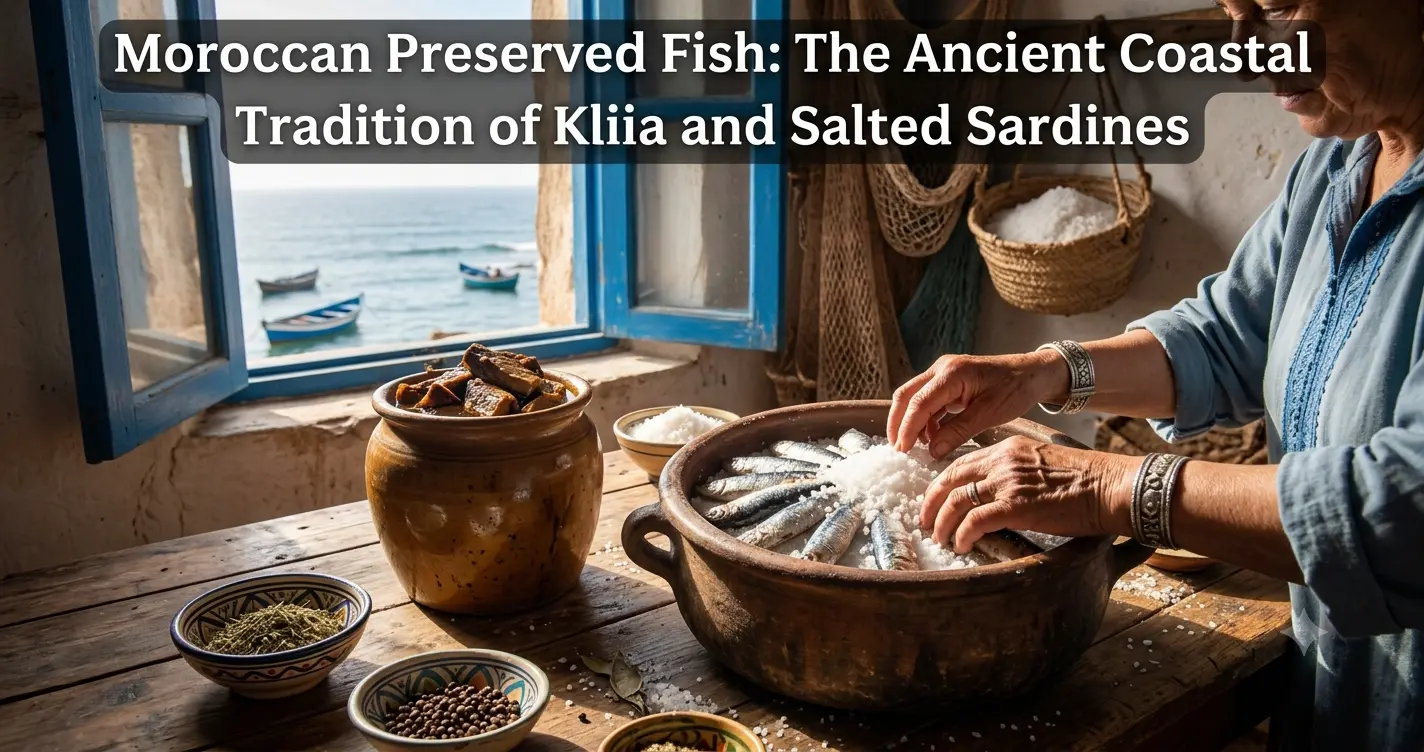
There is a moment, if you have ever wandered through the medina of Essaouira on a salt-sharp Atlantic morning, when the smell of the ocean seems to seep into the very walls of the city. The blue-painted doorways, the screaming gulls overhead, the fishermen hauling their catch up from the port — and then, tucked into the corner of a souk stall, a clay jar sealed with cloth and packed tight with something ancient, glistening, and intensely alive with flavor. That jar holds preserved fish, and behind it sits one of Morocco's most underappreciated culinary traditions. Long before refrigerators, before canning factories, before shrink-wrapped fillets in supermarkets, Moroccan coastal communities had already mastered the art of keeping fish — salting, drying, fermenting, and storing it in ways that concentrated flavor to an almost shocking degree. This is the world of kliia, of salted sardines packed in ceramic crocks, of sun-dried bonito and fermented shrimp paste, and it is a world that the global food community is only just beginning to appreciate. At MaCooking, we have spent years documenting these traditions directly from the women and men who carry them, and what follows is the most comprehensive English-language guide to Moroccan preserved fish you will find anywhere.
1. Understanding Preservation in Moroccan Food Culture: A Philosophy, Not Just a Technique
Before we dive into jars and salt crusts, we need to understand something fundamental: food preservation in Morocco is not a workaround for the absence of refrigeration. It is a culinary philosophy. Moroccans preserve food because preserved food tastes better — more complex, more layered, more deeply connected to place and season. The same logic that drives the making of smen (preserved fermented butter) or kliia l'hamra (preserved meat in spiced fat) applies equally to fish. Preservation is transformation, and transformation is the soul of Moroccan cooking.
The country's geography makes this philosophy almost inevitable. Morocco possesses one of the most extraordinary coastlines in the world — over 3,500 kilometers of Atlantic and Mediterranean shore, stretching from the wild, fog-shrouded waters near Dakhla in the south to the sun-bleached beaches of Saidia in the northeast. This coastline has fed Moroccan civilization for millennia, but it has also presented a challenge: how do you take the abundance of a good fishing season and stretch it through the lean months? The answer, developed over generations, was preservation, and the techniques that emerged are astonishingly sophisticated.
What is equally remarkable is how deeply preservation connects the coast to the interior. The mountains of the Atlas and the pre-Saharan oases were not fishing communities, yet salted sardines and dried fish were regular features of their diets. Caravans carried preserved fish just as they carried spices, dates, and salt. The flavors of the Atlantic coast traveled inland on the backs of mules, and the culinary traditions of the coast became embedded in regions hundreds of kilometers from the sea. This interchange — coastal abundance meeting inland ingenuity — is a defining thread of Moroccan food culture, and preserved fish sits right at its heart.
The Role of Women in Preserving Knowledge
It would be impossible to discuss Moroccan preserved fish without acknowledging the women who have been its primary custodians. In fishing households from Agadir to Nador, it was the women who managed the jars, who knew how much salt to use and when, who passed the knowledge to their daughters in the same way they passed down recipes for harira or techniques for weaving djellabas. This knowledge is oral, embodied, and dangerously close to being lost in an era of industrial food. Part of what we try to do at MaCooking is capture this knowledge before it disappears — not as a museum exhibit, but as living, usable culinary instruction.
2. Kliia: Morocco's Most Complex Preserved Fish
If salted sardines are Morocco's most democratic preserved fish — found in every coastal market, affordable to every household — then kliia is its aristocrat. The word itself can cause some confusion, because in Moroccan Arabic, kliia (also spelled khlia or klii) most commonly refers to preserved beef or lamb cooked down in spiced fat. But along the Atlantic coast, particularly in the regions around Agadir, Tiznit, and the Souss valley, the same word describes a preparation of preserved fish that follows a similar logic: slow-cooking, fat preservation, and intense spicing to create something that will last for weeks or months without refrigeration.
The Origins of Fish Kliia
Fish kliia is almost certainly an adaptation of meat kliia, brought to coastal communities either by nomadic Amazigh (Berber) groups who moved between the mountains and the sea, or developed independently by fishing families who observed the same preservation logic at work in the fat-preserved meats they encountered in inland markets. The Souss region, which sits at the intersection of Amazigh mountain culture and Atlantic coastal culture, is the most plausible birthplace of the fish version, and it remains the place where you find the most elaborate and varied traditions around it today.
Traditional fish kliia is made most commonly with sardines, though mackerel, bonito, and even anchovies are used depending on season and availability. The fish is cleaned, salted generously, and left to cure for anywhere from a few hours to several days. It is then cooked — typically fried or pan-seared in argan oil or olive oil — with a spice paste that varies by family but almost always includes cumin, paprika, dried chili, garlic, and preserved lemon. The cooked fish is then packed tightly into a ceramic jar and covered completely with the flavored oil in which it was cooked. Sealed and stored in a cool, dark place, it will keep for weeks.
What Makes Kliia Different from Simply Fried Fish
The key distinction between kliia and simply fried fish stored in oil is the deliberate transformation that occurs over time. As the preserved fish sits in its spiced oil bath, the flavors meld and deepen in ways that fresh cooking never achieves. The sardine flesh, initially firm and distinct, softens and absorbs the cumin and paprika until it becomes almost spreadable. The oil itself becomes an ingredient — intensely flavored, deeply golden, extraordinary drizzled over bread or stirred into a tagine. This is not simply storage. This is secondary cooking, a slow fermentation of flavor that the French might recognize as something like a confit, though the Moroccan version is older and more complexly spiced.
"When my grandmother made kliia, she would make enough to last the whole summer. By August, the first batch from June had changed completely — the fish was falling apart, the oil was thick and dark, and the smell alone could make you hungry from three rooms away. That oil, poured over hot bread, was one of the great tastes of my childhood. Nothing I have eaten in any restaurant, anywhere in the world, has ever quite matched it."
— A home cook from Tiznit, interviewed by the MaCooking team in 2023
Argan Oil: The Defining Ingredient of Southern Fish Kliia
In the Souss region and the broader Amazigh coastal communities of southern Morocco, fish kliia made with argan oil is considered the superior version. Argan oil — extracted from the nut of the Argania spinosa tree, which grows almost exclusively in southwestern Morocco — has a flavor profile unlike any other oil: nutty, slightly smoky, with a richness that is more savory than olive oil. When used as the preservation medium for spiced sardines, it creates a product of extraordinary complexity. The oil does not simply carry the flavors; it contributes its own character, creating a synergy between the fish, the spices, and the fat that is genuinely unlike anything else in global cuisine.
The use of argan oil in kliia also connects the dish to a broader ecosystem of Amazigh culinary identity. Argan oil is not just a cooking fat in southern Morocco; it is a cultural symbol, an economic lifeline for thousands of rural women, and a marker of place as specific as Parmesan cheese is to Emilia-Romagna. When you eat argan oil kliia, you are eating a dish that could only have come from a specific strip of Moroccan coastline, and that specificity is part of what makes it so compelling.
3. Salted Sardines: The People's Preserved Fish
If kliia is the aristocrat, salted sardines — sardines m'chermel or simply sardines bil mlah in Darija — are the beating heart of Moroccan coastal food culture. Morocco is one of the world's largest sardine producers, and the sardine has been a cornerstone of the Moroccan diet for as long as there have been Moroccan fishermen. The country's canning industry, centered in Agadir, Safi, and Tan-Tan, is one of the largest in the world. But long before the canneries, families along the coast were doing their own preserving, and the home-salted sardine tradition remains vibrant in many communities today.
The Salting Process: Simple in Theory, Demanding in Practice
Traditional Moroccan sardine salting is deceptively simple in description: clean the fish, pack them in salt, wait. The reality is considerably more nuanced. The quality of the salt matters enormously — coarse sea salt from the traditional saltpans near Moulay Bousselham or the Atlantic coast is preferred, its larger crystals drawing moisture from the fish more slowly and evenly than fine table salt. The ratio of salt to fish, the temperature of storage, the material of the container (ceramic is traditional and considered superior to plastic or metal), and the duration of curing all vary by family, by region, and by the intended use of the finished product.
A short cure of 24 to 48 hours produces what Moroccans call sardines fraîches salées — barely preserved fish that still has something of the fresh sardine's character but with its flavor sharpened and concentrated by the salt. These are typically used within a few days, grilled or pan-fried and served with chermoula. A longer cure of two weeks to a month produces something much more transformed: a fish with firm, almost meaty texture, an intensely savory and salty flavor, and the kind of umami depth that we in the West associate with anchovies or Japanese katsuobushi.
Regional Variations in Salted Sardine Traditions
The salted sardine tradition is practiced all along the Moroccan coast, but it takes distinctly different forms in different regions. In the north, around the cities of Larache, Asilah, and Tetouan, the Andalusian influence (brought by Spanish Moors expelled in 1492) is visible in a preference for very lightly salted sardines quickly cured and served fresh, sometimes with vinegar and spices in a preparation that recalls the Spanish escabeche. In Essaouira, the Gnawa cultural influence adds a distinctive twist — preserved fish here often incorporates dried herbs and spices in the curing process itself, not just in the subsequent cooking.
Further south, in Agadir and the Souss, the Amazigh tradition dominates. Salted sardines here are packed more densely, cured longer, and often used as a flavoring agent rather than a main ingredient — crumbled into dishes to add depth and salt, much as anchovies are used in Italian cooking. This is a fascinating parallel evolution: the Mediterranean and Moroccan Atlantic coasts both arrived independently at the same insight that a heavily salted, aged small fish is one of the most powerful flavor tools in a cook's arsenal.
4. The Spice Architecture of Preserved Fish: Chermoula and Beyond
No discussion of Moroccan preserved fish can proceed very far without addressing chermoula, the herb and spice marinade that is to Moroccan fish what sofrito is to Spanish cooking or mirepoix to French — a foundational flavor base that appears again and again, in infinite variations. Chermoula is used to marinate fresh fish before grilling, but it also plays a crucial role in fish preservation, either applied to the fish before curing or cooked into the preservation oil, as in kliia.
Classic Chermoula Components
- Fresh coriander (cilantro): The backbone of most chermoulas, providing freshness and a slightly citrusy edge that balances the richness of the fish.
- Flat-leaf parsley: Often combined with coriander in a roughly equal ratio, adding a grassy, slightly bitter counterpoint.
- Garlic: Always present, always generous. In preservation contexts, garlic also provides some antimicrobial protection.
- Cumin: The defining warm spice of Moroccan fish cookery, used more liberally here than in almost any other cuisine.
- Paprika: Both sweet and hot versions are used, adding color, sweetness, and heat depending on the type and quantity.
- Preserved lemon: The cured lemon rind, with its complex salty-sour-fermented flavor, is a signature element that distinguishes Moroccan chermoula from all other herb marinades.
- Olive oil: The medium that carries all these flavors and, in preservation contexts, seals the fish from oxygen.
- Saffron: In more elaborate versions, particularly those associated with the imperial cities of Fez and Meknes, saffron adds a golden hue and floral complexity.
The proportions and specific ingredients of a chermoula are intensely personal — every Moroccan cook has a version they consider the correct one, and most learned it from their mother or grandmother. This is exactly the kind of nuanced, living knowledge that MaCooking specializes in documenting, with dozens of regional chermoula variations catalogued and explained by our team of Moroccan culinary experts.
5. Other Preserved Fish Traditions Along the Moroccan Coast
Kliia and salted sardines are the most prominent Moroccan preserved fish traditions, but they are far from the only ones. A comprehensive picture of the country's coastal preservation culture requires exploring several other techniques and products, each with its own history and culinary logic.
Dried Fish (Poisson Séché)
Sun-drying fish is one of the oldest preservation methods in human history, and it is practiced along the Moroccan Atlantic coast in a form that has probably changed very little over thousands of years. Bonito, mackerel, and various species of small coastal fish are gutted, sometimes butterflied or cut into strips, and hung or laid on racks in the sun and sea wind to dry. The Atlantic coast, with its reliable winds and relatively low humidity compared to tropical regions, is an excellent environment for this technique. Dried fish is produced commercially in several port towns and sold in markets throughout the country, but artisanal home production still occurs in fishing villages from Tan-Tan to Ras el-Ma.
Dried fish in Morocco is used primarily as a flavoring rather than eaten straight. Added to bean stews, vegetable tagines, or the filling for bastilla in some regional traditions, it contributes the same concentrated, umami-rich depth that kliia oil provides — a reminder that Moroccans were seasoning their dishes with fermented fish flavor centuries before the word "umami" existed.
Fermented Shrimp Paste (Crevettes Fermentées)
Less well known outside Morocco but deeply important in certain coastal communities — particularly in the south near Dakhla and the Saharan coast — is a tradition of fermenting small shrimp or shrimp shells into a paste used as a seasoning. This practice has clear parallels with Southeast Asian shrimp pastes like belacan or bagoong, and while the connection is probably coincidental (independent invention is common with fermented seafood seasonings), the end result is similarly powerful: a pungent, deeply savory paste that transforms a dish with a small amount.
Pickled Fish in Vinegar (Escabèche Style)
Along the northern coast, particularly in cities with strong Andalusian heritage like Tetouan and Chefchaouen (which, while inland, drew its food culture from the same displaced Moorish communities), vinegar-pickled fish in the escabèche tradition is found. Small fish — sardines, smelt, sometimes mackerel — are fried and then submerged in a marinade of vinegar, olive oil, onions, bay leaves, and spices. This is technically more a quick preservation than a long-term storage method, but it represents a distinct branch of the Moroccan preserved fish family tree.
6. Comparing Moroccan Preserved Fish Methods
To help make sense of the various traditions discussed above, here is a comparison of the primary Moroccan preserved fish methods:
| Method | Primary Fish Used | Key Ingredients | Preservation Duration | Primary Region | Main Culinary Use |
|---|---|---|---|---|---|
| Fish Kliia (fat-preserved) | Sardines, mackerel, bonito | Argan or olive oil, cumin, paprika, preserved lemon, garlic | 2 to 8 weeks | Souss, Agadir, southern coast | Served on bread, with eggs, in tagines |
| Salted sardines (long cure) | Sardines | Coarse sea salt | 2 to 6 weeks | All coastal regions | Grilled, used as flavoring in cooked dishes |
| Salted sardines (short cure) | Sardines | Coarse sea salt | 24 to 72 hours | Northern coast especially | Grilled, pan-fried, marinated |
| Sun-dried fish | Bonito, mackerel, small coastal fish | Salt, sometimes spices | Several months | Atlantic coast fishing villages | Flavoring for stews, tagines |
| Vinegar-pickled fish (escabèche) | Sardines, smelt, mackerel | Vinegar, olive oil, onion, bay leaf, spices | 3 to 10 days | Northern coast, Andalusian-heritage cities | Served cold as appetizer or side dish |
| Fermented shrimp paste | Small shrimp, shrimp shells | Salt | Months | Southern coast, Dakhla region | Flavoring paste added to cooked dishes |
7. The Flavors of Preserved Fish in Traditional Moroccan Dishes
Preserved fish in Morocco is rarely the centerpiece of a meal the way a grilled fresh fish might be. More often, it functions as a flavor architect — present in the background of a dish, providing depth and intensity that elevate everything around it. Understanding this role helps explain why Moroccan cooking sometimes has a complexity that visitors find difficult to identify or replicate. What they are tasting, often without knowing it, is the contribution of preserved fish.
Kliia with Eggs: The Coastal Breakfast Classic
One of the most beloved uses of fish kliia is in a simple breakfast dish that requires nothing more than heating a spoonful of the preserved fish and its oil in a pan, cracking a couple of eggs into it, and cooking them to a just-set consistency. The kliia oil perfumes the eggs with cumin and paprika; the fish flakes and mingles with the soft whites; the flavors are simultaneously breakfast-simple and astonishingly complex. It is the kind of dish that stops you mid-bite because you cannot quite believe that something this good came together in five minutes from a jar in the pantry.
Salted Sardines with Preserved Lemon and Olive Oil
A classic presentation at coastal Moroccan tables involves rinsing long-cured salted sardines thoroughly to remove excess salt, then dressing them simply with high-quality olive oil, sliced preserved lemon, fresh herbs, and perhaps a scatter of dried chili. This is served at room temperature with bread as a first course or a component of a shared mezze-style spread. The contrast between the intense savoriness of the sardines and the bright, sour-salty complexity of the preserved lemon is one of those perfect flavor combinations that makes you understand instantly why it has persisted for centuries.
Dried Fish in Bissara
Bissara, the thick fava bean soup that is one of Morocco's great winter comfort foods, is sometimes made with the addition of crumbled dried fish or a piece of salted fish cooked into the pot. This practice is more common in coastal communities and in historically trade-connected inland towns, but wherever it occurs, it transforms the already deeply satisfying bean soup into something with an almost meaty richness — the fish providing glutamates that amplify every other flavor in the bowl.
8. How to Make Salted Sardines at Home: A Step-by-Step Guide
For Western readers who want to explore Moroccan preserved fish traditions in their own kitchens, salted sardines are the ideal starting point. The technique requires no special equipment, the ingredients are minimal, and the results — even a short cure — are transformatively good. Here is a comprehensive guide based on traditional coastal Moroccan practice.
Equipment You Will Need
- A ceramic, glass, or food-grade plastic container with a tight-fitting lid (ceramic is traditional and produces superior results)
- A clean weight or plate to press the fish down (a small jar filled with water works perfectly)
- Parchment paper or a clean cloth
- A cool, dark storage space (a cellar or the bottom of your refrigerator for longer cures)
Ingredients for a Basic Salt Cure (Short Method, 48-Hour Cure)
- 1 kg fresh sardines, as fresh as possible (this is not a place for second-rate fish)
- 200g coarse sea salt (use good-quality natural sea salt, not iodized table salt)
- 1 teaspoon cumin seeds, lightly toasted (optional but traditional)
- 1 teaspoon sweet paprika (optional)
- 2 bay leaves
Method
- Clean the sardines: Scale the fish by running the back of a knife from tail to head under cold running water. Remove the heads and gut the fish by making a small incision along the belly and removing the innards. Rinse thoroughly and pat dry with paper towels. Some Moroccan cooks leave the sardines whole and ungutted for short cures, arguing that the innards add flavor; this is a matter of preference and confidence in the freshness of your fish.
- Mix your curing salt: Combine the coarse sea salt with the cumin, paprika, and crumbled bay leaves if using. Mix well.
- Layer the fish: Spread a thin layer of the spiced salt on the bottom of your container. Lay the sardines in a single tight layer on top of the salt, arranging them head to tail to pack them efficiently. Cover with another generous layer of salt. Continue alternating layers of fish and salt until all the fish are packed in, finishing with a generous salt layer on top.
- Weight and seal: Place parchment paper directly on top of the fish and salt, then put your weight on top to press the fish down. The pressure helps draw moisture out and ensures the fish stays submerged in its own brine as the salt dissolves. Cover the container loosely to allow a little airflow but keep dust out.
- Cure: For a 48-hour cure (fresh-salted sardines), leave at room temperature if your kitchen is cool (below 18°C/65°F) or in the refrigerator. After 24 hours, you will notice significant liquid has been drawn from the fish — this is normal and desirable. After 48 hours, rinse the sardines thoroughly under cold water, dry well, and use within 2 to 3 days. For a longer cure of 2 to 4 weeks, use a sealed container, store in a cold cellar or the bottom of your refrigerator, and check every few days to ensure the fish remains submerged.
- To serve: Rinse the cured sardines well to remove excess salt (taste as you go — some salt should remain). Dress with olive oil, sliced preserved lemon, fresh coriander, and a pinch of cumin. Serve with crusty bread. Or grill them over high heat, basted with chermoula, for the classic coastal Moroccan treatment.
9. How Traditional Moroccan Preserved Fish Compares Globally
Morocco's preserved fish traditions do not exist in isolation. They belong to a global family of fermented and preserved seafood cultures, and understanding those relationships deepens appreciation of what makes the Moroccan versions distinctive.
| Tradition | Country/Region | Primary Method | Key Flavor Profile | Comparable Moroccan Product |
|---|---|---|---|---|
| Anchovy fillets in oil | Italy, Spain | Salt-cured then oil-packed | Intensely savory, salty, umami-rich | Long-cured salted sardines |
| Gravlax | Scandinavia | Salt, sugar, and dill cure | Mild, sweet-salty, herbal | Short-cured salted sardines with herbs |
| Garum / Colatura di Alici | Italy (ancient Rome) | Fermented fish liquid | Extreme umami, liquid format | Brine from long-cured salted fish |
| Confit de canard | France (Gascony) | Cooked and preserved in own fat | Rich, deeply flavored, silky | Fish kliia (same preservation logic) |
| Belacan / Shrimp paste | Southeast Asia | Fermented dried shrimp | Pungent, deeply savory | Southern Moroccan fermented shrimp paste |
| Boquerones en vinagre | Spain | Acid-cured in vinegar | Bright, acidic, fresh-tasting | Northern Moroccan escabèche sardines |
What this comparison reveals is that Moroccan preserved fish traditions are neither primitive nor derivative. They represent an independent development of preservation logic that arrived at similar solutions to similar problems as traditions in Spain, Italy, Scandinavia, and Southeast Asia — and in several cases, the Moroccan versions are distinguished by a more complex spice architecture than their global counterparts. The addition of cumin, saffron, preserved lemon, and chermoula herbs to the preservation process is distinctly Moroccan, and it creates flavor profiles that have no real equivalent elsewhere.
10. Where to Experience Moroccan Preserved Fish Today
If you are planning a trip to Morocco and want to experience these traditions firsthand, certain places are more rewarding than others. The fishing port of Essaouira, with its combination of active fishing culture and sophisticated food tourism infrastructure, is perhaps the best single destination for exploring coastal Moroccan food. The weekly market in the medina includes several stalls selling traditional preserved fish products, and several restaurants specialize in preparations that incorporate kliia and salted fish.
Agadir's harbor fish market is the largest in Africa and offers extraordinary insight into the sheer scale of Moroccan sardine production. Early morning visits, when the catch is coming in, are unforgettable experiences. The city's medina market, while smaller than the harbor, includes vendors selling artisanal preserved fish products including argan oil kliia that you are unlikely to find anywhere else.
For travelers interested in the northern coastal traditions, the old medina of Tetouan — a UNESCO World Heritage Site — offers access to Andalusian-influenced preserved fish preparations in its traditional food market. The escabèche tradition here is particularly well preserved (no pun intended), with several vendors making and selling it fresh weekly.
For those who cannot make the journey to Morocco but want to explore these flavors, high-quality Moroccan preserved sardines (the industrial canned version, while not the same as artisanal home-preserved fish, is genuinely excellent) are available in specialty food shops and online. Building from there toward the full kliia experience with preserved lemon, chermoula, and argan oil is a rewarding culinary project — and one that MaCooking can guide you through with detailed recipes and technique videos.
Frequently Asked Questions About Moroccan Preserved Fish
Q: Is Moroccan kliia safe to make and eat at home? What are the food safety considerations?
A: Fish kliia, when made properly, is safe to eat at home — the combination of salt curing, thorough cooking, and oil submersion creates an environment hostile to most pathogens. The key safety requirements are: (1) start with very fresh fish; (2) ensure the fish is completely submerged in oil with no air pockets, as exposure to oxygen is what allows dangerous molds and bacteria to develop; (3) use a clean, sterilized container; (4) store in a cool, dark place and check regularly for any signs of spoilage such as off-smells, discoloration, or mold on the oil surface. If you are making kliia for the first time, it is advisable to keep it refrigerated and consume within two to three weeks, rather than attempting the multi-month preservation that experienced Moroccan cooks achieve at room temperature. The brine and oil environment is naturally preservative, but successful long-term preservation requires experience and good judgment about temperature and conditions.
Q: Can I substitute regular olive oil for argan oil in fish kliia, and will the result be significantly different?
A: You can absolutely substitute good-quality olive oil for argan oil in fish kliia, and the result will still be excellent — just different. Argan oil has a distinctly nutty, roasted character that contributes a specific flavor dimension to the finished kliia. Olive oil produces a cleaner, fruitier flavor that allows the spices and fish to take center stage more directly. If you have access to culinary-grade argan oil (it is increasingly available online and in specialty food stores), it is worth using it at least once to understand what the traditional Souss version tastes like. Afterward, you will have a clear flavor reference for why the substitution works and in what ways the original is distinctive. Extra-virgin olive oil from Morocco itself — from the Meknès region or the Atlas foothills — is an excellent substitute that at least keeps the product authentically Moroccan in flavor geography.
Q: How do Moroccan preserved sardines differ from Italian or Spanish anchovies, which they superficially resemble?
A: The structural similarities are real — both involve small pelagic fish preserved in salt — but the differences in flavor are significant. Italian anchovies and Spanish boquerones are almost always made without spices, allowing the pure, intensely savory fish flavor to come through cleanly. Moroccan preserved sardines, by contrast, are almost always made with some level of spicing in the curing salt or applied afterward, meaning you are tasting a composite of fish, cumin, paprika, and often preserved lemon in addition to the salt. Texturally, anchovies are typically much more broken down and oily due to the longer fermentation periods used in commercial production, while Moroccan salted sardines retain more structural integrity. Sardines are also a larger fish than anchovies, which means more flesh and a somewhat less intense salt-to-fish flavor ratio. The two traditions arrived at similar preservation logic from different starting points and produce products that are cousins rather than twins.
Q: Are there vegetarian or vegan dishes in Moroccan coastal cuisine that use preserved fish flavors without actual fish?
A: This is a fascinating question, and the honest answer is that traditional Moroccan coastal cuisine does not really have a vegetarian substitute for preserved fish — historically, vegetarians in Morocco ate either with the fish present or simply avoided these specific dishes. However, modern Moroccan cooks and the growing community of people recreating Moroccan flavors outside Morocco have experimented with umami-rich alternatives. A spiced oil made with capers, sun-dried tomatoes, preserved lemon, cumin, and smoked paprika can approximate some of the flavor dimensions of kliia oil without any fish. Fermented olives packed in chermoula-spiced oil are another approach. Neither is traditional, but both honor the flavor logic of the original. If you are interested in how Moroccan culinary creativity is adapting to contemporary dietary preferences, MaCooking covers this evolving landscape alongside its documentation of traditional techniques.
Q: How important is the type of container to successful fish preservation? Does it really matter if I use plastic rather than ceramic?
A: Container choice matters more than people initially expect. Traditional Moroccan ceramic containers — either glazed terracotta pots or unglazed clay vessels — have several advantages over plastic or metal for long-term fish preservation. Ceramic is non-reactive, meaning it will not impart any off-flavors to the fish or oil. It is also a slight thermal buffer, keeping the contents cooler during warm weather and moderating temperature fluctuations. Unglazed pottery allows a very slight airflow that some preservers argue benefits flavor development, though this is contested. Glass is an excellent modern substitute for ceramic — completely non-reactive and allowing you to monitor the contents visually. Food-grade plastic is acceptable for short cures of a few days to a week but is not recommended for longer preservation due to the slight risk of flavor absorption and the fact that thin plastic can allow micro-oxidation over time. Metal containers are generally not recommended for fish preservation as the salt and acids can react with the metal and create off-flavors. For anyone serious about making traditional Moroccan preserved fish at home, investing in a good ceramic or glass container is worthwhile.
Conclusion: The Living Tradition of Moroccan Preserved Fish
We began this journey in the medina of Essaouira, with a jar of something ancient and glistening, and we end it, I hope, with a much richer understanding of what that jar contains — not just fish and salt and spices, but centuries of accumulated knowledge, cultural identity, ecological adaptation, and genuine culinary genius. The Moroccan preserved fish traditions we have explored here are not relics. They are living practices, maintained by fishing families from Tangier to Dakhla, adapted and reinvented by a new generation of Moroccan chefs, and increasingly recognized by the global food community as examples of what traditional food preservation can achieve when it is pursued with intelligence, patience, and respect for ingredients.
For Western readers, these traditions offer more than just interesting food history. They offer a practical invitation to think differently about flavor, about the relationship between preservation and transformation, and about the extraordinary culinary heritage that the Moroccan coastline has produced. Salted sardines are not hard to make. Fish kliia can be attempted in any kitchen with access to fresh sardines, good olive oil, and a decent spice rack. The barrier is not technique but knowledge — and that is precisely the barrier that this article, and the broader resources at MaCooking, exist to lower.
Whether you are a professional chef looking to incorporate Moroccan flavors into your cooking, a home cook curious about fermentation and preservation, or simply someone who fell in love with the food on a trip to Morocco and wants to understand it more deeply, the world of Moroccan preserved fish has something to offer you. Start with a jar of salted sardines. Move to chermoula. Find some argan oil and attempt a small batch of kliia. Pay attention to how the flavors change over time. And when that oil — dark, spiced, impossibly fragrant — finally hits a piece of warm Moroccan bread, I promise you: you will understand, in the most immediate and delicious way possible, why this tradition has endured for a thousand years.
Explore more of Morocco's extraordinary coastal and culinary heritage at MaCooking.com — your definitive guide to authentic Moroccan cuisine, written by people who have spent their lives cooking it, eating it, and loving it.