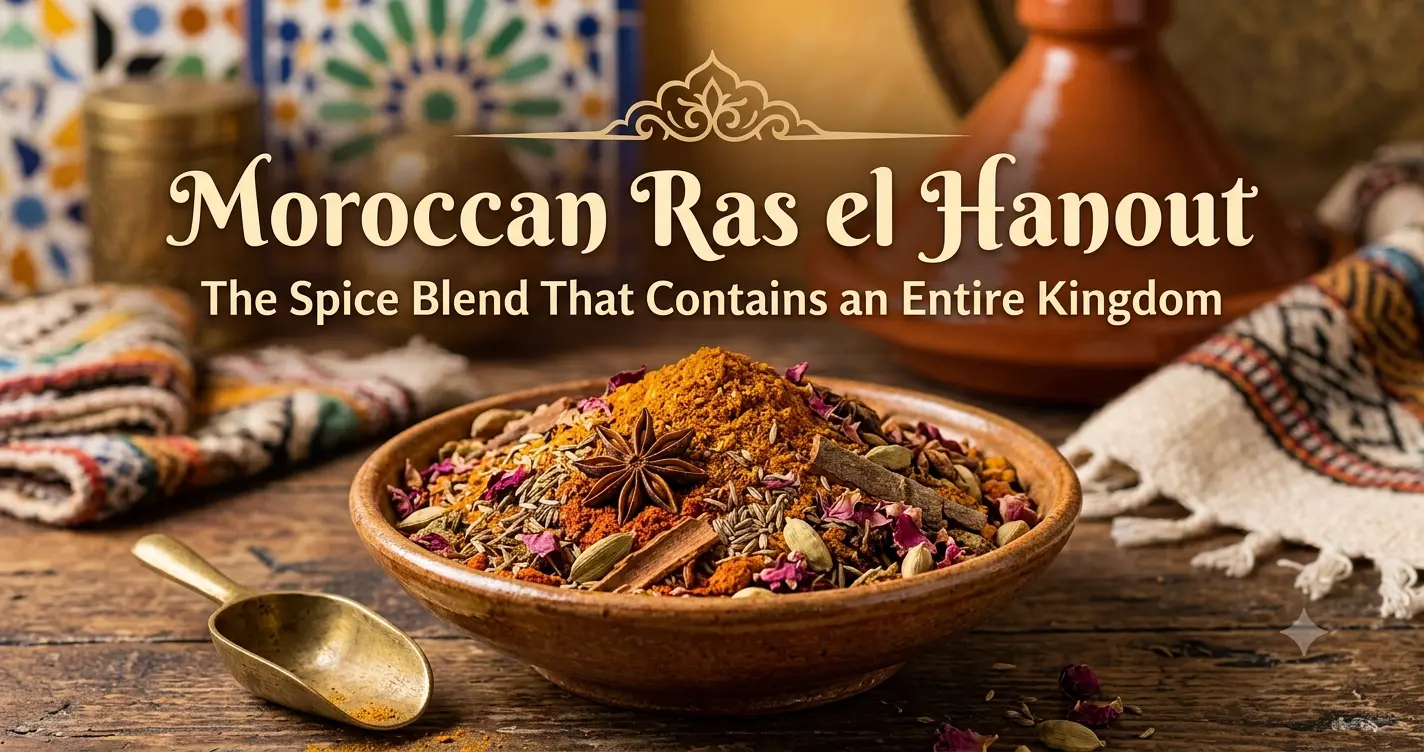
There is a moment — and if you have ever walked through the medina of Marrakech, Fès, or Meknès, you know exactly what I mean — when the air itself stops you in your tracks. You are moving through narrow alleyways lined with ceramic tiles, past vendors calling out over carts of olives and preserved lemons, and then it happens: a wave of fragrance so complex, so layered, so achingly alive that it feels less like a smell and more like a memory you never had. That fragrance is Ras el Hanout. And in that single breath, you have inhaled centuries of Moroccan history, trade, mysticism, and culinary genius. This is not merely a spice blend. This is an entire kingdom compressed into a handful of powder — and understanding it is the single most important key to understanding Moroccan cuisine at its most profound level.
1. What Does "Ras el Hanout" Actually Mean?
The name itself is your first lesson. Ras el Hanout (رأس الحانوت) translates from Arabic as "head of the shop" — literally, the top of the shop, the best of what a spice merchant has to offer. Think of it as the master blend, the one a spice dealer would put together from his finest, most precious, most carefully sourced ingredients. It was never meant to be a fixed recipe. It was — and in the most authentic Moroccan tradition, still is — a declaration of a merchant's expertise, reputation, and access to the rarest goods along the ancient trade routes.
Walk into any serious spice shop in Morocco today and you will still encounter this dynamic. The spice seller — called a attarine — does not read from a recipe card. He reaches into canisters, sniffs, pinches, adjusts, and assembles a blend that reflects his personal knowledge and his judgment about what is best in his shop on that particular day. Every blend is slightly different. Every blend tells its own story.
This is why anyone who tells you there is one single definitive recipe for Ras el Hanout is — with all due respect — missing the point entirely. At MaCooking, we have always approached this spice blend with that fundamental understanding: it is a living tradition, not a fixed formula.
2. The Ancient Trade Routes That Built This Blend
To truly understand Ras el Hanout, you need to understand Morocco's extraordinary position in the ancient world. Morocco was not simply a country at the edge of Africa. It was a crossroads — the meeting point of Sub-Saharan African caravans, Arab merchants from the east, Berber traders from across the Maghreb, Andalusian refugees from Spain bringing their own culinary heritage, and later, Portuguese, Ottoman, and European influences. The port cities of Essaouira, Tangier, and Casablanca were among the most cosmopolitan trading hubs in the known world for centuries.
Spices were the currency of civilization. They were more valuable than gold in many medieval markets, used not only in cooking but in medicine, preservation, perfumery, and religious ritual. The ingredients that eventually found their way into what we now call Ras el Hanout traveled extraordinary distances:
- Cardamom from the forests of India and Guatemala, moving through Arab trade networks
- Long pepper from Southeast Asia, prized before black pepper became dominant
- Cinnamon from Sri Lanka, one of the most coveted spices in ancient commerce
- Saffron from the high plateau of Taliouine in Morocco itself — among the finest in the world
- Mace and nutmeg from the Banda Islands of Indonesia, arriving via Venetian and Arab traders
- Rose petals from the Dadès Valley, Morocco's own "Valley of Roses"
- Galangal from Thailand and southern China, used in Moroccan cooking centuries before most European cuisines discovered it
When you add Ras el Hanout to a tagine or a couscous, you are not merely seasoning food. You are activating thousands of years of human connection, commerce, and curiosity. That is not hyperbole — that is the honest reality of what this spice blend carries within it.
The Silk Road and the Spice Road: Morocco's Unique Position
Morocco sat at the terminus of both the trans-Saharan trade routes and the western end of the broader Silk Road network. Caravans arriving from Timbuktu brought gold, salt, and spices from deep West Africa. Ships arriving at Atlantic ports brought goods from Europe and, eventually, the Americas — where chili peppers, allspice, and vanilla entered the Moroccan spice vocabulary. The imperial cities of Fès, Meknès, Marrakech, and Rabat were the processing centers for all of this abundance, and their spice souks became the laboratories where blends like Ras el Hanout were refined over generations.
3. The Core Ingredients: What Goes Into a Great Ras el Hanout?
This is where things get genuinely fascinating — and also where the most misinformation circulates in Western food media. A typical supermarket "Ras el Hanout" in the UK, US, or Australia might contain six to ten spices. An authentic Moroccan blend from a traditional attarine can contain anywhere from 20 to over 80 distinct ingredients. Some legendary blends from master spice merchants in Fès have been documented with more than 100 components.
Let me walk you through the key categories of ingredients:
The Aromatic Foundation
These are the backbone spices that give Ras el Hanout its recognizable character:
- Cumin — earthy, warm, quintessentially North African
- Coriander seed — citrusy and floral when freshly ground
- Cinnamon — Moroccan cooking uses this in savory dishes in a way that surprises many Western cooks
- Ginger — both dried and sometimes fresh, adding gentle heat and brightness
- Black pepper — the everyday workhorse of heat
- Turmeric — golden, earthy, with deep medicinal resonance in Moroccan culture
The Floral and Exotic Layer
This is what separates Ras el Hanout from every other spice blend on earth — the inclusion of ingredients most Western cuisines would never think to add to savory cooking:
- Rose petals (dried) — from the Dadès and M'Goun valleys, these add a subtle, haunting floral note that is unlike anything else
- Lavender — used sparingly but with extraordinary effect
- Orris root — the dried root of Iris florentina, earthy and violet-scented
- Orange blossom water residue or dried orange peel — adding citrus fragrance
The Heat Elements
- Cayenne or chili — for background warmth
- Long pepper — more complex and aromatic than regular black pepper, with a slow-building heat
- Grains of paradise (Aframomum melegueta) — a West African spice with peppery, citrusy character, a direct legacy of trans-Saharan trade
The Deep and Mysterious Notes
- Cardamom — green and black varieties, each contributing differently
- Cloves — intense and medicinal in small quantities
- Nutmeg and mace — the two products of a single fruit, each with distinct character
- Galangal — piney, medicinal, and absolutely distinct from ginger
- Cubeb pepper — a medieval spice that disappeared from most Western cooking but survives in Ras el Hanout
- Allspice — entering the blend post-Columbian Exchange from the Americas
- Monk's pepper (Vitex agnus-castus) — used in traditional blends, with a fascinating historical connection to medieval pharmacopeias
Comparison: Supermarket Ras el Hanout vs. Traditional Moroccan Blend
| Characteristic | Supermarket Blend (Western) | Traditional Moroccan Attarine Blend |
|---|---|---|
| Number of ingredients | 6–12 | 20–80+ |
| Freshness of grinding | Pre-ground, often months old | Ground fresh to order |
| Floral elements | Rarely included | Rose petals, lavender standard |
| Exotic components | Usually absent | Grains of paradise, cubeb, galangal common |
| Customization | None | Blended to customer preference |
| Saffron inclusion | Almost never | Sometimes included in premium blends |
| Shelf life expectation | 18–24 months | Best within 3–6 months of blending |
| Aromatic complexity | Moderate | Extraordinarily complex, multi-layered |
4. Regional Variations: Ras el Hanout Is Not One Thing
One of the most important things I want Western readers to understand is that Morocco is not a monolith. The country contains Berber mountain communities, Arab urban cultures, Saharan nomadic traditions, coastal fishing cultures, and Jewish culinary heritage that profoundly shaped the cuisine. Each region has its own Ras el Hanout sensibility.
Fès: The Imperial Sophisticate
Fès is arguably the culinary capital of Morocco — the city where the Fassi cooking tradition developed over a thousand years into arguably the most refined cuisine in North Africa. The Ras el Hanout of Fès tends toward complexity and elegance. The spice merchants of the Attarine souk (named, significantly, for the spice sellers themselves) are legendary. Fessi blends often include more floral notes, more exotic components like orris root and cubeb, and a greater emphasis on aromatic balance over raw heat.
Marrakech: Bold, Warm, and Theatrical
Marrakech blends tend to be warmer, bolder, and more immediately impactful. The influence of trans-Saharan trade is more pronounced here — you will find more grains of paradise, more aggressive heat, more of the deep earthy tones that come from galangal and long pepper. The Marrakchi version of Ras el Hanout is built for the tagines and slow-cooked dishes that have made the city famous worldwide.
The Berber Tradition: Mountains and Valleys
In the High Atlas and the Rif mountains, Berber communities have their own spice traditions that predate Arab influence. Their versions of Ras el Hanout are often simpler but deeply aromatic, emphasizing herbs like thyme and wild oregano alongside spices, and incorporating mountain-specific ingredients that rarely appear in urban blends.
The Saharan South: Heat and Dates
In the south, around Zagora, Merzouga, and the Drâa Valley, the blend takes on the character of the desert — intense, warm, with notes that complement the region's extraordinary dates, slow-cooked lamb, and camel meat traditions. Less flower, more fire.
"Every spice merchant in Morocco carries within him a lineage of knowledge that cannot be Googled. When he opens a canister and brings it to his nose, he is consulting centuries. The blend he makes for you is an act of trust — and of art."
— A master spice merchant of the Fès medina, in conversation with Chef Jamal
5. How to Make Your Own Ras el Hanout: A Serious Home Cook's Guide
Making your own Ras el Hanout at home is one of the most rewarding things you can do as a cook. It requires sourcing some less common ingredients, but the result — a completely personalized, absolutely fresh blend — will transform your cooking in ways that no store-bought version ever can.
Essential Equipment
- A dedicated spice grinder (a small electric coffee grinder works perfectly — keep one solely for spices)
- A mortar and pestle for pre-cracking whole spices
- An accurate small kitchen scale (measuring by weight is far more precise than volume for spices)
- Airtight glass jars for storage
A Foundational Home Recipe (Approximately 25 Ingredients)
This recipe represents a serious starting point — not the simplistic 8-spice versions that circulate widely online, but something closer to what you would actually find in a Moroccan kitchen. Think of it as your canvas, not your ceiling.
Warm Aromatic Base (toast and grind whole):
- 2 tsp cumin seeds
- 2 tsp coriander seeds
- 1 tsp black peppercorns
- 1 tsp green cardamom pods (seeds only)
- ½ tsp black cardamom seeds
- ½ tsp cubeb peppercorns (or long pepper if you can source it)
- 4 whole cloves
- 1 small piece dried ginger (or 1 tsp ground ginger)
Pre-ground Spices (add after grinding):
- 2 tsp ground cinnamon (Ceylon, not cassia, for elegance)
- 1 tsp ground turmeric
- 1 tsp sweet paprika
- ½ tsp cayenne pepper
- ½ tsp ground nutmeg
- ¼ tsp ground mace
- ¼ tsp ground allspice
- ¼ tsp ground galangal
- ¼ tsp ground white pepper
The Floral and Exotic Layer (add last, barely grind):
- 1 tbsp dried rose petals (food grade, unsprayed)
- ½ tsp dried lavender buds
- ¼ tsp orris root powder (available from specialist spice retailers)
- ¼ tsp grains of paradise (lightly crushed)
- ½ tsp dried orange peel, finely ground
Method:
- In a dry skillet over medium-low heat, toast the whole spices from the base group individually (or in compatible pairs) until fragrant — 60 to 90 seconds each. Do not rush this. Burnt spices are worse than no spices.
- Allow to cool completely on a plate.
- Grind the toasted spices in your spice grinder until fine. Pass through a fine mesh sieve to catch any larger pieces.
- In a bowl, combine the freshly ground spices with the pre-ground group, mixing thoroughly.
- Add the floral elements last. The rose petals should be briefly pulsed in the grinder — not pulverized, but broken into small fragments. The lavender and orris root should be mixed in whole or barely crushed.
- Store in an airtight glass jar away from light and heat. Use within 3 months for best results.
Sourcing Tips for Western Cooks
The most commonly unavailable ingredients for readers in the US, UK, Europe, Canada, and Australia are cubeb pepper, grains of paradise, galangal (dried), orris root, and dried food-grade rose petals. Here is where to find them:
- Specialty spice retailers: Shops like Penzeys (US), The Spice Shop (UK), and specialty Indian or Middle Eastern grocery stores carry most of these
- Online retailers: Amazon, Etsy (from specialty spice vendors), and dedicated online spice merchants ship most of these internationally
- Middle Eastern and North African grocery stores: These remain the best single-stop source for authentic ingredients, and often stock high-quality Moroccan-sourced saffron and rose water as well
- Iranian and Turkish grocery stores: Excellent for dried rose petals and other floral ingredients
6. Cooking With Ras el Hanout: Beyond the Tagine
Here is something that surprises many cooks new to Moroccan cuisine: while Ras el Hanout is indispensable in tagines and couscous, its potential reaches far beyond these iconic dishes. Understanding how and when to use it will genuinely expand your entire cooking vocabulary.
The Classic Applications
| Dish | How Ras el Hanout Is Used | Quantity Guide (per 4 servings) | Key Pairing Ingredients |
|---|---|---|---|
| Lamb Tagine | Rubbed on meat, added to braising liquid | 2–3 teaspoons | Preserved lemon, olives, saffron |
| Chicken Bastilla | Mixed into the spiced pigeon/chicken filling | 1½ teaspoons | Almonds, cinnamon, eggs, warqa pastry |
| Vegetable Couscous | Added to broth, vegetable marinade | 2 teaspoons | Root vegetables, chickpeas, dried fruit |
| Kefta (Spiced Meatballs) | Mixed directly into meat | 1 teaspoon | Tomato, egg, fresh herbs |
| Harira Soup | Added early in cooking with other spices | 1 teaspoon | Tomatoes, lentils, chickpeas, herbs |
| Mrouzia (Sweet Lamb Tagine) | Central spice component of the sauce | 3 teaspoons | Honey, raisins, almonds, smen |
Unexpected Modern Applications
One of the things I find most exciting about Ras el Hanout in contemporary cooking is how brilliantly it performs outside its traditional context. At MaCooking, we regularly explore these cross-cultural applications because they honor the spirit of the blend — which was always about combining the best of multiple traditions:
- Roasted root vegetables: Toss carrots, parsnips, and sweet potatoes with olive oil, Ras el Hanout, and a drizzle of honey. Roast at high heat. The result is extraordinary.
- Spice rub for grilled meats: Mixed with olive oil and garlic, it creates a magnificent marinade for lamb chops, chicken thighs, or even salmon.
- Butter compound: Blend 1 teaspoon into softened butter with lemon zest and a pinch of salt. Melt over grilled steak or spread on flatbread — it is revelatory.
- Spiced lentil soup: Replace your usual cumin-coriander combination with Ras el Hanout. Add a squeeze of preserved lemon at the end. This is comfort food elevated to something genuinely special.
- Vinaigrette: A quarter teaspoon whisked into a honey-lemon vinaigrette creates a salad dressing that pairs magnificently with bitter greens, orange segments, and toasted almonds.
- Braised lamb shanks: Italian-style braising techniques with Moroccan spicing — this is one of the most successful fusion applications, and it works because both traditions share a profound love of slow-cooked meat with complex aromatics.
- Spiced hot chocolate: A tiny pinch — and I mean tiny, no more than an eighth of a teaspoon — in dark hot chocolate with cardamom and cinnamon. This is Morocco in a cup.
The Golden Rule of Ras el Hanout Cooking
Here is the single most important technical point: always bloom Ras el Hanout in fat before adding liquid. This means adding it to hot oil or butter and stirring for 30 to 60 seconds before you add anything wet. This step — called tadzheen of spices in some Moroccan traditions — activates fat-soluble aromatic compounds that would otherwise never fully develop. The difference between spices bloomed in fat and spices added directly to a liquid is profound. It is the difference between a dish that is spiced and a dish that is aromatic.
7. Ras el Hanout, Health, and Traditional Moroccan Medicine
In Morocco, the line between the kitchen and the pharmacy has always been blurred — and in the most wonderful way imaginable. The spice souk and the herbalist's stall (herboristerie) have historically been closely related, and many of the ingredients in Ras el Hanout have documented medicinal uses in traditional Moroccan and broader Islamic medicine.
Modern nutritional science has begun to confirm what Moroccan grandmothers have known for centuries:
- Turmeric contains curcumin, one of the most extensively studied anti-inflammatory compounds in botanical medicine
- Cinnamon has been shown in multiple studies to help regulate blood sugar — highly relevant given its central role in Moroccan cooking
- Ginger is a powerful anti-nausea and digestive aid, with well-documented anti-inflammatory properties
- Cardamom has antimicrobial properties and has been used in traditional medicine to support digestion and respiratory health
- Coriander seed has been shown to have cholesterol-lowering effects and supports digestive health
- Cloves contain eugenol, a powerful antimicrobial and antioxidant compound
- Black pepper contains piperine, which significantly enhances the bioavailability of curcumin from turmeric — meaning that the traditional pairing of these two spices in Ras el Hanout is not coincidence, but evolved wisdom
The combined antioxidant load of a properly made Ras el Hanout blend is extraordinary. This is one of the reasons why Moroccan cuisine, despite its love of slow-cooked meats and rich sauces, is associated with the Mediterranean diet's remarkable health outcomes.
8. Buying Ras el Hanout: How to Choose Well in Western Markets
For readers who want to purchase Ras el Hanout rather than make their own — and there is absolutely no shame in that — here is what to look for:
Signs of a Quality Commercial Blend
- Color complexity: A good Ras el Hanout should not be uniform brown. Look for flecks of red (paprika, chilies), golden yellow (turmeric), near-black (pepper, cloves), and ideally small fragments of dried petals
- Immediate aromatic impact: Open the jar and bring it close to your nose. It should stop you. A weak, flat smell means old or poor-quality spices.
- Ingredient list length: As a rough guide, fewer than 10 ingredients is a shortcut blend. 15 or more suggests a more serious attempt at authenticity.
- No added salt or fillers: Some commercial blends add salt, anticaking agents, or starch. These dilute the spices and limit your control over seasoning.
- Country of origin: Blends produced in Morocco or by Moroccan-owned companies tend to be more authentic, though excellent blends are produced by specialty spice companies in the US, UK, and Europe.
Storage Best Practices
- Store in airtight glass or ceramic containers — never in the original paper or plastic packaging long-term
- Keep away from light, heat, and moisture — above the stove is the worst possible place for spice storage despite being the most popular
- Label with the purchase or blend date and commit to using within six months for whole spice blends and three months for finely ground blends
- Smell your spices before using them — your nose is the most accurate freshness indicator you have
Frequently Asked Questions About Ras el Hanout
Q1: Can I substitute Ras el Hanout with another spice blend like garam masala or baharat?
This is one of the most common questions I receive, and the honest answer is: not really, and here is why. Garam masala shares some ingredients with Ras el Hanout — cardamom, cinnamon, cloves, coriander — but it lacks the floral elements (rose petals, lavender), the African components (grains of paradise, long pepper), and the specific North African aromatic profile created by the combination of all these elements together. Baharat is closer in spirit — it is also a complex Middle Eastern spice blend — but it tends toward a warmer, meatier profile with more allspice and less floral complexity. In a genuine emergency, a combination of equal parts ground cumin, coriander, cinnamon, ginger, and a pinch of cayenne will give you something in the direction of Ras el Hanout's warmth, but it will lack the depth, the mystery, and the aromatic complexity of the real thing. The better answer is always: make your own or find an authentic source.
Q2: How spicy is Ras el Hanout? Can I use it if I don't tolerate heat well?
This is an important and often misunderstood point. Ras el Hanout is not, by its nature, a fiercely hot blend. Its brilliance lies in aromatic complexity, not chili heat. Many traditional Moroccan blends have only a modest level of heat — the warmth comes more from ginger, pepper, and galangal than from cayenne or chili. However, this varies significantly between blends and makers. If you are sensitive to heat, taste a very small amount of any new Ras el Hanout blend before cooking with it, and when making your own, simply reduce the cayenne and pepper components. The result will still be magnificent — Ras el Hanout's magic is in the aromatics, not the heat. You can even make an entirely gentle, floral version that focuses on rose, cardamom, cinnamon, and coriander, and it will still be deeply Moroccan in character.
Q3: Is Ras el Hanout the same everywhere in Morocco, or does it really vary that much?
It truly varies — and this is not marketing language but honest culinary reality. In twenty years of cooking Moroccan food professionally and of exploring the country's spice markets from the Rif mountains to the Saharan south, I have never encountered two identical Ras el Hanout blends from different merchants. The variations are sometimes subtle — a slightly heavier hand with rose petals here, more galangal there — and sometimes dramatic. Blends from Fès tend toward floral sophistication. Blends from Marrakech lean warmer and bolder. Mountain Berber blends often incorporate local herbs. Coastal blends sometimes include dried citrus more prominently. This diversity is a strength, not a weakness. It means that Ras el Hanout is a living tradition that adapts to place, culture, and individual expertise. The exploration of these variations is one of the great pleasures of Moroccan culinary travel.
Q4: What is the best dish to start with when cooking with Ras el Hanout for the first time?
My honest recommendation for the first-time Ras el Hanout cook is a simple roasted chicken. Here is why: chicken is forgiving, widely available, familiar to everyone, and the roasting process does extraordinary things to the spice blend — the aromatics bloom in the oven fat, the rose petals caramelize against the skin, and the result is something genuinely dramatic in its fragrance and flavor. Simply combine two generous teaspoons of Ras el Hanout with three tablespoons of softened butter, the juice of half a lemon, and two crushed garlic cloves. Rub this all over a whole chicken — under the skin and over it — and roast at 200°C (400°F) until cooked through. The result will make you understand immediately why Moroccan cuisine is considered one of the greatest culinary traditions in the world. From there, you can explore the MaCooking recipe library for dozens of more complex applications.
Q5: Are there any ingredients in traditional Ras el Hanout that are difficult to find or potentially controversial?
This is a thoughtful question, and yes — historically, there were some components. Traditional Ras el Hanout in older recipes sometimes included hashish (Cannabis sativa) as a component — this is documented in historical accounts, though it is almost never included in contemporary commercial or home blends. More practically relevant for today's Western cooks: belladonna berries (from Atropa belladonna) were historically recorded in some pre-20th-century blends — this is a highly toxic plant and has no place in any contemporary recipe. Monk's pepper (Vitex agnus-castus) has mild hormonal effects and should be avoided by pregnant women or those on hormonal medications. The overwhelming majority of modern Ras el Hanout blends contain none of these historical curiosities, but it is worth knowing they exist in the historical record. The ingredients I have listed in this article's recipe are all safe and appropriate for general culinary use.
Conclusion: Opening a Door to an Entire Kingdom
When I hold a jar of truly excellent Ras el Hanout — one made with care, with real ingredients, with knowledge accumulated over generations — I am always struck by how modest it looks. A small jar of brownish-red powder. Nothing dramatic to the eye. And yet within it is the entire history of a civilization that sat at the crossroads of three continents and absorbed the best of everything that passed through. The trans-Saharan caravans are in there. The Arab trade routes are in there. The Andalusian refugees fleeing the Reconquista and bringing their refined culinary culture with them are in there. The Berber mountain traditions and the coastal fishing cultures and the imperial kitchens of Fès and Marrakech are all, somehow, in there.
Moroccan cuisine is among the most complex and most rewarding in the world, and Ras el Hanout is its most eloquent expression. Learning to understand it — truly understand it, not just use it as a convenient shortcut — is one of the most valuable investments any serious cook can make.
This is exactly the kind of deep culinary knowledge that drives everything we do at MaCooking. Our mission has always been to bring the real Morocco to kitchens around the world — not the simplified, compromised, tourist-friendly version, but the genuine article, with all its complexity, its regional diversity, its historical depth, and its extraordinary flavor. We believe that authentic food knowledge changes how you cook, how you eat, and how you understand the world.
So buy the best Ras el Hanout you can find. Better yet — make your own. Source those rose petals. Hunt down those grains of paradise. Take the time to toast and grind whole spices and experience what freshness actually means. And when you add that first spoonful to your pan and the fragrance rises up and stops you in your tracks, remember: you are not just cooking. You are continuing a conversation that has been going on for a thousand years, across three continents, in a thousand kitchens, all of them connected by this remarkable, irreplaceable blend.
The kingdom is waiting in the jar. All you have to do is open it.
Explore hundreds of authentic Moroccan recipes, spice guides, and culinary deep-dives at MaCooking.com — the world's leading platform for Moroccan cuisine.