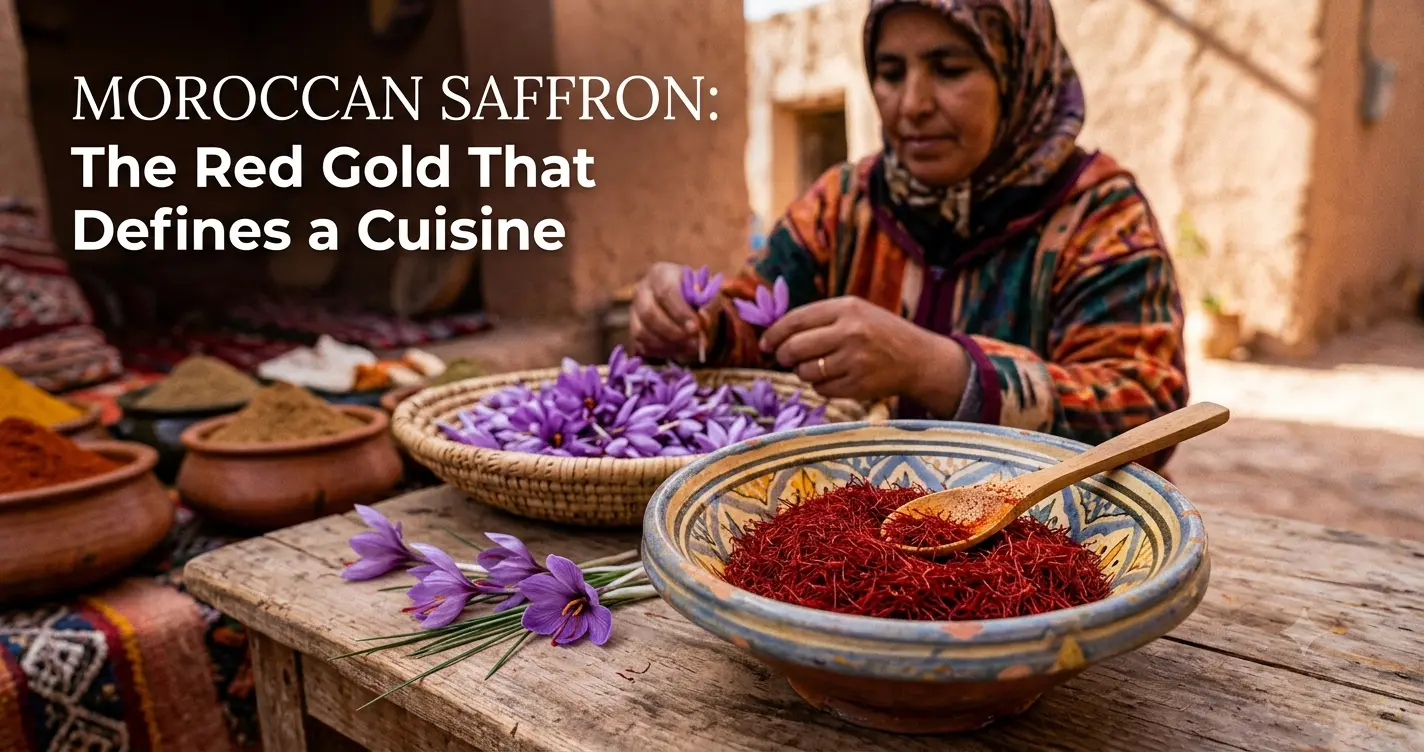
There is a moment in every Moroccan kitchen that is almost sacred. You pinch a few crimson threads between your fingers, drop them into a small bowl of warm water or milk, and within minutes, the liquid transforms into a deep amber gold — glowing, aromatic, impossibly beautiful. That moment, repeated millions of times across Morocco every single day, is the quiet ceremony of saffron. It is not merely a spice. It is a living thread connecting the ancient Silk Road merchants to the grandmothers of Marrakech, the palace kitchens of the Merenid sultans to the humble clay tagines of the Atlas foothills. It is, without exaggeration, the soul of Moroccan cuisine. Here at MaCooking, we believe that understanding saffron is not just understanding a spice — it is understanding Morocco itself.
Chapter 1: The Origins of Moroccan Saffron — A Story Written in the Earth of Taliouine
If you want to understand Moroccan saffron, you must first travel — at least in your imagination — to a small, sun-scorched valley in the Anti-Atlas Mountains, approximately 100 kilometers east of Taroudant. The town is called Taliouine, and it is, by any serious culinary reckoning, one of the most important places on earth for gastronomy. This is where Morocco's saffron capital sits, cradled between dramatic mountain ridges, at an altitude of roughly 1,200 to 1,800 meters above sea level. The thin air, the cold nights, the dry summers, the mineral-rich soil — together they create a terroir for Crocus sativus that is virtually impossible to replicate elsewhere on the planet.
The history of saffron cultivation in this region stretches back at least a thousand years, though some ethnobotanists and historians argue the relationship between these Berber communities and the saffron crocus is considerably older. The most widely accepted historical narrative suggests that saffron arrived in Morocco via the Arab conquests and subsequent trade routes that crisscrossed the medieval Islamic world. Andalusian scholars and traders brought refined cultivation techniques southward across the Strait of Gibraltar, and Berber farmers in the Anti-Atlas — practical, adaptive, and intimately connected to their land — quickly recognized that their particular terroir produced something extraordinary.
Why Taliouine Saffron Is Different
The question people always ask me is: what actually makes Taliouine saffron special? The answer is layered, like the mountains themselves. First, consider the altitude. At 1,200 to 1,800 meters, the temperature fluctuations between day and night are dramatic — sometimes as much as 20 degrees Celsius within a single 24-hour period. This thermal stress forces the crocus plant to concentrate its secondary metabolites, the chemical compounds responsible for saffron's color, aroma, and flavor. The result is threads with extraordinarily high concentrations of three critical molecules: crocin (responsible for that intense golden color), picrocrocin (the source of bitterness and flavor), and safranal (the aromatic compound that gives saffron its haunting, honeyed, slightly medicinal perfume).
Second, the soil in the Taliouine valley is a specific type of limestone-clay blend — well-drained, slightly alkaline, and rich in potassium. Saffron crocus roots despise waterlogged soil with the same passion that Moroccans despise a badly spiced tagine. The local soil drains beautifully while retaining just enough moisture to support the corm through the growing season. Third — and this is perhaps the factor that Western consumers underestimate most — the saffron of Taliouine is harvested by hand, by families who have done this work for generations, using knowledge passed from grandparent to grandchild with an intimacy that no industrial process can replicate.
The Harvest: A Festival of Exhausted Hands
The saffron harvest in Taliouine takes place during a narrow window — typically mid-October to mid-November, and sometimes even shorter depending on the year's climate. The Crocus sativus blooms for only a few weeks, and the flowers must be picked at dawn, before the sun's heat causes the delicate petals to wilt and the precious stigmas inside to degrade. This is not metaphorical — if you pick the flowers even two or three hours after sunrise on a warm October morning, the quality drops measurably.
Families rise before first light. Children, elders, neighbors — everyone participates. The flowers are gathered into wicker baskets and brought back to the family home, where the real labor begins: the tedious, painstaking separation of the three red stigmas from each individual flower. A single kilogram of finished, dried saffron requires approximately 150,000 to 200,000 flowers, and those flowers must be processed within hours of picking. The stigmas are then dried — traditionally over low charcoal heat or in the warm Moroccan sun — and the finished threads are what we know as saffron. The entire process is a testament to human patience, community solidarity, and a profound respect for the natural world.
"Saffron is not grown — it is cared for. Every thread represents a decision made at four in the morning, a pair of hands moving faster than thought, a family's winter income balanced between fingers and dawn."
— Chef Jamal, reflecting on the saffron harvest he witnessed firsthand in Taliouine
Chapter 2: Saffron in Moroccan History — From Royal Courts to Souks
Moroccan saffron has never been merely a kitchen ingredient. Throughout the country's history, it has served as currency, medicine, dye, cosmetic, and spiritual offering. The medieval Islamic world understood saffron as one of its most precious commodities, and Morocco — positioned at the crossroads of trans-Saharan trade routes and Mediterranean commerce — was both a producer and a conduit for its distribution across Europe, West Africa, and the Arabian Peninsula.
The great Merenid sultans, who ruled Morocco from the 13th to the 15th centuries and built some of the most magnificent madrasas and palaces in Islamic history, maintained elaborate palace kitchens where saffron featured prominently in royal cuisine. Dishes prepared for the sultan and his court were distinguished from common food not just by the quality of their ingredients but by the lavishness with which saffron was deployed. A tagine prepared for royalty would be golden with saffron, fragrant in a way that announced itself before it was even uncovered. This association between saffron and prestige, between the color gold and divine favor, runs deep in Moroccan cultural consciousness.
In the souks of Fez, Marrakech, and Meknes, saffron has been traded for centuries alongside other precious spices — oud, musk, ambergris, and the complex spice blends that Moroccan cuisine is famous for. Walking through the spice stalls of Fez's ancient medina today, you can still feel that history. The saffron sits in small glass jars or tiny plastic bags, threads of deep crimson against the backdrop of turmeric yellows, paprika reds, and cumin browns. Vendors who have inherited their stalls from fathers and grandfathers will tell you, without any particular drama, that good saffron should smell like honey and hay, that it should bleed a slow, persistent amber when dropped into water, and that you should never, under any circumstances, buy powdered saffron from a stranger.
Saffron as Medicine in Moroccan Tradition
The Moroccan relationship with saffron extends well beyond cooking. In traditional Moroccan medicine — a sophisticated system rooted in both Greco-Islamic medical theory and indigenous Berber herbalism — saffron was prescribed for an impressive range of conditions. It was considered a mood-lifting herb, given to those suffering from melancholy (what we would today call depression). It was used to ease menstrual cramps, improve digestion, soothe teething pain in infants, and enhance male and female libido. Mothers would rub diluted saffron water on the gums of crying babies. Newborns were bathed in water infused with saffron and rose water as a blessing ritual. Elderly women would prepare saffron-infused argan oil face masks to preserve the skin's luminosity.
Modern science, interestingly, has begun to validate many of these traditional uses. Clinical studies have shown that saffron contains compounds with measurable antidepressant effects, anti-inflammatory properties, and antioxidant capacity. The fact that Moroccan grandmothers knew this a thousand years before the randomized controlled trial is not surprising to anyone who has spent real time in Moroccan kitchens.
Chapter 3: The Science of Saffron — Understanding What You Are Cooking With
Before we talk about how to cook with saffron, we need to talk about what saffron actually is and why it behaves the way it does in cooking. I find that Western cooks who understand the chemistry of saffron use it with much greater confidence and achieve dramatically better results than those who treat it as a mysterious black box.
The Three Key Compounds
- Crocin: This is the water-soluble carotenoid pigment that gives saffron its spectacular golden-yellow color. Crocin is remarkably stable and water-soluble, which is why blooming saffron in warm liquid (rather than adding it dry) is so important — you are releasing and dissolving this compound efficiently. Crocin also has antioxidant properties and is the subject of active pharmaceutical research.
- Picrocrocin: This glycoside is responsible for saffron's characteristic bitter, complex flavor. It breaks down during drying and cooking into simpler compounds, including safranal. The bitterness of picrocrocin is part of what makes saffron's flavor profile so paradoxically appealing — it is simultaneously sweet, bitter, earthy, and floral.
- Safranal: The volatile aromatic compound that gives saffron its unforgettable smell. Safranal is the reason that a pinch of saffron can perfume an entire pot. It is heat-sensitive, which means prolonged boiling will diminish the aroma. This is why many experienced Moroccan cooks add their bloomed saffron toward the middle or end of a long-cooked dish rather than at the very beginning.
ISO Grading Standards for Saffron Quality
The International Organization for Standardization (ISO 3632) classifies saffron into four grades based on its concentrations of these three compounds. Understanding these grades helps you shop intelligently and ensures that when you are cooking an authentic Moroccan recipe — whether you found it on MaCooking or inherited it from a Moroccan friend — you are using a product worthy of the dish.
| ISO Grade | Crocin (Color Strength) | Picrocrocin (Flavor) | Safranal (Aroma) | Quality Level |
|---|---|---|---|---|
| Grade I (Category I) | ≥ 190 units | ≥ 70 units | 20–50 units | Superior / Premium |
| Grade II (Category II) | ≥ 150 units | ≥ 55 units | 20–50 units | Good |
| Grade III (Category III) | ≥ 110 units | ≥ 40 units | 20–50 units | Standard |
| Grade IV (Category IV) | ≥ 80 units | ≥ 30 units | 20–50 units | Lower Grade |
Authentic Taliouine saffron typically achieves Grade I classification, with some batches tested at color strength values well above 200 units — a level that puts it among the highest-quality saffron produced anywhere in the world, rivaling even Iranian and Spanish (La Mancha) varieties.
Chapter 4: Saffron Across the World — How Morocco Compares
Morocco is not the only country that produces saffron. Iran produces roughly 90% of the world's saffron by volume, followed by India (particularly Kashmir), Spain, Greece, Afghanistan, and a handful of others. But volume and quality are different conversations entirely, and Moroccan saffron occupies a very specific and prestigious position in the global hierarchy.
| Country | Primary Region | Annual Production | Flavor Profile | Notable Characteristics |
|---|---|---|---|---|
| Morocco | Taliouine, Anti-Atlas | ~3–4 tons/year | Floral, honeyed, earthy, slightly bitter | Exceptional color strength, small-farm artisanal production, altitude terroir |
| Iran | Khorasan Province | ~430–470 tons/year | Rich, intense, medicinal | World's largest producer, wide quality range from superb to mediocre |
| Spain (La Mancha) | Castilla-La Mancha | ~1–2 tons/year | Warm, toasty, slightly smoky | Protected Denomination of Origin (D.O.P.), often toasted before use |
| India (Kashmir) | Pampore, Jammu & Kashmir | ~6–16 tons/year | Delicate, sweet, subtle floral | GI-tagged, considered among finest but production declining |
| Greece | Kozani, Macedonia | ~5–7 tons/year | Sweet, mild, slightly hay-like | PDO protected, often sold as Krokos Kozanis |
What distinguishes Moroccan saffron in this international context is not simply the chemical data, impressive as it is. It is the embedded cultural context — the fact that this spice has been grown, harvested, traded, and cooked within a continuous culinary tradition that gives it meaning beyond its molecular composition. When you cook with Taliouine saffron, you are cooking with a living cultural artifact.
Chapter 5: Cooking with Moroccan Saffron — The Expert's Approach
Let me be honest about something. Most people, even relatively experienced home cooks, use saffron wrong. They either under-use it (afraid of its price, afraid of overpowering a dish) or they add it incorrectly (straight into a hot pan, where the volatile aromatics immediately evaporate before they can do any work). Both approaches waste money and result in dishes that never fully realize what saffron can do. Let me walk you through the proper techniques, the ones used in Moroccan home kitchens and taught by the cooks who have shaped this cuisine over centuries.
The Blooming Method: Non-Negotiable
Blooming saffron means soaking the threads in a small amount of warm liquid before adding them to your dish. This is not optional — it is the difference between properly using saffron and wasting it. Here is the process:
- Take the number of threads your recipe calls for. For most Moroccan tagines, this is between 15 and 25 threads. For saffron-forward dishes like rfissa or certain rice preparations, you might use up to 40.
- Lightly crush the threads between your fingers. This breaks open the thread structure and accelerates the release of crocin and safranal.
- Place the crushed threads in a small bowl or cup. Add 3 to 4 tablespoons of warm (not boiling) water, warm chicken stock, or warm whole milk depending on your recipe. Water or stock for savory dishes; milk for desserts and sweet preparations.
- Let the mixture steep for a minimum of 15 minutes, ideally 20 to 30 minutes. The liquid should turn a deep, gorgeous amber-gold color. If it looks pale yellow after 10 minutes, your saffron quality may be low.
- Add the entire mixture — threads and liquid — to your dish at the appropriate stage of cooking.
When to Add Saffron During Cooking
This is where many Western recipes mislead their readers. The timing of saffron addition profoundly affects the final dish. In Moroccan culinary tradition, there are essentially three approaches:
- Early addition: Used in dishes that benefit from deep color penetration throughout the ingredients — certain lamb tagines, chicken with preserved lemon and olives, lentil soups. The saffron is added with the braising liquid at the beginning of cooking. The flavor is more subtle, the color more evenly distributed.
- Middle addition: The most common approach in home Moroccan kitchens. Added roughly halfway through cooking time, this preserves more of the aromatic safranal while still allowing the crocin to do its coloring work. Used in couscous preparations, seafood tagines, and mixed vegetable dishes.
- Late addition: Reserved for dishes where the saffron's aroma should be prominent and fresh — rice puddings, certain pastries, finishing sauces. The bloomed saffron is stirred in during the last 10 to 15 minutes of cooking, or even as a finishing element.
Key Moroccan Dishes Where Saffron Is Essential
Saffron appears throughout the Moroccan culinary canon, but there are certain dishes where it is not a suggested addition — it is a defining ingredient whose absence would make the dish categorically different:
- Chicken Tagine with Preserved Lemon and Olives (Djej Mcharmel): The golden sauce of this iconic dish owes its color and depth to saffron working alongside ginger, turmeric, and coriander.
- Rfissa: A festive dish of braised chicken with fenugreek and lentils, served over shredded msemen flatbread — deeply saffron-forward, traditionally prepared for new mothers after childbirth.
- Bastilla (Pastilla): Morocco's extraordinary sweet-savory pigeon (or chicken) pie, layered in warqa pastry, uses saffron in its egg filling to achieve that characteristic golden color and complexity.
- Harira: Morocco's beloved national soup — a rich, tomato-and-lentil based preparation eaten to break the Ramadan fast — uses saffron as one of its essential aromatics alongside cinnamon, ginger, and celery.
- Lamb Tagine with Prunes and Almonds: A festive sweet-savory tagine where saffron bridges the gap between the savory lamb and the sweet dried fruit, adding a dimension that neither ingredient provides alone.
- Saffron Rice Pudding (Roz bil Hlib): A Moroccan version of milk rice, fragrant with saffron, orange blossom water, and cinnamon — simple, ethereal, perfect.
For complete, tested recipes for every one of these dishes, MaCooking has you covered with step-by-step instructions written by cooks who grew up making them.
Chapter 6: Buying, Storing, and Spotting Fake Saffron
Here is an uncomfortable truth: the global saffron market is plagued by adulteration. Studies have consistently found that a significant percentage of saffron sold globally is either partially or entirely fake — colored with turmeric, safflower (sometimes called Mexican saffron), marigold petals, red-dyed corn silk, or simple food coloring. Some of this fraud is obvious to an expert; some of it is sophisticated enough to fool casual buyers. The practical guidance below will help you navigate this minefield.
How to Identify Real Saffron
- Appearance: Genuine saffron threads are trumpet-shaped, with a wider end (the stigma) and a thinner end (the style). The stigmas are deep red, often with slightly orange tips. They are not uniform — slight variations in color, thickness, and length are normal. Suspiciously uniform threads of perfectly identical color are a red flag.
- The water test: Place 5 or 6 threads in a cup of cool water. Real saffron releases color slowly — it takes 5 to 10 minutes for the water to turn golden, and even after 15 minutes, the threads themselves should still be faintly reddish. Fake saffron (dyed threads or safflower) bleaches almost immediately — the threads turn white or pale within seconds as the artificial dye washes out.
- The smell test: Real saffron smells like honey, hay, and something slightly metallic or medicinal. It is distinctive and impossible to confuse once you know it. If the product smells generically floral, or like nothing at all, walk away.
- The taste test: Chew a single thread. Real saffron has a mildly bitter, complex taste. It should not be sweet (sugared threads are sometimes sold as saffron).
- Price as indicator: Real premium saffron costs between $10 and $20 per gram at retail, and sometimes significantly more for certified single-origin varieties. If someone is selling you saffron at $2 per gram, you are not buying saffron.
Buying Moroccan Saffron Specifically
If you want authentic Taliouine saffron, your best sources are:
- Specialty Moroccan and Middle Eastern food shops in major Western cities, particularly those with established Moroccan immigrant communities (Paris, Montreal, London, Amsterdam, Brussels, parts of New York and Miami).
- Reputable online spice retailers who explicitly state the origin as Taliouine or Anti-Atlas, Morocco, and who provide batch information or ISO certification documentation.
- Direct-trade platforms that work with Moroccan agricultural cooperatives — the Taliouine region has several active cooperatives that sell directly to international buyers.
- Moroccan expat-owned food businesses, which often source their ingredients directly from family connections in Morocco and can vouch for the provenance of what they sell.
Storage: Treating Saffron with the Respect It Deserves
Saffron is an investment. Treat it like one.
- Store saffron in an airtight container — ideally a small glass jar with a tight-fitting lid, not a plastic bag or an open tin.
- Keep it away from light. Crocin and safranal degrade in the presence of UV light. A dark cupboard or a drawer is ideal; a windowsill spice rack is not.
- Keep it away from heat and moisture. Do not store it near the stove. Do not refrigerate it (the condensation when you bring it in and out of the fridge is damaging).
- Properly stored saffron retains its quality for 2 to 3 years, though peak aromatic quality is best within the first 12 to 18 months of the harvest date.
- Never buy more than you will realistically use within a year. Freshness matters.
Chapter 7: Saffron and Health — What Science and Tradition Agree On
The health dimension of saffron is one of the most exciting areas of current nutritional and pharmaceutical research, and Moroccan traditional medicine — which has long prescribed saffron as both a preventive and therapeutic agent — is being increasingly validated by the clinical literature. Let me share what we know.
Evidence-Based Health Benefits
- Antidepressant effects: Multiple randomized controlled trials have demonstrated that saffron supplementation (typically 30mg per day of saffron extract) produces antidepressant effects comparable to low-dose SSRIs for mild to moderate depression. The mechanism is thought to involve serotonin reuptake inhibition. This is not homeopathy — these are peer-reviewed, placebo-controlled studies published in journals including the Journal of Ethnopharmacology and Phytomedicine.
- Antioxidant capacity: Crocin and crocetin (a metabolite of crocin) are potent antioxidants that neutralize free radicals. Regular consumption of saffron in culinary doses contributes measurably to total dietary antioxidant intake.
- Anti-inflammatory properties: Saffron extracts have shown anti-inflammatory effects in both in vitro and animal studies, with some human studies showing reductions in inflammatory markers. Given the central role of chronic inflammation in modern disease, this is significant.
- Eye health: Perhaps the most surprising emerging research area is saffron's potential protective effect against age-related macular degeneration (AMD). Studies from the University of L'Aquila in Italy suggest that saffron supplementation may improve visual function in early AMD patients.
- Memory and cognition: Early-stage research suggests that saffron may have neuroprotective effects relevant to Alzheimer's disease, with some studies showing modest improvements in cognitive function.
It is worth noting that these benefits are associated with consistent, regular culinary consumption as well as therapeutic supplementation. The Moroccan dietary tradition — which incorporates saffron into the weekly cooking rhythm in ways that Western diets typically do not — may represent an underappreciated component of what researchers are beginning to call the broader “Moroccan dietary pattern,” a cousin to the Mediterranean diet with its own distinct health profile.
Chapter 8: Saffron in Moroccan Culture — Beyond the Kitchen
I want to take a moment to speak about saffron in a register that food writing often neglects: the register of meaning. In Morocco, saffron is not just something you buy at the spice souk. It is something you receive as a gift. It is something you bring back from a journey as a way of saying “I thought of you in a meaningful place.” It is used to write Quranic verses for blessings and protective amulets. It colors the special foods prepared for weddings, for the birth of a child, for the return of a pilgrim from Mecca. The golden hue of saffron is not arbitrary — in Islamic aesthetics and Moroccan cultural symbolism, gold represents divine light, prosperity, and divine favor. To cook with saffron for someone you love is, in a very real cultural sense, to offer them a blessing.
The annual saffron festival in Taliouine — the Moussem du Safran, typically held in October — draws visitors from across Morocco and increasingly from international culinary tourism circles. The festival celebrates the harvest with music, dancing, traditional food, and the ceremonial presentation of the first saffron of the season. If you ever have the opportunity to attend, I cannot encourage you strongly enough to go. It will change the way you cook with this spice forever, because you will understand in your body — not just your intellect — that this is not a commodity. It is a community's livelihood, a family's pride, a valley's identity.
Frequently Asked Questions About Moroccan Saffron
Q1: How much saffron should I use per dish? I always feel like I'm using too little or too much.
This is the most common question I receive, and the anxiety behind it is understandable — saffron is expensive, and the fear of wasting it creates hesitation that results in under-seasoning. Here is a reliable framework: for a dish serving 4 to 6 people, start with 20 to 25 threads. This will give you a noticeable golden color and a discernible saffron flavor without overwhelming the dish. For dishes where saffron is the central character (like rfissa or a dedicated saffron rice), you can increase to 30 to 40 threads. For very subtle applications — a finishing touch in a sauce or a saffron-scented butter — 10 to 12 threads may be sufficient. The key rule is always to bloom your threads and taste as you go. You can always add more bloomed saffron; you cannot remove it once it is in the pot.
Q2: Can I substitute turmeric for saffron in Moroccan recipes?
Let me be very direct about this: no, not without fundamentally changing the dish. Turmeric provides color — a more yellow, less golden hue than saffron — but its flavor profile is entirely different. Turmeric tastes earthy, slightly bitter, and somewhat medicinal in a peppery way. Saffron tastes floral, honeyed, complex, and gently bitter in a completely different register. In Moroccan cooking, turmeric and saffron are often used together precisely because they do different things. Using turmeric as a saffron substitute is a bit like using lemon zest instead of vanilla — both are aromatic, but the results are not interchangeable. If cost is the concern, simply use less saffron rather than eliminating it entirely.
Q3: Why does my saffron sometimes have almost no color or smell? Did I get a bad batch?
Probably, yes. Weak color and aroma are the most reliable indicators of poor-quality saffron — whether it is adulterated, old, poorly stored, or simply low-grade. Test your saffron with the water test described above: drop 6 threads into cool water and wait 10 minutes. High-quality saffron will produce a rich, deep amber color. If the color is pale yellow or appears within seconds (indicating an artificial dye washing out), your saffron is compromised. Also check your storage: saffron stored in clear containers on a sunny kitchen shelf will degrade surprisingly quickly. If the saffron has been in your cupboard for more than two years, it may simply have lost its potency. Buy fresh from a reputable source and start again.
Q4: Is there a specific Moroccan variety of saffron, or is Taliouine saffron the same species grown everywhere?
All commercial saffron comes from the same species: Crocus sativus L. However, within that species, there are regional variations in corm genetics, cultivation practices, processing methods, and of course terroir — and these factors combine to produce noticeably different end products. Taliouine saffron is not a genetically distinct variety from Iranian or Spanish saffron in the way that, say, a Pinot Noir grape from Burgundy is legally distinct from one grown in California. But any experienced taster can distinguish Taliouine saffron from other origins by its specific flavor profile — more floral and honeyed than Iranian saffron, less toasty and smoky than La Mancha Spanish saffron. Think of it the way wine people think about terroir: same grape, different world.
Q5: I've seen "saffron" sold very cheaply at markets and online. Is it all fake?
Not all inexpensive saffron is fake, but the math is worth doing: genuine saffron costs somewhere between $5,000 and $10,000 per kilogram at wholesale, depending on quality and origin. If someone is selling you a gram of saffron for $1 or $2, they are either losing money (unlikely) or selling you something that is not primarily saffron (very likely). Common adulterants include safflower threads (sometimes called “American saffron” or “Mexican saffron”), which look similar to saffron but have no flavor or coloring power; dyed corn silk or grass fibers; powdered turmeric or paprika mixed with a few real threads; and partially genuine saffron that has been watered down with lower-grade material. The safest approach is to buy from a trusted, named source, pay a fair market price, and verify with the water test before committing an entire batch to an important dish.
Conclusion: The Red Gold Deserves Its Crown
There is a reason that saffron has been called red gold for a thousand years, in a dozen languages, across half the globe. It is because “spice” feels too small a word for what saffron actually is — a concentrated expression of a particular place, a particular people, and a particular relationship between human beings and the natural world. Moroccan saffron, and Taliouine saffron specifically, carries within its crimson threads the whole story of the Anti-Atlas mountains, of Berber farming communities, of medieval trade routes and royal palace kitchens, of mothers cooking for newborns and grandmothers teaching granddaughters to bloom a pinch of threads in warm water at dawn.
When you cook with genuine Moroccan saffron, you are not just adding flavor to your food. You are participating in something much older and much larger than any single recipe. You are joining a tradition that has been kept alive by extraordinary human care, against the constant economic pressure to cut corners, to substitute, to industrialize. That is worth something. That is worth paying the fair price for. And that is worth learning to use properly.
If this piece has lit a fire in you — if you want to go deeper into the world of Moroccan cuisine, to understand not just saffron but the hundred other ingredients and techniques that together create one of the world's great culinary traditions — then MaCooking is where your journey continues. We have built the most comprehensive resource for authentic Moroccan cooking available in English, written by cooks who have grown up in Moroccan kitchens, who speak to Moroccan grandmothers, who source from Moroccan farmers, and who believe with absolute conviction that this cuisine deserves to be understood — not simplified, not exoticized, but understood — by cooks everywhere in the world.
Come cook with us. The saffron is ready.