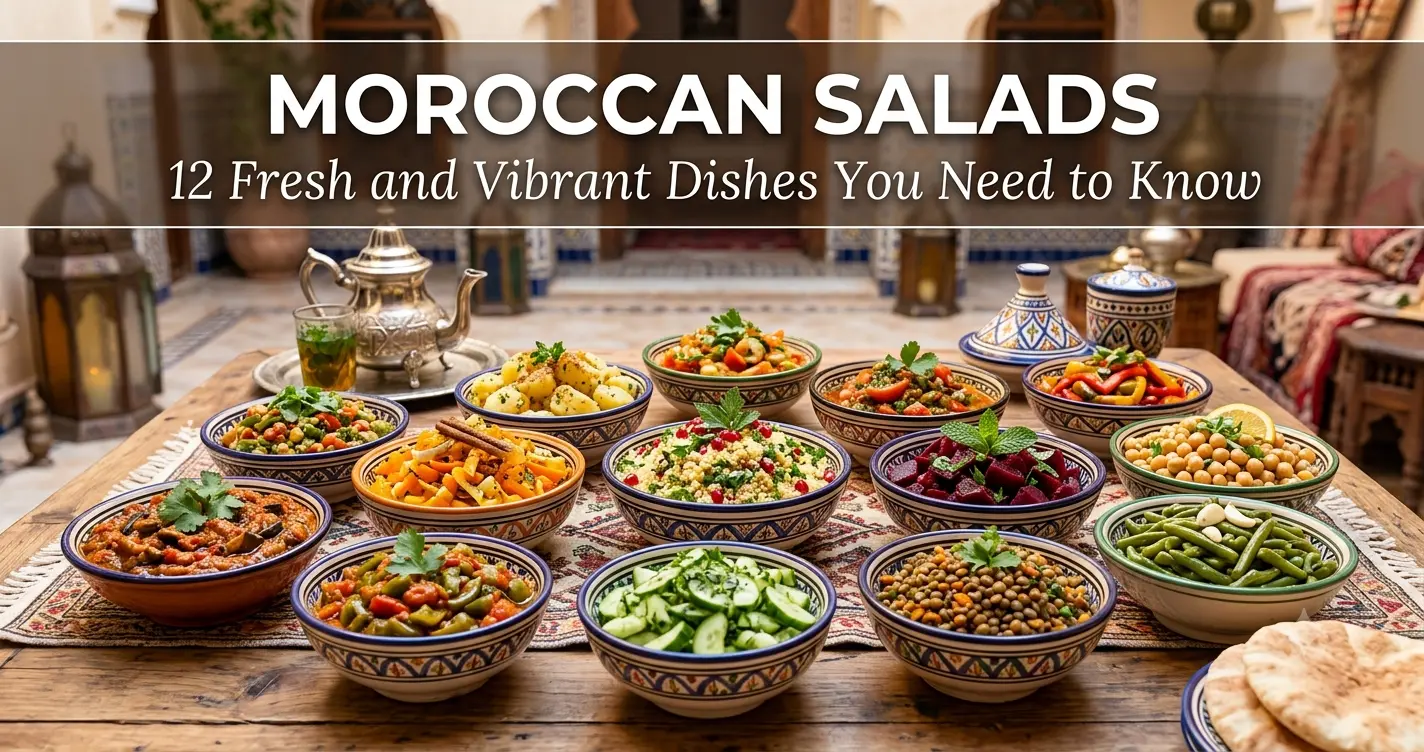
If you have ever sat down at a Moroccan table — whether in a riad in Marrakech, a family home in Fez, or a seaside restaurant in Essaouira — you already know that the meal does not begin with a single dish. It begins with an explosion. A spread of small plates arrives almost simultaneously: jewel-toned bowls of cooked vegetables glistening with olive oil, bright raw salads fragrant with cumin and preserved lemon, smoky eggplant purées, and herb-flecked carrot dishes that make you forget you are eating something as humble as a root vegetable. These are Moroccan salads, and they are one of the great unsung glories of world cuisine.
In the Western world, the word "salad" tends to conjure images of raw leaves tossed with vinaigrette. In Morocco, the concept is radically broader, deeper, and more culturally loaded. Moroccan salads can be raw or cooked, warm or cold, chunky or silky-smooth. They can be served as starters, side dishes, or even as the main attraction of a light meal. And they carry centuries of culinary history within every spoonful — influences from Berber, Arab, Andalusian, and Sub-Saharan African traditions all layered together in ways that continue to astonish food scholars and home cooks alike.
Here at MaCooking, we have spent years documenting, testing, and celebrating the full breadth of Moroccan cooking. In this guide, we are going deep into the world of Moroccan salads — covering 12 essential dishes you truly need to know, with expert commentary, cultural context, preparation tips, and the kind of insider knowledge that only comes from time spent in actual Moroccan kitchens. Whether you are a curious home cook in London, a food enthusiast in California, or a professional chef looking to expand your repertoire, this is the guide you have been waiting for.
The Philosophy Behind Moroccan Salads: More Than Just a Side Dish
To understand Moroccan salads, you first need to understand the Moroccan concept of hospitality — karam in Arabic. In Morocco, abundance at the table is not just a preference; it is a moral and social obligation. Welcoming guests with a generous spread is a form of honor, and the salad course — known collectively as the salades marocaines — is the opening statement of that hospitality.
Traditionally, a proper Moroccan feast might feature anywhere from three to twelve different salads served simultaneously before the main tagine or couscous arrives. Each dish is distinct in flavor, texture, and color. This is intentional. The Moroccan culinary tradition prizes contrast and complexity — the interplay of warm spices and cooling herbs, the tension between sweet and savory, the dialogue between smoky charred vegetables and bright fresh citrus.
The Berber people, the indigenous inhabitants of North Africa, planted the seeds of this tradition thousands of years ago. Their cooking was built around seasonal vegetables, legumes, and olive oil — ingredients that remain the backbone of Moroccan salads today. When Arab traders and later Arab dynasties arrived, they brought new spices, new techniques, and a sophisticated culinary culture. The Andalusian Moors, expelled from Spain in the 15th century, contributed delicate flavor combinations and a preference for sweet-savory pairings. All of these influences converged over centuries to create what we recognize today as Moroccan salad culture.
"A Moroccan table without its salads is like a medina without its souks — technically functional, but stripped of everything that makes it come alive." — Chef Jamal, MaCooking
Cooked vs. Raw: Understanding the Two Worlds of Moroccan Salads
One of the most important distinctions in Moroccan salad culture is between cooked salads (salades cuites) and raw salads (salades crues). Both have their place, both are deeply traditional, and understanding the difference helps you appreciate why each dish tastes the way it does.
| Feature | Cooked Salads (Salades Cuites) | Raw Salads (Salades Crues) |
|---|---|---|
| Texture | Silky, soft, sometimes chunky | Crisp, crunchy, refreshing |
| Flavor Profile | Deep, smoky, complex, concentrated | Bright, acidic, herbaceous, fresh |
| Key Technique | Roasting, sautéing, slow cooking | Chopping, marinating, tossing |
| Serving Temperature | Room temperature or slightly warm | Chilled or room temperature |
| Examples | Zaalouk, Taktouka, Mashed Carrots | Tomato-Cucumber, Beet Salad, Orange Salad |
| Best Season | Year-round | Spring and Summer |
| Shelf Life | 2-4 days refrigerated | Best consumed same day |
Both categories are essential. At a traditional Moroccan dinner party, you would typically see a balance of the two — the richness of cooked salads anchored by the brightness of raw ones. This is the art form: not any single dish in isolation, but the conversation between them.
The 12 Essential Moroccan Salads You Need to Master
1. Zaalouk — The Smoky Eggplant and Tomato King
If there is one Moroccan salad that has achieved near-mythological status both inside and outside Morocco, it is zaalouk. This cooked salad of roasted eggplant and tomatoes, seasoned with cumin, paprika, garlic, and a generous pour of olive oil, is served at virtually every Moroccan table — from the most modest working-class home to the grandest palace dining room in Fez.
The secret to truly great zaalouk lies in two things: the roasting of the eggplant and the patience of the cook. The eggplant must be charred — either over an open flame, under a broiler, or in a very hot oven — until the skin is completely blackened and the flesh inside has collapsed into a smoky, yielding mass. This charring is non-negotiable. It is where the depth of flavor comes from. Once the eggplant is roasted and peeled, it gets combined with a sauce of cooked-down tomatoes, generous amounts of garlic, ground cumin, smoked paprika, a touch of cayenne, fresh cilantro, and flat-leaf parsley. Everything is cooked together until it melts into a cohesive, intensely flavored spread.
Zaalouk is typically eaten at room temperature, scooped up with crusty Moroccan bread (khobz). It keeps beautifully in the refrigerator for up to four days, which makes it an ideal dish to prepare ahead when entertaining.
Expert tip: Add a small pinch of ground coriander to your zaalouk along with the cumin. It adds a subtle citrusy note that rounds out the smokiness beautifully.
2. Taktouka — Roasted Peppers and Tomatoes in Perfect Harmony
Taktouka is zaalouk's equally beloved cousin — another cooked salad, this time built on roasted green peppers and ripe tomatoes. The name is thought to derive from the Berber word for "mixed" or "pounded," which gives you a sense of the technique involved.
To make taktouka, green bell peppers (and sometimes mildly hot peppers for extra character) are roasted whole until completely soft and their skins slip off easily. Meanwhile, tomatoes are peeled, seeded, and cooked down with garlic, cumin, paprika, olive oil, and fresh cilantro until they form a thick, fragrant sauce. The roasted peppers are then added and everything is cooked together until unified.
The result is a salad that is simultaneously sweet, savory, gently spiced, and deeply satisfying. Unlike zaalouk, which leans smoky and earthy, taktouka is brighter and slightly sweeter — a perfect counterpoint when served alongside it.
Regional variation: In some parts of Morocco, particularly in the south, cooks add a handful of preserved lemon rind, finely chopped, to taktouka. The effect is electrifying — a burst of saline citrus that cuts through the richness of the olive oil.
3. Moroccan Carrot Salad — The Underestimated Beauty
Do not sleep on the Moroccan carrot salad. This is a dish that looks simple on the surface but contains multitudes. Carrots are boiled or steamed until tender, then dressed with olive oil, fresh lemon juice, ground cumin, paprika, harissa, fresh cilantro, and sometimes a touch of honey. The result is a salad that manages to be simultaneously sweet, spicy, tangy, and herbaceous.
There are dozens of regional variations across Morocco. In Marrakech, cooks tend to make it on the sweeter side with extra honey and raisins. In Casablanca, a spicier version with harissa and preserved lemon is more common. In the Rif Mountains in the north, you might encounter a version with mint and a splash of orange blossom water that is almost dessert-like in its delicacy.
The key to a great Moroccan carrot salad is not overcooking the carrots — you want them tender enough to absorb the dressing but still holding their shape. And always dress them while they are still warm; warm vegetables absorb flavors far more efficiently than cold ones.
4. Moroccan Tomato and Cucumber Salad (Salade Marocaine)
This is the everyday salad of Morocco — the one that appears on virtually every table, every day, in every region of the country. It is deceptively simple: ripe tomatoes and cucumber, finely diced, dressed with olive oil, lemon juice, cumin, salt, and fresh herbs (usually a combination of flat-leaf parsley and cilantro).
What makes it distinctly Moroccan rather than generic Mediterranean is the cut. Everything is diced very small — almost minced — creating a salad that is almost salsa-like in consistency. This fine dice allows the tomato juices, lemon juice, and olive oil to mingle into a deeply flavored liquid that you want to mop up with bread.
The other distinctly Moroccan touch is the cumin. While most Western tomato salads rely on dried herbs like oregano or basil, the Moroccan version uses ground cumin as its primary spice, giving it that warm, earthy undertone that is unmistakably North African.
Pro tip: Salt your diced tomatoes and cucumber separately, let them sit for ten minutes, then drain off the excess liquid before combining and dressing. This concentrates the flavor and prevents a watery, diluted salad.
5. Beet Salad with Orange and Cumin
Beets in Morocco are treated with the reverence they deserve. This salad — roasted or boiled beets tossed with fresh orange segments, ground cumin, olive oil, lemon juice, and fresh mint — is one of the most visually stunning dishes in the Moroccan repertoire. The deep crimson of the beets against the bright orange segments and the flecks of green mint creates a plate that looks almost too beautiful to eat.
The flavor combination might seem unusual if you have not encountered it before, but it is utterly logical once you taste it. Beets are naturally sweet and earthy; orange adds brightness and acidity; cumin brings warmth and depth; mint contributes cooling freshness. It is a complete flavor circle in a single bowl.
Roasting beets rather than boiling them concentrates their natural sugars and gives the salad more complexity. Wrap them individually in foil and roast at 200°C (400°F) for 45-60 minutes depending on size, then let them cool before peeling (the skin slips off effortlessly).
6. Moroccan Orange and Olive Salad
This is a salad that surprises almost everyone who encounters it for the first time — and then immediately becomes one of their favorites. Sliced oranges (blood oranges when in season are spectacular), good quality cured black olives, thinly sliced red onion, and a dressing of olive oil, ground cinnamon, cumin, cayenne pepper, and a handful of fresh herbs.
The Andalusian influence is unmistakable here. The combination of citrus with olives and the use of cinnamon as a savory spice are hallmarks of the cooking traditions brought to Morocco by the Moors expelled from Spain. It is history you can taste — a connection to a vanished civilization preserved in food.
This salad is particularly magnificent alongside grilled fish or roasted lamb, where the brightness of the orange cuts through the richness of the protein beautifully.
7. Zaalouk de Courgettes (Zucchini Zaalouk)
Less famous than its eggplant counterpart but equally delicious, zucchini zaalouk follows the same principle: zucchini is grated or diced, cooked down with tomatoes, garlic, cumin, paprika, and olive oil until it reaches a soft, unctuous consistency. The result is lighter than the original zaalouk but equally addictive.
The trick with zucchini zaalouk is managing the moisture. Zucchini releases a tremendous amount of water as it cooks, which can make the salad watery and bland if you are not careful. The solution is to grate the zucchini, salt it heavily, let it sit for 30 minutes, then squeeze out as much liquid as possible before cooking. This step seems fussy but it is absolutely essential.
8. Herb and Argan Oil Salad (Salade du Souss)
This salad comes from the Souss Valley in southwestern Morocco — the heartland of argan tree cultivation and one of the most distinctive culinary regions in the country. It is built around fresh herbs (a combination of flat-leaf parsley, cilantro, and sometimes mint), finely diced preserved lemon, capers or green olives, and dressed with — crucially — culinary argan oil rather than olive oil.
Culinary argan oil (distinct from the cosmetic grade oil used in hair and skin products) has a rich, nutty, slightly smoky flavor that is absolutely unique. It is one of the most prized cooking fats in North Africa, and this simple herb salad is one of the best ways to showcase it. The argan oil's nuttiness plays beautifully against the brightness of preserved lemon and the freshness of the herbs.
If you can find culinary argan oil at a specialty food store — and increasingly, you can — this salad is worth making purely as a vehicle for tasting it. You will understand immediately why Moroccan cooks treasure it so deeply.
9. Potato and Chermoula Salad
Chermoula is Morocco's most important marinade and sauce — a vibrant green paste of cilantro, flat-leaf parsley, garlic, cumin, paprika, lemon juice, and olive oil. It is most often used to marinate fish before grilling, but in this salad, it becomes the dressing for warm boiled potatoes.
The potatoes must be dressed while still warm — this is the cardinal rule. Warm potatoes are porous and absorbent; they drink in the chermoula like a sponge, becoming infused with its flavors all the way through. Cold potatoes simply coat on the surface, which gives you a completely different (and inferior) result.
This is a salad that travels beautifully to picnics and gatherings, as it actually improves as it sits. Make it two hours before serving and keep it at room temperature, and the flavors will have melded into something extraordinary.
10. Lentil Salad with Cumin and Herbs
Lentils have been cultivated in North Africa for thousands of years, and Moroccan cooks have developed countless ways to prepare them. This salad — warm or room-temperature lentils (brown or green work best; avoid red lentils, which disintegrate) dressed with olive oil, cumin, paprika, a splash of red wine or sherry vinegar, fresh parsley, and diced tomato — is one of the most satisfying and nutritionally complete salads in the Moroccan repertoire.
The key to lentil salad is texture. The lentils must be cooked until just tender — they should hold their shape completely but offer no resistance when you bite through them. Start checking them at the 20-minute mark and pull them from the heat the moment they are done. Overcooked, mushy lentils make a passable soup ingredient but a disappointing salad.
Add a dollop of harissa and some finely diced preserved lemon to take this salad from excellent to unforgettable.
11. Moroccan-Style Roasted Pepper Salad with Preserved Lemon
This salad celebrates the roasted pepper in its purest form. A mixture of red, yellow, and orange bell peppers are roasted under a broiler or over an open flame until completely charred on all sides. They are then placed in a covered bowl to steam for ten minutes (this makes peeling effortless), peeled, seeded, and torn into generous strips.
The dressing is simple but precise: good olive oil, fresh lemon juice, a minced clove of raw garlic, ground cumin, a pinch of smoked paprika, finely chopped preserved lemon rind, and fresh flat-leaf parsley. The preserved lemon is the element that transforms this from a vaguely Mediterranean roasted pepper salad into something unmistakably Moroccan.
Preserved lemons — lemons packed in salt and their own juice for at least a month — develop a complex, fermented, intensely lemony flavor that fresh lemon juice simply cannot replicate. They are available at Middle Eastern and North African grocery stores, and increasingly at well-stocked supermarkets. If you want to make your own, we have a detailed guide at MaCooking that walks you through the entire process.
12. Moroccan Spinach Salad with Raisins and Almonds
The last salad on our list showcases the sweet-savory dimension that runs throughout Moroccan cuisine — a direct inheritance from the Andalusian and Arab culinary traditions. Blanched spinach (squeezed very dry) is sautéed briefly with olive oil, garlic, and warming spices (cumin, a pinch of cinnamon, a touch of ginger), then tossed with plump golden raisins, toasted slivered almonds, and a drizzle of orange blossom water.
The combination sounds unusual to Western ears but makes immediate sense on the palate. The sweet raisins and fragrant orange blossom water soften the slight bitterness of the spinach; the almonds provide crunch and richness; the warm spices provide depth. This is the kind of salad that stops people in their tracks at a dinner party — they cannot quite identify what they are eating, but they know they want more of it.
Essential Moroccan Salad Ingredients: Your Pantry Checklist
Making authentic Moroccan salads at home requires building the right pantry. The good news is that most of these ingredients are now widely available in Western countries, either at specialty food stores, Middle Eastern grocers, or online retailers.
| Ingredient | Why It Matters | Where to Find It | Substitute (if needed) |
|---|---|---|---|
| Preserved Lemons | Adds fermented, intensely citrusy depth | Middle Eastern grocers, specialty stores | Fresh lemon zest + pinch of salt (inferior but functional) |
| Ground Cumin | The foundational spice of Moroccan salads | Any supermarket | No real substitute — buy it |
| Smoked Paprika | Adds smoky depth without heat | Any supermarket | Sweet paprika (less complex) |
| Harissa | Moroccan chili paste for heat and complexity | Middle Eastern grocers, many supermarkets | Sriracha + pinch of cumin (approximate) |
| Extra Virgin Olive Oil | The primary fat — quality matters enormously | Any supermarket | None — always use olive oil |
| Culinary Argan Oil | Unique nutty flavor for specific dishes | Specialty food stores, online | Toasted sesame oil (different but interesting) |
| Fresh Cilantro | Ubiquitous fresh herb in Moroccan cooking | Any supermarket | Extra flat-leaf parsley |
| Fresh Flat-Leaf Parsley | Pairs with cilantro in most dishes | Any supermarket | Curly parsley (less flavorful) |
| Orange Blossom Water | Floral finish for sweet-savory dishes | Middle Eastern grocers, online | Rose water (different but similar concept) |
| Ground Cinnamon | Used as a savory spice in several salads | Any supermarket | No substitute needed — use sparingly |
Serving Moroccan Salads: The Art of the Spread
Knowing how to cook Moroccan salads is one thing; knowing how to serve them is another. The presentation and sequencing of a Moroccan salad spread is itself an art form with its own etiquette and logic.
Temperature and Timing
Most Moroccan salads are best served at room temperature rather than straight from the refrigerator. This is not merely a preference — it is a flavor imperative. Cold suppresses the volatile aromatic compounds in spices and herbs, making food taste flat and muted. Removing salads from the refrigerator 30-45 minutes before serving allows the flavors to bloom and fully express themselves.
The Rule of Threes
A good Moroccan salad spread should include at minimum three salads: one cooked and warm, one cooked and room temperature, and one fresh raw salad. This triad provides the textural and flavor contrast that makes the Moroccan salad experience so compelling. For a more elaborate spread, aim for five to seven salads, alternating between the two categories.
Bread Is Non-Negotiable
Moroccan salads are eaten with bread — specifically with khobz, the round, slightly chewy Moroccan flatbread. The bread serves as both utensil and flavor vehicle. A good piece of khobz dragged through a bowl of zaalouk, picking up the olive oil and spiced tomato juices, is one of the simple pleasures of Moroccan food. If you cannot find Moroccan bread, a good crusty baguette or any artisan flatbread will work admirably.
Communal Eating
Traditionally, Moroccan salads are served communally — in shared bowls placed in the center of the table. Each diner eats from the communal bowl, using their bread to scoop. This communal style is not just logistically efficient; it creates a sense of warmth and togetherness that is central to Moroccan dining culture. When serving Moroccan salads at a dinner party, embrace this communal style rather than plating individual portions. It changes the energy of the meal entirely.
Health Benefits: Why Moroccan Salads Are Among the World's Healthiest Foods
Beyond their extraordinary flavor, Moroccan salads offer a nutritional profile that is genuinely impressive. The Mediterranean diet has long been celebrated by nutritionists and health researchers for its association with reduced rates of cardiovascular disease, inflammation, and metabolic disorders. Moroccan salads sit squarely within this tradition while adding their own distinct nutritional advantages.
- High in antioxidants: The heavy use of tomatoes, peppers, and eggplant provides lycopene, vitamin C, and a range of polyphenols that combat oxidative stress.
- Anti-inflammatory spices: Cumin, turmeric, cinnamon, and ginger — all common in Moroccan salads — have documented anti-inflammatory properties that have been studied extensively in nutritional science.
- Olive oil benefits: The generous use of extra virgin olive oil provides heart-healthy monounsaturated fats and oleocanthal, a compound with anti-inflammatory effects comparable to low-dose ibuprofen.
- High fiber content: Lentils, beets, carrots, and the abundant vegetables in Moroccan salads provide dietary fiber that supports digestive health and satiety.
- Plant-forward nutrition: The majority of Moroccan salads are entirely plant-based, providing protein (especially from lentils and chickpea-based dishes), complex carbohydrates, vitamins, and minerals without the saturated fat associated with animal proteins.
- Naturally low in refined sugar: Moroccan salads derive their sweetness from natural sources — roasted vegetables, fresh fruit, raisins — rather than added sugars.
The combination of these factors makes a spread of Moroccan salads one of the most nutritionally complete and genuinely healthy meals you can eat — and certainly one of the most delicious ways to eat well.
Regional Variations Across Morocco: A Country of Salad Diversity
Morocco is a geographically and culturally diverse country, and its salad traditions vary significantly from region to region. Understanding these regional differences adds another layer of appreciation to Moroccan cuisine.
Marrakech and the South
Marrakech cooking tends to be slightly sweeter and more aromatic than elsewhere in Morocco. Salads from this region often incorporate honey, dried fruits, and warming spices like cinnamon and ginger. The orange and olive salad is quintessentially from this region, as is a version of carrot salad that borders on dessert in its sweetness.
Fez — The Culinary Capital
Fez is widely considered the culinary heart of Morocco, the city where the most refined and elaborate cooking traditions developed under centuries of Arab-Andalusian influence. Fassi salads tend to be more delicate and complex, with more layers of flavoring and a preference for subtle spicing rather than bold heat. Preserved lemon appears in nearly everything, and the use of saffron even in salad dressings is not uncommon.
Coastal Regions — Essaouira, Agadir, and Casablanca
Morocco's Atlantic coast has its own salad traditions, heavily influenced by the abundance of fresh seafood. Chermoula-dressed salads are particularly common here, since chermoula is the primary marinade for the region's magnificent grilled fish. Salads incorporating capers, olives, and preserved lemon — ingredients with obvious connections to the sea and trade — are coastal signatures.
The Rif and Northern Morocco
The mountainous north, with its heavy Berber and Mediterranean Spanish influence, features salads that incorporate more fresh herbs and less spicing than southern Morocco. Mint appears more frequently, and salads here are sometimes dressed with a splash of vinegar rather than lemon juice — a nod to the Spanish influence that defined this region for centuries.
Frequently Asked Questions About Moroccan Salads
Q: Are Moroccan salads always vegetarian?
A: The vast majority of Moroccan salads are entirely vegetarian — and many are vegan. The salad course in Moroccan cuisine is almost exclusively plant-based, built around vegetables, legumes, herbs, and olive oil. The main courses — tagines and couscous — often feature meat or fish, but the salads that precede them are typically free of animal products. This makes Moroccan salad culture an absolute treasure for vegetarians and vegans looking for deeply flavored, satisfying plant-based food. There are occasional exceptions — some coastal salads incorporate canned tuna or anchovies — but these are clearly distinguishable and easily adapted.
Q: How far in advance can I prepare Moroccan salads?
A: This varies considerably by type. Cooked salads like zaalouk, taktouka, and carrot salad actually improve significantly with time as the flavors meld and deepen. These can be made 24-48 hours in advance and refrigerated — just remember to bring them to room temperature before serving. Raw salads like the tomato-cucumber salad are best made no more than 30-60 minutes before serving, as the salt draws moisture from the vegetables and the texture deteriorates quickly. Lentil and potato salads fall in the middle — best made a few hours ahead and kept at room temperature.
Q: What is the best way to learn to make authentic Moroccan salads at home?
A: The best approach combines reliable recipes with an understanding of technique and flavor principles. Start with the three foundational cooked salads — zaalouk, taktouka, and Moroccan carrot salad — as they will teach you the most important Moroccan flavor combinations and cooking techniques. Once you are comfortable with those, the others follow naturally. For step-by-step guidance with detailed recipes and video tutorials, MaCooking offers the most comprehensive collection of authentic Moroccan salad recipes available online, developed and tested by Moroccan chefs with decades of experience.
Q: Can I substitute regular lemon for preserved lemon in these recipes?
A: You can, but you will lose something significant in the process. Preserved lemon has a fermented, complex, almost briny quality that fresh lemon juice simply cannot replicate — the acidity is milder, the flavor is deeper, and the aromatic quality is completely different. That said, fresh lemon zest combined with a tiny pinch of salt is the closest practical substitute. If you have access to preserved lemons — and they are increasingly available at specialty grocery stores — use them. They keep for months in the refrigerator and transform any Moroccan dish that calls for them.
Q: How spicy are Moroccan salads typically?
A: Contrary to what many Western diners expect, Moroccan food is generally not very spicy in the chili-heat sense. Moroccan cuisine is heavily spiced — meaning it uses a wide range of aromatic spices — but the heat level is typically mild to moderate. Most of the salads in this guide have little to no chili heat; the spicing is warm and aromatic rather than fiery. Dishes that do use heat — like versions incorporating harissa or cayenne pepper — are clearly identified, and the amount is always adjustable to your preference. If you are cooking for guests who are sensitive to spice, simply reduce or omit the harissa and cayenne.
Conclusion: Bringing the Moroccan Salad Table to Your Home
Moroccan salads are one of the great accessible luxuries of world cuisine. They ask for inexpensive, seasonal vegetables; a handful of pantry spices; good olive oil; and your time and attention. In return, they deliver extraordinary flavor, remarkable nutritional density, and the kind of generous, convivial eating experience that transforms a meal into a memory.
Whether you start with the iconic zaalouk, the bright and simple tomato-cucumber salad, or the surprisingly sophisticated orange and olive combination, you are entering a culinary tradition that stretches back centuries — one that connects you to the Berber farmers, the Andalusian poets, the Arab traders, and the countless Moroccan home cooks who have perfected these dishes generation after generation.
The twelve salads in this guide are your gateway into that world. Master them, adapt them to your taste and the seasons, and serve them with good bread and good company. That is, in essence, the entire Moroccan philosophy of food.
For more authentic Moroccan recipes, detailed technique guides, and the cultural stories behind the food you love, explore the full collection at MaCooking — the world's most comprehensive platform for authentic Moroccan cuisine. From tagines to pastilla, from chermoula to couscous, everything you need to cook Morocco at home is waiting for you there.
Now go to your kitchen. The ingredients are simple. The flavors are magnificent. And somewhere in Marrakech, a grandmother is making zaalouk for her grandchildren — just as her grandmother made it for her. You are part of that story now.