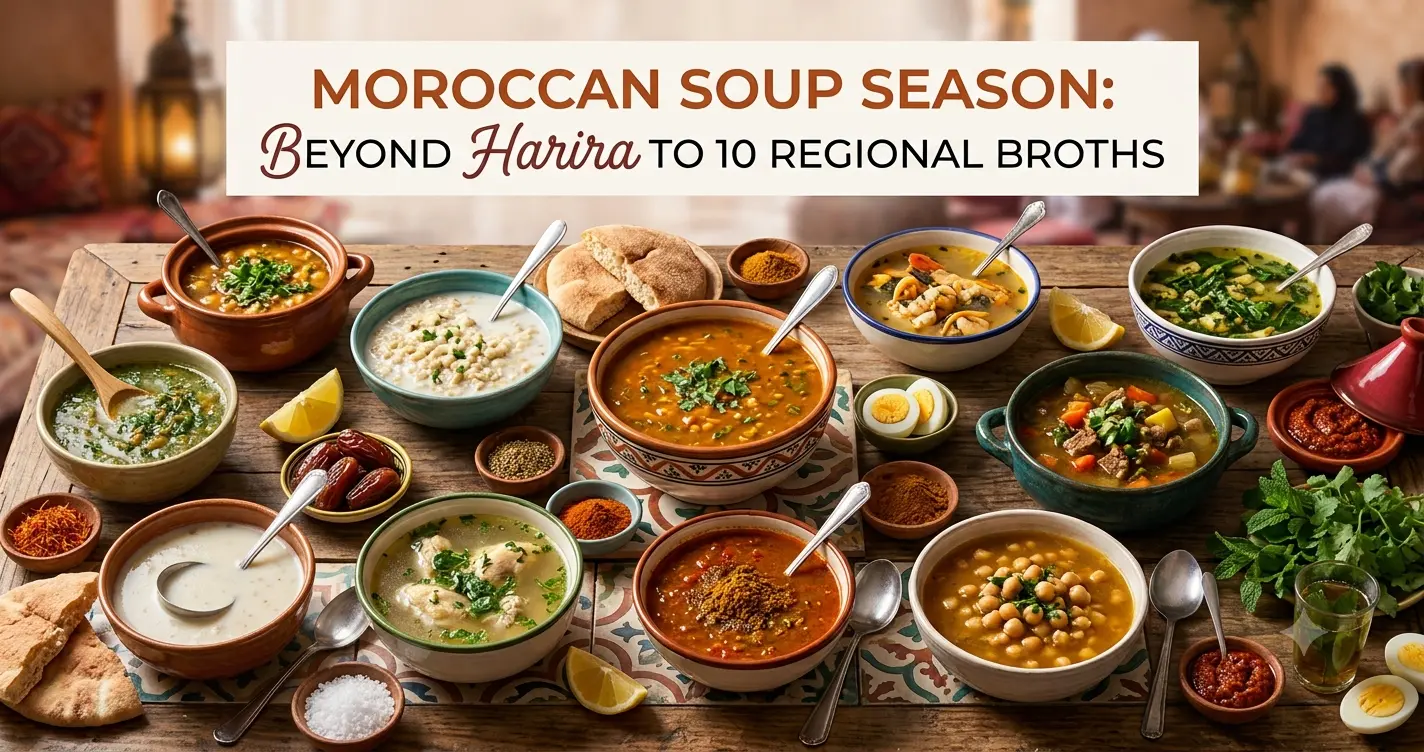
There is a moment — and every cook who has spent real time in Morocco knows it — when the air shifts. It happens sometime in late October, when the Atlantic wind rolls in off the coast and the High Atlas suddenly feels closer than it did the week before. In kitchens from Tangier to Tafraoute, a familiar ritual begins: dried legumes come off the shelf, earthenware pots return to the stovetop, and the deep, saffron-threaded perfume of simmering broth reclaims its rightful place in the home. Soup season in Morocco is not a culinary convenience. It is a cultural ceremony, a sensory calendar, and one of the most honest expressions of a civilization that has been feeding itself brilliantly for more than a thousand years.
Most Western food lovers, when they think of Moroccan soup, think of one thing: harira. And harira is extraordinary — a tomato-and-lemon-soured, herb-flecked, legume-rich masterpiece that has earned its global reputation. But harira is only the opening note of a much longer symphony. Morocco is a country of staggering geographical and cultural diversity — Berber mountain villages, Arab medina kitchens, Saharan desert camps, Atlantic fishing ports, and lush Rharb River plains — and each of these landscapes has given birth to its own broth tradition. These regional soups are among the least-documented and most delicious chapters of Moroccan cooking, and that is precisely why we are here today.
At MaCooking, we have spent years documenting, testing, and celebrating the full breadth of Moroccan culinary tradition, from the iconic to the nearly forgotten. This guide is our deepest dive yet into Morocco’s soup culture — ten regional broths, their histories, their ingredients, their techniques, and every practical detail you need to bring them to life in your own kitchen, wherever in the world that kitchen may be.
Chapter 1: Understanding Morocco’s Soup Culture — A Living Tradition
To understand Moroccan soup, you first have to understand that the concept of soup in Morocco carries a social and spiritual weight that it rarely carries in Western culinary culture. In the United States or the United Kingdom, soup is often a starter, a light lunch, or a remedy for a cold. In Morocco, soup is communion.
The Arabic word most commonly used is shourba (شوربة), derived from the verb meaning “to drink,” which tells you something important about texture and consistency. Moroccan soups are often drunk directly from a bowl or a ceramic cup, especially the thinner broths. Thicker soups, like harira or bissara, are eaten with a spoon and broken bread, the traditional khobz or its crusty cousin, the m’semen-like batbout.
The Historical Roots of Moroccan Broth
Moroccan soup culture draws from at least four distinct culinary civilizations. The indigenous Amazigh (Berber) population contributed the foundational grain and legume base — dried fava beans, barley flour, lentils — that forms the nutritional backbone of most traditional soups. Arab influences brought sophisticated spicing philosophies and the concept of acid-balance (the lemon juice and vinegar used to finish harira are distinctly Arab-influenced). Andalusian refugees who arrived in Morocco after 1492 brought a love of complex aromatics, including cinnamon in savory applications and the use of preserved citrus. Sub-Saharan and trans-Saharan trade routes contributed saffron, dried ginger, and the deeply warming spice blends we now call ras el hanout.
This layered history means that a bowl of Moroccan soup is never just dinner. It is archaeology.
Soup and the Moroccan Calendar
Moroccan soups follow a calendar that is both religious and agricultural:
- Ramadan: Harira becomes almost a sacred obligation — the soup by which the daily fast is broken at iftar across the entire country. Dates and sellou accompany it, but harira anchors the meal.
- Winter months (November through February): Thick, legume-heavy soups like bissara and lentil shourba dominate. These are warming, sustaining, deeply nutritious broths designed for cold evenings and hard-working bodies.
- Agricultural harvest seasons: Lighter vegetable soups appear in spring and early summer, using fresh produce from the Souss Valley and the Gharb plains.
- Celebrations and funerals: Certain broths, particularly chicken-based soups with vermicelli, are associated with hospitality and mourning alike — soup as care, soup as comfort.
Chapter 2: The Queen and Her Court — Harira in Context
Before we travel beyond harira, we owe it the respect of proper understanding. Harira is not a single recipe — it is a category, and the variation between a Fez harira and a Marrakech harira and a Casablanca harira is significant enough that Moroccan cooks from different cities have been known to argue passionately about whose version is the true one. (They are all right, and they are all wrong, which is the correct answer.)
What Makes Harira, Harira
The defining characteristics of a genuine harira, across all regional variations, include:
- A tomato and onion base, slowly sweated in oil
- At least one legume — chickpeas, lentils, or both
- Fresh herbs in generous quantity — cilantro and flat-leaf parsley are non-negotiable
- An acid finish — lemon juice is standard, though some older recipes use dried lemon or even a splash of white vinegar
- A thickening agent — tedouira, a paste of flour and water, stirred in during the final minutes to give harira its characteristic velvety body
- Spices: ginger, cinnamon, black pepper, turmeric, and often a pinch of saffron
Regional Harira Variations Worth Knowing
The Fez version (harira fassia) tends to be the most complex, with lamb pieces simmered into the broth and a higher concentration of saffron. The Marrakech version leans sweeter, sometimes with a whisper of cinnamon that is more pronounced than elsewhere. Along the Atlantic coast, some cooks add smoked paprika — a Spanish influence filtered through generations of cross-cultural exchange. The southern harira of Agadir often incorporates argan oil in a small quantity, finished at the table, giving the bowl a distinctly nutty depth.
“Harira is the soup that every Moroccan grandmother makes differently and every Moroccan grandmother makes perfectly. The secret is not the recipe. The secret is the patience — you cannot rush a harira any more than you can rush love.”
Chapter 3: The Ten Regional Broths — A Journey Through Morocco’s Soup Map
Now we travel. From the northern Rif mountains to the southern pre-Saharan oases, from the Atlantic coast to the Middle Atlas plateaus, here are ten Moroccan regional soups that deserve far more international attention than they currently receive.
1. Bissara — The Working People’s Broth (Northern Morocco & National)
If harira is Morocco’s queen, bissara is its salt-of-the-earth hero. Made from dried, skinned fava beans (or split peas in some northern variants), bissara is blended smooth and served in a shallow bowl or wide cup, drizzled with extra-virgin olive oil, dusted with cumin and smoked paprika, and often finished with a drizzle of chili oil in the north.
Bissara is the soup of the early morning — sold from street-side stalls in Tangier, Chefchaouen, and Tetouan before dawn, consumed by market workers and fishermen fueling up for long, physical days. It costs almost nothing to make, it is profoundly nutritious, and when it is done right — when the beans have been soaked overnight and cooked until they collapse into silk — it is one of the most satisfying things you will ever eat.
Key ingredients: Dried split fava beans, garlic, cumin, paprika, olive oil, chili flakes, salt
Technique note: The secret is long, slow simmering until the beans are truly falling apart, then vigorous whisking or blending. A food processor gives you a perfectly smooth result; traditional cooks use a hand mill. Finish always with good-quality olive oil — this is not optional.
Regional note: In Tetouan and the northern Rif, dried split peas are sometimes used instead of favas, producing a slightly sweeter, less earthy result.
2. Shourba Bil Hout — Atlantic Fish Broth (Essaouira, Agadir, El Jadida)
Morocco has more than 1,800 kilometers of coastline, and its fishing communities have been making fish soups for as long as anyone can remember. The Atlantic fish broth, known simply as shourba bil hout (soup with fish), is a coastal staple that varies dramatically by port but shares a common DNA: fresh tomato, onion, garlic, generous amounts of fresh cilantro, a careful hand with cumin and ginger, and whatever fish came off the boats that morning.
In Essaouira, the soup tends to be thinner and more delicate, flavored with preserved lemon and finished with a careful squeeze of fresh lemon. In Agadir, the influence of the local argan-growing culture means you will sometimes find a small measure of argan oil stirred in at the end. Along the Doukkala coast near El Jadida, potatoes are added to make the soup more substantial — a feeding-a-fishing-family soup rather than a restaurant showcase.
Key ingredients: White fish fillets (sea bass, grouper, or monkfish work beautifully outside Morocco), tomatoes, onion, garlic, cumin, ginger, turmeric, cilantro, preserved lemon, olive oil
Technique note: Never overcook the fish. Build the tomato-spice base first, simmer it for 20 minutes to concentrate the flavor, then add the fish for only the final 8-10 minutes. Overcooked fish ruins the soup entirely.
Pairing: Served with thick-cut bread and often accompanied by a small plate of harissa or chermoula for dipping.
3. Lentil Shourba — The Medina Comfort Bowl (Fez, Meknes, Rabat)
The imperial cities of Morocco’s interior — Fez, Meknes, and Rabat — have a particular affinity for lentil-based soups that is older than the cities themselves. Red lentils, which cook quickly and collapse into a naturally thick, smooth puree, are the most common variety used, seasoned with the characteristically complex spice palette of the imperial kitchen tradition: turmeric, ginger, cinnamon, black pepper, and always a generous handful of fresh cilantro stirred in at the last moment.
The Fez version (shourba adas fassia) is notably more aromatic than simpler versions, often including a small piece of preserved lemon rind cooked directly in the soup and removed before serving — a technique that perfumes the broth without making it overtly tart. In some traditional Fez homes, a small quantity of lamb or beef is simmered in the broth and then shredded back into it, turning this into a near-complete meal.
Key ingredients: Red lentils, onion, tomato, garlic, turmeric, ginger, cumin, cinnamon stick, fresh cilantro, lemon
Technique note: Toast whole cumin seeds in a dry pan before grinding them — this single step transforms the flavor profile. Add a tablespoon of tomato paste alongside fresh tomatoes for a deeper, more concentrated result.
4. Tchicha — Barley Broth of the Atlas Mountains
This is the soup that most Western visitors to Morocco never encounter, because it belongs firmly to the Amazigh heartland of the Middle and High Atlas mountains. Tchicha is made from broken barley — a coarse, slightly nutty grain that was the dietary staple of Berber mountain communities for millennia before wheat became widespread. The soup is essentially a barley porridge-broth hybrid: thick, warming, deeply filling, and seasoned with nothing more than olive oil, onion, salt, and sometimes a pinch of dried mint.
In its most austere, traditional form, tchicha is made with only water, barley, salt, and olive oil. This simplicity is not poverty — it is a profound respect for the grain itself. In village homes across the Azilal province and the Beni Mellal area, tchicha is still the standard breakfast on cold mornings, eaten communally from a large central bowl.
More elaborate versions add dried vegetables, a piece of bone for richness, or a swirl of smen (Moroccan aged butter) that melts into the hot barley and creates a flavor that is simultaneously funky, rich, and deeply comforting.
Key ingredients: Broken barley (tchicha grain), onion, olive oil or smen, salt, dried mint
Technique note: Barley needs long, patient cooking — a minimum of 45 minutes at a gentle simmer. Do not rush this. The grain should become tender enough to dissolve partially into the broth, creating a naturally thick consistency without any added thickener.
5. Harira Beida — White Harira (Casablanca & Greater Casablanca Region)
Few Moroccan soups surprise people quite like harira beida — white harira. The name alone seems contradictory. Harira without tomatoes? Without the rich red-amber color that defines the soup in most people’s minds? And yet this is a genuinely traditional preparation, associated primarily with the Casablanca-Settat region and with older, more refined culinary traditions that predate the widespread use of tomatoes in Moroccan cooking (tomatoes, remember, are a New World ingredient that did not fully integrate into Moroccan cuisine until the 18th and 19th centuries).
Harira beida builds its flavor from chicken or lamb broth, onions, celery, chickpeas, and a luxurious quantity of eggs beaten with lemon juice that are stirred into the hot soup in the final minutes — a technique almost identical to Greek avgolemono, hinting at the deep cross-Mediterranean culinary exchange that shaped both traditions. The result is a pale, creamy, beautifully aromatic soup with a silky texture and a brightness that the tomato-based version cannot quite replicate.
Key ingredients: Chicken or lamb broth, chickpeas, celery, onion, eggs, lemon juice, saffron, cilantro, flour for tedouira
Technique note: The egg-lemon mixture must be tempered before adding to the soup — whisk a ladle of hot broth into the eggs first to prevent curdling. Add very slowly, stirring constantly.
6. Chorba Frik — Cracked Wheat Soup (Eastern Morocco & Oujda Region)
Eastern Morocco, bordering Algeria, has a soup culture that is subtly but meaningfully different from the Atlantic-facing west. The influence of Algerian and broader Maghrebi cuisine is evident in chorba frik, a cracked green wheat (freekeh) soup that is widely eaten across the eastern provinces, particularly during Ramadan.
Freekeh — wheat harvested young and roasted over open fire — has a distinctive smoky, grassy flavor unlike any other grain. In chorba frik, it is cooked with lamb or chicken, tomatoes, onion, chickpeas, and a spice blend heavy on coriander seed and black pepper, with the freshness of chopped parsley and a squeeze of lemon to finish. The smoked grain character of the freekeh seeps into every element of the broth, creating a depth that is hard to achieve any other way.
Key ingredients: Freekeh (cracked roasted green wheat), lamb or chicken pieces, tomatoes, chickpeas, onion, coriander seed, black pepper, parsley, lemon
Technique note: Rinse freekeh thoroughly before cooking — it can carry grit and husks. Toast it briefly in a dry pan after rinsing to amplify the smoky notes before adding to the pot.
7. Mrouzia Broth — Spiced Lamb & Honey Soup (Fez & Marrakech)
This is perhaps the most unexpected entry on this list, because mrouzia is traditionally a tagine — a slow-braised lamb preparation with honey, raisins, and ras el hanout that is made for Eid Al-Adha celebrations. But in some older Fez and Marrakech culinary traditions, the intensely spiced, slightly sweet braising liquid from mrouzia is preserved and used as the base for a broth that is consumed the following day — a kind of consommé of the feast.
This broth is extraordinary: the ras el hanout lends it extraordinary complexity, the honey gives it a subtle sweetness, and the rendered lamb fat gives it a richness that is unlike any other Moroccan soup. It is served in small cups, almost like a beverage, alongside the day-after feast meal. It is the kind of tradition that is disappearing from modern Moroccan kitchens, which makes documenting it here all the more important.
Key ingredients: Lamb braising liquid, ras el hanout, honey, raisins (strained out), ginger, saffron
Technique note: If making this standalone (rather than as a byproduct of mrouzia), simmer lamb bones with ras el hanout, a tablespoon of honey, ginger, and saffron for two hours, then strain carefully for a clear, jewel-toned broth.
8. Shourba Dial Khodra — Vegetable Broth of the Souss Valley (Agadir & Surroundings)
The Souss Valley south of the High Atlas is one of Morocco’s most fertile agricultural regions — a broad, sun-drenched plain producing tomatoes, peppers, courgettes, green beans, and herbs in extraordinary abundance. The vegetable soup of this region is a celebration of that produce: a clear, herb-perfumed broth loaded with fresh vegetables, seasoned lightly with cumin and turmeric, and finished with argan oil and a handful of fresh cilantro.
What distinguishes this soup from a generic vegetable broth is the technique of adding the vegetables in stages — root vegetables first, then squash, then the delicate greens — so that each maintains its individual character rather than collapsing into an undifferentiated mass. The argan oil finish is essential: its warm, slightly toasted nut flavor transforms a simple vegetable soup into something with genuine personality.
Key ingredients: Seasonal vegetables (carrots, turnips, zucchini, green beans, tomatoes), onion, garlic, cumin, turmeric, cilantro, argan oil, lemon
Technique note: Build a strong vegetable broth base first by simmering the vegetable trimmings and onion skins for 30 minutes before starting the soup proper. This eliminates the insipid quality that plagues many homemade vegetable soups.
9. Rfissa Broth — Chicken, Fenugreek & Lentil Soup (National, with Regional Variations)
Rfissa occupies a unique place in Moroccan culinary culture — it is both a soup and a complete dish simultaneously. Traditionally served to new mothers in the weeks following childbirth (fenugreek is believed in Moroccan folk medicine to support milk production and recovery), rfissa consists of shredded chicken and lentils in a deeply spiced fenugreek-forward broth, poured over torn pieces of msemen (layered flatbread) or dry bread, which soak up the liquid and become part of the dish.
The broth itself, before the bread is added, is one of the most complex and beautiful soups in the Moroccan repertoire: chicken cooked until falling apart, lentils dissolved into the broth for body, fenugreek seeds adding a distinctive bitter-sweet depth, and the aromatic backbone of ras el hanout, preserved lemon, and fresh herbs. The fenugreek bitterness sounds intimidating but is completely tamed by the long cooking time and the balancing sweetness of the onions.
Key ingredients: Whole chicken, green lentils, fenugreek seeds, onion, saffron, ginger, ras el hanout, preserved lemon, cilantro, msemen or day-old bread
Technique note: Soak fenugreek seeds overnight to reduce bitterness before adding to the soup. Use a whole chicken rather than pieces — the long cooking extracts maximum gelatin from the carcass, giving the broth an extraordinary body.
10. Harira Dial Bzar — Spiced Pepper & Tomato Broth (Marrakech & the South)
Our tenth soup returns us to the harira family, but in a dramatically different southern expression. In Marrakech and the pre-Saharan south, there exists a version of harira that centers on roasted peppers as a primary ingredient alongside the tomatoes — a soup that is simultaneously brighter, smokier, and more intensely sweet-savory than the classic version. The addition of bzar, a southern Moroccan spice blend that differs from ras el hanout in its emphasis on hot peppers, dried ginger, and black pepper, gives this version a heat level uncommon in northern Moroccan soups.
This is a bold, vibrant, almost aggressive soup — the kind that announces itself the moment the lid comes off the pot. It pairs beautifully with the sweet, date-studded bread of the south, and is one of the most memorable things you can eat in a roadside restaurant between Marrakech and Ouarzazate.
Key ingredients: Tomatoes, roasted red peppers, chickpeas, onion, bzar spice blend (or a mix of hot paprika, ginger, black pepper, cumin), cilantro, lemon, olive oil
Technique note: Char the peppers directly over a gas flame or under a broiler until blackened, then steam in a covered bowl before peeling. This smoke is essential to the soup’s character.
Chapter 4: Comparing the Soups — A Practical Reference Guide
Understanding these ten soups in relation to each other helps you make informed choices about what to cook based on season, occasion, dietary needs, and available ingredients. The following tables provide a clear framework.
Comparison Table 1: Flavor Profiles and Regional Origins
| Soup Name | Primary Region | Primary Protein Base | Dominant Flavor Profile | Spice Intensity |
|---|---|---|---|---|
| Bissara | Northern Morocco (National) | Legume (fava bean) | Earthy, smoky, cumin-forward | Mild to medium |
| Shourba Bil Hout | Atlantic Coast | Fish | Bright, herby, lightly spiced | Mild |
| Lentil Shourba | Imperial Cities (Fez, Meknes) | Legume (red lentil) | Warm, aromatic, slightly tangy | Medium |
| Tchicha | Atlas Mountains | Grain (barley) | Nutty, simple, deeply warming | Very mild |
| Harira Beida | Casablanca Region | Chicken or lamb broth | Creamy, silky, lemon-bright | Mild |
| Chorba Frik | Eastern Morocco (Oujda) | Lamb or chicken | Smoky, grassy, complex | Medium |
| Mrouzia Broth | Fez & Marrakech | Lamb | Sweet-spiced, rich, exotic | High (ras el hanout) |
| Shourba Dial Khodra | Souss Valley (Agadir) | Vegetable | Fresh, clean, argan-nutty | Mild |
| Rfissa Broth | National | Chicken | Complex, fenugreek-bitter, rich | Medium-high |
| Harira Dial Bzar | Marrakech & South | Chickpea / tomato | Bold, smoky, peppery, hot | High |
Comparison Table 2: Dietary Suitability and Cooking Time
| Soup Name | Vegan/Vegetarian | Gluten-Free | Approximate Cook Time | Best Season | Difficulty Level |
|---|---|---|---|---|---|
| Bissara | Vegan | Yes | 60-75 mins | Winter/Year-round | Easy |
| Shourba Bil Hout | Pescatarian | Yes | 35-45 mins | Year-round | Easy-Medium |
| Lentil Shourba | Vegan (base recipe) | Yes | 40-50 mins | Autumn/Winter | Easy |
| Tchicha | Vegan | No (barley) | 60-90 mins | Winter | Easy |
| Harira Beida | No (contains egg & meat) | No (flour) | 75-90 mins | Year-round/Ramadan | Medium |
| Chorba Frik | No (meat) | No (wheat/freekeh) | 60-80 mins | Autumn/Ramadan | Medium |
| Mrouzia Broth | No (lamb) | Yes | 2-3 hours | Winter/Special occasions | Advanced |
| Shourba Dial Khodra | Vegan | Yes | 45-60 mins | Spring/Summer | Easy |
| Rfissa Broth | No (chicken) | No (with bread) | 90-120 mins | Winter/Postpartum | Medium-Advanced |
| Harira Dial Bzar | Vegan | Yes | 50-65 mins | Autumn/Winter | Easy-Medium |
Chapter 5: Essential Moroccan Soup Techniques — What Separates Good from Extraordinary
Having spent considerable time cooking in Moroccan home kitchens and restaurant kitchens from Fez to Tiznit, I can tell you with confidence that the difference between a mediocre Moroccan soup and a transcendent one almost always comes down to technique, not ingredients. The spices are available globally now. What you cannot buy is knowledge.
The Aromatic Base — Building Flavor from the Ground Up
Every Moroccan soup begins with a properly built aromatic base. This is not the same as a French soffritto or Italian sofrito, though the concept is related. The Moroccan aromatic base typically includes:
- Onion, very finely chopped and cooked low and slow in olive oil until truly translucent — not caramelized, but completely softened, which takes at minimum 12-15 minutes
- Garlic, added after the onion is soft and cooked for just 1-2 minutes
- Tomato (in most soups), added and cooked down with the onion and garlic until the mixture is deeply concentrated and the raw tomato smell has fully dissipated — at least 15-20 minutes
- Spices, bloomed in the hot oil at the start of the cooking process or added with the tomato — this fat-blooming of dry spices is perhaps the single most important technique in Moroccan cooking
The Tedouira — Morocco’s Secret Thickening Technique
Harira and some other Moroccan soups use a technique called tedouira — a mixture of flour (or in older recipes, dried chickpea flour) and water that is whisked smooth and drizzled into the simmering soup in the final minutes of cooking, stirring constantly. This thickens the soup gradually and evenly, without lumps, creating that characteristic velvety, slightly glossy body. The key points:
- The ratio is typically 2-3 tablespoons of flour whisked into 150ml of cold water per large pot of soup
- Always add tedouira to already-simmering soup, never to cold liquid
- Stir continuously for at least 5 minutes after adding to cook out the flour taste
- The soup will thicken further as it sits — account for this if making ahead
The Herb Finish — Non-Negotiable Freshness
A Moroccan soup without fresh herbs at the end is an incomplete soup. The standard finish is a generous handful each of fresh cilantro and flat-leaf parsley, added in the final 2-3 minutes of cooking (not at the beginning, not in the middle). Some soups additionally use fresh mint. The quantity should feel almost excessive by Western standards — this is not a garnish, it is a flavor component.
Acid Balance — The Finishing Touch That Changes Everything
Fresh lemon juice, added in the last moments before serving, is used to balance Moroccan soups in a way that is absolutely transformative. The acid brightens all the other flavors, cuts through the richness of the legumes or meat, and lifts the herbs. Always taste after adding the lemon and adjust. If the soup seems flat, add more lemon before assuming it needs more salt — nine times out of ten, the issue is acid, not seasoning.
Chapter 6: Sourcing Moroccan Ingredients in Western Countries
One of the most common questions we receive at MaCooking from our readers in the US, UK, Europe, Canada, and Australia is about ingredient sourcing. The good news is that the global ingredient landscape has improved dramatically. Here is a practical guide:
Where to Find Key Moroccan Soup Ingredients
- Dried fava beans (for bissara): Middle Eastern grocery stores, Indian grocery stores, and many natural food stores carry these. Online retailers including Amazon stock them reliably. Look for “split dried fava beans” or “dried broad beans”.
- Freekeh (for chorba frik): Now widely available in Whole Foods, specialty grocery stores, and health food stores across the US, UK, and Australia. Middle Eastern grocers are the most reliable source.
- Broken barley (for tchicha): Health food stores carry barley products, though broken barley specifically may require a Middle Eastern or North African grocery. Pearl barley can be substituted, though the texture will differ.
- Ras el hanout: Available in most large supermarkets now, and from specialist online spice retailers. Quality varies enormously — buy from a store with high turnover or an artisan spice blender rather than the supermarket own-brand version.
- Preserved lemons: Available in most larger supermarkets in the International aisle, specialty food stores, and online. Worth making your own if you plan significant Moroccan cooking — the process takes 3-4 weeks but requires almost no effort.
- Argan oil: Increasingly available in specialty food stores and online. Be cautious of very cheap versions — culinary argan oil should cost more than extra-virgin olive oil by volume. Refrigerate after opening.
- Saffron: Available in most supermarkets, though quality and price vary. Iranian or Moroccan saffron from specialist retailers will dramatically outperform supermarket alternatives.
- Fenugreek seeds: Indian grocery stores are the most reliable and affordable source. Many larger supermarkets now stock them in the spice aisle.
Chapter 7: Serving Moroccan Soups — The Complete Experience
Moroccan soups are not eaten in a cultural vacuum, and understanding the traditional serving context helps you get the most from them, both when eating them yourself and when serving them to guests.
Bread as Essential Partner
No Moroccan soup is complete without bread. The bread is not a side — it is a utensil, a companion, and in some cases (rfissa) an integral component of the dish itself. Traditional Moroccan khobz (round, slightly dense white bread) is ideal, but any good crusty bread serves well. Sourdough works beautifully with the more acidic soups like harira. Flatbread works well with bissara.
Accompaniments and Condiments
Depending on the soup, traditional accompaniments include:
- Dates: The classic accompaniment to harira at iftar, providing immediate sugar for the fasting body
- Chebakia: The flower-shaped fried and honey-soaked sesame cookie served alongside harira during Ramadan
- Hard-boiled eggs: Often served alongside harira in family settings, sliced and eaten between spoonfuls
- Chili sauce or harissa: Served at the table for heat lovers, particularly with bissara and fish soups
- Extra olive oil: Always on the table for drizzling, especially with bissara and vegetable soups
- Lemon wedges: For individual adjustment of acid balance
Serving Vessels
Moroccan soups are traditionally served in individual pottery bowls (often unglazed terracotta for the simpler village soups, or painted ceramic for more formal meals), or in the larger communal pot placed in the center of the table from which diners serve themselves. For Western table settings, wide, shallow bowls work well for the thicker soups; deeper bowls with a handle work better for the thinner broths.
Frequently Asked Questions About Moroccan Soups
Q1: Is it possible to make most of these soups ahead of time?
Absolutely, and in many cases, the soups are actually better the next day. Legume-based soups like bissara, lentil shourba, and harira develop deeper, more integrated flavor as they rest. The main caveat is that they will thicken considerably as they cool — when reheating, add a splash of water or broth and whisk to restore the original consistency. Fish soups are the exception: these are best eaten immediately, as fish deteriorates in texture when reheated. If you must make the fish broth ahead, add the fish only when reheating for service.
Q2: How do I make a fully vegan version of harira?
Traditional harira contains no meat in many home versions (it is sometimes made with lamb, but many everyday versions are entirely plant-based). A fully vegan harira is simple: use olive oil as your cooking fat, skip any meat, use vegetable broth or simply water as your liquid, and ensure your tedouira (thickener) uses plain flour (which is vegan). The finished soup is deeply flavorful without any animal products whatsoever. For extra richness in a vegan version, add a tablespoon of tomato paste early in the cooking process and a second drizzle of olive oil when serving.
Q3: What is the correct spice blend for ras el hanout, and can I make my own?
Ras el hanout is one of the most complex spice blends in world cuisine — the name literally means “top of the shop” in Arabic, implying the best spices the seller has. Traditional blends can contain anywhere from 20 to 80 different spices. A simplified but genuinely effective home version can be made by combining: 1 tsp each of cumin, coriander, cinnamon; ½ tsp each of ginger, allspice, black pepper; ¼ tsp each of cardamom, cloves, nutmeg, cayenne, and turmeric. This will produce a deeply aromatic, warm, complex blend suitable for mrouzia broth, rfissa, and other complex preparations. You can find more detailed spice blend guides at MaCooking.
Q4: Can I use a slow cooker or Instant Pot for these soups?
Many of these soups adapt beautifully to slow cooker and pressure cooker methods. Legume soups like bissara, lentil shourba, and rfissa broth are particularly well-suited to the Instant Pot — dried fava beans that normally require 60-75 minutes of simmering will be perfectly tender in 25-30 minutes at pressure. Tchicha barley soup works wonderfully in a slow cooker set on low for 6-8 hours. The important caveat for all methods: add fresh herbs, lemon juice, and any finishing oil only after cooking is complete, immediately before serving. Heat destroys the volatile aromatics in fresh cilantro and parsley very quickly.
Q5: How do Moroccan soups fit into a healthy, balanced diet for Western eaters?
Moroccan soups are, as a category, among the most nutritionally sound dishes in world cuisine. The legume-forward nature of most recipes means very high dietary fiber and plant protein content. Olive oil is the primary fat in almost every recipe, providing heart-healthy monounsaturated fats. The spice profiles — particularly the heavy use of turmeric, ginger, cumin, and cinnamon — correspond to an impressive body of research on anti-inflammatory compounds. Most soups are naturally low in saturated fat (unless made with lamb bones). For Western eaters specifically, these soups offer an excellent way to increase legume consumption, reduce reliance on animal protein, and expand spice use in everyday cooking — all goals supported by contemporary nutritional science. The vegetable-forward soups like shourba dial khodra are particularly aligned with plant-rich dietary approaches.
Conclusion: The Invitation to Explore
Morocco’s soup tradition is vast, old, and still very much alive — evolving in the same kitchen pots where it has always lived, carried forward by cooks who learned from their grandmothers who learned from theirs. These ten soups represent just a portion of that tradition; there are regional specialties in the Draa Valley, the Ziz Gorge oases, the Atlantic Sahara, and the northern Rif that deserve their own dedicated exploration.
What we hope you take from this guide is not just a set of recipes, but a new framework for understanding Moroccan cooking as a geographically and culturally rich tradition — one that goes far deeper than harira and far wider than any single dish or region. The soups of Morocco are a window into the country’s soul: its landscapes, its peoples, its agricultural rhythms, its spiritual life, and its extraordinary, centuries-long practice of making extraordinary food from simple, honest ingredients.
Whether you start with a pot of humble bissara on a cold weekday morning, or commit to the weekend project of a proper rfissa broth with hand-shredded chicken and fenugreek, you are participating in something much larger than dinner. You are connecting, bowl by bowl, to one of the world’s great food cultures.
We invite you to explore every corner of that culture with us at MaCooking — the world’s most comprehensive resource for authentic Moroccan recipes, techniques, cultural context, and culinary stories. New recipes, guides, and deep-dives are added regularly. Your Moroccan kitchen journey has only just begun.
Bssaha w raha — to your health and happiness.