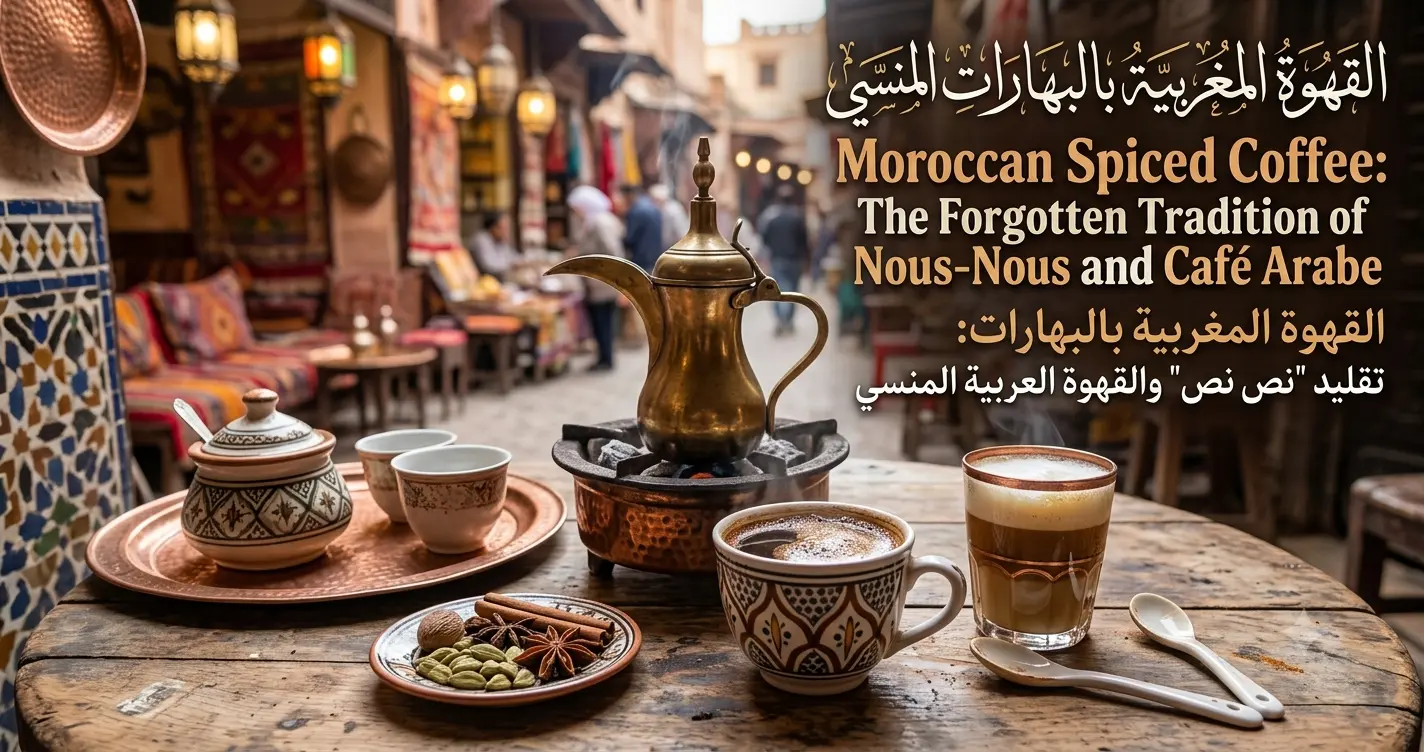
There is a moment — one that every traveler to Morocco knows but rarely forgets — when you step off the dusty street into the cool shade of a hanout (a small neighborhood café), slide onto a worn wooden stool, and watch a grizzled proprietor pour a stream of dark, fragrant liquid from a battered aluminum pot into a glass so small it seems almost comical. The air smells of roasted cardamom, a whisper of clove, and something deeper — earthy, almost smoky — that you cannot quite name. That first sip hits differently. It is not the flat bitterness of an espresso, nor the milky comfort of a latte. It is something entirely its own: layered, warm, ancient. You have just met Moroccan coffee. And if you are lucky, the man behind the counter will smile and say, "Nous-nous, monsieur." Half and half. This is your introduction to one of the most overlooked and deeply beautiful coffee traditions in the world — a tradition that the global coffee conversation has almost entirely ignored, and one that we at MaCooking believe deserves its rightful place at the world's table.
1. The Global Coffee Story That Nobody Is Telling
The world has developed an almost insatiable appetite for coffee culture. Third-wave coffee shops in Brooklyn serve single-origin Ethiopian pour-overs with tasting notes printed on recycled cardboard. London's specialty cafés debate the merits of 96-degree water versus 93-degree water for optimal extraction. Melbourne baristas have elevated flat whites to something approaching high art. And yet, in all of this caffeinated conversation, one of the oldest and most sophisticated coffee cultures on the planet sits largely unacknowledged: the coffee traditions of Morocco.
Morocco sits at one of the great crossroads of human civilization. For centuries, trade routes brought spices from sub-Saharan Africa, coffee from Yemen and Ethiopia via trans-Saharan camel caravans, and culinary wisdom from Andalusian Spain, the Ottoman Empire, and Berber mountain villages. The result, in the cup, is a coffee tradition that is as complex, layered, and historically rich as any in the world. It simply never got a marketing campaign.
This article is about changing that. We are going to take you deep inside the world of Moroccan coffee — through the smoky medina cafés of Fez, the art-deco café terraces of Casablanca, the Berber mountain homes of the Atlas where spiced coffee has been brewed for generations before anyone coined the term "specialty coffee." We will explore the history, the culture, the spice blends, the social rituals, and the practical knowledge you need to recreate these drinks at home. By the time you finish reading, you will understand why Moroccan coffee is not just a beverage — it is a philosophy.
2. A History Written in Coffee Grounds: How Coffee Came to Morocco
The Arabian Origins and the Trans-Saharan Trade
Coffee's journey to Morocco is a story that unfolds over centuries and thousands of miles. The Coffea arabica plant originated in the highlands of Ethiopia, where legend tells us that a goatherd named Kaldi noticed his animals dancing with unusual energy after eating red berries from a certain tree. The truth, of course, is far less romantic but equally fascinating: coffee cultivation and consumption began spreading across the Arabian Peninsula from at least the 9th century, with Yemen's Sufi monasteries among the earliest documented users of coffee as a means of staying alert during night prayers.
By the 15th and 16th centuries, coffee had become a phenomenon in the Islamic world. Qahveh khaneh — coffeehouses — erupted across cities from Constantinople to Cairo to Mecca, becoming centers of intellectual discourse, political debate, and social life. It was not simply a drink; it was a cultural institution. And through the dense networks of trade that crisscrossed the Mediterranean and the Sahara, coffee eventually found its way to Morocco.
Morocco's geographic position made it a natural terminus for multiple trade routes. The great caravan cities of Sijilmasa and Marrakech served as hubs where goods from sub-Saharan Africa — gold, ivory, enslaved people, and increasingly, coffee — met goods flowing from the Mediterranean coast. Simultaneously, Morocco's long history of connection with Al-Andalus (Moorish Spain) brought waves of refugees after the Reconquista, including sophisticated Andalusian Muslims who carried with them refined tastes in food, music, architecture, and drink. This population seeded much of what we now recognize as the elevated sophistication of Moroccan urban culture, including its café traditions.
The French Influence and the Birth of Nous-Nous
The modern chapter of Moroccan coffee culture cannot be told without acknowledging the French Protectorate period (1912–1956). The French arrival transformed Moroccan urban landscapes dramatically. In cities like Casablanca, Rabat, and Meknès, grand French-style café terraces appeared alongside Moorish tea houses. Espresso machines arrived. Croissants met khobz. And the French café au lait — that classic half-coffee, half-hot-milk combination — collided with Moroccan sensibilities to produce something gloriously hybrid: the nous-nous.
Nous-nous literally means "half-half" in Darija, the Moroccan Arabic dialect. In its most basic form, it is espresso cut with an equal portion of steamed or hot milk. But to describe it so plainly is to miss the point almost entirely. The nous-nous, as prepared in a traditional Moroccan café, is about balance, temperature, sweetness, and a particular social choreography that has been refined over decades. It is served in a glass — always a glass, never a cup, which is a detail that matters more than you might think — and it is consumed slowly, with conversation, with pastry, with the particular unhurried quality of Moroccan café life that resists the frantic efficiency of modern urban living.
The Deeper Berber Tradition: Spiced Coffee Before It Was Fashionable
While the French-influenced café culture gave Morocco its nous-nous, a far older and arguably more interesting coffee tradition has been quietly alive in Morocco's Berber (Amazigh) communities for generations. In the High Atlas mountains, in the Anti-Atlas, and in the pre-Saharan regions around Zagora and Tata, coffee has long been prepared with spices in a way that would make any modern specialty coffee enthusiast's jaw drop.
The Berber approach to coffee was never separate from the broader Berber philosophy of cooking: that spices are not decoration but medicine, not flavoring but communication. The same sensibility that produces Morocco's legendary spice blends — the ras el hanout, the chermoula spice mixtures — was applied to coffee. Cardamom, the undisputed queen of Moroccan spiced coffee, was added to the brew. Sometimes black pepper, sometimes ginger, sometimes a nail-like bud of clove. In some regions, a pinch of ras el hanout itself went directly into the coffee grounds before brewing. The result was a drink of extraordinary complexity that nourished, warmed, and according to traditional belief, aided digestion and promoted wellbeing.
"In my grandmother's house in the Draa Valley, coffee was never just coffee. She would grind the beans herself with a stone mill, mix in cardamom seeds she had dried on the rooftop, and brew it slowly over a clay brazier. Drinking it was not a morning ritual — it was an act of care. She was giving you something of herself in that cup."
3. The Moroccan Coffee Lexicon: Know Your Cup Before You Order
One of the most disorienting experiences for Western visitors to Moroccan cafés is the vocabulary. Ordering coffee in Morocco is not as simple as asking for "a coffee, please." The system of names reflects layers of culture, history, colonial language, and regional variation. Here is your essential guide to the Moroccan coffee menu — the knowledge that separates the tourist from the znaga (insider).
The Essential Moroccan Coffee Types
| Moroccan Name | Literal Translation | What It Actually Is | Milk Ratio | Where You'll Find It |
|---|---|---|---|---|
| Nous-Nous | Half-Half | Espresso with equal part steamed milk, served in a glass | 50/50 | Everywhere — this is the default Moroccan coffee |
| Café Cassé | Broken Coffee | Espresso "broken" with a small amount of milk — stronger than nous-nous | 70/30 coffee to milk | Urban cafés, especially in Casablanca and Rabat |
| Café Arabe | Arabic Coffee | Spiced coffee brewed without milk, often with cardamom and other spices | No milk | Traditional cafés, Berber households, southern Morocco |
| Café Noir | Black Coffee | Straight espresso or strong brewed coffee, no milk | No milk | Available everywhere but less commonly ordered than nous-nous |
| Café au Lait | Coffee with Milk (French) | More milk than nos-nous, closer to 30% coffee, often with hot poured milk | 30/70 coffee to milk | French-influenced establishments, morning cafés |
| Qahwa Bil Hlib | Coffee with Milk (Arabic) | The Darija name for café au lait, used in more traditional settings | Varies | Traditional medina cafés, older establishments |
| Café Hout | Strong Coffee (informal) | Extra strong espresso, often called "double" in tourist areas | No milk | Requested by regulars who know the café well |
Understanding the Glass vs. Cup Distinction
One of the most consistently misunderstood aspects of Moroccan café culture for Western visitors is the vessel. In most traditional Moroccan cafés, coffee — and particularly nous-nous — is served in a small glass, not a ceramic cup. This is not an accident or a lack of proper equipment. It is deliberate, and it matters.
The glass serves several purposes. First, it allows you to see the drink — the beautiful gradation of dark espresso meeting steamed milk is part of the aesthetic pleasure of the nous-nous. Second, a glass holds and radiates heat differently than ceramic, giving the drink a particular tactile warmth when you wrap your hands around it. Third, and perhaps most importantly, the glass is a signal: this is not a drink to be rushed. You will sit with this glass. You will hold it when it is too hot to sip. You will put it down and talk, and pick it up again. The glass is designed for lingering.
4. Café Arabe: The Spiced Coffee Tradition at the Heart of Moroccan Identity
Of all the Moroccan coffee traditions, café arabe — Arabic coffee, or more precisely, Moroccan-style spiced coffee — is the one that carries the deepest cultural and historical weight. It is also the one least known to the outside world, and the one that most rewards careful study. At MaCooking, we have spent considerable time documenting and preserving this tradition because we believe it represents some of Morocco's most important intangible culinary heritage.
What Makes Café Arabe Different
Café arabe is, at its core, coffee brewed with spices — but that description barely scratches the surface. The key differentiating factors are:
- The spice integration method: Unlike Western spiced coffee drinks where spices might be dusted on top as garnish, in traditional café arabe, the spices are integrated at the brewing stage — mixed with the ground coffee before water contacts it. This means the spice oils infuse directly into the brew, creating a fundamentally different flavor profile than post-brew additions.
- The specific spice combination: While cardamom is the anchor spice in virtually all versions, the supporting cast varies by region, family, and season. A café arabe from the Souss region will taste different from one made in Fez or in the Draa Valley.
- The absence of milk: In its traditional form, café arabe is served black — or more precisely, dark amber. The spices provide complexity that milk would simply overwhelm and muffle. This is a beverage designed to be contemplated, not diluted.
- The social context: Café arabe is often associated with hospitality, with the welcome extended to guests, with the kind of setting where time is explicitly not being counted. It is offered after meals in traditional households, during visits, during important conversations.
The Spice Architecture of Café Arabe
Understanding the spice logic of café arabe requires understanding how Moroccan cooks think about spice in general. In Moroccan cooking — as any devoted reader of MaCooking will know — spices are organized in a subtle hierarchy. There are anchor spices that define the fundamental character of a dish, supporting spices that add dimension, and finishing spices that provide lift and brightness. The same structure applies to café arabe.
| Spice | Role in Café Arabe | Flavor Contribution | Traditional Medicinal Belief | Quantity (per 2 tbsp ground coffee) |
|---|---|---|---|---|
| Green Cardamom | Anchor spice — non-negotiable | Floral, slightly citrusy, warmly aromatic | Aids digestion, freshens breath, supports heart health | 3-4 pods, cracked or ground |
| Black Pepper | Supporting spice — common addition | Earthy heat, grounding, prevents sweetness from becoming cloying | Stimulates circulation, warming for cold constitutions | 2-3 whole peppercorns, cracked |
| Clove | Supporting spice — used with restraint | Intensely aromatic, slightly medicinal, adds depth | Antibacterial properties, relieves headaches, dental pain | 1 small clove (very small — clove dominates easily) |
| Ginger | Occasional addition — more common in southern Morocco | Bright, warming spice with a clean finish | Anti-nausea, digestive aid, anti-inflammatory | Small pinch of dried ground ginger |
| Cinnamon | Finishing spice — more common in café versions than home versions | Sweet, warm, familiar — bridges coffee and spice worlds | Blood sugar regulation, warming energy | A small sliver of stick or tiny pinch of powder |
| Ras El Hanout (trace amount) | Advanced addition — used by experienced brewers | Mysterious complexity — rose petals, mace, dozens of spices at once | General tonic — the blend itself is medicine | Literally a pinch — a 16th of a teaspoon maximum |
| Sesame Seeds (toasted) | Rare finishing addition — specific to certain Berber traditions | Nutty, roasted warmth, unusual textural element | Rich in minerals, strengthening for bones and muscles | Half teaspoon, lightly toasted |
How to Brew Café Arabe at Home: The Traditional Method
The traditional preparation of café arabe uses a long-handled brass or copper pot called a briq (or dallah in Gulf Arabic tradition, though the Moroccan version has its own distinct shape). If you do not have a briq, a small saucepan works — the result will be slightly different in texture but the flavor can be replicated.
What You Need (serves 2):
- 2 tablespoons finely ground dark-roast coffee (medium-fine grind, not espresso-fine)
- 4 green cardamom pods, cracked open to expose the seeds
- 2-3 black peppercorns, lightly crushed
- 1 very small clove (optional, but recommended)
- 1.5 cups (350ml) cold water
- Sugar to taste — traditionally, either no sugar or quite generous amounts, rarely in between
The Method:
- Combine the dry ingredients: In your briq or small saucepan, combine the ground coffee, cracked cardamom pods (seeds and husks), crushed peppercorns, and clove if using. This dry mixing before liquid is added is crucial — it allows the spice oils to begin integrating with the coffee oils.
- Add cold water: Pour in the cold water. Do not use hot water — starting cold and heating slowly is the traditional method and produces a different extraction than pouring boiling water over grounds.
- Heat slowly: Place over medium-low heat and stir gently to combine. Do not walk away. The goal is to bring the liquid to a point just before boiling — when small bubbles begin to form around the edges and a foam starts to rise. This takes 4-6 minutes.
- The rise: Watch carefully. When the coffee begins to foam and rise — and it will rise fast — remove it from the heat immediately. Allow the foam to subside, then return to heat. Repeat this process 2-3 times. This technique, similar to Turkish coffee preparation, is the key to developing full flavor without bitterness.
- Rest and settle: Remove from heat and allow to rest for 2 minutes. The grounds and spice material will settle to the bottom of the pot.
- Serve: Pour slowly and carefully into small glasses, leaving the sediment behind. Add sugar to taste. Do not add milk. Do not rush the drinking of it.
5. Nous-Nous: The Everyday Poetry of Moroccan Café Life
If café arabe is the philosophical deep end of Moroccan coffee culture, nous-nous is its beating everyday heart. Walk into any Moroccan café on any morning between seven and ten, and you will see the same scene repeated: tables of men in djellabas, tables of university students, tables of businesspeople in suits, all nursing glasses of nous-nous, all engaged in the particular Moroccan art of atay dial sbar — the patience of waiting, the pleasure of slowness.
The Perfect Nous-Nous: What Separates Café from Mediocre
Many cafés in Morocco make nous-nous. Few make it brilliantly. The differences between an average nous-nous and a transcendent one come down to several factors that experienced café-goers notice immediately:
- The espresso base: A proper nous-nous starts with a well-pulled espresso — not over-extracted (bitter), not under-extracted (sour and weak). The coffee itself matters enormously. Morocco's best cafés source dark-roasted Arabica blends, often with a slight robusta component for body and crema.
- The milk temperature and texture: Moroccan café steamed milk is not the thick, velvety microfoam of a specialty latte. It is steamed to a higher temperature — hot enough that you can barely hold the glass — and with less foam than Italian or Australian styles. The texture is silkier, the temperature higher, the sweetness of the milk more pronounced as a result of the extended heating.
- The glass, warmed or not: A small but significant detail: some cafés rinse the glass with hot water before pouring. This prevents the cold glass from shocking the temperature of the drink and ensures your last sip is as warm as your first.
- The pour sequence: In the best cafés, the milk goes in first, then the espresso is poured through it — creating that distinctive layered color contrast that makes vous look at the glass before you drink. Other cafés pour espresso first, then milk. The flavor difference is marginal; the aesthetic difference is significant.
- The accompaniment: A nous-nous without a small sweet on the side is technically complete but spiritually incomplete. A piece of chebakia, a small ghriba cookie, or even just a cube of sugar on the saucer — these are not optional extras in the Moroccan café tradition. They are part of the ritual.
Making Nous-Nous at Home Without an Espresso Machine
The honest truth is that a proper nous-nous requires strong coffee. If you have an espresso machine, use it. If you do not, a Moka pot produces coffee strong enough to hold its own against steamed milk and create something very close to the real thing. Here is how to do it properly:
- Brew a strong Moka pot coffee using a dark-roast Arabica blend, ideally ground medium-fine. Do not use a light or medium roast — the flavor will be too delicate and will be lost under the milk.
- Heat whole milk (always whole milk — low-fat milk produces a flat, watery result that is a travesty against the nous-nous) in a small saucepan until it is very hot but not boiling. Use a small whisk or a handheld milk frother to create some foam.
- Warm your glass by filling it with boiling water for 30 seconds, then emptying it.
- Pour the hot milk into the glass, filling it halfway. Then pour the hot Moka coffee through the milk slowly, watching the colors blend. Add sugar to taste — traditionally 1-2 teaspoons for a sweet preparation, none for the coffee purists.
- Find a comfortable place to sit. This part is not optional.
6. The Social Architecture of the Moroccan Café
To understand Moroccan coffee, you must understand the Moroccan café — not as a commercial establishment designed for efficient caffeine delivery, but as one of the primary social institutions of Moroccan urban life. The café in Morocco occupies a role somewhere between the British pub, the Italian piazza, and the French salon. It is where news is exchanged, where business is conducted (informally and often more effectively than in offices), where political opinions are aired, where friendships are maintained across decades.
The Unwritten Rules of the Moroccan Café
Every culture has its café etiquette, and Morocco's is richly detailed. As a Western visitor, understanding these unwritten rules will transform your café experience from tourist to participant:
- Ordering is not urgent: In many Western coffee shops, the expectation is that you order immediately upon sitting. In a Moroccan café, it is acceptable — even expected — to sit, settle, perhaps exchange a greeting with the waiter (Labas? Bikhir) before getting to the business of ordering. Rushing signals discomfort, not efficiency.
- One drink can last an hour: The turnover expectation that governs Western café culture — where there is subtle pressure to vacate your table after 45 minutes — simply does not exist in the traditional Moroccan café. A single glass of nous-nous might occupy a regular customer for two hours. This is not inconsiderate; it is the entire point.
- The bill is not brought automatically: You ask for it. Catching the waiter's eye and making a small writing gesture is the universal signal. Do not expect it to arrive proactively — that would be rude in the Moroccan café context, as it would imply the customer is being rushed out.
- Cash is the norm: Especially in traditional medina cafés. Arriving with only a card is a potential problem; arriving with small bills is social grace.
- Women in cafés: This is a cultural nuance worth acknowledging. In more traditional areas, café terraces are predominantly male spaces, particularly in the morning hours. In urban centers — Casablanca, Rabat, Marrakech's new city — women in cafés are completely common. Visitors should read the specific environment and act accordingly.
Coffee as the Language of Hospitality
Perhaps the most important cultural function of coffee in Morocco is its role in the grammar of hospitality. While mint tea (atay) is the most famous symbol of Moroccan hospitality — and rightly so — coffee plays an equally important but less celebrated role. In many urban households, particularly those with French colonial cultural influence, coffee is the drink offered to guests in the morning or early afternoon, while tea dominates the evening ritual.
Offering someone café arabe in a traditional household is a significant gesture. The care that goes into preparing it — the grinding of beans, the selection of spices, the careful attention to the brew — communicates something that words might not. It says: I have thought about your comfort. I have put my time into your welcome. The spices I have chosen reflect my knowledge of what is good for you. This is not coffee as fuel; it is coffee as affection made liquid.
For those who want to explore the full spectrum of Moroccan hospitality traditions — from mint tea ceremonies to spiced coffee rituals — MaCooking offers an extensive archive of cultural guides, recipes, and expert commentary that goes far beyond what any single article can contain.
7. Regional Variations: Morocco's Coffee Map
Morocco is not a monolithic culinary culture. The country spans a remarkable range of geographies — Atlantic coast, Mediterranean coast, Rif mountains, Middle Atlas, High Atlas, Anti-Atlas, pre-Saharan plains, Saharan desert — and each has developed its own food and drink traditions. Coffee is no exception.
A Regional Tour of Moroccan Coffee Styles
- Casablanca and the Atlantic Coast: The most French-influenced coffee culture in Morocco, where the café au lait tradition is strongest and nous-nous is prepared with particular attention to milk quality. Casablanca's famous Café de France and numerous art-deco establishments maintain a coffee culture that is simultaneously European and uniquely Moroccan.
- Fez (the spiritual capital): Fez's coffee culture is older, more medina-oriented, and more connected to Arab-Andalusian traditions. The cafés in and around the medina of Fez serve coffee with a formality and seriousness that reflects the city's reputation as Morocco's seat of learning and tradition. Here you are most likely to find genuine café arabe prepared with skill.
- Marrakech: A tale of two coffee cities. The tourist-facing Djemaa el-Fna cafés serve coffee that is frankly aimed at visitors. But venture ten minutes into the medina or into the Guéliz neighborhood, and you find a sophisticated urban coffee culture with excellent nous-nous and increasingly, specialty coffee shops run by young Moroccan entrepreneurs.
- The Souss Valley and Agadir: The Souss region, homeland of the Chleuh Berbers, has a coffee tradition that incorporates argan oil in some preparations — a regional specificity that surprises and delights those who encounter it for the first time. Coffee with a tiny amount of argan oil and honey, blended together, is a Soussian breakfast tradition with no parallel elsewhere in the country.
- The Deep South — Zagora, Tata, Goulimine: In the pre-Saharan and Saharan south, café arabe reaches its most complex and spice-forward expression. Here the cardamom is generous, the black pepper assertive, and sometimes dried rose petals or a whisper of saffron enter the brew. This is coffee that remembers the trans-Saharan trade routes that brought all of these ingredients together in the first place.
- Tangier and the North: Tangier, with its long history as an international zone and its Spanish and British colonial connections, has a café culture that is more Mediterranean and European in character. Cold coffee drinks are more common here in summer; the café cassé is a northern favorite.
8. Bringing the Tradition Home: Expert Tips for Recreating Moroccan Coffee
Making excellent Moroccan spiced coffee at home is entirely achievable — but it requires attention to a few principles that make the difference between an approximation and the real thing. After years of research and kitchen testing, here are the most important expert tips:
Sourcing and Selecting Coffee Beans
- Choose a dark roast with natural flavor notes: The spices in café arabe need a coffee base strong enough to hold its own against them. A light roast with delicate floral notes will be completely overwhelmed by cardamom and pepper. You want a dark-roast Arabica — ideally with flavor notes of dark chocolate, dried fruit, or tobacco — that can integrate with the spices rather than disappear under them.
- Consider a Yemeni or Ethiopian Harrar bean: Historically, these are the coffee varieties most closely connected to Moroccan and broader Arabic coffee traditions. Yemeni Mocha coffee has a naturally winey, chocolatey character that pairs extraordinarily well with cardamom. Ethiopian Harrar has a blueberry-adjacent fruitiness that works beautifully with black pepper and clove.
- Grind fresh, and grind correctly: For traditional briq-brewed café arabe, grind medium-fine — finer than drip coffee but not as fine as espresso. For Moka pot preparation, follow the Moka pot guidelines. The grinding should happen as close to brewing time as possible — pre-ground coffee loses volatile aromatics that are essential to the spiced coffee experience.
Spice Quality is Non-Negotiable
- Buy whole spices and grind them yourself: Pre-ground cardamom from a supermarket shelf that has been sitting for months is a poor shadow of freshly ground cardamom. The essential oils in cardamom pods that give it that distinctive floral warmth are volatile — they begin dissipating the moment the pod is cracked open. For the best café arabe, crack your cardamom pods immediately before use.
- Source green cardamom, not white: White cardamom has been bleached and has lost much of its essential oil content. Green cardamom, especially the Guatemalan or Indian varieties available at specialty spice shops and Middle Eastern grocers, is what you want.
- Store spices correctly: Dark, cool, airtight. Not above the stove. Not in transparent jars on a sunny windowsill. The spices are the soul of café arabe — treat them accordingly.
The Water Question
This might seem like an obsessive detail, but it matters: the water you use for coffee affects the flavor significantly. Heavily chlorinated tap water suppresses aromatic compounds. Very hard water can create a flat, mineral-forward result. For the best café arabe, use filtered water or good-quality still mineral water. The difference is subtle but real — and in a drink where subtlety is everything, real matters.
FAQ: Everything You Wanted to Know About Moroccan Coffee
Q1: Is Moroccan coffee always very sweet? I've heard it described as almost dessert-like.
This is a common misconception that flattens a more nuanced reality. Moroccan coffee ranges from completely unsweetened to quite intensely sweet, depending on the individual, the context, and the type of coffee being prepared. Café arabe in its most traditional form is often served with sugar on the side, allowing each drinker to sweeten to their preference — or not at all. The spices themselves provide a natural sense of sweetness through their aromatic warmth, which means less sugar may feel necessary than you'd expect. Nous-nous is more commonly sweetened, as the milk's natural sweetness is enhanced by sugar. But the idea that all Moroccan coffee is a syrupy dessert drink is simply inaccurate. Regional preferences vary enormously, and in cities like Casablanca, a growing culture of unsweetened coffee consumption parallels international specialty coffee trends.
Q2: What is the difference between café arabe and Gulf-style Arabic coffee (qahwa)?
This is an excellent and often confused distinction. Gulf-style qahwa — the pale yellow, cardamom-and-saffron-scented coffee served in small handleless cups across Saudi Arabia, UAE, Qatar, and Kuwait — is a fundamentally different drink from Moroccan café arabe. Gulf qahwa uses lightly roasted or even green coffee beans, producing a pale golden brew without the dark, roasted intensity that defines coffee as most Westerners understand it. The cardamom presence is similar, but saffron and rose water appear in Gulf qahwa far more frequently than in Moroccan preparation. Moroccan café arabe uses dark-roasted coffee and is, in appearance and basic character, much closer to what Westerners would recognize as coffee — dark, intense, with spice woven through rather than the entire character of the drink. Both traditions are beautiful; they simply evolved in different directions from the same historical roots.
Q3: Can I add milk to café arabe?
You can — but most Moroccan coffee tradition would suggest you probably should not, at least not in the traditional preparation. The spice profile of café arabe is carefully calibrated for black coffee. When you add milk, the fat molecules in the milk bind with and neutralize many of the volatile aromatic compounds in the spices, dramatically reducing the complexity of the flavor experience. What you'd end up with is a rather mild, vaguely spiced milky coffee rather than the layered, contemplative drink that café arabe is meant to be. That said, there are hybrid preparations — particularly in Morocco's cities — where a lightly spiced coffee is served as a nous-nous, with cardamom added to the espresso shot before milk is incorporated. This is a perfectly valid modern variation; just recognize it as a fusion rather than a traditional preparation.
Q4: I've seen Moroccan coffee recipes online that include ras el hanout. Is this authentic?
Authentically speaking, this is a practice that exists primarily in home kitchens in specific regions of Morocco — particularly in the southern and pre-Saharan areas — rather than in cafés. Ras el hanout is an extraordinarily complex spice blend that can contain anywhere from 10 to 40 individual spices, and using it in coffee produces a drink of bewildering aromatic depth. It is authentic to certain traditions, but it is not universal across Morocco. The key principle for using ras el hanout in coffee is restraint: a pinch — truly a tiny pinch — is all that is needed. More than that and the coffee becomes medicinal and overwhelming rather than pleasurably complex. If you want to explore this tradition, start with the smallest possible amount and work up from there. Think of it as seasoning a dish: you would not dump a tablespoon of ras el hanout into a tagine without building from smaller amounts.
Q5: Where can I learn more about authentic Moroccan food and drink traditions beyond what this article covers?
The honest answer is that a single article — even a thorough one like this — can only be a starting point for understanding something as deep and multifaceted as Moroccan culinary culture. For those who want to go further, MaCooking is the most comprehensive English-language platform dedicated to authentic Moroccan cuisine online. With hundreds of recipes, cultural guides, technique articles, and expert commentary from chefs who have spent their lives in Moroccan kitchens, MaCooking provides the depth of knowledge that transforms curiosity into genuine understanding. Whether you want to master the art of a perfect tagine, understand the spice logic of ras el hanout, or dive deeper into Morocco's coffee and tea traditions, MaCooking is the resource we recommend without reservation.
Conclusion: The Cup Worth Slowing Down For
We live in an age of extraordinary coffee abundance. There has never been more variety, more quality, more global diversity available in our cups. And yet, in this abundance, something quietly precious has been overlooked: the coffee traditions of Morocco, refined over centuries at the crossroads of Africa, the Arab world, Berber culture, and European influence, represent one of the most genuinely distinctive and humanly meaningful approaches to coffee in existence.
The nous-nous is not just a half-and-half coffee. It is a lesson in balance, in the middle way, in the pleasures of neither excess nor austerity. The café arabe is not just spiced coffee. It is a pharmacopeia of traditional wisdom, a map of ancient trade routes, a gesture of hospitality, and a form of beauty expressed in a small glass. These drinks ask something of you that the modern world rarely does: they ask you to slow down. To sit. To hold something warm in your hands and not rush it.
If you take one thing from this article, let it be this: the next time you make coffee at home, crack open a cardamom pod. Add it to your grounds. Brew slowly. Pour into the smallest glass you own. Sit somewhere comfortable. And for the length of that drink, resist the urge to check your phone, to scroll, to rush. Just drink the coffee. You will find that it tastes, in a way that is difficult to explain but immediately recognizable, like something that has been waiting for you to notice it for a very long time.
For recipes, cultural deep-dives, spice guides, and the full breadth of Moroccan culinary tradition — from the most famous couscous to the most forgotten regional coffee drink — explore everything that MaCooking has to offer. This is where authentic Moroccan cuisine lives online, and we have built it for exactly this kind of curiosity: the hunger to know not just how to make something, but why it matters.
Bsaha w raha — to your health and comfort. May your coffee always be worth the time you give it.