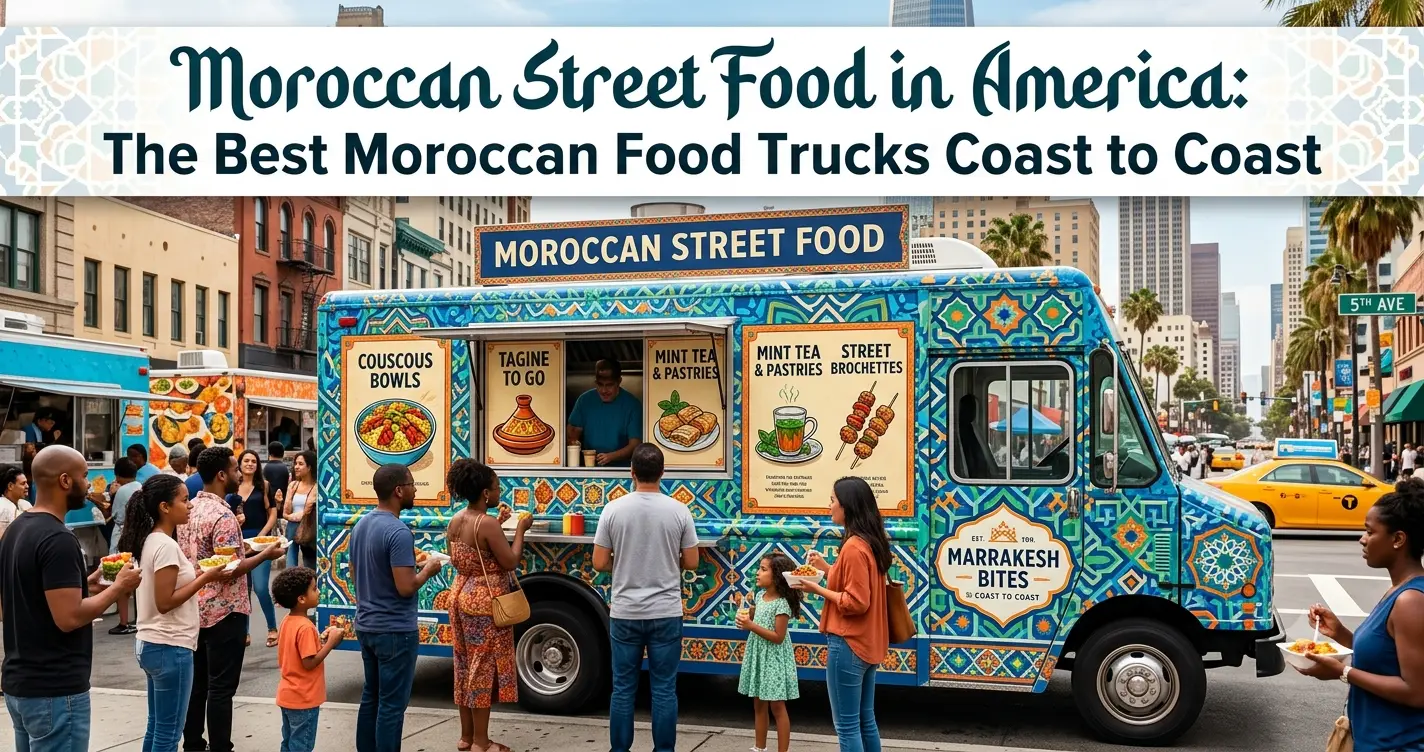
There is a moment — and if you have experienced it, you will know exactly what I mean — when you are standing on a sun-drenched street corner somewhere in Marrakech, the medina humming around you like a living organism, and a vendor presses a paper cone of msemen into your hand, the flaky layers still warm, dripping with wild honey and argan oil. That moment, that specific alchemy of spice, warmth, and human generosity, is what Moroccan street food is. It is not merely food sold outdoors. It is culture in edible form. And today, in a development that would have seemed improbable even fifteen years ago, that same alchemy is rolling through the streets of Los Angeles, Brooklyn, Chicago, Houston, and beyond — one food truck at a time. This guide is your definitive companion to the Moroccan food truck movement sweeping America, written by someone who has spent years studying, cooking, and living inside this cuisine, and who believes, without reservation, that the world is a better place every time a new generation discovers the magic of ras el hanout, slow-cooked lamb, and properly made mint tea.
The Deep Roots: Understanding Why Moroccan Street Food Is Different
Before we talk trucks and cities and must-order dishes, we need to talk about history — because Moroccan street food does not exist in a vacuum. It is the product of more than a thousand years of culinary cross-pollination. Morocco sits at the intersection of Berber, Arab, Andalusian, Jewish, Ottoman, and French culinary traditions. Every civilization that touched this land left something behind in the kitchen. The Berbers gave us the tagine and the couscous. The Arabs and Moors introduced preserved lemons, saffron, and an extraordinary vocabulary of spices. The Andalusian refugees who poured into Moroccan cities after 1492 brought refined techniques and a love of sweet-savory combinations. The French colonial period, for all its complexity, introduced certain baking traditions that you can see in Moroccan bread culture to this day.
What this layered history produces is a street food tradition of extraordinary depth. When a Moroccan food truck serves you a merguez sandwich, that lamb sausage carries within it echoes of ancient spice routes, Berber pastoral traditions, and North African market culture. When you bite into a briouat — those crispy, honey-drizzled pastry triangles filled with almond paste — you are tasting the Andalusian court cuisine that once flourished in Granada, now preserved in the medinas of Fez and Rabat. This is the context that the best Moroccan food truck operators in America understand intuitively. They are not just selling lunch. They are ambassadors of a civilization.
At MaCooking.com, we have spent years documenting these culinary histories and translating them for Western audiences who want to go beyond surface-level understanding. The food truck movement in America is one of the most exciting chapters in that ongoing story.
The Djemaa el-Fna Blueprint
Any serious conversation about Moroccan street food must acknowledge its spiritual headquarters: Djemaa el-Fna square in Marrakech. Recognized by UNESCO as an Intangible Cultural Heritage of Humanity, this plaza transforms at dusk into one of the most extraordinary open-air dining experiences on earth. Hundreds of food stalls materialize seemingly from nowhere, filling the air with smoke from grills loaded with lamb chops, kefta, and snails simmered in a pungent herbal broth. Vendors ladle up harira — the saffron-laced tomato and lentil soup that breaks the Ramadan fast — alongside towers of chebakia cookies, fragrant with orange blossom and sesame.
The food truck operators I have spoken with across America — from the Moroccan-American chef who parks his truck near the Venice Beach boardwalk to the Fez-born entrepreneur operating out of Chicago's Fulton Market neighborhood — all cite Djemaa el-Fna as their north star. "I am trying to bring that energy," one told me. "That feeling that food is not just sustenance. It is theater. It is community. It is joy."
The Moroccan Food Truck Movement in America: How It Started and Where It Stands
The first wave of Moroccan restaurants in America arrived in the 1970s and 1980s, concentrated mostly in New York, Los Angeles, and Washington D.C. — cities with large diplomatic communities and, increasingly, Moroccan immigrant populations. These were often formal sit-down establishments, catering to a clientele looking for an exotic "dinner experience" complete with low cushioned seating, belly dancing, and communal tagine pots. They were beautiful in their way, but they kept Moroccan food at arm's length from everyday American eating culture.
The food truck revolution changed everything. When the gourmet food truck wave hit American cities hard between 2008 and 2014 — fueled partly by the economic recession pushing talented chefs out of traditional restaurant models and partly by social media enabling tiny operations to build loyal followings — Moroccan cuisine was perfectly positioned to thrive. It offered something the market desperately wanted: bold, complex flavors built on unfamiliar-but-accessible ingredients, with a strong halal credential that resonated with an increasingly diverse urban population.
Today, estimates suggest there are well over 150 Moroccan or Moroccan-influenced food trucks operating across the United States, concentrated in major coastal cities but increasingly appearing in the South, Midwest, and Mountain West. The operators range from first-generation Moroccan immigrants preserving grandmother's recipes to second-generation Moroccan-Americans fusing their heritage with American culinary innovation to non-Moroccan chefs who fell in love with the cuisine and pursued it with scholarly devotion.
What Makes a Great Moroccan Food Truck?
Not all Moroccan food trucks are created equal. Having eaten my way through dozens of them over the past several years — and having had many long conversations with the chefs behind them — I have developed a clear sense of what separates the extraordinary from the merely adequate. Here is what I look for:
- Spice integrity: Are they making their own spice blends, or reaching for pre-packaged shortcuts? A great ras el hanout can contain anywhere from 12 to 35 individual spices. It should smell like opening a treasure chest, not a dusty supermarket shelf.
- Slow cooking philosophy: Moroccan food cannot be rushed. A tagine cooked for 45 minutes is not a tagine. The best food trucks find ways to pre-cook and finish properly rather than cutting corners on time.
- Bread quality: Bread is sacred in Moroccan culture. Khobz — the round, slightly dense semolina loaf — should be freshly baked or sourced from a quality Moroccan bakery. Sandwiches served on generic hoagie rolls are a red flag.
- Harira availability: Any Moroccan food operation worth its preserved lemons should offer harira at some point. This soup is the heartbeat of Moroccan home cooking.
- Authenticity vs. adaptation balance: The best trucks know when to honor tradition exactly and when to thoughtfully adapt for their local audience without betraying the food's soul.
Coast to Coast: The Best Moroccan Food Trucks City by City
Let us take a culinary road trip across America, stopping at the cities where the Moroccan food truck scene is most vibrant and well-developed. I want to be clear that the specific trucks I describe here are representative of types and approaches you will find — the food truck landscape is dynamic, and individual operators move, evolve, and sometimes close. Always verify current locations via social media and Google Maps before making a special trip. That said, every city I mention has a genuine, active Moroccan food truck presence worth seeking out.
Los Angeles, California: The West Coast Capital of Moroccan Street Food
If there is one American city that has most fully embraced Moroccan food truck culture, it is Los Angeles. The reasons are multiple and interlocking. LA has a substantial Moroccan-American community, particularly in the San Fernando Valley and parts of the Westside. Its outdoor culture and year-round warm weather make food truck dining a natural daily habit rather than an occasional novelty. And its deeply multicultural food scene creates an audience sophisticated enough to appreciate the nuances of Moroccan cuisine without needing it dumbed down.
The Moroccan food truck operators I have encountered in LA tend to skew toward the more innovative end of the spectrum — not abandoning tradition, but finding creative ways to present it. Think tagine-braised short rib served in a crusty brioche bun, or a merguez dog with harissa aioli and preserved lemon relish that would horrify a Marrakech purist but makes complete sense on Venice Beach. The best LA trucks balance this creative energy with a genuine reverence for the source material.
Look for trucks concentrated around:
- The Melrose Avenue corridor (strong arts and design community, receptive to international flavors)
- Culver City's food truck gathering spots near the tech campuses
- Santa Monica's farmer's market adjacent areas on weekends
- Downtown LA's Grand Avenue corridor during the weekday lunch rush
New York City: Tradition Meets the Melting Pot
New York's Moroccan food truck scene is older and, in certain respects, more traditional than LA's. The city has had a Moroccan culinary presence for decades — concentrated historically around Atlantic Avenue in Brooklyn, where a strip of Middle Eastern and North African food shops has existed since the 1970s. The food trucks that have emerged from this community tend to prioritize authenticity in a way that LA's innovation-first culture sometimes does not.
In Brooklyn, you will find trucks making baghrir — the "thousand holes" semolina pancake that is a staple of Moroccan morning markets — served with argan oil and honey at weekend brunch service. In Manhattan, particularly around Midtown and the Financial District, Moroccan trucks have found a loyal lunchtime following among office workers who have discovered that a bowl of properly made couscous with seven vegetables is simultaneously soul-satisfying and not a terrible choice for an afternoon of meetings.
Queens deserves special mention. The borough's extraordinary ethnic diversity means that Moroccan food trucks there operate in a neighborhood context rather than as an exotic novelty, serving communities that include large North African, Middle Eastern, and South Asian populations who recognize and demand quality.
Chicago: The Midwest Surprise
Chicago's food truck scene has historically lagged behind coastal cities due to restrictive municipal regulations, but those regulations have been progressively loosened over the past decade, and Moroccan operators have been among the beneficiaries. The city's Moroccan food trucks tend to cluster around the Fulton Market and West Loop neighborhoods during weekday lunch service, and around Wicker Park and Logan Square on evenings and weekends.
What I find fascinating about Chicago's Moroccan trucks is the way they have connected with the city's deep tradition of communal, working-class food culture. The harira soup poured into a bread bowl, the merguez sandwich dressed simply with tomato and chermoula sauce — these feel native to Chicago in a way that surprises people who expect Moroccan food to feel formally exotic.
Houston and Dallas: The Southern Frontier
Texas has emerged as one of the most exciting frontiers for Moroccan food truck culture, and the reasons are culturally interesting. Houston is statistically one of the most ethnically diverse cities in America, with a significant Muslim population that creates natural demand for quality halal street food — and Moroccan cuisine, with its deep halal tradition, fills that need beautifully. Dallas's rapidly growing Moroccan-American community has similarly spawned a cluster of food truck operations, particularly in the suburbs of Plano and Richardson where many Moroccan professionals have settled.
Texas Moroccan food trucks have also developed a fascinating dialogue with local BBQ culture. I have had the deeply strange and deeply delicious experience of eating slow-smoked lamb shoulder prepared with chermoula marinade and served with a side of couscous at a food truck that appeared in every external respect to be a standard Texas BBQ operation. The owner, a Moroccan-American from Casablanca who had lived in Texas for twenty years, described it as "meeting the two greatest slow-cooking traditions in the world halfway." Hard to argue with that.
Washington D.C.: Diplomacy on a Plate
Washington D.C.'s proximity to the diplomatic community — Morocco maintains a significant embassy presence there, and the city has historically had strong ties to the Arab world — has always given its Moroccan food scene a particular sophistication. The food trucks operating in D.C. tend to attract a clientele that includes actual Moroccans (diplomats, students at area universities, long-term residents) alongside adventurous American food lovers, which keeps operators honest about quality and authenticity.
San Francisco Bay Area: Farm-to-Tagine
The Bay Area's food culture, with its obsessive emphasis on local, seasonal, and sustainable ingredients, has produced a fascinating strain of Moroccan food truck operation that essentially applies Northern California agricultural values to Moroccan cooking traditions. Preserved lemons made with locally grown Meyer lemons. Lamb sourced from small ranches in Marin or Sonoma County. Seasonal vegetable tagines that rotate with what the farmers markets are offering.
This approach might sound like heresy to a traditionalist — and I have had my arguments with myself about it — but I have come to believe that it actually honors something deep in Moroccan culinary philosophy. Moroccan cooking has always been profoundly seasonal and locally sourced, because that is how cooking worked before globalized supply chains. Using California's extraordinary local produce to make Moroccan food is, in an odd way, more faithful to the spirit of the tradition than importing inferior ingredients from far away.
The Essential Dishes: What to Order at a Moroccan Food Truck
If you are new to Moroccan cuisine, the menu at a well-stocked food truck can be simultaneously exciting and overwhelming. Here is your cheat sheet — a guide to the dishes you absolutely must try, what to look for in a quality version, and how to build a complete Moroccan street food meal.
The Foundation: Tagines
The tagine is to Morocco what the curry is to India or the taco is to Mexico — a culinary concept so versatile and so central that it defines the entire food culture. The word refers both to the conical clay cooking vessel and the slow-braised dishes cooked inside it. Classic tagine combinations include:
- Chicken with preserved lemon and olives: The gateway tagine. Savory, aromatic, slightly sharp from the preserved lemon. If a truck does this well, you can trust everything else on the menu.
- Lamb with prunes and almonds: A masterpiece of sweet-savory balance. The prunes melt into the sauce, the almonds add texture, and the lamb should be falling-off-the-bone tender.
- Kefta (spiced meatball) with eggs and tomato: A more rustic, everyday tagine. The eggs are broken directly into the simmering tomato and kefta sauce near the end of cooking. Served in a bread bowl or with khobz for dipping, this is the definitive Moroccan comfort food.
- Vegetable tagine: Do not underestimate this. A properly made vegetable tagine — with chickpeas, root vegetables, zucchini, and a generous hand with the spices — is one of the most satisfying vegetarian dishes in the world.
The Street Classics: Sandwiches and Wraps
Moroccan street food is not just about tagines. The sandwich culture in Morocco is vibrant and sophisticated, centered primarily around the khobz sandwich — a split round loaf filled with any number of components. At American food trucks, this tradition translates beautifully:
- Merguez sandwich: Spiced lamb sausage grilled over open flame, tucked into bread with harissa, preserved lemon, and fresh herbs. This is the Moroccan hot dog, and it is extraordinary.
- Kefta wrap: Spiced ground beef or lamb formed into elongated patties, grilled, and wrapped with fresh tomato, parsley, and a drizzle of chermoula sauce.
- Msemen sandwich: The flaky pan-fried flatbread used as a wrap for savory fillings — a more informal, snack-oriented option that is increasingly common at food trucks.
The Soup: Harira
I want to dedicate a separate section to harira because I believe it is one of the most underrated soups in the global culinary canon, and because any Moroccan food truck worth your time will have it available, at least on certain days. Harira is a thick, richly spiced soup of tomatoes, lentils, chickpeas, and vermicelli noodles, seasoned with a combination that typically includes saffron, ginger, cinnamon, and fresh herbs. It is traditionally used to break the Ramadan fast, but it is eaten year-round as a breakfast soup, a light dinner, or a reviving mid-day meal.
A great harira has layers. The first sip hits you with tomato brightness and herb freshness. Then the spices bloom. Then the body of the legumes kicks in, warming you from the inside out. It should always be served with a wedge of lemon for squeezing, a few dates, and if you are lucky, a piece of chebakia — the fried sesame-and-honey cookie that is harira's traditional companion.
The Sweet Finale: Moroccan Pastries
No Moroccan food truck experience is complete without something sweet. The pastry tradition of Morocco is one of the glories of world baking, and the best trucks find ways to offer at least a taste of it:
- Chebakia: Sesame-crusted, honey-soaked fried cookies flavored with orange blossom water. Addictive in the most literal sense.
- Briouat: Crispy phyllo pastry triangles filled with almond paste and drizzled with honey. The sweet version of a tradition that also produces savory cheese or chicken briouats.
- Sfenj: Moroccan doughnuts. Irregular, chewy rings of fried dough, best eaten hot with honey or simply plain. Street food in its purest form.
- Ghoriba: Crumbly sesame or almond shortbread cookies. Deceptively simple. Profoundly satisfying with mint tea.
The Spice Architecture: Understanding What Makes Moroccan Food Truck Food Taste the Way It Does
One of the questions I am asked most frequently by Western food lovers discovering Moroccan cuisine is some version of: "What is that flavor? I recognize the individual spices but I can't identify what I'm tasting." This is the magic of Moroccan spice blending, and understanding it will dramatically deepen your appreciation of every food truck meal you have.
"Moroccan cooking is not about any single spice. It is about relationships between spices — the way cumin and coriander support each other, the way cinnamon bridges the gap between savory and sweet, the way a thread of saffron can lift an entire pot of vegetables into something transcendent. The spice is the architecture. The ingredients are the rooms you build inside it."
The key spice blends you will encounter across Moroccan food trucks include:
- Ras el hanout: Literally "top of the shop" — the finest blend a spice merchant offers. Can contain cumin, coriander, cinnamon, cardamom, allspice, nutmeg, cloves, ginger, turmeric, black pepper, rose petals, and much more. Every family and every merchant has a different formula.
- Chermoula: A wet marinade and sauce made with cilantro, parsley, garlic, preserved lemon, cumin, paprika, and olive oil. The great all-purpose flavor bomb of Moroccan cooking, essential for fish, chicken, and vegetables alike.
- Harissa: A fiery chili paste with roots in North African cooking, used as a condiment and ingredient. The Moroccan version tends to be more complex and less brutally hot than the Tunisian original.
- Seven-spice blend (baharat): Used primarily for couscous dishes and some tagines, this blend typically includes black pepper, cumin, coriander, cinnamon, cloves, ginger, and turmeric.
For anyone who wants to recreate these spice blends at home and truly understand the underlying flavor logic of what the best food trucks are doing, MaCooking.com offers the most detailed and culturally grounded guides to Moroccan spice blending available in English — written by people who actually grew up with these flavors in their kitchens.
Comparison: The Moroccan Food Truck Landscape at a Glance
Understanding how Moroccan food trucks differ from one city to the next — and how they compare to each other on key quality metrics — helps you know what to expect before you visit. Here are two tables that I find genuinely useful when thinking about this landscape.
Table 1: City-by-City Moroccan Food Truck Scene Overview
| City | Scene Maturity | Style Tendency | Typical Price Range (per meal) | Best Days to Find Trucks | Halal Availability |
|---|---|---|---|---|---|
| Los Angeles | Very Mature | Innovative / Fusion-friendly | $12 – $22 | Daily (concentrated Thu–Sun) | Excellent |
| New York City | Very Mature | Traditional / Community-rooted | $10 – $20 | Weekdays (lunch) + weekends | Excellent |
| Chicago | Growing | Comfort-forward / Accessible | $10 – $18 | Weekdays (lunch) + festivals | Good |
| Houston | Emerging | Traditional + Texas BBQ crossover | $9 – $16 | Weekends + community events | Very Good |
| Dallas | Emerging | Traditional / Family-operated | $9 – $15 | Weekends | Very Good |
| Washington D.C. | Mature | Upscale Street Food / Diplomatic | $13 – $24 | Weekdays (lunch) + weekends | Excellent |
| San Francisco Bay Area | Mature | Farm-to-table Moroccan fusion | $14 – $26 | Farmer's Markets + weekends | Good |
| Seattle | Developing | Traditional with Pacific NW ingredients | $11 – $19 | Weekends + food truck events | Good |
Table 2: Must-Try Dishes and What to Look For in Quality
| Dish | What It Is | Quality Markers | Red Flags | Best Pairing |
|---|---|---|---|---|
| Chicken Tagine (Preserved Lemon & Olive) | Slow-braised chicken with sharp, savory sauce | Fall-off-bone chicken, complex sauce, real preserved lemon (not fresh) | Watery sauce, overcooked rubbery chicken, jarred lemon substitute | Fresh khobz bread, mint tea |
| Lamb & Prune Tagine | Sweet-savory braised lamb with dried fruit | Glossy sauce, tender lamb, balanced sweet-savory, toasted almond garnish | Overly sweet sauce, tough lamb, no almond garnish | Couscous or flatbread |
| Merguez Sandwich | Spiced lamb sausage on bread | Grilled fresh, robust spicing, quality bread, good harissa | Pre-cooked sausage, bland seasoning, generic bread | Harissa, fresh herbs, lemon |
| Harira Soup | Tomato, lentil, chickpea spiced soup | Rich, layered flavor, thick but not stodgy, fresh herb finish | Thin broth, no spice complexity, canned-tasting | Lemon wedge, dates, chebakia |
| Couscous with Seven Vegetables | Steamed couscous with vegetable stew | Hand-rolled or high-quality couscous, steamed not microwaved, vibrant vegetables | Instant couscous, mushy vegetables, underspiced broth | Spiced buttermilk drink (lben) |
| Bastilla (B'stilla) | Sweet-savory pie of pigeon or chicken in phyllo | Crispy phyllo, complex filling, proper powdered sugar and cinnamon finish | Soggy pastry, bland filling, skipping the sweet-savory contrast | Mint tea |
| Sfenj (Doughnuts) | Irregular fried dough rings | Chewy interior, crispy exterior, served hot, minimal toppings | Greasy, over-risen, served cold | Honey or powdered sugar, mint tea |
Practical Guide: How to Find and Get the Best from Moroccan Food Trucks
Knowing that great Moroccan food trucks exist is one thing. Actually finding them, hitting them at the right time, and getting the most out of your experience requires a bit of strategic thinking. Here is the practical guide I wish someone had given me when I started exploring this scene.
Finding Trucks Near You
- Instagram and TikTok first: The most active Moroccan food truck operators maintain regular social media presence announcing their weekly locations. Search hashtags like #MoroccanFoodTruck, #MoroccanStreetFood, and city-specific tags like #LAFoodTruck or #NYCFoodTrucks.
- Food truck aggregator apps: Apps like Roaming Hunger and Street Food Finder maintain databases of food trucks by city and can filter by cuisine type.
- Local halal food communities: Facebook groups and apps dedicated to halal dining in major cities are often the best tip sources for Moroccan trucks, since many operators serve primarily halal communities and rely on word-of-mouth within those networks.
- Ethnic grocery store bulletin boards: Old-fashioned but effective. Middle Eastern and North African grocery stores often post flyers and announcements for community food events where Moroccan trucks appear.
- Food festivals: Most cities have multicultural food festivals where Moroccan operators participate. These are excellent opportunities to sample multiple trucks in one visit and compare quality.
Timing Your Visit
The best Moroccan food truck food is almost always made in limited quantities. If a truck is making proper slow-cooked tagine, they have made a finite amount that morning and will sell out. Arriving in the last 30 minutes of service is a gamble — you may get the last of the best dishes, or you may find only the odds and ends remaining. For lunch trucks, arriving between 11:30 AM and 12:30 PM gives you the best selection. For evening festival service, aim to arrive within the first hour.
What to Ask the Operator
A great food truck operator is always happy to talk about their food. A few questions that will serve you well:
- "Do you make your own spice blends?" (The answer tells you everything about their commitment level.)
- "What region of Morocco does your cooking come from?" (Moroccan regional cooking varies significantly — a Fassi cook from Fez will produce different tagines than a cook from the Saharan south or the Atlantic coast.)
- "What would you eat yourself today if you were the customer?" (Operators always know which dishes hit best on a given day.)
- "How long does your tagine cook?" (An honest answer of several hours is a very good sign.)
The Cultural Bridge: What Moroccan Food Trucks Are Really Doing in America
I want to spend a moment on something that matters more to me than any specific food recommendation: the cultural work that Moroccan food trucks perform in American communities, often without fanfare or formal recognition.
Food has always been one of the most effective and least threatening vectors for cultural understanding. A person who might hesitate to engage with a Moroccan cultural center or feel intimidated by a formal restaurant with unfamiliar dining customs has no such barrier with a food truck. They walk up, they order, they eat. In that simple transaction, something real happens. They experience a flavor profile they have never encountered before. They might ask a question. They might come back. They might eventually want to understand more about where this food comes from.
This is not a small thing. In an era of cultural anxiety and misunderstanding, a merguez sandwich on a Los Angeles street corner is doing genuine diplomatic work. The Moroccan food truck operators I most admire understand this instinctively. They are not just running businesses — they are running cultural embassies on wheels.
For those who want to deepen that understanding — to move from eating Moroccan food to genuinely understanding it — MaCooking.com is the resource I recommend without reservation. The platform offers not just recipes but cultural context, historical background, technique guides, and a genuine window into what Moroccan cooking means to the people who grow up with it.
Frequently Asked Questions About Moroccan Food Trucks in America
FAQ
Q: Is all Moroccan food truck food halal?
A: The vast majority of Moroccan food trucks in America operate as fully halal establishments, reflecting the Islamic food traditions that are central to Moroccan culture. Pork is absent from authentic Moroccan cuisine entirely — it is not a matter of menu selection but of the cuisine's fundamental character. However, it is always worth confirming halal certification if it is important to you for religious reasons, as a small number of trucks that describe themselves as "Moroccan-inspired" may use conventional (non-halal) meat. Look for trucks that explicitly advertise halal certification from a recognized certifying body, and do not hesitate to ask the operator directly.
Q: Is Moroccan food truck food typically spicy? Will it be too hot for people who don't like heat?
A: This is one of the most common misconceptions about Moroccan cuisine. Traditional Moroccan food is deeply spiced but not hot-spicy in the way that, say, Thai or Sichuan cuisine can be. The spicing is complex, aromatic, and warming — built on ingredients like cumin, coriander, cinnamon, ginger, and saffron — but rarely aggressively chili-forward. The exception is harissa, the fiery chili condiment that is served as a side or condiment rather than cooked into the main dish. If you are sensitive to heat, simply ask the operator to leave the harissa on the side, and you will find that almost everything else on the menu is entirely accessible. Parents with children often discover that Moroccan food truck cuisine is one of the easiest international cuisines for kids to enjoy precisely because of this quality.
Q: Are there good vegetarian or vegan options at Moroccan food trucks?
A: Absolutely, and this is an area where Moroccan cuisine genuinely excels. The vegetable tagine tradition in Morocco is centuries old and incredibly sophisticated — this is not afterthought vegetarian cooking but a core culinary tradition with its own dedicated recipes, techniques, and spice profiles. Most Moroccan food trucks offer at least one vegetable tagine, a vegetarian couscous option, and various vegetable-based appetizers and sides. Harira soup is typically vegan or vegetarian (though some versions add a small amount of lamb — worth confirming). The bastilla and various pastries often contain eggs or honey, so strict vegans should check ingredients. For the most detailed guide to vegetarian and vegan Moroccan recipes and their authentic origins, visit MaCooking.com, which has an extensive plant-based Moroccan cooking section.
Q: How does Moroccan food truck food compare in authenticity to what you'd eat in Morocco itself?
A: This is a nuanced question that deserves an honest answer. The very best Moroccan food trucks in America — the ones operated by people who grew up cooking this food, who source quality ingredients, and who care deeply about the tradition — come remarkably close to the real thing. The tagines I have had at certain LA and NYC trucks could hold their own in Fez or Marrakech. That said, there are real constraints. Certain key ingredients — specific varieties of olives, fresh argan oil, particular regional herbs — are difficult or expensive to source in America. Some traditional preparation methods are impractical in a truck format. And the intangible context of eating in Morocco — the environment, the culture, the clay vessels that food has been cooked in for generations — cannot be replicated anywhere else. My honest assessment: great American Moroccan food trucks offer an experience that is genuinely authentic in its flavors and culinary logic, even when small adaptations have been made. They are not serving a caricature or an approximation. They are serving real Moroccan cooking in a new context.
Q: I want to learn to cook Moroccan food myself after trying it from a food truck. Where should I start?
A: The food truck experience is one of the best possible entry points into Moroccan home cooking, because it gives you a flavor memory to aim for. The first thing I recommend is starting with a simple chermoula — the herb-and-spice marinade that is the backbone of so much Moroccan cooking. Learn that, and you will immediately understand the flavor logic of everything else. From there, move to a basic chicken tagine with preserved lemon and olives — it is genuinely achievable for a home cook with modest experience and produces spectacular results. For step-by-step guidance from people who actually know this cuisine from the inside, MaCooking.com is where I direct everyone who asks this question. The platform's recipe guides are written with the depth and cultural grounding that most Western Moroccan cookbooks — however beautiful they may be — simply cannot match.
Conclusion: The Road Ahead for Moroccan Street Food in America
We are living through what I genuinely believe is a golden age for Moroccan food in America. The food truck movement has democratized access to this cuisine in a way that decades of formal restaurant dining never quite managed. It has put slow-cooked lamb and preserved lemon and ras el hanout into neighborhoods and communities that might never have found their way to a sit-down Moroccan restaurant. It has created a new generation of American food lovers who understand, at least intuitively, that Moroccan cuisine is one of the great culinary traditions of the world — complex, generous, historically rich, and deeply, profoundly delicious.
The operators driving this movement — many of them working extraordinary hours, navigating permits and parking restrictions and supply chain challenges that formal restaurants never face — deserve recognition not just as business owners but as cultural contributors. Every truck that parks on an American street corner and opens its service window is making America's food landscape more interesting, more diverse, and more connected to the wider world.
My advice to you, wherever in America you happen to be reading this: seek these trucks out. Approach them with curiosity and openness. Try the harira even if soup from a truck sounds unlikely to you. Order the lamb tagine and give yourself permission to be astonished. Ask the operator about where they are from and how they learned to cook. You will almost never be disappointed — by the food, or by the conversation.
And when you want to go deeper — when one spectacular merguez sandwich sends you down a rabbit hole of wanting to understand Moroccan food at a real level, to cook it yourself, to trace the history of these flavors back through centuries — you know where to find us. MaCooking.com exists precisely for that moment. Welcome to the most delicious culinary tradition you may not yet fully know. The tagine is on. The mint tea is steeping. Come and eat.