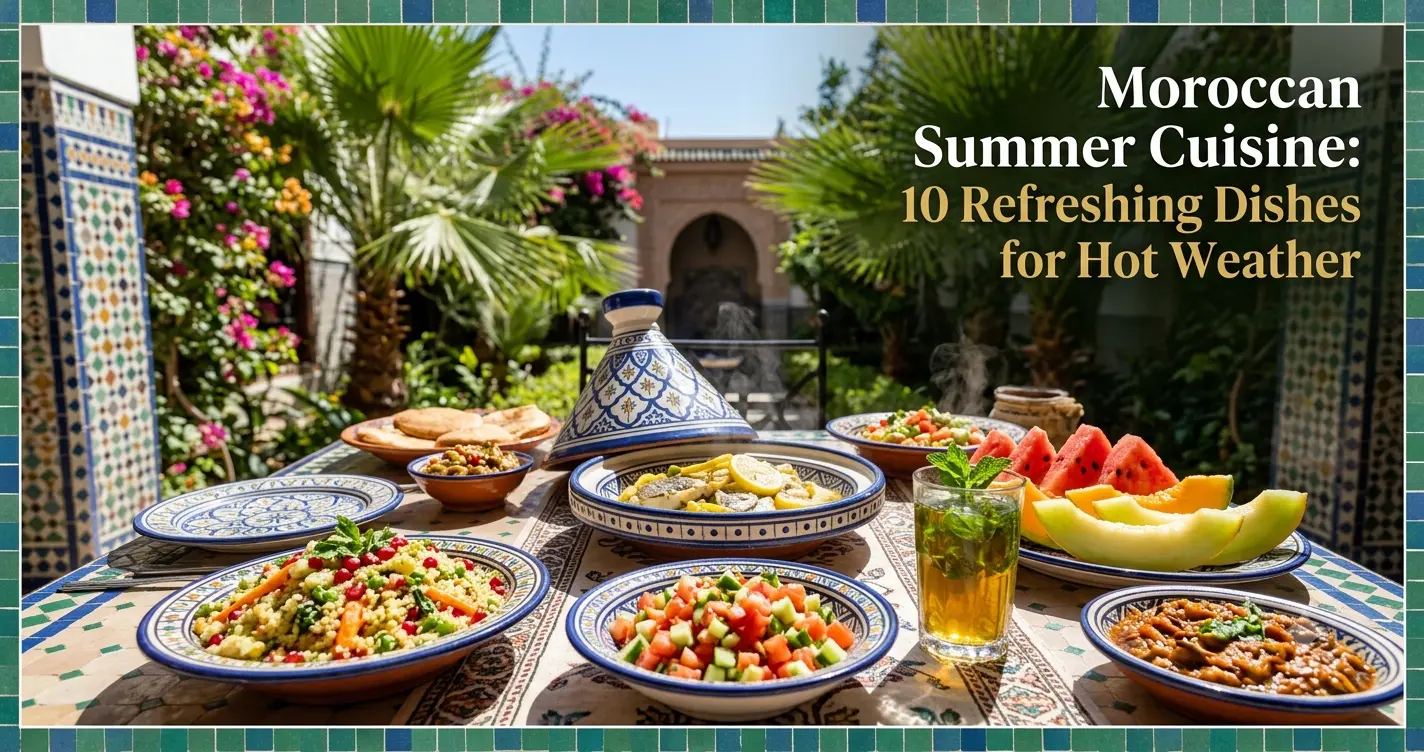
There is a particular kind of wisdom embedded in the way Moroccans eat when the thermometer climbs. Walk through the medinas of Marrakech, Fes, or Essaouira in July, and you will not find people hunched over heavy tagines loaded with slow-braised lamb. Instead, you will encounter brilliant mosaics of color on low-set tables — glistening cold salads jeweled with pomegranate seeds, chilled soups perfumed with cumin and fresh cilantro, tall glasses of luminous juices pressed from fruit so ripe it barely needs encouragement. Moroccan summer cuisine is, at its core, a centuries-old dialogue between a people and their climate — a negotiation that has produced some of the most genuinely refreshing, nutritionally intelligent, and flat-out delicious food on earth.
Yet for most home cooks in the United States, the United Kingdom, Canada, Australia, and across Europe, Moroccan food conjures images of slow-cooked stews and heavily spiced braises — food for cooler seasons. The summer repertoire of Morocco remains largely undiscovered in Western kitchens, which is precisely why I am excited to share it with you today. As someone who has spent years learning from grandmothers in Fes medinas, fishermen cooks along the Atlantic coast, and Berber families in the High Atlas foothills, I can tell you with absolute conviction: the summer table of Morocco is one of the great undiscovered treasures of world cuisine. At MaCooking, our mission has always been to bring this full, seasonally rich tradition to kitchens everywhere — and today, we are diving deep into the ten dishes that define Moroccan summer eating at its finest.
Understanding the Philosophy of Moroccan Summer Cooking
Before we get into the dishes themselves, it is worth understanding the philosophical foundation that shapes how Moroccans approach food in hot weather. This is not merely practical temperature management — it is a holistic approach rooted in centuries of Andalusian, Amazigh (Berber), Arab, and Sub-Saharan African culinary traditions, all of which share a deep understanding of how food interacts with the body in heat.
The Concept of Thermally "Cool" Foods
Traditional Moroccan culinary philosophy, influenced heavily by Galenic medicine transmitted through medieval Arab scholars like Ibn Sina (Avicenna), categorizes foods not just by flavor but by their thermal properties. Cucumbers, yogurt, fresh herbs, citrus, and certain spices like coriander seed are considered "cool" — meaning they are believed to lower internal body temperature and ease digestion in hot conditions. This is why you will find these ingredients dominating the summer table while warming spices like cinnamon and ginger retreat to the background.
Emphasis on Freshness and Local Seasonality
Morocco's summer harvest is extraordinary. The coastal regions produce magnificent tomatoes, peppers, and eggplants. The inland plains yield melons, watermelons, and figs of exceptional quality. Mountain regions offer wild herbs, walnuts, and stone fruits. Moroccan summer cooking celebrates this abundance with minimal interference — the cook's job is to enhance, not overwhelm, what nature provides at its peak.
The Role of Preserved and Fermented Ingredients
Preserved lemons, olives, and fermented dairy products like leben (a cultured buttermilk-like drink) also play a significant role in summer eating. These ingredients add complexity and depth without requiring heat or heavy cooking — a practical genius born of necessity in pre-refrigeration times that remains deeply satisfying today.
The 10 Essential Moroccan Summer Dishes
1. Zaalouk — The Queen of Moroccan Summer Salads
If I had to choose a single dish that best represents Moroccan summer cooking, it would be zaalouk without hesitation. This cooked eggplant and tomato salad is served at room temperature or slightly chilled, and it manages the extraordinary trick of being simultaneously deeply savory and wonderfully refreshing. It is eaten as a starter with crusty Moroccan khobz bread, as a side dish, or simply spooned onto a piece of bread for an afternoon snack.
The key to authentic zaalouk lies in technique and patience. The eggplant must be properly roasted or steamed before being mashed — never used raw — and the tomatoes need to cook down into a thick, concentrated sauce before the two are combined. The spicing is deliberately restrained: cumin, sweet paprika, a hint of cayenne, preserved lemon, and generous amounts of fresh cilantro and flat-leaf parsley. A good glug of Moroccan extra-virgin olive oil finishes the dish.
Expert Tip: The single most common mistake Western cooks make with zaalouk is under-salting and under-cooking. The tomatoes need to release all their liquid and concentrate almost to a paste before you add the eggplant. This process takes 20 to 25 minutes over medium heat — do not rush it. The reward is a silky, deeply flavored salad that improves significantly after a few hours in the refrigerator, making it ideal for meal prep.
2. Taktouka — Roasted Pepper and Tomato Salad
Often served alongside zaalouk as part of a summer mezze spread, taktouka is the fire-kissed cousin of its eggplant counterpart. Green peppers — ideally the long, mildly sweet Moroccan variety, though Italian frying peppers make an excellent substitute — are charred directly over a flame, peeled, and then slow-cooked with fresh tomatoes, garlic, cumin, and paprika until the whole thing collapses into a silky, smoky, intensely flavored compote.
The charring step is non-negotiable and is the soul of the dish. Without it, you simply have a pepper and tomato sauce. With it, you have something transformative — a dish with layers of flavor that unfold slowly as you eat it. Taktouka is traditionally served warm rather than cold, but in summer, room temperature or lightly chilled works beautifully.
3. Moroccan Cucumber and Herb Salad (Salade de Concombre)
This is perhaps the most deceptively simple dish in the Moroccan repertoire, and also one of the most perfect for hot weather. Thinly sliced cucumbers are dressed with nothing more than fresh lemon juice, a little sugar, salt, a tiny pinch of cinnamon, fresh mint, and sometimes a splash of orange blossom water. That last ingredient — orange blossom water — is the element that lifts this from ordinary cucumber salad to something genuinely Moroccan and genuinely transcendent.
The cinnamon may surprise you. In Moroccan cooking, cinnamon appears in both savory and sweet contexts with a fluency that can seem baffling until you taste it and realize it simply works. In this salad, it adds a warmth that contrasts beautifully with the cool cucumber and bright citrus, creating a complexity far beyond what the ingredient list suggests.
4. Chilled Harira — The Summer Soup Reinvention
Harira is Morocco's beloved national soup — a rich, hearty broth of tomatoes, lentils, chickpeas, and lamb traditionally eaten to break the Ramadan fast. In its classic form, it is warm, substantial, and deeply nourishing. But there is a lesser-known summer adaptation that takes the same foundational flavors — tomato, lemon, ginger, cilantro, and smen (Moroccan clarified butter) — and lightens them considerably into a chilled, tomato-forward soup that is closer in spirit to gazpacho than to the winter original.
In coastal cities like Casablanca and El Jadida, you will find versions of chilled harira that skip the lamb entirely and focus on the vegetable base, thickened very lightly with flour and brightened generously with preserved lemon and fresh herbs. This is the version I recommend for summer, and it is one of the dishes most frequently requested at outdoor Moroccan gatherings during the hot months.
5. Moroccan Watermelon and Feta Salad with Argan Oil
This dish sits at a fascinating intersection of modern Moroccan cooking and ancient tradition. Watermelon has been cultivated in North Africa for thousands of years — wall paintings in ancient Egyptian tombs depict watermelons as far back as 5,000 years ago — and Morocco produces some of the finest watermelons in the Mediterranean basin. The pairing with salty cheese is not a Western fusion invention; Moroccan farmers have long eaten watermelon with salty dried cheese as a field snack.
The contemporary version that has become popular in Moroccan restaurants and homes elevates this pairing with the addition of argan oil — Morocco's extraordinary liquid gold pressed from the fruit of the argan tree, found almost exclusively in the Souss region of southwestern Morocco. Argan oil has a distinctive nutty, slightly roasted flavor that creates a remarkable contrast with the sweet watermelon and briny feta. A scattering of fresh mint, a drizzle of honey, and perhaps a few toasted argan nuts complete the picture.
Where to Source Argan Oil: Culinary argan oil (not cosmetic) is now widely available at specialty food stores and online retailers across the US, UK, and Europe. Look for cold-pressed, unroasted varieties from certified Moroccan cooperatives for the best quality.
6. Khyar B'Lben — Cucumber Yogurt Dip
Think of this as Morocco's answer to Greek tzatziki or Indian raita — and then realize that it predates both in the form of cultured dairy preparations made by Amazigh (Berber) communities across North Africa. Khyar b'lben combines grated or finely diced cucumber with leben (Moroccan cultured dairy that sits somewhere between yogurt and buttermilk) or thick whole-milk yogurt, seasoned with dried mint, a little cumin, garlic, and salt.
What distinguishes the Moroccan version from its Mediterranean cousins is the use of dried mint rather than fresh — dried mint has a more concentrated, slightly different flavor profile — and the occasional addition of a few drops of orange blossom water, which gives the whole dip a subtly floral quality that is entirely Moroccan. It is served as a dip with bread, as a sauce alongside grilled fish or chicken, or simply eaten with a spoon as a cooling snack on a hot afternoon.
7. Seffa Medfouna — A Summer Celebration of Vermicelli and Fresh Fruit
Seffa is one of the more theatrical dishes in the Moroccan repertoire, and its summer fruit version is genuinely spectacular. Thin vermicelli or fine couscous is steamed until perfectly light and separate, then piled into a dramatic mound and scattered with powdered sugar, cinnamon, and an array of fresh summer fruits — sliced peaches, apricots, figs, and sometimes fresh dates. A drizzle of orange blossom-scented butter or argan oil finishes the dish.
This is typically served as a main course rather than a dessert in Moroccan tradition — a distinction that surprises many Western visitors. The sweetness is balanced by the natural savoriness of the steamed grain, and the whole dish is extraordinarily light for something that looks so lavish. In summer, a chilled version served at room temperature with an abundance of fresh fruit is one of the great pleasures of the Moroccan table.
8. Grilled Chermoula Fish — Atlantic Coast Summer Essential
Morocco has over 3,500 kilometers of coastline along the Atlantic Ocean and Mediterranean Sea, and Moroccans know how to cook fish. In summer, the preferred method is grilling, and the mandatory companion is chermoula — a vibrant, herb-laden marinade and sauce that is one of the fundamental flavor profiles of Moroccan cuisine.
Classic chermoula combines fresh cilantro, flat-leaf parsley, garlic, cumin, sweet paprika, cayenne, lemon juice, olive oil, and salt into a fragrant paste. Fish is marinated in it for at least an hour — whole sardines, sea bass, sea bream, or thick cuts of swordfish all work magnificently — then grilled over charcoal until charred at the edges and just cooked through. The result is light, smoky, intensely flavored, and completely appropriate for the hottest day of the year.
At MaCooking, we have published an extensive guide to chermoula variations — from the classic green version to a red chermoula popular in the south of Morocco — that is well worth exploring if you want to understand this essential building block of Moroccan cooking.
9. Moroccan Orange and Olive Salad
This combination sounds unusual until you taste it, and then it makes perfect, immediate sense. Sweet, juicy oranges — Morocco is one of the world's great orange-producing countries, particularly the Clementine and navel varieties from the Souss valley — are sliced into rounds and arranged with briny cured black olives, a drizzle of argan or olive oil, cumin, a little chili, and fresh mint. Some versions add thinly sliced red onion.
The contrast of sweet and salty, tender and firm, bright and earthy creates a salad that is simultaneously stimulating and cooling. It is often served at the beginning of a meal alongside other cold salads, and it has the excellent quality of being entirely at home on a picnic blanket, a beach towel, or an elegant dinner table. This dish has ancient roots in Moroccan-Andalusian cooking, where the combination of fruit with savory and salty elements was a hallmark of the sophisticated court cuisine of medieval Granada and Cordoba.
10. Moroccan Mint Tea — The Ultimate Cooling Ritual
No discussion of Moroccan summer cuisine would be complete without addressing the elephant in the room: Moroccan mint tea, known as atay in Darija (Moroccan Arabic). The seemingly paradoxical practice of drinking boiling-hot tea in scorching temperatures is, in fact, physiologically sound — hot drinks promote perspiration, which cools the body more efficiently than cold drinks. But beyond the science, Moroccan mint tea is a ritual, a social act, a meditation, and a pleasure that has no equal.
Authentic Moroccan mint tea requires Chinese gunpowder green tea (Camellia sinensis), fresh spearmint (na'na' in Darija), and sugar — lots of sugar, though you can adjust this to your preference. The tea is brewed in a small silver or nickel teapot, poured from a great height into small glasses to create froth (the "crown" or "turban" of the tea), tasted by the host, adjusted, and served. Three glasses are traditional — one for thirst, one for pleasure, one for love, as the old saying goes.
In summer, fresh mint is also sometimes combined with other herbs including fresh verbena (louisa), wormwood (chiba), or sage, each adding its own character to the tea. These regional and seasonal variations are part of what makes Moroccan tea culture so endlessly fascinating.
Comparing the 10 Dishes: A Practical Guide for Home Cooks
To help you plan your Moroccan summer menu, here is a comparative breakdown of these ten dishes across several practical dimensions that matter most to home cooks in Western kitchens.
| Dish | Prep Time | Skill Level | Serve Cold/Warm | Vegetarian | Make-Ahead Friendly |
|---|---|---|---|---|---|
| Zaalouk | 45 min | Intermediate | Room temp / Cold | Yes | Excellent (better next day) |
| Taktouka | 40 min | Beginner | Room temp / Cold | Yes | Very good |
| Cucumber & Herb Salad | 10 min | Beginner | Cold | Yes | Same day only |
| Chilled Harira | 60 min + chilling | Intermediate | Cold | Optional | Excellent |
| Watermelon & Feta Salad | 15 min | Beginner | Cold | Yes | Same day only |
| Khyar B'Lben | 15 min | Beginner | Cold | Yes | Good (up to 24 hrs) |
| Seffa with Fresh Fruit | 45 min | Intermediate | Room temp | Yes | Partially (grain separate) |
| Grilled Chermoula Fish | 30 min + marinating | Intermediate | Warm / Room temp | No | Marinate ahead only |
| Orange & Olive Salad | 15 min | Beginner | Cold / Room temp | Yes | Good (up to 4 hrs) |
| Moroccan Mint Tea | 15 min | Beginner | Hot | Yes | Brew fresh each time |
Building the Perfect Moroccan Summer Menu
One of the most important things to understand about Moroccan dining is that it is fundamentally communal and abundant. A Moroccan summer meal is rarely a single dish — it is a spread, a conversation in food, where multiple preparations appear simultaneously and guests graze, share, and return to favorites throughout the meal.
A Complete Moroccan Summer Spread
Here is how I would structure a full Moroccan summer meal for six to eight guests, drawing on the ten dishes above:
- Welcome: Moroccan mint tea with fresh dates and ma'amoul cookies
- First spread (served together): Zaalouk, Taktouka, Cucumber and Herb Salad, Khyar B'Lben, and Orange and Olive Salad — all with fresh khobz bread
- Main course: Grilled Chermoula Fish, optionally preceded by a small cup of chilled harira
- Transition: Watermelon and Feta Salad as a palate cleanser
- Sweet course: Seffa with fresh summer fruits
- Closing: More Moroccan mint tea
This structure reflects the actual rhythm of a Moroccan summer feast — generous, unhurried, and deeply satisfying without ever feeling heavy. The key is that everything up to the main course can be prepared the day before or the morning of the meal, meaning the host is free to enjoy the gathering rather than being trapped in the kitchen.
Essential Pantry Staples for Moroccan Summer Cooking
If you want to cook Moroccan food seriously throughout the summer, there are several pantry items that will pay dividends across dozens of recipes. Building this foundation means you are always within reach of an authentic Moroccan flavor:
- Preserved lemons: Indispensable. Make your own or buy good-quality Moroccan preserved lemons.
- Moroccan extra-virgin olive oil: Morocco produces some of the world's finest olive oil, particularly from the Marrakech and Meknes regions.
- Culinary argan oil: Nutty, distinctive, irreplaceable for authentic flavor in certain dishes.
- Ras el hanout: Morocco's complex spice blend. Recipes vary by maker, but look for versions containing at least 12 to 15 spices.
- Cumin (whole and ground): The backbone of Moroccan savory cooking.
- Sweet paprika and smoked paprika: Both have roles in Moroccan cooking.
- Orange blossom water: Available at Middle Eastern grocery stores and online — essential for authenticity.
- Chinese gunpowder green tea: For authentic mint tea.
- Dried spearmint: Different from peppermint — make sure you have the right variety.
- Saffron: Moroccan saffron from Taliouine is considered among the world's finest.
Nutritional Intelligence: Why Moroccan Summer Food Is So Good for You
There is a reason the Mediterranean diet consistently tops global health rankings, and Moroccan summer cuisine sits squarely within this tradition while adding its own distinctive nutritional profile. The dishes described in this article share several key characteristics that make them genuinely excellent for health as well as for pleasure.
| Nutritional Quality | Key Dishes | Primary Benefit |
|---|---|---|
| High in polyphenols | Olive oil, argan oil, mint tea, olives | Antioxidant, anti-inflammatory |
| Rich in dietary fiber | Zaalouk, chilled harira, seffa | Gut health, satiety |
| Excellent hydration | Cucumber salad, watermelon salad, mint tea | Essential in hot weather |
| High-quality protein | Grilled chermoula fish, khyar b'lben, harira | Muscle maintenance, satiety |
| Probiotic benefit | Khyar b'lben, preserved lemons | Digestive health, immunity |
| Vitamin C & carotenoids | Taktouka, orange & olive salad, chermoula fish | Immune function, skin health |
| Low glycemic load | Most salads, grilled fish, mint tea (unsweetened) | Blood sugar stability |
What is remarkable about this nutritional profile is that it emerges not from deliberate health consciousness but from the simple application of centuries-old culinary wisdom. Moroccans did not design their summer cuisine to be healthy — they designed it to be delicious, practical, and appropriate for the season. The health benefits are a consequence of that wisdom, not a goal in themselves.
Regional Variations: Morocco Is Not One Place
One of the things I feel most strongly about — and that I discuss frequently at MaCooking — is that Morocco is not a culinary monolith. The country encompasses some of the most dramatically different landscapes and climates in Africa, from the Atlantic-cooled coastline to the Saharan south, from the lush Rif mountains to the arid Anti-Atlas, and the cuisine reflects this diversity profoundly.
Coastal Variations (Casablanca, Essaouira, Agadir)
On the Atlantic coast, summer cooking is dominated by seafood. Chermoula fish preparations become almost ritualistically important, and the salt-kissed air seems to intensify every flavor. Fried sardines — fresh from the boat, lightly dusted with cumin and paprika — eaten at a harbor-side stall are as much a part of Moroccan summer as any elaborate home preparation.
Imperial City Variations (Fes, Meknes)
In the great inland imperial cities, summer cooking tends toward more elaborate preparations that showcase the sophisticated Fassi culinary tradition. Seffa reaches its highest expression in Fes, where it might incorporate bastilla pastry layers and intricate garnishes. The cold salad tradition is also particularly strong here, reflecting the influence of Andalusian refugees who brought their sophisticated vegetable preparations when they were expelled from Spain in 1492.
Saharan South (Zagora, Merzouga)
In the extreme south, where summer temperatures can exceed 45°C (113°F), food becomes even simpler and more focused on hydration. Watermelon is eaten in vast quantities. Tea ceremonies become even more elaborate and socially central. Dates — fresh, not dried — are eaten with Leben in a cooling combination that is among the most ancient food pairings in the region.
Berber Mountain Communities (High Atlas, Rif)
Mountain communities benefit from cooler summer temperatures and abundant fresh herbs, wild greens, and mountain honey. Summer here means dishes featuring fresh fava beans, wild thyme, fresh goat cheese, and the extraordinary mountain honeys that have no comparison in commercial products. These flavors are less well-known outside Morocco but are deeply worth seeking out.
"In Morocco, we say that summer is when the earth shows you everything she has. The cook's only task is to not get in the way. A ripe tomato, a good olive oil, salt, and a little cumin — this is Moroccan summer cooking at its most honest and its most profound."
Practical Tips for Recreating Moroccan Summer Flavors at Home
After years of teaching Western home cooks to make Moroccan food, I have identified several consistent stumbling blocks and their solutions. These tips will help you achieve genuinely authentic results regardless of where you are cooking.
Managing Spice Ratios
Western cooks tend to under-spice Moroccan dishes out of caution. In authentic Moroccan cooking, spices are used generously — but the balance between them is what prevents the food from tasting chaotic. Start with the ratios given in recipes, taste as you go, and do not be afraid to add more cumin or paprika if the dish seems flat. What you should be cautious about is cayenne and chili — Moroccan food is rarely fiery hot, but rather warmly spiced.
The Importance of Resting Time
Many Moroccan cold dishes — zaalouk, taktouka, the orange and olive salad — improve dramatically after a rest of one to several hours. The flavors meld, the textures settle, and the dish finds its balance. Never taste a Moroccan salad the moment you finish making it and judge it on that basis. Give it time. This is one of the most important and most frequently overlooked aspects of Moroccan cooking.
Sourcing Fresh Herbs in Abundance
Moroccan cooking uses cilantro and flat-leaf parsley not as garnishes but as genuine ingredients, often added in quantities that seem excessive to Western eyes. If a recipe says half a bunch of cilantro, that means half a large bunch — not a tablespoon. Growing your own during summer makes this both more affordable and more authentic, since fresh-cut herbs have a brightness that pre-packaged supermarket herbs rarely match.
Investing in a Charcoal Grill
For the grilled chermoula fish and any other grilled preparations, charcoal makes a meaningful difference. The smoky char that a wood or charcoal fire imparts to fish is part of the flavor signature of Moroccan coastal cooking. Gas grills can work, but if you have access to a charcoal setup, use it for these recipes.
Making Your Own Preserved Lemons
Preserved lemons require only lemons, salt, time, and a jar. They take roughly four weeks to be ready, but once made, they keep for a year and elevate every dish they touch. Make a large batch in spring so you have excellent preserved lemons throughout summer. The recipe on MaCooking uses the traditional Moroccan method and is one of our most-viewed guides for good reason.
Frequently Asked Questions About Moroccan Summer Cuisine
Q1: Can I substitute ingredients I cannot find locally for these Moroccan recipes?
Yes, with some caveats. The most important substitutions to know: if you cannot find preserved lemons, use a combination of fresh lemon zest and a small amount of salt-packed capers for a rough approximation (though it is worth making your own). Culinary argan oil can be replaced with a mild, toasted sesame oil in a pinch, though the flavor profile differs. Chinese gunpowder tea is widely available online and in international grocery stores — do not substitute another variety for Moroccan mint tea, as the result will be disappointingly different. Most Moroccan spices (cumin, paprika, coriander, cinnamon) are standard in Western supermarkets. The harder-to-find items — ras el hanout, orange blossom water, argan oil — are all available through online retailers, and the investment is worthwhile for the authentic flavor they bring.
Q2: How do I adapt these dishes for vegetarian or vegan diets?
Moroccan summer cuisine is naturally very vegetarian and vegan-friendly — in fact, the majority of dishes described in this article are already fully plant-based. The only non-vegetarian dish is the grilled chermoula fish; for a vegetarian equivalent, chermoula works beautifully as a marinade for halloumi cheese or thick slices of eggplant. For the watermelon and feta salad, omit the feta or replace it with a marinated firm tofu for a vegan version. Khyar b'lben can be made with coconut yogurt or any thick plant-based yogurt. The character of these dishes comes primarily from spices, herbs, and quality oils — all of which are plant-based — so the adaptation is straightforward.
Q3: Is Moroccan food generally spicy-hot, and can I adjust the heat level?
This is one of the most common misconceptions about Moroccan cuisine among Western audiences. Moroccan food is complex and aromatic, but it is not, by default, fiery hot. The heat level in most traditional recipes is mild to moderate, and cayenne or chili is used for background warmth rather than aggressive heat. You can absolutely reduce or omit the cayenne in any of these recipes without significantly compromising authenticity. Conversely, if you enjoy heat, you can add more cayenne or incorporate fresh chili — just do so gradually, as these flavors can overpower the more delicate herb and spice notes that are the true signature of Moroccan cooking.
Q4: What drinks pair best with a Moroccan summer meal besides mint tea?
Moroccans traditionally serve freshly pressed juices with meals — orange juice, avocado juice (which is actually blended avocado with milk and sugar, a Moroccan specialty), and freshly squeezed lemonade with orange blossom water are all excellent companions to a Moroccan summer spread. If you are serving alcohol, which is a personal choice and not part of traditional Moroccan dining culture, a crisp Moroccan rosé (Morocco has a growing wine industry in the Meknes and Casablanca regions), a light Albariño, or a minerally Vermentino all pair beautifully with the herb and citrus-forward flavors of this cuisine. Cold sparkling water with a slice of preserved lemon is also a wonderful non-alcoholic option that bridges Moroccan flavors with refreshment.
Q5: How far in advance can I prepare these dishes for a dinner party?
This is where Moroccan summer cuisine really shines for entertaining. Most of the salads — zaalouk, taktouka, the cucumber and herb salad (without its dressing), khyar b'lben, and the orange and olive salad — can be fully prepared the day before and refrigerated overnight. They will actually taste better the following day. The chilled harira can be made two days ahead. Chermoula can be made three days ahead and the fish marinated the morning of the event. Seffa grain can be steamed the morning of the event and the fruit prepared separately, with the dish assembled just before serving. The only thing that must be done fresh is the Moroccan mint tea. This make-ahead profile makes a full Moroccan summer feast one of the most practical entertaining menus imaginable — you can do 80% of the work before your guests arrive.
Conclusion: Bringing Moroccan Summer to Your Table
Moroccan summer cuisine is, in many ways, a love letter to the present moment — to the tomato at its absolute peak, the cucumber that needs nothing but a little lemon and mint, the fresh fish that demands only flame and a fragrant green paste to become something extraordinary. It is a cuisine that rewards attention, respects ingredients, and trusts the eater to appreciate nuance. It is also, I believe sincerely, one of the most pleasurable ways to eat during hot weather that human culinary tradition has produced.
The ten dishes we have explored today represent just a fraction of what Moroccan summer cooking has to offer. Behind each one lies a world of regional variations, family traditions, historical narratives, and ongoing culinary evolution that could fill volumes. That is, in fact, exactly what we are trying to do at MaCooking — build the most comprehensive, authentic, and genuinely useful resource for Moroccan cuisine available anywhere online. Whether you are a total beginner making your first zaalouk or an experienced cook looking to deepen your understanding of Moroccan culinary philosophy, MaCooking has content crafted with the same depth of knowledge and passion for authenticity that informs every word of this article.
Start with one dish. Make the zaalouk this weekend, and let it sit overnight in the refrigerator before you serve it. Taste the difference that time makes, and pay attention to how those simple ingredients — eggplant, tomato, cumin, lemon, olive oil, cilantro — have become something greater than the sum of their parts. That transformation, that alchemy, is Moroccan cooking at its most essential. And once you taste it, I promise you will want more.
The Moroccan summer table is waiting. Pull up a chair, tear off a piece of bread, and reach for the zaalouk first. Everything else will follow naturally from there.