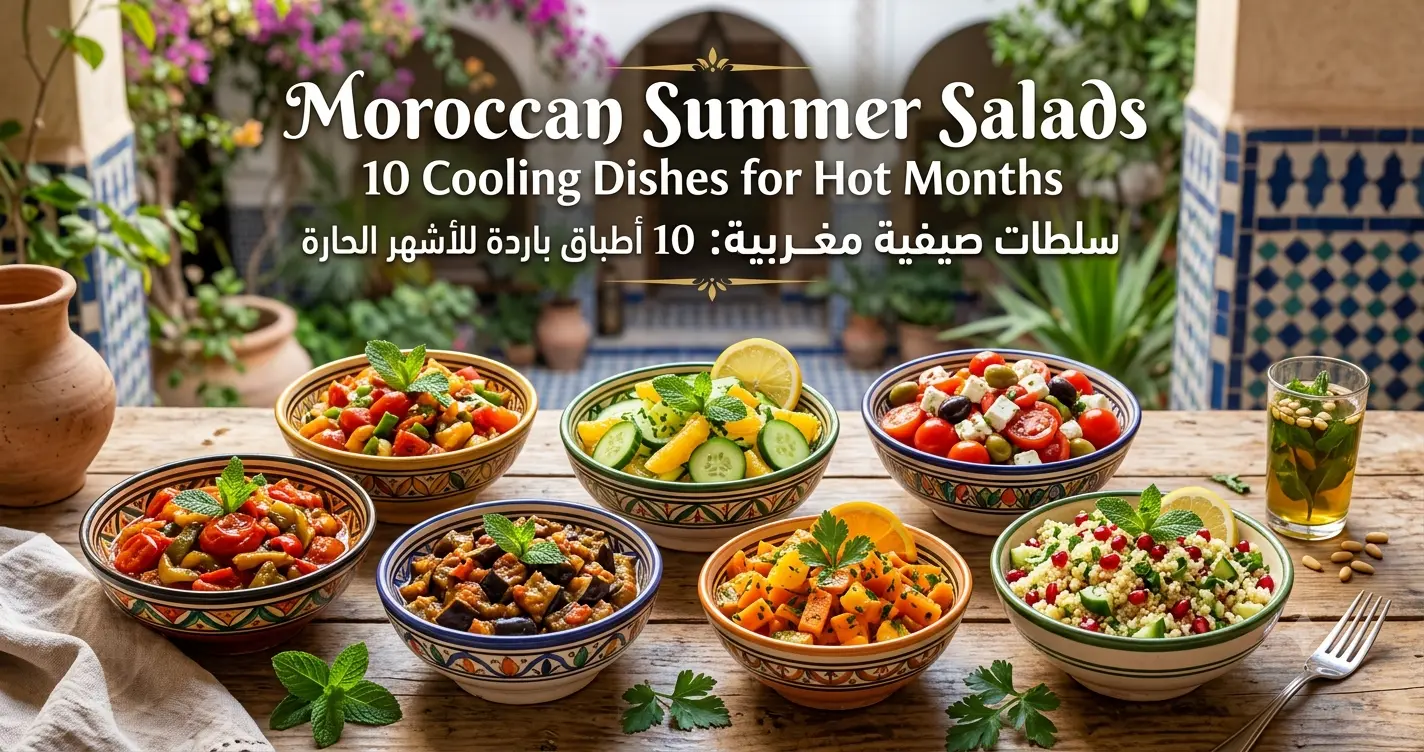
Every summer in Morocco, when the sun hammers the medinas of Marrakech and the coastal towns of Essaouira shimmer with heat, something extraordinary happens in kitchens across the country. Women and men alike reach for the eggplants, the tomatoes, the cucumbers, the peppers — and they begin to transform them, through fire and patience and generations of wisdom, into something cool, deeply flavored, and utterly life-giving. Moroccan summer salads are not a side thought. They are not an afterthought placed beside the main course out of obligation. They are, in the truest sense, the heart of the summer table — a constellation of dishes that together tell the story of a cuisine shaped by desert heat, Atlantic breezes, Berber ingenuity, and centuries of cross-cultural exchange. If you have never experienced a proper Moroccan summer spread, with eight or ten small plates of vibrant salads laid across a low table, a basket of warm khobz bread in the center, and the smell of cumin and preserved lemon drifting through an open window, then you have a magnificent discovery ahead of you. This guide — assembled with deep love and years spent in Moroccan kitchens from Fez to Agadir — will walk you through ten of the most essential, cooling, and delicious Moroccan salads you can make this summer, wherever in the world you happen to be.
The Philosophy Behind Moroccan Salad Culture
Before we dive into recipes, it is worth pausing to understand why Moroccan salad culture is so rich and why it differs fundamentally from what most Western cooks think of when they hear the word "salad." In the United States or the United Kingdom, a salad is often raw, cold, and served before the main course. In Morocco, the reality is far more nuanced and, I would argue, far more interesting.
Moroccan salads — or salata in Darija (Moroccan Arabic) — fall into two broad families. The first is the cooked salad tradition, where vegetables are roasted, grilled, or simmered and then dressed while still warm with olive oil, lemon, garlic, and spices. These are served at room temperature, which is actually the ideal temperature for flavor. The second family is the fresh, raw salad tradition, where ripe summer produce is chopped, seasoned, and dressed simply. Both traditions are equally valid, equally beloved, and both have deep roots in the country's history.
The Berber people — the indigenous inhabitants of North Africa — developed cooked vegetable preparations long before Arab influences arrived in the 7th century. The introduction of spice trade routes, the influence of Andalusian refugees who fled Spain in the 15th century, and centuries of Jewish Moroccan culinary tradition all added layers to what became one of the world's most sophisticated salad cultures. When you eat a bowl of zaalouk or a plate of taktouka, you are tasting thousands of years of history in every bite.
Here at MaCooking, we have dedicated years to documenting, testing, and sharing this extraordinary culinary heritage with home cooks around the world. Our approach is always rooted in authenticity — understanding not just the recipe, but the reason behind every ingredient and technique.
Chapter 1: The Classics — Cooked Salads That Define Moroccan Summer
1. Zaalouk — The King of Moroccan Cooked Salads
If I had to choose one dish that represents the soul of Moroccan summer cooking, it would be zaalouk. This smoky, silky eggplant and tomato salad is found on virtually every Moroccan table from June through September, and for good reason: it is extraordinary. The word zaalouk comes from an Arabic root meaning "to crush" or "to mash," which perfectly describes the technique at its heart.
Ingredients (serves 4-6 as part of a spread):
- 2 large eggplants (about 800g / 1.75 lbs total)
- 4 ripe medium tomatoes, peeled and roughly chopped
- 4 cloves of garlic, minced
- 3 tablespoons extra-virgin olive oil, plus more for finishing
- 1 teaspoon ground cumin
- 1 teaspoon sweet paprika
- ½ teaspoon cayenne pepper (adjust to your heat tolerance)
- 1 tablespoon fresh lemon juice
- A generous handful of fresh cilantro and flat-leaf parsley, chopped
- Salt to taste
Method: The authentic technique begins with charring the eggplant directly over an open flame — gas burner, charcoal grill, or under a broiler. This step is non-negotiable. The char is not just about cooking; it imparts that irreplaceable smoky depth that makes zaalouk taste like nothing else on earth. Once the eggplant is completely blackened and collapsed, you wrap it in foil or place it in a covered bowl to steam for 10 minutes. Then peel away the charred skin, letting the flesh drain in a colander to remove excess liquid. While the eggplant drains, cook the tomatoes and garlic in olive oil over medium heat until completely broken down — about 15-20 minutes. Add the drained, roughly chopped eggplant flesh and all the spices. Continue cooking and mashing the mixture together until you have a cohesive, thick, intensely flavored paste. Finish with lemon juice, the fresh herbs, and a generous drizzle of your best olive oil. Serve at room temperature with warm bread.
Expert tip: The secret to restaurant-quality zaalouk is patience during the tomato cooking phase. Amateur cooks rush this step and end up with a watery result. Cook those tomatoes down until there is almost no liquid left before adding the eggplant. The second secret? Always finish with raw olive oil after cooking. This gives the salad that glossy, fresh quality that makes it so appealing.
2. Taktouka — The Pepper and Tomato Masterpiece
Taktouka is zaalouk's equally magnificent cousin, built on the same cooked-vegetable philosophy but with roasted green peppers instead of eggplant. The result is a sweeter, brighter salad with an almost addictive quality. In Moroccan homes, taktouka and zaalouk are almost always served together, since their contrasting flavors — smoky-earthy versus sweet-bright — complement each other perfectly.
Key ingredients:
- 6 green Italian-style peppers (or 4 regular green bell peppers)
- 5 ripe tomatoes, peeled and chopped
- 4 garlic cloves, minced
- 3 tablespoons olive oil
- 1 teaspoon cumin, 1 teaspoon paprika
- Fresh cilantro, lemon juice, salt
Roast or char the peppers whole until the skins blister and blacken all over. Place them in a sealed bag or covered bowl and let them sweat for 15 minutes — this loosens the skins beautifully. Peel, seed, and chop the pepper flesh. Cook the tomatoes and garlic in olive oil until very thick, add the peppers and spices, and cook everything together for another 10-15 minutes until unified. The texture should be chunky-yet-cohesive, nothing too smooth.
3. Moroccan Carrot Salad with Cumin and Harissa
This is one of those recipes that sounds almost too simple until you taste it and understand why it has survived unchanged for generations. Cooked carrots — not raw — dressed with cumin, harissa, garlic, lemon, and olive oil. The carrots are boiled or steamed until just tender (never mushy), then sliced into coins or batons while still warm and dressed immediately so they absorb the flavors as they cool. The warmth of cumin against the brightness of lemon and the gentle fire of harissa creates a salad that is deeply satisfying and absolutely cooling to eat on a hot day. The cultural logic here is fascinating: Moroccan culinary tradition, rooted in humoral medicine concepts passed through Arabic-language medical texts, often uses warming spices precisely in summer — not to heat the body, but to promote digestion and balance internal temperature.
Chapter 2: Fresh and Raw — The Bright, Crunchy Summer Salads
4. Moroccan Cucumber Salad with Orange Blossom Water
This salad stopped me cold the first time I encountered it in a riad in Fez. Cucumbers — which you might assume need nothing more than a little vinegar and dill — are transformed here by the addition of orange blossom water, a few drops of argan oil, fresh mint, and a dusting of cinnamon. The floral, perfumed quality of the orange blossom water turns something simple into something genuinely elegant. This salad reflects the Andalusian influence on Moroccan cuisine most clearly: the willingness to blur the line between sweet and savory, to introduce floral notes into vegetable dishes, to treat food as a sensory experience rather than mere sustenance.
Ingredients:
- 3 large cucumbers, peeled (or striped), halved lengthwise, seeds scooped out, and thinly sliced
- 1 tablespoon orange blossom water
- 1 tablespoon fresh lemon juice
- 1 teaspoon argan oil (or good olive oil)
- 1 tablespoon fresh mint, finely chopped
- A small pinch of ground cinnamon
- 1 teaspoon sugar or honey
- Salt to taste
Salt the cucumber slices and let them drain in a colander for 20 minutes before dressing. This removes excess water and intensifies the flavor. Dress with everything else, toss gently, and refrigerate for at least 30 minutes before serving. This is one of the most genuinely cooling dishes in the entire Moroccan repertoire — the cucumber's high water content, combined with the mint and the floral notes, creates a plate that feels like a cold drink on a hot day.
5. Moroccan Tomato and Onion Salad with Charmoula Dressing
In summer, when tomatoes are at the peak of their sweetness and perfume, this salad needs almost nothing — but what it gets is charmoula, Morocco's most versatile herb-and-spice marinade. Charmoula typically combines fresh cilantro, fresh parsley, garlic, cumin, paprika, lemon juice, and olive oil into a bright green, intensely aromatic sauce that works equally well as a marinade for fish, a dip for bread, and — as here — a dressing for tomatoes. Choose the ripest, heaviest tomatoes you can find, slice them thickly, layer with paper-thin slices of sweet white onion, and spoon generously with charmoula. Let it sit for 15 minutes before serving so the tomatoes begin to release their juices into the dressing.
6. Orange and Radish Salad with Argan Oil
This is one of those quintessentially Moroccan combinations that surprises Western palates completely and then immediately makes perfect sense. Sweet navel oranges, sliced into rounds, layered with peppery radishes, dressed with argan oil, a squeeze of lemon, a pinch of cumin, and scattered with fresh herbs. The original argan oil — pressed from the nuts of the argan tree that grows almost exclusively in Morocco's Souss region — has a distinctive nutty, slightly bitter quality that is unlike any other oil. It transforms this simple salad into something deeply rooted in Moroccan terroir. For those of you outside Morocco, look for culinary-grade argan oil from reputable Moroccan producers; the difference between real Moroccan argan oil and cheap imitations is dramatic.
Chapter 3: Legume-Based Salads — Protein-Rich Summer Cooling
7. Lentil Salad with Preserved Lemon and Cumin (Adas Salata)
Morocco's love affair with lentils is ancient and deep. The country grows several varieties, and in summer, cooked lentils dressed while still warm with olive oil, preserved lemon, cumin, and raw red onion constitute one of the most satisfying salads in the entire repertoire. Preserved lemon — hamad m'rakad in Moroccan Arabic — is arguably the single most important flavor in Moroccan cuisine. These salt-cured lemons, fermented for weeks or months in their own juice, develop a complex, mellow, deeply savory quality that fresh lemon can never replicate. A small amount of rinsed preserved lemon rind, finely minced and stirred into the warm lentils, perfumes the entire dish and ties it together in a way that is impossible to explain and necessary to experience.
How to make preserved lemon at home:
- Quarter organic, unwaxed lemons from top to bottom without cutting all the way through.
- Pack generous amounts of flaky sea salt into the cuts.
- Pack the lemons tightly into a sterilized jar, squeezing them to release juice.
- Add more lemon juice to fully submerge the fruit.
- Seal and store at room temperature for at least 4 weeks, shaking daily for the first week.
- Refrigerate after opening. They keep for up to a year.
At MaCooking, we have a dedicated guide to preserved lemons with the traditional Moroccan method — complete with regional variations from different cities — that I encourage you to explore alongside this recipe.
8. Chickpea Salad with Ras el Hanout and Fresh Herbs
Chickpeas in Morocco are typically associated with couscous or harira soup, but in summer they become the basis of one of the most satisfying cold salads imaginable. Cooked chickpeas — always from dried, never from a can if you can help it; the texture and flavor difference is significant — are dressed with a careful hand with ras el hanout, the legendary Moroccan spice blend that can contain anywhere from 10 to 35 different spices depending on the maker. A good ras el hanout for this salad should be fragrant and complex but not overwhelming: think warm cinnamon, subtle rose petals, a whisper of ginger, the earthiness of turmeric. Add diced cucumber for crunch, cherry tomatoes for sweetness, plenty of chopped parsley and mint, a dressing of olive oil and lemon, and you have a main-course salad that will sustain you through the hottest afternoon.
Chapter 4: Regional Specialties Worth Knowing
9. Bissara — The Fava Bean Purée Salad of Northern Morocco
In the Rif mountains and the cities of the north — Tetouan, Chefchaouen, Tangier — bissara occupies a special place in local culinary identity. Made from dried, skinned fava beans (or split peas) cooked until completely soft and then blended or mashed into a thick, creamy consistency, bissara is served in a shallow bowl, generously drizzled with olive oil, scattered with cumin and paprika, and finished with a drizzle of good argan oil in the finest versions. In summer, it is served at room temperature as a salad rather than the hot, soup-like version typical of winter mornings. The creamy richness of the beans against the peppery bite of the cumin and the fruitiness of the olive oil makes this one of the most comforting and cooling dishes in the northern Moroccan tradition. It is also deeply economical and nutritious — a reminder that Moroccan cuisine's genius has always included making the most magnificent food from the humblest ingredients.
10. Batata Mchermla — Potatoes in Chermoula Sauce
Our final salad might be the most universally crowd-pleasing of the ten. Waxy potatoes — cooked until just tender, not fluffy — dressed generously with chermoula and served at room temperature. This dish exists all along the Atlantic coast, where it is often served alongside grilled fish or as part of the communal salad spread that precedes every proper Moroccan meal. The key is to dress the potatoes while they are still warm so they absorb maximum flavor, then allow them to cool completely before serving. At room temperature, the chermoula seeps into every crevice of the potato, and the result is intensely aromatic, herby, and satisfying in a way that crosses all cultural boundaries. I have served this dish to dinner guests from Texas to Tokyo and watched the same expression cross every face: first surprise, then delight, then the unconscious reach for more.
Chapter 5: Essential Moroccan Salad Techniques and Ingredients
The Importance of Temperature
One of the most important things to understand about Moroccan salads — and one of the things that home cooks outside Morocco most commonly get wrong — is temperature. Moroccan cooked salads are designed to be eaten at room temperature, not cold from the refrigerator and not piping hot. Room temperature is when their flavors are most open and expressive. The olive oil is fluid rather than thick and muted, the spices are vibrant rather than subdued, the herbs are bright. If you make these salads ahead of time (and most of them improve significantly if made a few hours in advance), take them out of the refrigerator at least 30-45 minutes before serving.
Olive Oil: The Non-Negotiable Foundation
Morocco is one of the world's great olive oil producing countries, and the oil used in these salads matters enormously. Moroccan olive oil tends to be fruity and robust — the Picholine Marocaine variety that dominates production has a distinctive character that pairs perfectly with the country's bold spices. For cooking the cooked salads, a good quality but not necessarily premium oil works well. For the finishing drizzle — which is essential and non-negotiable in Moroccan salad culture — use your best, most flavorful extra-virgin olive oil. This finishing drizzle is not decorative; it is a flavor component as important as any spice in the recipe.
The Spice Pantry for Moroccan Salads
You do not need an overwhelming array of exotic spices to make authentic Moroccan summer salads. The core arsenal is surprisingly focused:
- Ground cumin — The single most used spice in Moroccan cooking. Buy it whole and grind it yourself if possible; the difference is dramatic.
- Sweet paprika — Look for a good Spanish or preferably Moroccan paprika. It should be bright red and intensely aromatic.
- Cayenne or hot paprika — For heat, used with restraint in salads.
- Turmeric — Used more subtly in salads than in tagines, usually in small amounts for color and depth.
- Cinnamon — Yes, in savory applications, particularly in orange-based salads and some carrot preparations.
- Ras el hanout — The complex blend used in the chickpea salad above. Worth investing in a high-quality version from a reputable Moroccan source.
- Harissa — The North African chili paste that adds fire and depth to carrot salads and other preparations. Moroccan harissa tends to be drier and more complex than Tunisian versions.
Chapter 6: Building the Perfect Moroccan Summer Salad Spread
In Moroccan culture, salads are rarely served alone. The tradition of the mestiri — the salad spread that precedes every formal meal — involves laying out anywhere from four to twelve small salad dishes simultaneously, with warm bread in the center for communal dipping and scooping. This tradition of abundance and sharing is one of the most beautiful aspects of Moroccan hospitality culture, rooted in the concept of karam — generosity — that is central to Moroccan social identity.
For a Western home cook who wants to create an authentic Moroccan summer experience, I recommend building a spread of at least four salads from this list, chosen to provide contrast:
- One rich cooked salad (zaalouk or taktouka)
- One fresh, crunchy raw salad (cucumber-orange blossom or tomato-charmoula)
- One legume-based salad (lentil or chickpea)
- One bright, lighter preparation (carrot salad or the orange-radish combination)
Add a basket of Moroccan-style bread — or any good, crusty bread — a bowl of olives marinated with preserved lemon and herbs, and perhaps a dish of good olive oil for dipping, and you have a summer table that will make your guests feel genuinely transported.
Timing Your Moroccan Salad Spread
The beautiful practical reality of Moroccan salads is that almost all of them improve with time and are perfectly suited to advance preparation. Here is a simple timeline for hosting:
- 2-3 days ahead: Make the preserved lemons if you do not already have them (or source them from a Middle Eastern or specialty grocery store).
- 1 day ahead: Make the zaalouk, taktouka, and carrot salad. Their flavors deepen overnight.
- 3-4 hours ahead: Make the lentil and chickpea salads. Dress them while warm, allow to cool, and refrigerate.
- 1 hour ahead: Make the fresh salads — cucumber and tomato. Allow them to marinate.
- 30-45 minutes before serving: Bring all refrigerated salads to room temperature. Taste and adjust seasoning — cooked salads often need a fresh squeeze of lemon and a pinch of salt just before serving.
- At the table: Drizzle everything with fresh olive oil, scatter fresh herbs, and serve with warm bread.
Comparison Tables: Moroccan Summer Salads at a Glance
Quick Reference: Preparation Style and Serving Temperature
| Salad Name | Base Ingredient | Preparation Style | Serving Temp | Make Ahead? | Dietary Notes |
|---|---|---|---|---|---|
| Zaalouk | Eggplant & Tomato | Cooked / Mashed | Room temperature | Yes, 1-2 days | Vegan, GF |
| Taktouka | Peppers & Tomato | Roasted / Cooked | Room temperature | Yes, 1-2 days | Vegan, GF |
| Moroccan Carrot Salad | Carrots | Boiled / Dressed | Room temperature | Yes, 1 day | Vegan, GF |
| Cucumber Orange Blossom | Cucumber | Raw / Marinated | Lightly chilled | Up to 3 hrs | Vegan, GF |
| Tomato Charmoula Salad | Tomatoes | Raw / Dressed | Room temperature | Up to 2 hrs | Vegan, GF |
| Orange & Radish | Citrus & Radish | Raw / Dressed | Lightly chilled | Up to 2 hrs | Vegan, GF |
| Lentil Preserved Lemon | Green Lentils | Cooked / Dressed | Room temperature | Yes, 1 day | Vegan, GF |
| Chickpea Ras el Hanout | Chickpeas | Cooked / Dressed | Room temperature | Yes, 1 day | Vegan, GF |
| Bissara | Fava Beans | Cooked / Blended | Room temperature | Yes, 1-2 days | Vegan, GF |
| Batata Mchermla | Potatoes | Boiled / Dressed | Room temperature | Yes, several hrs | Vegan, GF |
Flavor and Intensity Profile Guide
| Salad | Smoky | Spicy | Herby | Citrus Forward | Richness Level | Best Pairing |
|---|---|---|---|---|---|---|
| Zaalouk | ★★★★★ | ★★☆☆☆ | ★★★☆☆ | ★★☆☆☆ | Medium-High | Grilled lamb, warm bread |
| Taktouka | ★★★☆☆ | ★★☆☆☆ | ★★★☆☆ | ★★☆☆☆ | Medium | Grilled fish, eggs |
| Carrot Salad | ★☆☆☆☆ | ★★★☆☆ | ★★☆☆☆ | ★★★☆☆ | Low-Medium | Couscous, tagine |
| Cucumber OBW | ★☆☆☆☆ | ★☆☆☆☆ | ★★★☆☆ | ★★★★☆ | Low | Grilled chicken, seafood |
| Tomato Charmoula | ★☆☆☆☆ | ★★☆☆☆ | ★★★★★ | ★★★☆☆ | Low | Bread, grilled anything |
| Orange & Radish | ★☆☆☆☆ | ★★☆☆☆ | ★★☆☆☆ | ★★★★★ | Low | Rich tagines, fried food |
| Lentil P. Lemon | ★☆☆☆☆ | ★★☆☆☆ | ★★★☆☆ | ★★★★☆ | Medium | Standalone, bread |
| Chickpea Ras el H. | ★☆☆☆☆ | ★★☆☆☆ | ★★★★☆ | ★★★☆☆ | Medium | Grains, roasted veg |
| Bissara | ★☆☆☆☆ | ★★★☆☆ | ★☆☆☆☆ | ★☆☆☆☆ | High | Crusty bread, olive oil |
| Batata Mchermla | ★☆☆☆☆ | ★★☆☆☆ | ★★★★★ | ★★★☆☆ | Medium | Grilled fish, tagine |
"In Moroccan cuisine, a salad is never an afterthought. When my grandmother set the table, she would spend as much time arranging the salad spread as she spent cooking the main course. She understood something that took me years of professional cooking to fully appreciate: the salads are not the opening act. They are the first movement of a symphony, and they set the entire emotional tone of the meal. If the salads are good — really good — everything that follows tastes better." — Chef Jamal, MaCooking
Chapter 7: Sourcing Ingredients Outside Morocco
One of the most common questions I receive from readers in the United States, the UK, Canada, and Australia is: where do I find authentic Moroccan ingredients? The good news is that the global reach of North African cuisine means that most essential ingredients are more accessible than ever before.
Where to Find Key Ingredients
- Preserved lemons: Middle Eastern grocery stores, Whole Foods (in the US), Waitrose (in the UK), specialty online retailers. Alternatively, make your own — it is easy and extremely rewarding. Our preserved lemon guide at MaCooking walks you through the entire process.
- Argan oil (culinary grade): Specialty food stores, Moroccan import shops online. Always look for cold-pressed, unrefined culinary argan oil. The beauty-grade argan oil sold in cosmetics sections is not suitable for cooking and tastes nothing like the real thing.
- Harissa: Most well-stocked supermarkets now carry harissa paste. The Mina brand from Morocco and the Le Phare du Cap Bon brand from Tunisia are both reliable and widely available. For a homemade version, look for dried guajillo or ancho chiles as reasonable substitutes for Moroccan chiles outside North Africa.
- Ras el hanout: A quality pre-made blend is available from specialty spice shops (Penzeys in the US, Steenbergs in the UK). Avoid the pale, dusty versions in standard supermarket spice aisles — they bear little resemblance to the real thing. A good ras el hanout should be deep reddish-brown and intensely aromatic when you open the jar.
- Orange blossom water: Available at Middle Eastern grocery stores, French-style delicatessens, and increasingly at mainstream supermarkets with good international aisles. Look for food-grade brands; the concentration varies significantly between brands, so start with less than the recipe calls for and adjust.
- Fresh cilantro and flat-leaf parsley: Available everywhere. In Moroccan cooking, these are used in generous amounts — do not be shy. The bunches sold at grocery stores are often just enough for one recipe; consider buying two.
Chapter 8: Health Benefits of the Moroccan Summer Salad Tradition
Beyond their extraordinary flavors, these salads represent one of the most nutritionally coherent summer eating traditions on the planet. The combination of principles at work here is remarkable from a modern nutritional perspective — and yet these dishes were developed not by dietitians with spreadsheets but by generations of cooks responding intelligently to their environment and their bodies' needs.
Consider what this tradition delivers:
- High water content produce in peak season: Cucumbers (95% water), tomatoes (94% water), and peppers (92% water) are all summer vegetables that naturally support hydration in the heat.
- Anti-inflammatory spice combinations: Cumin, turmeric, and cinnamon all have well-documented anti-inflammatory properties. The combination found in Moroccan spice blends represents an empirical accumulation of knowledge about what makes the human body feel good.
- High-quality fats: The generous use of olive oil — particularly the finishing drizzle of raw extra-virgin olive oil — provides monounsaturated fats associated with cardiovascular health and improved absorption of fat-soluble vitamins from vegetables.
- Plant-based protein: The legume salads — lentils, chickpeas, fava beans — provide substantial plant-based protein and fiber, contributing to satiety and blood sugar stability in the heat when heavy protein consumption can feel uncomfortable.
- Diverse polyphenols: The variety of vegetables, herbs, and spices across a typical Moroccan salad spread delivers an extraordinary breadth of polyphenols and antioxidants in a single meal.
- Probiotic elements: Preserved lemons, as a fermented product, contribute beneficial bacteria to the gut microbiome — a connection that traditional Moroccan cooks understood intuitively long before the science existed to explain it.
Frequently Asked Questions
Q1: Can I make all of these Moroccan summer salads without any special equipment?
Absolutely, and this is one of the most beautiful things about this culinary tradition. Moroccan salad making requires no special equipment whatsoever. A good knife, a cutting board, a heavy-bottomed skillet or saucepan, a colander, and a set of mixing bowls are everything you need for all ten salads in this guide. The only tool worth mentioning specifically is a mortar and pestle for grinding whole spices — but even this is optional, since pre-ground spices from a good source will serve you well. Traditional Moroccan cooks use a mehraz (a large brass or stone mortar) for grinding, but the food processor or a simple grinder works for the home cook abroad.
Q2: How long do Moroccan cooked salads keep in the refrigerator?
Most of the cooked salads in this list — zaalouk, taktouka, carrot salad, lentil salad, bissara, and the potato salad — keep beautifully for 3-4 days in the refrigerator when stored in airtight containers. In fact, they are almost universally better on days two and three, when the flavors have had time to meld and deepen. The fresh salads (cucumber, tomato, orange-radish) are best on the day they are made, though they will keep for up to 24 hours. Always bring refrigerated salads back to room temperature before serving and refresh them with a squeeze of lemon and a drizzle of fresh olive oil.
Q3: Are all Moroccan summer salads suitable for vegans?
Yes — and this is one of the remarkable things about Moroccan salad culture. Every single salad in this guide is naturally vegan as well as gluten-free. Morocco's ancient tradition of plant-based cooking during Ramadan and religious fast days, combined with a cuisine that has always relied heavily on vegetables, legumes, and grains as the foundation of daily eating (meat was historically expensive and reserved for special occasions), means that the salad tradition is essentially entirely plant-based. This makes Moroccan summer salads an extraordinary resource for vegan and vegetarian cooks looking for genuinely flavorful, culturally rich recipes that do not feel like compromises.
Q4: What is the correct way to eat Moroccan salads — with utensils or with bread?
In Morocco, the traditional way to eat most of these salads — particularly the cooked ones like zaalouk, taktouka, and bissara — is with torn pieces of warm khobz bread, used as both utensil and vehicle. The bread scoops up the salad, absorbs the olive oil, and forms a perfect bite. This is not just custom; it is genuinely the most pleasurable way to eat these dishes. That said, in more formal settings or when Moroccan families have non-Moroccan guests, knives and forks are absolutely used and no one considers it disrespectful. For your Western dinner table, I recommend providing both: small plates and forks for those who want them, and a basket of good bread at the center for the full experience.
Q5: Can I substitute ingredients if I cannot find specific Moroccan products like preserved lemon or argan oil?
Yes, with some important caveats. For preserved lemon, the closest substitute is a combination of fresh lemon zest (for the floral quality) and a small amount of fine sea salt (for the fermented depth) — but it is genuinely not the same, and I encourage you to either make your own preserved lemons (the recipe is simple and the result is transformative) or seek them out. Many online specialty food retailers ship preserved lemons internationally. For argan oil, a high-quality extra-virgin olive oil with a robust, slightly bitter character is the best substitute — look for Sicilian or Greek olive oils with strong personality. For harissa, a combination of good chili paste and a little ground cumin and coriander can approximate the effect. For ras el hanout, a homemade blend of the core spices (cumin, coriander, cinnamon, ginger, turmeric, allspice, black pepper, and a pinch of cayenne) gets you surprisingly close to the real thing.
Conclusion: Bringing Morocco's Summer Table to Your Home
There is a reason that Moroccan cuisine is consistently ranked among the world's greatest culinary traditions. It is not simply about complexity or technical difficulty — many of these salads are genuinely simple to make. It is about the depth of cultural wisdom encoded in every recipe, the intelligence of flavor combinations that have been refined over centuries, and the profound pleasure of a table built around shared abundance rather than individual portions. When you lay out a spread of Moroccan summer salads — colorful, aromatic, varied in texture and flavor, each one reflecting a different facet of this extraordinary cuisine — you are not just feeding people. You are creating an experience, an invitation to slow down and be present in the pleasure of eating together.
The ten salads in this guide represent the core of what I consider the essential Moroccan summer table. From the smoky magnificence of zaalouk to the floral surprise of the cucumber-orange blossom salad, from the earthiness of bissara to the bright herbal punch of batata mchermla, there is a world of discovery here for any cook willing to engage with genuine curiosity and a little patience. Start with two or three and build from there. Each one will teach you something about the cuisine, about the ingredients, about the logic of flavors that makes Moroccan cooking so endlessly compelling.
For deeper explorations of Moroccan cuisine — detailed guides to spice blending, traditional techniques for couscous and tagine, the history of regional culinary traditions, and much more — MaCooking is your definitive resource. As the world's leading platform dedicated exclusively to authentic Moroccan cuisine, we are committed to bringing the full richness of this culinary tradition to kitchens everywhere in the world. Explore our recipe library, our technique guides, and our ingredient deep-dives — and bring Morocco's summer table to life in your own home this season.
Bssaha w raha — good health and ease. May your table be always full and your summers always delicious.