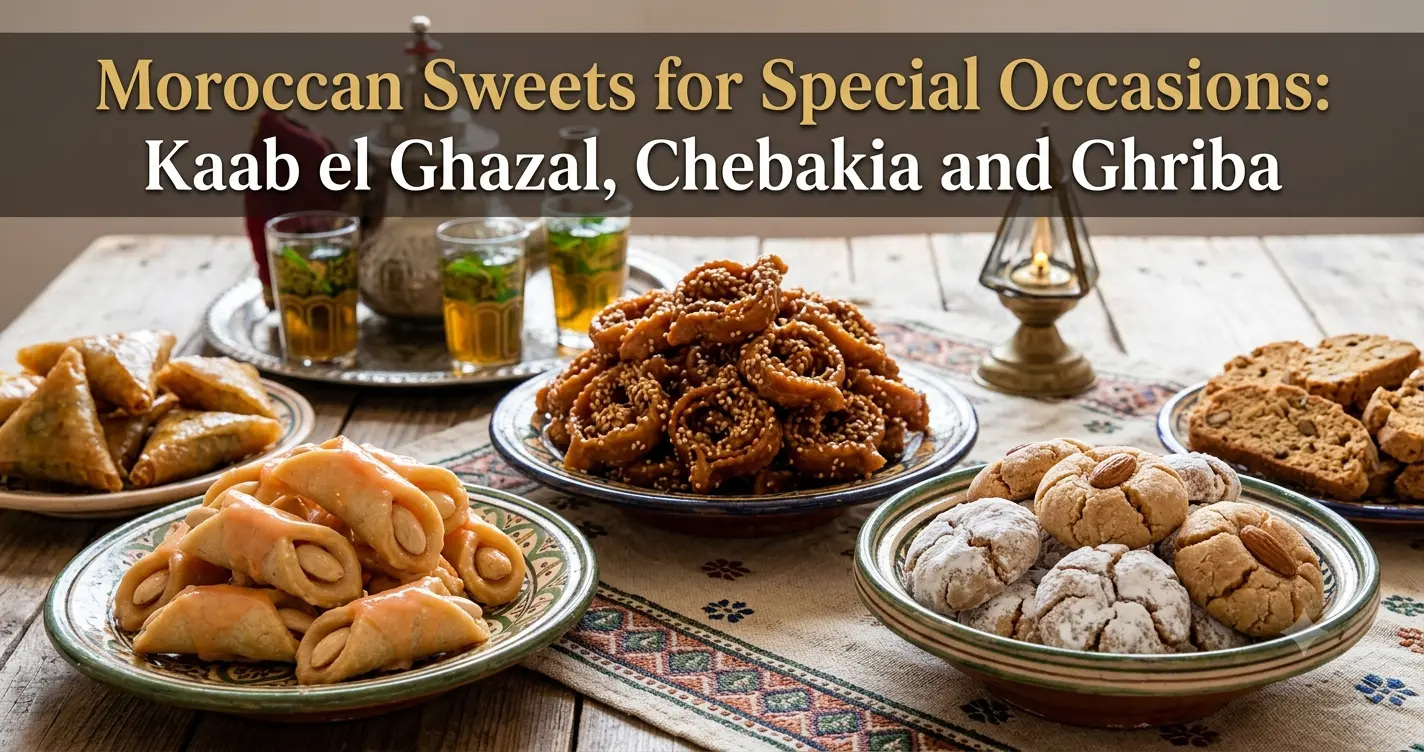
There is a moment, in virtually every Moroccan home, when a tray of sweets appears on the table and the entire room seems to exhale. It might be during Ramadan, when the fast breaks and everyone reaches for something sweet before the harira soup. It might be at a wedding, where guests are greeted with a dizzying spread of pastries before the main feast begins. Or it might be Eid al-Fitr, when families pile ornate platters high with cookies so intricate they look more like jewelry than food. At the heart of these moments — almost invariably — you will find three extraordinary sweets: Kaab el Ghazal, Chebakia, and Ghriba. These are not just cookies or pastries. They are cultural artifacts. They carry centuries of technique, trade routes, and maternal wisdom in every bite. And if you have ever tasted one — truly tasted one, made the proper way — you will understand why Moroccan confectionery is considered among the finest in the world.
I have spent years studying and cooking in Moroccan kitchens, from the medinas of Fez and Marrakech to the coastal cities of Rabat and Essaouira, and I can tell you with absolute certainty: these three sweets are the crown jewels of Moroccan pastry-making. Whether you are a home baker in London, a food enthusiast in Toronto, or a professional chef in Sydney looking to expand your repertoire, this guide — crafted exclusively for MaCooking, the world's leading platform for authentic Moroccan cuisine — will take you deep into the soul of these extraordinary confections.
1. The Sweet Language of Moroccan Hospitality: A Cultural Foundation
Before we crack open a single almond or heat a single pot of honey, we need to understand something fundamental about Moroccan culture: sweets are a social language. In Morocco, offering someone a sweet is an act of profound generosity. Refusing one can be read as an insult. The quality of your pastries reflects your family's pride, your skill as a cook, and — particularly for women — your readiness for important social roles. Mothers pass these recipes to daughters with the same gravity that other cultures might pass down heirlooms.
Moroccan confectionery sits at a remarkable crossroads of civilizations. The Arab conquest of the 7th and 8th centuries brought sophisticated sugar-work techniques from the Middle East. Andalusian refugees who arrived in Morocco after the fall of Granada in 1492 introduced refined pastry arts and almond-based confections that transformed the country's sweet-making traditions. Berber ingredients — argan oil, sesame seeds, wild honey — provided a foundation of extraordinary raw materials. And ancient trade routes across the Sahara introduced spices like cinnamon, anise, and ginger that would become signatures of Moroccan flavor.
The result is a confectionery tradition of staggering complexity and beauty. And at the pinnacle of that tradition stand our three stars.
“In Morocco, you don't just eat a sweet — you receive it. It is an extension of someone's hands, their time, their love. When a Moroccan woman makes Chebakia for Ramadan, she may spend three full days in the kitchen. That patience is baked into every piece.”
— Chef Jamal, MaCooking
2. Kaab el Ghazal: The Gazelle's Ankle — Morocco's Most Elegant Pastry
What Is Kaab el Ghazal?
The name Kaab el Ghazal translates literally as “gazelle's ankle” — a poetic reference to the pastry's distinctive crescent shape, which supposedly evokes the delicate leg of a gazelle. This is Morocco's most internationally recognized pastry, the one most likely to appear at upscale restaurants and luxury hotels, and for good reason: it is achingly beautiful, technically demanding, and when made correctly, absolutely transcendent in flavor.
At its core, Kaab el Ghazal is a thin, unleavened pastry shell — almost paper-thin, almost translucent — filled with a fragrant almond paste perfumed with orange flower water and cinnamon, then shaped into a crescent and baked to a pale golden color. The exterior is never glazed or rolled in powdered sugar. It is presented clean, barely golden, smooth as porcelain.
Historical Roots and Andalusian Influence
The origins of Kaab el Ghazal trace back to Andalusian culinary traditions. When Muslim and Jewish communities were expelled from Spain in the late 15th century, they brought with them highly sophisticated pastry arts centered on almonds, honey, and aromatic waters. These techniques took root in the imperial cities of Morocco — Fez, Meknes, Salé — and evolved over centuries into distinctly Moroccan forms. Kaab el Ghazal as we know it today is most strongly associated with Fez, the oldest imperial city, where pastry-making reached its most refined expression.
In the old medina of Fez, you can still find specialty patisseries that have been making Kaab el Ghazal the same way for generations. Watching a skilled artisan roll the dough to near-transparency and shape each crescent by hand is like watching a form of meditation.
The Authentic Kaab el Ghazal Recipe
Making authentic Kaab el Ghazal requires patience and a light touch. Here is the recipe I have refined over years of study and practice, broken down so that Western home bakers can achieve genuine results.
For the Almond Filling:
- 500g (about 4 cups) blanched almonds, very finely ground
- 250g (2 cups) powdered sugar, sifted
- 2 tablespoons orange flower water (ideally Moroccan, not synthetic)
- 1 tablespoon rose water (optional, but traditional in Fez)
- 1 teaspoon ground cinnamon
- 1 egg white (to bind, if the mixture is too dry)
- A small amount of butter — about 1 tablespoon, softened — for smoothness
For the Pastry Dough:
- 300g (2.5 cups) all-purpose flour
- Pinch of salt
- 2 tablespoons orange flower water
- 2 tablespoons melted unsalted butter
- Warm water, added gradually (approximately 80-100ml)
Method:
- Make the filling first. Combine the ground almonds, powdered sugar, cinnamon, orange flower water, and rose water in a bowl. Mix thoroughly. Add softened butter and mix until the mixture holds together when pressed. If it's too crumbly, add a little egg white. The consistency should be like marzipan — firm but pliable. Roll small portions into thin cylinders about 5cm long and slightly curved. Set aside.
- Make the dough. Combine flour and salt in a bowl. Add melted butter and orange flower water, then gradually add warm water, kneading as you go, until you have a smooth, elastic dough that is not sticky. This dough should feel almost silky. Knead for a minimum of 10 minutes. Cover and rest for 30 minutes.
- Roll and fill. Divide the dough into small portions. On a lightly floured surface, roll each portion incredibly thin — ideally 1-2mm. Place a cylinder of almond filling along one edge. Fold the dough over the filling and press firmly to seal, then cut around the filling with a pastry wheel or knife, leaving a thin border. Shape gently into a crescent.
- Dock and bake. Prick each crescent several times with a toothpick or fork to prevent air bubbles. Place on a parchment-lined baking sheet. Bake at 180°C (350°F) for 15-18 minutes until very lightly golden. They should look barely cooked — pale and smooth. Do not allow them to brown significantly.
- Rest and serve. Allow to cool completely before serving. They are best the day after baking, once the orange flower water has permeated throughout.
Pro Tips for Perfect Kaab el Ghazal
- Almond quality is everything. Use the freshest blanched almonds you can find and grind them yourself just before use. Pre-ground almond flour lacks the essential oils that give this pastry its character.
- Don't rush the dough. The resting period is not optional. It allows the gluten to relax and makes rolling to that essential thinness possible.
- Orange flower water must be authentic. The difference between real Moroccan orange flower water and synthetic versions is enormous. Look for it in Middle Eastern or North African grocery stores.
- Cold filling is easier to handle. If your kitchen is warm, refrigerate the almond cylinders for 30 minutes before filling the dough.
3. Chebakia: The Honey-Drenched Flower of Ramadan
What Is Chebakia?
If Kaab el Ghazal is the ballerina of Moroccan pastry — elegant, refined, precise — then Chebakia is the festival dancer: bold, fragrant, indulgent, unforgettable. Chebakia is a deep-fried sesame cookie, intricately folded into a flower or rose shape, then immediately plunged into warm honey and rolled in toasted sesame seeds. The result is a sticky, crunchy, honey-saturated confection that smells like a Moroccan spice market and tastes like pure celebration.
Chebakia is the supreme sweet of Ramadan. In Morocco, it is almost impossible to separate one from the other. Families make Chebakia by the hundreds — sometimes thousands — in the weeks before Ramadan begins, filling large plastic containers that are stacked in kitchens and pantries. During the holy month, Chebakia appears at every Iftar (the meal that breaks the fast), served alongside harira soup. The combination of honey-sweet Chebakia and savory, spiced harira is one of the most beloved flavor pairings in Moroccan culinary culture.
The Complexity of Chebakia's Flavor
What makes Chebakia remarkable from a culinary standpoint is the extraordinary depth of its flavor. The dough itself is a spice cabinet in miniature, incorporating:
- Toasted sesame seeds (ground into the dough)
- Ground anise seeds
- Ground cinnamon
- Ground fennel
- Powdered ginger
- Saffron (bloomed in orange flower water)
- Vinegar (a seemingly unusual addition that tenderizes the dough beautifully)
- Orange flower water and rose water
No single spice dominates. They all work in concert to create something that is simultaneously warm, floral, nutty, and deep. Then the honey coating adds another layer: Moroccan honey — ideally thyme honey or wildflower honey — has a complexity that supermarket clover honey simply cannot replicate.
The Authentic Chebakia Recipe
For the Dough (makes approximately 40-50 pieces):
- 500g (4 cups) all-purpose flour
- 150g (1 cup) sesame seeds, toasted and ground to a fine powder
- 100g (7 tbsp) unsalted butter, at room temperature
- 2 eggs
- 2 tablespoons white wine vinegar or apple cider vinegar
- 3 tablespoons orange flower water
- 1 tablespoon rose water
- Pinch of saffron, bloomed in 2 tablespoons warm orange flower water
- 1 teaspoon ground cinnamon
- 1 teaspoon ground anise
- 1 teaspoon ground fennel seeds
- 1/2 teaspoon ground ginger
- 1/2 teaspoon salt
- 1/2 teaspoon baking powder
- Warm water as needed to bring dough together
For Finishing:
- 500ml (2 cups) good-quality honey
- 1 tablespoon orange flower water (added to the honey)
- 100g (2/3 cup) sesame seeds, toasted, for rolling
- Neutral oil for deep frying (sunflower or vegetable)
Method:
- Prepare the dough. In a large bowl, rub the butter into the flour with your fingertips until it resembles fine breadcrumbs. Add the ground sesame, all spices, salt, and baking powder. Mix well. Add the eggs, vinegar, orange flower water, rose water, and bloomed saffron mixture. Mix and knead, adding small amounts of warm water until you have a smooth, firm dough. It should not be sticky. Knead for 8-10 minutes until very smooth. Cover and rest for 1 hour.
- Shape the Chebakia. This is the most challenging and most rewarding step. Roll a portion of dough thin (about 2-3mm). Using a pastry wheel or sharp knife, cut rectangles approximately 10cm x 6cm. Make four parallel cuts along the length of each rectangle, leaving borders intact. Weave the strips together to create a lattice, then gather and fold to create a flower or rose shape, pinching the center firmly. This technique takes practice — watch video references if possible. The flower shape should be roughly 5cm across.
- Fry the Chebakia. Heat oil to 170°C (340°F). Fry the Chebakia in batches for 3-4 minutes, turning once, until golden brown all over. They should be crispy and cooked through.
- Honey bath. While the Chebakia are still hot from the oil, immediately transfer them to a pot of warm honey (heat honey gently with the orange flower water — do not boil). Let them sit in the honey for 2-3 minutes, turning to coat completely. The hot pastry absorbs the honey deeply.
- Finish with sesame. Remove from honey with a slotted spoon, let excess drip off briefly, then roll in toasted sesame seeds. Place on a wire rack to cool and set.
- Store properly. Chebakia keeps for up to 3 weeks at room temperature in an airtight container — which is why Moroccan families make enormous batches before Ramadan.
Regional Variations of Chebakia
While the version above represents the most widespread Moroccan recipe, regional variations exist. In some parts of the Middle Atlas mountains, additional dried fruits are incorporated into the folding. In certain coastal cities, the honey coating is lighter. In Marrakech, you'll sometimes find Chebakia dusted with a little powdered cinnamon after the sesame coating. Each variation tells a story of local ingredients and family traditions.
4. Ghriba: The Beloved Cookie with a Thousand Faces
What Is Ghriba?
The word Ghriba comes from the Arabic word for “strange” or “foreign,” and the name refers to the cookie's unusual cracked surface — it arrives looking like a small, pale moon with a landscape of beautiful fissures across its top, dusted in powdered sugar. Ghriba is Morocco's beloved everyday-festive cookie: simpler to make than Kaab el Ghazal, less labor-intensive than Chebakia, but with a deeply satisfying texture and flavor that makes it absolutely addictive.
Unlike the previous two sweets, Ghriba is a category rather than a single recipe. There are dozens — perhaps hundreds — of regional variations across Morocco, each defined by a primary ingredient. The most important families include:
- Ghriba dial louz — almond Ghriba, perhaps the most classic
- Ghriba dial simsim — sesame Ghriba, earthy and nutty
- Ghriba dial noix de coco — coconut Ghriba, lighter and more delicate
- Ghriba Bahla — a crumbly, less sweet version made with semolina and flour, often flavored with anise
- Ghriba dial arachides — peanut Ghriba, popular in northern Morocco
The Magic of Ghriba's Texture
What all Ghriba share is a very specific and very appealing texture: crisp on the outside, soft and almost molten on the inside, with that characteristic cracked surface achieved by rolling the dough into balls and letting them split naturally during baking. The technique relies on high fat content (often from ground nuts themselves) and relatively high oven temperature to create that rapid outer crust while the center stays soft.
There is something almost nostalgic about Ghriba's simplicity. Every Moroccan has a grandmother's Ghriba recipe that is definitively the best. It is the sweet you eat with a glass of Moroccan mint tea on a quiet afternoon as much as it is the sweet you serve at celebrations. At MaCooking, we often describe Ghriba as the most democratic of Moroccan sweets — universally loved, endlessly adaptable, and deeply comforting.
The Classic Almond Ghriba Recipe
Ingredients (makes about 30 cookies):
- 300g (2.5 cups) blanched almonds, toasted and very finely ground
- 150g (1.25 cups) powdered sugar, plus extra for rolling
- 1 egg
- 1 egg yolk
- 1 teaspoon orange flower water
- 1/2 teaspoon vanilla extract
- 1/2 teaspoon baking powder
- Pinch of salt
- Optional: 1/2 teaspoon ground cinnamon
- Whole blanched almonds for decoration
Method:
- Mix the dough. Combine ground almonds, powdered sugar, baking powder, and salt. Add the egg, egg yolk, orange flower water, and vanilla. Mix until a soft, slightly sticky dough forms. If the dough is too wet, add a little more ground almond. Cover and refrigerate for 30 minutes — this makes rolling much easier.
- Shape. Pour a generous amount of powdered sugar onto a plate. Take tablespoon-sized pieces of dough, roll into balls between your palms, then roll generously in powdered sugar until completely coated.
- Place and press. Arrange on a parchment-lined baking sheet, leaving space between each. Gently press a whole almond into the center of each ball. The dough should crack slightly around the edges when you press — this is correct.
- Bake. Bake at 180°C (350°F) for 12-15 minutes. The cookies should be barely golden on the bottom and still look quite pale on top, with visible cracks. They will feel soft when you take them out — this is correct. They firm up as they cool.
- Cool completely before handling or eating, as they are fragile when warm.
Ghriba Bahla: The Anise-Scented Cousin
Worth a special mention is Ghriba Bahla, a more rustic version made with a combination of fine semolina and flour, flavored with anise seeds and sometimes a splash of mahia (Moroccan fig brandy) or orange flower water. It has a slightly more crumbly, drier texture than the almond version — more like a shortbread — and a wonderfully savory-sweet quality from the anise. Ghriba Bahla is particularly beloved as a tea cookie and is often found in mountain regions where almonds are less abundant.
5. Ingredients Decoded: A Western Baker's Guide to Moroccan Pantry Essentials
For readers in the US, UK, Europe, Canada, or Australia, some of the ingredients in these recipes may be unfamiliar or difficult to source. Here is a comprehensive guide to the key items you will need and how to find or substitute them.
Orange Flower Water (Eau de Fleur d'Oranger)
This is perhaps the single most important ingredient in Moroccan confectionery. Made by steam-distilling bitter orange blossoms, it has a delicate, floral, slightly citrusy aroma that is absolutely distinctive. Do not substitute it with orange extract or orange juice — they are completely different. Look for it in Middle Eastern grocery stores, specialty food shops, or online. Moroccan brands like Ziyad or Cortas are widely available. Avoid brands that list artificial flavoring.
Rose Water
Similar to orange flower water but with a more distinctly floral, rosy character. Again, quality matters enormously. Look for food-grade rose water from reputable sources. It is used more sparingly than orange flower water in most recipes.
Saffron
Moroccan saffron from the Taliouine region in the Anti-Atlas mountains is among the world's finest. For Chebakia, even a small pinch makes a visible and aromatic difference. Always bloom saffron in warm (not hot) liquid for 10-15 minutes before using to release its full color and flavor.
Blanched Almonds
Used extensively in Moroccan confectionery, they should be as fresh as possible. For almond paste preparations (Kaab el Ghazal, Ghriba), grind them yourself in a food processor rather than buying pre-ground almond flour, which tends to be drier and less flavorful.
Moroccan Honey
For Chebakia especially, honey quality is critical. Moroccan thyme honey (miel de thym) is ideal — intensely aromatic and not overly sweet. A good substitute is raw wildflower honey or buckwheat honey. Avoid mass-produced clover honey, which lacks the depth needed for this recipe.
| Ingredient | Where to Find in Western Countries | Acceptable Substitutes | Do NOT Substitute With |
|---|---|---|---|
| Orange flower water | Middle Eastern grocery, specialty food stores, Amazon | None — essential ingredient | Orange extract, orange juice, citrus zest |
| Rose water | Middle Eastern grocery, Indian grocery, online | Omit if unavailable (slightly reduces complexity) | Rose extract (too strong), perfumed water |
| Saffron | Specialty grocers, Middle Eastern stores, online | Turmeric (color only, not flavor) | Artificial saffron powder |
| Ground almonds | Most supermarkets | Home-ground blanched almonds (preferred) | Almond flour (too fine, too dry) |
| Moroccan honey | Specialty stores, World Market, online | Raw wildflower or buckwheat honey | Standard supermarket clover honey |
| Sesame seeds | Any supermarket | None recommended | Pre-toasted sesame oil |
6. Comparing the Three: A Comprehensive Overview
Now that we have explored each sweet in depth, let us put them side by side for a clear comparison. This is especially useful if you are planning a Moroccan sweet platter for a special occasion and want to select the right combination of textures, difficulty levels, and flavors.
| Feature | Kaab el Ghazal | Chebakia | Ghriba |
|---|---|---|---|
| Primary ingredient | Almonds + thin pastry | Sesame, flour, spices | Almonds or sesame (varies) |
| Cooking method | Baked | Deep-fried then honey-dipped | Baked |
| Texture | Crisp shell, soft almond interior | Crispy, sticky, honey-saturated | Crisp exterior, soft/crumbly interior |
| Sweetness level | Moderate | Very sweet (honey-based) | Moderate to sweet |
| Difficulty level | Advanced (very thin dough) | Advanced (complex folding + frying) | Beginner to intermediate |
| Key flavors | Orange flower water, almond, cinnamon | Honey, sesame, anise, saffron | Orange flower water, almond/sesame |
| Primary occasion | Weddings, Eid, special guests | Ramadan (Iftar), Eid | Eid, everyday celebrations, tea |
| Shelf life | 5-7 days airtight | Up to 3 weeks | Up to 2 weeks airtight |
| Time to prepare | 3-4 hours | 4-6 hours (or multiple sessions) | 1-2 hours |
| Best served with | Moroccan mint tea | Harira soup, mint tea | Moroccan mint tea, coffee |
Building the Perfect Moroccan Sweet Platter
For a truly impressive Moroccan spread for guests, serve all three together. Here is the logic: Kaab el Ghazal provides elegance and visual drama with its crescent shapes. Chebakia brings bold, indulgent honey sweetness that is unmistakably Moroccan. Ghriba offers textural contrast and accessibility. Together, they cover the full spectrum of what Moroccan confectionery can be. Add a pot of Moroccan mint tea — brewed strong with Chinese gunpowder green tea and fresh spearmint — and you have created an experience that will leave your guests talking for weeks.
7. The Cultural Calendar: When to Make Each Sweet
Ramadan
Ramadan is the undisputed high season for Moroccan sweets. Chebakia is the queen of Ramadan, made in enormous quantities and served at every Iftar without exception. Ghriba also appears frequently during Ramadan, particularly in the later weeks of the month as families prepare for Eid celebrations. Kaab el Ghazal is less specifically Ramadan-associated but appears on special Iftar gatherings and family meals.
Eid al-Fitr and Eid al-Adha
Both Eid celebrations trigger mass pastry production across Morocco. For Eid al-Fitr (which marks the end of Ramadan), all three sweets appear in abundance. Families who can afford to hire professional halwayyat (pastry specialists) do so, while others spend the days leading up to Eid cooking together — a multigenerational activity that is as much about bonding as it is about baking.
Moroccan Weddings
Moroccan weddings are legendary for their pastry spreads. A traditional wedding will feature platters of Kaab el Ghazal arranged in elaborate geometric patterns, alongside dozens of other sweets. The quality and variety of the sweets is seen as a direct reflection of the hosting family's reputation, so no expense or effort is spared. At MaCooking, we have extensive resources on Moroccan wedding cuisine for those interested in exploring this extraordinary culinary tradition further.
Everyday Celebrations and Tea Time
Ghriba, being simpler to make, is the most common everyday celebration sweet. A batch of Ghriba for a neighbor's new baby, a promotion, or simply a weekend tea gathering is entirely normal in Moroccan culture. The bar for “special occasion” in Morocco is refreshingly low when it comes to sweets — any gathering of people who matter to you is reason enough.
FAQ: Your Most Important Questions Answered
Q1: Can I make Kaab el Ghazal, Chebakia, and Ghriba ahead of time? How far in advance?
A: All three sweets are well-suited to advance preparation — in fact, this is how Moroccan families have always approached them. Chebakia is arguably better made several days or even weeks in advance; the honey coating firms up beautifully and the spice flavors deepen over time. Store in an airtight container at room temperature for up to 3 weeks. Ghriba can be made up to 2 weeks ahead and stored airtight at room temperature — they actually improve over the first 2-3 days as the flavors meld. Kaab el Ghazal is best made 1-2 days ahead and consumed within a week, stored in an airtight container at room temperature. Avoid refrigerating any of these three sweets, as cold air dries them out and dulls the aromatic compounds.
Q2: I don't have a food processor. Can I grind almonds by hand for Kaab el Ghazal and Ghriba?
A: Traditionally, yes — Moroccan women have been grinding almonds by hand using stone mortars and pestles for centuries. However, achieving the extremely fine texture required (especially for Kaab el Ghazal filling) without a food processor or powerful blender requires real effort and time. If you do grind by hand, work in small batches and be patient. A cleaner modern solution: buy whole blanched almonds and pulse them in a spice grinder in small batches, checking frequently to avoid turning them into almond butter. You want a fine powder with some texture, not a paste.
Q3: My Chebakia keeps falling apart when I fold it. What am I doing wrong?
A: This is the most common challenge beginners face with Chebakia. There are two likely culprits. First, your dough may be too dry — it should be firm but pliable, like Play-Doh. If it cracks when you fold it, add a teaspoon of water or orange flower water and knead again. Second, your cuts may not be precise enough, leaving the strips too thick to weave properly. The strips need to be thin and even. I strongly recommend watching the shaping technique demonstrated on video before attempting it — the visual reference makes an enormous difference. Practice with a few pieces before committing to the whole batch. The first dozen will look imperfect. By the second dozen, you will start to feel the rhythm of it.
Q4: Are these sweets suitable for guests with dietary restrictions?
A: This varies by sweet and restriction. All three are naturally free of artificial additives when made authentically. Regarding common dietary concerns: Kaab el Ghazal contains gluten (flour dough) but can theoretically be made with a gluten-free flour blend, though texture will differ. It is dairy-free if you omit or substitute the butter. Chebakia contains gluten, eggs, and honey (not suitable for vegans). Ghriba in its almond version is naturally gluten-free if no flour is added — the recipe above uses only ground almonds, making it excellent for gluten-intolerant guests. Always double-check for nut allergies, as almonds and sesame are major allergens in all three sweets. For dairy-free versions, substitute butter with coconut oil or good-quality vegetable oil — the result will be slightly different but still delicious.
Q5: Where can I find more authentic Moroccan recipes and learn more about Moroccan culinary culture?
A: You are already in the right place. MaCooking is the world's most comprehensive online resource for authentic Moroccan cuisine, covering everything from classic tagines and couscous to regional specialties, Moroccan bread traditions, and the full spectrum of Moroccan pastry-making. Our recipes are developed by chefs who have trained in Moroccan kitchens and are tested specifically for Western home bakers, with clear guidance on ingredient sourcing, technique adaptations, and cultural context. Whether you are a complete beginner or an experienced cook looking to deepen your knowledge of North African cuisine, MaCooking has the depth and authenticity you need.
Conclusion: Carrying the Tradition Forward
There is something profound about making Moroccan sweets in a kitchen far from Morocco — in Manchester or Melbourne, Chicago or Copenhagen. It is an act of cultural translation, yes, but also an act of connection across time and geography. When you roll thin dough around fragrant almond paste and shape it into a crescent, you are participating in a tradition that stretches back centuries, through the kitchens of Andalusian refugees and Amazigh mountain women and Fassi master pastry makers. When you plunge a perfectly folded Chebakia flower into warm honey and watch it emerge glistening and golden, you are touching something ancient and human and beautiful.
These three sweets — Kaab el Ghazal, Chebakia, and Ghriba — are not just recipes. They are stories told in flour and honey and almond and spice. They are the taste of welcome, the flavor of celebration, the sweet proof that the most enduring art forms are often made not in studios or galleries, but in kitchens, by hands that learned from other hands, who learned from hands before them.
My advice to you: start with Ghriba. Get comfortable with Moroccan flavors, with orange flower water and ground almond and the particular joy of watching a cracked, powdered cookie emerge from the oven looking like something from another century. Then tackle Kaab el Ghazal — be patient with the dough, embrace the learning curve. Then, when you are ready for a true adventure, dedicate a full day to Chebakia. Invite a friend. Make it an event. That is, after all, exactly what these sweets have always been about.
For detailed step-by-step video guides, additional regional variations, ingredient sourcing tips for your country, and hundreds more authentic Moroccan recipes, explore the full library at MaCooking.com — your definitive guide to the extraordinary culinary world of Morocco. The kitchen is waiting. The almonds are ready. Begin.