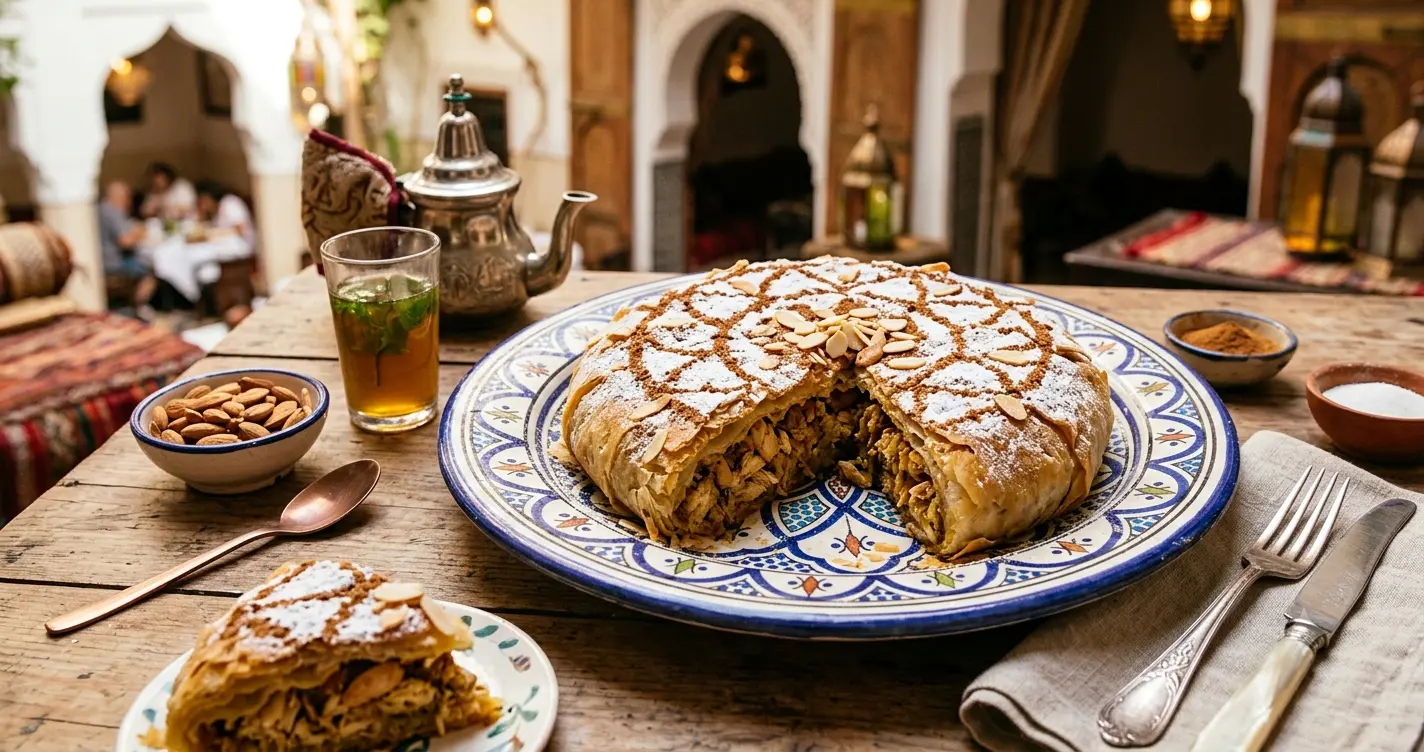
There is a dish in Morocco that stops conversations. It arrives at the table dusted in a snowfall of powdered sugar and cinnamon, its golden-brown layers catching the light like burnished parchment, and yet — beneath that impossibly sweet, fragile crust — lies a filling that is intensely savory, perfumed with saffron, loaded with slow-braised spiced meat, and layered with a rich egg custard and a crunch of toasted almonds. This is pastilla — sometimes spelled bastilla or b'stilla — and it is, without question, one of the greatest culinary creations in the history of human cooking. I have spent decades exploring Moroccan kitchens, from the medinas of Fez to the coastal riads of Essaouira, and I can say with absolute conviction: nothing prepares you for your first bite of a well-made pastilla. It is the dish that, more than any other, encapsulates the Moroccan genius for bold contradiction — sweet against savory, delicate against hearty, ancient against endlessly adaptable. At MaCooking, we believe that understanding pastilla is understanding Morocco itself.
Chapter One: The Soul of a Dish — History and Origins of Moroccan Pastilla
To understand pastilla, you must travel back in time — not just to medieval Morocco, but further, to the cultural crossroads where Berber, Arab, and Andalusian civilizations collided, exchanged, and ultimately fused into one of the world's most sophisticated culinary traditions. The word pastilla itself is believed to derive from the Spanish pastilla, meaning a small cake or pastry, a linguistic trace of the Moorish influence that flowed in both directions across the Strait of Gibraltar for centuries.
When the Moors — Muslims and Jews of Arab and Berber origin — were expelled from Andalusia during the Reconquista, particularly following the fall of Granada in 1492, hundreds of thousands of people poured into Morocco, settling in cities like Fez, Tetouan, Chefchaouen, and Rabat. They brought with them their music, their architecture, their poetry, and above all else, their food. The culinary sophistication of Andalusia, itself a product of centuries of Roman, Visigothic, Arab, and Jewish influence, merged with existing Moroccan and Berber cooking traditions to create something extraordinary. Pastilla was almost certainly shaped by this moment of cultural upheaval and creative synthesis.
Historically, the dish was made with pigeon — specifically squab, the young pigeon that was prized throughout the medieval Islamic world for its rich, gamey, deeply savory flesh. The combination of meat with sweet elements like almonds, sugar, and cinnamon was not unusual in medieval Arab and Andalusian cooking; the great medieval cookbooks from the Islamic world are full of such preparations, and the sweet-savory interplay was considered the height of refined cooking, a taste that distinguished the cultivated from the crude. Pastilla, with its extravagant layering, its labor-intensive preparation, and its theatrical presentation, was the food of celebration, of royalty, of the most important moments in Moroccan social life.
In the royal courts of Fez — the city long considered the cultural and intellectual capital of Morocco — pastilla held a place of singular honor. It was served at weddings, at circumcision ceremonies, at the feasts that mark the end of Ramadan, at banquets welcoming distinguished guests. To serve pastilla was to signal that no expense had been spared, that the highest honor was being extended. This tradition persists to this day: in many Moroccan households, pastilla is still reserved for the most special occasions, the moments when a family wants to say, without words, that the person across the table is truly loved.
"Pastilla is not just a recipe — it is a declaration. When a Moroccan grandmother decides to make pastilla for you, she is telling you that you matter, that the hours of her day are worth spending on your behalf, that the most complex and beautiful thing she knows how to create is yours. That is not cooking. That is love made edible."
— Chef Jamal, Culinary Director, MaCooking
Chapter Two: The Architecture of Pastilla — Understanding the Layers
What makes pastilla so technically demanding — and so deeply rewarding — is its architecture. This is not a dish you throw together. It is constructed, layer by careful layer, with each element playing a precise role in the final symphony of flavor and texture. Let me walk you through the structural logic of a traditional pastilla, because understanding why each layer exists will make you a dramatically better cook.
The Pastry Shell: Warqa, the Heart of Pastilla
The outer shell of pastilla is made from warqa (also spelled warka or ouarka), a paper-thin Moroccan pastry that is one of the most technically challenging preparations in any culinary tradition. Unlike phyllo dough — its closest Western cousin — warqa is not rolled thin with a pin. Instead, it is made by repeatedly dabbing a ball of wet, elastic dough against a hot, lightly greased griddle, leaving behind an almost translucent film of cooked dough. The process requires considerable skill, patience, and practice. A master warqa maker — called a warrakiya in Moroccan Arabic — can create sheets so thin you can almost read through them.
Warqa has a slightly different texture and behavior than phyllo. Where phyllo dries out quickly and shatters when baked, warqa has a slight chewiness to it, a very subtle elasticity, that gives the finished pastilla an incomparable texture — simultaneously crisp and yielding. For home cooks in the United States, United Kingdom, Canada, Australia, and Europe who cannot find warqa, high-quality phyllo dough can be substituted, though the result will be slightly different. Some experienced cooks also use spring roll wrappers as an emergency substitute, though the texture diverges more significantly.
The Three Essential Fillings
A classical pastilla contains three distinct filling components, each made separately and layered in a specific order:
- The Meat Layer: Traditionally squab or pigeon, though today chicken is the most common preparation. The meat is slow-braised in a deeply aromatic broth with onions, saffron, ginger, turmeric, coriander, parsley, and the fragrant spice blend ras el hanout. After braising, the meat is shredded from the bone and the cooking liquid is reduced until thick and concentrated.
- The Egg Custard Layer: The reduced braising liquid is used to cook a loose, softly scrambled egg mixture — almost a savory custard — that is simultaneously rich, silky, and intensely flavored. This layer acts as a binder and provides a luscious, velvety contrast to the crunchy pastry.
- The Almond Layer: Blanched almonds are fried or roasted until golden, then roughly chopped or ground and mixed with powdered sugar, cinnamon, and sometimes a little orange blossom water. This layer delivers the sweetness, the crunch, and the perfumed floral note that makes pastilla so distinctive.
The Finishing Touch
Once assembled and baked until golden, pastilla is finished with a generous dusting of powdered sugar and ground cinnamon, often arranged in decorative patterns — geometric designs, the name of the guest of honor, or simply sweeping diagonal stripes. This final layer is not merely decorative. The sugar melts slightly against the hot pastry, creating a delicate glaze that adds one more layer of sweetness and a subtle textural contrast.
Chapter Three: The Spice Vocabulary of Pastilla
No discussion of pastilla is complete without a deep dive into its spice profile, because the spices are what elevate this dish from impressive to transcendent. Moroccan cooking has one of the most sophisticated spice traditions in the world — a legacy of the country's position at the crossroads of sub-Saharan Africa, the Arab world, Andalusia, and the great Silk Road trading networks. The spices in a pastilla tell that entire story in a single bite.
Key Spices and Their Roles
- Saffron: The most prized spice in Moroccan cuisine, harvested from the crocus fields near Taliouine in the High Atlas region. In pastilla, saffron provides a haunting floral depth, a golden color, and a subtle bitterness that balances the sweetness. Never skip it; never substitute it with turmeric if you can help it.
- Ras el Hanout: Morocco's most complex spice blend, whose name translates literally to "top of the shop" — meaning the best the spice merchant has to offer. A good ras el hanout can contain anywhere from 10 to 30 different spices, including cardamom, mace, allspice, cinnamon, dried rose petals, and more. It brings warmth, complexity, and an almost intoxicating perfume to the meat filling.
- Cinnamon: Used in both the filling and the finishing dusting, cinnamon is the spice that most powerfully bridges the sweet and savory elements of pastilla. It is not background flavor here — it is a lead character.
- Ginger: Fresh or ground ginger adds brightness and a subtle heat that cuts through the richness of the egg custard and meat.
- Turmeric: Added more for its beautiful golden color than its flavor in this context, turmeric works in concert with saffron to give the filling its warm, jeweled appearance.
- White pepper: Traditional Moroccan recipes favor white pepper over black, and its slightly different heat profile — more aromatic, less sharp — is important to the overall balance.
- Orange blossom water: A few drops added to the almond filling bring an ethereal floral sweetness that is unmistakably Moroccan.
| Spice | Role in Pastilla | Role in Tagine | Role in Couscous | Intensity in Pastilla |
|---|---|---|---|---|
| Saffron | Depth, color, floral note | Color and flavor base | Subtle coloring | High |
| Cinnamon | Sweet-savory bridge, finishing dust | Background warmth | Aromatic layer | Very High |
| Ras el Hanout | Meat complexity | Primary spice blend | Key seasoning | Medium-High |
| Ginger | Brightness and heat | Essential base flavor | Aromatic support | Medium |
| Orange Blossom Water | Almond filling perfume | Rarely used | Occasionally in sweet versions | Subtle but essential |
| White Pepper | Gentle heat throughout | Background spice | Mild seasoning | Medium |
Chapter Four: Regional Variations and Modern Interpretations
Morocco is not a monolith, and neither is pastilla. Across the kingdom's diverse regions — from the imperial cities of the north to the Saharan outposts of the south, from the Atlantic coast to the High Atlas villages — you will find pastilla made differently, seasoned differently, filled with different ingredients, and eaten in different contexts. This regional diversity is one of the things that makes Moroccan cuisine so inexhaustibly interesting, and it is something we document extensively at MaCooking.
The Classic: Pigeon Pastilla of Fez
The original and still considered the gold standard. Made with young squab, heavily perfumed with saffron and ras el hanout, with a generous egg custard layer and a thick almond-sugar crust. This version is the most labor-intensive and the most extraordinary. If you ever visit Fez and see it on a menu at a reputable riad, order it without hesitation.
Chicken Pastilla: The Democratic Classic
Today, chicken pastilla is by far the most commonly made version, both in Morocco and internationally. Chicken is less expensive than squab, more widely available, and familiar to Western palates. Done well — and it can be done magnificently — chicken pastilla loses none of the magic of the original. The key is using bone-in, skin-on chicken pieces and braising them long enough to develop real depth of flavor in the cooking liquid.
Seafood Pastilla: A Coastal Innovation
In the coastal cities of Casablanca, Agadir, and Essaouira, where the Atlantic delivers extraordinary fish and shellfish, cooks have developed seafood pastilla as a brilliant adaptation. Typically filled with shrimp, calamari, and sometimes vermicelli noodles seasoned with chermoula (Morocco's quintessential herb-and-spice marinade), seafood pastilla omits the sweet finishing layer of powdered sugar, playing instead with fresh herbs, lemon, and the ocean's natural salinity. It is a completely different eating experience but equally compelling.
Vegetarian Pastilla: A Growing Tradition
As vegetarianism and veganism have grown globally — and as Moroccan cuisine has adapted to serve international visitors — vegetarian pastilla has emerged as a legitimate and delicious option. Common fillings include:
- Wild mushrooms with ras el hanout and caramelized onions
- Root vegetables with preserved lemon and fresh herbs
- Roasted butternut squash with warming spices and goat cheese
- Lentils with cumin, coriander, and harissa-spiced tomatoes
Mini Pastillas: The Modern Party Format
In contemporary Moroccan cuisine — particularly in the upscale restaurants of Casablanca, Marrakech, and increasingly in Moroccan restaurants in Paris, London, New York, and Montreal — mini pastillas have become a sophisticated appetizer format. Individual portion-sized pastillas, sometimes no larger than a large canapé, allow diners to experience the full flavor complexity without the commitment of a full serving. They also present beautifully on modern plating styles.
| Type | Primary Protein | Sweet Finish | Occasion | Difficulty Level | Region of Origin |
|---|---|---|---|---|---|
| Classic Pigeon | Squab/Pigeon | Yes (sugar + cinnamon) | Royal feasts, weddings | Expert | Fez, Imperial Cities |
| Chicken Bastilla | Chicken (bone-in) | Yes (sugar + cinnamon) | Family celebrations, restaurants | Intermediate | Nationwide |
| Seafood Pastilla | Shrimp, squid, fish | No | Coastal dining, modern restaurants | Intermediate | Atlantic Coast |
| Vegetarian Pastilla | Mushrooms, vegetables | Optional | Modern dining, dietary preference | Beginner-Intermediate | Contemporary Morocco |
| Mini Pastillas | Varies | Varies | Appetizers, events | Intermediate | Urban Morocco, International |
| Dessert Pastilla | None (milk-based) | Yes (honey, cream) | Ramadan, celebrations | Beginner | Northern Morocco |
Chapter Five: Making Pastilla at Home — The Expert's Complete Guide
I want to be honest with you: making an authentic pastilla at home for the first time is a project. It is not a Tuesday night dinner. It is a weekend endeavor, a deliberate act of culinary ambition, the kind of cooking project that your friends and family will talk about for years. But it is absolutely achievable, and the rewards are commensurate with the effort. Here is a complete, expert-level guide to making chicken pastilla at home.
Ingredients (Serves 8-10)
For the Chicken Filling:
- 1 whole chicken (about 1.8 kg / 4 lbs), cut into pieces, bone-in and skin-on
- 3 large yellow onions, very finely grated (not chopped — grated so they almost dissolve)
- 1 generous pinch of saffron threads, bloomed in 2 tablespoons warm water
- 1 teaspoon ground ginger
- 1 teaspoon ground cinnamon
- 1 teaspoon ras el hanout
- ½ teaspoon turmeric
- ½ teaspoon white pepper
- 1 large bunch fresh flat-leaf parsley, finely chopped
- 1 large bunch fresh cilantro, finely chopped
- 120ml (½ cup) high-quality olive oil
- 60g (4 tablespoons) unsalted butter
- Salt to taste
For the Egg Custard:
- 8 large eggs
- The reduced braising liquid from the chicken
- Salt and white pepper to taste
For the Almond Filling:
- 400g (about 3 cups) blanched almonds
- 80g (¾ cup) powdered sugar, plus more for finishing
- 2 teaspoons ground cinnamon, plus more for finishing
- 2 tablespoons orange blossom water
- 2 tablespoons neutral oil or clarified butter for frying
For Assembly:
- 400g (about 14 oz) warqa sheets or high-quality phyllo dough
- 120g (½ cup) clarified butter (smen) or regular unsalted butter, melted
- Powdered sugar and cinnamon for finishing
Step-by-Step Method
Day Before (Highly Recommended): The chicken filling improves dramatically when made a day ahead. The spices deepen, the flavors meld, and the meat becomes easier to shred cleanly from the bones.
Step 1 — Braise the Chicken: In a large, heavy-bottomed pot or Dutch oven, combine the chicken pieces with the grated onion, olive oil, butter, saffron water, and all ground spices. Add enough water to just cover the chicken (about 500ml / 2 cups). Bring to a boil, then reduce to a vigorous simmer. Cook uncovered for 45 minutes to an hour, until the chicken is completely tender and falling from the bone. Add the fresh herbs in the final 10 minutes of cooking.
Step 2 — Reduce and Separate: Remove the chicken pieces with tongs. When cool enough to handle, shred the meat from the bones, discarding the skin and bones. Set the shredded meat aside. Return the braising liquid to high heat and reduce it until it is thick, concentrated, and just covers the bottom of the pan — you want perhaps 300-400ml of deeply flavored liquid remaining.
Step 3 — Make the Egg Custard: Beat the eggs lightly, then pour them into the reduced braising liquid over medium-low heat. Stir constantly with a wooden spoon or spatula, cooking the eggs into soft, loose, very lightly scrambled curds. The mixture should be set but still soft and silky — not dry. Remove from heat and season carefully.
Step 4 — Prepare the Almonds: Fry blanched almonds in hot oil or butter until golden brown, watching carefully as they burn quickly. Drain on paper towels, then pulse briefly in a food processor — you want a rough chop, not a fine powder. Mix with powdered sugar, cinnamon, and orange blossom water.
Step 5 — Assemble: Preheat your oven to 190°C / 375°F. Brush a 30cm (12-inch) round baking pan generously with melted butter. Lay six to eight sheets of warqa or phyllo in the pan, brushing each sheet with butter and overlapping them so they drape over the sides of the pan by at least 8-10cm (3-4 inches). This overhang will fold up and over the top to seal the pastilla. Spread the shredded chicken evenly over the base. Layer the egg custard over the chicken. Spread the almond mixture evenly over the custard. Fold the overhanging pastry sheets up and over the filling to form the top crust, tucking them in neatly. Lay two to three more buttered sheets over the top, tucking their edges underneath the pastilla to create a tight, sealed package. Brush the entire top generously with melted butter.
Step 6 — Bake: Bake in the preheated oven for 30-35 minutes, until the pastilla is deeply golden brown and crisp on top. Some cooks carefully flip the pastilla onto a buttered baking sheet halfway through cooking to ensure even browning on both sides — this is the traditional method and produces a superior result, though it requires confidence.
Step 7 — Finish and Serve: Remove from the oven and dust generously with powdered sugar through a fine-mesh sieve. Use a sieve or stencil to create decorative cinnamon patterns over the sugar. Serve immediately, while hot and crisp.
Expert Tips from the Kitchen
- Do not skip the grated onion. Grating (rather than chopping) the onion allows it to dissolve completely into the braising liquid, giving the filling a silky body without any chunky texture.
- Bloom your saffron properly. Crush the threads slightly between your fingers before adding them to warm (not boiling) water. Let them steep for at least 15 minutes. This releases the full color and flavor.
- Keep the egg custard soft. Overcooked eggs become rubbery and dry. Pull the pan from the heat while the eggs still look slightly underdone — they will continue cooking from residual heat.
- Work quickly with phyllo. If using phyllo instead of warqa, keep the unused sheets covered with a damp towel to prevent them from drying out and cracking.
- Clarified butter is superior. The higher smoke point and pure fat content of clarified butter gives a crisper, more even browning than regular butter. If you can find Moroccan smen (a type of aged, fermented clarified butter), use it — it adds an incredible depth of flavor.
- Make ahead strategically. Assemble the pastilla fully and refrigerate unbaked for up to 24 hours. Brush with extra butter just before baking.
Chapter Six: Pastilla in Moroccan Culture and Ceremony
No food exists outside of its culture, and pastilla is perhaps more culturally embedded than any other Moroccan dish. To eat pastilla without understanding its social and ceremonial context is a little like listening to a piece of music without knowing it is a requiem — the notes are beautiful, but the meaning is lost.
Pastilla at Moroccan Weddings
At a traditional Moroccan wedding — particularly in Fez, Meknes, and Rabat, the cities where classical Moroccan culture is most preserved — pastilla occupies a position of supreme honor in the wedding feast. It is typically served as the second course, after the harira soup and before the parade of tagines and mechoui (slow-roasted lamb). In some wealthy families, the pastilla served at a wedding might be enormous — as much as a meter in diameter — carried to the table by multiple servers and presented to the guests of honor with great ceremony.
The making of a wedding pastilla is itself a communal act. In traditional communities, female relatives and neighbors gather at the bride's family home in the days before the wedding to make the filling, prepare the warqa, and assemble the pastillas together. This collaborative cooking is a form of community bonding, a transmission of knowledge from one generation to the next, and a ritual expression of care for the young couple beginning their life together.
Pastilla and Ramadan
During Ramadan, the month of fasting, Moroccan families break their fast each evening with the iftar meal. While harira soup and chebakia (honey-dipped sesame pastry) are the iconic iftar foods, pastilla appears regularly on the Ramadan table, particularly on weekends and for special family gatherings. The rich, satisfying nature of pastilla makes it an ideal meal for breaking a long day's fast — it is both deeply nourishing and celebratory, a reward for the day's spiritual discipline.
Pastilla as Diplomatic Cuisine
Throughout Moroccan history, pastilla has served as the country's most prestigious diplomatic dish. When foreign dignitaries visited the Moroccan royal court, pastilla was served as a demonstration of Moroccan culinary sophistication. Today, this tradition continues: Moroccan embassies around the world include pastilla in their official reception menus, and Moroccan cultural centers from Paris to Washington D.C. use pastilla as an introduction to Moroccan cuisine for international audiences. It is, in the truest sense, Morocco's culinary ambassador to the world.
Chapter Seven: Pairing Pastilla — Drinks, Sides, and the Complete Table
In Morocco, the question of what to drink with pastilla is answered simply and beautifully: mint tea. Moroccan mint tea — a strong, sweet infusion of gunpowder green tea, fresh spearmint, and sugar, poured from a great height to create the characteristic froth — is the universal accompaniment to every meal in Morocco, and its sweet, refreshing clarity cuts through pastilla's richness perfectly. The ritual of the tea service is as important as the pastilla itself: the elaborately decorated silver teapot, the small painted glasses, the performance of pouring from high above.
For Western occasions where wine is appropriate, pastilla presents a genuine pairing challenge precisely because of its sweet-savory duality. Here are expert recommendations:
- White: An off-dry Alsatian Gewürztraminer — its lychee, rose, and exotic spice notes harmonize beautifully with the saffron and ras el hanout, and its slight sweetness complements rather than clashes with the sugar dusting.
- White: A Moroccan Gris de Boulaouane — if you can find it, this iconic Moroccan rosé-style wine is the authentic pairing choice, a living link between Moroccan food and Moroccan winemaking traditions.
- Red: A light, fruit-forward Moroccan Syrah — the spiced fruit character of Moroccan reds, particularly from the Meknes region, mirrors the spice complexity of the pastilla filling.
- Non-alcoholic: Rose water lemonade — a refreshing, lightly floral drink that bridges the sweet and savory worlds of the pastilla elegantly.
As for what to serve alongside pastilla, the answer from a traditional Moroccan perspective is: nothing much. Pastilla is a complete dish. At a formal dinner, it is typically preceded by a selection of cold salades marocaines — the elaborate array of small cooked salads (roasted carrot with cumin, taktouka pepper and tomato, preserved lemon and olive salads) that are one of Morocco's great culinary traditions. These salads, with their bright acidity and fresh flavors, prepare the palate perfectly for the richness of the pastilla to come.
Chapter Eight: Sourcing Ingredients Internationally
One of the most common questions we receive at MaCooking from readers in the United States, United Kingdom, Canada, Australia, and Europe is: where can I find the authentic ingredients to make pastilla? The answer, happily, has become much more encouraging in recent years as Moroccan cuisine has grown in global profile and as online shopping has made specialty ingredients broadly accessible.
Finding Warqa Pastry
Warqa is the hardest ingredient to source outside Morocco. Your best options:
- Middle Eastern and North African grocery stores — larger cities in the US, UK, France, Canada, and Australia typically have Moroccan or Algerian-run grocery stores that stock frozen warqa.
- Online specialty retailers — several online shops now ship frozen warqa internationally from France (where Morocco's large diaspora has created strong demand).
- Make your own — ambitious home cooks can follow traditional warqa-making techniques; it requires practice but is deeply satisfying.
- Phyllo dough substitute — available in virtually every major supermarket worldwide (look in the frozen pastry section), this is the most practical option for most home cooks.
Finding Moroccan Spices
- Saffron: Available at most good supermarkets, specialty food stores, and online. Look for Moroccan or Spanish saffron — these are the highest quality. Avoid cheap "saffron" from unverified sources, which is often adulterated.
- Ras el Hanout: Available at Whole Foods and similar stores in the US, Waitrose and Ottolenghi shops in the UK, and most specialty spice shops globally. You can also blend your own using recipes available on MaCooking.
- Orange Blossom Water: Available at Middle Eastern grocery stores, well-stocked liquor stores (it's often near the spirits for cocktail use), and online. Lebanese and Moroccan brands are best.
Frequently Asked Questions About Moroccan Pastilla
Q: Can I make pastilla in advance for a dinner party?
A: Absolutely — and in many ways, making elements ahead of time produces a better result. The chicken filling (braised meat plus egg custard) can be prepared up to two days in advance and refrigerated. The almond mixture can be made a week ahead and stored in an airtight container at room temperature. You can fully assemble the pastilla and refrigerate it, unbaked, for up to 24 hours — just brush the top with additional melted butter before going into the oven, as the butter in the pastry will have been absorbed. What you should never do is bake the pastilla ahead of time and reheat it — the pastry goes soft and loses its essential crispness. Always bake it fresh, 30-45 minutes before serving.
Q: Is the sweet topping (powdered sugar and cinnamon) traditional or a modern addition?
A: The sweet, powdered sugar-and-cinnamon finish is absolutely traditional — in fact, it is one of the defining characteristics of the classical Moroccan pastilla and almost certainly reflects the medieval Andalusian culinary tradition of combining sweet and savory in the same dish. What you see sometimes in fusion restaurants — pastilla served without the sugar dusting — is a modern adaptation aimed at Western palates uncomfortable with sweetness in savory dishes. If you want the authentic experience, do not skip the sugar. It is not excessive when balanced against the savory filling; instead, it creates the magical contrast that makes pastilla so unforgettable.
Q: What is the difference between pastilla and Moroccan bastilla — are they the same dish?
A: Yes, pastilla and bastilla (also spelled b'stilla or bisteeya) refer to the same dish. The spelling variation reflects different romanizations of the Arabic/Moroccan Darija word, as well as regional preferences within Morocco and between different diaspora communities. In France, where Morocco's largest diaspora community lives, pastilla is the most common spelling. In the United States and United Kingdom, you will often see bastilla or bisteeya. In Morocco itself, depending on the region and the level of French or Spanish linguistic influence, you will encounter all of these spellings interchangeably. The dish is the same; the name simply reflects Morocco's gloriously multilingual cultural identity.
Q: I cannot find squab or pigeon — will chicken really give the same result?
A: Chicken will give you a wonderful result, though it is technically a different result. Squab has a much richer, darker, more intensely gamey flavor than chicken — closer in character to duck or quail — and this intensity plays a specific role in balancing the sweetness of the almond layer and the sugar dusting. When using chicken, you can compensate somewhat by using dark meat only (thighs and drumsticks rather than breast), braising for a longer time to develop deeper flavor, and being more generous with your spices, particularly the ras el hanout and saffron. Some cooks also add a small amount of chicken liver to the filling when making chicken pastilla, which adds some of the richness that squab provides naturally. If you do have access to duck legs through a specialty butcher, they make an exceptional alternative that splits the difference between chicken and squab in terms of flavor richness.
Q: How do I know when my pastilla is properly baked? What should I look for?
A: There are several indicators of a properly baked pastilla. Visually, the top should be a deep, even golden-amber color — not pale yellow (underbaked) and not dark brown (potentially bitter). When you tap the top lightly with your finger or the back of a spoon, it should sound hollow and feel firm and crisp — if it feels soft or gives, it needs more time. The edges of the pastilla should be clearly set and pulling slightly away from the sides of the pan. You should be able to smell a deep, caramelized, buttery aroma with hints of cinnamon. If you are unsure, it is always better to bake a few minutes longer — a slightly darker pastilla is far preferable to an underbaked one with soggy pastry. The interior filling is fully cooked before assembly, so your only concern is the pastry exterior.
Conclusion: Why Pastilla Matters — and Where to Go Next
There is a reason I have spent so many years returning to pastilla — studying it, making it, eating it in homes and restaurants across Morocco and the Moroccan diaspora worldwide. It is not just that the dish is delicious, though it is supremely, transcendently delicious. It is that pastilla represents something essential about what food can be at its greatest: a synthesis of cultures, a bridge across time, a declaration of love and hospitality, a technical challenge that rewards patience and skill, and an eating experience that is genuinely, undeniably unforgettable.
Every layer of a pastilla is a layer of Moroccan history. The warqa speaks to the paper-thin pastry traditions of the Arab world. The saffron speaks to the Silk Road trade routes that connected Morocco to the spice gardens of Persia and India. The almonds speak to the agricultural bounty of the Souss Valley. The cinnamon-sugar finish speaks to the Andalusian love of sweet-savory combination. The orange blossom water speaks to the flowering orchards of the Rif Mountains. When you eat pastilla, you eat all of this. You eat centuries.
If this deep dive into Moroccan pastilla has ignited your curiosity — or your ambition — I encourage you to explore further. Visit MaCooking, where you will find the most comprehensive collection of authentic Moroccan recipes, cultural guides, technique tutorials, and ingredient sourcing advice available anywhere in the world. Whether you are making pastilla for the first time or looking to perfect a version you have been working on for years, MaCooking is your most trusted companion on this journey into one of the world's greatest culinary traditions.
Make the pastilla. Take your time with it. Put on some Gnawa music. Invite people who matter to you. And when that golden, sugar-dusted, impossibly aromatic masterpiece comes out of the oven, know that you have joined a tradition that stretches back across centuries and across continents — that you are connected, through flour and saffron and time, to the cooks of Fez and Granada, to the royal kitchens of the Merenid sultans, to the grandmother in Rabat who is making the same dish this very weekend for the people she loves most in the world. That is what cooking is for. That is what pastilla is.