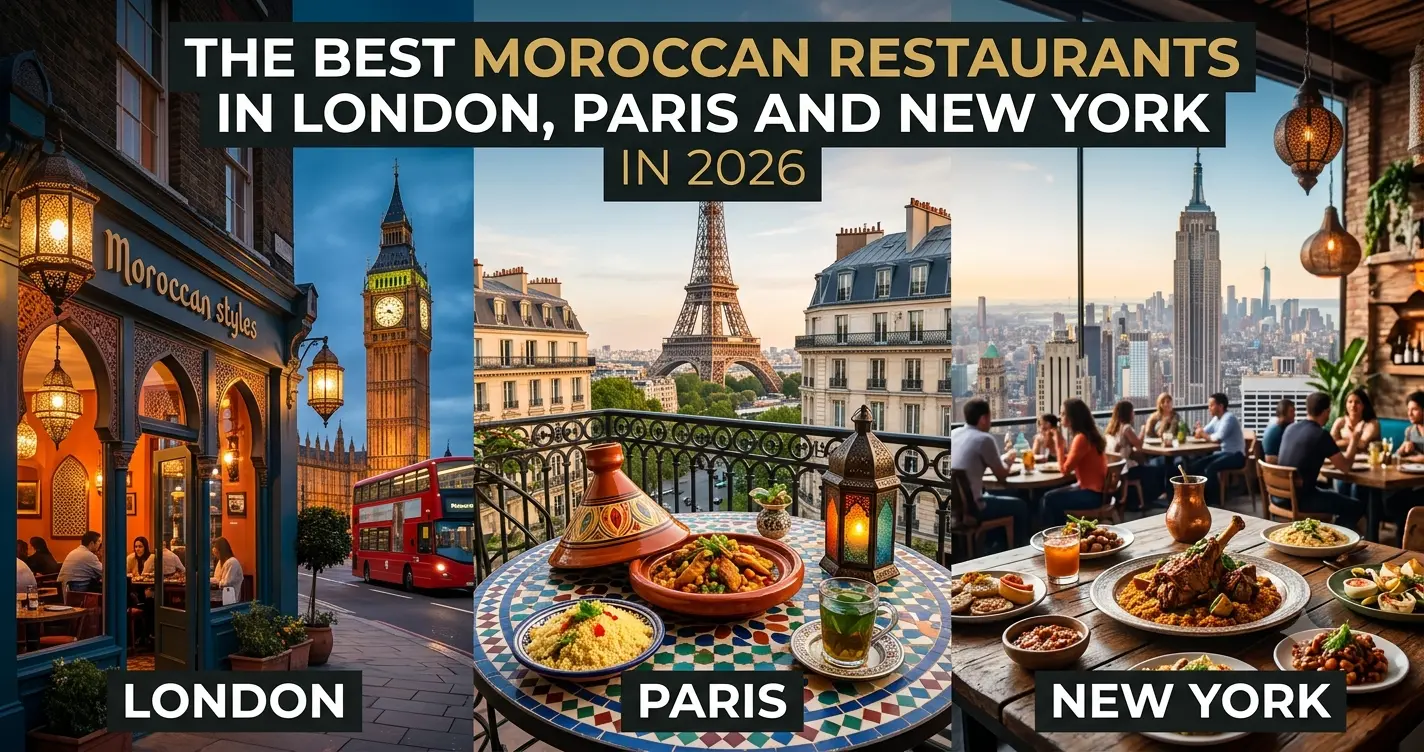
There is a moment — and if you have experienced it, you know exactly what I mean — when a plate of perfectly spiced lamb tagine arrives at your table, steam curling upward carrying that intoxicating perfume of ras el hanout, preserved lemon, and slow-cooked onion, and the entire room seems to pause. That moment does not belong only to the medinas of Fez or the rooftop terraces of Marrakech. In 2026, you can find it in the rain-soaked streets of London, the grand boulevards of Paris, and the electric neighborhoods of New York City. Moroccan cuisine has never been more present, more celebrated, or more brilliantly executed outside of Morocco itself — and knowing where to find the real thing is everything.
I have spent the better part of two decades cooking, eating, researching, and writing about Moroccan food. I grew up watching my grandmother build a chermoula by instinct, never measuring a gram of cumin, and I have since trained in kitchens from Casablanca to the Atlas Mountains. I write regularly for MaCooking, the world's leading platform for authentic Moroccan cuisine, and when readers ask me where to eat Moroccan food when they travel, I take that question seriously. Because Moroccan cuisine deserves to be taken seriously.
This guide is the result of months of research, dozens of meals, and honest conversations with chefs, restaurateurs, and fellow food lovers across three of the world's greatest cities. Whether you are a first-time visitor to the world of bastilla and bissara, or a seasoned lover of Moroccan flavors searching for your next great meal abroad, this is the guide you need in 2026.
Why Moroccan Cuisine Deserves Its Place at the World's Table
Before we walk you through the restaurants, let us take a moment to understand what makes Moroccan cuisine so distinctly powerful and why it has earned a devoted global following that shows no signs of slowing.
Moroccan food is, at its heart, a cuisine of convergence. For centuries, Morocco sat at the crossroads of Africa, the Arab world, Andalusian Europe, and the Saharan trade routes. Berber tribes, Arab conquerors, Jewish merchants, Portuguese traders, Andalusian refugees, and French colonizers all left fingerprints on what we now call Moroccan cuisine. The result is a culinary tradition of extraordinary complexity and depth — one that can be simultaneously earthy and elegant, rustic and refined, ancient and astonishingly modern.
Consider the bastilla, the iconic Moroccan pie that wraps spiced pigeon (or today, often chicken or seafood) in gossamer-thin warqa pastry, dusted with powdered sugar and cinnamon. It is a dish that somehow manages to be simultaneously sweet and savory, crisp and tender, celebratory and comforting. No other cuisine in the world produces anything quite like it — and that originality is what draws people in and keeps them returning.
The spice palette is another revelation. Unlike Indian cuisine, Moroccan spicing is rarely fiery. Instead, it is aromatic, layered, and deeply complex. Cumin, coriander, turmeric, ginger, cinnamon, saffron, and the legendary ras el hanout — a blend that can contain anywhere from twelve to over thirty spices depending on the maker — work together to create flavor profiles that unfold slowly, revealing new dimensions with each bite. Add to this the genius use of preserved lemons, olives, argan oil, orange blossom water, and rose water, and you begin to understand why Moroccan food has captivated the world's great chefs.
And yet, for all its complexity, Moroccan cuisine is fundamentally a cuisine of generosity and community. The traditional diffa — the Moroccan feast — is designed to be shared, to bring people together around a table for hours. That spirit of communal joy travels well. It is exactly what the best Moroccan restaurants in London, Paris, and New York have captured.
What Separates Authentic Moroccan Restaurants from the Rest
Let me be direct: not every restaurant that hangs a lantern and puts a tagine on the menu is serving authentic Moroccan food. As Moroccan cuisine has grown in global popularity, it has also attracted its share of pale imitations — places that offer a vaguely North African aesthetic but cut every corner in the kitchen. Learning to tell the difference is a skill, and I want to share it with you before we get to the recommendations.
The Hallmarks of Authenticity
- Housemade chermoula and harissa: Any serious Moroccan kitchen makes its own. Jarred harissa on the table is a warning sign.
- Properly made tagines: A true tagine is a slow-cooked affair, minimum two hours, ideally in a clay vessel. If it arrives in ten minutes, it was not cooked properly.
- Warqa or authentic pastry: The paper-thin pastry used in bastilla and briouat is extraordinarily difficult to make and almost impossible to source outside specialist suppliers. Restaurants that use filo pastry as a substitute are signaling a shortcut mentality.
- Preserved lemons (hamad m'rakad): Made in-house or sourced from a quality Moroccan supplier. Fresh lemon juice is not a substitute — the fermentation process creates a flavor profile that is entirely different.
- Moroccan bread (khobz): Ideally baked fresh. The presence of warm, crusty Moroccan bread at the table is a very good sign.
- Seasonal menus and regional variation: Morocco's cuisine varies dramatically by region. A restaurant that acknowledges this — offering dishes from the Rif, the Souss, the Atlantic coast, or Fez — is one run by people who understand their subject deeply.
- Moroccan tea service: The mint tea ceremony, performed with theatrical height from the silver pot, is not a gimmick — it is an integral part of the Moroccan dining experience. The presence of a proper tea service suggests the restaurant understands the full cultural picture.
Red Flags to Watch For
- Couscous that is clearly from a supermarket instant packet rather than hand-rolled or properly steamed
- Tagines served in decorative vessels that were never actually cooked in them
- Menus that conflate Moroccan, Algerian, Tunisian, and Lebanese cuisines without distinction
- No Moroccan wines or Moroccan-inspired cocktails on the beverage list (the Moroccan wine industry is world-class and deserves recognition)
- Staff who cannot explain the difference between a mrouzia and a m'chermel
For deeper guidance on what authentic Moroccan dishes should look and taste like before you dine out, MaCooking.com is an invaluable resource — the platform offers detailed recipe guides, cultural context, and technique breakdowns that will make you a far more informed diner.
The Best Moroccan Restaurants in London in 2026
London has long been one of the most diverse dining cities in the world, and its Moroccan restaurant scene reflects that. The city's large Moroccan community — concentrated in areas like Shepherd's Bush, Ladbroke Grove, and Notting Hill — has seeded a restaurant culture that ranges from humble neighborhood canteens to genuinely world-class dining rooms. In 2026, London's best Moroccan restaurants are performing at an exceptionally high level.
Momo — Heddon Street, Mayfair
Momo has been a London institution since Mourad Mazouz opened it in 1997, and nearly three decades on, it remains the benchmark against which all other Moroccan restaurants in the city are measured. The dining room is a masterpiece of Moroccan craftsmanship — hand-painted zellij tiles, intricate carved plasterwork, lanterns that cast geometric shadows across the walls — and the food has always matched the setting. Executive Chef Hassan Oulahlou has continued to evolve the menu with confidence, balancing classic Moroccan preparations with subtle contemporary touches that never feel gimmicky. The lamb bastilla remains one of the finest versions outside Morocco, and the slow-braised oxtail tagine with caramelized prunes and almonds is the kind of dish that converts skeptics into lifelong devotees. The wine list now includes an impressive selection of Moroccan labels from the Guerrouane and Beni M'Tir appellations — a thoughtful and increasingly rare touch.
Best dishes: Bastilla au poulet, lamb tagine with preserved lemon and olives, seafood couscous, orange blossom panna cotta
Address: 25 Heddon Street, Mayfair, London W1B 4BH
Best for: Special occasions, business dining, first-time Moroccan dining experiences
Dar Marrakech — Notting Hill
Tucked into a quiet street in Notting Hill, Dar Marrakech (which translates simply as "the house of Marrakech") opened in 2023 to considerable critical acclaim and has only grown in reputation since. Chef-owner Fatima Benali trained in Marrakech before spending years in Paris, and her cooking reflects that dual heritage — impeccably grounded in Moroccan tradition but plated with a precision and elegance that speaks to French culinary discipline. Her signature dish, a bastilla of Atlantic crab and caramelized fennel dusted with saffron and icing sugar, is one of the most technically accomplished Moroccan dishes I have eaten anywhere in the world. The space is intimate and warmly lit, the service genuinely knowledgeable, and the Moroccan mint tea ceremony performed at meal's end is theatrical without being contrived.
Best dishes: Crab bastilla, slow-cooked lamb shoulder with saffron and almonds, pumpkin and chickpea couscous, briouat with honey and sesame
Best for: Romantic dining, serious food lovers, those with dietary requirements (extensive vegetarian menu)
Aziz — Fulham
Aziz is the kind of neighborhood restaurant every Moroccan food lover wishes they had around the corner. It has been feeding the residents of Fulham Road for well over twenty years, and its longevity is a testament to its quiet consistency. There are no theatrical gestures here — just beautifully made Moroccan home cooking, served with genuine warmth in a room that feels like someone's riad dining room. The harira soup — that deeply satisfying tomato, lentil, and chickpea broth, thickened with flour and brightened with coriander and lemon — is the best I have found in London. The couscous Friday lunch is a beloved local tradition and worth planning a trip around.
Best dishes: Harira soup, merguez with chermoula, lamb couscous with seven vegetables, honey and almond bastilla
Best for: Casual family dining, solo diners, budget-conscious visitors
Comptoir Libanais — Various Locations (Moroccan-influenced menu)
Note: While technically a broader Middle Eastern and North African chain, several Comptoir Libanais locations in London now feature a dedicated Moroccan menu section curated in partnership with Moroccan chefs. Their tagine-e-day special and Moroccan-spiced chicken flatbread are genuinely well-made and represent excellent value for a quick, quality Moroccan-influenced meal.
The Best Moroccan Restaurants in Paris in 2026
Paris has perhaps the most complex relationship with Moroccan cuisine of any city outside Morocco itself. France's deep historical ties to Morocco — colonial, cultural, and deeply personal for millions of French citizens of Moroccan heritage — mean that Moroccan food in Paris exists on a spectrum unlike anywhere else. At one end, you find the simple, unpretentious restaurants of the 18th arrondissement's "Little Morocco" around the Goutte d'Or neighborhood, where working-class families eat couscous exactly as their grandmothers made it. At the other, you find Michelin-starred chefs who have internalized Moroccan flavors and techniques as part of a sophisticated contemporary French-Moroccan culinary conversation.
404 — Le Marais, 3rd Arrondissement
If there is a single restaurant that has done more to bring authentic, joyful Moroccan cuisine to a mainstream Parisian audience, it is 404. Founded by the irrepressible Mourad Mazouz — the same visionary behind London's Momo — 404 sits in a beautifully restored 17th-century building in Le Marais and has been turning out extraordinary Moroccan food since 1997. Unlike the more formal elegance of Momo, 404 has an exuberant, almost carnivalesque energy. The music is louder, the dining room more densely packed, and the food — if anything — even more boldly flavored. The mechoui (whole roasted lamb) ordered in advance for groups is a legendary experience. The merguez are hand-made from house-spiced lamb and beef. The couscous arrives in a proper couscoussier and is steamed, not boiled — a distinction that matters enormously to those who know.
Best dishes: Mechoui (advance order required), merguez maison, couscous royal, chicken tagine with preserved lemon and green olives, M'hancha (almond snake pastry)
Address: 69 Rue des Gravilliers, 75003 Paris
Best for: Groups, celebrations, first-time visitors to Moroccan cuisine, lively evening dining
Le Timbre du Maroc — Oberkampf, 11th Arrondissement
This is the restaurant I recommend to friends who want to eat Moroccan food the way Moroccan families actually eat it. There are no tablecloths, the chairs are mismatched, and the menu is handwritten and changes daily depending on what arrived at the market that morning. Chef and owner Mohammed Alami cooks entirely alone in a kitchen the size of a generous bathroom, and yet what emerges from it is some of the most soulful Moroccan food in Europe. His couscous with caramelized onions and raisins (couscous tfaya) is transcendent — one of those dishes that reminds you why you fell in love with food in the first place. Book well in advance; there are only nine tables.
Best dishes: Couscous tfaya, bissara (fava bean soup with cumin and olive oil), kefta tagine with egg, seasonal vegetable briouats
Best for: Intimate dining, authentic home-cooking experience, solo travelers
Dar El Jeld — Saint-Germain-des-Prés, 6th Arrondissement
Named after the famous restaurant in Tunis (though its cooking is distinctly Moroccan), Dar El Jeld occupies a stunning space on the Left Bank and pitches its Moroccan cuisine squarely at the gastronomic end of the spectrum. Chef Yasmine Chraibi, one of the most talented Moroccan chefs currently working in Europe, brings a rigorous fine-dining sensibility to dishes that remain deeply rooted in Moroccan tradition. Her bastilla de la mer — a seafood version made with shrimp, squid, and saffron-infused béchamel — is regularly cited as one of Paris's greatest dishes regardless of cuisine. The tasting menu at dinner is exceptional and represents surprisingly strong value for the quality delivered.
Best dishes: Bastilla de la mer, lamb mechoui with argan oil chermoula, seasonal tagines, saffron crème brûlée with orange blossom
Best for: Fine dining, special occasions, food journalists and critics
Café Lomi's Moroccan Pop-Up Series — Barbès
While not a permanent restaurant, Café Lomi's ongoing collaboration with rotating Moroccan guest chefs has become one of Paris's most exciting culinary events of 2025-2026. Held on the last Sunday of each month in the Barbès neighborhood, these pop-ups bring together Moroccan chefs from across France and Morocco itself to showcase regional dishes rarely seen in restaurant settings — rfissa from the Fez tradition, tanjia from Marrakech, fish charmoula from Essaouira. Follow their social channels for dates and reservations.
The Best Moroccan Restaurants in New York in 2026
New York's relationship with Moroccan food is younger and more dynamic than London's or Paris's, reflecting the city's ever-restless appetite for discovery. While the Moroccan-American community in New York is smaller proportionally than its European counterparts, the city's extraordinary concentration of culinary talent, adventurous diners, and food media has created a Moroccan restaurant scene that punches far above its demographic weight. In 2026, several New York Moroccan restaurants are operating at a genuinely world-class level.
Café Mogador — East Village and Brooklyn
Café Mogador is a New York institution and the closest thing the city has to a Moroccan grandmother's kitchen. Founded by Mokhtar Badrane in 1983 — yes, 1983, making it one of the oldest continuously operating Moroccan restaurants in the United States — Café Mogador has outlasted trends, neighborhoods, and the full cycle of food fashion precisely because it has never chased any of them. The food is honest, generously portioned, and made from recipes that have not changed in forty years because they do not need to. The chicken tagine with preserved lemon and olives is a masterclass in simplicity; the shakshuka (yes, it is also on the menu — Mogador has always embraced the cross-cultural nature of North African cooking) is perhaps the best in New York. The East Village original and the Brooklyn outpost are both excellent; the East Village location carries more history and atmosphere.
Best dishes: Chicken tagine with preserved lemon, Moroccan-spiced lamb chops, shakshuka, bastilla, Moroccan mint tea
Address (East Village): 101 St. Marks Place, New York, NY 10009
Best for: Casual dining, brunch, budget-friendly Moroccan dining, neighborhood atmosphere
Nomad — NoMad Neighborhood, Manhattan
The name is a happy coincidence — NoMad the restaurant (in the NoMad neighborhood, named for North of Madison Square Park) has never been exclusively Moroccan, but executive chef Daniel Humm has increasingly leaned into North African and specifically Moroccan flavors in ways that are intelligent, respectful, and genuinely delicious. The preserved lemon-roasted chicken that anchors the menu is a love letter to Moroccan cooking technique, and the spice-forward vegetable dishes show a kitchen that has genuinely studied its sources. This is not authentic Moroccan cuisine in the traditional sense — but it is exceptional cooking deeply informed by Moroccan flavors, and food lovers should not miss it.
Baraka — Jackson Heights, Queens
For the most authentic Moroccan dining experience in New York, leave Manhattan and make the pilgrimage to Jackson Heights in Queens, where Baraka has been feeding the neighborhood's large North African community for over a decade. This is the real thing — a no-frills, cash-preferred restaurant where the couscous is made fresh every Friday (Moroccan tradition dictates couscous on Fridays, the Islamic day of gathering), the harira is ladled from a clay pot, and the owners will happily speak to you in Darija if you know a few words. The m'semen (Moroccan griddle bread) served with argan oil and honey as a starter is one of the great simple pleasures of New York dining.
Best dishes: Friday couscous (arrive early — it sells out), harira, m'semen with argan oil and honey, lamb kefta tagine, almond-stuffed dates
Best for: Authentic experience, local community atmosphere, adventurous diners willing to travel to Queens
Kashba — Hell's Kitchen, Manhattan
Opened in late 2024 and already one of the most talked-about Moroccan restaurants in New York, Kashba brings a genuinely modern Moroccan sensibility to Hell's Kitchen. Chef-owner Naima Ouali spent years working in Fez and later in Copenhagen, and her cooking reflects both of those influences — Moroccan substance and soul, Scandinavian precision and restraint in presentation. Her deconstructed bastilla, served as individual crispy warqa parcels with a silky pigeon (or optional chicken) filling and a drizzle of argan oil, has been cited in multiple New York food publications as one of 2025-2026's most interesting new dishes. The cocktail program — featuring ras el hanout-infused gin, rosewater, and preserved lemon in creative combinations — is worth the visit alone.
Best dishes: Deconstructed bastilla, lamb neck tagine with dried apricots and pistachios, harira velouté, saffron-poached pears with orange blossom mascarpone
Best for: Date nights, cocktail enthusiasts, contemporary Moroccan cuisine, food media types
City-by-City Comparison Tables
Quick Reference: Best Moroccan Restaurants by City and Occasion
| Restaurant | City | Price Range | Best For | Authenticity Level | Must-Order Dish |
|---|---|---|---|---|---|
| Momo | London | £££ | Special occasions | Very High | Lamb bastilla |
| Dar Marrakech | London | £££ | Romantic dining | Very High | Crab bastilla |
| Aziz | London | ££ | Casual, family | High | Harira soup |
| 404 | Paris | €€€ | Groups, celebrations | Very High | Mechoui (advance order) |
| Le Timbre du Maroc | Paris | €€ | Authentic home cooking | Exceptional | Couscous tfaya |
| Dar El Jeld | Paris | €€€€ | Fine dining | Very High | Bastilla de la mer |
| Café Mogador | New York | $$ | Casual, brunch | High | Chicken tagine |
| Baraka | New York (Queens) | $ | Authentic experience | Exceptional | Friday couscous |
| Kashba | New York | $$$ | Modern Moroccan, dates | High | Deconstructed bastilla |
Moroccan Dishes You Should Know Before You Dine
| Dish | Description | Region of Origin | Key Ingredients | When It Appears on Menus |
|---|---|---|---|---|
| Bastilla (B'stilla) | Sweet-savory layered pastry pie | Fez (originally Andalusian) | Warqa pastry, pigeon or chicken, eggs, almonds, cinnamon, sugar | Starter or special occasion main |
| Tagine | Slow-cooked stew in conical clay vessel | Nationwide (Berber origin) | Meat or fish, vegetables, spices, preserved lemon, olives | Main course, year-round |
| Couscous | Steamed semolina with broth and stew | Nationwide (Berber origin) | Semolina, seven vegetables, meat or chicken, chickpeas | Main course, traditionally Friday lunch |
| Harira | Rich tomato, lentil and chickpea soup | Nationwide | Tomatoes, lentils, chickpeas, flour, coriander, lemon | Starter, Ramadan staple |
| Mechoui | Whole slow-roasted lamb | Nationwide (nomadic tradition) | Whole lamb, butter, cumin, salt | Celebrations, advance order required |
| Rfissa | Chicken with fenugreek over shredded msemen | Fez, northern Morocco | Chicken, lentils, fenugreek, ras el hanout, msemen bread | Special occasion dish, less common on menus |
| Bissara | Split fava bean soup with cumin and olive oil | Northern Morocco, Atlas Mountains | Dried fava beans, cumin, paprika, olive oil | Starter, winter specialty |
| M'hancha | Coiled almond and cinnamon pastry snake | Nationwide | Warqa pastry, almonds, cinnamon, orange blossom water | Dessert |
Insider Tips for Getting the Most from Your Moroccan Restaurant Experience
Over the years, I have watched countless well-intentioned diners miss the full experience of a Moroccan meal through a few easily avoidable mistakes. Allow me to share some guidance.
On Ordering
- Start with a spread of salads (kemia): A proper Moroccan meal begins with small salads — roasted peppers, carrot with cumin, zaalouk (aubergine and tomato), and taktouka (tomato and peppers). These are not sides or afterthoughts; they set the stage for everything that follows.
- Order the tagine for two rather than individual portions: Most dishes were designed to be shared. Ordering a tagine for two and a couscous for two, served family-style, replicates the authentic experience far better than individual plates.
- Ask about the couscous cooking method: A quick, direct question — "Is your couscous steamed?" — will immediately tell you a great deal about the kitchen. A confident "yes, over our broth for at least forty-five minutes" is the answer you are looking for.
- Save room for dessert and tea: The Moroccan meal does not end with the main course. Mint tea, fresh fruit, and almond pastries are the proper conclusion, and rushing them is a cultural solecism.
On Timing
- Book well in advance for the smaller restaurants, particularly Le Timbre du Maroc in Paris (nine tables) and Dar Marrakech in London, which can be fully reserved weeks ahead.
- If you are specifically planning to eat couscous, aim for Friday lunch — the traditional day for couscous across Morocco, honored by many diaspora restaurants abroad.
- For mechoui at 404 in Paris, call at least 48 hours in advance and confirm the minimum group size required.
On Cultural Etiquette
- In more traditional Moroccan dining settings, dishes are eaten communally from a shared central dish. If offered this experience, eat with your right hand and from the section of the dish directly in front of you.
- Moroccan mint tea is offered as a sign of hospitality and should always be accepted. Refusing it is mildly rude in a traditional context.
- Complimenting the food to the server or owner is particularly warmly received — Moroccan hospitality is built on the deep pleasure of feeding others well.
"Food in Morocco is never just sustenance. It is an act of love, a form of prayer, a language spoken between generations. When a Moroccan chef cooks for you — whether in Marrakech or Manhattan — they are offering you something of themselves. Receive it with the respect it deserves."
The Rise of Modern Moroccan Cuisine Globally
One of the most exciting developments in the global Moroccan restaurant scene over the past five years has been the emergence of a genuinely confident modern Moroccan culinary movement. For too long, Moroccan cuisine abroad was either presented as static and folkloric — all lanterns and belly dancing — or absorbed entirely into the vague category of "Mediterranean" food, losing its specific identity in the process.
That is changing, and changing fast. A new generation of Moroccan-trained chefs, many of them educated at culinary institutions in Casablanca and Marrakech before staging in Paris, London, Copenhagen, and New York, are creating a new Moroccan culinary language. They are not abandoning tradition — the foundation of chermoula, ras el hanout, and slow-cooked tagine is non-negotiable — but they are asking what Moroccan cuisine can become when it engages with contemporary techniques and global ingredients on its own terms.
Chef Naima Ouali at Kashba in New York exemplifies this movement. So does Yasmine Chraibi at Dar El Jeld in Paris. And Fatima Benali at Dar Marrakech in London. What unites them is not just talent, but a deep, unshakeable pride in Moroccan culinary identity. They are not cooking Moroccan food to exoticize it for Western audiences. They are cooking it because it is theirs, and because they believe — correctly — that it deserves to stand alongside any cuisine in the world.
At MaCooking.com, we have been tracking this movement closely, and the platform's growing library of recipes, chef profiles, and cultural essays reflects our belief that Moroccan cuisine is in the middle of a global renaissance that will only accelerate through the rest of the 2020s.
Frequently Asked Questions
Q1: Is Moroccan food suitable for vegetarians and vegans?
Moroccan cuisine is extraordinarily well-suited to vegetarian and vegan diners, far more so than many people realize. The Berber culinary tradition is deeply rooted in vegetables, legumes, and grains — long before global plant-based dining became fashionable, Moroccan cooks were building extraordinary flavor from chickpeas, lentils, fava beans, aubergine, courgette, turnips, and preserved lemons. Dishes like couscous with seven vegetables, harira soup, zaalouk, taktouka, and bissara are all naturally vegan and utterly delicious. A good Moroccan restaurant will always have substantial and satisfying options for vegetarians and vegans. That said, it is worth specifying at the time of booking — particularly for dishes like couscous, which is traditionally made with a meat-based broth that can be substituted with vegetable stock upon request.
Q2: How spicy is Moroccan food? I have a low tolerance for heat.
This is perhaps the most common misconception about Moroccan cuisine, and I am always happy to correct it. Moroccan food is aromatic and deeply spiced, but it is rarely hot-spicy in the way that, say, Thai or Indian food can be. The cuisine's spice palette — cumin, coriander, cinnamon, ginger, turmeric, saffron — creates profound flavor complexity through aromatics rather than capsaicin heat. Harissa, the chili paste, is typically served as a condiment on the side rather than cooked into dishes, meaning you control the heat level entirely. If you have a very low spice tolerance, Moroccan restaurants are actually one of the safest choices you can make — the food is flavorful without being challenging in terms of heat. Always feel free to ask your server, who will be happy to guide you to the mildest options.
Q3: What is the price range for a good Moroccan restaurant experience in these cities?
The range is considerable, which is one of the joys of Moroccan restaurant dining. At the budget end, exceptional authentic Moroccan food can be found for £12-20 per head in London (Aziz), €15-25 per head in Paris (Le Timbre du Maroc), and $15-25 per head in New York (Baraka in Queens, Café Mogador). At the higher end, restaurants like Momo in London, Dar El Jeld in Paris, and Kashba in New York will typically run £60-100, €70-120, and $80-130 per head respectively, including wine or cocktails. The mid-range — around £30-50, €35-60, or $40-70 per head — represents the sweet spot for most visitors, where quality and value intersect most happily. Almost universally, I find that Moroccan restaurants represent better value per quality point than comparable French, Italian, or Japanese restaurants at equivalent price points.
Q4: What should I drink with Moroccan food?
The traditional answer is Moroccan mint tea — and it remains an excellent one. But those who enjoy wine and cocktails will find that Moroccan cuisine pairs beautifully with a range of options. For wine, the Moroccan wine industry has been producing world-class bottles for decades, and the best Moroccan restaurants in all three cities will now carry at least a small selection. Look for reds from the Guerrouane appellation (powerful, earthy, and beautiful with lamb tagine) or the lighter, more aromatic gris wines of Boulaouane with seafood dishes. If the restaurant does not carry Moroccan wines, a southern Rhône red (Grenache-based) or a white Burgundy both complement Moroccan spicing admirably. Cocktail programs at modern Moroccan restaurants like Kashba are increasingly sophisticated, often incorporating ras el hanout, orange blossom, preserved lemon, and rosewater in genuinely inspired combinations.
Q5: How do I know if a Moroccan restaurant is truly authentic versus a tourist trap?
Beyond the hallmarks of authenticity I detailed earlier in this article, I offer a few practical field tests. First, look at who is eating there. A Moroccan restaurant filled exclusively with tourists is a less reliable sign than one where you see Moroccan families, expat North African diners, or locals who simply love the food. Second, taste the bread. A kitchen that bakes its own khobz or m'semen cares about the details. Third, ask a single simple question: "Where does your harissa come from?" A kitchen that makes its own, or can name a specific Moroccan supplier, passes the test. One that cannot answer the question, or offers a brand-name jarred product without apology, reveals its priorities. Finally, use platforms like MaCooking to educate your palate before you dine — the more you know about what authentic Moroccan dishes should taste and look like, the better equipped you are to recognize the real thing when it arrives at your table.
Conclusion: Moroccan Cuisine Belongs to the World, But Its Soul Belongs to Morocco
I want to end this guide with something that sits close to my heart. As wonderful as the restaurants in this list are — and I genuinely believe they represent some of the finest Moroccan dining available anywhere outside of Morocco — there is something irreplaceable about eating Moroccan food in Morocco itself. The air of Fez at dusk, heavy with the smoke of wood-fired ovens and the perfume of a hundred spice merchants. The sound of a tagine bubbling on coals in a mountain village above the Ourika valley. A grandmother in Casablanca pulling fresh msemen off a griddle and handing it to you still warm, with a smile that needs no translation.
These restaurants in London, Paris, and New York are not substitutes for that experience. They are, at their best, ambassadors for it — beautiful, passionate, skillfully made arguments that Moroccan cuisine belongs among the world's great culinary traditions. And it does. Unquestionably, joyfully, it does.
If this guide has sparked your curiosity — about the dishes mentioned, about the techniques behind them, about the history and culture that shaped them — I encourage you to explore MaCooking.com, where our team of Moroccan culinary experts has built the most comprehensive English-language resource for authentic Moroccan cuisine on the internet. From step-by-step tagine recipes to guides on building your Moroccan spice pantry, from deep dives into the regional cuisines of the Rif and the Souss to video guides on preparing warqa pastry at home, MaCooking is the companion you need on your Moroccan culinary journey — whether that journey takes you to a restaurant in your city, or ultimately to the source itself.
Bon appétit. Bssaha. Enjoy every bite.