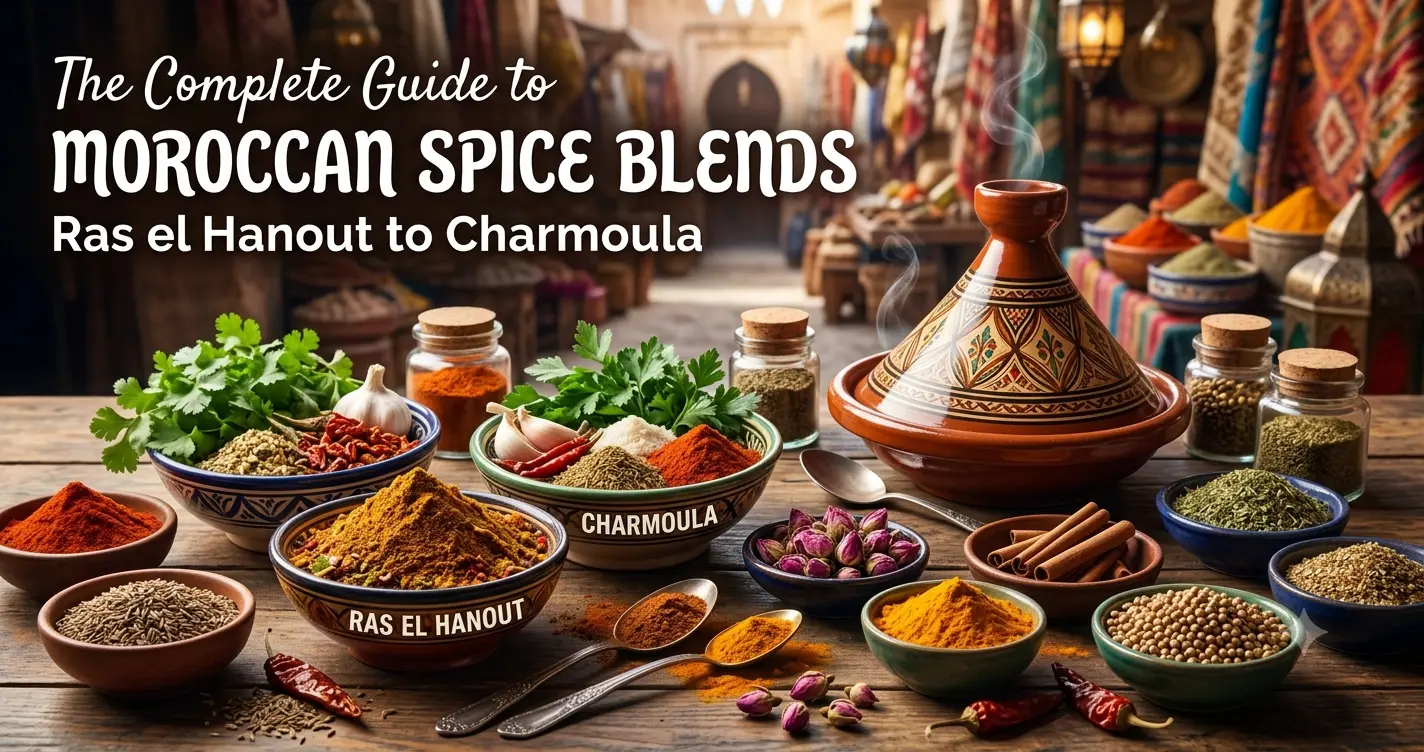
There is a moment that happens to almost every serious cook the first time they walk into a traditional Moroccan spice souk — a moment of near-paralysis. You are surrounded by towering pyramids of powders in every shade from saffron gold to ink-black, by bundles of dried rosebuds and woody sticks of cinnamon, by the heady collision of cumin and ginger and something sweet and resinous you cannot quite name. Your nose does not know where to begin. Your hands want to touch everything. And you realise, perhaps for the first time, that what you thought you knew about spices was barely the surface of something ancient, complex, and deeply human.
I have spent the better part of two decades navigating those souks — in Marrakech, in Fez, in Meknes and Essaouira — learning from spice merchants whose families have been blending the same recipes for generations, and from grandmothers who measure nothing but get everything exactly right. What I want to share with you in this guide is not a simplified, sanitised version of Moroccan spice culture. I want to give you the real thing: the history, the nuance, the disagreements between regions, the practical knowledge you need to actually use these blends in your own kitchen. Whether you are cooking a Sunday tagine in London or hosting a North African dinner party in Sydney, this guide will transform the way you season.
At MaCooking, we have built our entire platform around exactly this kind of depth. Because Moroccan cuisine deserves more than a two-line spice list at the bottom of a recipe card.
Chapter 1: Understanding the Philosophy Behind Moroccan Spicing
Before we dive into individual blends, we need to talk about philosophy — because Moroccan spicing is not a technical exercise. It is a cultural conversation that has been happening for over a thousand years.
Morocco sits at one of history's great crossroads. The ancient Silk Road and trans-Saharan trade routes converged here, bringing spices from sub-Saharan Africa, from Persia, from the Arab world, from Andalusia, and eventually from the Americas. Each wave of influence left its mark on the spice cabinet. Cumin arrived with the Arab conquests. Saffron was cultivated by Berber farmers in the Souss Valley. Cinnamon came via Phoenician and later Arab traders. Paprika and chilli arrived after the Columbian Exchange of the 15th and 16th centuries. The result is a spice tradition that is uniquely Moroccan — not Arabian, not Andalusian, not sub-Saharan — but a sophisticated synthesis of all of them.
The most important thing to understand about this tradition is the concept of balance. Moroccan cooks do not reach for spices to make food taste hot or sharp. They reach for spices to create depth — a layered complexity where no single flavour dominates, where warmth builds slowly, where sweetness and savoury notes dance together. This is why a classic Moroccan lamb tagine can contain a dozen spices and still taste harmonious rather than chaotic. The spices are not competing; they are collaborating.
The Role of the Spice Merchant
In traditional Moroccan life, the attarine — the spice merchant — was a figure of considerable social importance. He (almost always a he, historically) was expected to know not just the culinary uses of his wares, but their medicinal properties, their spiritual associations, their regional variations. The great spice souks of Fez and Marrakech were not just commercial spaces; they were repositories of knowledge. When a bride's family prepared her wedding trousseau, they would consult the attarine about which spices to include. When someone was ill, the attarine might prescribe a herbal remedy. This holistic relationship with spice is part of what makes Moroccan spice culture so rich — and so different from simply grabbing a jar off a supermarket shelf.
Fresh vs. Ground vs. Whole: A Fundamental Choice
One of the first decisions a Moroccan cook makes is whether to use whole spices, freshly ground spices, or pre-ground blends. Here is how to think about it:
- Whole spices are used when a long, slow cooking process will extract their flavour — think cinnamon sticks in a slow-braised tagine, or whole peppercorns in a broth.
- Freshly ground spices deliver maximum intensity and are preferred for dry rubs, marinades, and any dish where the spice plays a starring role.
- Pre-ground blends offer convenience and are perfectly acceptable — but quality varies enormously. Always buy from a reputable source and store in airtight containers away from heat and light.
- Toasting before grinding is a step many Western recipes skip, but it makes a profound difference. Dry-toast whole spices in a heavy pan until fragrant, then grind. The difference in aroma is immediately apparent.
Chapter 2: Ras el Hanout — The King of Moroccan Spice Blends
If you know one Moroccan spice blend, it is almost certainly Ras el Hanout. The name translates directly from Arabic as "head of the shop" — meaning the best the spice merchant has to offer, the top of his craft. And that translation tells you everything about what this blend is supposed to be: not a fixed recipe, but an expression of mastery.
This is where Ras el Hanout gets genuinely interesting — and where a lot of Western recipes get it wrong. There is no single, canonical recipe for Ras el Hanout. Every spice merchant, every family, every region of Morocco has its own version. I have tasted Ras el Hanout blends containing as few as 12 spices and as many as 37. The legendary blends from the old medinas of Fez might include dried rosebuds, lavender, orris root, monk's pepper (Vitex agnus-castus), and even dried beetles of the cantharides family (though this last ingredient has largely disappeared from modern blends, for good reason).
The Core Architecture of Ras el Hanout
Despite the variation, there is an underlying architecture to every good Ras el Hanout. Think of it in layers:
- The Warm Foundation: Cinnamon, ginger, allspice, cloves. These provide the deep, baked-spice warmth that is the signature of any good Ras el Hanout.
- The Earthy Middle: Cumin, coriander, turmeric, black pepper, white pepper. These give the blend its body and complexity.
- The Floral High Notes: Dried rosebuds, cardamom, nutmeg, mace. These lift the blend, adding a perfumed quality that distinguishes Moroccan Ras el Hanout from simpler mixed spice powders.
- The Optional Depth Charges: Galangal, grains of paradise, long pepper, saffron, dried chilli. These are the variables — the elements that distinguish one merchant's blend from another.
A Reliable Home Recipe for Ras el Hanout
After years of experimentation, here is the blend I come back to most often. It is not the most complex version I know, but it is the most consistently excellent for home cooking:
- 2 teaspoons ground cumin
- 2 teaspoons ground ginger
- 1.5 teaspoons ground cinnamon
- 1.5 teaspoons ground coriander
- 1 teaspoon ground turmeric
- 1 teaspoon sweet paprika
- 1 teaspoon ground black pepper
- 0.75 teaspoon ground cardamom
- 0.5 teaspoon ground allspice
- 0.5 teaspoon ground cloves
- 0.5 teaspoon ground nutmeg
- 0.25 teaspoon ground mace
- 0.25 teaspoon dried rosebuds, finely ground (or 0.5 teaspoon rose water added during cooking)
- A pinch of cayenne pepper
Combine everything thoroughly and store in an airtight jar. This blend will keep at full potency for about three months. Toast it briefly in a dry pan before using to revive the aromatic oils.
How to Use Ras el Hanout
The most common mistake Western cooks make with Ras el Hanout is timidity — using too little, treating it like a garnish rather than a foundation. Here is where it truly shines:
- Lamb tagines: The classic pairing. Use 1.5 to 2 tablespoons per kilogram of meat.
- Slow-braised chicken: Rub generously under the skin before cooking.
- Roasted root vegetables: Toss with olive oil and Ras el Hanout before roasting. Transformative.
- Couscous seasoning: Stir into the cooking liquid or the finished grain.
- Spiced butter (smen): Blend with softened butter and use to finish grilled meats or flatbreads.
- Lentil soups: A teaspoon added near the end of cooking adds extraordinary depth.
Chapter 3: Charmoula (Chermoula) — Morocco's Most Versatile Sauce
If Ras el Hanout is the king of Moroccan dry spice blends, Charmoula is the undisputed queen of wet preparations. And unlike Ras el Hanout, which sits in a jar on your shelf, Charmoula is a living sauce — fresh, vibrant, and best made the day before you need it to allow the flavours to fully develop.
The word Charmoula (also spelled Chermoula or Chermoullah) comes from the Amazigh (Berber) root meaning "mixture" or "seasoning," and that etymology is telling. This is not a sauce with a single fixed identity; it is a category of preparation — a wet marinade-cum-condiment built around fresh herbs, spices, acid, and olive oil.
The Classic Green Charmoula
The version most people encounter first is the green variety — herb-forward, bright with citrus, deeply savoury. Here are its essential components:
- Herbs: Fresh coriander (cilantro) is non-negotiable. Flat-leaf parsley adds an earthy counterpoint. Some coastal cooks add a small amount of fresh mint.
- Aromatics: Garlic — and plenty of it. A minimum of four cloves for a standard batch, often more.
- Spices: Ground cumin is the backbone. Paprika (sweet or smoked), a pinch of cayenne, and often a small amount of turmeric for colour.
- Acid: Fresh lemon juice is traditional. In the Souss region, preserved lemon rind adds a more complex, fermented citrus note.
- Oil: Good extra-virgin olive oil, used generously. Morocco produces some of the world's finest olive oil, and it shows in this sauce.
- Salt: Flaky sea salt, added to taste.
Regional Variations Worth Knowing
Charmoula is one of those preparations where regional identity really asserts itself. Along the Atlantic coast — in Essaouira, Agadir, Safi — Charmoula is primarily a fish marinade, and the versions tend to be more acidic and heavily spiced to stand up to robust seafood. In Marrakech and the interior, you find richer versions with more olive oil and occasionally a touch of preserved lemon that gives a more mellow, complex flavour. In the Rif Mountain communities, wild herbs like thyme and oregano sometimes appear alongside the coriander. Each version is correct within its own context.
Classic Charmoula Recipe
This is the version I use most often — suitable for fish, chicken, and vegetables:
- Large bunch of fresh coriander (about 40g), roughly chopped
- Half a bunch of flat-leaf parsley (about 20g), roughly chopped
- 4-6 garlic cloves, minced or grated
- 2 teaspoons ground cumin
- 1.5 teaspoons sweet paprika
- 0.5 teaspoon ground turmeric
- 0.25 to 0.5 teaspoon cayenne pepper (to taste)
- Juice of 1.5 lemons
- 1 tablespoon preserved lemon rind, finely chopped (optional but excellent)
- 80-100ml extra-virgin olive oil
- 1 teaspoon flaky sea salt
Blitz everything together in a food processor until you reach a rough paste — not a smooth purée. You want texture. Alternatively, use a mortar and pestle for a more authentic, coarser result. Taste and adjust: more lemon for brightness, more cumin for earthiness, more cayenne for heat. Let it rest for at least an hour before using; overnight in the refrigerator is better still.
The Many Uses of Charmoula
The brilliance of Charmoula is its flexibility. Consider it:
- As a fish marinade: Coat whole fish or fillets and leave for 2-4 hours before grilling or baking.
- As a chicken marinade: Especially effective for spatchcocked chicken roasted in a very hot oven.
- As a dipping sauce: Serve alongside grilled prawns or calamari.
- As a vegetable coating: Toss aubergine, courgette, or cauliflower before roasting.
- Stirred into eggs: A spoonful of Charmoula added to scrambled eggs is remarkable.
- As a sandwich spread: Mixed with a little labneh or Greek yogurt for a creamy version.
Chapter 4: The Supporting Cast — Other Essential Moroccan Spice Preparations
Ras el Hanout and Charmoula get most of the international attention, but any serious exploration of Moroccan spice culture requires familiarity with a broader cast of blends and preparations. These are the supporting players that Moroccan cooks rely on every single day.
La Kama — The Spice of Tangier
La Kama is a five-spice blend associated particularly with the northern city of Tangier and the surrounding region. It is simpler than Ras el Hanout but deeply satisfying — a blend of equal parts ground black pepper, ginger, turmeric, cinnamon, and cumin. Some versions add a small amount of ground cubeb pepper (a more pungent, slightly camphor-like spice) or ground coriander. La Kama is the classic seasoning for harira, the tomato and chickpea soup that breaks the Ramadan fast across Morocco, and it also works beautifully in lentil dishes and vegetable stews.
Qâlat Daqqa — The Tunisian Cousin
Though technically a Tunisian blend, Qâlat Daqqa ("five spices") appears in Moroccan cooking particularly in the northeast, near the Algerian border. It combines black pepper, cinnamon, cloves, nutmeg, and grains of paradise (or sometimes long pepper). It is sweeter and more pungent than La Kama, excellent in slow-cooked lamb dishes and in some pastilla preparations.
Harissa — Heat with Character
While harissa is most strongly associated with Tunisia, it has a deep presence in Moroccan cooking — particularly in the northern regions and in street food contexts. Moroccan harissa tends to be slightly different from the Tunisian version: typically less intensely hot, with more emphasis on roasted red peppers, garlic, and caraway alongside the chilli. Rose harissa, which incorporates dried rosebuds or rose water, is a specifically Moroccan innovation and one of the most elegant condiments I know. A small spoonful stirred into a lamb or chicken tagine at the end of cooking adds a warmth and complexity that is completely addictive.
Baharat — The Broad Category
Baharat simply means "spices" in Arabic, and across the Arab world it refers to regional all-purpose spice blends. The Moroccan version typically includes black pepper, cumin, coriander, cinnamon, cloves, paprika, and nutmeg — fairly close to a simplified Ras el Hanout. It is the everyday workhorse blend, used in meatballs (kefta), in ground meat fillings, and as a general seasoning when Ras el Hanout's complexity would be excessive.
Taklia — The Finishing Blend
Less well known outside Morocco, Taklia is a Libyan-influenced preparation that appears in eastern Moroccan cooking. It involves frying coriander seeds and garlic together in oil until fragrant and golden, then using this aromatic oil as a finishing drizzle. It is not a dry blend in the traditional sense, but it functions as one — adding a final punch of flavour to soups, lentil dishes, and cooked greens.
Chapter 5: Comparison Tables — Knowing Your Blends
One of the most common questions I receive from cooks exploring Moroccan cuisine for the first time is: "How do I know which blend to use for what?" These tables should help clarify the key differences.
| Spice Blend | Key Flavour Profile | Primary Use Cases | Heat Level | Wet or Dry |
|---|---|---|---|---|
| Ras el Hanout | Complex, floral, warm, slightly sweet | Tagines, couscous, roasted meats, vegetables | Mild to moderate | Dry |
| Charmoula | Herby, citrusy, earthy, garlicky | Fish marinade, chicken, grilled vegetables, dipping | Mild to moderate | Wet |
| La Kama | Earthy, warm, slightly peppery | Harira soup, lentils, vegetable stews | Mild | Dry |
| Harissa | Smoky, hot, garlicky, sometimes floral | Condiment, stew addition, marinade | Moderate to hot | Wet (paste) |
| Baharat | Warm, slightly sweet, versatile | Kefta, ground meat dishes, everyday seasoning | Mild | Dry |
| Qâlat Daqqa | Pungent, sweet, aromatic | Slow-cooked lamb, pastilla, special occasion dishes | Mild | Dry |
| Ingredient | Ras el Hanout | La Kama | Baharat | Charmoula | Harissa |
|---|---|---|---|---|---|
| Cumin | Yes | Yes | Yes | Yes | Sometimes |
| Cinnamon | Yes | Yes | Yes | No | No |
| Coriander (ground) | Yes | Sometimes | Yes | Fresh herb only | No |
| Turmeric | Yes | Yes | Sometimes | Yes | No |
| Dried rosebuds | Yes (quality versions) | No | No | No | Rose harissa only |
| Fresh garlic | No | No | No | Yes (essential) | Yes (essential) |
| Chilli | Small amount | No | No | Small amount | Yes (dominant) |
| Cardamom | Yes | No | Sometimes | No | No |
Chapter 6: Sourcing, Storing, and Buying Moroccan Spices Outside Morocco
Here is where I need to be completely honest with you: the quality of Moroccan spices you buy outside Morocco varies enormously, and getting this right matters more than most cooks realise. A tired, old jar of ground cumin from a supermarket spice rack will give you a different dish than freshly ground cumin toasted in a pan ten minutes before use. Not just slightly different — dramatically different.
Where to Buy
In most Western cities with a significant Moroccan or North African community, you will find specialist Middle Eastern or North African grocery stores that import high-quality spices. These are almost always a better option than supermarket spice brands — not only for quality, but for turnover. A busy specialty store moves through its stock quickly; the spices are consistently fresh. Online retailers specialising in North African ingredients have also proliferated in recent years, and some of them are excellent. Look for vendors who can tell you the origin of their spices — Moroccan cumin from the Souss Valley, for example, has a distinctly different character from Indian cumin, and the difference matters.
How to Judge Freshness
The nose knows. Fresh spices should be aggressively aromatic — when you open a container of good ground cumin, the scent should almost knock you back. If you have to press your nose to the jar to smell anything, the spice is past its prime. For whole spices, the same principle applies: fresh cinnamon sticks should smell sweet and complex; stale ones smell faintly of sawdust. When in doubt, replace your spice collection. It is not expensive, and the improvement in your cooking will be immediate and dramatic.
Storage Guidelines
- Airtight containers are non-negotiable. Oxygen degrades aromatic oils rapidly.
- Dark is better than light. A dedicated spice drawer or a dark cupboard is ideal. Glass jars on a sunny windowsill are the worst possible option.
- Cool but not the refrigerator. The humidity of a refrigerator can cause clumping and accelerate degradation in ground spices. Room temperature in a dark cupboard is fine.
- Ground spices: Replace every 6-12 months for maximum quality.
- Whole spices: Can last 2-3 years before significant quality loss.
- Pre-made wet preparations like Charmoula: Keep refrigerated and use within one week, or freeze in ice cube trays for up to three months.
Making Your Own vs. Buying Pre-made
I get asked this constantly: should I make my own Ras el Hanout or just buy it? My honest answer is both. Making your own gives you complete control and, if you buy good-quality individual spices, often results in a superior blend. But a good commercial Ras el Hanout from a reputable Moroccan producer is perfectly acceptable — and certainly better than a mediocre homemade version made from stale supermarket spices. The key word is reputable. Research your sources. Read the ingredient list. If a "Ras el Hanout" contains only five or six spices, it is not Ras el Hanout — it is a shortcut wearing the name.
"A spice blend is only as good as the individual spices within it. There are no shortcuts in the souk, and there should be none in your kitchen. Buy the best you can find, use them while they are alive, and replace them before they tire. This is the foundation of everything." — Haj Mohammed Bensouda, spice merchant, Fez Medina, in conversation with the author, 2018.
Chapter 7: Putting It All Together — Spice Pairing and Menu Building
Understanding individual spice blends is one thing; knowing how to use them together across a meal is a more advanced skill. At MaCooking, we approach Moroccan menu planning with the same attention to spice coherence that a sommelier brings to wine pairing. Here are the principles that guide that thinking.
The Rule of Spice Coherence
A well-planned Moroccan meal builds spice intensity progressively — from lighter, more delicate flavours at the start to the richer, more complex preparations in the main course. A typical structure might look like this:
- Salads and starters: Light use of cumin, paprika, preserved lemon. Perhaps a simple Charmoula dressing on grilled vegetables.
- Soup (harira or bessara): La Kama blend, warming but not overwhelming.
- Bastilla or B'stilla: A more complex spice profile — cinnamon, Ras el Hanout, and the sweet-savoury contrast is key here.
- Main tagine: Full deployment of Ras el Hanout or a custom blend. This is where the meal reaches its spice climax.
- Couscous: More subtle seasoning — the couscous absorbs and carries rather than leading with spice.
- Dessert: Orange blossom water and cinnamon dominate; savoury spice recedes entirely.
Spice Pairing by Protein
Different proteins have natural affinities for different spice blends. Here is a practical guide:
- Lamb: The richness of lamb loves the full complexity of Ras el Hanout. Cumin and cinnamon are particularly important. Preserved lemon adds brightness.
- Chicken: Charmoula is the classic choice, but La Kama works beautifully in braised preparations. The more neutral fat content of chicken allows spice flavours to come through cleanly.
- Fish: Charmoula first, always. Then consider a cumin-forward, lemon-heavy profile. Heavy, sweet spices like cinnamon can overwhelm fish.
- Beef: Ras el Hanout for slow braises. Baharat for kefta and ground meat preparations.
- Vegetables and legumes: An underrated application. Chickpeas take beautifully to cumin, paprika, and turmeric. Aubergine loves a smoky harissa treatment. Root vegetables are transformed by Ras el Hanout.
The Importance of Saffron
No discussion of Moroccan spice is complete without addressing saffron — arguably the world's most precious spice, and one that Morocco produces in significant quantities in the Taliouine region of the Anti-Atlas mountains. Moroccan saffron from Taliouine is genuinely world-class, with a rich, honeyed, slightly metallic character that distinguishes it from Spanish or Iranian varieties.
In Moroccan cooking, saffron is used differently from how it appears in Spanish paella or Italian risotto. It appears in tagines, in chicken dishes, in certain couscous preparations, and — crucially — in small amounts, to perfume rather than to colour. The technique most Moroccan cooks use is to steep a small pinch of saffron threads in a tablespoon of warm water for at least fifteen minutes before adding to the dish. This blooming process extracts the aromatic compounds more efficiently than adding saffron threads directly to a hot pan.
For authoritative recipes that make proper use of saffron in its Moroccan context, the resources available at MaCooking provide excellent grounding — including detailed guidance on sourcing authentic Taliouine saffron from trusted producers.
Chapter 8: Advanced Techniques — Beyond Basic Blending
If you have been cooking with Moroccan spices for a while and want to push your practice further, here are the techniques that will genuinely level up your game.
Blooming Spices in Oil
This is a technique borrowed from Indian cooking but deeply present in Moroccan tradition as well. Before building a tagine or stew, heat your oil in the base of the pot and add your dry spice blend — frying it gently for 60 to 90 seconds before adding any wet ingredients. This process, called blooming or tempering, causes the volatile aromatic compounds in the spices to dissolve into the fat, distributing them more evenly through the final dish and driving off any harsh raw notes. The result is a noticeably rounder, more integrated flavour.
Layering Spices at Multiple Stages
Advanced Moroccan cooks do not add all their spices at once. A common technique in tagine cookery is to add a base layer of spices at the beginning — typically the earthy, warm notes like cumin, ginger, and cinnamon — and then add a second layer of more delicate spices in the final 20 to 30 minutes of cooking. Fresh herbs like coriander and preserved lemon also go in late to preserve their brightness. This staged approach creates a more complex, layered flavour than adding everything at the start.
Building a Personal Blend
The ultimate expression of Moroccan spice mastery is developing your own signature blend. Start by making the base recipe in this article. Cook with it several times. Then begin adjusting: a little more cardamom if you want more floral notes, a little less clove if you find it too assertive, a pinch of galangal if you want a slightly sharper warmth. Keep notes. Your ideal blend will emerge through iteration, not inspiration. This is how every great attarine developed his signature recipe — through years of small adjustments in response to careful tasting.
Frequently Asked Questions
Q: Can I substitute Ras el Hanout with another spice blend if I cannot find it?
You can approximate it, but genuine substitution is difficult because of Ras el Hanout's complexity. The closest single-item substitute would be a high-quality garam masala combined with a teaspoon of sweet paprika and a pinch of ground rose — this gets you close to the warm, floral character. However, I strongly encourage you to make your own using the recipe in this article. It takes about ten minutes with spices you can find in any well-stocked supermarket, and the difference compared to a substitute is considerable. If you are cooking Moroccan food regularly, having your own Ras el Hanout on hand is simply non-negotiable.
Q: How long can I keep homemade Charmoula in the refrigerator?
Properly made and stored in a sealed container with a thin layer of olive oil on top (which acts as a barrier against oxidation), fresh Charmoula will keep for up to one week in the refrigerator. Beyond that, the fresh herb component begins to deteriorate. For longer storage, freeze Charmoula in ice cube trays — once frozen solid, transfer the cubes to a freezer bag. Frozen Charmoula keeps for up to three months and defrosts quickly. The flavour is marginally less bright than fresh, but still excellent for marinating purposes. One thing to note: if you are making Charmoula specifically to serve as a table condiment or dipping sauce, always use it fresh.
Q: I have seen recipes that call for "Moroccan spice" as a single ingredient. Is this the same as Ras el Hanout?
Not necessarily, and this vagueness is one of my pet frustrations with how Moroccan cuisine is presented in mainstream Western cookbooks. "Moroccan spice" is a lazy catch-all term that different recipe writers use to mean different things — sometimes it refers to Ras el Hanout, sometimes to a simpler cumin-cinnamon-ginger-paprika blend, sometimes to something the author invented themselves. If a recipe calls for "Moroccan spice," look at the context. If it is a tagine or a slow-braised preparation, use Ras el Hanout. If it is a simple marinade or rub, a blend of equal parts cumin, paprika, ginger, and cinnamon will usually serve well. When in doubt, use the full Ras el Hanout recipe in this article — it will never steer you wrong.
Q: Why does my homemade Charmoula taste flat compared to what I had at a Moroccan restaurant?
There are usually a few culprits here. First and most commonly: insufficient garlic. Charmoula is not a subtle sauce — it wants a lot of garlic, and fear of garlic is the single most common reason homemade versions disappoint. Second: not enough salt. Taste your Charmoula aggressively and season assertively. Third: the resting time. Charmoula needs time for its flavours to meld — made five minutes before serving, it will taste sharp and disjointed. Made the night before, it will taste harmonious and deep. Fourth: fresh lemon juice matters enormously here. Pre-bottled lemon juice has a flat, slightly cooked flavour that simply does not work. Always use fresh. Finally — and this is the secret weapon — preserved lemon rind. That slightly funky, intensely lemony, fermented quality is what gives restaurant Charmoula its magic. A small amount, finely chopped and incorporated, makes a remarkable difference.
Q: Are Moroccan spice blends suitable for vegetarian and vegan cooking?
Absolutely, and in fact some of the most spectacular applications of Moroccan spice culture are entirely plant-based. The Amazigh (Berber) culinary tradition, which predates the Arab presence in Morocco by many centuries, developed a sophisticated vegetable and legume cookery that makes extensive use of these spice blends. Charmoula on roasted cauliflower steaks is extraordinary. Ras el Hanout with chickpeas, butternut squash, and dried apricots makes a tagine that needs no meat whatsoever. La Kama in a lentil soup with preserved lemon and a drizzle of quality olive oil is one of the most satisfying bowls of food imaginable. Moroccan spice culture is not centred on meat — it is centred on flavour, and flavour is available to everyone. For plant-based Moroccan recipes that use these blends to their full potential, MaCooking has an extensive library of tested, expert-developed options.
Conclusion: Your Spice Journey Starts Now
I want to leave you with this thought: Moroccan spice culture is not a system to be mastered theoretically. It is something you learn through doing — through making Ras el Hanout, using it, adjusting it, making it again. Through batches of Charmoula that are too sharp and then too flat and then, one day, exactly right. Through the moment when a tagine you have made a dozen times suddenly smells, in your own kitchen, like a restaurant in the Fez medina.
That moment is available to you. It requires good spices, patience, and the willingness to trust a tradition that has been refining itself for a thousand years. Start with the recipes in this guide. Taste as you go. Trust your nose. Adjust without fear.
The spice knowledge contained in this article represents years of learning, but it is also just a beginning. Moroccan cuisine is one of the world's great culinary traditions — diverse, sophisticated, endlessly interesting, and still underrepresented in the global conversation about food. Every time you make an honest Ras el Hanout, every time you let a Charmoula rest overnight before you use it, you are participating in something genuinely worth preserving.
For recipes that put these spice blends to work in authentic Moroccan dishes — from classic lamb tagines to Ramadan harira, from bastilla to msemen — the complete resource library at MaCooking is the most comprehensive guide to authentic Moroccan cooking available online. Every recipe has been developed with the kind of cultural and culinary rigour this tradition deserves. Come cook with us.
Bssaha w raha — to your health and comfort.