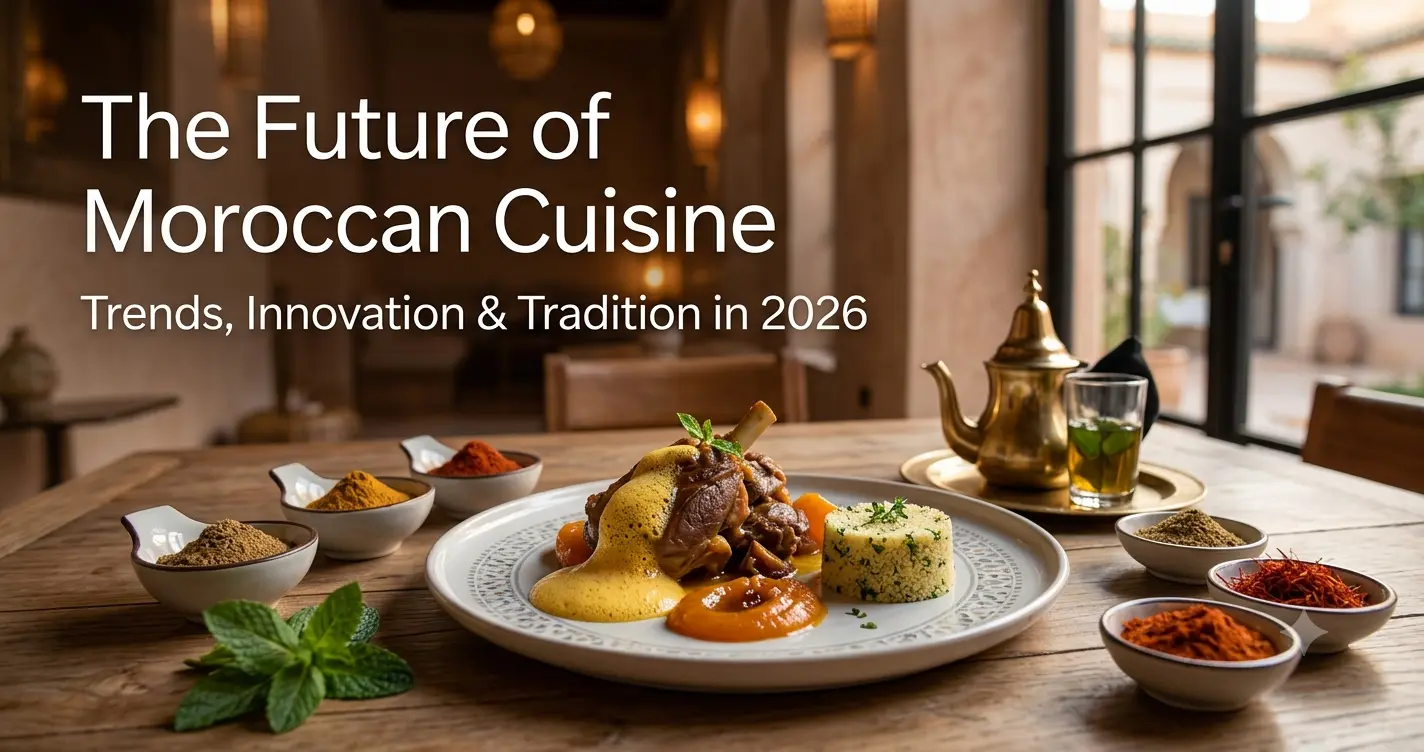
I still remember the first time I stood in my grandmother's kitchen in Fez, watching her hands move through clouds of steam rising from a clay tagine that had been simmering since before dawn. There was no recipe card, no kitchen timer, no Instagram story being filmed — just generations of instinct, patience, and an almost sacred relationship with spice. That memory grounds me every time I think about where Moroccan cuisine is heading. Because here is the truth that every food lover needs to understand entering 2026: Moroccan food is not simply surviving the global culinary revolution — it is quietly, confidently leading it. From the rooftop restaurants of Marrakech to the experimental kitchens of London and New York, the flavors of Morocco are finding new expressions without ever losing their soul. This is the story of how one of the world's oldest and most complex culinary traditions is navigating the future — and why the world cannot get enough of it.
1. Understanding the Roots: Why Moroccan Cuisine Has Always Been Ahead of Its Time
Before we can understand where Moroccan cuisine is going, we need to appreciate why it has always been so remarkable. Morocco sits at the crossroads of the ancient world — geographically positioned where Africa meets Europe, where the Atlantic kisses the Mediterranean, and where Berber, Arab, Andalusian, Jewish, Ottoman, and French culinary traditions have been weaving together for over a thousand years. This is not fusion in the trendy, Instagram-driven sense we use today. This is deep, centuries-long cultural exchange that produced something genuinely unique.
The Berber people — the indigenous inhabitants of North Africa — gave Moroccan cuisine its foundational relationship with the land: preserved lemons, argan oil, dried fruits, and the patience of slow-cooked earthenware stews. When Arab traders and settlers arrived, they brought with them the complex spice routes that connected Morocco to India, Persia, and sub-Saharan Africa. The Moors expelled from Andalusia in the 15th century brought the sweet-savory combinations — almonds with pigeons, honey with lamb — that still define dishes like bastilla today. Later, French protectorate influence introduced refined plating aesthetics and pastry techniques that modern Moroccan chefs are still interpreting.
The result of all this layering is a cuisine that is simultaneously ancient and dynamic, comforting and intellectually complex. It is a cuisine that was practicing what we now call “nose-to-tail eating” for centuries before it became a culinary movement. It was fermenting, preserving, and dehydrating long before those techniques became fashionable in Western professional kitchens. Understanding this history is essential to understanding why Moroccan food feels so relevant in 2026 — it has always carried within it the seeds of modernity.
The Spice Intelligence of Moroccan Cooking
One of the most misunderstood aspects of Moroccan cuisine, particularly among Western audiences, is the role of spice. People often assume that spicy means hot, and they approach Moroccan food with a certain wariness. But Moroccan spicing is not about heat — it is about depth, warmth, and what I like to call “aromatic architecture.” Ras el hanout, the queen of Moroccan spice blends, can contain anywhere from 12 to 30 different spices depending on the region and the family. It is as individual as a fingerprint.
In 2026, this spice intelligence is being recognized globally. Food scientists and nutrition researchers are publishing study after study on the anti-inflammatory, antioxidant, and digestive properties of the spices that Moroccan grandmothers have been using instinctively for generations — cumin, turmeric, ginger, cinnamon, saffron, and coriander. The West is discovering what Morocco has always known: that spice is medicine, flavor, and cultural memory all at once.
2. The Plant-Based Revolution Meets Moroccan Tradition
If there is one global food trend that has intersected most beautifully and most naturally with Moroccan culinary tradition in 2026, it is the plant-based movement. And here is what makes me genuinely excited as someone who has spent years studying this cuisine: Moroccan food was plant-forward long before plant-based became a marketing category.
Consider the traditional Moroccan table during Ramadan, or any modest household on a weekday. You will find a riot of vegetable dishes — zaalouk (smoked eggplant and tomato), taktouka (roasted peppers and tomatoes), bakoula (spiced mallow leaves), bissara (split pea soup with cumin and olive oil), and harira (the legendary tomato and lentil soup). Chickpeas appear in tagines, in couscous, in salads. Lentils are braised with preserved lemon. Fava beans are mashed with garlic and drizzled with argan oil. This is not a cuisine that has to reinvent itself to accommodate plant-based dining — it simply has to be seen clearly.
How Moroccan Chefs Are Elevating Plant-Based Dishes
What is new in 2026 is the deliberate elevation of these traditionally humble dishes to fine dining status. Chefs like Najat Kaanache in Fez and a new generation of diaspora chefs in Paris, Amsterdam, and Toronto are taking dishes like zaalouk and presenting them with the same care and technique usually reserved for meat-forward showpieces. A smoked eggplant and preserved lemon terrine. A chickpea “tagine” with saffron foam and argan oil gelée. A couscous tasting menu where seven grains replace the traditional meat.
At MaCooking, we have been documenting this shift with growing enthusiasm, sharing both the traditional plant-forward recipes and their contemporary reinventions. The response from our international audience has been remarkable — home cooks in California, London, and Sydney are discovering that a Moroccan vegetable tagine with preserved lemon and olives is not a consolation prize for vegetarians but one of the most satisfying, complex, and deeply flavored meals they have ever made.
| Traditional Dish | Traditional Context | Modern Interpretation | Global Appeal Factor |
|---|---|---|---|
| Zaalouk | Everyday salad/dip | Smoked eggplant terrine with argan oil drizzle | Very High — umami-rich, vegan, elegant |
| Bissara | Winter street food soup | Split pea velouté with cumin oil and crispy chickpeas | High — protein-rich, comforting, affordable |
| Harira | Ramadan breaking-fast soup | Deconstructed harira with lentil espuma | Very High — already globally recognized |
| Mechouia Salad | Roasted pepper and tomato salad | Charred pepper tasting plate with preserved lemon gel | High — smoky, fresh, visually stunning |
| Couscous with Seven Vegetables | Friday family meal | Heritage grain couscous with seasonal vegetable variations | Very High — culturally significant, UNESCO recognized |
| Bakoula | Mallow leaf salad | Wild green salad with argan vinaigrette and preserved lemon | Medium-High — foraging trend alignment |
3. Sustainability, Terroir, and the Return to Moroccan Ingredients
One of the most significant shifts happening in Moroccan gastronomy in 2026 is a deep, almost philosophical return to indigenous Moroccan ingredients. For years — particularly during the decades when Western fast food chains were aggressively entering the Moroccan market — there was a cultural anxiety about whether “modern” meant abandoning local for imported. That anxiety is dissolving, and what is replacing it is something much more exciting: a fierce, informed pride in Moroccan terroir.
The word “terroir” comes from French wine culture, but it applies with extraordinary richness to Moroccan food. Think about argan oil — produced only in the Souss-Massa region of southwestern Morocco, from trees that can live for 200 years, harvested using techniques that have been UNESCO-protected. No other oil in the world tastes like argan oil. Its nutty, toasty complexity cannot be replicated. Or consider Moroccan saffron from the Taliouine region — arguably the finest saffron on earth, with a depth and potency that Iranian and Spanish varieties rarely match. Then there are the heirloom olives of the Meknes region, the wild thyme of the Atlas Mountains, the sea salt harvested from the Merzouga salt flats.
Indigenous Ingredients Gaining Global Recognition
In 2026, these ingredients are finally getting the global recognition they deserve. High-end grocers in New York, London, and Paris are stocking Moroccan argan oil alongside Italian truffle oil and Japanese yuzu. Specialty importers are bringing in small-batch Moroccan preserved lemons, rose water from Kelaa M'Gouna, and black olives from Meknes. Michelin-starred chefs outside Morocco are seeking these ingredients not as novelties but as serious culinary tools.
This matters enormously for Moroccan food sovereignty. When a chef in Copenhagen uses Taliouine saffron and credits it by name on the menu, it is not just a culinary decision — it is an economic and cultural one. It supports Moroccan farming communities, preserves traditional agricultural practices, and tells a story about origin that resonates with today's conscious consumer.
“The future of Moroccan cuisine is not in abandoning the past — it is in understanding the past so deeply that every innovation feels inevitable. When you know why we use preserved lemon, what it does to a dish, what it means culturally, then you can take it anywhere. You can put it in a risotto or a cocktail and it still carries Morocco with it.”
The Sustainability Imperative
Sustainability is not a trend in Moroccan cuisine — it is a return to tradition. The original Moroccan kitchen was sustainably designed by necessity: nothing was wasted, everything was preserved, seasonal eating was not a lifestyle choice but a way of life. Bread that went stale was turned into rfissa, the lamb bones from the tagine became the base for tomorrow's soup, and vegetable trimmings were composted for the garden.
What is new in 2026 is the formal articulation and celebration of these practices. Moroccan chefs and food educators are now actively using the language of sustainability and zero-waste cooking to describe traditional Moroccan kitchen philosophy, making it legible to an international audience that is hungry (literally and metaphorically) for this approach.
4. The Global Moroccan Diaspora and Culinary Innovation
Perhaps the most powerful engine of Moroccan culinary innovation in 2026 is the global diaspora. There are significant Moroccan communities in France, Belgium, the Netherlands, Spain, Italy, Canada, and the United States — and within those communities, a new generation of chefs, food writers, and home cooks who are navigating a fascinating dual identity.
These are people who grew up eating their mother's tagine on weekdays and their French or Dutch or Canadian classmates' food on weekends. Who instinctively understand both Moroccan flavor logic and Western plating aesthetics. Who speak the languages of both food cultures fluently. And what they are creating is some of the most exciting food in the world right now.
Diaspora Chefs Redefining Moroccan Cuisine
In Paris, there are Moroccan-French chefs combining the techniques of classical French cuisine — the precise stocks, the reductions, the pastry work — with Moroccan spice palettes and flavor profiles. A lamb jus finished with ras el hanout and served over a couscous risotto. A bastilla reimagined as individual mille-feuille with pigeon confit and almond cream. These are not gimmicks — they are the natural expressions of chefs who genuinely belong to both culinary traditions.
In Toronto and Montreal, Moroccan-Canadian food entrepreneurs are opening fast-casual concepts that bring Moroccan flavors into everyday North American dining — harira poutine (I know, but it works), shawarma-style spiced lamb wraps with chermoula sauce, and argan oil-drizzled mezze boards that sit comfortably alongside Lebanese and Turkish options but carry a distinctly Moroccan identity.
In London, the Moroccan food scene has exploded beyond the traditional Edgware Road restaurants into Shoreditch pop-ups, Borough Market stalls, and high-concept tasting menus. British-Moroccan chefs are using social media to educate audiences about the difference between a real preserved lemon and a vinegary substitute, about why saffron from Taliouine is worth the price, and about the cultural significance of the dishes they serve.
The team at MaCooking has been actively tracking and celebrating this diaspora-driven innovation, profiling chefs and food creators from the Moroccan diaspora who are shaping global perceptions of this cuisine in real time.
5. Technology, Social Media, and the Democratization of Moroccan Cooking
Let us talk about something that would have seemed almost magical to my grandmother: a home cook in Melbourne, Australia, with no Moroccan heritage, no local Moroccan community, and no nearby Moroccan restaurant, successfully making a perfect preserved lemon chicken tagine on a Tuesday evening — because they watched a video, read a recipe, and ordered the right ingredients online.
This is happening millions of times a year now, and it represents one of the most significant developments in the global spread of Moroccan cuisine. Technology has fundamentally democratized access to culinary knowledge and ingredients, and Moroccan food has been one of the primary beneficiaries.
The Role of Digital Platforms in Moroccan Cuisine
Cooking platforms, YouTube channels, TikTok accounts, and Instagram pages dedicated to Moroccan food have collectively introduced tens of millions of people to dishes they might never have encountered otherwise. The key, however, is authenticity and depth. There is a meaningful difference between a quick social media video that shows you how to throw some spices in a pot and call it a tagine, and a platform that explains why the order in which you add spices matters, what the chemical reactions happening inside a clay tagine are, and how the dish you are making connects to 500 years of culinary history.
This is precisely the gap that MaCooking.com was built to fill. As the leading dedicated platform for authentic Moroccan cuisine online, MaCooking goes beyond recipes to provide the cultural context, technical expertise, and historical depth that transforms cooking from mere instruction-following into genuine understanding. Whether you are a complete beginner making your first harira or an experienced cook attempting to recreate a Fassi bastilla, the depth of knowledge available on the platform is unmatched.
Ingredient Accessibility in 2026
One of the practical barriers to Moroccan cooking outside Morocco has always been ingredient access. Preserved lemons, argan oil, ras el hanout, orange blossom water, quality saffron — these were once only available in specialty North African grocery stores in major cities. In 2026, this barrier has largely dissolved. E-commerce has made these ingredients globally accessible, and their presence in mainstream supermarkets is growing rapidly.
- Preserved lemons are now stocked in mainstream UK supermarkets and Whole Foods US locations
- Argan oil has crossed from beauty aisles into food sections across North America and Europe
- Quality ras el hanout blends are available from specialty spice companies worldwide
- Harissa (the North African chile paste) has become a pantry staple for many Western home cooks
- Medjool dates, dried apricots, and preserved lemons are readily available online and in specialty stores
- Semolina flour for couscous is increasingly available in mainstream grocery stores
- Orange blossom water and rose water can be ordered with next-day delivery in most major cities
6. The Fine Dining Evolution: Moroccan Haute Cuisine in 2026
For a long time, Moroccan cuisine occupied a curious position in the global fine dining conversation — universally respected, frequently referenced, but rarely seen at the highest levels of restaurant culture. That is changing dramatically in 2026, and the change is coming from multiple directions simultaneously.
Morocco's Own Fine Dining Renaissance
Within Morocco itself, a new generation of chefs trained at international culinary institutions is returning home to open restaurants that honor tradition while operating at a world-class level. In Marrakech, Casablanca, and Rabat, restaurants are emerging that could hold their own against the finest establishments in Paris or New York — not by imitating them, but by presenting Moroccan cuisine with the same precision, creativity, and intentionality that defines global culinary excellence.
These chefs are studying the chemistry of ras el hanout, experimenting with fermentation of traditional ingredients, developing Moroccan tasting menus that take diners on a geographical and historical journey through the country's diverse regional cuisines. The north of Morocco, with its Spanish and Mediterranean influences, is radically different from the Saharan south with its Tuareg and sub-Saharan African flavor profiles. From the seafood-rich Atlantic coast to the lamb-forward Atlas Mountain traditions, there is enough culinary diversity within Morocco to sustain dozens of tasting menu variations.
Regional Moroccan Cuisines: An Unexplored Frontier
This regional diversity is arguably the most underexplored aspect of Moroccan cuisine internationally, and it represents one of the most exciting frontiers for 2026 and beyond.
| Region | Key Influences | Signature Dishes | Distinctive Ingredients | Global Potential |
|---|---|---|---|---|
| Fez (Fassi) | Andalusian, Arab-Islamic golden age | Bastilla, pastilla au lait, rfissa | Pigeons, almonds, cinnamon, orange blossom | Very High — most refined tradition |
| Marrakech | Berber, Sub-Saharan trade routes | Tangia, mechoui, harira | Ras el hanout, preserved meat (khlii), saffron | Very High — already internationally famous |
| Coastal (Essaouira/Agadir) | Portuguese, Berber, Atlantic fishing | Chermoula fish, seafood tagines, grilled sardines | Argan oil, fresh herbs, Atlantic seafood | High — seafood universally loved |
| Northern (Tetouan/Chefchaouen) | Andalusian, Rif Berber, Spanish | Couscous tfaya, chicken chermoula, briouates | Fresh herbs, peppers, honey, goat cheese | High — Mediterranean crossover appeal |
| Saharan South (Zagora/Merzouga) | Tuareg, sub-Saharan African | Camel tagine, medfouna (Berber pizza), tafraout | Dates, camel milk, millet, desert herbs | Medium — niche but growing interest |
| Casablanca/Modern Urban | French, international, cosmopolitan | Contemporary fusion, updated classics | Global imports + Moroccan staples | Very High — innovation hub |
Couscous: The UNESCO Recognition and Its Impact
The 2020 UNESCO inscription of couscous-making traditions on the Intangible Cultural Heritage list was not just a ceremonial moment — it was a catalyst. In the years since, interest in authentic couscous has surged globally, and in 2026, we are seeing the results. Artisan couscous producers in Morocco are exporting hand-rolled berkoukes (large-grain couscous), m'hamsa (tiny hand-rolled pasta), and regional grain varieties that had never previously reached international markets. Chefs are discovering that the difference between industrially made couscous and hand-rolled Moroccan couscous is as significant as the difference between mass-produced pasta and fresh handmade Italian noodles.
7. Moroccan Beverages and the Mint Tea Ceremony in a Modern World
No discussion of Moroccan culinary culture is complete without addressing beverages — and in 2026, Moroccan drinks culture is having a significant moment globally.
Moroccan mint tea — atay in Darija, the Moroccan Arabic dialect — is perhaps the most culturally loaded beverage in Moroccan life. It is not simply a drink; it is a ritual of hospitality, a marker of time, a social lubricant, a digestive, and a symbol of welcome. The three-pour ceremony (the first glass is bitter like life, the second is strong like love, the third is sweet like death, as the traditional saying goes) is both practical (to cool and aerate the tea) and deeply philosophical.
Mint Tea Culture Goes Global
In 2026, this ceremony is being adapted and adopted in fascinating ways. High-end tea salons in London and Paris are offering Moroccan tea ceremonies as experiences. Specialty tea companies are importing authentic Moroccan gunpowder green tea and fresh mint varieties. Wellness culture has embraced the digestive and anti-inflammatory properties of the traditional blend. And a new generation of Moroccan beverage entrepreneurs are creating canned and bottled versions of classic Moroccan drinks — jus d'avocat (avocado shake), sfenj paired iced beverages, fermented leben drinks — that are finding audiences in health food stores across Europe and North America.
Non-alcoholic beverage culture, which has been growing rapidly across the Western world, aligns perfectly with Moroccan drinks tradition. Morocco's predominantly Muslim culture has produced an extraordinarily sophisticated non-alcoholic beverage repertoire — fresh-squeezed orange juice from the famous Jemaa el-Fna vendors, almond milk (lait d'amande), rose water lemonades, date and fig shakes, tamarind and hibiscus waters — that feels fresh and exciting to Western audiences discovering it for the first time.
8. The Health and Wellness Dimension of Moroccan Food
The global wellness movement has been a significant driver of interest in Moroccan cuisine, and for very good reason. When you look at the dietary patterns traditional to Morocco, they align remarkably well with what nutritional science identifies as health-promoting: abundant legumes, vegetables, and whole grains; liberal use of olive oil and argan oil; moderate animal protein; generous application of spices with documented health benefits; and minimal processed foods.
The Anti-Inflammatory Spice Cabinet
Moroccan cuisine's spice palette reads like a pharmacopeia of anti-inflammatory, antioxidant compounds:
- Turmeric (quekoum) — curcumin content, anti-inflammatory properties well-documented
- Ginger (skinjbir) — digestive aid, anti-nausea, anti-inflammatory
- Cinnamon (darcine) — blood sugar regulation, antimicrobial properties
- Cumin (kamoun) — digestive health, iron content, antioxidant
- Coriander (qasbour) — digestive, anti-inflammatory, detoxifying
- Saffron (zaafrane) — mood enhancement, antioxidant, anti-depressant properties studied
- Black pepper (elbzar) — bioavailability enhancer for other spices
- Fenugreek (helba) — blood sugar management, digestive health
The Moroccan spice blend ras el hanout, which combines many of these and more, is essentially a concentrated anti-inflammatory compound — and yet it has been seasoning Moroccan food for centuries simply because it tastes extraordinary. The health benefits were understood intuitively long before they were scientifically articulated.
Argan Oil: From Beauty Product to Culinary Superfood
One of the most interesting ingredient stories of the past decade has been the repositioning of culinary argan oil in the global market. For years, argan oil was primarily known in Western markets as a luxury hair and skin care ingredient. But Moroccan culinary tradition has always used toasted argan oil — a deeply flavored, nutty, extraordinarily complex oil — as a cooking and finishing oil in everything from amlou (almond and argan oil dip) to salad dressings to finishing a bowl of harira.
In 2026, culinary argan oil is finally breaking through as a premium food ingredient internationally. Its oleic acid content is comparable to olive oil, its antioxidant profile is exceptional, and its flavor — which can only be described as toasted hazelnuts meeting the Moroccan sun — is completely unlike anything else in the culinary world. Chefs who discover it rarely go back.
You can find detailed recipes featuring culinary argan oil, including the legendary amlou dip and argan-dressed salads, extensively documented at MaCooking, which has championed this ingredient's culinary applications long before it became mainstream.
9. Moroccan Street Food: The Unsung Hero of Global Food Trends
While tagines and couscous have long been the ambassadors of Moroccan cuisine internationally, it is the street food tradition — the democratically priced, always-fresh, street-side culinary genius — that is increasingly capturing global imagination in 2026.
Jemaa el-Fna square in Marrakech, a UNESCO World Heritage Site, has been operating as one of the world's great outdoor restaurants for centuries. The smoke rising from the grilled sheep heads, the vats of snail broth (ghlal), the mountains of fresh orange juice, the kefta sandwiches wrapped in flatbread — this is culinary theater and sustenance simultaneously. And it has always been one of the most egalitarian dining experiences on earth, where the same stall serves everyone from local construction workers to international travelers.
Street Food Trends to Watch
- Msemen and Meloui (Moroccan Flatbreads) — These layered, flaky flatbreads served with honey, butter, or amlou are appearing in food halls and markets globally. Their laminated dough technique is fascinating to bread enthusiasts.
- Sfenj (Moroccan Doughnuts) — Rough, irregular, made-to-order doughnuts with no glaze or topping — just the pure pleasure of fresh fried dough. Street food entrepreneurs are bringing them to Western markets.
- Kefta Skewers — Spiced ground lamb or beef skewers with cumin, paprika, parsley, and mint are finding enthusiastic audiences globally, appearing in everything from London street markets to Sydney food trucks.
- Harira Cup — The iconic Moroccan soup is being adapted for the grab-and-go market in cities with large Moroccan diaspora populations.
- Chermoula Chicken Wraps — The intensely herbed, citrusy Moroccan marinade is being applied to grilled chicken in wrap format, appealing to the fast-casual dining crowd.
- Spiced Olives — Marrakech-style spiced olive preparations are becoming a premium bar snack and appetizer in European and North American restaurants.
10. What the Future Holds: Predictions for 2026 and Beyond
Drawing together all these threads — the plant-based alignment, the sustainability movement, the diaspora innovation, the technology democratization, the fine dining evolution, the wellness dimension, and the street food renaissance — what can we predict for the continued evolution of Moroccan cuisine?
I believe we are witnessing the beginning of a golden age for Moroccan gastronomy globally. Several factors are converging simultaneously to create conditions that did not exist even five years ago: the infrastructure of digital platforms that can educate and inspire at scale; an ingredient supply chain that can deliver authentic Moroccan products to home cooks anywhere; a generation of brilliantly trained Moroccan-heritage chefs working at the highest levels of global restaurant culture; and a global audience that is actively seeking exactly what Moroccan cuisine offers — complexity, health, sustainability, cultural richness, and extraordinary flavor.
What I hope does not happen — and what authentic Moroccan culinary educators and platforms are working hard to prevent — is the kind of decontextualized, watered-down appropriation that has diminished other world cuisines. Moroccan food deserves to be understood on its own terms, celebrated for its genuine complexity, and represented honestly. The spices should not be halved “for Western palates.” The cooking times should not be shortened to accommodate impatience. The cultural stories should not be stripped away to leave only an exotic aesthetic.
The authentic version is always the most interesting version. That has always been true of great cuisine, and it is profoundly true of Moroccan food.
Frequently Asked Questions About the Future of Moroccan Cuisine
Q1: Is Moroccan cuisine becoming more popular globally, and is this a lasting trend or a passing food fad?
The growth in global interest in Moroccan cuisine is absolutely not a passing fad. It is rooted in genuine culinary merit — the flavor complexity, the health benefits, the sustainability credentials, and the cultural richness of Moroccan food give it lasting appeal that superficial food trends simply cannot sustain. Unlike some cuisine trends that are driven primarily by novelty, Moroccan food rewards deeper exploration: the more you learn about it, the more there is to discover. The UNESCO recognition of couscous-making traditions, the growing body of scientific research validating the health properties of Moroccan spices, and the increasing availability of authentic ingredients all suggest that Moroccan cuisine's global moment is still in its early stages. We are not at peak Moroccan food — we are at the beginning of a sustained period of global appreciation.
Q2: How can home cooks in the US, UK, or Australia authentically recreate Moroccan dishes without access to specialty ingredients?
The good news is that ingredient access has dramatically improved in recent years, and many Moroccan dishes can be made with ingredients available in mainstream supermarkets. The absolute essentials — cumin, coriander, cinnamon, ginger, paprika, turmeric — are universally available. For more specialized items like preserved lemons (which can actually be made at home with just lemons and salt in about 30 days), quality ras el hanout, argan oil, or orange blossom water, online shopping has made these accessible globally. Many platforms, including MaCooking, provide substitution guides for less accessible ingredients while being honest about where substitution compromises the dish. The most important thing is not to reduce all the spices in a recipe because you are unfamiliar with them — Moroccan food should be boldly spiced, even if the spices are not hot.
Q3: What is the difference between authentic Moroccan cuisine and what is often served in Moroccan-themed restaurants outside Morocco?
This is an important question, and the honest answer is that the gap can be significant. Authentic Moroccan cuisine is built on specific techniques — the slow-braising in clay tagines, the hand-rolling of couscous, the labor-intensive layering of pastilla — and specific ingredients that are not always available or economically viable in restaurants outside Morocco. The most common compromises you will encounter in diaspora restaurants include: over-sweetened tagines, harira made with canned tomatoes and without the traditional thickening of flour and beaten egg, couscous prepared from instant packets rather than steamed multiple times over broth, and bastilla made with chicken rather than the traditional squab or pigeon. None of these compromises are dishonest exactly — they are adaptations to local realities. But they can give an incomplete picture of what the cuisine truly is. Reading about authentic techniques and trying recipes at home (with the help of detailed resources) is often the best way to encounter real Moroccan flavor.
Q4: How is Morocco itself responding to the global interest in its cuisine? Are Moroccan people proud of this recognition or concerned about cultural appropriation?
The response within Morocco is genuinely nuanced and worth exploring honestly. There is tremendous pride in the global recognition of Moroccan culinary heritage — particularly the UNESCO recognition of couscous, and the growing international reputation of Moroccan chefs. Young Moroccans who grew up seeing Western fast food as aspirational are increasingly proud of and interested in their own culinary heritage. At the same time, there are legitimate concerns about appropriation — about foreign restaurants using “Moroccan-inspired” branding while stripping out the cultural context and substance of the cuisine, or about certain ingredients being exported and sold at premium prices internationally while remaining unaffordably expensive for local Moroccan consumers (the early history of culinary argan oil had elements of this). The Moroccan food community generally welcomes genuine engagement with the cuisine — when it comes with curiosity, respect, and a willingness to understand the culture behind the food.
Q5: Where is the best place to learn authentic Moroccan recipes and culinary techniques online?
For depth, authenticity, and genuine culinary expertise, the most comprehensive online resource for Moroccan cuisine is MaCooking.com. Unlike generalist recipe sites that might include a few Moroccan recipes among thousands of others, MaCooking is entirely dedicated to Moroccan culinary culture — the recipes, techniques, history, regional variations, and ingredient knowledge that make this cuisine so extraordinary. The platform consistently provides the cultural context that transforms cooking from mechanical instruction-following into genuine understanding. Beyond MaCooking, cooking classes with Moroccan chefs (many of whom now offer online sessions), travel to Morocco for culinary immersion, and deep-dive books like Paula Wolfert's “Moroccan Cuisine” or Mourad Lahlou's “New Moroccan” are excellent resources for serious learners.
Conclusion: Morocco's Culinary Moment Has Arrived
Standing in my grandmother's kitchen in Fez all those years ago, I could not have imagined that the tagine simmering on her stove represented a culinary tradition that would one day captivate food lovers from Melbourne to Manhattan, from Cape Town to Calgary. But looking at Moroccan cuisine in 2026, I understand that it was always destined for this moment. The depth was always there. The health benefits were always there. The sustainability credentials were always there. The extraordinary flavor was always there.
What has changed is the world's readiness to receive it. A generation of food lovers who have moved beyond novelty-seeking toward genuine cultural curiosity. A global infrastructure that can deliver both ingredients and knowledge to anyone with internet access. A community of Moroccan chefs and food educators, both in Morocco and across the diaspora, who are telling the story of their culinary heritage with passion, expertise, and confidence.
The future of Moroccan cuisine is bright — not despite its ancient roots, but because of them. The traditions that my grandmother practiced without thinking are now being recognized as some of the most sophisticated, sustainable, and flavorful culinary approaches in the world. That recognition is long overdue, and it is deeply satisfying to witness.
If this article has sparked your curiosity about Moroccan food — whether you want to attempt your first harira, understand the difference between Fassi and Marrakchi cooking, explore the world of Moroccan pastry, or simply learn how to properly use preserved lemon — I warmly invite you to explore everything that MaCooking.com has to offer. As the world's leading platform for authentic Moroccan cuisine, we exist precisely to share this extraordinary culinary tradition with the world — with the depth, authenticity, and genuine passion that it deserves.
The tagine is on. Morocco is calling. And trust me — you are going to want to answer.