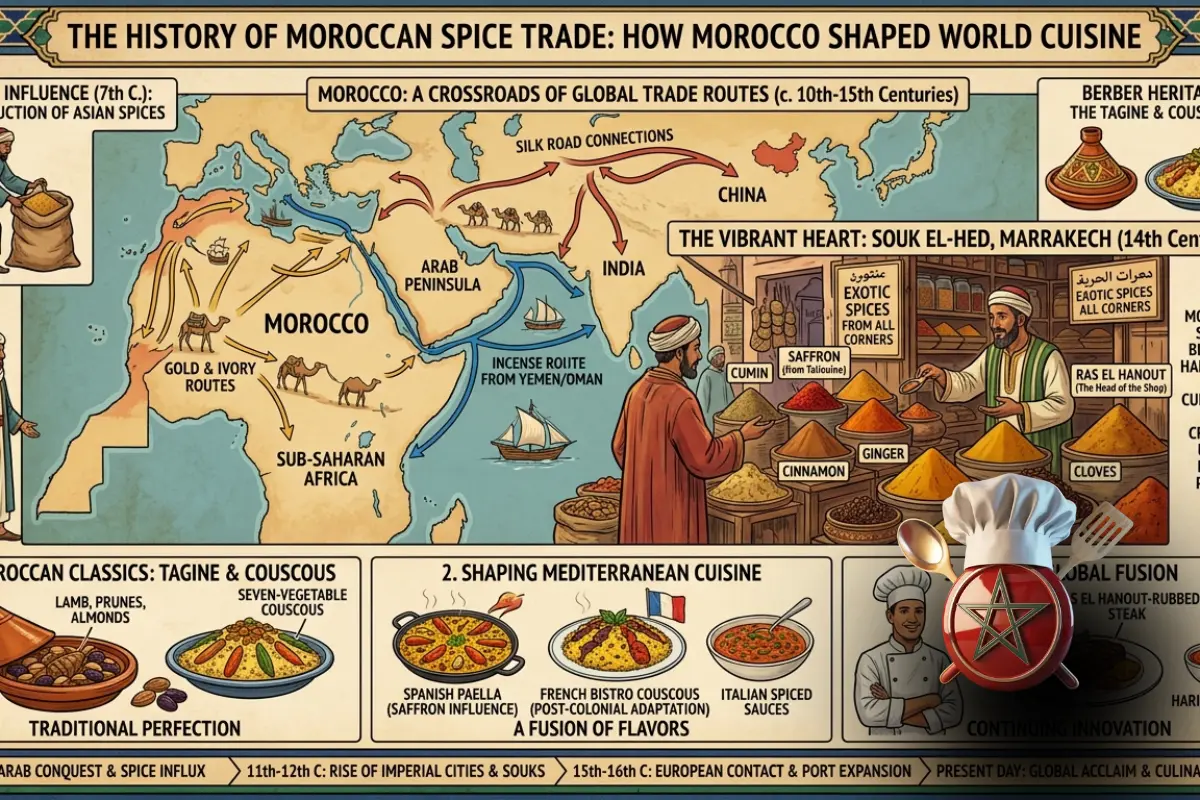
When you walk through the vibrant souks of Marrakech or Fez, breathing in the intoxicating aromas of cinnamon, cumin, and saffron, you're experiencing more than just a sensory delight. You're standing at the crossroads of culinary history, where Morocco's strategic position as a gateway between Africa, Europe, and the Middle East transformed it into one of the world's most influential spice trading hubs.
For over a millennium, Morocco has been the beating heart of the spice trade, serving as a crucial link in the ancient trading networks that connected distant continents. This North African kingdom didn't just facilitate the passage of precious spices; it absorbed, adapted, and refined them, creating a unique culinary identity that would eventually influence kitchens from Andalusia to the Americas.
The story of Moroccan spice trade is not merely about commerce—it's about cultural exchange, culinary innovation, and the birth of flavor profiles that continue to captivate palates worldwide. From the legendary Ras el Hanout blend to the aromatic tagines that have become synonymous with Moroccan cuisine, the spices that passed through Morocco's ancient trade routes left an indelible mark on global gastronomy.
In this comprehensive exploration, we'll journey through the fascinating history of how Morocco became a spice trading powerhouse and examine the profound ways in which this legacy continues to shape contemporary cuisine across the globe.
Morocco's Geographic Advantage: Gateway to Three Continents
Morocco's emergence as a spice trading giant wasn't accidental—it was geography's gift. Positioned at the northwestern tip of Africa, with coastlines touching both the Atlantic Ocean and Mediterranean Sea, Morocco served as the perfect bridge between three continents. This strategic location made it an inevitable stopping point for merchants traveling between sub-Saharan Africa, Europe, and the Middle East.
The Atlas Mountains, running through the heart of Morocco, created natural corridors that guided trade routes, while the Sahara Desert to the south connected the kingdom to the gold and spice-rich regions of West Africa. These geographic features transformed Morocco into what historians call a "commercial crossroads," where traders from diverse cultures converged to exchange not just goods, but culinary knowledge and techniques.
The Berber Foundation
Long before Arab conquest in the 7th century, the indigenous Berber populations had established sophisticated trading networks across North Africa. The Berbers, also known as Amazigh, were master traders who understood the value of spices for both culinary and medicinal purposes. They cultivated and traded native herbs like za'atar, wild mint, and various aromatic plants that grew naturally in the Atlas Mountains.
These early Berber communities developed the foundational spice knowledge that would later be enhanced by successive waves of cultural influence. Their understanding of local flora and their expertise in preserving and blending spices created the bedrock upon which Morocco's spice trade empire would be built.
Roman and Byzantine Influences
During the Roman period (roughly 42-429 AD), Morocco was part of the province of Mauretania Tingitana. Roman merchants introduced Mediterranean spices and herbs, including oregano, rosemary, and bay leaves, while also establishing more formalized trade routes that connected Morocco to the broader Roman Empire.
The Romans were particularly interested in accessing African spices and exotic ingredients through Moroccan ports. They established Volubilis (near modern-day Meknes) as a major trading center, where Roman culinary preferences merged with local Berber traditions, creating some of the earliest fusion cuisine in the region.
The Golden Age: Islamic Conquest and the Rise of Trans-Saharan Trade
The arrival of Islam in Morocco during the late 7th century marked the beginning of what many consider the golden age of Moroccan spice trade. Islamic merchants brought with them not only religious and cultural influences but also an extensive network of trading relationships that stretched from Al-Andalus (Islamic Spain) to Baghdad and beyond.
The Almoravid and Almohad Dynasties
Under the Almoravid dynasty (1040-1147), Morocco experienced unprecedented growth in spice trading. The Almoravids controlled territories from southern Spain to sub-Saharan Africa, creating a vast empire that facilitated the free flow of spices and culinary knowledge. During this period, Moroccan traders established permanent trading posts in cities like Timbuktu, Ghana, and other West African commercial centers.
The subsequent Almohad dynasty (1147-1269) further expanded these trading networks. They were particularly instrumental in developing the trans-Saharan spice routes that brought exotic ingredients from the heart of Africa to Mediterranean markets. Cinnamon, ginger, and black pepper from Asian sources were combined with locally sourced cumin, coriander, and turmeric to create the complex spice blends that would become Morocco's culinary signature.
The Birth of Ras el Hanout
It was during this golden age that Morocco's most famous spice blend, Ras el Hanout, was born. Literally meaning "top of the shop," this complex mixture could contain anywhere from 10 to 50 different spices, depending on the spice merchant's secret recipe. The blend typically included:
- Cardamom and cinnamon from Asia
- Rose petals and dried flowers from Persia
- Hot peppers from sub-Saharan Africa
- Saffron from Kashmir
- Local herbs and spices from the Atlas Mountains
Ras el Hanout represented more than just a spice blend—it was a testament to Morocco's role as a cultural melting pot where ingredients from across the known world could be combined into something entirely new and uniquely Moroccan.
European Encounters: The Portuguese, Spanish, and French Influences
The arrival of European powers on Morocco's coasts brought new dimensions to the spice trade. Unlike the gradual cultural absorption that characterized earlier influences, European contact often involved direct competition for control of spice routes and trading rights.
Portuguese Coastal Trading Posts
Beginning in the 15th century, Portuguese explorers established trading posts along Morocco's Atlantic coast. Cities like Essaouira (then called Mogador) became crucial ports for spice exports to Europe. The Portuguese were particularly interested in accessing the gold and spice routes that terminated in Moroccan ports, often bypassing traditional overland routes through the Ottoman Empire.
Portuguese influence introduced new preservation techniques and trading practices, but perhaps more importantly, it connected Moroccan spices to the broader Age of Exploration. When Portuguese ships carried Moroccan spice blends to their colonies in Brazil and Asia, they spread Moroccan culinary influences to previously unconnected parts of the world.
The Spanish Connection: Al-Andalus Legacy
The relationship between Morocco and Spain was particularly complex and influential. During the Islamic period, Al-Andalus (Islamic Spain) and Morocco formed a cultural and economic unit. Spices flowed freely between Córdoba, Seville, and Moroccan cities like Fez and Meknes.
When Christian forces reconquered Spain, many Muslim and Jewish populations fled to Morocco, bringing with them sophisticated culinary knowledge and spice-working techniques. This migration enriched Morocco's already diverse spice culture and introduced new methods of spice cultivation and processing.
The influence was bidirectional—Spanish cuisine absorbed many Moroccan spice combinations, which is why dishes like paella use saffron and paprika in ways that echo Moroccan cooking techniques, and why Spanish chorizo shares flavor profiles with Moroccan merguez sausages.
French Colonial Impact
The French Protectorate period (1912-1956) brought both challenges and opportunities to Morocco's spice trade. While French colonial policies aimed to control and redirect trade toward French markets, they also modernized transportation and storage facilities, making it easier to export Moroccan spices to European markets.
French culinary techniques merged with traditional Moroccan spice knowledge, creating new hybrid dishes and preparation methods. French chefs working in Morocco during this period were instrumental in documenting traditional Moroccan spice combinations and introducing them to European haute cuisine.
The Spice Routes: From Timbuktu to Toledo
Understanding Morocco's impact on world cuisine requires mapping the actual routes through which spices flowed. These weren't just commercial highways—they were conduits of cultural exchange that carried recipes, cooking techniques, and culinary philosophies across vast distances.
The Trans-Saharan Network
The trans-Saharan routes were perhaps the most important for bringing exotic spices to Morocco. Caravans traveling from cities like Timbuktu, Gao, and Djenné carried:
- Grains of Paradise - A pepper-like spice from West Africa
- Dried ginger - Originally from Asia but cultivated in African kingdoms
- Tamarind - Used both as a spice and preservative
- Various chili peppers - Indigenous to Africa and later the Americas
These routes also brought gold, salt, and ivory, but spices were among the most valuable commodities by weight. A single caravan might carry dozens of different spice varieties, each destined for specific markets and culinary applications.
Mediterranean Coastal Routes
Morocco's Mediterranean ports, particularly Tangier and Tetouan, served as gateways to European markets. Ships departing from these ports carried Moroccan spice blends to:
- Italian city-states like Venice and Genoa
- French Mediterranean ports including Marseille
- Spanish coastal cities
- Ottoman territories in the Eastern Mediterranean
The coastal routes were faster than overland alternatives, making them preferred for high-value, perishable spice products. This maritime network was crucial in establishing Morocco's reputation for quality spice blends in European markets.
Atlantic Trade Networks
With the opening of Atlantic trade routes, Moroccan spices reached the Americas. This connection was particularly significant because it created a circular trade pattern: American crops like tomatoes, potatoes, and new varieties of chili peppers were brought back to Morocco, where they were integrated into traditional spice blends and cooking methods.
Morocco's Signature Spice Blends and Their Global Influence
Morocco's contribution to world cuisine extends far beyond simply facilitating spice trade. Moroccan spice merchants and cooks developed sophisticated blending techniques that created entirely new flavor profiles. These blends became templates that influenced cooking traditions across multiple continents.
Ras el Hanout: The Crown Jewel
As mentioned earlier, Ras el Hanout represents the pinnacle of Moroccan spice blending artistry. Each spice merchant guarded their recipe jealously, and the complexity of the blend demonstrated both their knowledge and access to rare ingredients. Traditional Ras el Hanout might include:
| Spice Category | Common Ingredients | Origin | Flavor Contribution |
|---|---|---|---|
| Warm Spices | Cinnamon, Cardamom, Allspice | Asia/Middle East | Sweet, warming base notes |
| Pungent Spices | Black Pepper, Long Pepper, Grains of Paradise | Africa/Asia | Heat and complexity |
| Aromatic Herbs | Dried Rose Petals, Lavender, Mint | Morocco/Persia | Floral, fresh top notes |
| Earthy Spices | Cumin, Turmeric, Ginger | Middle East/Asia | Depth and earthiness |
| Exotic Additions | Saffron, Mace, Nutmeg | Kashmir/Southeast Asia | Luxury and refinement |
Harissa: The Fiery Ambassador
While often associated with Tunisia, harissa-style chili pastes were developed simultaneously across North Africa, with Morocco contributing its own variations. Moroccan harissa typically incorporates:
- Dried chili peppers (various varieties)
- Garlic and preserved lemons
- Caraway and coriander seeds
- Rose petals for complexity
- High-quality olive oil as a base
This fiery blend traveled with North African communities and influenced hot sauce traditions from the Mediterranean to the Caribbean, where similar pepper-based condiments developed among communities with North African connections.
Chermoula: The Herb Blend
Chermoula represents Morocco's mastery of fresh herb and spice combinations. This versatile marinade and sauce typically combines:
- Fresh cilantro and parsley
- Preserved lemons
- Garlic and ginger
- Cumin and paprika
- Olive oil and lemon juice
Chermoula's influence can be traced in Mediterranean herb blends, Middle Eastern zhug, and even some Latin American chimichurri variations, demonstrating how Moroccan spice knowledge spread through various cultural channels.
Global Impact: How Moroccan Spices Shaped World Cuisines
The true measure of Morocco's influence on world cuisine isn't just in the spices it traded, but in how those spices were integrated into diverse culinary traditions. This influence operated through multiple channels: direct trade relationships, cultural migration, colonial connections, and culinary innovation.
Mediterranean Basin Influence
Moroccan spice combinations profoundly influenced Mediterranean cooking. In Spain, the use of saffron in paella and the paprika-heavy chorizo both reflect Moroccan spice knowledge. Italian cuisine incorporated Moroccan-style spice blends in certain regional dishes, particularly in Sicily and southern Italy, where Arab influence was strongest.
French cuisine, particularly in southern France, shows clear Moroccan influences in dishes like bouillabaisse, which uses saffron and complex spice blends reminiscent of Moroccan fish stews. The French technique of creating spice bouquets and compound seasonings owes much to Moroccan blending traditions.
Sub-Saharan African Connections
Morocco's role in trans-Saharan trade created lasting culinary connections with West and Central African cuisines. The use of complex spice blends in dishes like Senegalese thieboudienne or Nigerian jollof rice reflects techniques and flavor combinations that originated in Moroccan trading centers.
The preservation techniques used for spices during long desert journeys also influenced food preservation methods across the Sahel region, contributing to the development of dried spice pastes and preserved seasoning blends that remain central to West African cooking.
European Colonial Spread
As European powers established colonies, they carried Moroccan spice knowledge with them. French colonists brought Moroccan-influenced cooking to West Africa, Madagascar, and Southeast Asia. Portuguese traders spread Moroccan spice combinations to Brazil, Goa, and Macau.
This colonial spread explains why dishes in places like Goa use spice combinations that echo Moroccan blends, or why certain Brazilian dishes incorporate North African-style seasoning techniques alongside indigenous ingredients.
New World Connections
The connection between Morocco and the Americas was particularly transformative. While Moroccan spices traveled to the New World, American ingredients like tomatoes, chili peppers, and potatoes were integrated into Moroccan cuisine. This exchange created new fusion dishes that combined Moroccan spice knowledge with American ingredients.
In the United States, Moroccan influence can be traced in Creole and Cajun cuisines, where complex spice blends and preservation techniques show similarities to Moroccan methods. The use of spice rubs in American barbecue traditions also reflects techniques that originated in North African spice trading centers.
Modern Legacy: Moroccan Spices in Contemporary Global Cuisine
Today's global culinary landscape continues to be shaped by Morocco's spice trade legacy. Modern chefs around the world draw inspiration from traditional Moroccan spice combinations, while food manufacturers incorporate Moroccan-style blends into mass-market products.
Restaurant and Fine Dining Influence
High-end restaurants worldwide feature dishes that showcase Moroccan spice techniques. From New York to London to Sydney, chefs use Ras el Hanout, preserved lemons, and harissa as signature ingredients. The popularity of Moroccan restaurants has also introduced mainstream diners to traditional spice combinations.
Fusion cuisine particularly benefits from Moroccan spice knowledge. Chefs combine Moroccan spicing techniques with local ingredients to create innovative dishes that honor both traditions while creating something entirely new.
Home Cooking Revolution
The globalization of food culture has made Moroccan spices accessible to home cooks worldwide. Specialty stores and online retailers now stock traditional Moroccan spice blends, while cookbooks and cooking shows teach home cooks how to use these complex seasonings.
This democratization of Moroccan spice knowledge has led to creative adaptations where home cooks integrate Moroccan spicing techniques into their own cultural cooking traditions, creating new fusion dishes that continue the tradition of culinary innovation that has always characterized Moroccan cuisine.
Comparison Tables: Moroccan Spice Influence Across Cultures
| Region/Cuisine | Moroccan-Influenced Dish | Key Spices Used | Adaptation Method |
|---|---|---|---|
| Spanish | Paella | Saffron, Paprika | Direct cultural transfer via Al-Andalus |
| French (Provençal) | Bouillabaisse | Saffron, Complex herb blends | Mediterranean trade connections |
| Italian (Sicilian) | Caponata | Cinnamon in savory dishes | Arab conquest influence |
| West African | Jollof Rice | Complex spice blends | Trans-Saharan trade routes |
| Indian (Goan) | Vindaloo | Portuguese-Moroccan spice combinations | Colonial Portuguese influence |
| American (Creole) | Jambalaya | Complex spice blends, saffron | French colonial connections |
| Spice/Blend | Traditional Moroccan Use | Global Adaptations | Modern Applications |
|---|---|---|---|
| Ras el Hanout | Tagines, Couscous, Meat dishes | European spice blends, American rubs | Fine dining, Fusion cuisine |
| Harissa | Condiment, Marinade | Hot sauces worldwide, Chili pastes | Mass market condiments, Gourmet products |
| Preserved Lemons | Tagines, Salads | Mediterranean preserved citrus | Modern fine dining, Artisanal products |
| Chermoula | Fish marinades, Vegetable dishes | Herb sauces, Pesto variations | Contemporary herb blends, Healthy cooking |
Frequently Asked Questions
How did Morocco become such an important center for spice trading?
Morocco's strategic geographic position at the crossroads of Africa, Europe, and the Middle East made it a natural hub for spice trading. The combination of Atlantic and Mediterranean coastlines, proximity to both European and African markets, and established trans-Saharan trade routes created ideal conditions for Morocco to become a major spice trading center. Additionally, successive cultural influences from Berbers, Arabs, and Europeans contributed diverse spice knowledge that Moroccan merchants could synthesize and trade.
What are the most important spices that Morocco introduced to world cuisine?
While Morocco was more of a synthesizer than originator of individual spices, the kingdom's most important contributions were sophisticated spice blends like Ras el Hanout, harissa-style chili blends, and chermoula. Morocco also popularized the use of preserved lemons, saffron in savory dishes, and the technique of combining sweet and savory spices in complex blends. These combinations influenced spicing techniques worldwide.
How can modern cooks incorporate authentic Moroccan spice techniques?
Modern cooks can start by learning to make basic Moroccan spice blends like a simple Ras el Hanout (combining cumin, coriander, cinnamon, ginger, and paprika) or harissa. The key to Moroccan spicing is layering flavors—using whole spices that are toasted and ground fresh, combining sweet and savory elements, and allowing spice blends to marry with oil or other liquids before adding to dishes. Start with traditional recipes like tagines or couscous to understand how spices interact.
What role did the spice trade play in Morocco's economic development?
The spice trade was fundamental to Morocco's historical economic prosperity. It provided revenue through taxation of trade caravans, created employment in ports and trading centers, and established Morocco as an essential link in international commerce. The wealth generated from spice trading funded the construction of major cities, palaces, and infrastructure. Even today, spice trading and related food exports remain important economic sectors for Morocco.
How has globalization affected traditional Moroccan spice trading?
Globalization has transformed Moroccan spice trading by creating both opportunities and challenges. On the positive side, there's increased international demand for authentic Moroccan spices, better transportation and storage methods, and new markets in countries with growing interest in North African cuisine. However, globalization has also brought competition from mass-produced spice blends and pressure to standardize traditional recipes. Many traditional spice merchants now balance maintaining authentic methods with meeting modern commercial demands.
Conclusion: The Enduring Legacy of Morocco's Spice Trade
The story of Moroccan spice trade is ultimately a story about human connection—how the desire for flavor, sustenance, and culinary adventure drove people to cross deserts, oceans, and cultural boundaries. Morocco's position as a gateway between worlds allowed it to become more than just a conduit for spices; it became a laboratory where different culinary traditions could meet, mingle, and create something entirely new.
From the bustling souks of medieval Fez to the modern spice sections of supermarkets in New York or London, Morocco's influence on world cuisine continues to unfold. Every time a chef reaches for saffron to add to a savory dish, every time a home cook combines sweet and warming spices in an unexpected way, every time someone discovers the complexity that comes from layering multiple spice flavors, they're participating in a culinary tradition that Morocco helped create and spread across the globe.
The legacy of Morocco's spice trade teaches us that cuisine is never static or isolated. The flavors we consider authentic to our own cultures often carry the DNA of distant places and ancient trade routes. In Morocco's case, that DNA includes Berber knowledge of mountain herbs, Arab mastery of spice blending, European preservation techniques, and African cultivation methods—all synthesized into something uniquely Moroccan yet universally appealing.
As we continue to explore global cuisine and seek new flavor experiences, Morocco's approach to spices offers valuable lessons. The Moroccan tradition of respecting each spice's individual character while understanding how they work in harmony with others provides a model for contemporary fusion cooking. The emphasis on quality, complexity, and balance that characterized traditional Moroccan spice merchants continues to influence how we think about seasoning food today.
Perhaps most importantly, Morocco's spice trade history reminds us that food is one of humanity's greatest diplomatic tools. Long before formal treaties or international agreements, spice merchants were building bridges between cultures, creating understanding through shared meals and mutual appreciation for flavor. In our increasingly connected world, the Moroccan tradition of welcoming foreign influences while maintaining cultural identity offers inspiration for how we might continue to share and celebrate our diverse culinary heritages.
The aromatic legacy of Morocco's spice trade will undoubtedly continue to evolve, influencing new generations of cooks and eaters who discover the magic that happens when carefully chosen spices come together in perfect harmony. In every perfectly balanced tagine, every complex Ras el Hanout blend, every dish that marries sweet and savory in unexpected ways, we taste the continuation of a story that began over a thousand years ago in the markets and caravans of Morocco.