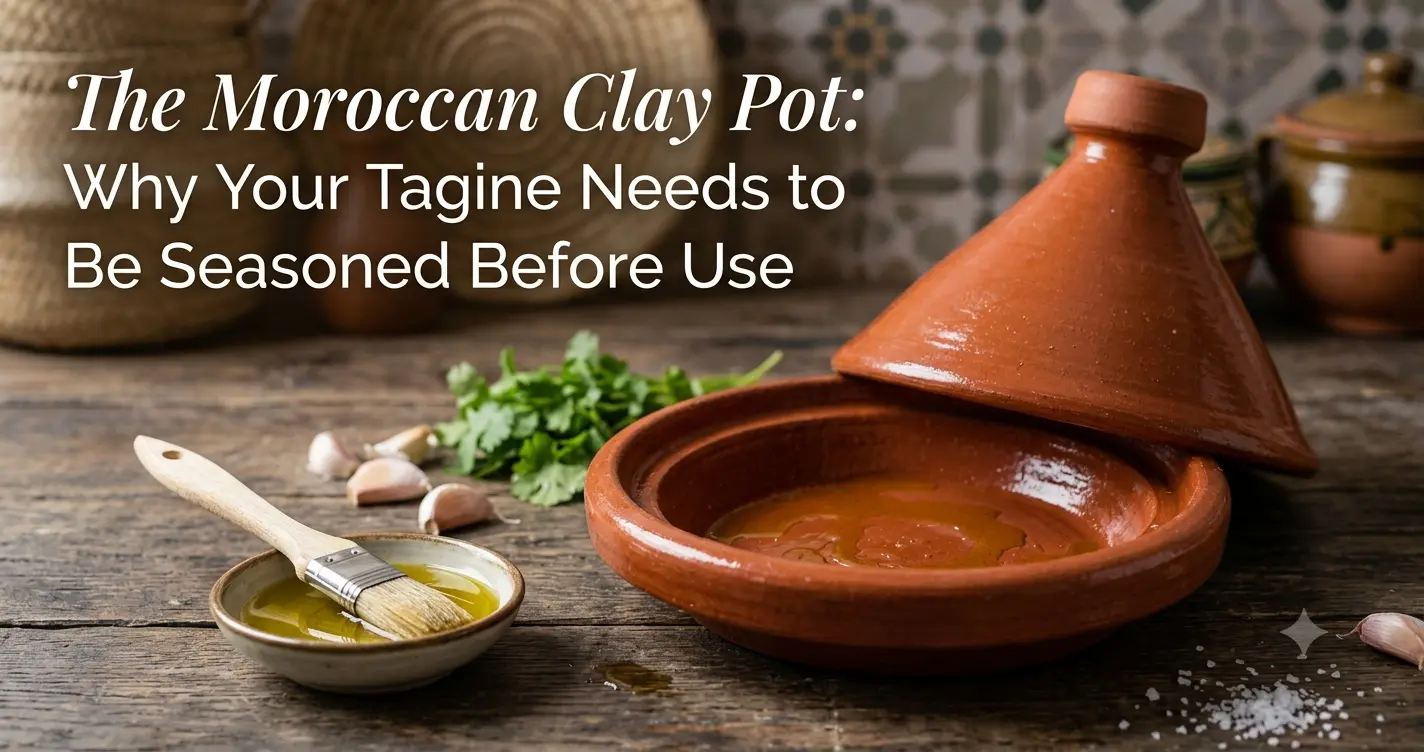
There is a moment — and if you have ever stood in a Moroccan souk, you will know exactly the one I mean — when you spot it for the first time. Sitting on a low wooden shelf, barely lit by the thin shafts of light filtering through the market canopy, a raw, unglazed clay tagine sits waiting. It smells of earth and sun-dried riverbed, of ancient Atlas Mountain clay that has been worked by the same families for generations. You reach out, run your thumb across its porous, slightly rough surface, and something deep and primal inside you understands: this is not just a cooking vessel. This is living history. This is culture made tangible. And if you are about to take one of these beauties home and place it directly on your stovetop flame without a single word of preparation — please, please, put it down and read this first.
Seasoning a Moroccan clay tagine before its first use is not optional. It is not a quaint old tradition you can skip because you are in a hurry. It is the single most important thing you will ever do for your tagine, and for every magnificent slow-cooked lamb shank, preserved lemon chicken, and spiced vegetable medley that will ever emerge from it. At MaCooking, we have fielded hundreds of questions from passionate home cooks across the United States, the UK, Canada, Australia, and Europe asking why their brand-new tagine cracked on first use, why their food tastes faintly of raw clay, or why the base has already started to show hairline fractures. The answer, almost universally, is the same: the tagine was never properly seasoned.
In this definitive guide, I am going to walk you through everything — the history, the science, the technique, the cultural significance, and the practical step-by-step process — so that your tagine becomes the heirloom-quality cooking vessel it was always meant to be.
1. A Brief History of the Moroccan Tagine: More Than Just a Pot
To understand why seasoning matters, you first need to understand what a tagine actually is — not in the modern, Instagram-filtered sense of a photogenic conical pot sitting on a table, but in the deep, historically rooted sense that Moroccans themselves carry.
The word tagine (also spelled tajine) refers both to the clay vessel and to the slow-cooked dish prepared within it. The vessel itself has been documented in North African culinary history for over a thousand years, with archaeologists finding clay cooking pots with conical lids in Berber settlements dating back centuries before the Arab conquest of the Maghreb. The Amazigh (Berber) people of the Atlas Mountains were using porous clay vessels to cook over open fires long before the rich spice trade routes of the medieval Islamic world brought cinnamon from Ceylon, saffron from Persia, and ginger from sub-Saharan caravans into Moroccan kitchens.
The genius of the tagine's design — that distinctive conical lid rising to a blunt peak — is an engineering solution to the harsh realities of desert and mountain cooking. In an environment where water is precious and fuel is scarce, the cone catches rising steam, condenses it, and funnels it back down over the food, creating a self-basting, moisture-preserving cooking cycle that requires remarkably little water and fuel. It is one of the most thermally efficient cooking systems ever devised by a human civilization, and it was invented not by engineers but by home cooks trying to feed their families in difficult terrain.
The Clay Itself: A Living Material
Traditional Moroccan tagines are made from local clay — particularly the reddish, iron-rich clay found in regions around Marrakech, Salé, and the Rif Mountains. This clay is porous by nature. It breathes. Under heat, it expands. When cold, it contracts. This constant micro-movement is what gives clay cookware its extraordinary ability to distribute heat evenly and gently — but it is also what makes an unseasoned tagine so vulnerable to thermal shock.
Think of a new, unseasoned clay tagine as a sponge that has been sitting in a dry room for months. Its pores are open, its structure is brittle in the way that all very dry porous materials are brittle. Place it directly over a flame, introduce sudden, intense heat, and the rapid, uneven expansion of those microscopic clay structures will crack the vessel — sometimes immediately, sometimes after a second or third use. Seasoning closes those pores, deposits protective oils and minerals deep into the clay's structure, and transforms a fragile piece of earthenware into a resilient, seasoned cooking instrument.
"In Morocco, we say the tagine must be taught before it can teach your food. A new tagine knows nothing of heat. You must introduce them slowly, with oil and water and patience, the way you would introduce a young apprentice to a hot kitchen. Only then will it serve you faithfully for years." — My grandmother, Fatima, Marrakech, circa 1987, a memory I carry into every kitchen I enter.
2. Understanding Clay Porosity: The Science Behind Seasoning
I want to spend a moment here on the actual science, because understanding why something works always makes you better at doing it. You do not need a chemistry degree — but you do need to understand what is happening inside that clay when you season it.
What Happens Inside Unglazed Clay
Unglazed clay is, at its microscopic level, a matrix of mineral particles — primarily silica, alumina, iron oxides, and various trace minerals — held together in a fired but still-porous lattice. When clay is fired in a kiln (or traditionally, in an open wood fire), the process drives out most of the water and organics, but leaves behind thousands of tiny channels and pores running through the material.
These pores serve a beautiful culinary function during cooking: they allow minimal moisture to migrate through the vessel walls, creating a very slight evaporative cooling effect that helps maintain gentle, even temperatures inside the pot. This is part of why food cooked in an authentic clay tagine genuinely tastes different from food cooked in enameled cast iron or stainless steel — the clay is an active participant in the cooking process, not merely a passive container.
However, those same open pores present two problems for a new, unseasoned tagine:
- Thermal vulnerability: Open pores heat unevenly and rapidly. The outer surface of the clay heats faster than the interior, creating stress fractures along pore lines when subjected to sudden or intense heat.
- Flavor contamination: Raw, unfired clay minerals can leach into food, producing a distinctly earthy, sometimes slightly bitter clay taste that ruins an otherwise beautifully spiced dish.
- Structural weakness: Dry, open-pored clay is significantly more brittle than clay whose pores have been infused with polymerized oils and mineral deposits from the seasoning process.
- Absorption of soap residues: If you wash an unseasoned tagine with soap, those pores will absorb detergent compounds that will then leach into your first batch of food. Never use dish soap on an unglazed tagine.
What Seasoning Actually Does
When you soak a tagine in water and then rub it with olive oil before its first heat treatment, you are doing several things simultaneously:
- Hydration: Water penetrates the open pores, hydrating the clay and making it more flexible and less brittle before the first heat exposure.
- Oil polymerization: When olive oil is introduced into a hydrated clay surface and then heated, the oil undergoes a process called polymerization — the long-chain fatty acid molecules link together and essentially become a solid, non-stick coating embedded within the clay's pores. This is the same fundamental process that seasons cast iron skillets.
- Pore sealing: The combination of polymerized oil and mineral deposits from the water and oil physically narrows the pores, reducing thermal stress and leaching.
- Garlic treatment: Many traditional Moroccan cooks (and I am firmly in this camp) also rub the interior of a new tagine with a cut garlic clove before the first oil treatment. The sulfur compounds in garlic are mildly antibacterial and help neutralize raw clay odors.
3. Glazed vs. Unglazed Tagines: What You Need to Know Before You Buy
Before we get into the seasoning process itself, I want to address a question that comes up constantly in the comment sections here at MaCooking: "Do I need to season a glazed tagine?"
The answer is nuanced, and the following comparison table should help clarify the differences between the main types of tagines available to Western buyers.
Comparison Table: Types of Moroccan Tagines
| Feature | Traditional Unglazed Clay | Partially Glazed (Interior Only) | Fully Glazed Decorative | Cast Iron / Enameled |
|---|---|---|---|---|
| Authenticity | Highest — traditional Moroccan use | High — common in Moroccan households | Low — primarily decorative | Medium — Western adaptation |
| Requires Seasoning | Yes — absolutely essential | Yes — base and exterior still porous | Minimal — glaze acts as barrier | No — follow cast iron instructions |
| Heat Distribution | Exceptional — slow, even, gentle | Very good | Good | Good but heavier |
| Flavor Impact | Significant — clay enhances flavor | Moderate | Minimal | Minimal |
| Durability (seasoned) | Excellent — can last decades | Very good | Moderate — glaze can chip | Excellent |
| Stovetop Compatible | Yes — with diffuser recommended | Yes — with diffuser recommended | Often oven only | Yes — direct heat fine |
| Price Range (USD) | $20–$80 | $30–$120 | $40–$200+ | $80–$300+ |
| Oven Safe | Yes | Yes | Usually yes | Yes |
The important takeaway here: if you have purchased an authentic, unglazed Moroccan clay tagine — the kind that is rough to the touch, reddish-brown or buff-colored, and smells distinctly earthy — you must season it before use, full stop. If you have a partially glazed tagine, you should still season it, paying particular attention to the unglazed base and exterior. A fully decorative, heavily painted tagine is generally not safe for cooking at all and should be kept as a serving vessel only.
How to Identify an Authentic, Cookware-Grade Tagine
- It feels heavy and substantial for its size
- The surface is rough and matte, not shiny
- It smells of raw earth or clay
- When you tap it gently with your knuckle, it produces a slightly dull, resonant sound (a clear, ringing sound may indicate glazing)
- The base (the wide, shallow cooking bowl) is unglazed on the outside
- It may have been purchased from a Moroccan pottery market, a reputable online Moroccan goods retailer, or a specialty cookware store
4. The Complete Step-by-Step Tagine Seasoning Process
Now we arrive at the heart of this guide. I am going to walk you through the process exactly as I learned it from the potters of Marrakech's Bab Doukkala neighborhood and from years of cooking in traditional Moroccan kitchens. This is not a rushed, five-minute process. This is a ritual, and it deserves to be treated as one.
What You Will Need
- Your new, unglazed clay tagine (both the base and the lid)
- Enough cold water to fully submerge the tagine (a large bucket, sink, or bathtub works perfectly)
- High-quality extra-virgin olive oil (this is Morocco — please do not use vegetable oil)
- 2–3 cloves of fresh garlic, halved
- A pastry brush or your clean hands
- A heat diffuser (a metal plate that sits between your burner and the tagine — strongly recommended for gas and electric stovetops)
- Paper towels or a clean cloth
- Patience — this process takes approximately 24–48 hours from start to finish
Step 1: The Long Soak (12–24 Hours)
Place both the base and the lid of your tagine in cold water. A large bucket, a clean utility sink, or even a bathtub works perfectly. The tagine needs to be fully submerged — weigh it down with a heavy pot or plate if necessary, as the clay may initially float. Leave it to soak for a minimum of 12 hours. I prefer 24 hours. The clay will absorb an extraordinary amount of water during this time, and you will likely see bubbles rising from the tagine as trapped air is displaced. This is exactly what you want.
Why so long? Remember what I said about open, dry pores. We want to saturate those pores completely with water before we introduce any heat. A fully hydrated clay tagine is flexible, resilient, and far less susceptible to the thermal shock that cracks dry clay on first use.
Step 2: Air Drying (2–4 Hours)
Remove your tagine from the water and place it upside down on a clean towel to drain. Then set it right-side up and allow it to air dry for 2–4 hours. You want the surface to feel slightly damp but not dripping wet. Do not rush this stage with a towel — gentle air drying is fine. The clay should still feel cool and slightly moist to the touch when you move on to the next step.
Step 3: The Olive Oil Treatment
This is where the magic begins. Using your pastry brush or your clean hands (I always use my hands — you get a much better feel for how much oil is being absorbed), coat the entire interior surface of the tagine base generously with extra-virgin olive oil. Do not be shy — you want the clay to absorb oil, not just have a surface coating. Also coat the interior of the lid, and then coat the exterior of both pieces as well.
Now take your halved garlic cloves and rub them vigorously over the interior surfaces of both pieces. The garlic juice will mix with the olive oil and penetrate the clay, helping to neutralize raw clay odors and impart a very gentle, deeply traditional flavor foundation to the vessel.
Once oiled and garlicked, fill the base of the tagine with water to about one-third full. Add a splash of olive oil to this water — perhaps two tablespoons. This water-oil mixture will steam during the heating process and help carry oil deeper into the clay from the inside.
Step 4: The First Heating (The Critical Stage)
Place your heat diffuser on your burner. If you are using an electric stovetop or a gas range, the diffuser is not optional — it is essential. Direct, concentrated heat on an unseasoned clay base creates the very thermal stress you are trying to prevent. The diffuser spreads the heat gently and evenly across the entire base surface.
Place your oiled, water-filled tagine on the diffuser. Put the lid on. Turn the heat to the absolute lowest setting your burner allows. Leave it there. Do not be tempted to increase the heat. Do not hover anxiously. Just let it warm up slowly over 30–40 minutes.
After 30–40 minutes on low, you may increase the heat to medium-low. Continue heating for another 30–40 minutes. The water inside will begin to simmer gently. This is perfect — you want a gentle simmer, not a rolling boil. The steam is doing important work, driving olive oil deeper into the clay pores from the inside.
After the second 30–40 minute period, turn off the heat and allow the tagine to cool completely and naturally on the stovetop. Do not move it to a cold surface, do not run cold water over it, and do not try to speed up the cooling. Thermal shock can happen just as easily during the cooling phase as during heating. Let it cool for at least 2 hours — longer is better.
Step 5: The Second Oil Treatment and Rest
Once completely cool, examine your tagine. You will likely notice that the clay has darkened slightly from the oil treatment and heating — this is completely normal and actually a sign that the seasoning is working. Apply another coat of olive oil to the interior surfaces, replace the lid, and allow the tagine to rest and absorb the oil for another 12–24 hours at room temperature before use.
Step 6 (Optional but Recommended): The Oven Method for Extra Seasoning
For maximum durability and seasoning depth, many Moroccan cooks (and I recommend this to all beginners) follow up the stovetop heating with an oven treatment. After the second oil treatment and rest, preheat your oven to 300°F (150°C). Place the oil-coated tagine (base and lid, both interior-oiled) in the cold oven. Allow the oven to reach temperature with the tagine inside — never place a cold clay vessel in a preheated oven. Bake for one hour at 300°F, then turn off the oven and allow the tagine to cool inside it with the door closed. The gradual, even heat of an oven is ideal for polymerizing the olive oil throughout the clay's pore structure.
After this oven treatment, your tagine is fully seasoned and ready for its first real cooking adventure.
5. First Use and Ongoing Care: Building Your Tagine's Seasoning Over Time
Seasoning is not a one-time event — it is a continuous process that deepens and improves every time you cook with your tagine. The first several meals you cook should be relatively simple and liquid-rich: a vegetable tagine, a chicken and olive dish, a simple lamb with tomatoes and onions. These moisture-rich dishes continue to season the clay during cooking, and the gradually building layers of polymerized oils and food residues create what French cooks call a patine — a seasoned patina that is the hallmark of a well-used, well-loved clay pot.
Ongoing Tagine Care Rules
- Never use dish soap. Soap will penetrate the porous clay and ruin your seasoning — and your next meal. Rinse with hot water and use a stiff brush or coarse salt as a scrub if needed.
- Always use a heat diffuser on stovetop. Even a well-seasoned tagine benefits from diffused heat, particularly when cooking on high-output gas burners.
- Never subject your tagine to sudden temperature changes. Do not place a hot tagine on a cold counter, do not add cold liquid to a hot tagine, and do not put a cold tagine in a hot oven.
- Re-oil periodically. After every four to five uses, rub a thin coat of olive oil on the interior and allow it to absorb before the next cooking session.
- Store with the lid ajar. Clay breathes, and sealing a tagine tightly in storage can encourage mold growth in the residual moisture. Store it with the lid slightly open in a well-ventilated cabinet.
- Never use metal utensils on the interior surface. Wood or silicone only.
Comparison Table: Seasoned vs. Unseasoned Tagine Cooking Results
| Characteristic | Unseasoned Tagine | Properly Seasoned Tagine |
|---|---|---|
| Risk of Cracking | Very high — especially on first use | Very low — clay is resilient and flexible |
| Food Flavor | May taste of raw clay or minerals | Clean, enhanced by gentle clay minerality |
| Non-stick Properties | None — food sticks significantly | Good — polymerized oil coating resists sticking |
| Heat Distribution | Uneven — risk of hot spots | Even and gentle throughout |
| Moisture Retention | Poor — pores too open, excess evaporation | Excellent — controlled moisture cycling |
| Lifespan | Short — likely to crack within 3–5 uses | Long — can last 10–20+ years with care |
| Odor During Cooking | Strong clay or mineral smell | Neutral to pleasantly earthy |
| Food Safety | Potential mineral leaching | Safe — sealed pores prevent leaching |
6. Common Mistakes Western Cooks Make With Tagines (And How to Avoid Them)
I want to be honest here: these are not mistakes made by careless cooks. They are mistakes made by enthusiastic, well-intentioned cooks who simply were not given the right information at the point of purchase. This is one of the reasons MaCooking exists — to bridge the gap between the deep, practical knowledge that Moroccan home cooks carry intuitively and the information that Western cooks need to access it authentically.
Mistake 1: Using the Tagine Straight Out of the Box
This is the most common and most devastating mistake. A beautiful new tagine arrives, there is excitement, there is a recipe bookmarked, and the tagine goes straight from its packaging onto a hot burner. Within twenty minutes, there is a crack in the base. The tagine is ruined. The cook is heartbroken. The fix: twenty-four hours of soaking and a proper seasoning ritual, as described above.
Mistake 2: Cooking on High Heat
A tagine is a slow-cooking vessel. It is designed for low, gentle, patient heat. High heat will crack an unglazed tagine and burn food in a glazed one. The rule in every Moroccan kitchen I have ever cooked in: if your tagine is making aggressive bubbling sounds with the lid rattling, the heat is too high. You should hear a quiet, gentle simmer — almost a whisper.
Mistake 3: Washing With Dish Soap
I will say it again because it bears repeating: never use dish soap or detergent on an unglazed clay tagine. The porous clay will absorb the soap, and your next tagine will taste like a clean kitchen rather than a Moroccan feast. Hot water, a stiff brush, and coarse salt are all you need.
Mistake 4: Skipping the Heat Diffuser
Gas burners, in particular, produce intense, concentrated heat directly under the center of the tagine base. This creates a dramatic temperature differential between the center and the edges of the base — exactly the thermal stress condition that causes cracking. A simple, inexpensive metal heat diffuser (available at any kitchen supply store for under $15) solves this problem entirely by distributing the flame's heat evenly across the entire base surface.
Mistake 5: Storing With the Lid Sealed
After washing and drying your tagine, always store it with the lid slightly ajar or turned upside down in the base. Trapping residual moisture inside a sealed clay tagine can lead to mold growth inside the vessel — particularly in humid climates. A well-ventilated storage method keeps your tagine fresh and ready for its next use.
Mistake 6: Using the Tagine Directly on an Induction Cooktop
Clay tagines are not compatible with induction cooktops, which require ferromagnetic cookware to generate heat. If you have an induction cooktop, you have two options: use an oven exclusively for tagine cooking, or invest in a cast-iron or enameled steel tagine specifically designed for induction. The results will not be identical to traditional clay, but the flavors will still be excellent with the right spice work and technique.
7. The Cultural Dimension: What Seasoning Your Tagine Really Means
I want to close the main body of this article with something that goes beyond technique — because in Morocco, cooking is never merely technique. It is relationship. It is conversation between the cook, the ingredient, and the vessel. And seasoning a tagine is the beginning of a very long and deeply satisfying conversation.
In traditional Moroccan households — particularly in the medinas of Fès, Meknès, and Marrakech — a family's tagine is often decades old. It has cooked the wedding feast and the Eid lamb. It has bubbled quietly through rainy winter afternoons and been carried to communal ovens during Ramadan. Its interior is so deeply seasoned that it is almost black, a built-up patina of a hundred years of olive oil, spices, preserved lemon, and slow-cooked collagen from a thousand lamb shoulders. It is, quite literally, irreplaceable — not because of its monetary value, which is nothing, but because of what it carries.
When you season your tagine properly, you are beginning that story. You are committing to the vessel. You are saying: I will learn your rhythms. I will not rush you. I will give you time and oil and patience, and in return, you will give me food that no other pot can produce. That is a promise worth keeping.
For those who want to go deeper into the world of Moroccan clay cooking — understanding the regional differences between a Fès-style tagine and a Marrakech-style one, learning which traditional tagine recipes are best suited to a newly seasoned vessel, or exploring the fascinating history of Moroccan pottery towns — the resources and recipes at MaCooking offer some of the most comprehensive Moroccan culinary content available in English. We are deeply committed to making authentic Moroccan cooking accessible without stripping away the knowledge and context that makes it meaningful.
Frequently Asked Questions About Tagine Seasoning
Q1: My tagine developed a small hairline crack during the soaking or first heating. Is it ruined?
Not necessarily. Hairline cracks that do not go fully through the clay wall are relatively common in new, inexpensive tagines and may seal over with continued seasoning and use. If you can hold the base up to strong light and see the crack glowing through the full thickness of the clay, however, the structural integrity is compromised and you should not cook in it — particularly on a stovetop. Use it as a serving vessel instead. A crack that is surface-level only will often close and stabilize as the seasoning builds up. To be safe, after discovering a hairline crack, complete the full seasoning process including the oven method described in Step 6, as the gradual, even heat of an oven is gentler and more likely to help the crack stabilize than stovetop heat.
Q2: Can I use any oil for seasoning, or does it have to be olive oil?
Traditionally and culturally, olive oil is the correct choice for a Moroccan tagine, and I would strongly advocate for it on both culinary and practical grounds. Extra-virgin olive oil has a relatively high concentration of oleic acid, which polymerizes well under the moderate temperatures used in tagine cooking. It also imparts a very subtle, authentic flavor to the clay that genuinely affects the taste of food cooked in it. That said, if you do not have olive oil, a high-quality, pure vegetable oil or grapeseed oil with a decent smoke point (above 375°F / 190°C) will work as a functional substitute. Avoid refined coconut oil or butter — both have flavor profiles that can leave unwanted residues in the clay. Never use extra-light or refined olive oil — the refining process removes many of the natural compounds that aid polymerization.
Q3: How do I know when my tagine is fully seasoned and ready for cooking?
After the initial seasoning process (soaking, oil treatment, stovetop heating, and ideally the oven treatment), your tagine is ready for its first cooking use. However, it is important to understand that seasoning is a continuum — your tagine gets better with every use. Signs that your tagine is well-seasoned include: a darkened, slightly shiny interior surface; a neutral or pleasantly earthy smell (not raw clay); food that releases easily from the surface; and a general sense of resilience and solidity when handled. A fully mature, deeply seasoned tagine may take six to twelve months of regular weekly cooking to develop — and it will be noticeably superior to its freshly seasoned state.
Q4: My tagine smells strongly of clay even after seasoning. Is this normal, and will it affect my food?
A mild, earthy clay aroma is completely normal even in a fully seasoned tagine and is actually part of what gives tagine cooking its distinctive character. However, if the smell is strong and somewhat chemical or mineral — like wet concrete or a building site — the tagine may need additional seasoning cycles. I recommend: soaking again in cold water for 12 hours, re-coating with olive oil and garlic, and repeating the stovetop and oven heating process. Some artisan tagines, particularly those fired at lower temperatures in traditional wood kilns, have a more pronounced raw clay aroma that requires two or even three full seasoning cycles to fully neutralize. If the smell persists after three complete seasoning cycles, you may have a tagine that was improperly fired — in which case, contact your retailer about a replacement.
Q5: I have been using my tagine for months but did not season it properly at the start. Is it too late to season it now?
It is almost never too late to improve your tagine's seasoning. If your tagine has survived several months of use without cracking, it has actually already begun developing a natural seasoning from the oils and cooking liquids of your recipes. To bring it up to fully seasoned status, I recommend a thorough re-seasoning process: wash it with hot water (no soap), allow it to dry completely over 24–48 hours, then apply a generous olive oil treatment to all surfaces and run it through the full oven seasoning method (place in cold oven, heat to 300°F / 150°C, bake for one hour, cool in the oven). Repeat this oil-and-oven treatment two to three times over the course of a week, and your tagine will be significantly more resilient, non-stick, and flavor-positive going forward.
Conclusion: The Patience That Makes the Dish
There is a reason that Moroccan cuisine is consistently ranked among the world's great food cultures — not just for its extraordinary complexity of spice and its breathtaking range of flavors, but for its fundamental philosophy of cooking. Moroccan cooking teaches patience. It teaches respect for ingredients. It teaches you to work with your materials rather than against them. And nowhere is that philosophy more concretely expressed than in the relationship between a cook and their tagine.
Seasoning your tagine is not an inconvenient extra step between you and your first batch of slow-cooked lamb with preserved lemons and olives. It is the beginning of something lasting. It is the moment you and your tagine make a mutual commitment — you give it time and oil and care, and it gives you decades of the most extraordinary slow-cooked food you have ever tasted, food that carries in every mouthful the memory of Atlas Mountain clay and centuries of Moroccan kitchen wisdom.
Take the time. Do it properly. Your future self — sitting at a table with a steaming tagine in front of you, the scent of cumin and saffron and preserved lemon filling the room — will be deeply, profoundly grateful.
For more expert guidance on traditional Moroccan cooking techniques, authentic recipes from across Morocco's extraordinary regional culinary landscape, and deep-dive guides into Moroccan ingredients and spice blends, visit MaCooking.com — your home for everything authentic Moroccan cuisine has to offer. We will see you in the kitchen.