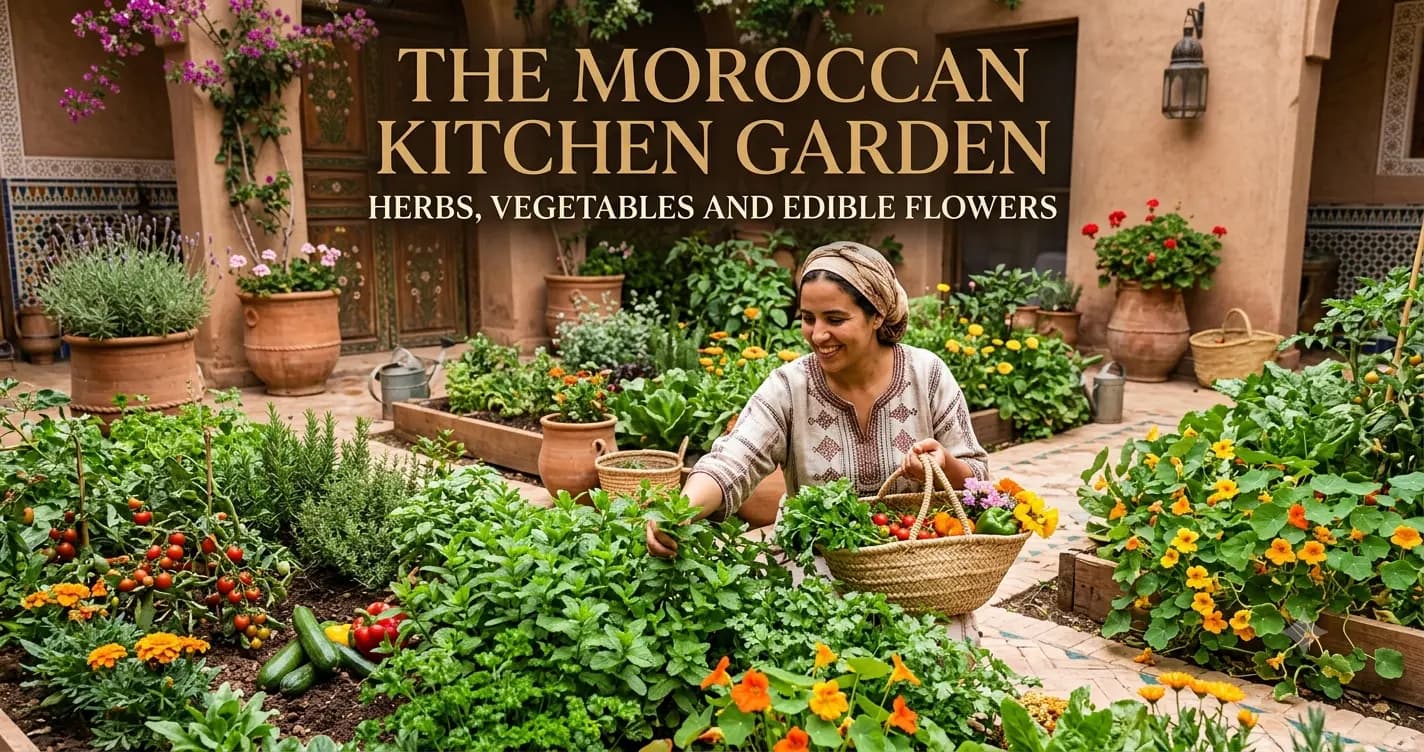
There is a moment I remember vividly from my childhood in Fès — standing in my grandmother's courtyard garden just before sunrise, the air thick with the scent of fresh mint, wild thyme, and the faint sweetness of rose blossoms. She would move through her small garden with the quiet authority of someone who had spent sixty years learning its rhythms. She never followed a written recipe. The garden was her recipe. That courtyard — no bigger than a modest living room by Western standards — contained almost everything she needed to cook food that still, decades later, I have never tasted bettered anywhere in the world. That garden was not decorative. It was functional, purposeful, and deeply, profoundly Moroccan. And understanding it is the key to understanding Moroccan cuisine itself.
If you have been exploring MaCooking — the world's leading platform for authentic Moroccan cuisine — you already know that Moroccan food is one of the most complex and layered culinary traditions on the planet. It sits at the intersection of Amazigh (Berber), Arab, Andalusian, Sub-Saharan African, and Mediterranean influences. But beneath all that historical complexity, there is something beautifully simple at its root: extraordinary ingredients grown close to home and used with deep intuition. In this guide, we are going to explore the Moroccan kitchen garden in full — the essential herbs, the backbone vegetables, and the often-overlooked edible flowers — and understand not just what they are, but why they matter so profoundly to Moroccan culinary identity.
1. The History and Philosophy of the Moroccan Kitchen Garden
To understand the Moroccan kitchen garden, you have to understand Moroccan domestic architecture. The traditional Moroccan home — the dar or riad — is built around an interior courtyard. This is not accidental. It reflects a philosophy of inward-facing life, of privacy and intimacy, of the home as a self-sufficient world. That courtyard almost always contains water (a fountain or a well), shade (from fruit trees or trellised vines), and a collection of herbs and plants that blur the line between kitchen and garden.
This tradition stretches back well over a thousand years. The Moorish gardens of Andalusia — those breathtaking spaces in Granada and Córdoba that tourists visit today — were direct descendants of the Moroccan garden tradition, carried across the Strait of Gibraltar during the height of Islamic civilization. When the Moorish population was expelled from Spain in the 15th and 16th centuries, many returned to Morocco, bringing back refined horticultural knowledge and new plant varieties that further enriched an already sophisticated tradition. The gardens of Marrakech's medina, with their mixture of ornamental and culinary plants, still carry that Andalusian DNA.
Beyond architecture, the Moroccan kitchen garden philosophy is shaped by the concept of baraka — a kind of divine blessing or abundance. Moroccan cooks have always believed that food grown with care and intention carries a spiritual quality that transforms a meal. My grandmother would never have articulated this in philosophical terms. But she weeded her garden before dawn prayers and watered it after them. The connection between the garden, the kitchen, and the sacred was seamless.
Regional Variations Across Morocco
Morocco is a country of extraordinary geographic diversity — from the Atlantic coast to the Saharan south, from the fertile Gharb plain to the High Atlas mountains — and this diversity is reflected in what grows in kitchen gardens across the country.
- Northern Morocco (Tetouan, Chefchaouen, Tangier): Strong Andalusian influence, with abundant fresh mint, parsley, cilantro, and a notable use of tomatoes and sweet peppers. The cooler, wetter climate supports lush herb growth.
- Fès and Meknès (Imperial Cities): Considered the heartland of refined Moroccan cuisine. Kitchen gardens here emphasize aromatic herbs, rose bushes, orange trees, and a wide variety of greens used in complex, layered dishes.
- Marrakech and the Pre-Saharan South: Hotter, drier conditions favor drought-resistant plants — argan trees (technically not a garden plant but ubiquitous in the landscape), preserved lemons, olives, and heat-loving herbs like za'atar and rosemary.
- The Atlantic Coast (Casablanca, Essaouira, Agadir): Coastal kitchens make heavy use of fennel — both wild and cultivated — along with parsley, cilantro, and a variety of sea-adjacent greens.
- The Souss Valley and Amazigh heartlands: Argan oil defines the culinary identity here, along with wild thyme (zaâtar beldi), indigenous vegetables, and a more austere but intensely flavored herb palette.
2. The Essential Herbs of the Moroccan Kitchen Garden
If Moroccan spices are the architecture of a dish, then Moroccan herbs are its living, breathing soul. They are used fresh far more often than dried, added at the beginning, middle, and end of cooking, and deployed with a sophistication that takes years to fully appreciate. Let me walk you through the herbs you will find in virtually every serious Moroccan kitchen garden.
Fresh Mint — Na'na' (نعناع)
If there is one herb that is absolutely synonymous with Moroccan hospitality and daily life, it is fresh mint. Na'na' is used in Moroccan mint tea — the single most culturally significant beverage in the country — but its culinary role extends far beyond the tea glass. It appears in salads, in certain tagines, in harira (the iconic soup of Ramadan), and scattered fresh over a finished dish to add brightness and perfume.
Moroccan cooks typically use spearmint (Mentha spicata) rather than peppermint, and the difference matters enormously. Spearmint is sweeter, less aggressively menthol, and more compatible with savory applications. In a Moroccan kitchen garden, mint grows in abundance — often in large terracotta pots to prevent it from spreading — and bunches of it are cut fresh multiple times a week.
"My mother always said that a house without fresh na'na' in the kitchen was a house that had stopped welcoming guests. The mint was not just for cooking — it was a signal. It said: someone is here, someone is cooking, someone is waiting for you."
— Fatima Benali, home cook, Fès
Flat-Leaf Parsley — Maâdnous (معدنوس)
Flat-leaf parsley is perhaps the most workmanlike herb in the Moroccan kitchen — ever-present, versatile, and occasionally underappreciated precisely because of its ubiquity. It appears in chermoula (the essential herb-and-spice marinade used for fish and grilled meats), in kefta (spiced ground meat), in countless salads, and as a finishing herb on tagines. Moroccan parsley tends to be grown in very large quantities — a typical household might cut a substantial bunch every day or two.
Cilantro — Qesbour (قزبور)
Where parsley provides freshness and mild green flavor, cilantro adds a citrusy, almost floral pungency that is absolutely characteristic of Moroccan cooking. The two herbs are almost always used together in a ratio of roughly equal parts, and this combination is one of the most recognizable flavor signatures of the cuisine. Cilantro is also used in its seed form (coriander) as a spice, but the fresh herb is treated as its own distinct ingredient. In the garden, cilantro is grown in successive short rows to ensure a constant supply, since it tends to bolt quickly in heat.
Wild Thyme — Zaâtar Beldi (زعتر بلدي)
In the Moroccan context, zaâtar refers specifically to wild thyme (Thymus spp.), not the Lebanese spice blend of the same name. It grows wild across the Atlas mountains and is gathered by hand by rural communities, but it is also cultivated in kitchen gardens where it forms low, woody mounds of extraordinary fragrance. It is used in marinades, in mechoui (slow-roasted lamb), in bread baking, and brewed as a medicinal tea. It has a more complex, earthy flavor than Mediterranean cultivated thyme — resinous, slightly peppery, intensely aromatic.
Fenugreek — Helba (حلبة)
Less known to Western cooks but absolutely essential in Moroccan culinary tradition, fenugreek is used both as a fresh herb (the leaves) and as a spice (the seeds). The leaves have a slightly bitter, slightly sweet flavor that pairs magnificently with lamb and legume dishes. In the Amazigh culinary tradition of the Atlas, fenugreek leaves are dried and crushed into a coarse powder used to season bread dough and slow-cooked stews. The seeds appear in ras el hanout blends and spice rubs.
Verbena — Louiza (لويزة)
Lemon verbena is cultivated in almost every Moroccan garden, primarily for tea but also as a culinary herb. Its intensely lemony, slightly floral fragrance makes it a natural partner for fish dishes, fruit salads, and desserts. A sprig of louiza added to a pot of mint tea transforms the drink into something transcendent. As a culinary herb in savory applications, it is used with great restraint — a single leaf can perfume an entire dish.
Comparison Table: Key Moroccan Culinary Herbs
| Herb (Moroccan Name) | Primary Culinary Use | Flavor Profile | Used Fresh or Dried? | Key Dishes |
|---|---|---|---|---|
| Mint — Na'na' | Tea, salads, soups, tagines | Sweet, cooling, aromatic | Almost always fresh | Moroccan mint tea, harira, tabbouleh-style salads |
| Flat-leaf Parsley — Maâdnous | Chermoula, kefta, tagines, salads | Fresh, green, slightly peppery | Fresh (occasionally dried) | Chermoula, kefta tagine, zaalouk |
| Cilantro — Qesbour | Chermoula, tagines, salads, bread | Citrusy, floral, pungent | Fresh (seeds dried) | Fish chermoula, harira, chicken tagine |
| Wild Thyme — Zaâtar Beldi | Marinades, roasted meats, bread | Resinous, earthy, peppery | Both fresh and dried | Mechoui, khobz bread, lamb tagine |
| Fenugreek — Helba | Stews, bread, spice blends | Bitter-sweet, maple-like | Leaves fresh, seeds dried | Amazigh bread, slow-cooked lamb |
| Lemon Verbena — Louiza | Tea, fish dishes, desserts | Intensely lemony, floral | Both fresh and dried | Mint tea blend, fish marinade, fruit salads |
| Marjoram — Merdedouch | Tagines, soups, spice blends | Sweet, oregano-like, milder | Dried most commonly | Ras el hanout, lamb tagine, harira |
3. The Backbone Vegetables of Moroccan Cooking
Moroccan cuisine is one of the most vegetable-forward in the world — a fact that surprises many Western visitors who associate it primarily with tagines and couscous. The truth is that vegetables are not a side note in Moroccan cooking; they are often the main event, celebrated in their own right through elaborate preparations, clever spicing, and ancient cooking techniques that coax extraordinary depth from simple ingredients.
Preserved Lemons — Hamad M'rakad (حامض مرقد)
Technically a preserved fruit rather than a fresh vegetable, preserved lemons deserve first mention because they are perhaps the single most defining ingredient in the entire Moroccan pantry. Made by packing whole or quartered lemons in salt and their own juice for a minimum of four weeks, the transformation that occurs is nothing short of remarkable. The bitterness disappears, the peel becomes tender and intensely flavored, and what remains is a concentrated, funky, deeply savory-citrus flavor that is absolutely irreplaceable. Almost every serious Moroccan cook grows their own lemons for this purpose, and the large terracotta jars of curing lemons on a rooftop or windowsill are a universal sight across the country.
Tomatoes — Matisha (مطيشة)
Although tomatoes are a New World crop introduced to Morocco relatively recently in historical terms, they have been adopted so completely into Moroccan cooking that it is now impossible to imagine the cuisine without them. Moroccan kitchen gardens grow tomatoes in extraordinary abundance — large beefsteak varieties for cooking down into sauces, smaller cherry varieties eaten fresh in salads, and a particularly prized semi-dried variety that concentrates the sweetness through sun-drying on flat rooftops. Tomatoes form the base of dishes like zaalouk (a cooked eggplant and tomato salad), matisha maaâmra (stuffed tomatoes), and countless tagine sauces.
Eggplant (Aubergine) — Denjal (دنجال)
Eggplant has been grown in Morocco for well over a thousand years, introduced through Arab and Persian culinary channels, and it holds a central place in the vegetable pantheon. It is grilled over open flame until completely charred and collapsed, then combined with preserved lemon and spices to make zaalouk — one of the most extraordinary cooked salads in world cuisine. It is also stuffed, fried in olive oil, added to tagines, and pureed into dips. In a Moroccan kitchen garden, eggplant grows as a large, beautiful shrub — the glossy purple fruits hanging heavy from their stems through the long summer months.
Zucchini (Courgette) — Qurâa (قرعة)
Zucchini is grown in generous quantities in Moroccan gardens and used in a wider variety of ways than most Western cooks employ. Beyond the familiar sauté, Moroccan cooks hollow them out and stuff them with spiced meat and rice, add them to mrouzia-style tagines, bake them in kefta-topped gratins, and serve them as a cooked salad dressed with cumin, garlic, and olive oil. The zucchini flowers are also eaten — more on that in our edible flowers section.
Fava Beans — Fool (فول)
Fava beans are among the oldest cultivated crops in the world, and Morocco's relationship with them is ancient and intimate. Fresh fava beans are a seasonal joy of spring — shelled and eaten raw with salt and cumin, or cooked into bessara (a silky fava bean soup that is one of the great Moroccan street foods), or added to spring tagines. Dried favas form the backbone of bessara year-round and are a staple of the working-class Moroccan table. The plants are also important for the garden itself — as legumes, they fix nitrogen and improve soil fertility.
Turnips — Left (لفت)
Turnips are underappreciated in Western cooking but beloved in Morocco, where they appear in winter tagines alongside preserved lemons, in pickled form as a sharp and vivid accompaniment to grilled meats, and in the extraordinary vegetable-laden couscous of Friday family lunches. Both the root and the green tops are used. The pickled turnips of Morocco — typically colored a brilliant pink-purple from the addition of beet — are one of the most visually striking and delicious fermented vegetables in North African cuisine.
Swiss Chard — Selq (سلق)
Swiss chard has been a staple of Moroccan kitchens for centuries, cooked down with olive oil, garlic, and cumin into silky, deeply savory preparations. It is added to harira for body and nutrition, used in bastilla variations, and served as a cooked salad in its own right. In kitchen gardens, both the classic green-stemmed variety and the more colorful rainbow chard are grown, though Moroccan cooks tend to favor the former for its more robust, less sweet flavor.
4. The Root Vegetables and Aromatics
No survey of the Moroccan kitchen garden would be complete without addressing the root vegetables and aromatics that provide the foundational flavors of the cuisine. These are not glamorous ingredients — you will not find them celebrated in food photography with the same frequency as a gleaming tagine — but they are the invisible architecture upon which every great Moroccan dish is built.
Onions — Besla (بصلة)
The Moroccan kitchen consumes onions in truly staggering quantities. They are cooked slowly and patiently until they caramelize into a sweet, jammy mass that forms the base of hundreds of dishes. The technique of long, slow onion cooking — often for forty-five minutes to an hour over very low heat — is one of the defining techniques of Moroccan cuisine, and it requires a specific kind of discipline and patience that is cultivated through years of cooking. Yellow onions are most commonly used, though red onions appear in salads and certain traditional preparations.
Garlic — Touma (تومة)
Used raw in chermoula and dressings, and cooked in virtually everything else, garlic is a constant presence. Moroccan garlic tends to be smaller and more pungent than the large cultivated bulbs common in Western supermarkets, and Moroccan cooks use it generously. It is not uncommon to see an entire head of garlic incorporated into a single tagine for a family of four — the long cooking time mellows and transforms its intensity into something sweet and deeply savory.
Carrots and Parsnips
Carrots are a couscous essential, cooked until tender but not mushy, and served in the classic seven-vegetable couscous that is the centerpiece of the Moroccan Friday family meal. They also appear in tagines, in pickled vegetable plates, and as a cooked salad with cumin and harissa. Parsnips, more common in northern Morocco, add a sweet, earthy depth to winter couscous that carrots alone cannot provide.
Comparison Table: Moroccan Kitchen Garden Vegetables by Season
| Vegetable | Peak Season in Morocco | Primary Preparation Method | Key Moroccan Dishes | Cultural Significance |
|---|---|---|---|---|
| Fava Beans (Fool) | Spring (Feb–April) | Soaked, puréed, or fresh-cooked | Bessara, spring tagine | Ancient staple, associated with renewal |
| Tomatoes (Matisha) | Summer (June–Sept) | Roasted, sun-dried, stewed | Zaalouk, tagine sauce, salads | Central to modern Moroccan table |
| Eggplant (Denjal) | Summer (July–Sept) | Charred, fried, stuffed | Zaalouk, stuffed eggplant tagine | Over 1,000 years of cultivation |
| Zucchini (Qurâa) | Summer (June–Aug) | Stuffed, sautéed, raw in salads | Stuffed zucchini tagine, couscous | Flowers also eaten in Andalusian-influenced north |
| Swiss Chard (Selq) | Autumn–Winter (Oct–Feb) | Braised in olive oil with garlic | Harira, cooked salad, bastilla | Medieval Moorish culinary heritage |
| Turnips (Left) | Autumn–Winter (Nov–Mar) | Pickled, braised in tagines | Winter tagine, couscous vegetables | Essential in Amazigh winter cooking |
| Carrots (Khizou) | Year-round (best in winter) | Braised, pickled, roasted | Seven-vegetable couscous, salads | Friday couscous centerpiece |
| Artichokes (Qoq) | Spring (March–May) | Braised with preserved lemon | Artichoke tagine with lamb and peas | Ancient Mediterranean heritage |
5. Edible Flowers — The Perfumed Soul of the Moroccan Garden
This is the chapter that most surprises Western readers, and frankly, it is the one I find most beautiful to write. The use of edible flowers in Moroccan cuisine is ancient, sophisticated, and deeply embedded in both the culinary and spiritual traditions of the country. Long before the modern trend of garnishing restaurant plates with nasturtiums and pansies arrived in Western fine dining, Moroccan cooks were incorporating flowers into their cooking in ways that were genuinely transformative — not decorative.
Roses — Ward (ورد)
The Dadès Valley in the High Atlas mountains, known as the Valley of Roses, is one of the most beautiful agricultural landscapes in the world. Every spring, the valley floods pink and red with the blooms of the Rosa damascena — the Damask rose — cultivated here for centuries for its extraordinary fragrance. The petals are distilled into rose water (maâ ward) and rose oil, both of which are absolutely central to Moroccan pastry and confectionery.
Rose water perfumes bastilla — the extraordinary sweet-savory pigeon or chicken pie that is Morocco's most technically complex dish. It appears in chebakia (the honey-soaked sesame cookies of Ramadan), in sellou (the rich sesame and almond confection), in briwat sweet pastries, and in the spiced almond milk drink called lben m'hessel. Dried rose petals also appear in some versions of ras el hanout — the "head of the shop" spice blend — adding a subtle floral depth.
In kitchen gardens, climbing roses grown along courtyard walls serve a dual purpose — providing beauty and privacy while their petals are harvested for culinary and cosmetic use. A good cook knows which roses in her garden produce the most intensely fragrant petals and times the harvest to just before full bloom, when the volatile aromatic compounds are most concentrated.
Orange Blossom — Zhar (زهر)
If rose water is the romantic note in Moroccan sweet cooking, orange blossom water (maâ zhar) is the playful one. Made by steam-distilling the blossoms of the bitter orange tree (Citrus aurantium), orange blossom water has a delicate, honeyed, slightly heady floral fragrance that is unlike anything else in the culinary world. It is used in kaab el ghazal (gazelle horn pastries), in ma'amoul-inspired date pastries, in fruit salads, and splashed over warm msemen flatbreads.
In the medinas of Fès and Marrakech, orange trees line the streets and their blossoms fill the air in April with a fragrance so intense it is almost overwhelming. The harvest of orange blossoms for distillation is a communal event in many traditional neighborhoods, with families pooling their trees' production to create enough blossom water for the year's cooking.
Nasturtiums and Borage
Less iconic than roses or orange blossoms, nasturtiums and borage are nonetheless found in the kitchen gardens of more culinarily adventurous Moroccan cooks, particularly in northern Morocco where Andalusian culinary traditions remain strong. Nasturtium flowers add a peppery brightness to fresh salads, and their leaves can substitute for capers in a pinch. Borage flowers, with their brilliant blue color and mild cucumber flavor, are floated on drinks and used to garnish cold salads in summer.
Zucchini Flowers — Warq Qurâa
Zucchini flowers are gathered in the early morning before they close in the heat of the day, stuffed with a mixture of spiced rice, herbs, and sometimes minced meat, and then gently braised in a light tomato or olive oil sauce. This preparation is particularly associated with northern Moroccan cooking and is a dish of extraordinary delicacy — the flowers become translucent and tender in the braising liquid, releasing their subtle squash flavor into the sauce. If you have never eaten a stuffed zucchini flower braised in Moroccan spiced tomato sauce, it belongs firmly on your culinary bucket list.
Elderflower — Zahrour
Wild elderflower grows in the northern mountains of Morocco and in the cooler Atlas regions, and while its use is less systematic than in European culinary traditions, it is gathered for tisanes and occasionally added to sweet preparations. The flowers are dried and used to make a calming, fragrant herbal tea that doubles as a remedy for colds and respiratory ailments.
6. The Art of Growing and Sourcing in Morocco Today
The world of the Moroccan kitchen garden is changing. Urbanization has moved millions of Moroccans from villages and medina homes with courtyard gardens into modern apartment buildings. The old relationship between garden and kitchen — that seamless, intuitive connection my grandmother embodied — is increasingly rare in urban Morocco. And yet, it has not disappeared. It has adapted.
Urban Rooftop Gardens
In Moroccan cities, the rooftop has become the garden. Flat-roofed apartment buildings and traditional homes are increasingly planted with containers of essential herbs — mint, parsley, cilantro, verbena — that allow urban cooks to maintain some connection to the fresh-herb tradition. These rooftop gardens are informal, practical, and often surprisingly productive. A row of mint pots on a Casablanca rooftop in full afternoon sun, their leaves glistening with water from the morning watering — this is the modern incarnation of my grandmother's courtyard garden.
The Market as an Extension of the Garden
For most Moroccan cooks today, the daily market — the souk or hanout — fulfills many of the functions once performed by the kitchen garden. Moroccan markets remain extraordinarily fresh and seasonal, with vendors selling herbs cut that morning from peri-urban smallholdings. The relationship between market seller and cook is often personal and long-standing — a Fessi housewife may buy her parsley and cilantro from the same family for decades, trusting their product completely. This market relationship is itself a form of culinary knowledge transmission.
The Organic and Heritage Revival
There is a meaningful movement in Morocco — still young, but growing — toward organic production and the revival of heritage seed varieties. Organizations working with small-scale farmers in the Atlas mountains and the Souss Valley are helping to preserve vegetable and herb varieties that had nearly disappeared under pressure from commercial agriculture. Some of the most exciting cooking happening in Morocco today — at a handful of innovative restaurants in Marrakech, Fès, and Casablanca — draws explicitly on these heritage varieties, creating a dialogue between ancient agricultural tradition and contemporary culinary creativity. This movement is something we've been following closely at MaCooking, and we believe it represents one of the most important developments in Moroccan food culture of the past decade.
7. Practical Guide — Growing Your Own Moroccan Kitchen Garden
One of the most rewarding things you can do as a lover of Moroccan cuisine living in the West is to grow your own Moroccan herb garden. You do not need a large space — a sunny windowsill, a small balcony, or a corner of a yard will do. Here is a practical guide to getting started.
The Absolute Essentials (Start Here)
- Spearmint: Grow in a pot to contain its spreading habit. Keep well-watered and in partial sun. Cut regularly to prevent bolting and encourage bushy growth. A 12-inch pot will supply the average tea-drinking household.
- Flat-leaf Parsley: Sow directly in a deep pot (parsley has a taproot). Needs consistent moisture and partial sun. Grow two or three pots in succession for a continuous supply.
- Cilantro: Sow in short rows every three weeks (succession planting) to prevent the entire crop bolting at once. In hot climates, grow in partial shade. Use the leaves before it flowers.
- Lemon Verbena: A beautiful, somewhat shrubby plant that can grow quite large in warm climates. In cold climates, treat as an annual or bring indoors for winter. The fragrance is extraordinary — brushing past it in a garden releases an intense lemon-sherbet perfume.
Intermediate Additions
- Wild Thyme / Zaâtar: Buy a named cultivar from a specialty herb nursery if possible. Grows well in poor, well-drained soil in full sun. Drought-tolerant once established.
- Nasturtiums: Incredibly easy to grow from seed. Sow directly outdoors after frost risk has passed. Both flowers and leaves are edible and useful in Moroccan-inspired salads.
- Marjoram: Related to oregano but sweeter. Grows easily in full sun in well-drained soil. Dry bunches for use in spice blends through winter.
The Ambitious Project — Preserved Lemons
If you have access to an outdoor space in a warm climate (USDA zones 9–11), growing your own lemon tree for preserved lemons is one of the most satisfying long-term kitchen garden projects imaginable. The variety most commonly used in Morocco is the doqq or beldi lemon — thin-skinned, highly aromatic, and relatively small. Eureka or Meyer lemons are reasonable substitutes available in Western nurseries. A mature tree in a large container can produce sufficient fruit for several batches of preserved lemons annually.
For step-by-step guidance on making authentic preserved lemons and dozens of recipes that use them, explore the comprehensive recipe library at MaCooking — the most complete resource for authentic Moroccan cooking available in English online.
8. Frequently Asked Questions
FAQ: The Moroccan Kitchen Garden
- Q1: What is the single most important herb in Moroccan cooking, and why?
This is genuinely difficult to answer because different herbs dominate different culinary contexts, but if forced to choose, I would say the combination of flat-leaf parsley and cilantro used together — treated almost as a single ingredient — is the most defining herb presence in Moroccan cooking. Individually, neither is unique to Morocco; together, in the proportions and applications that Moroccan cooks use them, they create a flavor signature that is unmistakably, irreducibly Moroccan. The ratio is typically around 60% parsley to 40% cilantro in most applications, though this varies significantly by region, cook, and specific dish. The combination forms the heart of chermoula, appears in every serious tagine, and gives Moroccan salads their characteristic fresh, layered brightness.
- Q2: How is Moroccan rose water different from commercial rose water, and does the difference matter in cooking?
Yes, the difference matters enormously, and it is one of the most important quality issues in Moroccan pastry-making. Authentic Moroccan rose water, particularly that distilled from Rosa damascena petals in the Dadès Valley, is far more concentrated and complexly fragrant than the diluted commercial rose waters sold in Western supermarkets and Middle Eastern grocery stores. It has a depth and a slightly warm, almost spicy quality beneath the floral note that cheap rose water entirely lacks. When Moroccan recipes call for rose water, they are calibrated for the authentic product. If you are using commercial rose water from a supermarket, you may need to use significantly more to achieve the same effect — or, more accurately, you will never quite achieve the same effect, though you will get close enough for very good results. Seeking out Moroccan-produced rose water from specialty importers or online retailers is absolutely worth the effort if you are serious about authentic Moroccan pastry.
- Q3: Can I substitute other herbs for cilantro in Moroccan recipes if I dislike it?
This question comes up constantly from Western cooks, and the honest answer is: partially, but not completely. The aversion to cilantro that affects a significant percentage of Northern Europeans and people of Northern European descent has a genuine genetic basis — a variation in olfactory receptor genes that causes cilantro to smell and taste soapy rather than citrusy. If this is you, the best partial substitute in Moroccan recipes is a combination of extra flat-leaf parsley with a small amount of preserved lemon zest finely minced — the lemon zest mimics some of the brightness and slight citrus pungency of cilantro. Celery leaves (the inner, paler leaves from the heart of a celery bunch) also work surprisingly well in cooked applications. No substitute is perfect, and dishes will taste genuinely different, but they can still be very good Moroccan food.
- Q4: What makes Moroccan vegetables and herbs taste so different from the same produce grown in the US or Europe?
Several converging factors create this difference, and Moroccan cooks themselves often notice it when cooking abroad. First, many traditional Moroccan varieties of herbs and vegetables are distinct cultivars from those grown commercially in the West — they have been selected over generations for flavor rather than appearance, shelf life, or shipping durability. Second, Moroccan soil in agricultural areas like the Souss Valley and the Atlantic plain is naturally mineral-rich and benefits from traditional irrigation and composting practices. Third, the Mediterranean-Atlantic climate of Morocco — with its long, warm growing season, high light intensity, and relatively cool nights — concentrates essential oils in herbs and sugars in vegetables in ways that cooler, cloudier climates cannot replicate. Fourth, and perhaps most importantly, Moroccan produce is typically harvested at full maturity and sold within twenty-four hours. When you buy fresh mint at a Fès market, it was growing in someone's garden that morning. The difference in fragrance and flavor compared to mint that has traveled thousands of miles in refrigerated trucks is profound and immediate.
- Q5: Are edible flowers actually traditional in Moroccan cooking, or is their use a modern trend borrowed from Western fine dining?
The use of certain edible flowers — particularly rose water, orange blossom water, and dried rose petals in ras el hanout — is unambiguously ancient and traditional in Moroccan cooking, with documented evidence stretching back to medieval Moorish culinary manuscripts. The use of fresh flowers as garnish is a separate matter: this is less systematically traditional, though the use of zucchini blossoms in northern Moroccan cooking is genuine and old, and fresh herb flowers have long been used in Moroccan tisanes and folk medicine. What is modern is the self-conscious, aesthetic use of flowers as plating elements — but even here, the ingredients themselves (nasturtiums, borage, rose petals) have natural ecological homes in the Moroccan garden. The tradition provides the vocabulary; the contemporary application is evolving, as it always has. Moroccan cuisine has never been static — it has always absorbed, adapted, and innovated while maintaining its essential character.
Conclusion: The Garden is the Recipe
I began this piece with my grandmother in her courtyard garden in Fès, and I want to return there now. She passed away when I was in my twenties, but the food she made from that small garden has stayed with me in a way that has shaped everything about how I understand Moroccan cuisine. She did not think about herbs and vegetables as ingredients in the Western, recipe-centric sense. She thought about the garden as a living system, and the kitchen as the place where that system expressed its fullest potential. The parsley was not "flat-leaf parsley" to her — it was maâdnous beldi, the parsley that had been growing in that soil for thirty years, that she had cultivated and saved seed from and handed on. The mint was the mint her mother had brought from her family's garden in Meknès when she married and moved to Fès. These were not commodities. They were living inheritances.
That is, I think, the deepest truth about the Moroccan kitchen garden. It is not a list of ingredients. It is a living archive of cultural memory, a practical expression of ecological intelligence, and the most intimate possible relationship between a cook and the food she makes. Understanding it does not just make you a better Moroccan cook — it makes you a more thoughtful cook in every tradition.
Whether you are a complete beginner just starting to explore Moroccan flavors or an experienced home cook looking to deepen your understanding of one of the world's great cuisines, the garden is always the best place to start. Grow a pot of spearmint. Find some good fresh cilantro. Learn to make preserved lemons. Follow the seasons. The rest will follow.
For the most comprehensive, expert, and genuinely authentic collection of Moroccan recipes, technique guides, ingredient deep-dives, and cultural context available anywhere online, visit MaCooking. We have built this platform specifically to be the resource that serious lovers of Moroccan food have always deserved — rigorously researched, passionately written, and grounded in real culinary tradition. Whether you are looking for your first harira recipe or you want to master the intricacies of a proper bastilla, MaCooking.com is where your journey belongs.
Bssaha w raha — to your health and ease.