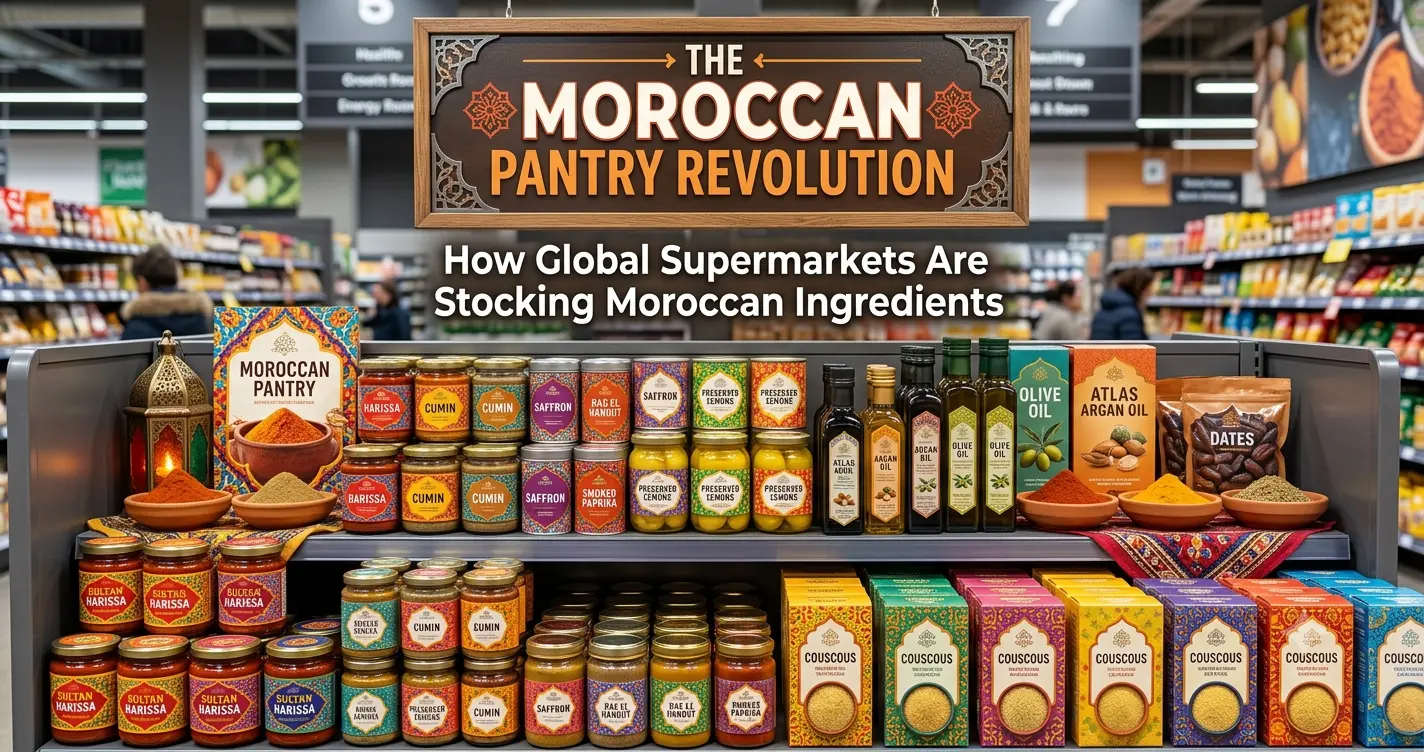
Something quietly extraordinary has been happening in the spice aisles of Whole Foods in Chicago, Waitrose in London, Carrefour in Paris, and Woolworths in Sydney. Tucked between the familiar paprika jars and turmeric tins, a new constellation of ingredients has appeared — dark, fragrant jars of ras el hanout, golden tins of preserved lemons, fiery tubes of harissa, and bottles of pale, precious argan oil. The Moroccan pantry, once the exclusive domain of home cooks in Fez, Marrakech, and Casablanca, has crossed oceans and landed on the shelves of mainstream supermarkets across the Western world. As someone who grew up watching my grandmother blend her own spices in a stone mortar while the smell of cumin and cinnamon drifted through the riad, I find this moment nothing short of revolutionary. And for those of you eager to explore these flavors authentically, MaCooking has been at the forefront of guiding home cooks through every jar, every powder, and every preserved rind. This is the story of how Moroccan cuisine conquered the world's shopping carts — and how you can make the most of this extraordinary pantry revolution.
Chapter One: The Ancient Roots of the Moroccan Pantry
To understand why Moroccan ingredients are suddenly everywhere, you first need to understand where they come from — and that story stretches back more than a thousand years. Morocco sits at one of history's great culinary crossroads. The Saharan trade routes brought sub-Saharan spices northward. The Mediterranean coast connected Morocco to Andalusian, Jewish, and Byzantine culinary traditions. The Arab conquests of the 7th and 8th centuries introduced new spice philosophies. The Berber populations — Morocco's indigenous people — had their own deeply rooted herb and spice knowledge stretching back millennia. And the Portuguese, Spanish, and French colonial presences all left their marks on ingredients and techniques.
The result is a pantry of extraordinary complexity and depth. Moroccan cuisine doesn't rely on one or two signature spices the way, say, Indian cuisine might lean on turmeric or Thai food leans on lemongrass. Instead, it operates as a sophisticated orchestral system where a dozen or more spices must work in perfect harmony. Cinnamon in a lamb tagine isn't sweetness for its own sake — it's a bridge between the earthiness of cumin and the brightness of coriander. Saffron in a chicken bastilla isn't just color — it's a whisper of the ancient spice trade that once made Morocco fabulously wealthy.
The Souk as a Living Pantry
In Moroccan cities, the souk — the traditional market — functions as an extension of every kitchen. Spice merchants, known as attarines, have operated their stalls for generations, offering custom spice blends ground fresh on request. A Moroccan cook doesn't simply buy "ras el hanout" off a shelf — she describes her intended dish to the attarin, who adjusts the blend accordingly. This intimacy between cook and ingredient is something that gets partially lost in the translation to supermarket shelves, but the fact that the translation is happening at all is remarkable. It means that the flavors my grandmother considered her private culinary inheritance are now available to a cook in Toronto or Brisbane who has never set foot in a Moroccan medina.
The souk tradition also helps explain why Moroccan ingredients tend to be whole, layered, and multidimensional in a way that packaged Western spices often are not. When you open a jar of good ras el hanout from a reputable supplier, you're supposed to smell something that evolves — first the rose petals or lavender on top, then the warming spices beneath, then the earthy base notes. That complexity is a direct descendant of the attarin's art.
Chapter Two: The Ten Essential Moroccan Pantry Ingredients — and Where to Find Them Now
Let's get practical. If you walked into a well-stocked Western supermarket today — or browsed a major online grocery platform — which authentic Moroccan ingredients could you realistically find? The answer, in 2026, is far more than you might expect. Here are the ten cornerstone ingredients of the Moroccan pantry, with notes on their cultural significance and current availability.
1. Ras El Hanout
The king of Moroccan spice blends. The name translates literally as "head of the shop" — meaning the best the spice merchant has to offer. A traditional ras el hanout can contain anywhere from 12 to over 30 individual spices, including cumin, coriander, cinnamon, ginger, turmeric, cardamom, nutmeg, cloves, allspice, black pepper, cayenne, paprika, and — in the most luxurious versions — dried rose petals, lavender, and even Spanish fly (historically). Today, ras el hanout is available at Whole Foods, Trader Joe's, Sainsbury's, Tesco, Coles, and most international grocery stores. Quality varies enormously. Look for blends that list actual whole spice names rather than vague "spice" catch-alls in the ingredient list.
2. Preserved Lemons
Perhaps no single ingredient says "Moroccan kitchen" more immediately than preserved lemons. Made from whole lemons packed in salt and their own juice for weeks or months, they develop a silky, intensely aromatic quality that fresh lemons simply cannot replicate. The rind becomes the star — deeply savory, floral, and complex. You use them in chicken tagines, fish dishes, salads, and marinades. Just a quarter of a preserved lemon rind, finely chopped, can transform a dish. Once available only in Middle Eastern or North African specialty stores, preserved lemons now appear regularly at Whole Foods, Waitrose, Marks & Spencer, and through Amazon Fresh. You can also make your own — MaCooking has a definitive guide to the traditional method.
3. Harissa
Harissa is technically North African rather than exclusively Moroccan — it has deep roots in Tunisia — but it has been fully adopted and adapted into the Moroccan kitchen. The Moroccan version tends to be slightly different from the Tunisian original, often incorporating preserved lemon, rose petals, or additional spices. It's a paste of red chiles, garlic, olive oil, and spices, and it serves simultaneously as a condiment, a marinade base, a soup enricher, and a dipping sauce. Today, harissa might be the single most successfully mainstreamed Moroccan-adjacent ingredient in Western supermarkets. You'll find it at virtually every major grocery chain, in tubes, jars, and cans. CAVA and Mina are among the most authentic commercial brands widely available in the US.
4. Argan Oil
Argan oil comes from the kernels of the argan tree, which grows almost exclusively in the Souss region of southwestern Morocco. It is one of the world's rarest and most expensive edible oils. The culinary version (as opposed to the cosmetic grade) has a distinctive toasty, nutty flavor that is extraordinary drizzled over couscous, used in amlou (a Moroccan almond-argan dip), or simply served with bread for dipping. It's now available at Whole Foods, specialty food stores, and online retailers like Amazon and iHerb. Be aware: genuine culinary argan oil should come with a DOP (Designation of Protected Origin) certification and list Morocco as its origin. Many cheaper imitations exist.
5. Saffron
Morocco, particularly the Taliouine region in the High Atlas mountains, produces some of the world's finest saffron. Moroccan saffron is intensely aromatic and deeply colored, and it appears in dishes from bastilla to fish chermoula to celebration couscous. Saffron is now widely available in Western supermarkets, though the quality and origin vary. Look specifically for Moroccan saffron from Taliouine when shopping online — it is considered by many chefs to be among the top three saffron-producing regions on earth alongside Iran's Khorasan and Spain's La Mancha.
6. Chermoula Spice Mix
Chermoula is Morocco's great marinade and sauce — a blend of fresh herbs, garlic, cumin, paprika, preserved lemon, and olive oil used primarily with fish and seafood. Some supermarkets now carry dried chermoula spice blends (sans the fresh herbs) that you can rehydrate and build into a full chermoula with fresh cilantro, parsley, garlic, and lemon juice. These are a convenient gateway into authentic Moroccan flavor profiles.
7. Medjool Dates
Dates are fundamental to Moroccan hospitality culture — a guest is always welcomed with dates and milk. Medjool dates, large and luxuriously caramel-like, are now widely available across Western supermarkets and are frequently used in Moroccan tagines with lamb or chicken to add natural sweetness, as well as in desserts and breakfast spreads. Their mainstream availability is one of the quiet success stories of Moroccan ingredient globalization.
8. Orange Blossom Water and Rose Water
These floral waters are the soul of Moroccan pastry and dessert cooking. Orange blossom water perfumes bastilla, snake cake (m'hanncha), and countless cookies. Rose water appears in sharbat drinks, rice puddings, and certain tagines. Both are now available at most Middle Eastern grocery sections of large supermarkets, and increasingly in mainstream baking aisles as Western pastry chefs have adopted them. Look for Lebanese or Moroccan brands for the most authentic intensity.
9. Dried Chickpeas and Fava Beans
These humble legumes are the backbone of Moroccan everyday cooking. Bissara — a thick fava bean soup enriched with cumin, paprika, and olive oil — is the breakfast of Fez's working medina. Chickpeas appear in harira soup, in couscous, and in countless vegetable tagines. Both are universally available in Western supermarkets, though the Moroccan approach to cooking them (long soaks, slow simmering, finishing with olive oil and spices) transforms these familiar staples into something revelatory.
10. Couscous
Couscous — tiny semolina pasta granules that are steamed, not boiled — is probably the most globally recognized Moroccan staple. It's been in Western supermarkets for decades, though authentic preparation (steaming multiple times over a broth-filled couscoussier) is still largely unknown to Western home cooks who default to the "just add boiling water" packet method. For guidance on preparing couscous the way it's done in Moroccan households — with patience, with steam, with love — the resources at macooking.com are unmatched in their authenticity and detail.
Chapter Three: A Supermarket Availability Comparison by Country
Not all Western markets are equal when it comes to Moroccan ingredient availability. Here's an honest assessment of where things stand in 2026 across five major Western markets.
| Ingredient | United States | United Kingdom | France | Canada | Australia |
|---|---|---|---|---|---|
| Ras El Hanout | Widely available (Whole Foods, Trader Joe's, Amazon) | Mainstream (Sainsbury's, Tesco, Waitrose) | Universal (every supermarket) | Specialty stores, Amazon.ca | Specialty & online |
| Preserved Lemons | Whole Foods, Trader Joe's, online | Waitrose, M&S, online | Most supermarkets | Specialty & online | Specialty stores |
| Harissa | Universal availability | Universal availability | Universal availability | Most major stores | Major supermarkets |
| Argan Oil (culinary) | Whole Foods, online specialists | Waitrose, Holland & Barrett, online | Bio & health food stores | Health food stores, online | Health food stores, online |
| Moroccan Saffron | Specialty stores, online | Online, some delis | Specialty stores | Online | Online |
| Orange Blossom Water | Most supermarkets (ethnic aisle) | Most supermarkets | Universal | Most major stores | Specialty & major supermarkets |
| Medjool Dates | Universal | Universal | Universal | Universal | Universal |
| Couscous | Universal | Universal | Universal | Universal | Universal |
France deserves special mention here. The deep historical and cultural ties between France and Morocco — a relationship that is complicated politically but undeniably rich culinarily — mean that France has the most mature Western market for Moroccan ingredients. Walk into any French supermarket and you will find an entire aisle dedicated to North African cooking products. The approximately 1.5 million Moroccan-born residents of France, plus their French-born descendants, have created a genuine culinary infrastructure that benefits all shoppers. The UK and US are catching up rapidly, driven by restaurant trends and the rise of adventurous home cooking culture.
Chapter Four: Why This Is Happening Now — The Forces Behind the Moroccan Food Boom
The timing of this pantry revolution is not accidental. Multiple cultural and commercial forces have converged to make Moroccan cuisine one of the most fashionable — and genuinely beloved — food movements of the 2020s.
The Restaurant Effect
The explosion of high-quality Moroccan restaurants in Western cities has been transformational. When a diner in New York or London encounters a perfectly executed lamb shank tagine with preserved lemon and olives, or a bastilla that somehow combines pigeon, almonds, cinnamon, and sugar into something that defies description, they leave with a hunger that persists beyond the meal. They go home wanting to recreate those flavors. And recreating them means buying the ingredients. Restaurant culture creates pantry demand.
Chefs like Mourad Lahlou in San Francisco, Meryem Cherkaoui in Casablanca (whose work has reached international recognition), and numerous others have elevated Moroccan cuisine in fine-dining contexts, lending it a prestige that drives both media coverage and consumer curiosity.
The Social Media Spice Trail
Instagram and TikTok have been transformative for Moroccan food visibility. The visual drama of Moroccan cuisine — the jewel-toned tagines, the architectural couscous mounds, the golden bastilla dusted with powdered sugar and cinnamon — is extraordinarily photogenic. Moroccan food travels exceptionally well on social media, and food influencers traveling to Marrakech and Fez have generated millions of views of cooking demonstrations, market visits, and recipe attempts.
The #MoroccanFood hashtag has hundreds of millions of views across platforms. When someone sees a gorgeous chicken tagine with preserved lemons and wants to make it at home, they need preserved lemons. That social media moment translates directly into shelf space in supermarkets.
The Health Food Convergence
There is a remarkable alignment between traditional Moroccan cooking and contemporary Western nutritional values. Moroccan cuisine is:
- Mediterranean diet-adjacent — heavy on olive oil, legumes, vegetables, and lean proteins
- Anti-inflammatory — turmeric, ginger, cinnamon, and saffron are all prized in functional nutrition
- Plant-forward — Moroccan vegetable tagines, bissara, and zaalouk (a smoky eggplant salad) are inherently vegan
- Fermented-food-friendly — preserved lemons are a traditional fermented product
- Low in processed ingredients — traditional Moroccan cooking builds from whole spices, whole vegetables, whole legumes
This alignment has been actively recognized and marketed by food brands bringing Moroccan ingredients to Western shelves. Argan oil was initially marketed as a health food product before its culinary uses became better known. Harissa has been embraced by the wellness community as a capsaicin-rich condiment with metabolic benefits. The health food industry has essentially provided Moroccan pantry items with a second marketing argument beyond pure flavor.
The Diaspora Effect
Approximately 5 million Moroccans live outside Morocco, with significant communities in France, Spain, Belgium, the Netherlands, Italy, the United States, and Canada. These diaspora communities have maintained demand for authentic ingredients for decades, sustaining the North African specialty stores and halal markets that have long been the primary source of Moroccan pantry items in Western cities. As the broader population has become curious about Moroccan food, these existing specialty suppliers have been perfectly positioned to meet demand — and mainstream supermarkets have noticed.
Chapter Five: The Quality Question — What to Look For, What to Avoid
The democratization of Moroccan ingredients in Western supermarkets is largely wonderful, but it comes with a significant caveat: quality varies enormously, and some products marketed as "Moroccan" bear little resemblance to the authentic article. As someone who has spent years cooking and eating in Morocco, here is my honest guide to what separates the genuine from the imitation.
Ras El Hanout — Quality Indicators
- Smell it before you buy if possible: A good ras el hanout should be complex, evolving, and slightly floral. If it smells primarily like generic curry powder, walk away.
- Check the ingredient list: Premium blends will name 15+ individual spices. Cheap blends hide behind the word "spices" as a catch-all.
- Color: Authentic ras el hanout should be a rich, dark reddish-brown, not the flat orange of generic spice blends.
- Avoid anything labeled "Moroccan seasoning" that doesn't specify it as ras el hanout — these generic blends are rarely authentic.
Preserved Lemons — Quality Indicators
- Only two ingredients are needed: lemons and salt. If the label shows preservatives, citric acid as a primary ingredient, or artificial flavoring, the product has been industrialized in a way that compromises the authentic character.
- The brine should be cloudy and golden, not clear. Cloudiness indicates genuine fermentation has occurred.
- Texture of the rind should be silky and somewhat translucent when you open the jar. Tough or rubbery rind suggests insufficient curing time.
- Moroccan-origin products are preferable to generic "North African style" versions.
Argan Oil — Quality Indicators
- Origin certification: Look for the COSUMAR or the AMDPOC cooperative seal, or a DOP certification indicating Moroccan origin from the Souss-Massa region.
- Color: Culinary argan oil should be a clear, deep golden color — significantly darker than olive oil.
- Aroma: It should smell distinctly toasty and nutty, like roasted sesame seeds but lighter. If it smells neutral or faintly rancid, it is poor quality.
- Price: Genuine culinary argan oil is expensive. If you find it at a bargain price, it is likely adulterated or mislabeled.
| Ingredient | Signs of Authentic Quality | Red Flags to Avoid | Recommended Brands (Western Markets) |
|---|---|---|---|
| Ras El Hanout | Complex evolving aroma, 15+ named spices, dark reddish-brown color | Flat curry smell, generic "spices" label, bright orange color | Épices de Cru, Frontier Co-op, La Boite |
| Preserved Lemons | Salt + lemons only, cloudy golden brine, silky rind texture | Preservatives added, clear brine, tough rubbery rind | Mina, Les Moulins Mahjoub, homemade |
| Harissa | Deep red color, visible texture, balanced heat-garlic-spice aroma | Overly smooth, artificial red coloring, salt as first ingredient | Mina, CAVA, Les Moulins Mahjoub |
| Argan Oil | Deep golden color, toasty nutty aroma, DOP certification, Moroccan origin | Pale color, neutral smell, no origin certification, very cheap | Zitoun, Kahina Giving Beauty (culinary), Argand'Or |
| Saffron | Deep crimson threads, intense floral-metallic aroma, Moroccan or Iranian origin | Orange threads (turmeric fraud), weak aroma, powdered form | Taliouine saffron cooperatives, Burlap & Barrel |
Chapter Six: Building Your Moroccan Pantry — A Practical Starter Guide
You don't need to acquire everything at once. The Moroccan pantry is built over time, and the best approach is to start with the highest-impact ingredients and build outward. Here is a tiered approach based on the dishes you are most likely to want to cook first.
Tier One: The Absolute Essentials (Start Here)
If you are new to Moroccan cooking and want to be able to make a substantial range of dishes immediately, these five items should be your first purchases:
- Ras el hanout — the master key to dozens of Moroccan dishes
- Preserved lemons — or a batch you make yourself (4-6 weeks ahead)
- Harissa — for heat, depth, and versatility
- Good quality couscous (medium grain, not instant) — the staple of Moroccan Friday meals
- Cumin (whole seeds and ground) — the single most used individual spice in Moroccan cooking
With just these five items, plus olive oil, onions, garlic, and whatever protein and vegetables you prefer, you can produce genuinely excellent Moroccan food. The tagine formula alone — protein, onions, ras el hanout, preserved lemon, olive oil, a splash of water, and time — requires nothing more exotic than this basic kit.
Tier Two: The Expanding Pantry (Weeks Two to Four)
- Saffron — for celebratory dishes and authentic bastilla
- Sweet paprika and smoked paprika — Moroccan paprika culture is sophisticated and distinct from Spanish usage
- Ground ginger — a cornerstone of the Moroccan spice palette, used in ways that differ from South Asian applications
- Orange blossom water — opens up the entire world of Moroccan pastry and dessert
- Dried chickpeas — for harira soup, vegetable tagines, and couscous toppings
- Medjool dates — for sweet tagines and hospitality rituals
Tier Three: The Expert Pantry (The Full Moroccan Kitchen)
- Culinary argan oil — for finishing couscous, making amlou, drizzling over salads
- Smen (aged fermented butter) — challenging to find commercially but transformative in couscous
- Fenugreek seeds — used in certain Moroccan bread traditions and spice blends
- Dried rose petals — for making your own premium ras el hanout and certain sweet tagines
- Mastic resin — used in some Moroccan pastries and for flavoring certain traditional drinks
- Kefta spice mix — the dedicated blend for Moroccan ground meat preparations
- Mahlab — a cherry pit spice used in some Moroccan celebration breads
"A Moroccan kitchen is not built in a day. It is built through a series of meals, each one teaching you something new about how these ingredients speak to each other. The preserved lemon teaches you about fermented brightness. The ras el hanout teaches you about layered warmth. The argan oil teaches you about the power of finishing. Build your pantry the way you build understanding — one ingredient, one dish, one revelation at a time."
— Chef Jamal, MaCooking
Chapter Seven: The Cultural Dimension — What Gets Lost and What Survives in Translation
I would be doing this subject a disservice if I didn't address the more complex cultural dimensions of this pantry revolution. When Moroccan ingredients move from the souk to the supermarket shelf, something inevitably changes. Some of that change is practical and acceptable. Some of it deserves honest reflection.
What Survives
The fundamental flavor profiles of Moroccan cuisine survive beautifully in well-made commercial versions of these ingredients. A high-quality jar of preserved lemons from a reputable Moroccan cooperative carries genuine Moroccan DNA. The cumin, coriander, and cinnamon in a good ras el hanout are the same cumin, coriander, and cinnamon that have been used in Moroccan kitchens for centuries. The chemistry of flavor is largely transferable.
What also survives — and this is perhaps most important — is the invitation to curiosity. When someone in Melbourne buys their first jar of ras el hanout and uses it in a chicken tagine, they often want to know more. They research the spice. They find its history. They begin to understand something about Moroccan culture that they could not have accessed before. This is the genuine gift of culinary globalization at its best.
What Requires Attention
The context of these ingredients — the rituals surrounding their use, the family memories they encode, the social significance of sharing food prepared with them — cannot be packaged and sold. You can buy preserved lemons, but you cannot buy the Moroccan tradition of the Thursday evening preparation for Friday couscous, where the whole household gathers and participates in the cooking. You can buy orange blossom water, but you cannot buy the memory of your grandmother's bastilla, the one she only made for weddings and returns from Hajj.
This is not an argument against the spread of Moroccan ingredients — quite the opposite. It is an argument for approaching them with genuine curiosity and respect rather than as mere trend items. The best way to honor an ingredient is to understand its origins and use it thoughtfully. That is why platforms like MaCooking exist — not just to provide recipes, but to provide the cultural context that makes cooking with these ingredients a meaningful act rather than a superficial one.
The Fair Trade Question
There is also an economic justice dimension worth considering. Argan oil, for example, is produced largely by women's cooperatives in the Souss region of Morocco. The global argan oil boom has created genuine economic opportunity for thousands of Berber women — but it has also attracted counterfeit products that undercut authentic Moroccan suppliers without benefiting the communities that developed this product over centuries. When you choose certified Moroccan argan oil over a cheaper imitation, you are making an ethical choice, not just a culinary one.
The same logic applies to saffron (buying from Taliouine cooperatives directly supports High Atlas farming communities), to preserved lemons (cooperative-produced versions support sustainable lemon farming in Morocco's citrus regions), and to many other ingredients. Eating Moroccan food well means, where possible, sourcing ingredients in ways that respect and support their origins.
Frequently Asked Questions
Q1: I can't find preserved lemons in my local supermarket. What's the best alternative, and can I make them myself?
The best immediate substitute for preserved lemons is a combination of fresh lemon zest and a small amount of kosher salt, though the result will lack the deep fermented complexity of the real thing. A slightly better substitution is to use a thin strip of fresh lemon rind that has been briefly blanched in boiling water (30 seconds) and then rubbed with salt — this removes some of the bitterness and brings you closer to the preserved version's character.
However, the best solution by far is to make your own. The method is genuinely simple: pack whole lemons (scored in quarters but not cut through) with generous amounts of kosher or sea salt, pack into sterilized jars, squeeze in extra lemon juice to submerge, seal, and leave at room temperature for 4 to 6 weeks. The lemons are ready when the rind is soft and silky. Once made, they keep for up to a year in the refrigerator. Making your own preserved lemons is one of the most satisfying acts of Moroccan kitchen preparation — it connects you physically to the patience that characterizes authentic Moroccan cooking.
Q2: Is the harissa sold in Western supermarkets authentically Moroccan, or is it a Tunisian product?
Great question, and an important distinction. Harissa originated in Tunisia, and the classic Tunisian version — smoky, intensely spicy, relatively simple — is different from what Moroccan kitchens traditionally use. Morocco has adopted and adapted harissa, adding preserved lemon, rose petals, additional spices like caraway, and sometimes a richer blend of dried chile varieties. The harissa sold in most Western supermarkets falls somewhere between the two traditions, often leaning toward the Tunisian original.
For genuinely Moroccan-style harissa, look for brands that specifically indicate Moroccan origin or that list preserved lemon and rose petals among the ingredients. Alternatively, you can make your own Moroccan harissa at home — a project well worth the effort, and one that MaCooking covers in detail.
Q3: I've heard that ras el hanout varies massively by region and by cook. How do I know which version to use for which dish?
You are absolutely right that ras el hanout is not a fixed formula — it is a philosophy. In the Fez tradition, ras el hanout tends to be more complex and floral, often incorporating rose petals, lavender, and orris root. The Marrakech version is often warmer and heavier on the cinnamon and ginger. Northern Moroccan versions may be lighter and more herb-forward.
For a general-purpose Western kitchen, a good quality commercial ras el hanout with 15+ spices will work beautifully for tagines, couscous, grilled meats, and vegetable dishes. As you develop your palate, you can begin adjusting — adding extra cinnamon for lamb dishes, extra ginger for chicken, extra cumin for vegetable preparations. The goal is not to be rigid but to understand the spirit: ras el hanout should always add warmth, complexity, and a certain mysterious depth that makes people ask, "What is in this?"
Q4: What is the single most important Moroccan ingredient a Western home cook should add to their pantry first, and why?
Without hesitation: preserved lemons. Here is why. Preserved lemons do something that no other ingredient in any cuisine quite replicates — they provide a fermented, deeply savory, intensely aromatic brightness that simultaneously enriches and lifts a dish. They are the ingredient that most immediately makes a Moroccan dish taste unmistakably Moroccan. Ras el hanout is magnificent, but many of its component spices are individually familiar to Western cooks. Preserved lemons, by contrast, are revelatory — they produce a flavor that is genuinely new to most Western palates, and that newness is the beginning of genuine culinary education. Start with preserved lemons, and the Moroccan kitchen will begin to make sense in ways that no amount of description can achieve.
Q5: Are Moroccan ingredients suitable for vegetarians and vegans, and is Moroccan cooking naturally accommodating to plant-based diets?
Moroccan cuisine is one of the world's great naturally plant-forward food cultures, and yes — the vast majority of Moroccan pantry ingredients are suitable for vegetarians and vegans. The spice blends (ras el hanout, chermoula mix, kefta spice), the preserved lemons, the harissa, the argan oil, the orange blossom water, the rose water, the couscous, the dried legumes — all are entirely plant-based. Traditional Moroccan vegetable dishes include zaalouk (smoky eggplant), taktouka (roasted pepper and tomato), makouda (potato fritters), and dozens of herb salads. The Friday couscous can be made entirely with seasonal vegetables. Bissara fava bean soup is inherently vegan. Morocco's street food tradition includes numerous plant-based items, from msemen flatbreads to sfenj doughnuts. For those following plant-based diets who want to explore Moroccan cuisine fully, the pantry resources and recipe guides available at macooking.com are an excellent starting point.
Conclusion: Your Moroccan Kitchen Begins Today
The Moroccan pantry revolution represents something genuinely beautiful — the democratization of one of the world's most sophisticated and historically rich culinary traditions. The fact that you can now walk into a major supermarket in Toronto, Sydney, London, or Chicago and come home with enough authentic Moroccan pantry ingredients to produce a genuinely excellent tagine or a proper harira soup is not something to take lightly. It represents decades of diaspora persistence, the gradual education of global palates through restaurants and travel, and the willingness of mainstream food retailers to take culinary risk on ingredients that were once considered "too exotic" for the average shopper.
But ingredients alone don't make a Moroccan kitchen. What makes a Moroccan kitchen is knowledge — the kind of knowledge that tells you to add the preserved lemon at the end of cooking rather than the beginning, or that teaches you why couscous must be steamed three times to achieve its true character, or that explains the difference between the chicken chermoula of Essaouira (heavy on the cumin and cilantro) and the fish chermoula of Agadir (brighter, more lemon-forward). That knowledge is what we at MaCooking have dedicated ourselves to sharing — not just recipes, but the cultural and culinary intelligence that makes those recipes meaningful.
Whether you are standing in a supermarket aisle wondering which jar of ras el hanout to choose, or you are already an experienced Moroccan home cook looking to deepen your understanding of specific regional traditions, we invite you to make macooking.com your companion on this journey. The Moroccan pantry is open. The argan oil is golden. The preserved lemons are waiting. Your tagine pot is ready. The revolution has come to your kitchen — and the best part is, it tastes extraordinary.
Bsaha w raha — to your health and comfort, as we say in Morocco when we share food with those we love.