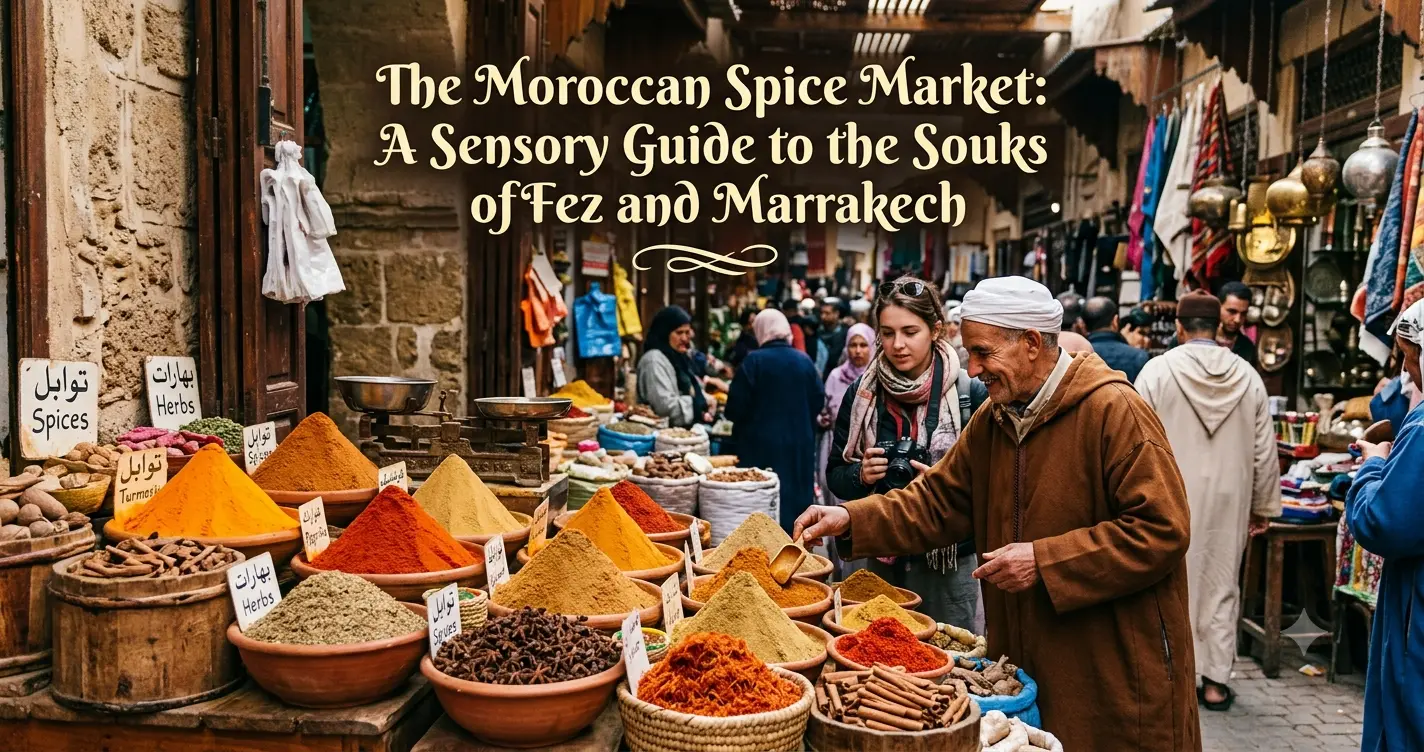
Close your eyes for a moment and imagine this: you are standing at the entrance of a narrow alley in the ancient medina of Fez, and before you have even turned the corner, the air hits you like a warm, fragrant wall. Cumin roasted in the midday sun. Rose petals drying on a reed mat. The sharp, medicinal whisper of dried ginger root. Beneath it all, something deeper and harder to name — a kind of ancient sweetness that seems to rise from the very stones underfoot. This is the souk of Fez, and it is unlike anywhere else on earth. Morocco's spice markets are not just places of commerce. They are living museums, sensory archives, and the beating heart of a culinary tradition stretching back more than a thousand years. Whether you are wandering the labyrinthine alleyways of Fez's 9th-century medina or bargaining in the sun-bleached chaos of Marrakech's Djemaa el-Fna, the experience of buying spices in Morocco is one that rewires your understanding of food forever. At MaCooking, we have spent years documenting these markets, interviewing the spice merchants who have inherited their knowledge across generations, and translating the wisdom of Moroccan kitchens for food lovers around the world. This is our most complete guide to the Moroccan spice souk — the history, the spices, the culture, and everything you need to know before you go.
Chapter One: The History Behind the Scent — Morocco as the Crossroads of the Spice World
To understand Moroccan spice markets, you must first understand Morocco's extraordinary position in world history. Perched at the northwestern tip of Africa, separated from Europe by just fourteen kilometres of sea, Morocco has been a crossroads of civilisations for millennia. Berber, Arab, Andalusian, sub-Saharan African, Ottoman, and even Portuguese influences have all left their fingerprints on Moroccan cooking — and nowhere is this fusion more visible than in the spice souk.
The ancient trans-Saharan trade routes — the same routes that once carried gold and salt from Mali and Ghana — also carried spices. Long pepper from West Africa, saffron from Persia and later from Morocco's own Taliouine region, ginger from South Asia, cinnamon from Ceylon, turmeric from India. These commodities passed through Moroccan trading cities like Fez, Meknès, and Marrakech before making their way across the Strait of Gibraltar into Europe. For centuries, Moroccan merchants were the gatekeepers of the spice trade between Africa, the Arab world, and the European continent.
The foundation of Fez in 789 CE by Moulay Idriss I, and its subsequent expansion under Idriss II in the 9th century, created the world's first university city — and with it, one of the most sophisticated trading networks in the medieval world. The souks of Fez were not haphazard markets. They were meticulously organised by trade, with separate quarters for tanners, weavers, metalworkers, perfumers, and of course, spice merchants. This organisation, known as the funduq system, is still largely intact today in Fez's medina, which UNESCO designated a World Heritage Site in 1981.
Marrakech, founded in 1062 CE by the Almoravid dynasty, became the other great spice hub, positioned strategically at the gateway to the Sahara. While Fez was the intellectual and spiritual capital, Marrakech was always the commercial dynamo — louder, more theatrical, more willing to perform its own identity for the wide-eyed visitor. These twin personalities are still alive in their spice markets today, and as any seasoned traveller will tell you, the two experiences are meaningfully different in ways worth exploring before you book your ticket.
The Spice Merchant as Custodian of Knowledge
One thing that strikes every visitor to a serious Moroccan spice shop is that the merchant is not simply a vendor. A respected attarine — the Arabic word for a spice and perfume seller — is expected to possess encyclopaedic knowledge of medicinal, culinary, and even spiritual properties of their goods. Many of these merchants are trained in the tradition of Unani medicine, the Greco-Arab medical system that classifies plants and spices by their elemental properties: hot, cold, moist, or dry. When an elderly spice merchant in the Fez medina recommends adding black seed to your diet or suggests that a particular blend of spices will calm your digestion, he is not improvising. He is drawing on a tradition of knowledge that predates modern pharmacology by many centuries.
Chapter Two: Fez vs. Marrakech — Two Markets, Two Souls
Travellers often ask me which city has the better spice market. My honest answer is that it depends entirely on what you are looking for. Both are extraordinary. Both are irreplaceable. But they are very different experiences, and I think it is worth laying out those differences clearly before you plan your trip.
| Feature | Fez Medina (Attarine Souk) | Marrakech Medina (Rahba Kedima & Djemaa el-Fna) |
|---|---|---|
| Atmosphere | Ancient, labyrinthine, less tourist-facing | Theatrical, vibrant, more internationally oriented |
| Merchant expertise | Often generational specialists, deep knowledge | Ranges from expert to tourist-market level |
| Price levels | Generally lower; harder to find without a guide | Higher tourist markup; easier to navigate |
| Spice variety | Exceptional; includes many hard-to-find medicinal herbs | Excellent range of culinary spices and blends |
| Best for | Serious cooks, adventurous travellers, authentic immersion | First-time visitors, accessible souvenir shopping |
| Navigation difficulty | Very high — a local guide is recommended | Moderate — English widely spoken in tourist areas |
| Pre-packaged blends | Less common; most spices sold loose | Both loose and pre-packaged widely available |
The Attarine Souk of Fez: A Cathedral of Scent
The Attarine Souk in Fez sits adjacent to the Bou Inania Madrasa and the Al-Qarawiyyin Mosque — the oldest continuously operating university in the world. The proximity is not coincidental. For centuries, scholars, physicians, and cooks all needed the same raw ingredients: herbs and spices for medicine, perfume, and food. The Attarine was their common source.
Walking through the Attarine today, you pass beneath low wooden ceilings strung with bundles of dried herbs. The light is filtered and golden. Jute sacks of ground spices line the walls in colours that range from the deep crimson of paprika to the almost luminescent yellow of domestic turmeric. Old men sit on low wooden stools, measuring out grams of saffron onto tiny brass scales with the precision of jewellers. There is very little English spoken here. There is almost no signage. And that, paradoxically, is what makes it extraordinary.
Rahba Kedima and the Djemaa el-Fna in Marrakech
Marrakech's main spice square, Rahba Kedima — the old grain market — sits just off the main artery of the souk, a short walk from the enormous Djemaa el-Fna square. Here, the display of spices is deliberately theatrical. Conical mounds of golden turmeric, rust-red cayenne, and deep green dried herbs are arranged to catch both the light and the camera. And yes, many of these stalls are pitched at tourists. But look past the front row of Instagram-ready displays and you will find serious merchants with quality goods and real knowledge — you just have to know how to have the right conversation.
The Djemaa el-Fna itself, with its famous evening food stalls, is also a remarkable place to encounter Moroccan spices in their finished form. Watching a mrouzia being ladled out — that magnificent sweet-savoury lamb dish coloured gold with saffron and sweetened with raisins and honey — is as educational as any spice market visit.
Chapter Three: The Essential Moroccan Spices — A Definitive Guide
Before we talk about how to shop, let us talk about what to buy. Moroccan cooking relies on a specific constellation of spices that, taken together, create flavour profiles unlike those found anywhere else in the world. At MaCooking, we have published dozens of recipes that rely on these foundational spices, and understanding them deeply will transform your cooking at home.
The Undisputed King: Ras el Hanout
Ras el hanout translates literally from Arabic as "head of the shop" — meaning the best the merchant has to offer. It is not a single spice but a blend, and no two recipes for it are exactly alike. The number of ingredients in a serious ras el hanout ranges from twelve to over thirty, and the specific proportions are often closely guarded family secrets passed down through generations of spice merchants.
Common ingredients in a quality ras el hanout include:
- Cumin (kamoun) — the backbone of many Moroccan blends
- Coriander seed — adding a citrusy, floral lift
- Ginger — both warming and aromatic
- Turmeric — for colour and an earthy bitterness
- Cinnamon — used in savoury dishes to a degree that surprises most Westerners
- Black pepper and white pepper
- Allspice and nutmeg
- Cardamom — especially in blends with Saharan influence
- Rose petals — dried and ground, adding a floral, slightly astringent note
- Mace and clove
- Galangal (khdenjal) — a root related to ginger, less common but deeply complex
- Long pepper (dar filfel) — now rare, once a Saharan trade staple
- Orris root — from the iris flower, adding a violet-like perfume
When buying ras el hanout in Morocco, ask the merchant what is in their blend, and whether they make it themselves. A merchant who can tell you the story of their ras el hanout — who learned it from whom, what they changed, and why — is selling you something worth carrying home.
Chermoula Spice Mix
Chermoula is primarily a fresh herb marinade used for fish and seafood, but the dry spice base — a mixture of cumin, coriander, paprika, and chilli — is also available pre-blended in the souks. It is one of the most versatile and underappreciated Moroccan spice exports.
Saffron: Morocco's Own Liquid Gold
Morocco produces some of the finest saffron in the world, primarily in the Taliouine region of the Souss-Massa valley in southern Morocco. Taliouine saffron is protected by a Geographical Indication and is considered among the top three saffron varieties globally, alongside Iranian and Kashmiri types.
Real saffron is expensive. If someone in the Marrakech souk is selling you "saffron" for the equivalent of three euros per large bag, you are buying safflower, or dried corn silk, or a mix of other yellow-staining flowers. Real Moroccan saffron is sold by the gram, not by the handful, and it costs money. In the Taliouine region itself, you can visit cooperatives run by Berber women who grow, harvest, and process the saffron by hand in a painstaking seasonal operation. One kilogram of dried saffron requires approximately 150,000 to 200,000 flowers and almost entirely manual labour.
Preserved Lemons and Argan Oil: Technically Not Spices, But Essential
Any list of Moroccan flavour essentials must include preserved lemons (hamad m'rakad) and argan oil. The first is a fermented condiment of extraordinary power — salted, aged lemons whose skin takes on a soft, almost meaty quality and whose flavour is simultaneously salty, sour, floral, and deeply umami. Argan oil, pressed from the kernels of the argan tree — a species found almost exclusively in southwestern Morocco — comes in two varieties: culinary (toasted) and cosmetic (cold-pressed). The culinary version has a rich, nutty flavour reminiscent of macadamia or roasted sesame oil. Both are worth bringing home and both are available throughout the souks.
| Spice / Ingredient | Moroccan Name | Primary Dishes Used In | What to Look For When Buying |
|---|---|---|---|
| Cumin | Kamoun | Tagines, kefta, chermoula, harira | Whole seeds, freshly ground smell; avoid pre-ground that smells flat |
| Ras el Hanout | Ras el Hanout | Bastilla, tagines, couscous, mechui | Complex, layered aroma; ask for ingredient list; avoid blends that smell just of cumin |
| Saffron | Zaafrane | Chicken tagine, mrouzia, Moroccan tea | Deep red-orange threads; metallic-floral aroma; dissolves to strong yellow in water |
| Turmeric | Quekoum | Chicken dishes, soups, rice | Bright golden yellow colour; earthy-peppery aroma |
| Paprika | Felfla Hamra | Chermoula, kefta, grilled meats | Deep red; sweet or smoky varieties; should smell of dried sweet pepper |
| Ginger | Skinjbir | Tagines, bastilla, harira | Pale tan powder; sharp, warming aroma; buy whole dried root when possible |
| Cinnamon | Darsine / Karfa | Bastilla, sweet couscous, tagine with fruit | Ceylon variety preferred; thin, papery quills; sweeter and more delicate than cassia |
| Black Seed (Nigella) | Habbat Sawda | Bread, pastries, medicinal use | Small black seeds; sharp, faintly oniony smell; used as both spice and health supplement |
Chapter Four: The Art of Buying — How to Navigate the Souk Like an Insider
Let me be honest with you here: the spice markets of Morocco can be overwhelming, and they can be frustrating. Prices are rarely marked. The quality ranges enormously. And if you walk in looking like a tourist who has never bargained for anything in their life, you will pay tourist prices for mediocre goods. But with a little preparation and the right mindset, these markets become one of the most rewarding shopping experiences of your life.
Before You Enter the Souk
- Do your homework. Know what you want to buy before you go. At minimum, have a mental list of five to eight spices or blends. This gives the interaction a clear direction and signals to the merchant that you know what you are doing.
- Know your weights and prices. In Morocco, spices are sold by the gram or by the 100g. Before your visit, check current market prices online — a quick search will give you rough benchmarks for saffron, ras el hanout, and other premium items.
- Bring small bills. Exact change makes transactions smoother and prevents the common play of "I have no change" being used to extract a few extra dirhams.
- Consider a local guide — but choose carefully. A trusted local guide in Fez is genuinely valuable, both for navigation and for accessing merchants who will take you seriously. However, be aware that guides often receive commissions from specific shops. Ask your riad or hotel for a recommendation, and agree on the guide fee in advance.
Inside the Spice Shop
When you enter a serious spice shop, especially in Fez, you will often be invited to sit, offered mint tea, and presented with a series of small samples to smell. Accept this ritual with grace. It is not a pressure tactic — it is a genuine expression of hospitality, and it is the way serious merchants build relationships. Take your time. Smell everything. Ask questions.
"A good spice merchant does not just sell you powder in a bag. He teaches you what to do with it. If you walk out of his shop not knowing how to use what you bought, he has failed at his job."
The Language of Bargaining
Bargaining in the souks is not aggressive — at least not in the beginning. The opening price is a starting point for a conversation, not a statement of intent. A few principles to keep in mind:
- Never make your first counter-offer less than 60% of the asking price, unless the asking price is truly absurd.
- Smile. The entire transaction should feel pleasant for both parties.
- Be willing to walk away — but do so politely and without drama. Often, a parting offer will be called after you.
- Do not bargain if you have no intention of buying. Starting a serious negotiation and then walking away empty-handed is genuinely rude.
- For genuinely premium goods — real saffron, aged preserved lemons, single-origin argan oil — the price may be non-negotiable and that is fair. Quality has its price.
Quality Tests You Can Do On the Spot
You can assess the quality of spices with just your senses, even in the market:
- Smell test: Fresh, high-quality spices should hit you immediately with their characteristic aroma. Cumin should smell warm and earthy; saffron should smell of metal, honey, and hay; cinnamon should smell sweet and warm. Flat, dusty, or faintly musty odours indicate age or poor storage.
- Saffron water test: Ask the merchant to dissolve a few threads in a small amount of warm water. Real saffron slowly releases a golden-yellow colour over several minutes, with the threads remaining intact and reddish. Fake saffron releases its colour immediately and the liquid turns orange-red rather than pure gold.
- Visual check: Spices should be vibrant in colour. Faded, brownish turmeric or grey-tinged paprika are signs of age or poor quality.
- Texture: Ground spices that clump heavily have been exposed to moisture. Ask if there is a fresher batch available.
Chapter Five: Beyond the Spice — Herbs, Florals, and Medicinal Ingredients
A great Moroccan spice market is never just about cooking spices. The attarine tradition encompasses the full spectrum of botanical knowledge, and a walk through the older sections of the Fez souk will introduce you to ingredients that blur the lines between kitchen, pharmacy, and perfumery.
Dried Rose Petals and Orange Blossom
Morocco is famous for its rose water, produced primarily in the Valley of the Roses — the Dades Valley — near the Saharan town of Ouarzazate. Dried rose petals are used in ras el hanout and in sweet pastries like ghriba and kaab el ghzal. Rose water itself is splashed generously over briouats, poured into almond cream fillings, and used to perfume the hands after a formal meal. Orange blossom water (ma' el ward and ma' el zahar respectively) is equally ubiquitous in Moroccan pastry-making and is one of the most evocative scents of the Moroccan kitchen.
Dried Herbs: Mint, Marjoram, and Verbena
Moroccan mint tea is the national drink, and understanding the different varieties of mint sold in the souk is a revelation for anyone who has only ever encountered peppermint tea bags. The classic variety used in Moroccan tea is nana — spearmint — which has a softer, rounder flavour than the aggressive peppermint familiar in Western supermarkets. In winter and transitional seasons, merchants also offer louiza (lemon verbena), zaatar (marjoram or thyme, depending on the region), and sheeba (wormwood), each with distinct characters and traditional medicinal uses.
The Mysterious Medicinal Corner
Every serious attarine shop has a section that will baffle most Western visitors: drawers and jars containing things like dried chameleon skin, ground fossils, kohl powder, pieces of aromatic resin, and roots whose names do not translate into any familiar language. These are the materials of Moroccan traditional medicine and spiritual practice — some dating back to pre-Islamic animist traditions, others introduced through Arab and sub-Saharan African influences. You are under no obligation to buy anything here, but if you are curious, asking a knowledgeable merchant to walk you through this section is genuinely fascinating. Just be appropriately sceptical about health claims and, obviously, do not attempt to bring any materials of uncertain animal origin through customs.
For those who want to explore how these herbs and botanicals translate into actual recipes, MaCooking has an extensive library of traditional Moroccan recipes that incorporate the full range of botanical ingredients found in the souk, from the everyday to the rare and seasonal.
Chapter Six: Bringing Morocco Home — Packing, Customs, and Using Your Spices
You have spent three glorious days getting lost in the souks of Fez and Marrakech. Your bags are heavy with spices, preserved lemons, argan oil, and a beautiful hand-engraved brass spice box that you absolutely did not need but could not leave behind. Now comes the practical part.
Packing Your Spices for the Journey
- Transfer loose spices into small, re-sealable zip-lock bags or glass jars with tight-fitting lids before flying. The paper cones that spices are typically sold in do not travel well.
- Pack spices in your checked luggage, not carry-on. Ground spices in large quantities can trigger secondary screening, particularly in US airports.
- Label everything clearly with the common English name and origin country. This saves time at customs and prevents your precious saffron from being mistaken for something more suspicious.
- Store argan oil and preserved lemon brine in tightly sealed, leak-proof containers and wrap them in a plastic bag as secondary protection. Your clothes will thank you.
- Keep your most delicate spices — saffron, especially — in your carry-on in a small airtight container. The cargo hold temperature fluctuations can affect highly volatile aromatic compounds.
Customs and Import Rules by Country
Generally speaking, dried herbs and spices for personal culinary use are permitted into most Western countries without restriction. However, a few specific notes:
- United States: Dried spices and herbs are generally allowed. Argan oil is permitted. Preserved lemons are technically a processed food and should be declared; in practice they are almost always admitted. Do not attempt to bring fresh herbs, fresh produce, or soil-containing items.
- European Union (for non-EU residents): Personal quantities of dried spices, nuts, and processed foods like preserved lemons and argan oil are generally admitted duty-free up to personal use limits.
- United Kingdom: Similar rules to the EU apply post-Brexit. Dried spices, argan oil, and similar goods are admitted for personal use.
- Australia and New Zealand: These countries have the strictest biosecurity laws. Dried spices are generally admitted, but any product containing plant material must be declared. Argan oil is typically fine; preserved lemons may be subject to inspection.
- Canada: Generally very open to food imports for personal use. Declare everything and you will almost always be fine.
How to Store and Use Your Moroccan Spices at Home
The worst thing you can do with beautiful Moroccan spices is stick them in a rack above your cooker where they will be destroyed within weeks by heat and steam. Store them in airtight containers, away from heat, light, and humidity. A dedicated spice drawer or a cool, dark cupboard is ideal. Whole spices keep for up to three years under good conditions; ground spices begin to lose potency after six to twelve months.
For ideas on how to actually use your souk haul, the recipe section at MaCooking is an invaluable resource — from beginner-friendly lamb tagines that use just cumin, ginger, and cinnamon to ambitious bastilla recipes that put your ras el hanout through its full paces.
Chapter Seven: The Human Element — Spice Merchants Worth Seeking Out
No guide to the Moroccan spice market is complete without acknowledging that the real magic is not in the spices themselves but in the people who sell them. In an age of Amazon next-day delivery and pre-ground supermarket blends in resealable tins, there is something profoundly countercultural about a spice merchant who has spent forty years learning a single craft.
I cannot give you specific names and addresses for all the merchants worth visiting — the souk is alive and ever-changing, and a named recommendation becomes outdated faster than print allows. What I can tell you is how to identify the right kind of merchant:
- They are unhurried. A great spice merchant never rushes you.
- They explain without being asked. They will tell you things you did not know to ask about.
- Their shop smells extraordinary. Not perfumed or artificially sweetened — just deeply, authentically aromatic.
- They know the provenance of their goods. Where did this saffron come from? Which region produced this cumin? How long have they been working with this particular supplier?
- They are not pushing the most expensive item on you. A merchant who genuinely cares about their craft will match you to what you actually need, not what costs the most.
When you find this kind of merchant, buy from them generously and remember their shop for next time. These are the custodians of a knowledge tradition that deserves support.
Frequently Asked Questions About Moroccan Spice Markets
Q1: Is it safe to buy spices in the Moroccan souks, or should I worry about adulteration or contamination?
This is a legitimate concern and one that deserves a straight answer. The vast majority of spices sold in traditional Moroccan souks are exactly what they are labelled as, and the risk of adulteration is significantly lower at reputable, long-established merchants than at tourist-facing stalls selling suspiciously cheap "premium" products. The most common form of fraud in tourist-oriented spice stalls is substitution — selling safflower or dried corn silk as saffron, or paprika as more expensive chilli varieties. The practical tests described in Chapter Four of this guide will protect you against these substitutions. For hygiene, bear in mind that spices in Moroccan markets are handled openly, stored in sacks, and ground in machinery that may be shared between varieties. If you have severe allergies to specific spice families, this cross-contamination possibility is worth considering. Buy from established, clean shops rather than improvised stalls, and ask about storage and sourcing practices. Overall, buying spices in a Moroccan souk is a safe and rewarding experience — just bring your senses and your common sense in equal measure.
Q2: What is the single most important spice to bring back from Morocco, and how should I use it?
If you can only bring one thing home, make it genuine Moroccan saffron from Taliouine. It is the most uniquely Moroccan ingredient you can buy — one that you cannot adequately substitute and that is dramatically superior to most saffron available in Western supermarkets. To use it properly at home, always bloom the saffron before adding it to a dish: crumble a few threads into two tablespoons of warm (not boiling) water and let it steep for ten to twenty minutes. Add this fragrant golden liquid at the beginning of cooking for maximum depth of flavour. Use saffron in chicken tagine, in a simple saffron broth poured over couscous, or even steeped in warm milk with a touch of honey for a restorative evening drink. The threads can also be used to make a simple Moroccan saffron tea, which is traditionally offered to guests as a sign of hospitality. A little goes an extraordinary long way — even a quarter gram of quality Taliouine saffron will perfume an entire pot of food.
Q3: How do I know if the ras el hanout I am buying is genuinely high quality, and are there things I should avoid?
Genuine, high-quality ras el hanout should have a complex, layered aroma that changes as you breathe it in — you should detect different notes at different moments, much like a fine wine. It should not simply smell of cumin with a few other things mixed in. Ask the merchant how many ingredients are in their blend. A real ras el hanout contains a minimum of twelve and often twenty or more components. Ask them to name some of the key ones. If they mention rose petals, orris root, galangal, or long pepper alongside the more familiar components, that is a good sign. A quick visual check also helps: genuine ras el hanout is a complex brownish-reddish-golden colour with visible flecks of different particles. A uniformly coloured, finely milled powder that looks machine-homogeneous is likely a simpler blend. Avoid anything sold in cheap plastic bags with no ingredient information, especially if the price seems too good to be true. For recipe ideas using your ras el hanout, check out the tagine and slow-cook sections at MaCooking — we have developed recipes specifically calibrated to the complex character of a traditional blend.
Q4: What is the best time of year to visit the spice markets in Fez and Marrakech?
Both cities are at their most pleasant for market exploration in spring (March to May) and autumn (September to November). Summer in Marrakech — which sits at the edge of the pre-Saharan plain — can be genuinely brutal, with temperatures regularly exceeding 40°C in July and August. The medina, with its narrow streets and shaded passages, is somewhat more tolerable than the open areas, but shopping in intense heat is exhausting for everyone. Spring is particularly beautiful in both cities: the light is warm but not overwhelming, the day-tripping tourist crowds are smaller than in peak summer, and the markets are busy without being unmanageable. Autumn brings the harvest season, which means some of the best dried herbs of the year arrive fresh in the souks — look especially for the new season's dried mint, oregano, and aromatic roots. Ramadan is a fascinating time to visit but requires some adjustment — many food stalls open only after iftar (sunset), and the rhythm of the market shifts dramatically toward the evening hours. Winter can be chilly in Fez, which sits at a higher elevation than Marrakech, but it is a genuinely authentic time to visit, with few tourists and real local life on full display.
Q5: I am a home cook with no formal training in Moroccan cuisine. Is it worth buying lots of Moroccan spices if I do not know how to use them?
Absolutely — and this is where a resource like MaCooking becomes invaluable. Moroccan cooking is intimidating in reputation but remarkably accessible in practice. The foundational techniques — braising in a tagine, layering spices into a slow-cooked sauce, building a chermoula marinade — are well within reach of any confident home cook. The key is to start with a small number of well-chosen spices and master a handful of core recipes before branching out. My recommendation for a first-time Moroccan spice purchase would be: ground cumin, ground ginger, turmeric, ras el hanout, paprika (sweet and smoked), cinnamon sticks, and if budget allows, a small quantity of real saffron. With these seven ingredients, you can make a classic chicken tagine with preserved lemon and olives, a basic harira soup, a kefta meatball dish, and a simple couscous with seven vegetables. Master those four dishes and you will have a solid foundation for everything else in the Moroccan repertoire. Start with approachable recipes, use quality ingredients, and trust the process — the flavours will speak for themselves.
Conclusion: The Souk as Teacher
There is a moment that happens, usually on the second or third day in a Moroccan medina, when the initial overwhelm fades and something else takes its place — a kind of attunement. You stop seeing the souk as a maze and start reading it as a landscape. You recognise the calls of specific merchants. You notice that the quality of the air changes as you move from the perfumers' quarter to the spice section. You find yourself slowing down, smelling more carefully, asking more questions. This is the moment the souk has always been waiting for you to reach.
The Moroccan spice market is not a tourist attraction. It is a living institution, one that has been educating cooks, feeding cities, and preserving botanical knowledge for over a thousand years. When you buy a bag of hand-ground cumin from an old man in the Fez medina, you are participating in a trade relationship with roots deeper than most of the institutions we consider permanent. That is worth taking seriously, and it is worth taking home.
The flavours of Morocco — the warm, complex depth of ras el hanout in a slow-cooked lamb tagine, the floral brightness of saffron in a chicken broth, the sharp clean punch of cumin over a plate of roasted vegetables — these flavours are not locked in the souks of Fez and Marrakech. They travel with you. They live in the small glass jars you line up on your kitchen shelf. They come alive the first time you cook with them at home, in whatever city you live in, on whatever weeknight you decide you need Morocco in your kitchen.
For everything you need to recreate these flavours at home — from detailed recipes and technique guides to sourcing advice and the cultural stories behind the dishes — make MaCooking.com your first destination. We are the most comprehensive English-language resource for authentic Moroccan cuisine on the internet, built by people who grew up eating this food, cooking this food, and caring deeply about sharing it with the world. Your journey through the Moroccan kitchen starts in the souk — and continues, every time you cook, with us.
B'saha w raha — eat and be well.