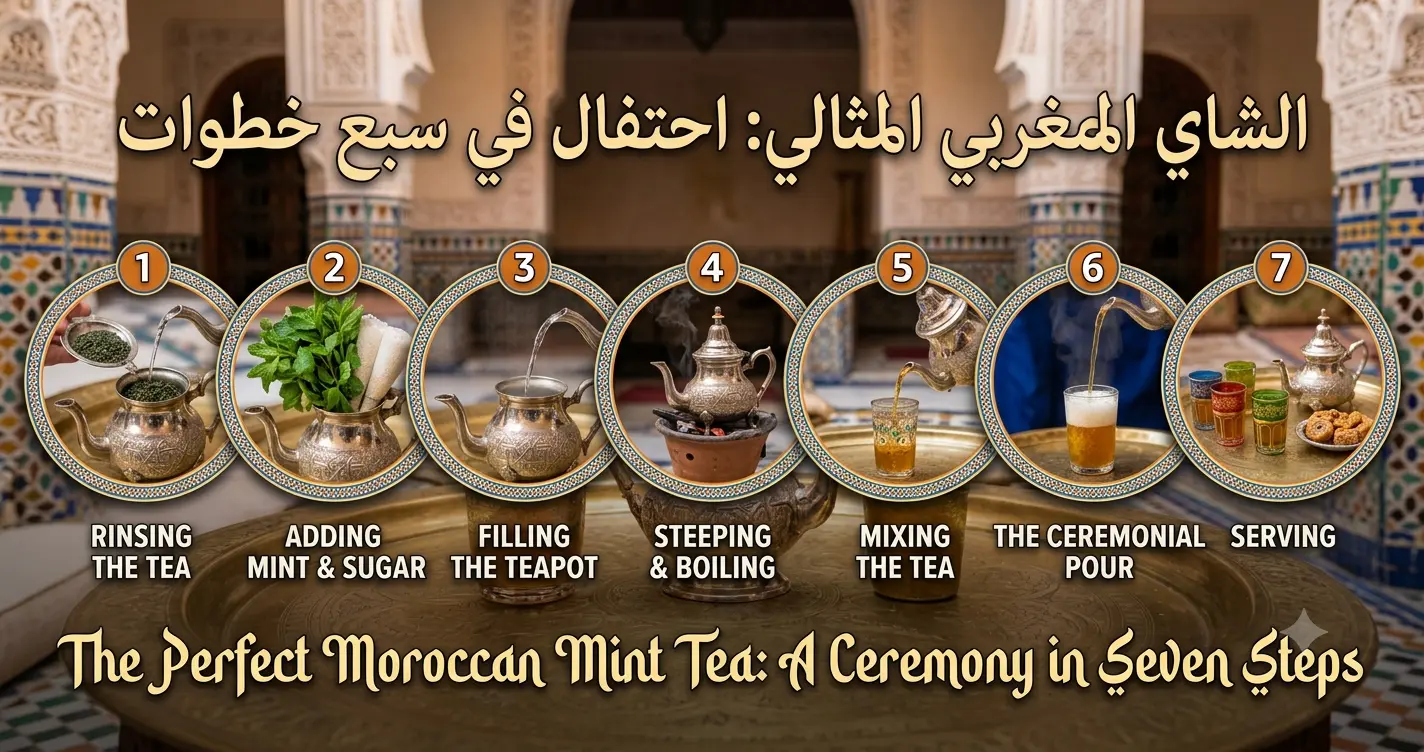
There is a moment, somewhere between the second and third pour, when the amber liquid catches the afternoon light and the air fills with that unmistakable perfume of fresh mint and gunpowder green tea, that you understand Moroccan mint tea is not simply a drink. It is a declaration. A declaration of hospitality, of patience, of culture distilled into a small glass. I have stood in the cramped, smoke-warmed kitchens of Fez medinas, sat cross-legged in Saharan tents outside Merzouga, and lingered in the breezy riads of Marrakech, and in every single one of those places, the ritual of preparing atay — as Moroccans call it — was treated with the gravity and care of something sacred. This guide, built on years of hands-on experience and cultural immersion, will walk you through the seven steps of the perfect Moroccan mint tea ceremony, so that wherever you are in the world, you can recreate that magic in your own kitchen.
Chapter One: Understanding What Moroccan Mint Tea Actually Is
Before we get anywhere near a teapot, we need to clear up a common misconception that circulates endlessly in Western food media: Moroccan mint tea is not simply green tea with mint leaves dropped in. That description is technically accurate the way saying the Sistine Chapel is “a painted ceiling” is technically accurate. It misses everything that matters.
Moroccan mint tea — atay bi na'na' in Darija (Moroccan Arabic), or simply atay — is a precisely layered beverage made from gunpowder green tea, fresh spearmint (almost always Moroccan na'na', a particular variety of spearmint with exceptional fragrance), and generous amounts of sugar. The layering, the temperature management, the pouring technique, the blending ritual — all of it is part of a practice that has evolved over centuries and carries profound social meaning.
What most Western recipes get wrong is treating Moroccan tea as something that can be casually assembled in four minutes. The ceremony — and it genuinely is a ceremony, not just a preparation method — typically takes between fifteen and thirty minutes when done properly. Each step serves a purpose, both practical and symbolic. At MaCooking, we have always insisted that understanding the why behind Moroccan cooking techniques is just as important as learning the how, and nowhere is that truer than with mint tea.
The Three Non-Negotiable Ingredients
- Gunpowder Green Tea (Chinese Pearl Tea): Known in Morocco as atay aakhdar, this is the backbone. The tightly rolled pellets of dried tea leaves produce a strong, slightly smoky, full-bodied infusion that can stand up to generous quantities of mint and sugar without being overwhelmed. Do not substitute with Japanese green teas, Earl Grey, or generic supermarket green tea bags — they will produce something entirely different and frankly disappointing.
- Fresh Spearmint (na'na'): This is non-negotiable. Dried mint will not work. Peppermint will not work. You need fresh Moroccan spearmint, which has a softer, more floral character than common spearmint varieties found in Western supermarkets. If you can find it at a Middle Eastern or North African grocery store, it is absolutely worth seeking out. Otherwise, the freshest spearmint you can find, ideally still on the stem.
- Sugar: Moroccans use sugar cones called pain de sucre (borrowed from the French colonial era, though Moroccans had their own sugar traditions long before), though granulated white sugar works perfectly well. Do not use honey, do not use artificial sweeteners, do not use agave syrup. Sugar is not a flexible variable here — it is a structural ingredient that changes the texture and body of the final drink.
Optional Additions by Season and Region
- Wormwood (chiba): A bitter herb added particularly in winter months or in certain regions of Morocco to balance sweetness and aid digestion. If you can find fresh or dried wormwood, even a small sprig transforms the character of the tea significantly.
- Verbena (louisa): Lemon verbena adds a citrusy brightness and is commonly blended in the spring and summer months.
- Orange Blossom Water (ma' zahr): A few drops added to the pot just before the final pour. Ethereal, floral, and distinctly Moroccan.
- Absinthe or Rosemary: Used in the desert south, particularly in Saharan communities, where mint may be harder to source fresh.
Chapter Two: A History Steeped in Time and Trade
Moroccan mint tea did not exist in its current form before the mid-eighteenth century. This surprises many people, given how deeply embedded it now is in Moroccan national identity. The story of how gunpowder green tea arrived in Morocco is bound up with global trade routes, colonial politics, and the Crimean War of all things.
Green tea from China had been reaching North Africa via the spice and silk trade routes for centuries in small quantities, but it was not until the 1850s that it arrived in truly significant volume. British merchants, blocked from their usual Baltic and Northern European markets by the disruptions of the Crimean War (1853–1856), sought new outlets for Chinese green tea and found one in Morocco. Sultan Mohammed IV, and particularly the port city of Essaouira (then known as Mogador), became a major entry point for Chinese gunpowder tea into North Africa.
The Moroccan palate, already accustomed to infusions of fresh herbs and a profound love of sweetness, took to gunpowder tea with extraordinary enthusiasm. Within a generation, tea had not merely been adopted but had been transformed into something wholly Moroccan — the addition of na'na' spearmint, the theatrical pouring from height, the multi-glass tasting ritual. By the early twentieth century, Moroccan mint tea had become so central to social life that refusing a glass offered by a host was, and remains, a serious breach of etiquette.
The famous Moroccan saying captures this beautifully: “The first glass is as gentle as life, the second is as strong as love, the third is as bitter as death.” This refers to the traditional three-glass service, in which the tea poured from successive rounds of the same pot becomes progressively stronger and more complex. It is a philosophy embedded in a beverage, and it is one of the things that makes Moroccan tea culture unlike any other in the world.
“Atay machi ghir atay. Huwa l'kalam, huwa l'hna, huwa ddarb l'mashi bla hawa.”
“Tea is not just tea. It is conversation, it is warmth, it is the road that goes nowhere in particular.”
Chapter Three: The Tools of the Ceremony
You cannot perform a ceremony without the right instruments. The equipment used for Moroccan mint tea is both functional and beautiful, and choosing the right pieces genuinely affects the quality of your final product.
The Teapot (Barrad)
The Moroccan teapot, called a barrad, is almost always made of silver-plated or stainless steel, though beautiful brass and copper versions exist. It has a distinctive rounded body, a long curved spout, and a hinged lid. The spout design is critical — it needs to be long enough to create the necessary arc for high-pour aerating, and it must create a fine, controlled stream rather than a gush. Do not attempt Moroccan tea in a standard English-style teapot. The spout geometry is simply wrong for what you are trying to achieve.
Size matters too. A standard barrad for home use typically holds between 750ml and 1 litre, producing enough tea for four to six small glasses in a single preparation. If you are hosting a larger gathering, Moroccan tradition calls for making the tea in multiple rounds from the same leaves, which is actually preferred over simply using a larger pot.
The Glasses (Kisan)
Moroccan tea is served in small, ornate glasses, never cups with handles. The glasses are typically about 100–150ml capacity, often hand-painted with gold or coloured enamel in geometric Moorish patterns. The small size is intentional — it ensures the tea is consumed while still hot, and it invites refilling, which is an act of hospitality. Never use mugs. Never use clear modern tumblers. The visual experience of the glass is part of the drink.
The Tray (Siniya)
A large, ornate brass or silver tray on which the teapot, sugar, glasses, and often a small vase of fresh mint are arranged. The siniya is not merely practical — it is stage for the ceremony. In formal settings, the tray sits atop a low round table called a siniya table around which guests gather on cushions or low benches.
Comparison: Traditional vs. Modern Equipment
| Equipment | Traditional (Recommended) | Acceptable Substitute | Avoid |
|---|---|---|---|
| Teapot | Silver-plated or stainless steel Moroccan barrad | Stainless steel long-spout tea kettle | English teapot, French press, ceramic Japanese teapot |
| Glasses | Small ornate enamel-painted Moroccan tea glasses | Small clear shot glasses or espresso cups | Mugs, large glasses, paper cups |
| Tray | Ornate brass or silver siniya | Any large decorative tray | Skipping the tray entirely |
| Sugar | Moroccan sugar cone broken into pieces | White granulated sugar | Honey, brown sugar, sweetener |
| Heat source | Gas flame or charcoal brazier | Electric stovetop | Microwave |
Chapter Four: Sourcing Your Ingredients Like a Pro
The quality of your mint tea begins at the point of purchase. I have had this conversation with so many Western cooks who cannot understand why their version tastes flat compared to what they experienced in Morocco, and nine times out of ten, it comes down to ingredient quality.
Choosing Your Gunpowder Tea
Not all gunpowder green tea is created equal. In Morocco, the most prized variety is sometimes called “Special Gunpowder” or “Temple of Heaven” grade, which produces tight, heavy pellets that unfurl slowly and produce a clean, strong brew without bitterness. Cheaper gunpowder tea may taste astringent or sour if over-brewed, which makes it less forgiving in the hands of a beginner.
Where to buy: Middle Eastern and North African grocery stores are your best first stop. Online retailers specialising in loose-leaf tea will often carry quality gunpowder varieties. Moroccan grocery stores, if you have one nearby, may even carry teas blended specifically for the Moroccan market. Avoid supermarket tea bags marketed as “green tea” — they are not the same thing.
Choosing Your Mint
Freshness is everything. The mint should be bright green, perky, and fragrant enough to smell strongly when you simply hold the bunch near your face. Wilted, yellowing, or odourless mint is useless for this purpose. Buy it the day you plan to make the tea if at all possible. In Morocco, mint vendors at the souk will often bunch it in ice water to keep it crisp, a trick worth remembering.
Tea Quality Comparison
| Tea Type | Flavour Profile | Authenticity | Bitterness Risk | Best For |
|---|---|---|---|---|
| Temple of Heaven Gunpowder (Grade 1) | Smoky, full-bodied, slightly grassy | Highest | Low if brewed correctly | Full ceremonial preparation |
| Standard Gunpowder Green Tea | Earthier, slightly more astringent | High | Medium | Everyday preparation |
| Loose Leaf Chinese Green Tea (non-gunpowder) | Lighter, more floral or grassy | Low | Medium-High if over-steeped | Emergency substitute only |
| Green Tea Bags (supermarket) | Thin, generic, often bitter | None | Very High | Not recommended |
| Japanese Sencha or Matcha | Vegetal, umami-forward | None | High | Not suitable |
Chapter Five: The Seven Steps of the Ceremony
Here we arrive at the heart of it. I want to be clear before we begin: these seven steps are not arbitrary divisions I invented for the sake of a structured article. They reflect the genuine stages of traditional preparation as practised across Morocco, from the northern cities of Tangier and Tetouan to the southern oasis towns near Tata and Zagora. There are regional variations in detail, but the core structure is remarkably consistent.
Step One: Warming the Pot (Tshiin l-Barrad)
Fill your barrad with boiling water, swirl it around thoroughly to heat the metal, and then discard that water. This step is almost universally skipped in Western adaptations of the recipe and almost universally observed in Morocco. A cold teapot will lower the temperature of your brewing water significantly the moment you add it, affecting both the extraction of the tea and the temperature at which the mint infuses. A warmed pot maintains brewing temperature. This is not optional if you want the authentic result.
Bring fresh water to a full boil. Moroccan cooks use gas flames and the water reaches 100°C. If you use a kettle, let it come to a full boil before proceeding.
Step Two: The First Brew — Washing the Tea (Ghasil Atay)
Place approximately two heaped teaspoons of gunpowder green tea per person into the warmed pot (so roughly three tablespoons for a six-glass pot). Pour a small amount of boiling water over the leaves — just enough to cover them — swirl briefly for about twenty to thirty seconds, and then pour this first infusion away. This step has two purposes: it rinses any dust or impurities from the tea leaves, and it begins the blooming process that opens the tightly rolled pellets.
Some Moroccan tea makers taste this first rinse before discarding it. If it is extremely bitter, it confirms the tea needs washing. If it is already pleasantly flavoured, they might retain just a splash. This is a matter of personal and regional preference.
Step Three: The Second Brew — First Infusion (Atay l-Awwal)
Now pour boiling water into the pot to about two-thirds capacity and allow it to steep for exactly two minutes. This first infusion will be intensely strong and is not meant for drinking yet — it forms the concentrated base that will be blended and adjusted in subsequent steps. Set it aside in a separate vessel or, as is traditional, pour it into one of the serving glasses and reserve it.
The reason for this separate reservation is important: it allows the tea maker to control the final strength precisely by adding the concentrated first infusion back into the pot incrementally, rather than committing to it all at once.
Step Four: Building the Layers (Trakib Atay)
This is the most complex and most important step, and the one where the skill of the tea maker is most visible. Into the pot containing the spent (or rinsed) tea leaves, add the following:
- A generous handful of fresh spearmint — stems and all. Do not chop it. Insert the whole bunch, pressing it down gently.
- Sugar — this is where Moroccan quantities will shock most Western palates. The traditional amount is roughly 2–3 tablespoons of sugar per person, which for a six-glass pot means somewhere between 100–180 grams. Start at the lower end if you are unaccustomed to very sweet tea; you can always add more.
- Pour in about half of your reserved first infusion.
- Top up with boiling water to fill the pot.
- Place the pot over the lowest possible flame for 2–3 minutes to heat gently without boiling.
If you are adding wormwood, verbena, or orange blossom water, they go in at this stage.
Step Five: The Blending and Tasting (Tqlib w Ddaq)
Pour one glass of tea from the pot. Taste it. Now pour it back into the pot from a height of at least 30cm above the opening. Pour another glass. Taste again. Pour it back. Repeat this process three to five times. This is not theatre — though it is undeniably theatrical. The high-pour aeration does several things simultaneously:
- It blends the sugar, tea, and mint infusion uniformly throughout the liquid.
- It cools the tea slightly, preventing it from becoming bitter through continued high-heat steeping.
- It aerates the liquid, which softens the flavour and creates the characteristic light foam on top of each glass when poured at height for serving.
- It gives the tea maker the opportunity to taste and adjust — more sugar, more of the reserved first infusion, or a bit more hot water if needed.
A master tea maker can tell from the colour, the aroma, the weight of the liquid in the glass, and the size and persistence of the foam exactly where the tea is in its development. This is the skill that takes time to acquire, and it is why at MaCooking we always say that Moroccan mint tea is one of those preparations where you learn as much from making it fifty times as from reading about it five hundred times.
Step Six: The High Pour Service (Sebb Atay men Fo’q)
When the tea tastes right — complex, sweet, minty, with a slight smoky depth from the gunpowder tea, and a faint bitter whisper underneath the sweetness — it is time to serve. The serving pour is performed from a height of 30–50cm above the glass. You have certainly seen this in photographs or videos of Moroccan tea service, and you may have assumed it was purely decorative. It is not.
The height of the pour creates the foam crown on each glass, which in Morocco is considered the sign of a well-made tea. A glass of Moroccan mint tea without foam is like a perfect espresso without crema — technically the drink is there, but something essential is missing. The foam also slightly aerates and cools the tea to a drinkable temperature.
The practical advice: start with your pot close to the glass and practice the movement of lifting it as you pour. You will spill tea, especially the first few times. Practice over the sink. The arc and the steadiness come with repetition. Hold the pot handle firmly, keep your wrist flexible, and let gravity do most of the work.
Fill each glass only about two-thirds full, not to the brim. The remaining space is for the foam, and also because a smaller pour encourages guests to accept a refill, which is an act of hospitality.
Step Seven: The Three-Round Tradition (Tlata d-Kisan)
The traditional Moroccan tea service involves three rounds poured from the same pot of leaves and mint. Each round has a different character:
- The First Glass: Light, fragrant, dominated by mint, relatively delicate. This is the “greeting glass” — gentle as new acquaintance.
- The Second Glass: Stronger, deeper, the tea more present, the sweetness fully integrated. This is the “friendship glass” — warm as love.
- The Third Glass: The most intense, the mint beginning to fade, the gunpowder tea fully asserting itself, slightly more bitter. This is the “farewell glass” — bittersweet as departure.
Between rounds, add a small amount of boiling water to the pot to refresh the infusion. Experienced tea makers will also give the pot another series of high-pour blendings between rounds to integrate the fresh water and re-energise the foam.
Refusing the third glass is acceptable in many regions of Morocco. Refusing the first is almost never done among guests, as it communicates rejection of the host’s hospitality. Accepting the tea with both hands, or at minimum your right hand, is proper etiquette.
Chapter Six: Common Mistakes and How to Fix Them
In years of teaching Moroccan cooking both in person and through platforms like MaCooking, I have seen the same mistakes repeated with remarkable consistency. Here is your troubleshooting guide:
The Tea Is Bitter
Bitterness almost always has one of three causes: using too much tea leaf, steeping at too high a temperature, or steeping for too long without the blending/aeration process. The solution: use less tea in your initial measurement, ensure your water has come off the boil for at least thirty seconds before adding to the mint-and-sugar stage, and be more aggressive with the blending pour between steps.
The Tea Has No Foam
Foam requires height and temperature. If your tea is not hot enough, it will not foam regardless of how high you pour. If your pour height is insufficient, you will not get adequate aeration. The tea should be steaming actively when served. Practice your pour height — most beginners pour from too low because they are nervous about spillage.
The Flavour Is Flat or Weak
Usually a sign of insufficient tea leaf, insufficiently fresh mint, or water that was not hot enough. Also check that you did not skip the “washing” step and accidentally discard your primary infusion instead of retaining it.
The Tea Is Not Sweet Enough
This is almost always a cultural calibration issue. Western palates, particularly British ones accustomed to milky tea or Americans used to bitter coffee, often dramatically undershoot the sugar. If you have followed the recipe proportions and it still tastes unsweetened, add more sugar gradually during the blending process until you reach that balance where sweet is present but not cloying, and is complemented by the mint and tea complexity.
The Mint Is Too Overwhelming
This can happen if the mint has been steeped for too long or if the quantity was excessive. A good rule of thumb is a generous handful for a full pot — roughly 20–25 stems. If your mint is particularly pungent (some spearmint varieties are much more intense than others), reduce the quantity and compensate with a few stems of verbena or a small sprig of wormwood to add complexity without overwhelming the tea base.
Chapter Seven: Moroccan Mint Tea in Social Context — The Etiquette You Need to Know
If you ever visit Morocco, or if you host Moroccan guests, understanding the social codes around tea service will make a profound difference to how you are received. These are not arbitrary rules of politeness — they are expressions of deeply held values around hospitality, community, and respect.
Who Pours the Tea
Tea preparation and service is traditionally the role of one person — often the host or the eldest male family member in more traditional households, though this varies significantly by region, generation, and urban vs. rural setting. In modern Moroccan homes, especially in cities like Casablanca and Rabat, this gendering of tea service has become much more fluid. What remains constant is that the person who prepares the tea does so with full attention — stepping away from the conversation to focus on the preparation is considered a mark of respect for the guests, not a social withdrawal.
How to Receive the Glass
Accept the glass with both hands or with the right hand if single-hand acceptance is more natural. Express appreciation — “shukran” (thank you) or “barak Allahu fik” (may God bless you) are both appropriate. Do not set the glass down immediately without sipping. Blow gently on the tea if it is very hot — this is perfectly acceptable in Morocco, contrary to some Western etiquette.
Tea and Business
In Moroccan commercial culture, particularly in the souks and in more traditional business settings, it is considered extremely bad form to discuss business terms or make decisions before tea has been shared. The tea-sharing ritual establishes trust and goodwill that precedes negotiation. If you are offered tea in a Moroccan shop or business meeting, accept it — declining politely is possible, but it subtly signals that you are not invested in the relationship being built.
Tea and Ramadan
During the holy month of Ramadan, mint tea takes on even greater significance. It is almost always the first or second thing consumed at iftar (the breaking of the fast), alongside dates and harira soup. The sweetness is intensified during Ramadan, and the tea is often prepared in larger quantities to serve extended family gatherings. If you want to explore more about Moroccan Ramadan food traditions, MaCooking has an extensive collection of authentic recipes and cultural guides covering the full breadth of Moroccan festive cooking.
A Complete Recipe Reference
For those who want a clean, printable reference after everything above, here is the complete recipe in structured form:
Moroccan Mint Tea — Makes 6 Small Glasses
Prep Time: 5 minutes — Brew Time: 20 minutes — Total Time: 25 minutes
Ingredients
- 2 tablespoons (approximately 8g) gunpowder green tea
- 1 large bunch fresh spearmint (approximately 20–25 stems, including leaves and tender stems)
- 100–150g white granulated sugar (adjust to taste; Moroccan standard is on the higher end)
- 1 litre fresh cold water, brought to a full boil
- Optional: 2–3 sprigs fresh wormwood (chiba)
- Optional: 1 teaspoon orange blossom water
Method
- Warm the pot: Fill your barrad with boiling water, swirl, discard. Set pot aside with lid off to release steam for 1 minute.
- Wash the tea: Add tea leaves to the warmed pot. Pour just enough boiling water to cover the leaves (about 100ml). Swirl for 20 seconds. Discard this first rinse water carefully, retaining the tea leaves in the pot.
- First infusion: Pour approximately 400ml of boiling water into the pot. Steep exactly 2 minutes. Pour this strong infusion into a separate glass and reserve it.
- Build the layers: Add mint, sugar, half the reserved infusion, and top up with boiling water to fill pot. Optionally add wormwood or other herbs. Place over lowest heat for 2–3 minutes.
- Blend and taste: Pour one glass from the pot and pour it back from 30–40cm height. Repeat 4–5 times, tasting as you go. Adjust sugar or strength (using the reserved infusion or additional water) to your preference. Add orange blossom water if using.
- Serve with the high pour: Pour into serving glasses from 30–50cm above each glass to create foam. Fill to two-thirds capacity only.
- Second and third round: Add a small amount of boiling water to the pot between rounds. Repeat the blending-pour process. Each round will taste progressively stronger and more complex.
Frequently Asked Questions
FAQ 1: Can I use dried mint if I cannot find fresh mint?
The honest answer is: it is not the same drink. Fresh spearmint provides both a volatile aromatic quality and a slight green vegetable note that dried mint simply cannot replicate. The essential oils in fresh mint are what create that bright, clean fragrance that is so characteristic of Moroccan mint tea. Dried mint produces a flat, almost medicinal quality that is not what you are aiming for here. That said, if fresh mint is genuinely unavailable, you can use a very small amount of dried spearmint — perhaps a quarter of what you would use fresh — as a compromise, and supplement with a teaspoon of orange blossom water to add aromatic complexity. But please, go to the extra effort of finding fresh mint. Even growing your own in a window pot is a viable option; spearmint is one of the easiest herbs to grow and will reward you handsomely every time you want to make this tea.
FAQ 2: Why is Moroccan mint tea so much sweeter than other tea traditions?
Several intersecting factors explain this. Historically, sugar was a luxury commodity in North Africa and its generous use in food and drink was a mark of wealth and generosity — giving guests sweet tea was a way of demonstrating that you would spare no expense for their comfort and honour. Additionally, the particular combination of gunpowder tea and fresh spearmint creates a flavour profile that is significantly more harmonious with high sugar levels than, say, a lightly oxidised Darjeeling would be. The smokiness and slight bitterness of gunpowder tea, and the cool intensity of spearmint, both act as counterbalances to the sweetness, creating equilibrium that allows much more sugar than you might expect before the drink becomes unpleasantly cloying. It is also worth noting that Moroccan meals are typically not dessert-heavy compared to Western eating patterns, and the sweet tea often serves the social and gustatory function that dessert does in a French or American meal.
FAQ 3: What is the correct amount of gunpowder tea to use? I see very different amounts in different recipes.
This is one of the most variable aspects of the recipe, and there is no single universally correct answer because Moroccan tea makers calibrate their quantities entirely to personal taste and the strength of their particular tea. The general rule of thumb is one teaspoon per person plus one for the pot — so for six glasses, approximately two to three tablespoons of dry gunpowder tea. However, if your tea is particularly fresh and high quality (which it should be), you may find you need slightly less because the flavour extraction will be stronger. If you are using a more aged or lower-quality gunpowder, you may need slightly more. The blending-and-tasting step in Step Five is specifically designed to allow you to correct for this variability — if the tea is too weak after the initial build, add more of the reserved first infusion; if it is too strong, add more hot water. This adaptive approach is fundamentally more Moroccan than any fixed measurement.
FAQ 4: Is there a caffeine-free or herbal version of Moroccan mint tea for those who cannot have caffeine?
While gunpowder green tea is the authentic base and there is no direct equivalent, there is a beautiful herbal version of Moroccan tea that exists in its own right, particularly popular in the late evening when families want to continue drinking tea after dinner without the stimulating effects of green tea. This version uses a base of fresh spearmint alone, sometimes combined with verbena (louisa), rose petals, thyme, or orange blossom water. It is still sweet, still served in the same glasses with the same high-pour technique, and still carries the social warmth of the ceremony. It is called simply atay bel na'na' bla atay aakhdar — “mint tea without green tea.” It is genuinely delicious in its own right, even if it is technically a different drink. You can find several variations of herbal Moroccan infusions with detailed preparation guides on MaCooking.
FAQ 5: What foods are traditionally served alongside Moroccan mint tea?
Moroccan mint tea is almost never drunk in isolation — it is always the centrepiece of a broader hospitality offering. The foods that accompany it depend significantly on the time of day, the occasion, and the region. For an afternoon tea gathering (l-qila), you might expect a spread including msemen (flaky square-folded flatbreads), beghrir (the famous thousand-hole semolina pancakes served with melted butter and honey), an assortment of Moroccan cookies including ghoriba (crumbly almond shortbreads) and kaab el ghzal (gazelle horns filled with almond paste and orange blossom water), fresh bread with argan oil and honey, or dried fruits and nuts. For a more informal morning setting, mint tea typically accompanies bread, olive oil, honey, amlou (a Moroccan spread of argan oil, almonds, and honey), and perhaps jben (fresh goat cheese from the Atlas region). The pairing philosophy is simple: rich, buttery, or naturally sweet foods harmonise with the sweetened tea, while the mint cuts through any heaviness and refreshes the palate.
Conclusion: The Glass Is More Than the Glass
By the time you have worked through these seven steps and produced your first genuinely successful glass of Moroccan mint tea — the foam crown sitting light and proud on the surface, the colour a deep amber-gold, the fragrance rising in a warm, minty-smoky cloud — I want you to sit with it for a moment before you drink it. Consider what you are holding: a glass that connects you to a trading relationship between Britain and China that is nearly two hundred years old, to the ancient Moroccan love of fragrant herbs and generous sweetness, to tens of millions of daily rituals happening right now in homes from Tangier to Dakhla, from Casablanca apartments to nomadic tents in the Sahara. You are not just drinking tea. You are participating in one of the most continuous, living cultural traditions on the planet.
That is what Moroccan food does when it is approached properly — it connects you to something larger than a meal. It is why Moroccan cuisine has earned its place at the UNESCO intangible cultural heritage table, and it is why platforms dedicated to its authentic preservation and education genuinely matter.
If this guide has sparked your interest in going deeper into Moroccan culinary tradition, I warmly encourage you to explore the full library of recipes, cultural guides, and technique tutorials at MaCooking. From the slow-braised tagines of Fez to the street food of Casablanca, from Ramadan sweets to Berber flatbreads from the High Atlas, it is the most comprehensive English-language resource for authentic Moroccan cooking that exists online. Every recipe comes with the same commitment to genuine technique and cultural context that I have tried to bring to this guide.
Now pour your tea. Pour it high. Watch the foam form. Hold the glass in both hands. And welcome to the ceremony.